YIP Note Download

What the Supreme Court has held on IP, 1952–2026: 2,000+ findings

Read and mark judgments in YIP Note on iPad and Android tablets. Prepare court bundles with YIP PDF for Windows.

Every Supreme Court judgment and order in this set, read in full and broken into findings in the Court's own words, each with a pin citation.

137 judgments · 2,356 findings · 232 headings · 12 Parts

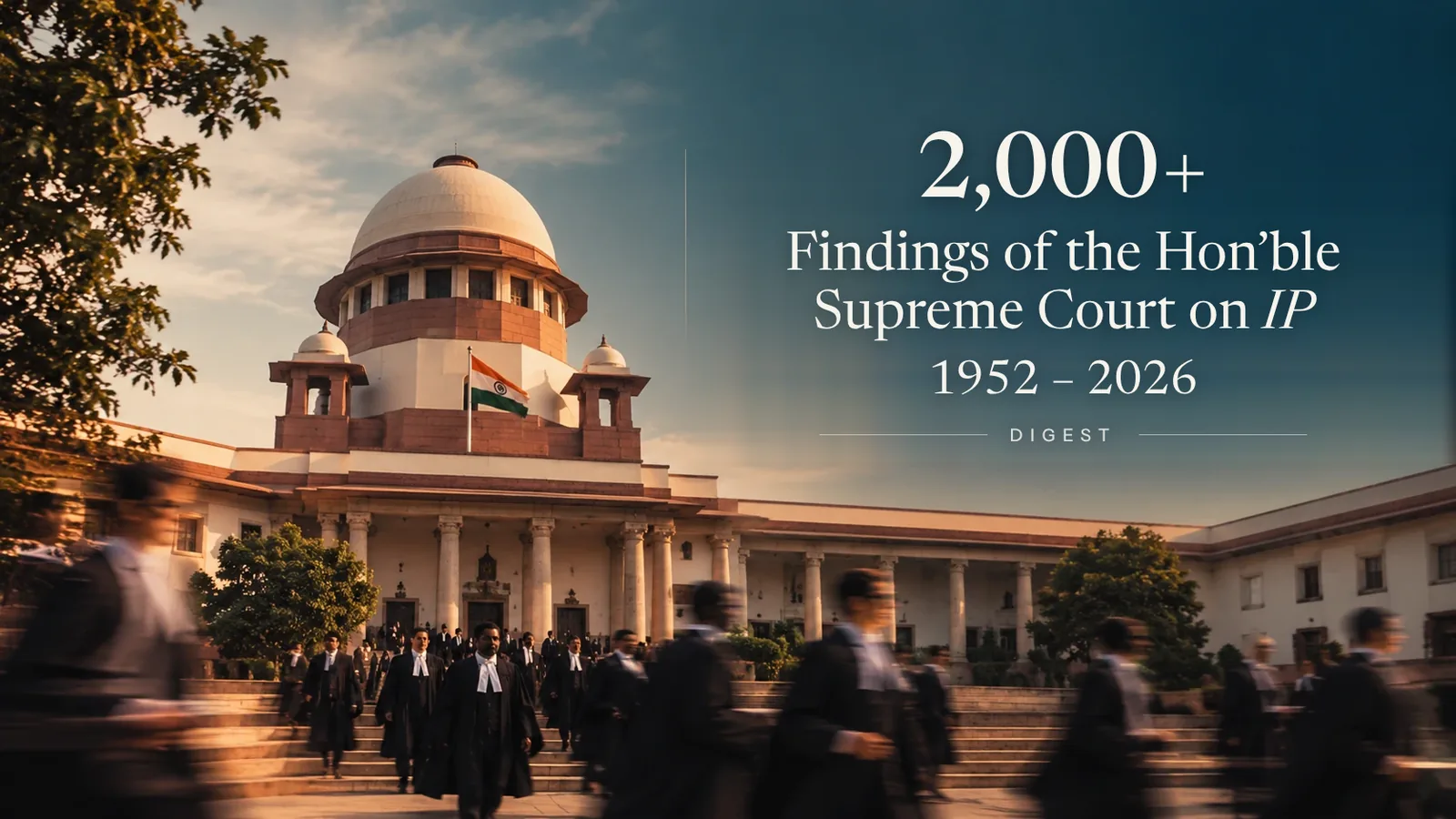
The Supreme Court of India at golden hour, advocates in gowns crossing the forecourt; beside the dome the words “120+ Supreme Court Judgments on IPR (1952–2026) · Digest”.
How to use

The findings sit under 232 headings that each state the answer. Under every heading you get a two-line note in our words, then the Court's exact words with a pin citation.

  • Skim the law: open a Part. The headings alone read as a summary of what the Court has held.
  • Search the Court's words: type in the search box. It looks inside every quote, note and case name, and lists the findings that match.
  • Narrow it down: filter by area, decade or kind of finding, hide interim-stage (prima facie) views, or show only the key statement under each heading.
  • Use it in a brief: “Copy with citation” copies the exact quote with case name, neutral citation, report citation and paragraph or page. The link button beside it copies a link straight to that finding.
  • Work case by case: the index lists all 137 judgments with bench, outcome, a short summary and links to every finding taken from each.

Filters

Area
Decade
Kind

Part I Trade marks — similarity and likelihood of confusion

19 headings · 223 findings

I.1 Likelihood of deception or confusion is the core test for registration, infringement and passing off; neither intent nor actual confusion need be shown

13 findings · 9 judgments · 1969–2025

Note: Parle (1972) and S.M. Dyechem (2000) define a deceptively similar mark as one so nearly resembling another as to be likely to deceive or cause confusion, and Dyechem distinguishes deceiving from confusing. Ruston & Hornsby (1969) and Pernod Ricard (2025) treat the test as the same for infringement and passing off, Khoday (2008) makes it the main criterion for registration and rectification, and Satyam (2004) and Brihan Karan (2023) frame it as confusion among actual or potential customers. Hoffmann-La Roche (1969) holds intent unnecessary, Chinna Krishna Chettiar (1969) holds the absence of actual confusion not decisive, and Pernod Ricard adds that exact imitation is not required.

Parle Products (P) Ltd. v. J. P. & Co., Mysore (1972) Key statementPrincipleAdopting: Section 2(d), Trade and Merchandise Marks Act, 1958
In brief: A mark is deceptively similar to another if it so nearly resembles that other mark as to be likely to deceive or cause confusion.
A mark shall be deemed to be deceptively similar to another mark if it so nearly resembles that other mark as to be likely to deceive or cause confusion;
1972 INSC 31 · [1972] 3 S.C.R. 289 · decided 28.01.1972 · at p. 292
In brief: The guiding test under the Trade Marks Act, 1999 is the likelihood of confusion in the mind of an average consumer, not actual confusion, for both refusal of registration and infringement.
Crucially, the guiding test is the likelihood of confusion in the mind of an average consumer – not actual confusion – which serves as the touchstone for both refusal of registration and infringement proceedings.
2025 INSC 981 · decided 14.08.2025 · para 18.8
In brief: Absence of evidence of actual confusion does not displace a finding of deceptive similarity, as it may be due to the appellant's trade not being of long standing.
There is no evidence of actual confusion, but that might be due to the fact that the appellant's trade is not of long standing.
1969 INSC 110 · [1970] 1 S.C.R. 290 · decided 14.04.1969 · at p. 294
In brief: For deceptive similarity it is not necessary that the mark be intended to deceive or cause confusion; what matters is its probable effect on the ordinary kind of customers.
It is not necessary that it should be intended to deceive or intended to cause confusion. It is its probable effect on the ordinary kind of customers that one has to consider.
1969 INSC 223 · [1970] 2 S.C.R. 213 · decided 08.09.1969 · at p. 216
In brief: The test as to likelihood of confusion or deception arising from similarity of marks is the same in infringement and passing off actions.
In other words, the test as to likelihood of confusion or deception arising from similarity of marks is the same both in infringement and passing off actions.
1969 INSC 224 · [1970] 2 S.C.R. · decided 08.09.1969 · PDF p. 5
S.M. Dyechem Ltd. v. Cadbury (India) Ltd. (2000) PrincipleAdopting: Section 2(1)(d), Trade and Merchandise Marks Act, 1958
In brief: A mark is deceptively similar if it so nearly resembles another mark as to be likely to deceive or cause confusion.
Under section 2(d), the words "deceptively similar" are defined as follows: "a mark shall be deemed to be deceptively similar to another mark if it so nearly resembles that other mark as to be likely to deceive or cause confusion".
2000 INSC 312 · [2000] Supp. 1 S.C.R. 86 · decided 09.05.2000 · at p. 108
In brief: The distinction between 'deceive' and 'confuse' in section 2(1)(d) must be kept in view when applying 'deceptively similar' in section 29.
Section 29 uses the words 'deceptively similar' and section 2(1)(d) defines 'deceptively similar' as situations where one is 'deceiving' others or 'confusing' others. We have to keep in view the distinction between the words 'deceive' and 'confuse' used in section 2(1)(d).
2000 INSC 312 · [2000] Supp. 1 S.C.R. 86 · decided 09.05.2000 · at p. 115
S.M. Dyechem Ltd. v. Cadbury (India) Ltd. (2000) PrincipleAdopting: Parker-Knoll v. Knoll International, (1962) RPC 265 (HL), Lord Denning (quoted in Roche v.
In brief: To deceive is to make a false representation, even innocently, whereas confusion can arise without any falsehood because the buyer lacks the knowledge or ability, or does not take the trouble, to distinguish.
Secondly, 'to deceive' is one thing. To cause 'confusion' is another. The difference is this: when you deceive a man, you tell him a lie. You make a false representation to him and thereby cause him to believe a thing to be true which is false. You may not do it knowingly, or intentionally but still you do it, and so you deceive him. But you may cause confusion without telling him a lie at all, and without making any false representation to him. You may indeed tell him the truth, the whole truth and nothing but the truth, but still you may cause confusion in his mind, not by any fault of yours, but because he has not the knowledge or ability to distinguish it from the other pieces of truth known to him or because he may not even take the trouble to do so."
2000 INSC 312 · [2000] Supp. 1 S.C.R. 86 · decided 09.05.2000 · at p. 116
In brief: What must be established is the likelihood of confusion in the minds of the public, meaning actual or potential customers or users, that the defendant's goods or services are the plaintiff's, and courts must allow for the imperfect recollection of a person of ordinary memory.
What has to be established is the likelihood of confusion in the minds of the public, (the word "public" being understood to mean actual or potential customers or users) that the goods or services offered by the defendant are the goods or the services of the plaintiff. In assessing the likelihood of such confusion the courts must allow for the "imperfect recollection of a person of ordinary memory"
2004 INSC 368 · [2004] Supp. 2 S.C.R. 465 · decided 06.05.2004 · at p. 473
In brief: Whether the application is a class or group action or a private action is relevant but not decisive; public interest must remain uppermost, and deceptive similarity or confusion is the principal criterion for both registration and rectification.
For the aforementioned purpose, whether it is a class or group action or a private action although would be relevant but may not be decisive. It is one thing to say that class or group action will receive special attention of the statutory authority vis-a-vis a private action. But, in both types of cases, public interest should remain uppermost in the mind of the authority. The question which is required to be posed therefor would be as to whether the public in general or the class of bias would be deceived or be confused if the existing mark is allowed to remain on the register. Thus, deceptively similar or confusion is the principal criteria for determining applications both for registration as also for rectification.
2008 INSC 741 · [2008] 9 S.C.R. 975 · decided 27.05.2008 · para 40
Brihan Karan Sugar Syndicate Private Limited v. Yashwantrao Mohite Krushna Sahakari Sakhar Karkhana (2023) PrincipleAdopting: Satyam Infoway Ltd. v. Sifynet Solutions (P) Ltd., (2004) 6 SCC 145
In brief: What must be established is the likelihood of confusion in the minds of actual or potential customers that the defendant's goods or services are the plaintiff's, allowing for the imperfect recollection of a person of ordinary memory.
What has to be established is the likelihood of confusion in the minds of the public (the word “public” being understood to mean actual or potential customers or users) that the goods or services offered by the defendant are the goods or the services of the plaintiff. In assessing the likelihood of such confusion the courts must allow for the “imperfect recollection of a person of ordinary memory” [Aristoc v. Rysta, 1945 AC 68 : (1945) 1 All ER 34 (HL)].
2023 INSC 831 · decided 14.09.2023 · para 10
In brief: Likelihood of confusion is the cornerstone of both infringement and passing off.
Trademark protection – whether based on name, colour combination, trade dress, or structural features – centres on a mark’s ability to distinguish the commercial origin of goods or services in the minds of consumers. The likelihood of confusion remains the cornerstone of both infringement and passing off actions.
2025 INSC 981 · decided 14.08.2025 · para 31
In brief: Deceptive similarity does not require exact imitation; what matters is the likelihood of confusion or association arising from overall resemblance, judged by an average consumer with imperfect recollection.
It is a settled principle of trademark law that deceptive similarity does not necessitate exact imitation. What is material is the likelihood of confusion or association in the minds of consumers arising from an overall resemblance between the competing marks. The applicable standard is that of an average consumer with imperfect recollection.
2025 INSC 981 · decided 14.08.2025 · para 41

I.2 The Act sets no fixed criteria: each case turns on its own facts, and similarity is a question of fact for the court, decided on first impression

12 findings · 8 judgments · 1959–2025

Note: Corn Products (1959) and Amritdhara (1962) hold that the question is one of first impression for the court and that precedents matter for their tests, not their outcomes; Cadila (2001) and Pernod Ricard (2025) restate this. Durga Dutt Sharma (1964) treats deceptive similarity as a question of fact that the Supreme Court will not disturb unless the wrong test was applied, and Mahendra & Mahendra (2001) says it is for the court, not witnesses. Parle (1972) and Ramdev (2006) add that counting points of similarity and difference is of no use.

Amritdhara Pharmacy v. Satyadeo Gupta (1962) Key statementPrinciple
In brief: The Act lays down no criteria for deciding what is likely to deceive or cause confusion, so each case turns on its own facts and the value of precedents lies in the tests they apply.
The Act does not lay down any criteria for determining what is likely to deceive or cause confusion. Therefore, every case must depend on its own particular facts, and the value of authorities lies not so much in the actual decision as in the tests applied for determining what is likely to deceive or cause confusion.
1962 INSC 170 · [1963] 2 S.C.R. 484 · decided 27.04.1962 · at p. 493
In brief: Whether two marks are likely to cause confusion is a question of first impression for the court to decide, and English cases based on the English way of pronouncing English words may be of little assistance in India on phonetic similarity.
It is well known that the question whether the two marks are likely to give rise to confusion or not is a question of first impression. It is for the court to decide that question. English cases proceeding on the English way of pronouncing an English word by Englishmen, which it may be stated is not always the same, may not be of much assistance in our country in deciding questions of phonetic similarity.
1959 INSC 130 · [1960] 1 S.C.R. 968 · decided 08.10.1959 · at p. 978
In brief: Whether two names so nearly resemble each other as to cause deception or confusion must be determined as a case of first impression, irrespective of earlier decisions.
That isa question which we must determine as a case of first impression and irrespective of the earlier decisions.
1962 INSC 170 · [1963] 2 S.C.R. 484 · decided 27.04.1962 · at p. 497
In brief: Deceptive similarity is a question of fact, with which the Supreme Court will not interfere unless the test applied suffers from error; the conclusion that the marks were deceptively similar was held not erroneous.
It appears to us that the conclusion reached by the Courts below that the appellant’s mark is deceptively similar to that of the respondent’s cannot be stated to be erroneous. Besides, this question of deceptive similarity is a question of fact, unless the test employed for determining it suffers from error. In the present case, it was not suggested that the Courts below had committed any error in laying down the principles on which the comparison has to be made and deceptive similarity ascertained.
1964 INSC 221 · [1965] 1 S.C.R. 737 · decided 20.10.1964 · at p. 756
In brief: Each case must be judged on its own features, and it is of no use to count the points of similarity and of difference.
We do not think it necessary to refer to the decisions referred to at the Bar as in our view each case will have to be judged on its own features and it would be of no use to note on how many points there was similarity and in how many others there was absence of it.
1972 INSC 31 · [1972] 3 S.C.R. 289 · decided 28.01.1972 · at p. 295
Cadila Health Care Ltd. v. Cadila Pharmaceuticals Ltd. (2001) PrincipleAdopting: Corn Products Refining Company v. Shangrila Food Products Limited, [1960] 1 SCR 968
In brief: Quoting Corn Products, the Court records that whether two marks are likely to confuse is a question of first impression for the court to decide, and English cases on English pronunciation of English words may not help much in India on phonetic similarity.
It is well known that the question whether the two marks are likely to give rise to confusion or not is a question of first impression. It is for the court to decide that question. English cases proceeding on the English way of pronouncing an English word by Englishmen, which it may be stated is not always the same, may not be of much assistance in our country in deciding questions of phonetic similarity.
2001 INSC 173 · [2001] 2 S.C.R. 743 · decided 26.03.2001 · at p. 751
Cadila Health Care Ltd. v. Cadila Pharmaceuticals Ltd. (2001) PrincipleAdopting: Amritdhara Pharmacy v. Satya Deo, AIR (1963) SC 449
In brief: Quoting Amritdhara, the Court records that the Act lays down no criteria for deciding what is likely to deceive or cause confusion, so every case depends on its own facts and the value of authorities lies in the tests applied rather than the decision.
The Act does not lay down any criteria for determining what is likely to deceive or cause confusion. Therefore, every case must depend on its own particular facts, and the value of authorities lies not so much in the actual decision as in the tests applied for determining what is likely to deceive or cause confusion.
2001 INSC 173 · [2001] 2 S.C.R. 743 · decided 26.03.2001 · at p. 752
In brief: Where there is a likelihood of deception or confusion is a matter for the Court, not witnesses, all factors that create or allay confusion must be considered together, and these include the nature of the market, class of customers, extent of reputation, trade channels and any connection in the course of trade.
Without intending to be exhaustive some of the principles which are accepted as well settled may be stated thus; that whether there is a likelihood of deception or confusion arising in a matter for decision by the Court, and no witness is entitled to say whether the mark is likely to deceive or to cause confusion; that all factors which are likely to create or allay deception or confusion must be considered in combination; that broadly speaking, factors creating confusion would be, for example, the nature of the market itself, the class of customers, the extent of the reputation, the trade channels, the existence of any connection in course of trade, and others.
2001 INSC 568 · [2001] Supp. 5 S.C.R. 225 · decided 09.11.2001 · at p. 234
Mahendra and Mahendra Paper Mills Ltd. v. Mahindra and Mahindra Ltd. (2001) PrincipleAdopting: Corn Products Refining Co. v. Shangrila Food Products Ltd., [1960] 1 SCR 968
In brief: Whether two competing marks are likely to deceive or cause confusion is a question of first impression for the Court, approached from the point of view of a man of average intelligence and imperfect recollection.
the question whether two competing marks are so similar as to be likely to deceive or cause confusion is one of first impression and it is for the court to decide it. The question has to be approached from the point of view of a man of average intelligence and imperfect recollection.
2001 INSC 568 · [2001] Supp. 5 S.C.R. 225 · decided 09.11.2001 · at p. 234
Ramdev Food Products Pvt. Ltd. v. Arvindbhai Rambhai Patel and Ors. (2006) PrincipleAdopting: Parle Products (P) Ltd. v. J.P. and Co., Mysore, [1972] 1 SCC 618
In brief: An ordinary purchaser lacks the powers of observation of a Sherlock Holmes, each case must be judged on its own features, and it is of no use to count how many points show similarity and how many show its absence.
After all, an ordinary purchaser is not gifted with the powers of observation of a Sherlock Homes. We have therefore no doubt that the defendants' wrapper is deceptively similar to the plaintiffs' which was registered. We do not think it necessary to refer to the decisions referred to at the bar as in our view each case will have to be judged on its own features and it would be of no use to note on how many points there was similarity and in how many others there was absence of it.
2006 INSC 563 · [2006] Supp. 5 S.C.R. 521 · decided 29.08.2006 · at p. 566
In brief: Whether a mark is likely to deceive or cause confusion is a question of fact, assessed by the broad and essential features of the rival marks, including visual appearance, phonetic similarity, nature of the goods, class of purchasers and manner of sale.
Whether a trade mark is likely to deceive or cause confusion is a question of fact. Courts have consistently held that the broad and essential features of the rival marks must be considered. The assessment focuses on visual appearance, phonetic similarity, the nature of the goods, the class of purchasers, and the manner of sale.
2025 INSC 981 · decided 14.08.2025 · para 31.2
In brief: The Trade Marks Act, 1999 prescribes no rigid or exhaustive criteria for likelihood of deception or confusion, and each case is decided on its own facts, precedents illuminating the tests and not dictating outcomes.
The Trade Marks Act, 1999 does not prescribe any rigid or exhaustive criteria for determining whether a mark is likely to deceive or cause confusion. Each case must necessarily be decided on its own facts and circumstances, with judicial precedents serving to illuminate the applicable tests and guiding principles rather than to dictate outcomes.
2025 INSC 981 · decided 14.08.2025 · para 36

I.3 Marks are judged by look and sound, the goods, the buyers and all surrounding circumstances, assuming normal use, with each factor's weight varying by case

15 findings · 10 judgments · 1959–2025

Note: Amritdhara (1962) and Hoffmann-La Roche (1969) adopt the Pianotist test, later approved in Dyechem (2000), Cadila (2001), Khoday (2008) and Pernod Ricard (2025); Amritdhara and Chinna Krishna Chettiar (1969) assume normal and fair use of both marks. Corn Products (1959) treats resemblance of marks and trade connection of goods as independent tests. For passing off of unregistered marks, Cadila (2001) lists the factors to weigh and says their weight depends on the facts, as Mahendra & Mahendra (2001) and Milmet (2004) repeat.

Amritdhara Pharmacy v. Satyadeo Gupta (1962) Key statementPrincipleAdopting: Parker J. in Pianotist Co.'s Application, (1906) 23 R.P.C. 774, 777
In brief: Two words are to be judged by their look and sound, the goods, the kind of customer and all surrounding circumstances, including what is likely to happen if each mark is used normally for the respective goods.
You must take the two words. You must Judge them, both by their look and by their sound. You must consider the goods to which they are to be applied. You must consider the nature and kind of customer who would be likely to buy those goods. In fact you must consider, all the surrounding circumstances and you must further consider what is likely to happen if each of those trade marks is used in a normal way as a trade mark for the goods of the respective owners, of the marks,
1962 INSC 170 · [1963] 2 S.C.R. 484 · decided 27.04.1962 · at p. 493
In brief: In a passing off action on an unregistered mark, deceptive similarity is decided by considering: the nature of the marks; the degree of resemblance, phonetic and in idea; the nature of the goods; their similarity in nature, character and performance; the class of purchasers and the care they exercise; the mode of purchase or ordering; and any other relevant surrounding circumstances.
Broadly stated in an action for passing off on the basis of unregistered trade mark generally for deciding the question of deceptive similarity the following factors to be considered: (a) The nature of the marks i.e. whether the marks are word marks or label. marks or composite marks, i.e. both words and label works. (b) The degree of resembleness between the marks, phonetically similar and hence similar in idea. (c) The nature of the goods in respect of which they are used as trade marks. (d) The similarity in the nature, character and performance of the goods of the rival traders. (e) The class of purchasers who are likely to buy the goods bearing the marks they require, on their education and intelligence and a degree of care they are likely to exercise in purchasing and/or using the goods. (f) The mode of purchasing the goods or placing orders for the goods and (g) Any other surrounding circumstances which may be relevant in the extent of dissimilarity between the competing marks.
2001 INSC 173 · [2001] 2 S.C.R. 743 · decided 26.03.2001 · at p. 767
In brief: Identity or close resemblance of marks and trade connection between different goods are independent tests of likelihood of deception or confusion, and the trade-connection test applies where the marks closely resemble each other just as where they are identical; the conclusion depends on all the facts.
But that in our opinion makes no difference. The absolute identity of the two competing marks or their close resemblance is only one of the tests for determining the question of likelihood of deception or confusion. Trade connection between different goods is another such test. Ex hypothesi, this latter test applies only when the goods are different. These tests are independent tests. There is no reason why the test of trade connection between different goods should not apply where the competing marks closely resemble each other just as much as it applies, as held in the “ Black Magic” and “ Panda” cases, where the competing marks were identical. Whether by applying these tests in a particular case the conclusion that there is likelihood of deception or confusion should be arrived at would depend on all the ‘facts of the case.
1959 INSC 130 · [1960] 1 S.C.R. 968 · decided 08.10.1959 · at p. 980
In brief: A mark is likely to deceive or cause confusion if it is likely to do so in the course of its legitimate use in a market where both marks are assumed to be in use, taking all circumstances into account.
A trade mark is likely to deceive or cause confusion by the resemblance to another already on the Register if it is likely to do so in the course of its legitimate use in a market where the two marks are assumed to be in use by traders in that market. In considering the matter, all the circumstances of the case must be considered.
1962 INSC 170 · [1963] 2 S.C.R. 484 · decided 27.04.1962 · at p. 493
In brief: The test is whether, if the applicant's mark is used in a normal and fair manner for the goods and similarly fair and normal use is assumed of the existing registered marks, there will be such a likelihood of deception that the mark ought not to be registered.
The vital question in issue is whether, if the appellant’s mark is used in a normal and fair manner in connection with the snuff and if similarly fair and normal user is assumed of the existing registered marks, will there be such a likelihood of deception that the mark ought not to be allowed to be registered (see In the matter of Broadhead’s Application(*) for registration of a trade mark).
1969 INSC 110 · [1970] 1 S.C.R. 290 · decided 14.04.1969 · at p. 293
F. Hoffmann-La Roche & Co. Ltd. v. Geoffrey Manners & Co. Pvt. Ltd. (1969) PrincipleAdopting: Lord Parker in Pianotist Co., Ltd.'s application, (1906) 23 R.P.C. 774
In brief: Two word marks are compared by look and sound, the goods, the kind of customer and all surrounding circumstances, asking whether use of both in a normal way would produce confusion in the mind of the public.
You must take the two words. You must judge of them, both by their look and by their sound. You must consider the goods to which they are to be applied. You must consider the nature and kind of customer who would be likely to buy those goods. In fact, you must consider all the surrounding circumstances; and you must further consider what is likely to happen if each of those trade marks is used in a normal way as a trade mark for the goods of the respective owners of the marks. If, considering all those circumstances, you come to the conclusion that there will be a confusion— that is to say, not necessarily that one man will be injured and the other will gain illicit benefit, but that there will be a confusion in the mind of the public which will lead to confusion in the goods—then you may refuse the registration, or rather you must refuse the registration in that case.
1969 INSC 223 · [1970] 2 S.C.R. 213 · decided 08.09.1969 · at p. 217
S.M. Dyechem Ltd. v. Cadbury (India) Ltd. (2000) PrincipleAdopting: Pianotist Co's Application (Pianola), (1906) 23 RPC 774, Parker J.
In brief: Word marks are compared by look and sound, with regard to the goods, the likely customers and all surrounding circumstances, asking whether confusion is likely if the marks are used normally; this dictum was approved by this Court.
So far as resemblance in words is concerned, Justice Parker in Pianotist Co's Application (Pianola) : (1906) 23 RPC 774 (at 777) has stated as follows: "You must take the two words. You must judge of them, both by their look and by their sound. You must consider the goods to which they are to be applied. You must consider the nature and kind of customer who would be likely to buy the goods. In fact, you must consider all the surrounding circumstances and you must further consider what is likely to happen if each of these trade marks is used in a normal way as a trade mark for the goods of the respective owners of the marks. If considering all those circumstances, you come to the conclusion that there will be confusion - that is to say, not necessarily that one man will be injured and the other will gain illicit benefit, but there will be confusion in the mind of the public which will lead to confusion in the goods - then you may refuse registration, or rather you must refuse registration in that case". This dictum has been quoted with approval by this Court in Amritdhara Pharmacy v. Satya Dea Gupta, AIR (1963) SC 449 and Roche v. Geoffrey Manners and Co. Pvt. Ltd., AIR (1970) SC 2062.
2000 INSC 312 · [2000] Supp. 1 S.C.R. 86 · decided 09.05.2000 · at p. 109
Cadila Health Care Ltd. v. Cadila Pharmaceuticals Ltd. (2001) PrincipleAdopting: Re Pianotist Co.'s Application, (1906) 23 RPC 774 (Parker J.), as quoted in Amritdhara Pha
In brief: Quoting Parker J. in Pianotist, the Court records that two words must be judged by their look and sound, the goods, the kind of customer and all surrounding circumstances, including what is likely to happen if each mark is used normally for the respective owners' goods.
You must take the two words. You must judge them, both by their look and by their sound. You must consider the goods to which they are to be applied. You must consider the nature and kind of customer who would be likely to buy those goods. In fact you must consider all the surrounding circumstances; and you must further consider what is likely to happen if each of those trade marks is used in a normal way as a trade mark for the goods of the respective owners of the marks.
2001 INSC 173 · [2001] 2 S.C.R. 743 · decided 26.03.2001 · at p. 752
In brief: The weightage given to each factor for deceptive similarity depends on the facts of each case, and the same weightage cannot be given to each factor in every case.
Weightage to be given to each of the aforesaid factors depends upon facts of each case and the same weightage cannot be given to each factor in every case.
2001 INSC 173 · [2001] 2 S.C.R. 743 · decided 26.03.2001 · at p. 768
Mahendra and Mahendra Paper Mills Ltd. v. Mahindra and Mahindra Ltd. (2001) PrincipleAdopting: Cadila Health Care Ltd. v. Cadila Pharmaceuticals Ltd., [2001] 5 SCC 73
In brief: In a passing-off action on an unregistered mark, deceptive similarity is judged by factors including the nature of the marks, their degree of resemblance, the nature and character of the goods, the class of purchasers, the mode of purchase and other surrounding circumstances, with weightage depending on the facts of each case.
Broadly stated, in an action for passing-off on the basis of unregistered trade mark generally of deciding the question of deceptive similarity the following factors are to be considered : (a) The nature of the marks i.e. whether the marks are word marks or label marks or composite marks i.e. both words and label works. (b) The degree of resembleness between the marks, phonetically similar and hence similar in idea. (c) The nature of the goods in respect of which they are used as trade marks. (d) The similarity in the nature, character and performance of the goods of the rival traders. (e) The class of purchasers who ar likely to buy the goods bearing the marks they require, on their education and intelligence and a degree of care they are likely to exercise in purchasing and/or using the goods. (f) The mode of purchasing the goods or placing orders for the goods. (g) Any other surrounding circumstances which may be relevant in the extent of dissimilarity between the competing marks. Weightage to be given to each of the aforesaid factors depending upon facts of each case and the same weightage cannot be given to each factor in every case.
2001 INSC 568 · [2001] Supp. 5 S.C.R. 225 · decided 09.11.2001 · at p. 238
Milmet Oftho Industries and Ors. v. Allergan Inc. (2004) PrincipleAdopting: Cadila Health Care Ltd. v. Cadila Pharmaceuticals Ltd., 2001 PTC 300 (SC)
In brief: In a passing off action, deceptive similarity is decided by considering the nature of the marks, the degree of resemblance, the nature of the goods, similarity in nature, character and performance of the goods, the class of purchasers, the mode of purchasing, and any other surrounding circumstances.
This Court held that in a passing off action for deciding the question of deceptive similarity the following facts had to be taken into consideration: "a) The nature of the marks i.e. whether the marks are word marks or label marks or composite marks, i.e. both words and label works. b) The degree of resembleness between the marks, phonetically similar and hence similar in idea. c) The nature of the goods in respect of which they are used as trade marks. d) The similarity in the nature, character and performance of the goods of the rival traders. e) The class of purchasers who are likely to buy the goods bearing the marks they require, on their education and intelligence and a degree of care they are likely to exercise in purchasing and/or using the goods. f) The mode of purchasing the goods or placing orders for the goods, and g) Any other surrounding circumstances which may be relevant in the extent of dissimilarity between the competing marks."
2004 INSC 374 · [2004] Supp. 2 S.C.R. 586 · decided 07.05.2004 · at p. 590
Khoday Distilleries Limited (now known as Khoday India Limited) v. The Scotch Whisky Association and Others (2008) PrincipleAdopting: Pianotist Co.'s Application, Re, (1906) 23 RPC 774
In brief: The tests for deceptive similarity differ from case to case: the marks are judged by look and sound, the goods, the kind of customers, surrounding circumstances, and what would likely happen if the marks were used normally as trade marks.
The tests which are, therefore, required to be applied in each case would be different. Each word must be taken separately. They should be judged by their look and by their sound. Must consider the goods to which they are to be applied: Nature and kind of customers who would likely to buy goods must also be considered. Surrounding circumstances play an important factor. What would likely to happen if each of those trade marks is used in a normal way as a trade mark of the goods of the respective owners of the marks would also be a relevant factor. [See Pianotist Co.' Application, Re, (1906) 23 RPC 774]. Thus, when and how a person would likely to be confused is a very relevant consideration.
2008 INSC 741 · [2008] 9 S.C.R. 975 · decided 27.05.2008 · para 83
In brief: Indian courts apply a holistic standard of deceptive similarity requiring consideration of the visual and phonetic similarity of the marks, the nature of the goods, the class of consumers and all surrounding circumstances.
Indian courts continue to apply this holistic standard, which requires consideration of the visual and phonetic similarity of the marks, the nature of the goods, the class of consumers, and all surrounding circumstances.
2025 INSC 981 · decided 14.08.2025 · para 35.5
Pernod Ricard India Private Limited and Another v. Karanveer Singh Chhabra (2025) PrincipleAdopting: Pianotist Co. Ltd's Application, (1906) 23 RPC 774, per Parker J.
In brief: In judging deceptive similarity, the two words are judged by look and sound, with regard to the goods, the kind of customer and surrounding circumstances, and by what is likely to happen if each mark is used normally for the respective goods.
You must take the two words. You must judge of them, both by their look and by their sound. You must consider the goods to which they are applied, the nature and kind of customer who would be likely to buy the goods, and all the surrounding circumstances. You must further consider what is likely to happen if each of these trademarks is used in a normal way for the respective goods. If, considering all these circumstances, you come to the conclusion that there will be confusion – not necessarily that one trader will be passed off as another – but that there will be confusion in the mind of the public leading to confusion in the goods, then registration must be refused.
2025 INSC 981 · decided 14.08.2025 · para 35.5
In brief: The multifactorial test focuses on the overall commercial impression left by the marks and not a mechanical or analytical breakdown, and Indian courts have consistently adopted this approach in both infringement and passing off.
This multifactorial framework complements the modern average consumer test, ensuring that the analysis of deceptive similarity remains practical and context-sensitive. It focuses on the overall commercial impression left by the marks, rather than conducting a mechanical or analytical breakdown. Indian courts have consistently adopted this approach in determining the likelihood of confusion in both infringement and passing off actions.
2025 INSC 981 · decided 14.08.2025 · para 35.6

I.4 The viewpoint is an average purchaser of ordinary intelligence and imperfect recollection, guided by overall impression rather than side-by-side scrutiny of details

18 findings · 8 judgments · 1953–2025

Note: National Sewing Thread (1953) asks how an average purchaser would react to the mark and what association he would form, as Cadila (2001) and Nandhini (2018) repeat. Amritdhara (1962) and Parle (1972) stress imperfect recollection and general impression, holding that marks are not placed side by side to find differences, and Ramdev (2006) applies this. Pernod Ricard (2025) describes the average consumer as reasonably well-informed but not analytical, with attentiveness varying by the goods.

In brief: In deciding likelihood of deception or confusion, the real question is how a purchaser, taken as an average man of ordinary intelligence, would react to the mark, what association he would form, and how he would connect the mark with the goods.
The real question to decide in such cases is to see as to how a purchaser, who must be looked upon as an average man of ordinary intelligence, would react to a particular trade mark, what association he would form by looking at the trade mark, and in what respect hey would connect the trade mark with the goods which he would be purchasing.
1953 INSC 42 · [1953] S.C.R. 1028 · decided 07.05.1953 · at p. 1046
In brief: To decide whether one mark is deceptively similar to another, the broad and essential features of the two are to be considered, without placing them side by side to find differences; overall similarity likely to mislead a person usually dealing with one into accepting the other suffices.
It is therefore clear that in order to come to the conclusion whether one mark is ‘deceptively similar to another, the broad and essential features of the two are to be considered. They should not be placed side by side to find out if there are any differences in the design and if so, whether they are of such character as to prevent one design from being mistaken for the other. It would be enough if the impugned mark bears such an overall similarity to the registered mark as would be likely to mislead a person usually dealing with one to accept the other if offered to him.
1972 INSC 31 · [1972] 3 S.C.R. 289 · decided 28.01.1972 · at p. 294
In brief: For deceptive resemblance one asks who is likely to be deceived and what rules of comparison apply; confusion describes the state of mind of a customer who doubts whether a perceived difference is due to imperfect recollection.
For deceptive resemblance two important questions are: (1) who are the persons whom the resemblance must be likely to deceive or confuse, and (2) what rules of comparison are to be adopted in judging whether such resemblance exists. As to confusion, it is perhaps an appropriate description of the state of mind of a customer who, on seeing a mark thinks that it differs from the mark on goods which he has previously bought, but is doubtful whether that impression is not due to imperfect recollection.
1962 INSC 170 · [1963] 2 S.C.R. 484 · decided 27.04.1962 · at p. 494
In brief: An unwary purchaser of average intelligence and imperfect recollection goes by the overall structural and phonetic similarity and the nature of the medicine he has previously purchased or heard of, rather than by etymology.
He would go more by the overall structural and phonetic similarity and the nature of the medicine he has previously purchased, or has been told about, or about which has otherwise learnt and which he wants to purchase.
1962 INSC 170 · [1963] 2 S.C.R. 484 · decided 27.04.1962 · at p. 495
F. Hoffmann-La Roche & Co. Ltd. v. Geoffrey Manners & Co. Pvt. Ltd. (1969) PrincipleAdopting: Lord Johnston, as quoted from Tokalon Ltd. v. Davidson & Co., 32 R.P.C. 133, 136
In brief: Words are not to be scanned microscopically; the comparison is from the general and even casual point of view of a customer walking into a shop.
It is not a matter for microscopic inspection, but to be taken from the general and even casual point of view of a customer walking into a shop.
1969 INSC 223 · [1970] 2 S.C.R. 213 · decided 08.09.1969 · at p. 218
Parle Products (P) Ltd. v. J. P. & Co., Mysore (1972) PrincipleAdopting: Kerly's Law of Trade Marks and Trade Names, 9th ed., para. 838
In brief: Two marks may differ in many details yet leave the same main idea on the mind, so a person who knows one mark and does not have the two side by side may be deceived into thinking the goods bear the mark he knows.
Two marks, when placed side by side, may exhibit many and various differences vet the main idea left on the mind by both may be the same. A person acquainted with one mark, and not having the two side by side for comparison, might well be deceived, if the goods were allowed to be impressed with the second mark, into a belief that he was dealing with goods which bore the same mark as that with which he was acquainted.
1972 INSC 31 · [1972] 3 S.C.R. 289 · decided 28.01.1972 · at p. 293

Note: "vet" (as printed), reproduced as it appears in the report.

Parle Products (P) Ltd. v. J. P. & Co., Mysore (1972) PrincipleAdopting: Kerly's Law of Trade Marks and Trade Names, 9th ed., para. 838
In brief: Persons dealing in trade-marked goods cannot be expected to remember exact details of marks; marks are remembered by general impressions or some significant detail, and variations may be assumed to be made by the owner.
It would be too much to expect that persons dealing with trade-marked goods, and relying, as they frequently do, upon marks, should be able to remember the exact details of the marks upon the goods with which they are in the habit of dealing. Marks are: remembered rather by general impressions or by some significant detail than by any photographic recollection of the whole.
1972 INSC 31 · [1972] 3 S.C.R. 289 · decided 28.01.1972 · at p. 294
Cadila Health Care Ltd. v. Cadila Pharmaceuticals Ltd. (2001) PrincipleAdopting: National Sewing Thread Co. Ltd., Chidambaram v. James Chadwick and Bros Ltd., AIR (1953) S
In brief: Quoting National Sewing Thread, the Court records that the real question is how a purchaser, an average man of ordinary intelligence, would react to the mark, what association he would form and how he would connect the mark with the goods.
The real question to decide in such cases is to see as to how a purchaser, who must be looked upon as an average man of ordinary intelligence, would react to a particular trade mark, what association he would form by looking at the trade mark, and in what respect he would connect the trade mark with the goods which he would be purchasing.
2001 INSC 173 · [2001] 2 S.C.R. 743 · decided 26.03.2001 · at p. 750
Cadila Health Care Ltd. v. Cadila Pharmaceuticals Ltd. (2001) PrincipleAdopting: Amritdhara Pharmacy v. Satya Deo, AIR (1963) SC 449
In brief: Quoting Amritdhara, the Court records that an unwary purchaser of average intelligence and imperfect recollection would not split a name into its component parts and consider etymological meaning, but would go by overall structural and phonetic similarity and the nature of the medicine.
An unwary purchaser of average intelligence and imperfect recollection would not, as the High Court supposed, split the name into its component parts and consider the etymological meaning thereof or even consider the meaning of the composite words as 'current of nectar' or 'current of Lakshman'. He would go more by the overall structural and phonetic similarity and the nature of the medicine he has previously purchased, or has been told about, or about which has otherwise learnt and which he wants to purchase.
2001 INSC 173 · [2001] 2 S.C.R. 743 · decided 26.03.2001 · at p. 753
Cadila Health Care Ltd. v. Cadila Pharmaceuticals Ltd. (2001) AppliedAdopting: Amritdhara Pharmacy v. Satya Deo, AIR (1963) SC 449
In brief: Quoting Amritdhara, the Court records that a mark is not refused merely because unusually stupid people may be deceived, but a critical comparison showing some differences does not help where an unwary purchaser of average intelligence and imperfect recollection would be deceived by the overall similarity of the names for medicines.
We are aware that the admission of a mark is not to be refused, because unusually stupid people, "fools or idiots", may be deceived. A critical comparison of the two names may disclose some points of difference but an unwary purchaser of average intelligence and imperfect recollection would be deceived by the overall similarity of the two names having regard to the nature of the medicine he is looking for with a somewhat vague recollection that he had purchased a similar medicine on a previous occasion with a similar name.
2001 INSC 173 · [2001] 2 S.C.R. 743 · decided 26.03.2001 · at p. 754
Ramdev Food Products Pvt. Ltd. v. Arvindbhai Rambhai Patel and Ors. (2006) PrincipleAdopting: Parle Products (P) Ltd. v. J.P. and Co., Mysore, [1972] 1 SCC 618
In brief: It is enough if the impugned mark bears such an overall similarity to the registered mark as would be likely to mislead a person usually dealing with one to accept the other if offered to him.
It would be enough if the impugned mark bears such an overall similarity to the registered mark as would be likely to mislead a person usually dealing with one to accept the other if offered to him ...
2006 INSC 563 · [2006] Supp. 5 S.C.R. 521 · decided 29.08.2006 · at p. 566
M/s. Nandhini Deluxe v. M/s. Karnataka Co-operative Milk Producers Federation Ltd. (2018) PrincipleAdopting: National Sewing Thread Co. Ltd. v. James Chadwick and Bros., AIR 1953 SC 357
In brief: Likelihood of deception or confusion is not decided by merely comparing the applicant's mark with the opponent's registered mark; the real question is how an average man of ordinary intelligence would react to the mark, what association he would form and how he would connect the mark with the goods.
Moreover in deciding whether a particular trade mark is likely to deceive or cause confusion that duty is not discharged by arriving at the result by merely comparing it with the trade mark which is already registered and whose proprietor is offering opposition to the registration of the mark. The real question to decide in such cases is to see as to how a purchaser, who must be looked upon as an average man of ordinary intelligence, would react to a particular trade mark, what association he would form by looking at the trade mark, and in what respect he would connect the trade mark with the goods which he would be purchasing.
2018 INSC 642 · decided 26.07.2018 · para 27
Pernod Ricard India Private Limited and Another v. Karanveer Singh Chhabra (2025) PrincipleAdopting: Parle Products (P) Ltd. v. J.P. & Co., Mysore, (1972) 1 SCC 618
In brief: To decide whether one mark is deceptively similar to another, the broad and essential features of the two are considered; they are not placed side by side to find differences, and it is enough if the impugned mark bears such an overall similarity as would be likely to mislead a person usually dealing with one into accepting the other.
It is therefore clear that in order to come to the conclusion whether one mark is deceptively similar to another, the broad and essential features of the two are to be considered. They should not be placed side by side to find out if there are any differences in the design and if so, whether they are of such character as to prevent one design from being mistaken for the other. It would be enough if the impugned mark bears such an overall similarity to the registered mark as would be likely to mislead a person usually dealing with one to accept the other if offered to him.
2025 INSC 981 · decided 14.08.2025 · para 19.5
In brief: The evaluation of confusion is made from the standpoint of an average consumer with imperfect recollection, emphasising the overall commercial impression and not a minute or mechanical comparison.
The evaluation must be made from the standpoint of an average consumer with imperfect recollection, emphasizing the overall commercial impression rather than engaging in a minute or mechanical comparison.
2025 INSC 981 · decided 14.08.2025 · para 31.3
In brief: The average consumer is a person who is reasonably well-informed, observant and circumspect, but not an expert or overly analytical, and the test is grounded in that person's perception of likelihood of confusion or lack of distinctiveness.
The average consumer test is a central standard in trademark and unfair competition law. It assesses whether there exists a likelihood of confusion between two marks, or whether a mark lacks distinctiveness or is merely descriptive. The test is grounded in the perception of the average consumer – a person who is reasonably well-informed, observant, and circumspect, but not an expert or overly analytical.
2025 INSC 981 · decided 14.08.2025 · para 35
In brief: Consumers rarely recall marks with perfect accuracy, so minor phonetic or visual similarities may cause confusion if marks share prominent or memorable features, and consumer attentiveness varies with the nature of the goods, greater care being exercised for luxury items than everyday goods.
A key feature of this test is the recognition that consumers rarely recall trademarks with perfect accuracy. For example, this Court in Amritdhara Pharmacy v. Satyadeo Gupta (supra) emphasized that the comparison must be made from the perspective of a person of average intelligence and imperfect recollection. Thus, minor phonetic or visual similarities may cause confusion if the marks share prominent or memorable features. The test also considers that the degree of consumer attentiveness may vary depending on the nature of the goods: greater care may be exercised when purchasing luxury items than in the case of everyday consumer goods.
2025 INSC 981 · decided 14.08.2025 · para 35.1
Pernod Ricard India Private Limited and Another v. Karanveer Singh Chhabra (2025) ObservationAdopting: Match Group LLC v. Muzmatch Ltd., [2023] EWCA Civ 454, para 27, as extracted from Iconix L
In brief: In the extracted UK principles, likelihood of confusion is judged through the eyes of the average consumer who is reasonably well informed, circumspect and observant, rarely able to compare marks directly and relying on an imperfect picture in the mind, and who normally perceives a mark as a whole.
(b) the matter must be judged through the eyes of the average consumer of the goods or services in question, who is deemed to be reasonably well informed and reasonably circumspect and observant, but who rarely has the chance to make direct comparisons between marks and must instead rely upon the imperfect picture of them he has kept in his mind, and whose attention varies according to the category of goods or services in question; (c) the average consumer normally perceives a mark as a whole and does not proceed to analyse its various details;
2025 INSC 981 · decided 14.08.2025 · para 40.6

I.5 Resemblance may be visual, phonetic or in idea; phonetic similarity counts even where marks look different or are spelt differently

10 findings · 8 judgments · 1959–2025

Note: Durga Dutt Sharma (1964) holds that resemblance may be phonetic, visual or in the basic idea, as Pernod Ricard (2025) repeats. Chinna Krishna Chettiar (1969) holds that lack of visual resemblance is not decisive, and Hoffmann-La Roche (1969), quoted in Cadila (2001), calls for both visual and phonetic tests; Cadila and Heinz (2007) refuse to discard phonetic similarity. Corn Products (1959) and Mahendra & Mahendra (2001) treat similarity of idea as a relevant test.

In brief: The persons whose deception matters are the purchasers of the goods; resemblance may be phonetic, visual or in the basic idea, and the comparison seeks to find whether the essential features of the plaintiff's mark are in the defendant's.
The persons who would be deceived are. of course, the purchasers of the goods and it is the likelihood of their being deceived that is the subject of consideration. The resemblance may be phonetic, visual or in the basic idea represented by the plaintiff’s mark. The purpose of the comparison is for determining whether the essential features of the plaintiff’s trade mark are to be found in that used by the defendant.
1964 INSC 221 · [1965] 1 S.C.R. 737 · decided 20.10.1964 · at p. 755
In brief: Lack of visual resemblance is not decisive because ocular comparison is not always the decisive test; resemblance must be considered with reference to the ear as well as the eye, and there was a close affinity of sound between 'Ambal' and 'Andal'.
There is no visual resemblance between the two marks, but ocular comparison is not always the decisive test. The resemblance between the two marks must be considered with reference to the ear as well as the eye. There is a close affinity of sound between Ambal and Andal.
1969 INSC 110 · [1970] 1 S.C.R. 290 · decided 14.04.1969 · at p. 294
In brief: The commonness of the idea between two marks is a test that may be applied in deciding the question of similarity between them.
The Aquamatic case (Harry Reynolds v. Laffeaty’s Ld.) is a recent case where the test of the commonness of the idea between two marks was applied in deciding the question of similarity between them.
1959 INSC 130 · [1960] 1 S.C.R. 968 · decided 08.10.1959 · at p. 979
F. Hoffmann-La Roche & Co. Ltd. v. Geoffrey Manners & Co. Pvt. Ltd. (1969) PrincipleAdopting: Luxmoore L.J. in Aristoc Ltd. v. Rysta Ltd., 62 R.P.C. 65, 72, accepted by Viscount Maugha
In brief: Whether the sound of one word is too like another depends on first impression and an imperfect recollection, little help comes from meticulous letter-by-letter comparison, and allowance must be made for careless pronunciation by buyers and shop assistants.
The answer to the question whether the sound of one word resembles too nearly the sound of another so as to bring the former within the limits of section 12 of the Trade Marks Act, 1938, must nearly always depend on first impression, for obviously a person who is familiar with both words will neither be deceived nor confused. It is the person who only knows the one word and has perhaps an imperfect recollection of it who is likely to be deceived or confused. Little assistance, therefore, is to be obtained from a meticulous comparison of the two words, letter by letter and syllable by syllable, pronounced with the clarity to be expected from a teacher of elocution, The Court must be careful to make allowance for imperfect recollection and the effect of careless pronunciation and speech on the part not only of the person seeking to buy under the trade description, but also of the shop assistant ministering to that person’s wants”.
1969 INSC 223 · [1970] 2 S.C.R. 213 · decided 08.09.1969 · at p. 218
Cadila Health Care Ltd. v. Cadila Pharmaceuticals Ltd. (2001) PrincipleAdopting: F. Hoffmann-La Roche & Co. Ltd. v. Geoffrey Manner & Co. Pvt. Ltd., (1969) 2 SCC 716
In brief: Quoting Hoffmann-La Roche, the Court records that it is necessary to apply both the visual and phonetic tests in comparing marks.
It is necessary to apply both the visual and phonetic tests.
2001 INSC 173 · [2001] 2 S.C.R. 743 · decided 26.03.2001 · at p. 757
Cadila Health Care Ltd. v. Cadila Pharmaceuticals Ltd. (2001) PrincipleAdopting: Aristoc Ltd. v. Rysta Ltd. (House of Lords), as quoted in F. Hoffmann-La Roche & Co. Ltd.
In brief: Quoting Aristoc via Hoffmann-La Roche, the Court records that whether the sound of one word resembles another depends on first impression, that the person to be considered is one with imperfect recollection of the one word, and that a meticulous letter-by-letter comparison is of little help.
The answer to the question whether the sound of one word resembles too nearly the sound of another so as to bring the former within the limits of Section 12 of the Trade Marks Act, 1938, must nearly always depend on first impression, for obviously a person who is familiar with both words will neither be deceived nor confused. It is the person who only knows the one word and has perhaps an imperfect recollection of it who is likely to be deceived or confused. Little assistance, therefore, is to be obtained from a meticulous comparison of the two words, letter by letter and syllable by syllable, pronounced with the clarity to be expected from a teacher of elocution. The Court must be careful to make allowance for imperfect recollection and the effect of careless pronunciation and speech on the part not only of the person seeking to buy under the trade description, but also of the shop assistant ministering to that person's wants".
2001 INSC 173 · [2001] 2 S.C.R. 743 · decided 26.03.2001 · at p. 757
In brief: The principle of phonetic similarity cannot be jettisoned merely because the competing words are written differently, as that would be contrary to the binding precedent in Amritdhara.
With respect, we are unable to agree that the principle of phonetic similarity has to be jettisoned when the manner in which the competing words are written is different and the conclusion so arrived at is clearly contrary to the binding precedent of this Court in Amritdhara's case (supra) where the phonetic similarity was applied by judging the two competing marks.
2001 INSC 173 · [2001] 2 S.C.R. 743 · decided 26.03.2001 · at p. 760
Mahendra and Mahendra Paper Mills Ltd. v. Mahindra and Mahindra Ltd. (2001) PrincipleAdopting: Corn Products Refining Co. v. Shangrila Food Products Ltd., [1960] 1 SCR 968
In brief: Similarity of idea is a relevant consideration in deciding whether two marks are so similar as to be likely to deceive or cause confusion.
In deciding whether two marks are so similar as to be likely to deceive or cause confusion the similarity of idea is a relevant consideration
2001 INSC 568 · [2001] Supp. 5 S.C.R. 225 · decided 09.11.2001 · at p. 234
Heinz Italia & Anr. v. Dabur India Ltd. (2007) PrincipleAdopting: Cadila Healthcare Ltd. v. Cadila Pharmaceuticals Ltd., 2001 PTC 300 (SC)
In brief: In a passing off action, the similarities rather than the dissimilarities must be noted, phonetic similarity cannot be ignored, and the test is whether the mark has obtained acceptability in the market so as to confuse a buyer as to the product he is purchasing.
In Cadila Healthcare case (supra), it has also been held that in the case of a passing off action the similarities rather than the dissimilarities have to be taken note of by the Court and the principle of phonetic "similarity" cannot be ignored and the test is as to whether a particular mark has obtained acceptability in the market so as to confuse a buyer as to the nature of product he was purchasing.
No neutral citation · decided 18.05.2007 · para 11
Pernod Ricard India Private Limited and Another v. Karanveer Singh Chhabra (2025) PrincipleAdopting: Kaviraj Pandit Durga Dutt Sharma v. Navaratna Pharmaceutical Laboratories, AIR 1965 SC 980
In brief: The resemblance between marks may be phonetic, visual or in the basic idea; the purpose of comparison is to see whether the essential features of the plaintiff's mark are in the defendant's, identifying them is a question of fact, and the ultimate inquiry is whether the defendant's mark as a whole is deceptively similar to the registered mark.
The resemblance may be phonetic, visual or in the basic idea represented by the plaintiff's mark. The purpose of the comparison is for determining whether the essential features of the plaintiff's trade mark are to be found in that used by the defendant. The identification of the essential features of the mark is in essence a question of fact and depends on the judgment of the Court based on the evidence led before it as regards the usage of the trade. It should, however, be borne in mind that the object of the enquiry in ultimate analysis is whether the mark used by the defendant as a whole is deceptively similar to that of the registered mark of the plaintiff.
2025 INSC 981 · decided 14.08.2025 · para 19.4

I.6 The class of buyers matters: courts allow for buyers unfamiliar with English, while educated buyers of costly goods take more care but are not immune from confusion

10 findings · 6 judgments · 1959–2025

Note: Corn Products (1959) and Amritdhara (1962) consider buyers to whom English is foreign or who are poorly educated, and Cadila (2001) holds that English principles cannot be applied wholesale in India. Khoday (2008) holds that the test differs between educated, wealthy buyers and poor or illiterate villagers, declines a heightened scrutiny test, and treats Scotch whisky buyers as discerning; Pernod Ricard (2025) repeats this. Ramdev (2006) cautions that sophisticated buyers may still be confused.

In brief: The test of deceptive similarity depends on the class of buyers: it differs where buyers are educated and rich from where they are villagers, illiterate and poor, and where the product is bought by both villagers and town people the test of a prudent man applies.
Where the class of buyers, as noticed hereinbefore, is quite educated and rich, the test to be applied is different from the one where the product would be purchased by the villagers, illiterate and poor. Ordinarily, again they, like tobacco, would purchase alcoholic beverages by their brand name. When, however, the product is to be purchased both by villagers and town people, the test of a prudent man would necessary be applied.
2008 INSC 741 · [2008] 9 S.C.R. 975 · decided 27.05.2008 · para 84
In brief: English principles cannot be applied in their entirety in India without regard to Indian conditions; courts must keep in mind the purchaser who may know no English or the language of the mark and to whom differently spelt words may sound phonetically the same.
While English cases may be relevant in understanding the essential features of trade mark law but when we are dealing with the sale of consumer items in India, you have to see and bear in mind the difference in situation between England and India. Can English principles apply in their entirety in India with no regard to Indian conditions? We think not. In a country like India where there is no single common language, a large percentage of population is illiterate and a small fraction of people know English, then to apply the principles of English law regarding dissimilarity of the marks or the customer knowing about the distinguishing characteristics of the plaintiffs goods seems to over look the ground realities in India. While examining such cases in India, what has to be kept in mind is the purchaser of such goods in India who may have absolutely no knowledge of English language or of the language in which the trade mark is written and to whom different words with slight difference in spellings may sound phonetically the same.
2001 INSC 173 · [2001] 2 S.C.R. 743 · decided 26.03.2001 · at p. 766
In brief: In judging phonetic similarity, it is relevant that an English word is a foreign word to the mass of the Indian people.
It cannot be overlooked that the word is an English word which to the mass of the Indian people is a foreign word.
1959 INSC 130 · [1960] 1 S.C.R. 968 · decided 08.10.1959 · at p. 978
In brief: Where goods are largely sold to illiterate or badly educated persons, it is no answer that a person educated in Hindi would see the etymological or ideological difference between the names.
Where the trade relates to goods largely sold to illiterate or badly educated persons, it is no answer to say thata person educated in the Hindi language would go by the entymological or ideological meaning and, see the difference between ‘current of nectar’ and ‘current of Lakshman’.
1962 INSC 170 · [1963] 2 S.C.R. 484 · decided 27.04.1962 · at p. 495
Ramdev Food Products Pvt. Ltd. v. Arvindbhai Rambhai Patel and Ors. (2006) PrincipleAdopting: Baker Hughes Limited v. Hiroo Khushalani, (1998) PTC (18) 580, quoting Grotrian, Helfferic
In brief: The mere fact that purchasers may be sophisticated or discriminating is not sufficient to preclude a likelihood of confusion.
Thus, the mere fact that purchasers may be sophisticated or discriminating is not sufficient to preclude the likelihood of confusion.
2006 INSC 563 · [2006] Supp. 5 S.C.R. 521 · decided 29.08.2006 · at p. 554
Khoday Distilleries Limited (now known as Khoday India Limited) v. The Scotch Whisky Association and Others (2008) PrincipleAdopting: Kerly's Law of Trade Marks and Trade Names, Thirteenth Edition, p. 600
In brief: In judging deceptive similarity, expensive or important goods not usually selected without deliberation and bought by generally educated customers are matters to be considered.
If the goods are expensive or important to the purchasers and not of a kind usually selected without deliberation, and the customers generally educated persons, these are all matters to be considered.
2008 INSC 741 · [2008] 9 S.C.R. 975 · decided 27.05.2008 · para 73
Khoday Distilleries Limited (now known as Khoday India Limited) v. The Scotch Whisky Association and Others (2008) PrincipleAdopting: Cadila Health Care Ltd. v. Cadila Pharmaceuticals Ltd., (2001) 5 SCC 73
In brief: In deciding deceptive similarity, one factor is the class of purchasers likely to buy the goods, their education and intelligence and the degree of care they are likely to exercise.
Broadly stated, in an action for passing-off on the basis of unregistered trade mark generally for deciding the question of deceptive similarity the following factors are to be considered : (e) "The class of purchasers who are likely to buy the goods bearing the marks they require, on their education and intelligence and a degree of care they are likely toe exercise in purchasing and/or using the goods."
2008 INSC 741 · [2008] 9 S.C.R. 975 · decided 27.05.2008 · para 82

Note: "toe" (as printed), reproduced as it appears in the report.

In brief: The tests applied in India may differ from those in England, the United States or Australia, but the Heightened Scrutiny Test urged by the appellant need not be applied in a case of this nature.
It may be true that the tests which are to be applied in a country like India may be different from the tests either in a country of England, United Sates of America or Australia. We however, do not mean to suggest that in a case of this nature, the Heightened Scrutiny Test should be applied as urged on behalf of the appellant.
2008 INSC 741 · [2008] 9 S.C.R. 975 · decided 27.05.2008 · para 84
In brief: The buyers of Scotch Whisky are supposed to know the value of money and the quality and content of Scotch Whisky and to be aware of its manufacture and origin, a distinction the Registrar and the High Court failed to notice.
But then we are concerned with the class of buyer who supposed to know the value of money, the quality and content of Scotch Whisky. They are supposed to be aware of the difference of the process of manufacture, the place of manufacture and their origin. Respondent No.3, the learned Single Judge as also the Division Bench of the High Court, therefore, failed to notice the distinction, which is real and otherwise borne out from the precedents operating in the field.
2008 INSC 741 · [2008] 9 S.C.R. 975 · decided 27.05.2008 · para 88
Pernod Ricard India Private Limited and Another v. Karanveer Singh Chhabra (2025) PrincipleAdopting: Khoday Distilleries Ltd. v. Scotch Whisky Association, (2008) 10 SCC 723
In brief: The class of buyers matters to the test of confusion: where buyers are quite educated and rich the test differs from where the product is bought by villagers, illiterate and poor.
Where the class of buyers, as noticed hereinbefore, is quite educated and rich, the test to be applied is different from the one where the product would be purchased by the villagers, illiterate and poor.
2025 INSC 981 · decided 14.08.2025 · para 19.7

I.7 Marks are compared as a whole; dissecting a word or mark and comparing only its parts is impermissible

17 findings · 7 judgments · 1959–2025

Note: Corn Products (1959), Amritdhara (1962) and Hoffmann-La Roche (1969) hold that the mark is the whole thing and must be compared as a whole, a rule Cadila (2001) restates. Chinna Krishna Chettiar (1969) holds that adding a pictorial device does not cure a similar name, and Heinz (2007) looks at overall effect of packaging. Pernod Ricard (2025) calls this the anti-dissection rule, gives it a statutory basis in the 1999 Act, and ties it to how consumers perceive marks.

In brief: In deciding the similarity between two marks, the marks have to be considered as a whole.
It is well recognised that in deciding a question of similarity between two marks, the marks have to be considered as a whole.
1959 INSC 130 · [1960] 1 S.C.R. 968 · decided 08.10.1959 · at p. 978
In brief: Marks must be compared as wholes; it is not right to take a portion of a word and say that because that portion differs there is no sufficient similarity to cause confusion.
It is also important that the marks must be compared as wholes. It is not right to take a portion of the word and say that because that portion of the word differs from the corresponding portion of word in the other case there is no sufficient similarity to cause confusion.
1969 INSC 223 · [1970] 2 S.C.R. 213 · decided 08.09.1969 · at p. 218
In brief: Although 'dhara' is not by itself decisive, what must be considered is the overall similarity of the composite names for medicinal preparations of the same description.
We agree that the use of the word ‘dhara’ which literally means ‘current or stream’ is not by itself decisive of the matter. What we have to consider here is the overall similarity of the composite having regard to the circumstance that the goods bearing the two names are medicinal preparations of the same description.
1962 INSC 170 · [1963] 2 S.C.R. 484 · decided 27.04.1962 · at p. 495
In brief: A trade mark is the whole thing, and the whole word has to be considered rather than parts of it.
The trade mark is the whole thing -the whole word has to be considered.
1962 INSC 170 · [1963] 2 S.C.R. 484 · decided 27.04.1962 · at p. 496
Amritdhara Pharmacy v. Satyadeo Gupta (1962) PrincipleAdopting: Farwell J. in William Bailey (Birmingham) Ltd.'s Application, (1935) 52 R.P.C. 137
In brief: One word must be considered as a whole and compared with the other as a whole; it is dangerous to divide a word up and distinguish a portion of it from a portion of the other word.
I do not think it is right to take a part of the word and compare it with a part of the other word; one word must be considered as a whole and compared with the other word as a whole,
1962 INSC 170 · [1963] 2 S.C.R. 484 · decided 27.04.1962 · at p. 496
In brief: The name 'Andal' does not cease to be deceptively similar because it is used together with a pictorial device.
The name Andal does not cease to be deceptively similar because it is used in conjunction with a pictorial device.
1969 INSC 110 · [1970] 1 S.C.R. 290 · decided 14.04.1969 · at p. 294
In brief: The true test is whether the totality of the proposed mark is such that it is likely to cause deception, confusion or mistake in the minds of persons accustomed to the existing mark.
The true test is whether the totality of the proposed trade mark is such that it is likely to cause deception or confusion or mistake in the minds of persons accustomed to the existing trade mark.
1969 INSC 223 · [1970] 2 S.C.R. 213 · decided 08.09.1969 · at p. 218
Cadila Health Care Ltd. v. Cadila Pharmaceuticals Ltd. (2001) PrincipleAdopting: Corn Products Refining Company v. Shangrila Food Products Limited, [1960] 1 SCR 968
In brief: Quoting Corn Products, the Court records that in deciding similarity between two marks, the marks have to be considered as a whole.
it is well recognised that in deciding a question of similarity between two marks, the marks have to be considered as a whole.
2001 INSC 173 · [2001] 2 S.C.R. 743 · decided 26.03.2001 · at p. 751
Cadila Health Care Ltd. v. Cadila Pharmaceuticals Ltd. (2001) PrincipleAdopting: Amritdhara Pharmacy v. Satya Deo, AIR (1963) SC 449
In brief: Quoting Amritdhara, the Court records that the trade mark is the whole thing and the whole word has to be considered.
The trade mark is the whole thing - the whole word has to be considered.
2001 INSC 173 · [2001] 2 S.C.R. 743 · decided 26.03.2001 · at p. 754
Cadila Health Care Ltd. v. Cadila Pharmaceuticals Ltd. (2001) PrincipleAdopting: Durga Dutt Sharma v. N.P. Laboratories, AIR (1965) SC 980
In brief: Quoting Durga Dutt Sharma, the Court records that the object of the enquiry is ultimately whether the defendant's mark as a whole is deceptively similar to the plaintiff's registered mark.
It should, however, be borne in mind that the object of the enquiry in ultimate analysis is whether the mark used by the defendant as a whole is deceptively similar to that of the registered mark of the plaintiff.
2001 INSC 173 · [2001] 2 S.C.R. 743 · decided 26.03.2001 · at p. 756
Cadila Health Care Ltd. v. Cadila Pharmaceuticals Ltd. (2001) PrincipleAdopting: F. Hoffmann-La Roche & Co. Ltd. v. Geoffrey Manner & Co. Pvt. Ltd., (1969) 2 SCC 716
In brief: Quoting Hoffmann-La Roche, the Court records that marks must be compared as wholes, that it is wrong to compare only a differing portion of the words, and that the true test is whether the totality of the proposed mark is likely to cause deception, confusion or mistake in the minds of persons accustomed to the existing mark.
It is important that the marks must be compared as wholes. It is not right to take a portion of the word and say that because that portion of the word differs from the corresponding portion of the word in the other case there is no sufficient similarity to cause confusion. The true test is whether the totality of the proposed trade mark is such that it is likely to cause deception or confusion or mistake in the minds of persons accustomed to the existing trade mark.
2001 INSC 173 · [2001] 2 S.C.R. 743 · decided 26.03.2001 · at p. 758
In brief: In comparing packaging, the colour scheme and the overall effect must be seen, so a difference such as the number of persons in the depicted family does not make the packaging dissimilar.
We are of the opinion however that the colour scheme and the overall effect of the packaging has to be seen.
No neutral citation · decided 18.05.2007 · para 11
In brief: Courts do not make a mechanical side-by-side comparison of marks but are guided by doctrines such as the anti-dissection rule and the doctrine of the dominant mark, among other tests.
Courts are not expected to adopt a mechanical, side-by-side comparison of the marks. Rather, judicial scrutiny is guided by interpretative doctrines such as the anti-dissection rule and the doctrine of the dominant mark, inter alia, other well-established tests.
2025 INSC 981 · decided 14.08.2025 · para 4
In brief: The anti-dissection rule has statutory foundation in the Trade Marks Act, 1999, whereas the dominant mark doctrine is a judicially evolved principle for identifying the essential component of a mark, and the analysis proceeds from the perspective of an average consumer with imperfect recollection.
While the anti-dissection rule – which requires the mark to be considered as a whole – has statutory foundation under the Trade Marks Act, 1999, the doctrine of the dominant mark is a judicially evolved principle, aimed at identifying the essential or memorable component of a mark that is likely to influence consumer perception. The purpose of this doctrine is to determine whether the impugned mark creates a deceptive association in the minds of consumers, thereby enabling the defendant to unjustly benefit from the plaintiff’s established reputation. This analysis is guided by the perspective of an average consumer with imperfect recollection, who is not expected to retain or compare marks with exact precision.
2025 INSC 981 · decided 14.08.2025 · para 5
Pernod Ricard India Private Limited and Another v. Karanveer Singh Chhabra (2025) PrincipleAdopting: Amritdhara Pharmacy v. Satya Deo Gupta, AIR 1963 SC 449
In brief: An average consumer does not dissect a trade mark into its components or analyse its etymology but perceives the mark as a whole.
Reaffirming the anti-dissection rule, the court observed that an average consumer does not dissect a trademark into its components or analyze its etymology, but perceives the mark as a whole.
2025 INSC 981 · decided 14.08.2025 · para 19.3
Pernod Ricard India Private Limited and Another v. Karanveer Singh Chhabra (2025) PrincipleAdopting: F. Hoffmann-La Roche & Co. Ltd. v. Geoffrey Manner & Co. (P) Ltd., (1969) 2 SCC 716, as qu
In brief: Marks must be compared as wholes; it is not right to take a portion of a word and say there is no sufficient similarity because that portion differs, the true test being whether the totality of the proposed mark is likely to cause deception or confusion.
It is also important that the marks must be compared as wholes. It is not right to take a portion of the word and say that because that portion of the word differs from the corresponding portion of the word in the other case there is no sufficient similarity to cause confusion. The true test is whether the totality of the proposed trade mark is such that it is likely to cause deception or confusion or mistake in the minds of persons accustomed to the existing trade mark.
2025 INSC 981 · decided 14.08.2025 · para 19.6
In brief: Marks must be compared as a whole and not by dissecting them into components; this anti-dissection rule reflects how consumers perceive marks, by overall impression of appearance, sound, structure and commercial impression.
A foundational principle in trademark law is that marks must be compared as a whole, and not by dissecting them into individual components. This is known as the anti-dissection rule, which reflects the real-world manner in which consumers perceive trademarks – based on their overall impression, encompassing appearance, sound, structure, and commercial impression.
2025 INSC 981 · decided 14.08.2025 · para 32

I.8 Within the whole-mark comparison, courts identify essential or dominant features; copying them may infringe, but a dominant feature alone is not decisive

8 findings · 3 judgments · 1969–2025

Note: Chinna Krishna Chettiar (1969) compares the marks as a whole and their essential features, and Dyechem (2000) holds that a mark is infringed if its essential features are copied, identified partly by sound as well as sight. Pernod Ricard (2025) explains how dominant features are identified, holds that the dominant feature test and the anti-dissection rule work together, and says partial imitation of a composite mark may infringe, but the final test remains the overall impression.

In brief: The anti-dissection rule and the dominant feature test are not mutually exclusive; identifying a dominant feature is an analytical aid in the holistic comparison, but emphasis on it alone cannot be determinative and the ultimate test is whether the mark viewed as a whole is likely to mislead an average consumer.
The principles of the anti-dissection rule and the dominant feature test, though seemingly in tension, are not mutually exclusive. Identifying a dominant feature can serve as an analytical aid in the holistic comparison of marks. In certain cases, an infringing component may overshadow the remainder of the mark to such an extent that confusion or deception becomes virtually inevitable. In such instances, courts – while maintaining a contextual and fact-specific inquiry – may justifiably assign greater weight to the dominant element. However, emphasis on a dominant feature alone cannot be determinative; the ultimate test remains whether the mark, viewed as a whole, creates a deceptive similarity likely to mislead an average consumer of ordinary intelligence and imperfect recollection.
2025 INSC 981 · decided 14.08.2025 · para 33.1
In brief: The court must decide deceptive similarity by comparing the competing marks as a whole and their distinctive and essential features.
It is for the court to decide the question on a comparison of the competing marks as a whole and their distinctive and essential features.
1969 INSC 110 · [1970] 1 S.C.R. 290 · decided 14.04.1969 · at p. 294
In brief: Identifying an essential feature depends partly on the court's own judgment and partly on the evidence, and is not by the ocular test alone; the sound of words in the mark must also be considered.
The identification of an essential feature depends partly on the courts' own judgment and partly on the burden of the evidence that is placed before it. Ascertainment of an essential feature is not to be by ocular test alone; it is impossible to exclude consideration of the sound of words forming part or the whole of the mark.
2000 INSC 312 · [2000] Supp. 1 S.C.R. 86 · decided 09.05.2000 · at p. 108
S.M. Dyechem Ltd. v. Cadbury (India) Ltd. (2000) PrincipleAdopting: Kerly's Law of Trade Marks and Trade Names, 11th Ed. 1983, para 17.08
In brief: Likelihood of deception is judged by the leading character of each mark; a mark is infringed if its essential features are copied, and for device marks it helps to identify the essentials of the plaintiff's device first.
When the question arises whether a mark applied for bears such resemblance to another mark as to be likely to deceive, it should be determined by considering what is the leading character of each. The one might contain many, even most, of the same elements as the other, and yet the leading, or it may be the only, impression left on the mind might be very different. On the other hand, a critical comparison of the two marks might disclose numerous points of difference, and yet the idea which would remain with any person seeing them apart at different times might be the same. Thus, it is clear that a mark is infringed if the essential features, or essential particulars of it, are copied. In cases of device marks, especially, it is helpful before comparing the marks, to consider what are the essentials of the plaintiffs device.
2000 INSC 312 · [2000] Supp. 1 S.C.R. 86 · decided 09.05.2000 · at p. 110
In brief: At the heart of trade mark law is that there must be no likelihood of confusion in the mind of the average consumer, and for composite marks even partial imitation may amount to infringement or passing off if it evokes an association with the registered or prior-used mark.
At the heart of trademark law lies the foundational principle that there must be no likelihood of confusion in the mind of the average consumer. In cases involving composite marks, it is not necessary that the impugned mark replicate the original in its entirety; even partial imitation may amount to infringement or passing off if it evokes an association with the registered or prior-used mark in the consumer’s mind.
2025 INSC 981 · decided 14.08.2025 · para 3
Pernod Ricard India Private Limited and Another v. Karanveer Singh Chhabra (2025) PrincipleAdopting: Cadila Health Care Ltd. v. Cadila Pharmaceuticals Ltd., AIR 2001 SC 1952
In brief: The test of deceptive similarity is not exact or absolute similarity but whether the essential and distinctive features of the plaintiff's mark have been appropriated by the defendant in a manner likely to mislead or confuse the average consumer.
The applicable test is not one of exact or absolute similarity, but whether the essential and distinctive features of the plaintiff’s mark have been appropriated by the defendant in a manner likely to mislead or confuse the average consumer.
2025 INSC 981 · decided 14.08.2025 · para 19.6
In brief: The dominant feature of a mark is identified by factors such as visual and phonetic prominence, placement (initial components often carrying greater weight), inherent distinctiveness and consumer association, and it functions as the hook for brand recall.
The dominant feature of a mark is typically identified based on factors such as its visual and phonetic prominence, placement within the mark (with initial components often carrying greater perceptual weight), inherent distinctiveness, and the degree of consumer association it has generated. The dominant element functions as the “hook” that captures the consumer’s attention and facilitates brand recall.
2025 INSC 981 · decided 14.08.2025 · para 33.3
In brief: Marks are assessed in their entirety, the dominant feature may help cross the preliminary threshold but the ultimate inquiry is the overall impression, the marks are not to be placed side by side to find dissimilarities, and imitation of an essential and distinctive feature may infringe even if that component lacks inherent distinctiveness.
While comparing rival marks, Courts must assess the marks in their entirety, rather than dissecting composite trademarks into isolated components. The dominant feature of a mark may assist in crossing the preliminary threshold of analysis, but the ultimate inquiry must focus on the overall impression created by the mark – especially in the context of the relevant goods, trade channels, and target consumers. The proper test is not to place the two marks side by side to identify dissimilarities, but to determine whether the impugned mark, when viewed independently, is likely to create an impression of association or common origin in the mind of the average consumer. Even if a particular component of a mark lacks inherent distinctiveness, its imitation may still amount to infringement if it constitutes an essential and distinctive feature of the composite mark as a whole.
2025 INSC 981 · decided 14.08.2025 · para 42

I.9 Dyechem (2000) gave weight to differences in essential features of composite marks; Cadila (2001) disagreed, holding similarity and likely confusion decisive

10 findings · 2 judgments · 2000–2001

Note: S.M. Dyechem (2000) held that device and composite marks call for more emphasis on differences in essential features, set out three tests, and at the interim stage found PIKNIK and PICNIC different. Cadila (2001) disagreed, holding that for decades the Court had looked to similarity and likely confusion, and that Dyechem's view of the relevant customer was contrary to Amritdhara and did not lay down correct law. The Dyechem applications are prima facie.

S.M. Dyechem Ltd. v. Cadbury (India) Ltd. (2000) Key statementPrinciple
In brief: Where essential features differ, three tests apply: whether any special aspect of the common feature was copied, whether the different mode of putting parts together makes the whole dissimilar, and whether more regard should be paid to the non-common parts without disregarding the common parts, judged on first impression.
In our opinion, in the present case, three tests to which reference has been made above, have to be applied. The first one is this: Is there any special aspect of the common feature which has been copied? The second test will be with reference to the mode in which the parts are put together differently? That is to say whether the dissimilarity of the part or parts is enough to mark the whole thing dissimilar (Kerly para 17 .17 referred to above). The third test is whether When there are common elements, should one not pay more regard to the parts which are not common, while at the same time not disregarding the common parts? What is the first impression?
2000 INSC 312 · [2000] Supp. 1 S.C.R. 86 · decided 09.05.2000 · at p. 114
In brief: The Court disagrees with Dyechem's observations that differences in essential features are relevant; for decades this Court has held that in a passing off action what must be seen is the similarity between the competing marks and whether deception or confusion is likely.
As far as this Court is concerned, the decisions in the last four decades have clearly laid down that what has to be seen in the case of a passing off action is the similarity between the competing marks and to determine whether there is likelihood of deception or causing confusion.
2001 INSC 173 · [2001] 2 S.C.R. 743 · decided 26.03.2001 · at p. 759
In brief: The considerations that apply to word marks differ appreciably when device marks are compared or when a device mark is compared with a word mark.
But the considerations relating to words, however, differ appreciably when device marks are to be compared or when a device mark is to be compared with a word mark.
2000 INSC 312 · [2000] Supp. 1 S.C.R. 86 · decided 09.05.2000 · at p. 110
In brief: For devices and composite marks, the rule that one similar essential feature suffices has not been strictly applied; dissimilarities in essential features are given more emphasis, and the 'whole thing' principle rests on first impression.
In our opinion, in the case of devices and composite marks, the above principle has not been strictly applied. The English Courts have laid emphasis more on dissimilarities in essential features rather than on similarity. The "whole thing" principle is based on first impression as seen by the Court.
2000 INSC 312 · [2000] Supp. 1 S.C.R. 86 · decided 09.05.2000 · at p. 110
In brief: A trade mark is the whole thing and the whole picture of each mark must be considered, including the mode in which parts are put together and whether dissimilar parts make the whole dissimilar.
The trade mark is the whole thing - the whole picture on each has to be considered. There may be differences in the parts of each mark, but it is important to consider the mode in which the parts are put together and to judge whether the dissimilarity of the part or parts is enough to make the whole dissimilar.
2000 INSC 312 · [2000] Supp. 1 S.C.R. 86 · decided 09.05.2000 · at p. 110
In brief: Under Indian law as shown by this Court's decisions, stress has been laid on common features rather than on differences in essential features.
Broadly, under our law as seen above, it can be said that stress is laid down on common features rather than on differences on essential features, except for a passing reference to a limited extent in one case.
2000 INSC 312 · [2000] Supp. 1 S.C.R. 86 · decided 09.05.2000 · at p. 113
In brief: This Court had not earlier decided how far differences in essential features outweigh similarities, and the English principles on differences in essential features are equally applicable in India.
It appears to us that this Court did not have occasion to decide, as far as we are able to see, an issue where there were also differences in essential features nor to consider the extent to which the differences are to be given importance over similarities. Such a question has arisen in the present case and that is why we have referred to the principles of English Law relating to differences in essential features which principles, in our opinion, are equally applicable in our country.
2000 INSC 312 · [2000] Supp. 1 S.C.R. 86 · decided 09.05.2000 · at p. 113
In brief: At the interim stage, the essential features of the plaintiff's PIKNIK label were the word, its special script in block letters and curve, and the caricature of a boy with a hat, none of which except the phonetically similar word appeared in the defendant's PICNIC mark.
It is clear that apart from the word PIKNIK, the essential features are also the special script of these words in block letters and the curve in which these words are inscribed and the caricature of the boy with a hat occurring between the words K and N on the plaintiffs mark. On the other hand, the defendant's mark contains the words PICNIC in a straightline, the script is normal and the words 'Cadbury' are written above the words PICNIC. Neither the peculiar script nor the curve nor the boy with a hat are found in the defendant's mark. It is true that there is phonetic similarity and use of the word PICNIC.
2000 INSC 312 · [2000] Supp. 1 S.C.R. 86 · decided 09.05.2000 · at p. 114
In brief: Applying the three tests, the peculiar script, curve and boy caricature were not copied and their absence outweighs the phonetic similarity, so that on first impression the essential features of PIKNIK and PICNIC are different.
As to the first test, whether there are any peculiar features of the common part which have been copied, it is seen that the peculiar aspects of the common features of PIKNIK namely the peculiar script and the curve have not been copied; then, as to the second test, we have to see the dissimilarity in the part or parts and if it has made the whole thing dissimilar. Absence of the peculiar script in the letters, the curve and the absence of the caricature of the boy with a hat, in our view, have made the whole thing look dissimilar. Then, as to the third test, the above three dissimilarities have to be given more importance than the phonetic similarity or the similarity in the use of the word PICNIC for PIKNIK. That is how these three tests have to be applied in this case. On first impression, we are of the view that the dissimilarities appear to be clear and more striking to the naked eye than any similarity between the marks. Thus, on the whole, the essential features are different.
2000 INSC 312 · [2000] Supp. 1 S.C.R. 86 · decided 09.05.2000 · at p. 114
In brief: Dyechem's view that the court must consider only the customer who knows the distinguishing characteristics of the plaintiff's goods is contrary to Amritdhara; the Indian purchaser cannot be equated with an English one, and while comparable strength is relevant, Dyechem's decision on merits does not lay down correct law.
These observations appear to us to be contrary to the decision of this Court in Amritdhara's case (supra) where it was observed that the products will be purchased by both villagers and townfolk, literate as well as illiterate and the question has to be approached from the point of view of a man of average intelligence and imperfect recollection. A trade may relate to goods largely sold to illiterate or badly educated persons. The purchaser in India cannot be equated with a purchaser of goods in England. While we agree that in trade mark matters, it is necessary to go into the question of comparable strength, the decision on merits in Dyechem's case (supra) does not, in our opinion, lay down correct law and we hold accordingly.
2001 INSC 173 · [2001] 2 S.C.R. 743 · decided 26.03.2001 · at p. 761

I.10 Shared common or descriptive elements are not disregarded but carry less weight, and relying on other marks sharing them requires proof of their market use

13 findings · 8 judgments · 1959–2025

Note: Corn Products (1959) holds that a common element reduces confusion only if other marks containing it are shown to be in extensive use. Durga Dutt Sharma (1964) and Dyechem (2000) look at marks as wholes without disregarding common parts, while paying more regard to the parts that differ. Amritdhara (1962), Hoffmann-La Roche (1969), J.R. Kapoor (1994, prima facie), Laxmikant Patel (2001, prima facie) and Pernod Ricard (2025) apply this to words such as 'dhara', 'VIT', 'micro', 'QSS' and 'PRIDE'.

Kaviraj Pandit Durga Dutt Sharma v. Navaratna Pharmaceutical Laboratories (1964) Key statementPrincipleAdopting: Textbook on trade marks, 8th Edn. p. 467 (cited in the judgment as '...Marks 8th Edn. 467'
In brief: Where common marks are included in the marks to be compared, the marks should be looked at as wholes without disregarding the common parts.
Where common marks are included in the trade marks to be compared or in one of them, the proper course is to look at the marks as wholes and not to disregard the parts which are common
1964 INSC 221 · [1965] 1 S.C.R. 737 · decided 20.10.1964 · at p. 756
In brief: In composite marks, the mere presence of a shared or generic word does not by itself justify a finding of deceptive similarity; the court must make a holistic visual, phonetic, structural and conceptual comparison, and a common descriptive or laudatory element will not by itself amount to infringement.
Consequently, in disputes involving composite marks, the mere presence of a shared or generic word in both marks does not, by itself, justify a finding of deceptive similarity. Courts must undertake a holistic comparison examining visual, phonetic, structural, and conceptual elements, to assess whether the overall impression created by the rival marks is likely to mislead an average consumer of ordinary intelligence and imperfect memory. If the marks, viewed in totality, convey distinct identities, the use of a common element – particularly if it is descriptive or laudatory – will not by itself amount to infringement.
2025 INSC 981 · decided 14.08.2025 · para 32.3
In brief: An applicant can derive assistance from the presence of other marks sharing a common feature with his own only if he proves that those marks had acquired a reputation by user in the market.
It is clear however from that case, as we shall presently show, that before the applicant can seek to derive assistance for the success of his application from the presence of a number of marks having one or more common features which occur in his mark also, he has to prove that those marks had acquired a reputation by user in the market.
1959 INSC 130 · [1960] 1 S.C.R. 968 · decided 08.10.1959 · at p. 974
Corn Products Refining Co. v. Shangrila Food Products Ltd. (1959) PrincipleAdopting: In re: Harrods' application, 52 R.P.C. 65
In brief: Where two marks share a common element that also occurs in a number of other marks in use in the same market, purchasers tend to pay more attention to the other features of the marks, but this requires that the marks with the common element be in fairly extensive use in that market.
Now it is a well recognised principle, that has to be taken into account in considering the possibility of confusion arising between any two trademarks, that, where those two marks contain a common element which is also contained in a number of other marks in use in the same market such a common occurrence in the market tends to cause purchasers to pay more attention to the other features of the respective marks and to distinguish between them by those features. This principle clearly requires that the marks comprising the common element shall be (1) 52 R-P.C. 65. (2) 64 R.P.C. 76. in fairly extensive use and, as I have mentioned, in use in the market in which the marks under consideration are being or will be used.
1959 INSC 130 · [1960] 1 S.C.R. 968 · decided 08.10.1959 · at p. 976
In brief: Ordinary dictionary words in which no one has any right are not marks with a common element, and the High Court erred in deciding for the respondent on the basis of 'series' marks having 'Gluco' or 'Vita' as prefix or suffix.
But these marks do not help the respondent in the present case. They are ordinary dictionary words in which no one has any right. They are really not marks with a common element or elements. We, therefore, think that the learned appellate Judges were in error in deciding in favour of the respondent basing themselves on the series marks, having ‘ Gluco’ or ‘ Vita’ as a prefix or a suffix.
1959 INSC 130 · [1960] 1 S.C.R. 968 · decided 08.10.1959 · at p. 977
In brief: The proprietor was not claiming a monopoly in the common Hindi word 'dhara' but its statutory right under s. 21 to the exclusive use of its mark and to oppose registration of a mark so nearly resembling it as to be likely to deceive or cause confusion.
Nor do we think that the High Court was right in thinking that the appellant was claiming a monopoly in the common Hindi word ‘dhara’. We do not think that is quite the position here. What the appellant is claiming is its right under s. 21 of the Act, the exclusive right to the use of its trade mark, and to oppose the registration of a trade mark which so nearly resembles its trade mark that it is likely to deceive or cause confusion.
1962 INSC 170 · [1963] 2 S.C.R. 484 · decided 27.04.1962 · at p. 496
In brief: Where the registrant cannot be made to disclaim a common word, the whole registered mark including that word is compared with the defendant's mark.
But this proceeds, in our opinion, on ignoring that the appellant is not. as we have explained earlier, entitled to insist on a disclaimer in regard to that word by the respondent. In these circumstances, the trade mark to be compared with that used by the appellant is the entire registered mark including the word ‘Navaratna’.
1964 INSC 221 · [1965] 1 S.C.R. 737 · decided 20.10.1964 · at p. 756
In brief: The terminal syllable VIT in the two marks is descriptive and common to the trade, as the register shows about 57 marks with that suffix.
It is apparent that the terminal syllable “VIT” in the two marks is both descriptive and common to the trade.
1969 INSC 223 · [1970] 2 S.C.R. 213 · decided 08.09.1969 · at p. 219
J.R. Kapoor v. Micronix India (1994) PrinciplePrima facie
In brief: Once 'micro' is held to be a common descriptive word, the only question prima facie at the interim stage is whether the remaining parts of the names, 'tel' and 'nix', are deceptive and likely to confuse buyers.
Once, therefore, it is held that the word 'micro' is a common or general name descriptive of the products which are sold or of the technology by which the products are manufactured, and the users of such products are, therefore, not likely to be misguided or confused by the said word, the only question which has to be prima facie decided at this stage is whether the words 'tel' and 'nix' in the trade names of the appellant and the respondent are deceptive for the buyers and users and are likely to misguide or confuse them in purchasing one for the other.
1994 INSC 312 · [1994] Supp. 2 S.C.R. 567 · decided 10.08.1994 · para 5
S.M. Dyechem Ltd. v. Cadbury (India) Ltd. (2000) PrincipleAdopting: Kerly's Law of Trade Marks and Trade Names, 11th Ed. 1983, para 17.17
In brief: The view that there is no infringement where marks resemble only in common parts is hardly suited to word marks, and even for labels or get-up the case should be considered as a whole against the background of other marks in use.
It has been said that if the only resemblances between two marks are in parts which are common, so that the owner of the one has taken nothing which is peculiar to the other, then there is at all events no infringement, at any rate unless the plaintiff had a distinctive arrangement of the common elements. (But this approach is hardly suited to a comparison of word marks; and even in relation to label marks or other features of get-up, it would be more appropriate to consider the case as a whole, with due regard to the background provided by any other marks shown to be in use (Kerly para 17 .17).
2000 INSC 312 · [2000] Supp. 1 S.C.R. 86 · decided 09.05.2000 · at p. 111
In brief: Where a common feature exists, the question is whether the defendant copied a distinctive arrangement or unusual feature of it, and marks must be considered as a whole by the totality of impression given orally and visually.
Therefore, the question is whether the defendant has, - so far as the common feature is concerned, - copied any distinctive arrangement of the common elements? Or has copied any unusual feature of the common element (Crispin's Appln. (1917) 34 RPC 249)(see Kerly para 17.19, fn.77). The marks, names or get-up concerned must always be considered as the whole thing, as the true test is whether the totality of the impression given both orally and visually is such that it is likely to cause mistake, deception or confusion (Halsbury Vol.38, 3rd Ed. para 987).
2000 INSC 312 · [2000] Supp. 1 S.C.R. 86 · decided 09.05.2000 · at p. 111
S.M. Dyechem Ltd. v. Cadbury (India) Ltd. (2000) PrincipleAdopting: Broadhead's Application, (1950) 67 RPC 209 and Halsbury's Laws of England, 3rd Ed., para 9
In brief: Where common marks are included in rival marks, more regard is paid to the parts not common, and the marks are looked at as a whole without disregarding the common parts.
Where common marks are included in the rival trade marks, more regard is to be paid to the parts not common and the proper course is to look at the marks as whole, but at the same time not to disregard the parts which are common.
2000 INSC 312 · [2000] Supp. 1 S.C.R. 86 · decided 09.05.2000 · at p. 111
In brief: The Trial Court's observation that the defendants' name was only "somewhat similar" was immaterial; the prefix "QSS" (Quick Service Station) was merely an adjective, and it is the word "Muktajivan" that makes the plaintiff's business name distinctive and whose continued use created property linked with the plaintiff, so a clear case for an ad interim injunction was made out.
The observation of the Trial Court that the business name sought to be adopted by the defendants was "somewhat similar" to that of the plaintiff was immaterial and irrelevant. This observation, the Trial Court was probably persuaded to make, in the background that the business name sometimes adopted by the plaintiff used "QSS" as prefixed to 'Muktajivan Colour Lab' or as part of the full name and that made the difference. The learned counsel for the plaintiff-appellant has pointed out that 'QSS' is an abbreviation, the elongated or full form whereof is 'Quick Service Station' and that was merely an adjective prefixed to the name. We find merit in the submission. It is the word 'Muktajivan' the employment of which makes distinctive the business name of the plaintiff and it is the continued use of 'Muktajivan' in the business name of the plaintiff which has created a property therein linked with the plaintiff. We are, therefore, unhesitatingly of the opinion that a clear case for the grant of ad interim injunction prayed for by the plaintiff was made out and the trial court and the High court-both fell in an error in not granting the same.
2001 INSC 594 · [2001] Supp. 5 S.C.R. 435 · decided 04.12.2001 · at p. 444

I.11 Registering a composite mark protects it as a whole, not its generic components, though the parts of a registered logo need not be registered separately

8 findings · 3 judgments · 1955–2025

Note: Ashok Chandra Rakhit (1955) held that registering a label as a whole gives no exclusive right in a word within it. Ramdev (2006) said that case turned on peculiar facts and did not apply, and held that the s. 28 right in a registered mark is absolute without separate registration of each part of the logo. Pernod Ricard (2025) holds that s. 17 limits rights to the mark as a whole and that generic components cannot be monopolised.

In brief: Section 17 limits exclusive rights to the mark as a whole, but courts may still identify dominant or essential features of a composite mark to assess confusion, evaluating them in the context of the overall commercial impression and not in isolation.
While Section 17 of the Trade Marks Act, 1999 restricts exclusive rights to the trademark as a whole and does not confer protection over individual, non-distinctive components per se, courts may still identify dominant or essential features within a composite mark to assess the likelihood of confusion. However, this does not permit treating such features in isolation; rather, they must be evaluated in the context of the overall commercial impression created by the mark.
2025 INSC 981 · decided 14.08.2025 · para 32.1
In brief: The right under Section 28 is to be read with Sections 15 and 17, but it is difficult to accept that each part of the logo had to be separately registered; Section 28 confers an exclusive right of using the trade mark on the person who has registered it, and that right is absolute.
The right conferred in terms of Section 28 of the 1958 Act although is required to be read with Sections 15 and 17 thereof but it is difficult to accept that each part of the logo was required to be separately registered. Section 28 of the 1958 Act confers an exclusive right of using trade mark a person who has got the trade mark registered in his name. Such right is, thus, absolute.
2006 INSC 563 · [2006] Supp. 5 S.C.R. 521 · decided 29.08.2006 · at p. 563
In brief: Where a distinctive label is registered as a whole, the registration cannot give the proprietor any exclusive statutory right to a particular word or name in it apart from the mark as a whole.
It is true that where a distinctive label is registéred as a whole, such registration cannot possibly give anv exclusive statutory right to the vroprietor of the trade mark to the use of any particular word or ndme contained therein apart from the mark .as a whole.
1955 INSC 29 · [1955] S.C.R. 252 · decided 15.04.1955 · at p. 267
In brief: Section 15 of the 1958 Act was not attracted; it permits registration of a trade mark and of a part of it separately, and a separately applied-for part must satisfy the conditions of and have all the incidents of an independent trade mark.
Section 15 of the 1958 Act, in our considered opinion, is not attracted in the instant case. By reason of the said provision, registration of trade mark in regard to the exclusive use is permissible both in respect of the whole trade mark as also the part thereof separately. Where such separate trade mark in regard to a part of it is applied for, the applicant must satisfy the conditions applying to and have all the incidents of an independent trade mark.
2006 INSC 563 · [2006] Supp. 5 S.C.R. 521 · decided 29.08.2006 · at p. 562
In brief: Ashok Chandra Rakhit, which held that registration of a distinctive label as a whole gives no exclusive statutory right in a particular word contained in it, was decided in a peculiar factual background.
It was in the peculiar factual background obtaining therein, this Court, referred to the decision of Lord Esher in Pinto v. Badman, [8 RPC 181] to say that where a distinctive label is registered as a whole such registration cannot possibly give any exclusive statutory right to the proprietor of the trade mark to the use of any particular word or name contained therein apart from the mark as a whole.
2006 INSC 563 · [2006] Supp. 5 S.C.R. 521 · decided 29.08.2006 · at p. 562
In brief: For composite marks the overall impression is relevant, but a proprietor cannot claim exclusive rights over individual components, particularly non-distinctive or descriptive ones, and courts have often required disclaimers of such generic parts at registration.
In the case of composite marks – those contained multiple elements, such as words and logos – the overall impression created by the mark is relevant. However, proprietors cannot claim exclusive rights over individual components, particularly, non-distinctive or descriptive elements. Courts have often required disclaimers of such generic parts at the time of registration.
2025 INSC 981 · decided 14.08.2025 · para 31.5
In brief: The appellants, while invoking the anti-dissection principle, themselves sought to dissect their composite marks and claim exclusive rights over elements such as PRIDE and the colour blue, their claim in essence resting on brand association with the Seagram's or Pernod Ricard portfolio and not on legally cognizable infringement.
Though the appellants heavily rely on the anti-dissection principle, they themselves seek to dissect their composite marks and claim exclusive rights over isolated elements such as ‘PRIDE’ and the use of the colour blue. Their claim, in essence, appears to be based on brand association with the Seagram’s or Pernod Richard portfolio, rather than any legally cognizable infringement.
2025 INSC 981 · decided 14.08.2025 · para 47

I.12 Different but trade-connected goods or overlapping services can cause confusion, while distinct goods may dispel it; belonging to the same class alone proves nothing

13 findings · 5 judgments · 1959–2018

Note: Corn Products (1959) found a trade connection between glucose and biscuits, following the Black Magic and shoe-polish cases, and Satyam (2004, prima facie) found overlapping services despite a claimed different field. London Rubber (1963) found little risk of confusion between identical 'Durex' marks used for different goods, and Hoffmann-La Roche (1969) assessed the class of goods involved. Nandhini (2018) set out the Polaroid factors for different products and rejected the notion that goods in the same class bar registration.

In brief: Because glucose is used in making biscuits, there is a trade connection between glucose and biscuits, so that an average purchaser would likely think 'Gluvita biscuits' were made with 'Glucovita' glucose.
That would establish a trade connection between the two commodities, namely, glucose manufactured by the appellant and the biscuits produced by the respondent. An average purchaser would therefore be likely to think that the respondent’s ‘ Gluvita biscuits’ were made with the appellant’s ‘Glucovita’ glucose.
1959 INSC 130 · [1960] 1 S.C.R. 968 · decided 08.10.1959 · at p. 979
In brief: The reasoning that goods of the parties belong to the same class and therefore registration is impermissible is meaningless, as there is no such principle of law.
Having arrived at the aforesaid conclusion, the reasoning of the High Court that the goods belonging to the appellant and the respondent (though the nature of goods is different) belong to same class and, therefore, it would be impermissible for the appellant to have the registration of the concerned trade mark in its favour, would be meaningless. That apart, there is no such principle of law.
2018 INSC 642 · decided 26.07.2018 · para 30
Corn Products Refining Co. v. Shangrila Food Products Ltd. (1959) PrincipleAdopting: In re: an application by Edward Hack (the 'Black Magic' case)
In brief: In the 'Black Magic' case, trade connection between different goods (chocolates and laxatives) was taken into consideration in concluding that confusion or deception was likely.
This was the kind of trade connection between different goods which in the “Black Magic” case (In re: an application by Edward Hack (*)) was taken into consideration in arriving at the conclusion that there was likelihood of confusion or deception. The goods in this case were chocolates and laxatives and it was proved that laxatives were often made with chocolate coatings.
1959 INSC 130 · [1960] 1 S.C.R. 968 · decided 08.10.1959 · at p. 979
Corn Products Refining Co. v. Shangrila Food Products Ltd. (1959) PrincipleAdopting: In re: an application by Ladislas Jellinek, 63 R.P.C. 59 (the 'Panda' case)
In brief: Where goods such as shoes and shoe polishes are different but trade-connected, the connection may lead to confusion or deception.
It was observed that shoe polishes being used for shoes, there was trade connection between them and that this might lead to confusion or deception though the goods were different.
1959 INSC 130 · [1960] 1 S.C.R. 968 · decided 08.10.1959 · at p. 979
In brief: The argument that biscuits use liquid glucose while the appellant's mark covers powder glucose fails: nothing shows an average buyer knows the type of glucose used in biscuits, and a tradesman's enquiry for biscuits under the 'Glucovita' mark showed the likelihood of confusion from the trade connection.
But there is nothing to show that an average buyer knows with what kind of glucose, biscuits containing glucose are or can be made. That there is trade connection between glucose and biscuits and a likelihood of confusion or deception arising therefrom would appear from the fact ‘stated by the appellant that it received from a tradesman an enquiry for biscuits manufactured by it under its mark ‘Glucovita’. The tradesman making the enquiry apparently thought that the manufacturer of ‘Glucovita’ glucose was likely to manufacture biscuits with glucose; he did not worry whether biscuits were made with powder or liquid glucose.
1959 INSC 130 · [1960] 1 S.C.R. 968 · decided 08.10.1959 · at p. 980
In brief: Unrebutted statements that the respondent adopted 'Gluvita' to indicate that glucose was used in its biscuits established a trade connection between glucose and biscuits.
Then again it is stated in one of the affidavits filed by the appellant that the respondent’s director told the appellant’s manager that the respondent had adopted the name ‘Gluvita’ to indicate that inthe manufacture of its biscuits glucose was used. Those statements on behalf of the appellant are not denied by the respondent. So,a trade connection between glucose and biscuits would appear to be established.
1959 INSC 130 · [1960] 1 S.C.R. 968 · decided 08.10.1959 · at p. 980
London Rubber Co. Ltd. v. Durex Products (1963) PrincipleAdopting: Kerly on Trade Marks, 8th edn. p. 158
In brief: A registration may often be refused under the English s. 11 when refusal could not be justified under s. 12(1) because the goods are of a different description.
A registration may often be refused under section 11 when refusal could not be justified under section 12(1) owing to the goods being of a different description.
1963 INSC 50 · [1964] 2 S.C.R. 211 · decided 04.03.1963 · at p. 219
In brief: There was hardly any likelihood of confusion or deception between the identical 'Durex' marks because the respondent's goods were contraceptives for women usable only with medical assistance while the appellant's were essentially for men.
In our opinion there is hardly any likelihood of confusion or deception here because the respondent’s goods are confined to contraceptives for use by women which can only be used with medical assistance while the appellant’s contraceptives are essentially for men.
1963 INSC 50 · [1964] 2 S.C.R. 211 · decided 04.03.1963 · at p. 230
In brief: Deceptive similarity must be decided on the class of goods to which the marks apply, subject to the limitation to vitamin-containing preparations to which the respondent agreed.
The question of deceptive similarity must therefore be decided on the basis of the class of goods to which the two trade marks apply subject to the limitation agreed to by the respondent,
1969 INSC 223 · [1970] 2 S.C.R. 213 · decided 08.09.1969 · at p. 219
In brief: The respondent's plea that confusion is unlikely because it works in a different field was held factually incorrect and legally untenable, since a domain name is accessible to all internet users and a deceptively similar domain name may cause confusion of source and receipt of unsought services.
The respondent's assertion is factually incorrect and legally untenable. A domain name, is accessible by all internet users and the need to maintain an exclusive symbol for such access is crucial as we have earlier noted. Therefore a deceptively similar domain name may not only lead to a confusion of the source but the receipt of unsought for services.
2004 INSC 368 · [2004] Supp. 2 S.C.R. 465 · decided 06.05.2004 · at p. 481
In brief: As the respondent's website advertised software and intranet/extranet solutions overlapping with the appellant's services, there was an overlap of identical or similar services, and although actual loss may be hard to prove, the possibility of loss through diverted customers was more than reasonably probable.
Besides, the appellants have brought on record printouts of the respondent's website in which they have advertised themselves as providing inter alia software solution, integrating and management solutions and software development covering the same field as the appellant. To take a specific example, the respondent's brochure explicitly offers Intranet and Extranet solutions which are also explicitly offered by the appellant. There is clearly an overlap of identical or similar services. It may be difficult for the appellant to prove actual loss having regard to the nature of the service and the means of access but the possibility of loss in the form of diverted customers is more than reasonably probable.
2004 INSC 368 · [2004] Supp. 2 S.C.R. 465 · decided 06.05.2004 · at p. 481
M/s. Nandhini Deluxe v. M/s. Karnataka Co-operative Milk Producers Federation Ltd. (2018) PrincipleAdopting: Polaroid Corporation v. Polarad Electronics Corporation, 287 F.2d 492 (1961)
In brief: The Court set out the Polaroid test, under which the prior owner's chance of success where products are different is a function of many variables such as strength of the mark, similarity of the marks, proximity of the products, likelihood of bridging the gap, actual confusion, defendant's good faith, quality of the defendant's product and sophistication of buyers.
Where the products are different, the prior owner's chance of success is a function of many variables: the strength of his mark, the degree of similarity between the two marks, the proximity of the products, the likelihood that the prior owner will bridge the gap, actual confusion, and the reciprocal of defendant's good faith in adopting its own mark, the quality of defendant's product, and the sophistication of the buyers. Even this extensive catalogue does not exhaust the possibilities — the court may have to take still other variables into account.
2018 INSC 642 · decided 26.07.2018 · para 26
In brief: The goods applied for, being used in the appellant's restaurant business (and its stationery relatable to Class 16), were not all in Classes 29 or 30, so there was hardly any question of confusion or deception.
One other significant factor which is lost sight of by the IPAB as well as the High Court is that the appellant is operating a restaurant under the trademark ‘NANDHINI’ and it had applied the trademark in respect of goods like coffee, tea, cocoa, sugar, rice, tapioca, sago, artificial coffee, flour and preparations made from cereals, bread, pastry, spices, bill books, visiting cards, meat, fish, poultry and game; meat extracts; preserved, dried and cooked fruits and vegetables; jellies, jams, fruit sauces, etc. which are used in the products/services of restaurant business. The aforesaid items do not belong to Class 29 or 30. Likewise, stationery items used by the appellant in the aid of its restaurant services are relatable to Class 16. In these circumstances, there was hardly any question of confusion or deception.
2018 INSC 642 · decided 26.07.2018 · para 29

I.13 A broad class registration stands while operative, but registration may be confined to specific articles, and broad registrations rectified to goods actually traded

10 findings · 3 judgments · 1959–2018

Note: Corn Products (1959) requires the opponent's mark to be registered for the same goods or description of goods. Vishnudas (1996) holds that a class may contain distinct goods, that registration may be limited to specific articles within it, and that a broad registration covers all its articles while operative but may be rectified. Nandhini (2018) applies Vishnudas under the 1999 Act.

In brief: It is permissible, and just and proper, to register one or more specific articles under a class or genus where registration is in reality intended only for those articles, so cigarettes or other specific tobacco products may be registered alone in Class 34.
In our view, it is not only permissible but it will be only just and proper to register one or more articles under a class or genus if in reality registration only in respect of such articles are intended, by specifically mentioning the names of such articles and by indicating the class under which such article or articles are to be comprised. It is, therefore, permissible to register only cigarette or some other specific products made of manufactured tobacco as mentioned in Class 34 of 4th Schedule of the Rules.
1996 INSC 719 · [1996] Supp. 3 S.C.R. 329 · decided 09.07.1996 · at p. 358
In brief: The Vishnudas principle applies equally under the Trade Marks Act, 1999, because the proprietor of a mark cannot enjoy monopoly over the entire class of goods, particularly where the mark is not used for certain goods in that class; s.11 does not cover the same class of goods as such.
We may mention that the aforesaid principle of law while interpreting the provisions of Trade and Merchandise Act, 1958 is equally applicable as it is unaffected by the Trade Marks Act, 1999 inasmuch as the main object underlying the said principle is that the proprietor of a trade mark cannot enjoy monopoly over the entire class of goods and, particularly, when he is not using the said trade mark in respect of certain goods falling under the same class. In this behalf, we may usefully refer to Section 11 of the Act which prohibits the registration of the mark in respect of the similar goods or different goods but the provisions of this Section do not cover the same class of goods.
2018 INSC 642 · decided 26.07.2018 · para 31
In brief: For s. 10(1) to apply, the opponent must establish that its mark is registered for the same goods or description of goods as those for which the applicant seeks registration.
In order that s. 10(1) might apply to the case, the appellant had to establish that its mark had been registered in respect of the same goods or description of goods for which the respondent had made its application for registration.
1959 INSC 130 · [1960] 1 S.C.R. 968 · decided 08.10.1959 · at p. 971
In brief: Cigarettes, quiwam, zarda, snuff and similar tobacco products are differently used, marketed separately and held to be distinct articles even though all fall under the broad class "manufactured tobacco".
There is no manner of doubt that the varieties of articles made of tobacco are differently used and they have their distinctive quality and separate identity. These articles are also marketed as distinct articles of use in different manner. In the common trade channel such articles are not only held different and distinct articles but are marketed separately. It does not require any imagination to hold that snuff or quiwam are entirely distinct products and even though the said product and the cigarettes, bidis, cheroot are also made of tobacco and all such products may come under the broad classification ‘manufactured tobacco’, each of the said products is always held as a distinct and separate article of use having its specific characteristics.
1996 INSC 719 · [1996] Supp. 3 S.C.R. 329 · decided 09.07.1996 · at p. 356
In brief: So long as its registration under a broad classification remains operative, the proprietor is entitled to claim exclusive use of the mark for all articles falling under that classification.
The respondent Company got registration of its brand name "Charminar" under the broad classification ‘manufactured tobacco.’ So long such registration remains operative, the respondent Company is entitled to claim exclusive use of the said brand name in respect of articles made of tobacco coming under the said broad classification manufactured tobacco.
1996 INSC 719 · [1996] Supp. 3 S.C.R. 329 · decided 09.07.1996 · at p. 356
In brief: The expressions "goods" and "description of goods" in s.12(1) indicate that registration may be made in respect of one or more goods or of all goods conforming to a general description.
It is also to be noted that the expression “goods” and "description of the goods" appearing in Section 12(1) of Trade Marks Act indicate that registration may be made in respect of one or more goods or of all goods conforming a general description.
1996 INSC 719 · [1996] Supp. 3 S.C.R. 329 · decided 09.07.1996 · at p. 358
In brief: A "class" in the Fourth Schedule may comprise a number of separately identifiable and vendible goods that are not goods of the same description as commonly understood in trade; within "manufactured tobacco" there are distinctly identifiable goods marketed and used differently.
The "class" mentioned in the 4th Schedule may subsume or comprise a number of goods or articles which are separately identifiable and vendible and which are not goods of the same description as commonly understood in trade or in common parlance. Manufactured tobacco is a class mentioned in Class 34 of 4th Schedule of the Rules but within the said class, there are number of distinctly identifiable goods which are marketed separately and also used differently.
1996 INSC 719 · [1996] Supp. 3 S.C.R. 329 · decided 09.07.1996 · at p. 358
In brief: The contention that the change in language from s.5 of the 1940 Act to s.8 of the 1958 Act confines registration to a class or genus and not to articles of different species under it was rejected as based on an incorrect appreciation of s.8 and the Fourth Schedule.
In our view, the contention of Mr. Vaidyanathan that in view of change in the language of Section 8 of Trade Marks Act as compared to Section 5 of Trade Marks Act 1940, registration of trade mark is to be made only in respect of class or genus and not in respect of articles of different species under the genus is based on incorrect appreciation of Section 8 of the Trade Marks Act and 4th Schedule of the Rules.
1996 INSC 719 · [1996] Supp. 3 S.C.R. 329 · decided 09.07.1996 · at p. 358
M/s. Nandhini Deluxe v. M/s. Karnataka Co-operative Milk Producers Federation Ltd. (2018) PrincipleAdopting: Vishnudas Trading as Vishnudas Kushandas v. The Vazir Sultan Tobacco Ltd. and Anr., 1996 S
In brief: A trader who deals in only some articles under a broad classification and has no bona fide intention to deal in the others should not enjoy monopoly over all articles in the classification, and a general registration is liable to be rectified by confining it to the articles that really concern the proprietor.
In our view, if a trader or manufacturer actually trades in or manufactures only one or some of the articles coming under a broad classification and such trader or manufacturer has no bona fide intention to trade in or manufacture other goods or articles which also fall under the said broad classification, such trader or manufacturer should not be permitted to enjoy monopoly in respect of all the articles which may come under such broad classification and by that process preclude the other traders or manufacturers from getting registration of separate and distinct goods which may also be grouped under the broad classification. If registration has been given generally in respect of all the articles coming under the broad classification and if it is established that the trader or manufacturer who got such registration had not intended to use any other article except the articles being used by such trader or manufacturer, the registration of such trader is liable to be rectified by limiting the ambit of registration and confining such registration to the specific article or articles which really concern the trader or manufacturer enjoying the registration made in his favour.
2018 INSC 642 · decided 26.07.2018 · para 30
M/s. Nandhini Deluxe v. M/s. Karnataka Co-operative Milk Producers Federation Ltd. (2018) PrincipleAdopting: Vishnudas Trading as Vishnudas Kushandas v. The Vazir Sultan Tobacco Ltd. and Anr., 1996 S
In brief: It is permissible, and just and proper, to register one or more specific articles under a class or genus where registration is in reality intended only for those articles.
In our view, it is not only permissible but it will be only just and proper to register one or more articles under a class or genus if in reality registration only in respect of such articles is intended, by specifically mentioning the names of such articles and by indicating the class under which such article or articles are to be comprised. It is, therefore, permissible to register only cigarette or some other specific products made of “manufactured tobacco” as mentioned in Class 34 of Fourth Schedule of the Rules.
2018 INSC 642 · decided 26.07.2018 · para 30

I.14 Medicinal marks call for stricter scrutiny because confusion can endanger life; prescription sale, once treated as reducing risk, does not alone prevent confusion

17 findings · 5 judgments · 1969–2015

Note: Hoffmann-La Roche (1969) found confusion remote for vitamin preparations sold on prescription by licensed dealers. Cadila (2001) holds that prescription sale is not enough, requires a stricter test and lesser proof for medicines, and directs drug authorities to check for confusion before approving brand names; Milmet (2004) and Ramdev (2006) repeat its principles. Neon (2015, prima facie) found PROFOL and ROFOL confusable even by specialists.

In brief: Where medicinal products are involved the test for violation of trade mark law is not at par with non-medicinal products; a stricter approach applies because confusion may have disastrous effects on health and life, especially for medicines of last resort.
However, the appellants are right in contending that where medicinal products are involved, the test to be applied for adjudging the violation of trade mark law may not be at par with cases involving non-medicinal products. A stricter approach should be adopted while applying the test to judge the possibility of confusion of one medicinal product for another by the consumer. While confusion in the case of non-medicinal products may only cause economic loss to the plaintiff, confusion between the two medicinal products may have disastrous effects on health and in some cases life itself. Stringent measures should be adopted specially where medicines are the medicines of last resort as any confusion in such medicines may be fatal or could have disastrous effects. The confusion as to the identity of the product itself could have dire effects on the public health.
2001 INSC 173 · [2001] 2 S.C.R. 743 · decided 26.03.2001 · at p. 767
In brief: That both drugs are sold under prescription is not alone sufficient to prevent confusion, and given the varying supervision of physicians and pharmacists across India and the possibility of accidental negligence, strict measures are required to prevent confusion from similar marks among medicines.
As far as present case is concerned, although both the drugs are sold under prescription but this fact alone is not sufficient to prevent confusion which is otherwise likely to occur. In view of the varying infrastructure for supervision of physicians and pharmacists of medical profession in our country due to linguistic, urban, semi-urban and rural divide across the country and with high degree of possibility of even accidental negligence, strict measures to prevent any confusion arising from similarity of marks among medicines are required to be taken.
2001 INSC 173 · [2001] 2 S.C.R. 743 · decided 26.03.2001 · at p. 763
In brief: For vitamin preparations most customers would obtain a doctor's prescription and show it to the chemist, so unless the handwriting is very bad or illegible the chance of confusion is remote.
From the nature of the goods it is likely that most of the customers would obtain a prescription from a doctor and show it to the chemist before the purchase. In such a case, except in the event of the handwriting of the doctor being very bad or illegible the chance of confusion is remote.
1969 INSC 223 · [1970] 2 S.C.R. 213 · decided 08.09.1969 · at p. 219
In brief: Because about 57 marks on the register carry the suffix VIT, even an average customer would know the suffix is common in vitamin preparations and would be on his guard against making a mistake.
As we have already observed the evidence shows that there are as many as 57 trade marks in the Register of Trade Marks with the suffix “VIT”. Therefore, even an average customer would know that in respect of Vitamin preparations the word “VIT” occurs in large number of trade marks and because of this he would naturally be on his guard and take special care against making a mistake.
1969 INSC 223 · [1970] 2 S.C.R. 213 · decided 08.09.1969 · at p. 219
In brief: Because the goods can be sold only by licensed dealers under the Drug Rules, 1945, the possibility of confusion is reduced to a considerable extent.
The question of confusion must hence be determined on the basis that the goods with one of the two rival trade marks would be sold only by such a licensed dealer and would not be available in any other shop. The fact that the vendor would be a licensed dealer also reduces the possibility of confusion to a considerable extent,
1969 INSC 223 · [1970] 2 S.C.R. 213 · decided 08.09.1969 · at p. 219
Cadila Health Care Ltd. v. Cadila Pharmaceuticals Ltd. (2001) PrincipleAdopting: American Cynamid Corporation v. Connaught Laboratories Inc., 231 USPQ 128 (2nd Cir. 1986)
In brief: Citing a US decision, the Court records that exacting judicial scrutiny is required where marks on medicinal products may be confused because the potential harm is far more dire than for ordinary consumer products.
Exacting judicial scrutiny is required if there is a possibility of confusion over marks on medicinal products because the potential harm may be far more dire than that in confusion over ordinary consumer products.
2001 INSC 173 · [2001] 2 S.C.R. 743 · decided 26.03.2001 · at p. 761
In brief: Although Schedule H drugs are sold on prescription and Schedule L drugs only to hospitals and clinics, mistakes can arise through lack of competence or otherwise, especially where the marks are deceptively similar.
Nevertheless, it is not un-common that because of lack of competence or otherwise, mistakes can arise specially where the trade marks are deceptively similar.
2001 INSC 173 · [2001] 2 S.C.R. 743 · decided 26.03.2001 · at p. 761
Cadila Health Care Ltd. v. Cadila Pharmaceuticals Ltd. (2001) PrincipleAdopting: R.J. Strasenburgh Co. v. Kenwood Laboratories, Inc., (1955) 106 USPQ 379, 380
In brief: Adopting the observations in Strasenburgh as particularly apt, the Court records that physicians are not immune from confusion, and telephoned or illegible handwritten prescriptions enhance the chance of pharmacists confusing marks that look or sound alike.
Physicians are not immune from confusion or mistake. Further more it is common knowledge that many prescriptions are telephoned to the pharmacists and others are handwritten, and frequently handwriting is not unmistakably legible. These facts enhance the chances of confusion or mistake by the pharmacists in filling the prescription if the marks appear too much alike when handwritten or sound too much alike when pronounced.
2001 INSC 173 · [2001] 2 S.C.R. 743 · decided 26.03.2001 · at p. 762
In brief: Drugs are poisons, not sweets, and confusion between medicinal products may be life threatening and not merely inconvenient.
Drugs are poisons, not sweets. Confusion between medicinal products may, therefore, be life threatening, not merely inconvenient.
2001 INSC 173 · [2001] 2 S.C.R. 743 · decided 26.03.2001 · at p. 765
Cadila Health Care Ltd. v. Cadila Pharmaceuticals Ltd. (2001) PrincipleAdopting: McCarthy on Trade Marks, 3rd Edition, para 23.12
In brief: Quoting McCarthy, the Court records that the tests of confusing similarity are modified for medicinal products, greater protection is required, and it is proper to require a lesser quantum of proof of confusing similarity for drugs and medicinal preparations.
The tests of confusing similarity are modified when the goods involved are medicinal products. Confusion of source or product between medicinal products may produce physically harmful results to purchasers and greater protection is required than in the ordinary case. If the goods involved are medicinal products each with different effects and designed for even subtly different uses, confusion among the products caused by similar marks could have disastrous effects. For these reasons, it is proper to require a lesser quantum of proof of confusing similarity for drugs and medicinal preparations. The same standard has been applied to medical products such as surgical sutures and clavicle splints.
2001 INSC 173 · [2001] 2 S.C.R. 743 · decided 26.03.2001 · at p. 766
In brief: In view of Section 17-B of the Drugs and Cosmetics Act, the drug authority should be satisfied before permitting manufacture under a brand name that there will be no confusion or deception, and should consider requiring an official Trade Mark office search report from the applicant.
Keeping in view the provisions of Section 17-B of the Drugs and Cosmetics Act, 1940 which inter alia indicates an imitation or resemblance of another drug in a manner likely to deceive being regarded as a spurious drug it is but proper that before granting permission to manufacture a drug under a brand name the authority under that Act is satisfied that there will be no confusion or deception in the market. The authorities should consider requiring such an applicant to submit an official search report from the Trade Mark office pertaining to the trade mark in question which will enable the drug authority to arrive at a correct conclusion.
2001 INSC 173 · [2001] 2 S.C.R. 743 · decided 26.03.2001 · at p. 767
Milmet Oftho Industries and Ors. v. Allergan Inc. (2004) PrincipleAdopting: Cadila Health Care Ltd. v. Cadila Pharmaceuticals Ltd., 2001 PTC 300 (SC)
In brief: For medicinal products exacting judicial scrutiny is required where confusion over marks is possible, because the potential harm may be far more dire than with ordinary consumer products.
In respect of medicinal products it was held that exacting judicial scrutiny is required if there was a possibility of confusion over marks on medicinal products because the potential harm may be far more dire than that in confusion over ordinary consumer products.
2004 INSC 374 · [2004] Supp. 2 S.C.R. 586 · decided 07.05.2004 · at p. 590
Milmet Oftho Industries and Ors. v. Allergan Inc. (2004) PrincipleAdopting: Cadila Health Care Ltd. v. Cadila Pharmaceuticals Ltd., 2001 PTC 300 (SC)
In brief: Confusion and mistakes can arise even for prescription drugs sold under marks that look and sound alike, since physicians are not immune from confusion and prescriptions may be telephoned or illegibly handwritten, enhancing the chance of pharmacist error.
It was held that even though certain products may not be sold across the counter, nevertheless it was not uncommon that because of lack of competence or otherwise that mistakes arise specially where the trade marks are deceptively similar. It was held that confusion and mistakes could arise even for prescription drugs where the similar goods are marketed under marks which looked alike and sound alike. It was held that physicians are not immune from confusion or mistake. It was held that it was common knowledge that many prescriptions are telephoned to the pharmacists and others are handwritten, and frequently the handwriting is not legible. It was held that these facts enhance the chances of confusion or mistake by the pharmacists in filling the prescription if the marks appear too much alike.
2004 INSC 374 · [2004] Supp. 2 S.C.R. 586 · decided 07.05.2004 · at p. 591
In brief: In assessing likelihood of deception or confusion for medicines, courts must keep in mind that the field of medicine is international, that conflict may arise over time between use in India and use by an overseas company, and that public interest must not be imperilled.
Whilst considering the possibility of likelihood of deception or confusion, in present times and particularly in the field of medicines, the Courts must also keep in mind the fact that nowadays the field of medicine is of an international character. The Court has to keep in mind the possibility that with the passage of time, some conflict may occur between the use of the mark by the Applicant in India and the user by the overseas company. The Court must ensure that public interest is in no way imperiled.
2004 INSC 374 · [2004] Supp. 2 S.C.R. 586 · decided 07.05.2004 · at p. 591
Ramdev Food Products Pvt. Ltd. v. Arvindbhai Rambhai Patel and Ors. (2006) PrincipleAdopting: Milmet Oftho Industries and Ors. v. Allergan Inc., [2004] 12 SCC 624
In brief: In considering likelihood of deception or confusion for medicinal products, courts must keep in mind that medicine is of an international character, that conflict may arise between use of a mark in India and use by an overseas company, and that public interest must not be imperilled.
Whilst considering the possibility of likelihood of deception or confusion, in present times and particularly in the field of medicine, the courts must also keep in mind the fact that nowadays the field of medicine is of an international character. The court has to keep in mind the possibility that with the passage of time, some conflict may occur between the use of the mark by the applicant in India and the user by the overseas company. The court must ensure that public interest is in no way imperilled .....
2006 INSC 563 · [2006] Supp. 5 S.C.R. 521 · decided 29.08.2006 · at p. 555
In brief: In the pharmaceutical industry marks commonly reproduce the constituent composition; this may be a ground for declining registration but may nevertheless remain a favourable determinant in a passing off action.
Having said this, we must accept the reality that in the pharmaceutical industry it is commonplace that trademarks reproduce and resonate the constituent composition. While this aspect and feature may be a good ground for declining registration of the trademark, it may nevertheless remain a favourable determinant in a passing-off action.
2015 INSC 728 · [2015] 10 S.C.R. 684 · decided 05.10.2015 · para 2
In brief: PROFOL and ROFOL are so similar that even the concerned medical practitioner or anaesthesiologist could fail to discern the difference between them.
So far as the subject trademarks are concerned, not only do their names constitute part of the generic drug "Propofol", but they are also so similar that even the concerned medical practitioner/ anaesthesiologist could fail to discern the difference between them.
2015 INSC 728 · [2015] 10 S.C.R. 684 · decided 05.10.2015 · para 2

I.15 The party alleging confusion must prove it, and objections based on a mark's reputation need evidence of its actual use and sales

5 findings · 3 judgments · 1963–1970

Note: Durga Dutt Sharma (1964) puts the onus of proving deceptive similarity on the plaintiff in an infringement action. London Rubber (1963) frames the s. 8(a) question by reference to the reputation acquired by use, and National Bell (1970) declined to infer likely confusion where there was no evidence of the extent of sales.

In brief: In an infringement action the onus is on the plaintiff to prove deceptive similarity, which is ascertained by comparing the marks, the degree of resemblance not being definable by objective standards.
But this apart, as the question arises in an action for infringement the onus would be on the plaintiff to establish that the trade mark used by the defendant in the course of trade in the goods in respect of which his mark is registered, is deceptively similar. This has necessarily to be ascertained by a comparison of the two marks—the degree of resemblance which is necessary to exist to cause deception not being capable of definition by laying down objective standards.
1964 INSC 221 · [1965] 1 S.C.R. 737 · decided 20.10.1964 · at p. 755
London Rubber Co. Ltd. v. Durex Products (1963) Key statementPrinciple
In brief: Under s. 8(a), the Registrar asks whether, having regard to reputation acquired by use, the mark used normally and fairly for the proposed goods will not be reasonably likely to cause deception and confusion amongst a substantial number of persons.
Confining ourselves to cl. (a) the question which the Registrar has to decide is, whether having regard to the reputation acquired by use of a mark or a name, the mark at the date of the application for registration if used in a normal and fair manner in connection with any of the goods covered by the proposed registration, will not be reasonably likely to cause deception, and confusion amongst a substantial number of persons (1).
1963 INSC 50 · [1964] 2 S.C.R. 211 · decided 04.03.1963 · at p. 217
In brief: Sales of foreign bells with the numeral '50' as late as 1958 must have been few and far between, being from remaining old stock, and could hardly be evidence of likelihood of confusion or deception under s. 11(a).
Though there was some evidence that foreign made bells such as Lucas “30°, “50” and “61” were being sold as late as 1958, such must have been few and far between as they could only be from the remaining stock out of the earlier imports. Such sales could hardly be considered as evidence showing a likelihood of confusion or deception as contemplated by s. 11(a).
1970 INSC 71 · [1971] 1 S.C.R. 70 · decided 18.03.1970 · at p. 82
In brief: Where no evidence was led of the extent of manufacture or sale of the appellants' 'Gupta 50' bells, the Court could not be asked to infer likelihood of deception or confusion.
As regards the bells called “Gupta 50” said to have been manufactured by one of the companies since 1947, no evidence was led to show either the extent of manufacture or sale between 1947 and 1953 or thereafter from which the High Court could be asked to draw any inference as to the likelihood of deception or confusion.
1970 INSC 71 · [1971] 1 S.C.R. 70 · decided 18.03.1970 · at p. 82
In brief: Purchasers called the foreign bells by manufacturers' names and not numerals, and against the respondent's voluminous sales there was no corresponding evidence of sales of other bells with numerals from which confusion or deception could be deduced.
In fact, the evidence was that purchasers used to call those bells not by their numerals but simply as Lucas’ bells and those manufactured by the respondent company as “Asia bells”, and in some cases “Asia 50°. As against the voluminous sales by the respondent-company shown by the statements filed by it for the years 1949-50 to 1961-62, there was no such corresponding evidence indicating the sales of other bells with numerals, such as “50° inscribed on them from which any likelihood of confusion or deception could be deduced. Regarding deception, there was indeed no evidence whatsoever in that regard.
1970 INSC 71 · [1971] 1 S.C.R. 70 · decided 18.03.1970 · at p. 82

I.16 Post-sale confusion is still a novel idea in Indian law and has been left open

2 findings · 1 judgment · 2025

Note: Pernod Ricard (2025) notes that post-sale confusion is relatively novel in Indian trade mark law. It held the doctrine inapplicable to goods consumed privately and left the issue open for a future case.

In brief: The notion of post-sale confusion, confusion arising after purchase when the product is seen in use by others, is still relatively novel within Indian trade mark law.
The notion of post-sale confusion – though well recognized in jurisdictions like the United States and now the UK – is still relatively novel within Indian trademark law. It refers to the confusion that occurs not at the point of purchase, but rather after the product has been bought and is seen in use by others.
2025 INSC 981 · decided 14.08.2025 · para 40.2
In brief: The post-sale confusion doctrine did not apply here because the goods are not for public display but private consumption, and the issue was left open for a future case.
However, in the present case, the goods in question are not intended for public display and are for private consumption. Therefore, the doctrine of post-sale confusion, while significant, is not directly applicable to the facts of this particular matter. The issue remains ripe for more comprehensive analysis in a future case where such considerations may come up for consideration.
2025 INSC 981 · decided 14.08.2025 · para 40.4

I.17 Applying these tests, the Court has found marks deceptively similar in many cases, including GLUVITA, LAKSHMANDHARA, ANDAL, DACKBACK and Glucose-D

18 findings · 11 judgments · 1953–2015

Note: Corn Products (1959), Amritdhara (1962) and Chinna Krishna Chettiar (1969) found word marks similar on overall structural, phonetic or idea resemblance, and National Sewing Thread (1953) and Durga Dutt Sharma (1964) did likewise. Parle (1972) and Lal Babu Priyadarshi (2015) found get-up and design close enough to mislead, and Bengal Waterproof (1996) upheld similarity of DACKBACK and DUCK BACK. Ramdev (2006), Satyam (2004) and Heinz (2007) are interim-stage views.

In brief: Similarity must be approached from the point of view of a man of average intelligence and imperfect recollection, and to such a man the overall structural and phonetic similarity and similarity of idea of 'Gluvita' and 'Glucovita' is reasonably likely to cause confusion.
Again, in deciding the question of similarity between the two marks we have to approach it from the point of view ofa man of average intelligence and of imperfect recollection. To such a man the overall structural and phonetic similarity and the similarity of the idea in the two marks is reasonably likely to cause a confusion between them.
1959 INSC 130 · [1960] 1 S.C.R. 968 · decided 08.10.1959 · at p. 979
Amritdhara Pharmacy v. Satyadeo Gupta (1962) Key statementApplied
In brief: The names 'Amritdhara' and 'Lakshmandhara', used for the same description of medicinal goods, are by overall structural and phonetic similarity likely to deceive or cause confusion to a man of average intelligence and imperfect recollection, and the High Court was wrong to say no Indian would mistake one for the other.
To such a man the overall structural and phonetic similarity of the two names ‘Amritdhara’ and ‘Lakshmandhara’ is, in our opinion, likely to deceive or cause confusion. We must consider the overall similarity of the two composite words ‘Amritdhara’ and ‘Lakshmandhara’. We do not think that the learned Judges of the High Court were right in saying that no Indian would mistake one for the other.
1962 INSC 170 · [1963] 2 S.C.R. 484 · decided 27.04.1962 · at p. 494
In brief: If the appellants' mark conveys the idea of an Eagle and an unwary purchaser is likely to accept their goods as answering a requisition for Eagle goods, the mark is likely to deceive or cause confusion; the bird in the appellants' mark was likely to be mistaken for an Eagle.
If the trade mark conveys the idea of an Eagle and if an unwary purchaser is likely to accept the goods of the appellants as answering the requisition for Eagle goods, then undoubtedly the appellants’ trade mark is one which would be likely to deceive or cause confusion. It is clear to us that the bird in the appellants’ trade mark is likely to be mistaken by an average man of ordinary intelligence as an Eagle and if he asked for Eagle goods and he got goods bearing this trade mark of the appellants it is not likely that he would reject, them by saying that this cannot bean Eagle.
1953 INSC 42 · [1953] S.C.R. 1028 · decided 07.05.1953 · at p. 1047
In brief: Considered as a whole, 'Gluvita' and 'Glucovita' are similar, since apart from the syllable 'co' the two marks are identical and that syllable would not enable buyers in India to distinguish them.
So considered, we are inclined to agree with Desai, J., that the marks with which this case is concerned are similar. Apart from thesyllable ‘co’ in the appellant’s mark, the two marks are identical. That syllable is not in our opinion such as would enable the buyers in our country to distinguish the one mark from the other.
1959 INSC 130 · [1960] 1 S.C.R. 968 · decided 08.10.1959 · at p. 978
In brief: The idea of the two marks 'Glucovita' and 'Gluvita' is the same.
We also agree with Desai, J., that the idea of the two marks is thesame.
1959 INSC 130 · [1960] 1 S.C.R. 968 · decided 08.10.1959 · at p. 978
In brief: On all the circumstances, the overall similarity between 'Amritdhara' and 'Lakshmandhara' for the same description of goods was likely to cause deception or confusion under s. 10(1), and the Registrar was right so to hold.
On a consideration of all the circumstances, we have come to the conclusion that the overall similarity between the two names in respect of the same description of goods was likely to cause deception or confusion within the meaning of s. 10(1) of the Act and Registrar was right in the view he expressed. The High Court was in error taking a contrary view.
1962 INSC 170 · [1963] 2 S.C.R. 484 · decided 27.04.1962 · at p. 497
In brief: The 'Navaratna Pharmacy' and 'Navaratna Pharmaceutical Laboratories' marks are similar within the meaning of s. 21.
That the words ‘Navaratna Pharmacy’ and ‘Navaratna Pharmaceutical Laboratories’ are similar in the sense spoken of by s. 21 does not appear to us to be of much doubt.
1964 INSC 221 · [1965] 1 S.C.R. 737 · decided 20.10.1964 · at p. 753
In brief: Where the words 'Sri Ambal' form part of or the whole of the registered marks, 'Ambal' is the essential and more distinctive feature, fixing itself in the recollection of an average buyer with imperfect recollection, while the common 'Sri' is subsidiary.
Now the words “Sri Ambal” form part of trade mark no. 126808 and are the whole of trade mark no, 146291. There can be no doubt that the word “Ambal” is an essential feature of the trade marks. The common “Sri” is the subsidiary part, of the two words “Ambal” is the more distinctive and fixes itself in the recollection of an average buyer with imperfect recollection.
1969 INSC 110 · [1970] 1 S.C.R. 290 · decided 14.04.1969 · at p. 293
In brief: Used in a normal and fair manner, the proposed mark would come to be known by its distinguishing feature 'Andal', which has a striking similarity and affinity of sound with 'Ambal', so there is a real danger of confusion between the two marks.
We have no doubt in our mind that if the proposed mark is used in a normal and fair manner the mark would come to be known by its distinguishing feature “Andal”. There is a striking similarity and affinity of sound between the words “Andal” and “Ambal”. Giving due weight to the judgment of the Registrar and bearing in mind the conclusions of the learned Single Judge and the Divisional Bench, we are satisfied that there is a real danger of confusion between the two marks.
1969 INSC 110 · [1970] 1 S.C.R. 290 · decided 14.04.1969 · at p. 294
In brief: Where 'Sri' is in common use, the distinguishing features of the two marks are 'Ambal' and 'Andal', which are deceptively similar in sound.
In the present case the word “Sri” may be regarded as in common use. The distinguishing feature of the respondent's mark is Ambal while that of the appellant’s mark is Andal. The two words are deceptively similar in sound.
1969 INSC 110 · [1970] 1 S.C.R. 290 · decided 14.04.1969 · at p. 294
In brief: The argument that the words convey distinct ideas (names of two different goddesses) and so cannot be confused fails, because the respondent's customers are not confined to Hindus of South India and are not likely to remember fine distinctions between the two goddesses.
Mr. Sen’s argument loses sight of the realities of the case. The Hindus in the south of India may be well aware that the words Ambal and Andal represent the names of two distinct goddesses. But the respondent’s customers are not confined to Hindus alone, Many of their customers are Christians, Parsees, Muslims and persons of other religious denominations. Moreover, their business is not confined to south of India. The customers who are not Hindus or who do not belong to the south of India may not know the difference between the words Andal and Ambal. The words have no direct reference to the character and quality of snuff. The customers who use the respondent’s goods will have a recollection that they are known by the word Ambal. They may also have a vague recollection of the portrait of a benign goddess used in connection with the mark. They are not likely to remember the fine distinctions between a Vaishnavite goddess and a Shivaite deity.
1969 INSC 110 · [1970] 1 S.C.R. 290 · decided 14.04.1969 · at p. 295
In brief: The defendants' biscuit wrapper, being of practically the same size and colour scheme with essentially the same design and similar lettering, was held so close to the plaintiffs' wrapper that one could easily be mistaken for the other, and an ordinary purchaser is not expected to have the observation of Sherlock Holmes.
In this case we find that the packets are practically of the same size, the colour scheme of the two wrappers is almost the same; the design on both though not identical bears such a close resemblance that one can easily be mistaken for the other. The essential features of both are that there is a girl with one arm raised and carrying something in the other with a cow or cows near her and hens or chickens in the foreground. In the background there is a farm house with a fence. The word “Gluco Biscuits” in one and “Glucose Biscuits” on the other occupy a prominent place at the top with a good deal of similarity between the two writings. Anyone in our opinion who has a look at one of the packets to-day may easily mistake the other if shown on another dav as being the same article which he had seen before. If one was not careful enough to note the peculiar features of the wrapper on the plaintiffs’ goods, he might easily mistake the defendants’ wrapper for the plaintiffs’ if shown to him some time after he had seen the plaintiffs’. Afterall, an ordinary purchaser is not gifted with the powers of observation of a Sherlock Holmes.
1972 INSC 31 · [1972] 3 S.C.R. 289 · decided 28.01.1972 · at p. 294

Note: "dav" (as printed), reproduced as it appears in the report.

In brief: The Court accepted the High Court's finding that the 'DACKBACK' raincoats are phonetically and visually similar to the plaintiff's 'DUCK BACK' goods and amount to passing off, and held the plaintiff had made out actionable infringement and passing off so that its suit must be decreed.
As the learned Single Judge of the High Court has held on merits in favour of the plaintiff and has taken the view that the action of the defendants is actionable and amounts to acts of passing off as the waterproof raincoats manufactured by the first dependent bearing the trade mark 'DACKBACK' are phonetically and visually similar to those of the plaintiff bearing the trade mark 'DUCK BACK'. It must be held that the plaintiff had made out a case for actionable breach of infringement of plaintiff's trade mark as well as actionable act of passing off by the defendants of their goods as if they were plaintiff's goods and, therefore, the plaintiff's suit would be required to be decreed.
1996 INSC 1321 · [1996] Supp. 8 S.C.R. 695 · decided 18.11.1996 · at p. 709
In brief: The similarity in the names may lead an unwary internet user of average intelligence and imperfect recollection to assume a business connection and, by adding an extra 'f', reach the respondent's site and be disappointed, which is likelihood of confusion with injury to the public and loss to the appellant.
Another facet of passing off is the likelihood of confusion with possible injury to the public and consequential loss to the appellant. The similarity in the name may lead an unwary user of the internet of average intelligence and imperfect recollection to assume a business connection between the two. Such user may, while trying to access the information or services provided by the appellant, put in that extra 'f' and be disappointed with the result.
2004 INSC 368 · [2004] Supp. 2 S.C.R. 465 · decided 06.05.2004 · at p. 481
In brief: The Court proceeded on the undisputed basis that the marks, packing and labels used by the respondents were deceptively similar to the trade mark registered in favour of the appellant.
The Courts below proceeded on the basis that the mark used by the respondents are deceptively similar to the trade mark registered in favour of the appellant. There is no dispute in regard to the said findings.
2006 INSC 563 · [2006] Supp. 5 S.C.R. 521 · decided 29.08.2006 · at p. 551
Ramdev Food Products Pvt. Ltd. v. Arvindbhai Rambhai Patel and Ors. (2006) AppliedAdopting: K.R. Chinna Krishna Chettiar v. Shri Ambal and Co., Madras and Anr., [1969] 2 SCC 131
In brief: Customers who are not familiar with the distinction between two words, here 'Ambal' and 'Andal', may not know the difference and are not likely to remember fine distinctions.
The customers who are not Hindus or who do not belong to the south of India may not know the difference between the words Andal and Ambal. The words have no direct reference to the character and quality of snuff. The customers who use the respondent's goods will have a recollection that they are known by the word Ambal. They may also have a vague recollection of the portrait of a benign goddess used in connection with the mark. They are not likely to remember the fine distinctions between a Vaishnavite goddess and a Shivaite deity ...
2006 INSC 563 · [2006] Supp. 5 S.C.R. 521 · decided 29.08.2006 · at p. 568
Heinz Italia & Anr. v. Dabur India Ltd. (2007) AppliedPrima facie
In brief: At the ad-interim stage, the Court found remarkable phonetic similarity between Glucon-D and Glucose-D, both being glucose products.
We observe that the both Glucon-D and Glucose-D are items containing glucose and to us it appears that there is remarkable phonetic similarity in these two words.
No neutral citation · decided 18.05.2007 · para 11
In brief: Where the two marks were identical in design, colour scheme and reproduction of photographs, an ordinary buyer would reasonably conclude that the article under one brand could be the article under the other.
On a perusal of the artistic work said to have been created, there is no doubt that both the marks are identical in design, colour, scheme and the reproduction of photographs is in such a manner that an ordinary buyer would reasonably come to a mistaken conclusion that the article covered by one brand can be the article covered by the other.
2015 INSC 1036 · [2015] 12 S.C.R. 1009 · decided 27.10.2015 · para 20

I.18 Applying the same tests, the Court has held marks not deceptively similar where they differ overall, as with PROTOVIT, MICROTEL and NANDHINI

10 findings · 6 judgments · 1969–2022

Note: Hoffmann-La Roche (1969) held DROPOVIT and PROTOVIT dissimilar, and Nandhini (2018) held NANDHINI and NANDINI not deceptively similar because the marks and products differ, as Renaissance (2022) later noted. J.R. Kapoor (1994), Precious Jewels (2014) and Parakh Vanijya (2018) found no similarity at the interim stage.

In brief: The conclusion of the IPAB and High Court that the appellant's mark would cause confusion could not be sustained, and the two marks were held not deceptively similar.
When we examine the matter keeping in mind the aforesaid salient features, it is difficult to sustain the conclusion of the IPAB in its order dated 4th October, 2011 as well in the impugned order of the High Court that the mark adopted by the appellant will cause any confusion in the mind of consumers, what to talk of deception. We do not find that the the two marks are deceptively similar.
2018 INSC 642 · decided 26.07.2018 · para 25
In brief: The differing letters D and P in DROPOVIT and P and T in PROTOVIT cannot be slurred over in pronunciation, so the words are so dissimilar that there is no reasonable probability of confusion visually or phonetically.
The letters ‘D’ and ‘P’ in “DROPOVIT” and the corresponding letters ‘P’ and ‘T’ in “PROTOVIT” cannot possibly be slurred over in pronunciation and the words are so dissimilar that there is no reasonable probability of confusion between the words either from the visual or phonetic point of view.
1969 INSC 223 · [1970] 2 S.C.R. 213 · decided 08.09.1969 · at p. 219
In brief: DROPOVIT and PROTOVIT must each be taken as a whole word in deciding whether they are deceptively similar.
In order to decide whether the word “DROPOVIT” is deceptively similar to the word “PROTOVIT” each of the two words must, therefore, be taken as a whole word.
1969 INSC 223 · [1970] 2 S.C.R. 213 · decided 08.09.1969 · at p. 218
J.R. Kapoor v. Micronix India (1994) AppliedPrima facie
In brief: At the interim stage, MICRONIX and MICROTEL were held phonetically totally dissimilar and not likely to cause confusion among users.
According to us, phonetically the words being totally dissimilar are not going to create any such confusion in the mind of the users.
1994 INSC 312 · [1994] Supp. 2 S.C.R. 567 · decided 10.08.1994 · para 5
J.R. Kapoor v. Micronix India (1994) AppliedPrima facie
In brief: The visual impression of the two trade names differed: MICRONIX was in slim black and white letters ensconced in triangular designs, while MICROTEL was in thick bold red letters without any design.
In the first instance, the respondent's trade name 'MICRONIX' is in black and white in slimmer letters and they are ensconced in designs of elongated triangles both above and below the said name. On the other hand, the appellant's trade name 'MICROTEL' is in thick bold letters in red colour without any design around.
1994 INSC 312 · [1994] Supp. 2 S.C.R. 567 · decided 10.08.1994 · para 5
Precious Jewels & Anr. v. Varun Gems (2014) AppliedPrima facie
In brief: On perusing the hoardings of the two shops, the Court found no similarity between them.
We have perused the hoardings of the shops where they are doing the business and upon perusal of the hoardings we do not find any similarity between them.
No neutral citation · decided 04.08.2014 · para 11
In brief: At the interim stage, comparing the two labels, the Court found the respondents' label, with a different get-up, substantially different from the appellant's, with no similarity and no deceptive similarity.
The label of the respondents containing the words "BAROMA", "MALABAR", "GOLD" are circled having a different get-up from that of the appellant. By comparison of the two label marks, in our view, both appear to be substantially different. There appears to be no similarity between both the labels, more so, deceptive similarity.
2018 INSC 602 · decided 12.07.2018 · para 8
In brief: On the undisputed facts, although NANDHINI and NANDINI are phonetically similar, the two parties' marks with their logos, styles and added matter are altogether different and show hardly any similarity when seen in totality.
Though there is a phonetic similarity insofar as the words NANDHINI/NANDINI are concerned, the trade mark with logo adopted by the two parties are altogether different. The manner in which the appellant has written NANDHINI as its mark is totally different from the style adopted by the respondent for its mark ‘NANDINI’. Further, the appellant has used and added the word ‘Deluxe’ and, thus, its mark is ‘NANDHINI DELUXE’. It is followed by the words ‘the real spice of life’. There is device of lamp with the word ‘NANDHINI’. In contrast, the respondent has used only one word, namely, NANDINI which is not prefixed or suffixed by any word. In its mark ‘Cow’ as a logo is used beneath which the word NANDINI is written, it is encircled by egg shape circle. A bare perusal of the two marks would show that there is hardly any similarity of the appellant’s mark with that of the respondent when these marks are seen in totality.
2018 INSC 642 · decided 26.07.2018 · para 24
In brief: Applying those principles, because the visual appearance of the two marks differs, they relate to different products and are traded differently, it is difficult to imagine that an average man of ordinary intelligence would associate the appellant's goods with the respondent.
Applying the aforesaid principles to the instant case, when we find that not only visual appearance of the two marks is different, they even relate to different products. Further, the manner in which they are traded by the appellant and respondent respectively, highlighted above, it is difficult to imagine that an average man of ordinary intelligence would associate the goods of the appellant as that of the respondent.
2018 INSC 642 · decided 26.07.2018 · para 28
In brief: Nandhini Deluxe is of no assistance to the defendants because in that case the marks differed visually and related to different products.
It could thus be seen that in the facts of the said case, not only the visual appearance of the two marks were different, but they even related to different products. As such, the said judgment would also be of no assistance to the case of the respondents-defendants in the present case.
2022 INSC 70 · decided 19.01.2022 · para 69

I.19 LONDON PRIDE was held not deceptively similar to BLENDERS PRIDE or IMPERIAL BLUE, as the common laudatory word PRIDE and shared colours were insufficient

14 findings · 1 judgment · 2025

Note: Pernod Ricard (2025) applied the anti-dissection rule, dominant feature test and average consumer standard and found no likelihood of confusion, the prima facie conclusion refusing interim relief. It held PRIDE generic and laudatory in the liquor trade, found the dominant parts, packaging and trade dress distinct, and treated premium whisky buyers as discerning.

In brief: Isolating the word PRIDE as the basis of comparison was legally untenable; viewed as a whole, BLENDERS PRIDE, IMPERIAL BLUE and SEAGRAM'S are structurally, phonetically and visually distinct from LONDON PRIDE, and the common generic and laudatory word PRIDE does not make them deceptively similar.
In the present case, the appellants’ attempt to isolate the word ‘PRIDE’ as the basis of comparison is legally untenable. Trademark similarity must be assessed by considering the mark as a whole, and not by extracting a single component for comparison. When viewed in their entirety, the appellants’ marks – ‘BLENDERS PRIDE’, ‘IMPERIAL BLUE’, and ‘SEAGRAM’S’ – are structurally, phonetically, and visually distinct from the respondent’s mark ‘LONDON PRIDE’. The mere presence of the common word ‘PRIDE’ which is a generic and laudatory term, does not render the competing marks deceptively similar in the absence of an overall resemblance. Thus, under the anti-dissection rule, no case for infringement or passing off is made out.
2025 INSC 981 · decided 14.08.2025 · para 32.4
In brief: BLENDERS PRIDE and LONDON PRIDE are visually, phonetically and conceptually distinct; the appellants cannot claim a monopoly over PRIDE, and in the absence of demonstrable confusion or misrepresentation there is neither infringement under Section 29 nor passing off.
Applying the settled legal principles, it is evident that the marks ‘BLENDERS PRIDE’ and ‘LONDON PRIDE’ are visually, phonetically, and conceptually distinct. The appellants cannot assert monopoly over the common term ‘PRIDE’, and no actionable similarity arises merely from its use in the respondent’s mark. In the absence of demonstrable confusion or misrepresentation, the respondent’s use does not amount to infringement under Section 29 nor does it constitute passing off.
2025 INSC 981 · decided 14.08.2025 · para 34.6
In brief: At the interim stage, the respondent's mark LONDON PRIDE was held not deceptively similar, in totality, to BLENDERS PRIDE, IMPERIAL BLUE and SEAGRAM'S, because PRIDE is a common laudatory term, the blue and gold elements are insufficient, and the label design, fonts and emblems differ materially.
Applying the foregoing principles to the present case, we are not persuaded that the respondent’s mark is deceptively similar to the appellants’ registered trademarks, when viewed in totality. The appellants’ marks – ‘BLENDERS PRIDE’, ‘IMPERIAL BLUE’, and ‘SEAGRAM’S’ – are inherently distinctive. By contrast, the respondent’s mark ‘LONDON PRIDE’ uses the term ‘PRIDE’ in a distinct commercial context and overall presentation. The term ‘PRIDE’ being a common and laudatory expression, cannot be claimed exclusively in isolation. Although both parties’ trade dress and colour schemes feature elements of blue and gold, such similarities are insufficient to establish deceptive similarity. The placement of elements, design of labels, font styles, and emblems differ in material respects. Viewed holistically, the competing marks do not create such an overall resemblance as is likely to cause confusion or deception in the mind of an average consumer exercising imperfect recollection.
2025 INSC 981 · decided 14.08.2025 · para 31.9
In brief: In BLENDERS PRIDE and IMPERIAL BLUE the terms BLENDERS and IMPERIAL may be regarded as dominant, while PRIDE and BLUE are relatively generic or commonplace in the liquor industry and cannot be monopolised unless shown to have acquired secondary meaning through extensive and exclusive use.
For instance, in composite marks such as ‘BLENDERS PRIDE’ or ‘IMPERIAL BLUE’, the terms ‘BLENDERS’ and ‘IMPERIAL’ may be regarded as dominant, owing to their distinctive and less frequently used character. In contrast, elements such as ‘PRIDE’ or ‘BLUE’ are relatively generic, descriptive, or commonplace in the liquor industry, as evidenced by other marks like ROCKFORD PRIDE, ROYAL PRIDE, or OAK PRIDE. Such shared or non-distinctive terms cannot be monopolized, unless it is established that they have acquired secondary meaning through extensive and exclusive use, and are uniquely associated with the plaintiff’s goods in the minds of the public.
2025 INSC 981 · decided 14.08.2025 · para 33.3
In brief: On a holistic comparison, LONDON PRIDE does not imitate the dominant features of the appellants' marks, its overall commercial impression being substantially different, so there is no real likelihood of confusion for an average consumer of imperfect recollection.
In the present case, the appellants contend that the respondent’s use of the mark ‘LONDON PRIDE’ infringes their marks ‘BLENDERS PRIDE’ and ‘IMPERIAL BLUE’. However, upon a holistic comparison, the overall commercial impression of ‘LONDON PRIDE’ is substantially different from either of the appellants’ marks. The trade dress, label design, colour scheme, typography, and brand presentation are all distinctive and unrelated. Moreover, the term ‘LONDON’ introduces a geographical identifier that conveys a distinct brand identity, divergent from ‘BLENDERS’ or ‘IMPERIAL’. The respondent’s mark, therefore, does not imitate the dominant features of the appellants’ marks. As such, there exists no real likelihood of confusion or false association in the mind of an average consumer exercising ordinary caution and imperfect recollection.
2025 INSC 981 · decided 14.08.2025 · para 33.4
In brief: The rival marks were held not deceptively similar because the appellants' marks convey distinct commercial impressions from LONDON PRIDE, and the structural and conceptual dissimilarities outweigh incidental similarities such as the use of blue and gold.
Applying these principles, it becomes evident that the rival marks are not deceptively similar. The appellants’ trademarks – ‘BLENDERS PRIDE’, ‘IMPERIAL BLUE’, and ‘SEAGRAM’S’ – convey distinct commercial impressions, when compared with the respondent’s mark ‘LONDON PRIDE’. The overall visual appearance, phonetic structure, and trade dress – though sharing some generic elements such as use of blue and gold – are sufficiently different. These structural and conceptual dissimilarities between the marks outweigh any incidental similarities, negating the likelihood of confusion in the mind of a consumer of average intelligence and imperfect recollection.
2025 INSC 981 · decided 14.08.2025 · para 35.7
In brief: On a prima facie assessment, the rival marks viewed in their entirety do not show such visual, phonetic or structural similarity as would give a real and tangible likelihood of confusion, the trade dress and market presentation sufficiently distinguishing the respondent's product, so no interim relief was warranted.
Applying these settled principles to the facts of the present case, we are of the considered view that the rival marks, when assessed in their entirety, do not exhibit such visual, phonetic, or structural similarity as would give rise to a real and tangible likelihood of confusion in the mind of an average consumer possessing imperfect recollection. The overall trade dress, distinctive components, and market presentation of the respondent’s product serve to sufficiently distinguish it from that of the appellants. Accordingly, the allegation of deceptive similarity is not borne out on a prima facie assessment, and no case is made out warranting the grant of interim relief.
2025 INSC 981 · decided 14.08.2025 · para 39
In brief: On a prima facie view, applying the anti-dissection rule, overall similarity test and average consumer perspective, there is no deceptive similarity between the competing marks giving rise to confusion.
Applying the settled legal standards – including the anti-dissection rule, the overall similarity test, and the perspective of an average consumer – we prima facie find no deceptive similarity between the competing marks that would give rise to confusion.
2025 INSC 981 · decided 14.08.2025 · para 44
In brief: BLENDERS PRIDE and LONDON PRIDE are not identical and, though the products are similar, their branding, packaging and trade dress are materially distinct; PRIDE is publici juris in the liquor industry and the dominant components BLENDERS, IMPERIAL BLUE and LONDON differ visually and phonetically.
In the present case, the marks – ‘BLENDERS PRIDE’ and ‘LONDON PRIDE’ – are clearly not identical. Though the products are similar, the branding, packaging, and trade dress of each are materially distinct. The Commercial Court and High Court have rightly held that the term ‘PRIDE’ is publici juris, and commonly used in the liquor industry. The dominant components – ‘BLENDERS’, ‘IMPERIAL BLUE’, and ‘LONDON’ – are entirely different both visually and phonetically, producing distinct overall impressions.
2025 INSC 981 · decided 14.08.2025 · para 45
In brief: Because the products are premium and ultra-premium whiskies aimed at a discerning consumer base who exercise greater care, and the trade dress is distinct, the likelihood of confusion is reduced, and shared use of the laudatory word PRIDE in isolation cannot found injunctive relief.
The courts below also correctly observed that the products in question are premium and ultra-premium whiskies, targeted at a discerning consumer base. Such consumers are likely to exercise greater care in their purchase decisions. The distinct trade dress and packaging reduce any likelihood of confusion. The shared use of the laudatory word ‘PRIDE’, in isolation, cannot form the basis for injunctive relief.
2025 INSC 981 · decided 14.08.2025 · para 46
In brief: In the liquor industry, where advertising is highly restricted, brand recognition rests predominantly on packaging and consumer loyalty, so unless imitation is deliberate and intended to mislead the chance of confusion is minimal, and the counterfeiting allegation here was speculative and unsupported by credible evidence.
In the liquor industry, where advertising is highly restricted, brand recognition rests predominantly on packaging and consumer loyalty. Unless the imitation is deliberate and intended to mislead, the chance of confusion is minimal. The allegation of counterfeiting in the present case appears to be speculative and unsupported by credible evidence.
2025 INSC 981 · decided 14.08.2025 · para 49
In brief: The appellants' piece-meal approach of combining unrelated features of their own marks undermined their claim; apart from the shared common term, packaging, typography, bottle design and label layout are materially distinct and, among discerning consumers, the likelihood of confusion is negligible.
The piece-meal approach adopted by the appellants – seeking to combine unrelated features from their own marks – has undermined their claim. Apart from the shared use of a common term, there is no meaningful similarity between the marks. Key elements such as packaging, typography, bottle design, and label layout are materially distinct. In a market segment, where consumers are more discerning, the likelihood of confusion is negligible.
2025 INSC 981 · decided 14.08.2025 · para 52
In brief: The High Court's holistic analysis belied the contention of mechanical dissection: BLENDERS PRIDE uses a round bottle and LONDON PRIDE a cylindrical form, and the labels, cartons and design motifs are entirely different, eliminating the possibility of confusion.
The appellants’ contention that the Commercial Court dissected the marks mechanically is belied by the High Court’s holistic analysis. The High Court correctly noted that ‘BLENDERS PRIDE’ uses a round bottle, whereas ‘LONDON PRIDE’ adopts a cylindrical form. The labels, cartons, and design motifs are entirely different. These variations eliminate the possibility of confusion.
2025 INSC 981 · decided 14.08.2025 · para 53
In brief: IMPERIAL BLUE and LONDON PRIDE differ in word arrangement, label structure and packaging with no visual, phonetic or structural similarity, and since resemblance is a sine qua non for both infringement and passing off, the appellants' claim fails.
The comparison between ‘IMPERIAL BLUE’ and ‘LONDON PRIDE’ reveals even greater divergence. The marks differ in word arrangement, label structure, and packaging. No similarity exists – visual, phonetic, or structural – that can support a claim for infringement or passing off. Since resemblance is a sine qua non for both causes of action, the appellants’ claim must fail.
2025 INSC 981 · decided 14.08.2025 · para 54

Part II Trade marks — infringement and passing off

20 headings · 221 findings

II.1 Infringement vindicates a statutory right in a registered mark; passing off is a separate common law action in deceit protecting goodwill

17 findings · 10 judgments · 1953–2025

Note: Kaviraj Pandit Durga Dutt Sharma (1964) drew the basic distinction, and Ruston & Hornsby (1969), Parle (1972), Cadila (2001), Ramdev (2006), Renaissance (2022) and Pernod Ricard (2025) repeat it: use of the plaintiff's mark is essential only in infringement. N.R. Dongre (1996) describes passing off as a species of unfair trading, and Pernod Ricard (2025) adds that passing off is not confined to similar goods and carries a heavier evidentiary burden. National Sewing Thread (1953) notes that passing off considerations also differ from those on registration.

In brief: Passing off is a common law remedy in substance an action for deceit, whereas infringement is a statutory remedy for vindicating the exclusive right to use the mark, and use of the plaintiff's mark by the defendant is essential only in infringement.
While an action for passing off is a Common Law remedy being in substance an action for deceit, that is, a passing off by a person of his own goods as those of another, that is not the gist of an action for infringement. The action for infringement is a statutory remedy conferred on the registered proprietor of a registered trade mark for the vindication of the exclusive right to the use of the trade mark in relation to those goods (Vide s..21 of the Act). The use by the defendant of the trade mark of the plaintiff is not essential in an action for passing off, but is the sine qua non in the case of an action for infringement.
1964 INSC 221 · [1965] 1 S.C.R. 737 · decided 20.10.1964 · at p. 754
In brief: Passing off and infringement have different causes of action and relief: passing off is a common law action for deceit, infringement is a statutory right of the registered proprietor, and use of the plaintiff's mark by the defendant is a sine qua non of infringement.
It could thus be seen that this Court has pointed out the distinction between the causes of action and right to relief in suits for passing off and for infringement of registered trade mark. It has been held that the essentials of a passing off action with those in respect of an action complaining of an infringement of a registered trade mark, cannot be equated. It has been held that though an action for passing off is a Common Law remedy being an action for deceit, that is, a passing off by a person of his own goods as those of another; the action for infringement is a statutory right conferred on the registered proprietor of a registered trade mark for the vindication of the exclusive rights to the use of the trade mark in relation to those goods. The use by the defendant of the trade mark of the plaintiff is a sine qua non in the case of an action for infringement.
2022 INSC 70 · decided 19.01.2022 · para 45
In brief: The considerations in a passing off action differ somewhat from those on an application for registration, so an earlier passing off decision is not relevant to the questions the Registrar must decide under the Act.
The considerations relevant in a passing off action are somewhat different than they are on an application made for registration of a mark under the Trade Marks Act and that being so the decision of the Madras High Court referred to above could not be considered as relevant on the questions that the Registrar had to decide under the provisions of the Act.
1953 INSC 42 · [1953] S.C.R. 1028 · decided 07.05.1953 · at p. 1048
In brief: The objection that a finding of deceptive similarity is inconsistent with a rejection of passing off proceeds on an error about the basic differences between passing off and infringement of a registered mark.
The other ground of objection that the findings are inconsistent really proceeds on an error in appreciating the basic differences between the causes of action and right to relief in suits for passing off and for infringement of a registered trade mark and in equating the essentials of a passing off action with those in respect of an action complaining of an infringement of a registered trade mark.
1964 INSC 221 · [1965] 1 S.C.R. 737 · decided 20.10.1964 · at p. 754
In brief: The issue in a passing off action is whether the defendant is selling goods so marked as to lead purchasers to believe they are the plaintiff's goods, whereas in an infringement action it is whether the defendant is using a mark which is the same as or a colourable imitation of the plaintiff's registered trade mark.
The distinction between an infringement action and a passing off action is important. Apart from the question as to the nature of trade mark the issue in an infringement action is quite different from the issue in a passing off action. In a passing off action the issue is as follows : “Is the defendant selling goods so marked as to be designed or calculated to lead purchasers to believe that they are the plaintiff’s goods ?” But in an infringement action the issue is as follows : “Is the defendant using a mark which is the same as or which is a colourable imitation of the plaintiff's registered trade mark ?”
1969 INSC 224 · [1970] 2 S.C.R. · decided 08.09.1969 · PDF p. 3
In brief: Infringement is a statutory right dependent on the validity of the registration and subject to restrictions in the Act, whereas passing off requires no proof of knowledge, intent to deceive, actual deception or actual damage, only that the plaintiff's get-up has become distinctive and confusion is probable.
The action for infringement is a statutory right. It is dependent upon the validity of the registration and subject to other restrictions laid down in ss. 30, 34 and 35 of the Act. On the other hand the gist of a passing off action is that A is not entitled to represent his goods as the goods of B but it is not necessary for B to prove that A did this knowingly or with any intent to deceive. It is enough that the get-up of B’s goods has become distinctive of them and that there is a probability of confusion between them and the goods of A. No case of actual deception nor any actual damage need be proved.
1969 INSC 224 · [1970] 2 S.C.R. · decided 08.09.1969 · PDF p. 4
Ruston & Hornsby Ltd. v. The Zamindara Engineering Co. (1969) PrincipleAdopting: Saville Perfumery Ltd. v. June Perfect Ltd. (Master of the Rolls)
In brief: Infringement law rests on the same fundamental idea as passing off but is concerned only with use of a trade mark and gives absolute statutory protection, so that a user of an offending mark cannot escape by showing that something outside the mark distinguishes his goods; infringement covers use of a mark so nearly resembling the registered mark as to be likely to deceive.
The Statute law relating to infringement of trade marks is based on the same fundamental idea as the law relating to passing-off. But it differs from that law in two particulars, namely (1) it is concerned only with one method of passing-off, namely, the use of a trade mark, and (2) the statutory protection is absolute in the sense that once a mark is shown to offend, the user of it cannot escape by showing that by something outside the actual mark itself he has distinguished his goods from those of the registered proprietor. Accordingly, in considering the question of infringement the Courts have held, and it is now expressly provided by the Trade Marks Act, 1938, section 4, that infringement takes place not merely by exact imitation but by the use of a mark so nearly resembling the registered mark as to be likely to deceive.
1969 INSC 224 · [1970] 2 S.C.R. · decided 08.09.1969 · PDF p. 4
In brief: In deciding whether a registered trade mark has been infringed, the approach must not be that of an action for passing off.
To decide the question as to whether the plaintiffs’ right to a trade mark has been infringed in a particular case, the approach must not be that in an action for passing off goods of the defendant as and for those of the plaintiff.
1972 INSC 31 · [1972] 3 S.C.R. 289 · decided 28.01.1972 · at p. 293
Parle Products (P) Ltd. v. J. P. & Co., Mysore (1972) PrincipleAdopting: Durga Dutt v. Navaratna Laboratories, [1965] 1 S.C.R. 737, 754
In brief: Passing off is a common law action in the nature of deceit, whereas infringement is a statutory remedy for vindicating the exclusive right to use the registered mark; use of the plaintiff's mark by the defendant is essential only in infringement.
While an action for passing off is a Common Law remedy being in substance an action for deceit, that is, a passing off. by a person of his own goods as those of another, that is not the gist of an action for infringement. The action for infringement is a statutory remedy conferred on the registered proprietor of a registered trade mark for the vindication of the exclusive right to the use of the trade mark in relation to those goods (vide s.21 of the Act). The use by the defendant of the trade mark of the plantiff is not essential in an action for passing off, but is the sine qua non in the case of an action for infringement.
1972 INSC 31 · [1972] 3 S.C.R. 289 · decided 28.01.1972 · at p. 293
N.R. Dongre and Ors. v. Whirlpool Corporation and Anr. (1996) PrincipleAdopting: Wander Ltd. & Anr. v. Antox India P. Ltd., [1990] Supp. S.C.C. 727, pp. 733-734
In brief: An infringement action lies for violation of a specific statutory property right, whereas the right in a passing-off action is independent of any statutory right and is against deceptive conduct; passing off is a species of unfair trading by which one person through deception tries to obtain the economic benefit of another's reputation.
An infringement action is available where there is violation of specific property right acquired under and recognised by the statute. In a passing-off action, however, the plaintiffs right is independent of such a statutory right to a trade mark and is against the conduct of the defendant which leads to or is intended or calculated to lead to deception Passing-off is said to be a species of u11fair trade competition or of actionable unfair trading by which one person, through deception, attempts to obtain a11 eco11omic be11efit of the reputatio11 which another has established for himself in a panicular trade or business.
1996 INSC 971 · [1996] Supp. 5 S.C.R. 369 · decided 30.08.1996 · at p. 377
Cadila Health Care Ltd. v. Cadila Pharmaceuticals Ltd. (2001) PrincipleAdopting: Durga Dutt Sharma v. N.P. Laboratories, AIR (1965) SC 980
In brief: Quoting Durga Dutt Sharma, the Court records that passing off is a common law action in substance for deceit, whereas infringement is a statutory remedy of the registered proprietor to vindicate the exclusive right to use the mark, and use of the plaintiff's mark by the defendant is essential for infringement but not for passing off.
While an action for passing off is a common law remedy being in substance an action for deceit, that is, a passing off by a person of his own goods as those of another, that is not the gist of an action for infringement. The action for infringement is a statutory remedy conferred on the registered proprietor of a registered trade mark for the vindication of "the exclusive right to the use of the trade mark in relation to those goods" (Vide S. 21 of the Act). The use by the defendant of the trade mark of the plaintiff is not essential in an action for passing off, but is the sine qua non in the case of an action for infringement.
2001 INSC 173 · [2001] 2 S.C.R. 743 · decided 26.03.2001 · at p. 755
Ramdev Food Products Pvt. Ltd. v. Arvindbhai Rambhai Patel and Ors. (2006) PrincipleAdopting: Kaviraj Pandit Durga Dutt Sharma v. Navaratna Pharmaceutical Laboratories, AIR (1965) SC 9
In brief: An action for passing off is a common law remedy in substance an action for deceit, which is not the gist of an action for infringement.
While an action for passing off is a Common Law remedy being in substance an action for deceit, that is, a passing off by a person of his own goods as those of another, that is not the gist of an action for infringement.
2006 INSC 563 · [2006] Supp. 5 S.C.R. 521 · decided 29.08.2006 · at p. 567
Ramdev Food Products Pvt. Ltd. v. Arvindbhai Rambhai Patel and Ors. (2006) PrincipleAdopting: Kaviraj Pandit Durga Dutt Sharma v. Navaratna Pharmaceutical Laboratories, AIR (1965) SC 9
In brief: Use by the defendant of the plaintiff's trade mark is not essential in a passing off action, but is the sine qua non in an infringement action.
The use by the defendant of the trade mark of the plaintiff is not essential in an action for passing off, but is the sine qua non in the case of an action for infringement.
2006 INSC 563 · [2006] Supp. 5 S.C.R. 521 · decided 29.08.2006 · at p. 567
In brief: In Kaviraj Pandit Durga Dutt Sharma v. Navaratna Pharmaceutical Laboratories the distinction between a passing off action and an infringement action was highlighted.
In Kaviraj Pandit Durga Dutt Sharma v. Navaratna Pharmaceutical Laboratories, AIR (1965) SC 980 the distinction between passing off action and infringement action was highlighted.
2007 INSC 105 · [2007] 2 S.C.R. 256 · decided 02.02.2007 · para 9
In brief: A passing off action requires the plaintiff to prove goodwill or reputation, a misrepresentation by the defendant and a likelihood of damage, whereas in an infringement action the plaintiff need not establish distinctiveness or goodwill and, if the mark is identical or deceptively similar to the registered mark, no further evidence of confusion is necessary.
A key distinction between the two lies in the requirements of proof. In an infringement action, the plaintiff is not required to establish the distinctiveness or goodwill of the mark – registration, by itself, affords the right to seek protection. If the impugned mark is shown to be identical or deceptively similar to the registered mark, no further evidence of confusion or deception is necessary. However, in a passing off action, the plaintiff must prove: (i) the existence of goodwill or reputation in the mark, (ii)a misrepresentation made by the defendant, and (iii)a likelihood of damage to the plaintiff’s goodwill.
2025 INSC 981 · decided 14.08.2025 · para 29.1
In brief: In passing off the defendant's goods need not be identical to the plaintiff's and may be allied or unrelated if the misrepresentation is likely to affect the plaintiff's reputation, whereas infringement requires use for the same or similar goods or services for which the mark is registered.
Another key distinction is that in a passing off action, the defendant’s goods need not be identical to those of the plaintiff – they may be allied or even unrelated, provided the misrepresentation is such that it affects or is likely to affect the plaintiff’s business reputation. In contrast, infringement requires that the unauthorised use relate to the same or similar goods or services for which the trademark is registered.
2025 INSC 981 · decided 14.08.2025 · para 29.3
In brief: Infringement offers broader statutory protection based solely on registration and ownership, whereas passing off is grounded in equitable principles and imposes a higher evidentiary burden to protect goodwill.
Thus, while both actions seek to prevent unfair competition and protect against consumer confusion, an action for infringement offers broader statutory protection based solely on registration and ownership. In contrast, passing off is grounded in equitable principles and imposes a higher evidentiary burden to safeguard commercial goodwill under common law.
2025 INSC 981 · decided 14.08.2025 · para 29.5

II.2 Registration gives an exclusive right to use the mark and sue for infringement; an unregistered mark is protected only through passing off, which the statute preserves

11 findings · 6 judgments · 1970–2025

Note: American Home Products (1985) and Cadila (2001) explain that no infringement action lies on an unregistered mark while the passing off remedy is preserved (s. 27); Pernod Ricard (2025) confirms this for prior users. National Bell (1970) holds registration is prima facie evidence of validity, and Ramdev (2006) and Patel Field Marshal (2017) restate the registered owner's exclusive right. Pernod Ricard (2025) adds that a registered owner need not have begun use to sue for infringement, whereas passing off requires prior use and distinctiveness.

In brief: Registration gives the proprietor the exclusive right to use the mark for the registered goods and an infringement action for injunction, damages or an account of profits against use of the same or a deceptively similar mark, in which registration is prima facie evidence of validity.
When a person gets his trade mark registered, he acquires valuable rights by reason of such registration. Registration of his trade mark gives him the exclusive right to the use of the trade mark in connection with the goods in respect of which it is registered and if there is any invasion of this right by any other person using a mark which is the same or deceptively similar to his trade mark, he can protect his trade mark by an action for infringement in which he can obtain injunction, damages or an account of profits made by the other person. In such an action, the registration of a trade mark is prima facie evidence of its validity.
1985 INSC 218 · [1985] Supp. 3 S.C.R. 264 · decided 30.09.1985 · at p. 314
In brief: The proprietor of an unregistered mark cannot sue for infringement and is limited to passing off, where he must prove that the mark has acquired by user such reputation as to be distinctive of his goods, whereas in an infringement action he need not prove reputation.
The proprietor of an unregistered trade mark whose mark is unauthorisedly used by another cannot, however, sue for the infringement of such trade mark. His only remedy lies in bringing a passing-off action, an inconvenient remedy as compared to an infringement action. In a passing-off action the plaintiff will have to prove that his mark has by user acquired such reputation as to become distinctive of the plaintiff's goods so that if it is used in relation to any goods of the kind dealt with by the plaintiff, it will be understood by the trade and public as meaning that the goods are the plaintiff's goods. In an infringement action, the plaintiff is not required to prove the reputation of his mark.
1985 INSC 218 · [1985] Supp. 3 S.C.R. 264 · decided 30.09.1985 · at p. 315
In brief: Under s. 31 registration is prima facie evidence of validity, which facilitates proof of title by a plaintiff suing for infringement.
Under s. 31, registration is prima facie evidence of its validity. The object of the section is obviously to facilitate proof of title by a plaintiff suing for infringement of his trade mark. He has only to produce the certificate of registration of his trade mark and that would be prima facie evidence of his title.
1970 INSC 71 · [1971] 1 S.C.R. 70 · decided 18.03.1970 · at p. 78
In brief: Registration confers very valuable rights: no infringement action lies for an unregistered mark, but the right of action for passing off is not affected by the mark being unregistered.
The registration of a trade mark confers very valuable rights upon the registered proprietor of that trade mark. Under section 27(1) of the 1958 Act, no person can institute any proceeding to prevent, or to recover damages for, the infringement of an unregistered trade mark. However, his right of action against any person for passing off goods as the goods of another person or the remedies in respect thereof is not affected by reason of the fact that his trade mark is an unregistered one.
1985 INSC 218 · [1985] Supp. 3 S.C.R. 264 · decided 30.09.1985 · at p. 298
In brief: A registered proprietor under Section 28 gets an exclusive right to use the mark for the registered goods and relief for infringement, while an unregistered mark cannot found an infringement action under Section 27(1), but a passing off action is preserved under Section 27(2) and is maintainable.
Under Section 28 of the Trade and Merchandise Marks Act on the registration of a trade mark in Part - A or B of the register, a registered proprietor gets an exclusive right to use the trade mark in relation to the goods in respect of which trade mark is registered and to obtain relief in respect of infringement of the trade mark in the manner provided by the Act. In the case of un-registered trade mark, Section 27(1) provides that no person shall be entitled to institute any proceeding to prevent, or to recover damages for, the infringement of an unregistered trade mark. Sub-section (2) of Section 27 provides that the Act shall not be deemed to affect rights of action against any person for passing off goods as the goods of another person or the remedies in respect thereof. In other words in the case of un-registered trade marks, a passing off action is maintainable.
2001 INSC 173 · [2001] 2 S.C.R. 743 · decided 26.03.2001 · at p. 749
In brief: A trade mark is the property of the manufacturer, its purpose is to connect the goods with their source and suggest quality, and use of a registered mark by a person not authorised to do so constitutes infringement.
A trade mark is the property of the manufacturer. The purpose of a trade mark is to establish a connection between the goods and the source thereof which would suggest the quality of goods. If the trade mark is registered, indisputably the user thereof by a person who is not otherwise authorised to do so would constitute infringement. Section 21 of the 1958 Act provides that where an application for registration is filed, the same can be opposed.
2006 INSC 563 · [2006] Supp. 5 S.C.R. 521 · decided 29.08.2006 · at p. 552
In brief: A registered proprietor has a statutory right and, on use by another, a statutory remedy under Section 29 of the 1958 Act; ordinarily two people are not entitled to the same trade mark unless there is an express licence.
A proprietor of a registered trade mark indisputably has a statutory right thereto. In the event of such use by any person other than the person in whose name the trade mark is registered, he will have a statutory remedy in terms of Section 29 of the 1958 Act. Ordinarily, therefore, two people are not entitled to the same trade mark, unless there exists an express licence in that behalf.
2006 INSC 563 · [2006] Supp. 5 S.C.R. 521 · decided 29.08.2006 · at p. 553
In brief: Once the proprietor has acquired goodwill and reputation in the mark, the remedies under the 1958 Act are available to it on any infringement.
Once the appellant had acquired goodwill and reputation thereto, in the event of any infringement to the said right, the remedies provided for in the 1958 Act would be available to it.
2006 INSC 563 · [2006] Supp. 5 S.C.R. 521 · decided 29.08.2006 · at p. 557
In brief: Registration of a trade mark gives the registered owner an exclusive right to use the mark for the registered goods, subject to conditions and limitations in the registration, and a right to relief for infringement.
Registration of a trade-mark vests in the registered owner an exclusive right to use the mark in relation to the goods in respect of which the mark has been registered. This is, however, subject to such conditions and limitations as may be incorporated in the registration itself. It also grants to the registered owner a right to seek and obtain relief in case of infringement of the mark.
2017 INSC 1157 · decided 29.11.2017 · para 23
In brief: Section 27(2) preserves the common law remedy of passing off, so rights in an unregistered trade mark can be protected on the basis of prior use.
Section 27(2) recognizes the common law remedy of passing off, thereby ensuring that rights in an unregistered trademark can still be protected based on prior use.
2025 INSC 981 · decided 14.08.2025 · para 18.5
In brief: A registered proprietor who has not commenced use can sue for infringement, but in passing off the plaintiff must show prior and continuous use and that the mark has acquired distinctiveness in the minds of the public.
Additionally, in an infringement suit, it is not necessary for the plaintiff to establish use of the mark; even a registered proprietor who has not commenced use can sue for infringement. However, in a passing off action, the plaintiff must demonstrate prior and continuous use, and that the mark has acquired distinctiveness in the minds of the public.
2025 INSC 981 · decided 14.08.2025 · para 29.4

II.3 A registered mark is infringed by unauthorised use in the course of trade of an identical or deceptively similar mark for the registered goods; the plaintiff bears that onus

9 findings · 7 judgments · 1964–2025

Note: Ruston & Hornsby (1969) and Parle (1972) set out the statutory elements under the 1940 and 1958 Acts, which Kaviraj Pandit Durga Dutt Sharma (1964) frames as a comparison of the marks. S.M. Dyechem (2000) and Cadila (2001) place the onus of proving deceptive similarity on the plaintiff, and Ramdev (2006) holds that a deceptively similar, not only identical, mark infringes and that a registered label covers the name in it. Pernod Ricard (2025) rejects an unproved allegation of infringing embossing.

Parle Products (P) Ltd. v. J. P. & Co., Mysore (1972) Key statementPrincipleAdopting: Section 29(1), Trade and Merchandise Marks Act, 1958
In brief: Under s. 29(1) of the 1958 Act a registered trade mark is infringed by a non-proprietor who uses in the course of trade an identical or deceptively similar mark for goods covered by the registration, in such manner as to be likely to be taken as used as a trade mark.
A registered trade mark is infringed by a person who, not being the registered proprietor of the trade mark or a registered user thereof using by way of permitted use, uses in the course of a trade a mark which is identical with, or deceptively similar to, the trade mark, in relation to any goods in respect of which the trade mark is registered and in such manner as to render the use of the mark likely to be taken as being used as a trade mark.
1972 INSC 31 · [1972] 3 S.C.R. 289 · decided 28.01.1972 · at p. 292
In brief: Infringement is decided by comparing the marks: identical marks mean infringement, and otherwise the plaintiff must show the defendant's mark so nearly resembles the registered mark as to be likely to deceive or cause confusion.
When once the use by the defendant of the mark which is claimed to infringe the plaintiff’s mark is shown to be “in the course of trade”, the question whether there has been an infringement is to be decided by comparison of the two marks. Where the two marks are identical no further questions arise; for then the infringement is made out. When the two marks are not identical, the plaintiff would have to establish that the mark used by the defendant so nearly resembles the plaintiff’s registered trade mark as is likely to deceive or cause confusion and in relation to goods in respect of which it is registered (Vide s. 21).
1964 INSC 221 · [1965] 1 S.C.R. 737 · decided 20.10.1964 · at p. 755
Ruston & Hornsby Ltd. v. The Zamindara Engineering Co. (1969) PrincipleAdopting: Section 21, Trade Marks Act, 1940
In brief: Under s. 21 of the Trade Marks Act, 1940, registration gives the proprietor the exclusive right to use the mark, and that right is deemed infringed by a non-proprietor who uses an identical or so nearly resembling mark as to be likely to deceive or cause confusion, in the course of trade for registered goods, in a manner likely to be taken as use as a trade mark or as referring to a person entitled to use the mark.
Subject to the provisions of section 22, 25 and 26 the registration of a person in the register as proprietor of a trade mark in respect of any goods shall, give to that person the exclusive right to the use of the Trade mark in relation to those goods and, without prejudice to the generality of the foregoing provision, that right shall be deemed to be infringed by any person who, not being the proprietor of the trade mark or a registered user thereof using by way of the permitted use, uses a mark identical with it or so nearly resembling it as to be likely to deceive or cause confusion, in the course of trade, in relation to any goods in respect of which it is registered, and in such manner as to render the use of the mark likely to be taken either— (a) as being used as a trade mark; or (b) to import a reference to some person having the right either as a proprietor or as registered user to use the trade mark or to goods with which such a person as aforesaid is connected in the course of trade.
1969 INSC 224 · [1970] 2 S.C.R. · decided 08.09.1969 · PDF p. 3
In brief: In an infringement suit the plaintiff must prove that the defendant, not being a registered proprietor or user, uses a mark identical with or deceptively similar to the registered mark in a manner likely to be mistaken for it.
Under section 29 of the Act, a plaintiff in a suit on basis of infringement has to prove not only that his trade mark is infringed by a person who is not a registered proprietor of the mark or a registered user thereof but that the said person is using a mark in the course of his trade, "which is identical with or deceptively similar to the trade mark of the plaintiff, in such manner as to render the use of the mark likely to be mistaken as the registered trade mark".
2000 INSC 312 · [2000] Supp. 1 S.C.R. 86 · decided 09.05.2000 · at p. 108
Cadila Health Care Ltd. v. Cadila Pharmaceuticals Ltd. (2001) PrincipleAdopting: Durga Dutt Sharma v. N.P. Laboratories, AIR (1965) SC 980
In brief: Quoting Durga Dutt Sharma, the Court records that in an infringement action the onus is on the plaintiff to establish that the defendant's mark, used in the course of trade for goods for which the plaintiff's mark is registered, is deceptively similar.
But this apart, as the question arises in an action for infringement the onus would be on the plaintiff to establish that the trade mark used by the defendant in the course of trade in the goods in respect of which his mark is registered, is deceptively similar.
2001 INSC 173 · [2001] 2 S.C.R. 743 · decided 26.03.2001 · at p. 756
In brief: A person cannot use a mark deceptively similar to a registered mark; registration is meant to remove confusion among consumers, and goods from two sources may cause confusion and in a given situation amount to fraud on the public.
It is equally well-settled that a person cannot use a mark which would be deceptively similar to that of the registered trade mark. Registration of trade marks is envisaged to remove any confusion in the minds of the consumers. If, thus, goods are sold which are produced from two sources, the same may lead to confusion in the mind of the consumers. In a given situation, it may also amount to fraud on the public.
2006 INSC 563 · [2006] Supp. 5 S.C.R. 521 · decided 29.08.2006 · at p. 553
In brief: It is incorrect to contend that only a label was registered and not the name 'Ramdev', because the definition of 'mark' in Section 2(j) of the 1958 Act also includes a name, signature, etc.
Mr. Nariman is also not correct in contending that only a label has been registered and not the name 'Ramdev'. Definition of 'mark' as contained in Section 2(j) of the 1958 Act also includes name, signature, etc.
2006 INSC 563 · [2006] Supp. 5 S.C.R. 521 · decided 29.08.2006 · at p. 563
In brief: Section 29 provides the infringement remedy; the cause of action requires use of a deceptively similar (not necessarily identical) mark, meaning one that so nearly resembles the other as to be likely to deceive or cause confusion, and the respondents could not raise a valid defence under Section 29.
Section 28 of the 1958 Act confers the right of registration whereas Section 29 thereof provides for the remedies for infringement of trade mark. What is needed by way of cause of action for filing a suit of infringement of trade mark is use of a deceptively similar mark which may not be identical. What would be deceptively similar, as defined in Section 2(d) of the 1958 Act, would be a mark if it nearly resembles that other mark as to be likely to deceive or cause confusion. It is, therefore, not a case where the respondents could raise valid defence in terms of Section 29 of the 1958 Act.
2006 INSC 563 · [2006] Supp. 5 S.C.R. 521 · decided 29.08.2006 · at p. 563
In brief: The allegation that the respondent's bottle bore the embossing 'Seagram Quality' was rightly rejected because the bottle produced lacked such embossing and the appellants furnished no invoice or witness, making the allegation unreliable.
The allegation regarding the embossing of “Seagram Quality” on the respondent’s bottle was rightly rejected by the Commercial Court. The bottle produced as evidence by the appellants lacked such embossing, and this finding remains unchallenged. The appellants themselves admitted that they failed to furnish any invoice or produce a witness to support their claim, thereby rendering the allegation unreliable and lacking in bona fides.
2025 INSC 981 · decided 14.08.2025 · para 48

II.4 Copying the essential features or overall similarity is enough for infringement; added matter, own name and lack of intent are generally no answer

7 findings · 4 judgments · 1969–2025

Note: S.M. Dyechem (2000) holds that copying one or more essential features infringes, that intention is irrelevant, and that added matter is no answer, though the defendant's own name may tip the scales; it adopts Parle (1972) on overall similarity. Ruston & Hornsby (1969) disregarded the added word 'INDIA', and Parle (1972) found a wrapper deceptively similar. Pernod Ricard (2025) limits the comparison: features of two distinct marks cannot be combined to attack a defendant's mark.

S.M. Dyechem Ltd. v. Cadbury (India) Ltd. (2000) Key statementPrinciple
In brief: The plaintiff alleging infringement must prove that essential features of its registered mark were copied, the onus of proving deception lies on it, and using one or more essential features without the whole is infringement.
It is well-settled that the plaintiff must prove that essential features of his registered mark have been copied. The onus to prove 'deception' is on the part of the plaintiff who alleges infringement. A mark is said to be infringed by another trader if, even without using the whole of it, the latter uses one or more of its "essential features".
2000 INSC 312 · [2000] Supp. 1 S.C.R. 86 · decided 09.05.2000 · at p. 108
S.M. Dyechem Ltd. v. Cadbury (India) Ltd. (2000) Key statementPrincipleAdopting: Parle Products (P) Ltd. v. J.P. and Co., Mysore, AIR (1972) SC 1359
In brief: In an infringement action it is sufficient if there is overall similarity such as would mislead a person usually dealing with one product to accept the other.
This Court held, on those facts, that in an infringement action, it was sufficient if there was 'overall similarity' as would mislead a person usually dealing with one to accept the other if offered to him.
2000 INSC 312 · [2000] Supp. 1 S.C.R. 86 · decided 09.05.2000 · at p. 112
In brief: If the respondent's mark is deceptively similar to the appellant's, the addition of the word 'INDIA' to it is of no consequence and the appellant is entitled to succeed in its infringement action.
If the respondent’s trade mark is deceptively similar to that of the appellant the fact that the word ‘INDIA’ is added to the respondent’s trade mark is of no consequence and the appellant is entitled to succeed in its action for infringement of its trade mark.
1969 INSC 224 · [1970] 2 S.C.R. · decided 08.09.1969 · PDF p. 5
In brief: The defendants' wrapper was held deceptively similar to the plaintiffs' registered wrapper.
We have therefore no doubt that the defendants’ wrapper is deceptively similar to the plaintiffs’ which was registered.
1972 INSC 31 · [1972] 3 S.C.R. 289 · decided 28.01.1972 · at p. 295
In brief: In an infringement action it is no answer that the defendant's mark adds other matter or its own name, although the addition of the defendant's own name is an element to be considered and may turn the scales in his favour.
It is no answer to a charge of infringement - as contrasted with a passing off action - that the defendant's mark, whilst including the plaintiff's mark, includes other matters too. Still less is it an answer that by something outside that actual mark the defendant has distinguished his goods from those of the plaintiff - by adding his own name (Kerly para 14.22). But this principle is not absolute. It is also accepted that addition of his own name by defendant is an element to be considered and may turn the scales in favour of the defendant.
2000 INSC 312 · [2000] Supp. 1 S.C.R. 86 · decided 09.05.2000 · at p. 109
In brief: If the essential features have been copied, intention to deceive or cause confusion is not relevant in an infringement action; an unintended false representation or unintended confusion can suffice.
Therefore if, in a given case, the essential features have been copied, the intention to deceive or to cause confusion is not relevant in an infringement action. Even if, without an intention to deceive, a false representation is made, it can be sufficient. Similarly, confusion may be created unintentionally but yet the purchaser of goods may get confused for he does not have the knowledge of facts which can enable him not to get confused.
2000 INSC 312 · [2000] Supp. 1 S.C.R. 86 · decided 09.05.2000 · at p. 116
In brief: A plaintiff cannot combine elements from two distinct marks, BLENDERS PRIDE and IMPERIAL BLUE, to challenge a defendant's mark as a hybrid case; each mark must be assessed independently and cherry-picking generic or unregistered features from multiple marks is not legally sustainable.
The appellants’ attempt to combine elements from two distinct marks – ‘BLENDERS PRIDE’ and ‘IMPERIAL BLUE’ – to challenge the respondent’s mark ‘LONDON PRIDE’, constitutes a hybrid and untenable pleading. Each mark must be assessed independently, and cherry-picking generic or unregistered features from multiple marks to fabricate a composite case of infringement is not legally sustainable.
2025 INSC 981 · decided 14.08.2025 · para 50

II.5 Get-up, packaging and added matter may save a defendant in passing off but not in infringement, so the two actions can succeed or fail independently

15 findings · 9 judgments · 1964–2025

Note: Kaviraj Pandit Durga Dutt Sharma (1964) and Ruston & Hornsby (1969) held that differences in get-up and price are immaterial once the plaintiff's mark is improperly used; Parle (1972), Cadila (2001), Renaissance (2022) and Pernod Ricard (2025) repeat this. S.M. Dyechem (2000), adopted in Gomzi (2007), adds that on the same facts passing off may fail while infringement succeeds, or vice versa. Ramdev (2006) observes that a passing off case may be made out on get-up alone and that the likelihood-of-confusion test is the same in both actions.

In brief: In an infringement action, where the marks are so close that the court finds an imitation, no further evidence is needed and differences in get-up or packing are immaterial, unlike in passing off where added matter may avoid liability.
In an action for infringement, the plaintiff must, no doubt, make out that the use of the defendant’s mark is likely to deceive, but where the similarity between the plaintiff’s and the defendant’s mark is so close either visually, phonetically or otherwise and the court reaches the conclusion that there is an imitation, no further evidence is required to establish that the plaintiffs rights are violated. Expressed in another way, if the essential features of the trade mark of the plaintiff have been adopted by the defendant, the fact that the get-up, packing and other writing or marks on the goods or on the packets in which he offers his goods for sale show marked differences, or indicate clearly a trade origin different from that of the registered proprietor of the mark would be immaterial; whereas in the case of passing off, the defendant may escape liability if he can show that the added matter is sufficient to distinguish his goods from those of the plaintiff.
1964 INSC 221 · [1965] 1 S.C.R. 737 · decided 20.10.1964 · at p. 754
S.M. Dyechem Ltd. v. Cadbury (India) Ltd. (2000) Key statementPrinciple
In brief: On the same facts a passing off suit may fail while an infringement suit succeeds, because additions, get-up and trade dress can let a defendant escape in passing off; the Court notes a passing off judgment could not be relied on in later registration proceedings.
It is possible that, on the same facts, a suit for passing off may fail but a suit for infringement may succeed because the additions, the get up and trade dress may enable a defendant to escape in a passing off action. A somewhat similar but interesting situation arose in a dispute between two companies. In N.S. Thread & Co. v. James Chadwick & Bros., AIR (1948) Mad. 481, the passing off action failed. But thereafter James Chadwick Co. succeeded in an appeal arising out of the registration proceedings and the said judgment was confirmed by this Court in N.S. Thread & Co. v. James Chadwick & Bros., AIR (1953) SC 357. It was held that the judgment in the passing off case could not be relied upon by the opposite side in latter registration proceedings.
2000 INSC 312 · [2000] Supp. 1 S.C.R. 86 · decided 09.05.2000 · at p. 117
In brief: Differences in packing, get-up and the like, which are of the essence of passing off, play only a limited role in an infringement action by the registered proprietor.
These matters which are of the essence of the cause of action for relief on the ground of passing off play but a limited role in an action for infringement of a registered trade mark by the registered proprietor who has a statutory right to that mark and who has a statutory remedy in the event of the use by another of that mark or a colourable imitation thereof.
1964 INSC 221 · [1965] 1 S.C.R. 737 · decided 20.10.1964 · at p. 754
In brief: In an infringement action an injunction issues as soon as it is proved that the defendant is improperly using the plaintiff's mark, even if differences in get-up and price would make deception of the public improbable.
It very often happens that although the defendant is not using the trade mark of the plaintiff, the get up of the defendant’s goods may be so much like the plaintiff’s that a clear case of passing off would be proved. It is on the contrary conceivable that although the defendant may be using the plaintiff's mark the get up of the defendant’s goods may be so different from the get up of the plaintiff’s goods and the prices also may be so different that there would be no probability of deception of the public. Nevertheless, in an action on the trade mark, that is to say, in an infringement action, an injunction would issue as soon as it is proved that the defendant is improperly using the plaintiff’s mark.
1969 INSC 224 · [1970] 2 S.C.R. · decided 08.09.1969 · PDF p. 3
Parle Products (P) Ltd. v. J. P. & Co., Mysore (1972) PrincipleAdopting: Durga Dutt v. Navaratna Laboratories, [1965] 1 S.C.R. 737, 754
In brief: In an infringement action, if the defendant has adopted the essential features of the plaintiff's mark, differences in get-up, packing or other matter are immaterial, whereas in passing off added matter may save the defendant.
In an action for infringement, the plaintiff must, no doubt, make out that the use of the defendant’s mark is likely to deceive, but where the similarity between the plaintiff's and the defendant’s mark is so close either visually, phonetically or otherwise and the court reaches the conclusion that there is an imitation, no further evidence is required to establish that the plaintiff's rights are violated. Expressed in another way, if the essential features of the trade mark of the plaintiff have been adopted by the defendant, the fact that the get-up, packing and other writing or marks on the goods or on the packets in which he offers his goods for sale show marked differences, or indicate clearly a trade origin different from that of the registered proprietor of the mark would be immaterial; whereas in the case of passing off, the defendant may escape liability if he can show that the added matter is sufficient to distinguish his goods from those of the plaintiff.
1972 INSC 31 · [1972] 3 S.C.R. 289 · decided 28.01.1972 · at p. 293
S.M. Dyechem Ltd. v. Cadbury (India) Ltd. (2000) PrincipleAdopting: Durga Dutt Sharma v. Navaratna Pharmaceutical Laboratories, AIR (1965) SC 980
In brief: In infringement, adoption of the essential features suffices and differences in get-up, packing and other marks on the goods are not material, though they may matter in passing off.
If the essential features had been proved to be adopted by the opposite party, that was sufficient. The fact that the get-up, packing and other writing or marks on the goods or packets showed marked difference was not material, though such features could be material in a passing-off action and the defendant might escape liability by showing some additional matter to distinguish his goods.
2000 INSC 312 · [2000] Supp. 1 S.C.R. 86 · decided 09.05.2000 · at p. 113
In brief: Proof of resemblance differs between passing off and infringement: additions, get-up or trade dress may help a defendant escape in passing off but are irrelevant in infringement.
As discussed under Point 5, the proof of resemblance or similarity in cases of passing off and infringement are different. In a passing off action additions, get up or trade-dress might be relevant to enable the defendant to escape. In infringement cases, such facts do not assume relevance.
2000 INSC 312 · [2000] Supp. 1 S.C.R. 86 · decided 09.05.2000 · at p. 117
S.M. Dyechem Ltd. v. Cadbury (India) Ltd. (2000) PrincipleAdopting: Kerly's Law of Trade Marks and Trade Names, para 16.12
In brief: Conversely, an infringement action may fail for want of registration, its extent or validity, yet the plaintiff may still show passing off by imitation of the mark.
As to vice-versa, Kerly says (para 16.12), an infringement action may fail where plaintiff cannot prove registration or that its registration extends to the goods or to all the goods in question or because the registration is invalid and yet the plaintiff may show that by imitating the mark or otherwise, the defendant has done what is calculated to pass off his goods as those of plaintiff.
2000 INSC 312 · [2000] Supp. 1 S.C.R. 86 · decided 09.05.2000 · at p. 117
Cadila Health Care Ltd. v. Cadila Pharmaceuticals Ltd. (2001) PrincipleAdopting: Durga Dutt Sharma v. N.P. Laboratories, AIR (1965) SC 980
In brief: Quoting Durga Dutt Sharma, the Court records that in infringement, if the essential features of the plaintiff's mark are adopted, differences in get-up, packing or other marks are immaterial, whereas in passing off the defendant may escape liability if added matter sufficiently distinguishes his goods.
Expressed in another way, 'if the essential features of the trade mark of the plaintiff have been adopted by the defendant, the fact that the get-up, packing and other writing or marks on the goods or on the packets in which he offers his goods for sale show marked differences, or indicate clearly a trade origin different from that of the registered proprietor of the mark would be immaterial; whereas in the case of passing off, the defendant may escape liability if he can show that the added matter is sufficient to distinguish his goods from those of the plaintiff. "
2001 INSC 173 · [2001] 2 S.C.R. 743 · decided 26.03.2001 · at p. 755
In brief: A clear case of passing off may be proved despite no use of the actual mark if the get-up is much alike, whereas in an infringement action an injunction issues if the defendant is improperly using the plaintiff's mark, the Court not inquiring into deception where the marks are identical, and the test of likelihood of confusion from similarity of marks is the same in infringement and passing off.
Although, the defendant may not be using the actual trade mark of the plaintiff, the get up of the defendant's goods may be so much like the plaintiffs that a clear case of passing off could be proved. It is also possible that the defendant may be using the plaintiffs mark, the get up of the defendant's goods may be so different from the get up of the plaintiffs goods and the prices also may be so different that there would be no probability of deception of the public. However, in an infringement action, an injunction would be issued if it is proved that the defendant is improperly using the plaintiffs mark. In an action for infringement where the defendant's trade mark is identical with the plaintiffs mark, the Court will not enquire whether the infringement is such as is likely to deceive or cause confusion. The test, therefore, is as to likelihood of confusion or deception arising from similarity of marks is the same both in infringement and passing off actions. [See Ruston & Hornsby Ltd v. The Zamindara Engineering Co., [1969] 2 SCC 727]
2006 INSC 563 · [2006] Supp. 5 S.C.R. 521 · decided 29.08.2006 · at p. 566
M/s Gomzi Active v. M/s Reebok India Co. & Anr. (2007) PrincipleAdopting: S.M. Dyechem Ltd. v. Cadbury (India) Ltd., [2000] 5 SCC 573, para 49
In brief: On the same facts a suit for passing off may fail while a suit for infringement succeeds, because additions, get-up and trade dress may let a defendant escape a passing off action.
It is possible that, on the same facts, a suit for passing off may fail but a suit for infringement may succeed because the additions, the get up and trade dress may enable a defendant to escape in a passing off action.
2007 INSC 105 · [2007] 2 S.C.R. 256 · decided 02.02.2007 · para 8
M/s Gomzi Active v. M/s Reebok India Co. & Anr. (2007) PrincipleAdopting: S.M. Dyechem Ltd. v. Cadbury (India) Ltd., [2000] 5 SCC 573, para 49 (citing Halsbury's La
In brief: In a passing off action the degree of similarity of the name, mark or other features is important but not necessarily decisive, so an infringement action may succeed on the same facts where a passing off action fails, or vice versa.
In the same tone, Halsbury (Trade Marks, 4th Ed., 1984 Vol. 48, para 187) says that in a passing off action the "degree of similarity of the name, mark or other features concerned is important but not necessarily decisive, so that an action for infringement of a registered trade mark may succeed on the same facts where a passing off action fails or vice versa".
2007 INSC 105 · [2007] 2 S.C.R. 256 · decided 02.02.2007 · para 8
M/s Gomzi Active v. M/s Reebok India Co. & Anr. (2007) PrincipleAdopting: S.M. Dyechem Ltd. v. Cadbury (India) Ltd., [2000] 5 SCC 573, para 49 (citing Kerly, para 1
In brief: An infringement action may fail where the plaintiff cannot prove registration, or that it extends to the goods in question, or because the registration is invalid, yet the plaintiff may still show that the defendant has done what is calculated to pass off his goods as the plaintiff's.
As to vice-versa, Kerly says (para 16.12), an infringement action may fail where plaintiff cannot prove registration or that its registration extends to the goods or to all the goods in question or because the registration is invalid and yet the plaintiff may show that by imitating the mark or otherwise, the defendant has done what is calculated to pass off his goods as those of plaintiff.
2007 INSC 105 · [2007] 2 S.C.R. 256 · decided 02.02.2007 · para 8
In brief: In an infringement action, if the essential features of the plaintiff's mark have been adopted, differences in get-up, packing or other marks are immaterial, whereas in passing off the defendant may escape liability if added matter sufficiently distinguishes his goods.
It has further been held that if the essential features of the trade mark of the plaintiff have been adopted by the defendant, the fact that the get-up, packing and other writing or marks on the goods or on the packets in which he offers his goods for sale show marked differences, or indicate clearly a trade origin different from that of the registered proprietor of the mark, would be immaterial in a case of infringement of the trade mark, whereas in the case of a passing off, the defendant may escape liability if he can show that the added matter is sufficient to distinguish his goods from those of the plaintiff.
2022 INSC 70 · decided 19.01.2022 · para 45
Pernod Ricard India Private Limited and Another v. Karanveer Singh Chhabra (2025) PrincipleAdopting: Kaviraj Pandit Durga Dutt Sharma v. Navaratna Pharmaceutical Laboratories, AIR 1965 SC 980
In brief: In an infringement action, if the essential features of the plaintiff's registered mark have been adopted by the defendant, differences in get-up, packing and other writing on the goods are immaterial, whereas in passing off the defendant may escape liability if added matter sufficiently distinguishes his goods.
Expressed in another way, if the essential features of the trade mark of the plaintiff have been adopted by the defendant, the fact that the get-up, packing and other writing or marks on the goods or on the packets in which he offers his goods for sale show marked differences, or indicate clearly a trade origin different from that of the registered proprietor of the mark would be immaterial; whereas in the case of passing off, the defendant may escape liability if he can show that the added matter is sufficient to distinguish his goods from those of the plaintiff.
2025 INSC 981 · decided 14.08.2025 · para 19.4

II.6 Where marks are identical the Court does not enquire into confusion; for identical marks on identical goods, s. 29(3) presumes it

8 findings · 3 judgments · 1969–2025

Note: Ruston & Hornsby (1969) held that the Court will not enquire into likely deception where the marks are identical. Renaissance (2022) applies this under the 1999 Act: s. 29(3) presumes confusion for identical marks and goods, though for identical marks on merely similar goods confusion or association may need proof; Pernod Ricard (2025) notes the presumption eases the plaintiff's burden. Renaissance also holds the Court cannot ask whether the parties serve different customers.

In brief: In an infringement action, once the defendant's mark is found identical with the registered mark, the Court cannot enquire whether the infringement is likely to deceive or confuse or whether the parties cater to different classes of customers, and an injunction issues once improper use is proved.
We find that the High Court has erred in entering into the discussion as to whether the respondents-defendants and the appellant-plaintiff cater to different classes of customers and as to whether there was likely to be confusion in the minds of consumers with regard to the hotel of the respondents-defendants belonging to the same group as of the appellant-plaintiff’s. As held by this Court in the case of Ruston & Hornsby Limited (supra), in an action for infringement, once it is found that the defendant’s trade mark was identical with the plaintiff’s registered trade mark, the Court could not have gone into an enquiry whether the infringement is such as is likely to deceive or cause confusion. In an infringement action, an injunction would be issued as soon as it is proved that the defendant is improperly using the trade mark of the plaintiff.
2022 INSC 70 · decided 19.01.2022 · para 54
In brief: Where the defendant's mark is identical with the plaintiff's registered mark and the goods or services are identical, the Court shall presume likelihood of confusion.
However, when the trade mark of the defendant is identical with the registered trade mark of the plaintiff and that the goods or services of the defendant are identical with the goods or services covered by registered trade mark, the Court shall presume that it is likely to cause confusion on the part of the public.
2022 INSC 70 · decided 19.01.2022 · para 43
In brief: Where the defendant's trade mark is identical with the plaintiff's mark, the Court does not enquire whether the infringement is likely to deceive or cause confusion.
In an action for infringement where the defendant's trade mark is identical with the plaintiff's mark, the Court will not enquire whether the infringement is such as is likely to deceive or cause confusion.
1969 INSC 224 · [1970] 2 S.C.R. · decided 08.09.1969 · PDF p. 4
In brief: Where the defendant's mark is identical with the plaintiff's registered mark and the goods or services are similar, it may be necessary to prove likelihood of confusion or association.
The legislative scheme is clear that when the mark of the defendant is identical with the registered trade mark of the plaintiff and the goods or services covered are similar to the ones covered by such registered trade mark, it may be necessary to prove that it is likely to cause confusion on the part of the public, or which is likely to have an association with the registered trade mark.
2022 INSC 70 · decided 19.01.2022 · para 43
In brief: In an infringement action an injunction issues as soon as improper use of the plaintiff's registered mark is proved, even if get-up and prices differ; no actual deception or damage need be proved, and where the marks are identical the Court does not enquire whether the infringement is likely to deceive or cause confusion.
It has further been held that though the get up of the defendant’s goods may be so different from the plaintiff’s goods and the prices may also be so different that there would be no probability of deception of the public, nevertheless even in such cases, i.e., in an infringement action, an injunction would be issued as soon as it is proved that the defendant is improperly using the plaintiff’s mark. It has been reiterated that no case of actual deception nor any actual damage needs to be proved in such cases. This Court has further held that though two actions are closely similar in some respects, in an action for infringement, where the defendant’s trade mark is identical with the plaintiff’s trade mark, the Court will not enquire whether the infringement is such as is likely to deceive or cause confusion.
2022 INSC 70 · decided 19.01.2022 · para 47
In brief: Where the defendant's mark was identical with the plaintiff's and its services fell in the same classes (16 and 42) for which the plaintiff's mark was registered, the case was covered by s.29(2)(c) read with s.29(3) of the Trade Marks Act, 1999.
In the present case, both the trial court and the High Court have come to the conclusion that the trade mark of the respondents-defendants is identical with that of the appellant-plaintiff and further that the services rendered by the respondents-defendants are under the same class, i.e., Class 16 and Class 42, in respect of which the appellant-plaintiff’s trade mark “RENAISSANCE” was registered. In such circumstances, the trial court had rightly held that the goods of the appellant-plaintiff would be covered by Section 29(2)(c) read with Section 29(3) of the said Act.
2022 INSC 70 · decided 19.01.2022 · para 48
In brief: In an eventuality under clause (c) of s.29(2), the Court shall presume likelihood of confusion by virtue of s.29(3).
It is further clear that in case of an eventuality covered under clause (c) of sub-section (2) of Section 29 in view of the provisions of sub-section (3) of Section 29 of the said Act, the Court shall presume that it is likely to cause confusion on the part of the public.
2022 INSC 70 · decided 19.01.2022 · para 51
In brief: Section 29(3) of the Trade Marks Act, 1999 raises a presumption of confusion when identical marks are used for identical goods or services, easing the evidentiary burden on the plaintiff.
Significantly, Section 29(3) raises a presumption of confusion when identical marks are used for identical goods/ services, easing the evidentiary burden on the plaintiff.
2025 INSC 981 · decided 14.08.2025 · para 18.6

II.7 Section 29(2) is satisfied by any one of its clauses; reputation and unfair advantage under s. 29(4) need be shown only for dissimilar goods

9 findings · 1 judgment · 2022

Note: Renaissance (2022) holds that s. 29(2) covers similar goods and s. 29(4) dissimilar goods, so the High Court erred in requiring proof of reputation and unfair advantage where the goods were similar. On the facts, use of SAI RENAISSANCE was infringement under s. 29(2)(c) with s. 29(3), and also under s. 29(5) (use as a trade name) and s. 29(9) (phonetic and visual similarity).

In brief: The High Court erred in considering only s.29(4)(c); because the legislature used "or" in s.29(2) and "and" in s.29(4), it is sufficient under s.29(2) that any one of clauses (a), (b) or (c) is satisfied.
We find that the High Court has totally erred in taking into consideration only clause (c) of sub-section (4) of Section 29 of the said Act. It is to be noted that, whereas, the legislature has used the word ‘or’ after clauses (a) and (b) in sub-section (2) of Section 29 of the said Act, it has used the word ‘and’ after clauses (a) and (b) in sub-section (4) of Section 29 of the said Act. It could thus be seen that the legislative intent is very clear. Insofar as sub-section (2) of Section 29 of the said Act is concerned, it is sufficient that any of the conditions as provided in clauses (a), (b) or (c) is satisfied.
2022 INSC 70 · decided 19.01.2022 · para 50
In brief: Section 29(4) deals with identical or similar marks used for goods or services that are not similar, and only in that eventuality is it necessary to establish reputation in India and unfair advantage or detriment without due cause.
The perusal of sub-section (4) of Section 29 of the said Act would reveal that the same deals with an eventuality when the impugned trade mark is identical with or similar to the registered trade mark and is used in relation to goods or services which are not similar to those for which the trade mark is registered. Only in such an eventuality, it will be necessary to establish that the registered trade mark has a reputation in India and the use of the mark without due cause takes unfair advantage of or is detrimental to, the distinctive character or repute of the registered trade mark.
2022 INSC 70 · decided 19.01.2022 · para 52
In brief: Unless all three conditions of s.29(4) are satisfied, the proprietor cannot sue for infringement where the impugned mark is identical but used for goods or services that are not similar.
The legislative intent is clear by employing the word “and” after clauses (a) and (b) in sub-section (4) of Section 29 of the said Act. Unless all the three conditions are satisfied, it will not be open to the proprietor of the registered trade mark to sue for infringement when though the impugned trade mark is identical with the registered trade mark, but is used in relation to goods or services which are not similar to those for which the trade mark is registered.
2022 INSC 70 · decided 19.01.2022 · para 52
In brief: Section 29(2) deals with identical or similar marks and identical or similar goods, while s.29(4) deals with identical marks where the goods or services are not similar.
To sum up, while sub-section (2) of Section 29 of the said Act deals with those situations where the trade mark is identical or similar and the goods covered by such a trade mark are identical or similar, sub-section (4) of Section 29 of the said Act deals with situations where though the trade mark is identical, but the goods or services are not similar to those for which the trade mark is registered.
2022 INSC 70 · decided 19.01.2022 · para 52
In brief: The plaintiff's mark was registered for goods and services in Classes 16 and 42, and the defendants' mark SAI RENAISSANCE, identical or similar to it, was used for similar goods and services.
Undisputedly, the appellant-plaintiff’s trade mark “RENAISSANCE” is registered in relation to goods and services in Class 16 and Class 42 and the mark “SAI RENAISSANCE”, which is identical or similar to that of the appellant-plaintiff’s trade mark, was being used by the respondents-defendants in relation to the goods and services similar to that of the appellant-plaintiff’s.
2022 INSC 70 · decided 19.01.2022 · para 53
In brief: It was not open to the High Court to discuss whether the plaintiff's mark had a reputation in India and whether use without due cause took unfair advantage or was detrimental to its distinctive character or repute.
In these circumstances, we are of the considered view that it was not open for the High Court to have entered into the discussion as to whether the appellant-plaintiff’s trade mark had a reputation in India and the use of the mark without due cause takes unfair advantage of or is detrimental to, the distinctive character or repute of the registered trade mark.
2022 INSC 70 · decided 19.01.2022 · para 54
In brief: Use of "RENAISSANCE" by the defendants as part of their trade name or business concern, where both marks relate to Classes 16 and 42, is squarely hit by s.29(5) of the Trade Marks Act, 1999.
It is not in dispute that the appellant-plaintiff’s trade mark “RENAISSANCE” is registered under Class 16 and Class 42, which deals with hotels and hotel related services and goods. It is also not in dispute that the mark and the business name “SAI RENAISSANCE”, which was being used by the respondents-defendants, was also in relation to Class 16 and Class 42. As such, the use of the word “RENAISSANCE” by the respondents-defendants as a part of their trade name or business concern, would squarely be hit by sub-section (5) of Section 29 of the said Act.
2022 INSC 70 · decided 19.01.2022 · para 55
In brief: The words RENAISSANCE and SAI RENAISSANCE are phonetically and visually similar, and use of SAI RENAISSANCE is also an act of infringement under s.29(9).
It is further to be noted that the words “RENAISSANCE” and “SAI RENAISSANCE” are phonetically as well as visually similar. As already discussed hereinabove, sub-section (9) of Section 29 of the said Act provides that where the distinctive elements of a registered trade mark consist of or include words, the trade mark may be infringed by the spoken use of those words as well as by their visual representation. As such, the use of the word “SAI RENAISSANCE” which is phonetically and visually similar to “RENAISSANCE”, would also be an act of infringement in view of the provisions of sub-section (9) of Section 29 of the said Act.
2022 INSC 70 · decided 19.01.2022 · para 56
In brief: The case stood squarely covered by s.29(2)(c) read with s.29(3), and also by s.29(5) and s.29(9) of the Trade Marks Act, 1999.
The present case stood squarely covered by the provisions of Section 29(2)(c) read with sub-section (3) of Section 29 of the said Act. The present case also stood covered under sub-sections (5) and (9) of Section 29 of the said Act.
2022 INSC 70 · decided 19.01.2022 · para 71

II.8 Statutory defences such as consent, honest practices and bona fide use of one's own name must be proved by the defendant who raises them

13 findings · 6 judgments · 1963–2025

Note: Ramdev (2006) places the onus on the defendant who pleads a right of user, acquiescence or s. 30(1)(b), and rejected those defences on the facts; Power Control (1994) sets out the consent defence. Renaissance (2022) requires both honest practices and no unfair advantage under s. 30(1). London Rubber (1963, adopting the Calcutta High Court) and Precious Jewels (2014) recognise bona fide use of one's own name, and Lifestyle Equities (2025, prima facie) holds a licensor is not liable for a licensee's acts it did not authorise.

In brief: Given the non-obstante clause in Section 30 of the 1958 Act, once infringement is established the onus is on the defendant to show entitlement by the owner's acquiescence or an acquired right, and the Standards of Weights and Measures Act and the Prevention of Food Adulteration Act do not confer such a right.
The question which also escaped the attention of the High Court was that having regard to the non-obstante clause contained in Section 30 of the 1958 Act ordinarily for any purpose, the trade mark cannot be infringed. If an infringement of trade mark is established, the onus would be on the defendants to show that he is entitled thereto either by reason of acquiescence on the part of the owner of the registered trade mark or he himself has acquired a right thereto. The Provisions of the Standards of Weights and Measures Act or the Prevention of Food Adulteration Act do not confer such right.
2006 INSC 563 · [2006] Supp. 5 S.C.R. 521 · decided 29.08.2006 · at p. 559
In brief: To avail the benefit of s.30(1), twin conditions must be fulfilled: use must be in accordance with honest practices in industrial or commercial matters, and must not take unfair advantage of or be detrimental to the distinctive character or repute of the mark.
The perusal of Section 30(1) of the said Act would reveal that for availing the benefit of Section 30 of the said Act, it is required that the twin conditions, i.e., the use of the impugned trade mark being in accordance with the honest practices in industrial or commercial matters, and that such a use is not such as to take unfair advantage of or be detrimental to the distinctive character or repute of the trade mark, are required to be fulfilled.
2022 INSC 70 · decided 19.01.2022 · para 59
London Rubber Co. Ltd. v. Durex Products (1963) PrincipleAdopting: P. B. Mukherji J. (Calcutta High Court), as quoted in the judgment
In brief: A company using its own name on its own product is normally entitled to do so unless there are cogent reasons against it, which counts as a special circumstance.
In the first instance the word ‘Durex’ is the name of the company itself. The company used its own name on its own product which every company should be entitled normally to use unless there be cogent reasons against it.
1963 INSC 50 · [1964] 2 S.C.R. 211 · decided 04.03.1963 · at p. 228
Power Control Appliances and Ors. v. Sumeet Machines Pvt. Ltd. (1994) PrincipleAdopting: Section 30(1)(b), Trade and Merchandise Marks Act, 1958
In brief: Under s. 30(1)(b) of the Trade and Merchandise Marks Act, 1958, use of a mark by a person connected in the course of trade with the proprietor or registered user does not infringe the registered mark if the proprietor or registered user has expressly or impliedly consented to its use.
“30. Acts not constituting infringement- (1) Notwithstanding anything contained in this Act, the following acts do not constitute an infringement of the right to the use of a registered trade mark: (b) the use by a person of a trade mark in relation to goods connected in the course of trade with the proprietor or a registered user of the trade mark if, as to these goods or a bulk of which they form part, the registered proprietor or the registered user conforming to the permitted use has applied the trade mark and has not subsequently removed or obliterated it, or has at any time expressly or impliedly consented to the use of the trade mark.”
1994 INSC 54 · [1994] 1 S.C.R. 708 · decided 08.02.1994 · para 26
In brief: When defences in regard to right of user are set up, the onus is on the person who has taken the plea.
It is well-settled that when defences in regard to right of user are set up, the onus would be on the person who has taken the said plea.
2006 INSC 563 · [2006] Supp. 5 S.C.R. 521 · decided 29.08.2006 · at p. 553
In brief: Sections 48 and 49 of the 1958 Act were not applicable so as to allow the respondents a defence under Section 30(1)(b).
It is not a case where Sections 48 and 49 of the 1958 Act would be applicable so as to enable the respondents to raise a defence in terms of Section 30(1 )(b) thereof.
2006 INSC 563 · [2006] Supp. 5 S.C.R. 521 · decided 29.08.2006 · at p. 564
Precious Jewels & Anr. v. Varun Gems (2014) PrincipleAdopting: Section 35, Trade Marks Act, 1999
In brief: Section 35 of the Trade Marks Act, 1999 provides that nothing in the Act entitles the proprietor or registered user of a registered trade mark to interfere with a person's bona fide use of his own name or place of business, or a bona fide description of the character or quality of goods or services.
Nothing in this Act shall entitle the proprietor or a registered user of a registered trade mark to interfere with any bona fide use by a person of his own name or that of his place of business, or of the name, or of the name of the place of business of any of his predecessors in business, or the use by any person of any bona fide description of the character or quality of his goods or services.
No neutral citation · decided 04.08.2014 · para 7
In brief: Section 35 of the Trade Marks Act, 1999 permits anyone to carry on business in his own name in a bona fide manner.
Section 35 of the Act permits anyone to do his business in his own name in a bona fide manner.
No neutral citation · decided 04.08.2014 · para 10
In brief: Where the defendants were trading in their own names and their bona fides were not disputed, the use fell within s. 35 even though the parties were related and nearly all family members were in the jewellery business.
In the instant case, it is not in dispute that the defendants are doing their business in their own name and their bona fides have not been disputed. It is also not in dispute that the plaintiff and defendants are related to each other and practically all the family members are in the business of jewellery.
No neutral citation · decided 04.08.2014 · para 10
In brief: The High Court erred in referring only to clause (b) of s.30(1) and ignoring clause (a); both conditions must be fulfilled, and unless honest practices are established no benefit under s.30(1) is available.
The High Court has referred only to the condition stipulated in clause (b) of sub-section (1) of Section 30 of the said Act ignoring the fact that, to get the benefit of sub-section (1) of Section 30 of the said Act, both the conditions had to be fulfilled. Unless it is established that such a use is in accordance with the honest practices in industrial or commercial matters, and is not to take unfair advantage or is not detrimental to the distinctive character or repute of the trade mark, one could not get benefit under Section 30(1) of the said Act. As such, the finding in this regard by the High Court is also erroneous.
2022 INSC 70 · decided 19.01.2022 · para 59
In brief: Picking up part of s.29(4) and part of s.30(1) and giving it a textual meaning without regard to context is not permissible.
By picking up a part of the provisions in sub-section (4) of Section 29 of the said Act and a part of the provision in sub-section (1) of Section 30 of the said Act and giving it a textual meaning without considering the context in which the said provisions have to be construed, in our view, would not be permissible. We are at pains to say that the High Court fell in error in doing so.
2022 INSC 70 · decided 19.01.2022 · para 61
In brief: To avail the benefit of s.30, besides showing the use does not take unfair advantage of or harm distinctiveness or repute, it must also be established that the use is in accordance with honest practices in industrial or commercial matters.
The High Court has failed to take into consideration that in order to avail the benefit of Section 30 of the said Act, apart from establishing that the use of the impugned trade mark was not such as to take unfair advantage of or is detrimental to the distinctive character or repute of the trade mark, it is also necessary to establish that such a use is in accordance with the honest practices in industrial or commercial matters.
2022 INSC 70 · decided 19.01.2022 · para 71
Lifestyle Equities C.V. & Anr. v. Amazon Technologies Inc. (2025) PrinciplePrima facieAdopting: Division Bench of the High Court of Delhi, impugned judgment (Lifestyle Equities C.V. v. A
In brief: A licence from one party to another to do a particular act does not make the licensor liable for every infringing or illegal act of the licensee unless the licence also authorised that act.
Needless to say, a licence by one party to another, to do a particular act, cannot render the first party liable for every infringing or illegal act committed by the second, in the absence of any material to indicate that the commission of the illegal infringing act was also authorised by the license.
2025 INSC 1190 · decided 07.10.2025 · para 128

II.9 Passing off protects a trader's goodwill: no one may represent his goods, services or business as those of another

16 findings · 8 judgments · 1972–2023

Note: Cadila (2001), Laxmikant V. Patel (2001), Satyam Infoway (2004) and Ramdev (2006) state that goodwill, not the name or mark as such, is the property protected, and that honesty and fair play underlie the law; K. Narayanan (2008) calls passing off a species of unfair trade competition. Sumat Prasad Jain (1972) and Cadila (2001) describe a mark's function of indicating source and quality, T.V. Venugopal (2011) reaffirms that no one may encroach on another's goodwill, and Brihan Karan (2023) notes that the action protects both the plaintiff's reputation and the public.

Laxmikant V. Patel v. Chetanbhai Shah and Anr. (2001) Key statementPrincipleAdopting: Salmond & Heuston, Law of Torts, Twentieth Edition, p. 395
In brief: The right of property protected by the tort of passing off lies in an established business, commercial or professional reputation or goodwill and not in a particular name, mark or style; misleading the public into believing one's goods or business are another's is actionable.
The legal and economic basis of this tort is to provide protection for the right of property which exists not in a particular name, mark or style but in an established business, commercial or professional reputation or goodwill. So to sell merchandise or carry on business under such a name, mark, description, or otherwise in such a manner as to mislead the public into believing that the merchandise or business is that of another person is a wrong actionable at the suit of that other person. This form of injury is commonly, though awkwardly, termed that of passing off one's goods or business as the goods or business of another and is the most important example of the wrong of injurious falsehood. The gist of the conception of passing off is that the goods are in effect telling a falsehood about themselves, are saying something about themselves which is calculated to mislead. The law on this matter is designed to protect traders against that form of unfair competition which consists in acquiring for oneself, by means of false or misleading devices, the benefit of the reputation already achieved by rival traders.
2001 INSC 594 · [2001] Supp. 5 S.C.R. 435 · decided 04.12.2001 · at p. 442
In brief: Passing off rests on the principle that nobody has a right to represent his goods as the goods of somebody else, or to sell goods or services under the pretence that they are those of another person.
The passing off action depends upon the principle that nobody has a right to represent his goods as the goods of some body. In other words a man is not to sell his goods or services under the pretence that they are those of another person.
2001 INSC 173 · [2001] 2 S.C.R. 743 · decided 26.03.2001 · at p. 749
Sumat Prasad Jain v. Sheojanam Prasad (Dead) & Ors. (1972) PrincipleAdopting: Bowen L.J. in In re Powell's Trade Mark, (1893) 10 R.P.C. 200
In brief: The function of a trade mark is to indicate to the purchaser the manufacture or quality of the goods, and the trade source from which they come or the trade hands through which they pass to the market.
The function of a trade mark is to give an indication to the purchaser or a possible purchaser as to the manufacture or quality of the goods, to give an indication to his eye of the trade source from which the goods come, or the trade hands through which they pass on their way to the market.
1972 INSC 195 · [1973] 1 S.C.R. 1050 · decided 29.08.1972 · at p. 1054
In brief: A trade mark attempts to portray the nature and quality of the product, and once the mark becomes popular over time others are tempted to pass off their products as those of the original owner.
It attempts to portray the nature and, if possible, the quality of the product and over a period of time the mark may become popular. It is usually at that stage that other people are tempted to pass off their products as that of the original owner of the mark.
2001 INSC 173 · [2001] 2 S.C.R. 743 · decided 26.03.2001 · at p. 765
Laxmikant V. Patel v. Chetanbhai Shah and Anr. (2001) PrincipleAdopting: Kerly, Law of Trade Marks and Trade Names, Twelfth Edition
In brief: A business name normally carries goodwill that courts will protect, and passing off lies where the defendant's name or intended name is calculated to deceive or confuse; an injunction will issue where confusion is probable even if the defendant adopted the name innocently.
Independently of questions of trade or service mark, however, the name of a business (a trading business or any other) will normally have attached to it a goodwill that the courts will protect. An action for passing-off will then lie wherever the defendant company's name, or its intended name, is calculated to deceive, and so to divert business from the plaintiff, or to occasion a confusion between the two businesses. If this is not made out there is no case. The ground is not to be limited to the date of the proceedings; the court will have regard to the way in which the business may be carried on in the future, and to its not being carried on precisely as carried on at the date of the proceedings. Where there is probability of confusion in business, an injunction will be granted even though the defendants adopted the name innocently.
2001 INSC 594 · [2001] Supp. 5 S.C.R. 435 · decided 04.12.2001 · at p. 441
In brief: Goodwill or reputation acquired by a business or services under a name becomes protected property, and the law does not permit anyone to carry on business so as to make customers believe his goods or services are those of, or associated with, another, whether fraudulently or otherwise.
A person may sell his goods or deliver his services such as in case of a profession under a trading name or style. With the lapse of time such business or services associated with a person acquire a reputation or goodwill which becomes a property which is protected by courts. A competitor initiating sale of goods or services in the same name or by imitating that name results in injury to the business of one who has the property in that name. The law does not permit any one to carry on his business in such a way as would persuade the customers or clients in believing that the goods or services belonging to someone else are his or are associated therewith. It does not matter whether the latter person does so fraudulently or otherwise. The reasons are two. Firstly, honesty and fair play are, and ought to be, the basic policies in the world of business. Secondly, when a person adopts or intends to adopt a name in connection with his business or services which already belongs to someone else it results in confusion and has propensity of diverting the customers and clients of someone else to himself and thereby resulting in injury.
2001 INSC 594 · [2001] Supp. 5 S.C.R. 435 · decided 04.12.2001 · at p. 441
Laxmikant V. Patel v. Chetanbhai Shah and Anr. (2001) PrincipleAdopting: Oertli v. Bowman, (1957) RPC 388, at page 397
In brief: A passing off claim based on a mark or get-up requires the plaintiff to show the mark or get-up has become distinctive of his goods by user, so that its use on similar goods will be understood as meaning they are the plaintiff's goods; this is a quasi-proprietary right invaded by use of the same or a deceptively similar mark, get-up or name.
In Oertli v. Bowman, (1957) RPC 388, (at page 397) the gist of passing off action was defined by stating that it was essential to the success of any claim to passing off based on the use of given mark or get-up that the plaintiff should be able to show that the disputed mark or get-up has become by user in the country distinctive of the plaintiff's goods so that the use in relation to any goods of the kind dealt in by the plaintiff of that mark or get up will be understood by the trade and the public in that country as meaning that the goods are the plaintiff's goods. It is in the nature of acquisition of a quasi-proprietary right to the exclusive use of the mark or get-up in relation to goods of that kind because of the plaintiff having used or made it known that the mark or get-up has relation to his goods. Such right is invaded by anyone using the same or some deceptively similar mark, get-up or name in relation to goods not of plaintiff.
2001 INSC 594 · [2001] Supp. 5 S.C.R. 435 · decided 04.12.2001 · at p. 442
In brief: A passing off action restrains the defendant from passing off its goods or services as the plaintiff's, protects both the plaintiff's reputation and the public, and requires that the defendant's goods or services be offered in a manner likely to deceive the public into thinking they are the plaintiff's.
An action for passing off, as the phrase "passing off' itself suggests, is to restrain the defendant from passing off its goods or services to the public as that of the plaintiff's. It is an action not only to preserve the reputation of the plaintiff but also to safeguard the public. The defendant must have sold its goods or offered its service in a manner which has 'deceived or would be likely to deceive the public into thinking that the defendant's goods or services are the plaintiff's.
2004 INSC 368 · [2004] Supp. 2 S.C.R. 465 · decided 06.05.2004 · at p. 473
In brief: A passing off action is based on the goodwill a trader has in his name, unlike an infringement action where the right is based on property in the name, so the plaintiff must show that the public associates the name with its services.
As we have already said, a passing off action is based on the goodwill that a trader has in his name unlike an action for infringement of a trademark where as trader's right is based on property in the name as such. Therefore unless goodwill can be established by the appellant by showing that the public associates the name 'Sify' with the services provided by the appellant, it cannot succeed.
2004 INSC 368 · [2004] Supp. 2 S.C.R. 465 · decided 06.05.2004 · at p. 478

Note: "where as trader's" (as printed), reproduced as it appears in the report.

In brief: Making use of another's trade mark is a violation of business ethics and is linked to dishonestly using the goodwill and reputation built up and associated with the mark.
Making use of another's trade mark is not only a violation of business ethics but has also been linked to dishonestly making use of the goodwill and reputation built up and associated with the mark. In Laxmikant V. Patel v. Chetanbhai Shah and Anr., [2002] 3 SCC 65, it was stated:
2006 INSC 563 · [2006] Supp. 5 S.C.R. 521 · decided 29.08.2006 · at p. 552
Ramdev Food Products Pvt. Ltd. v. Arvindbhai Rambhai Patel and Ors. (2006) PrincipleAdopting: Laxmikant V. Patel v. Chetanbhai Shah and Anr., [2002] 3 SCC 65
In brief: Reputation or goodwill acquired in a name is property protected by courts; a competitor may not sell goods or services in the same or an imitating name, whether fraudulently or otherwise, because honesty and fair play are basic policies of business and adopting another's name causes confusion and diverts customers.
With the lapse of time such business or services associated with a person acquire a reputation or goodwill which becomes a property which is protected by courts. A competitor initiating sale of goods or services in the same name or by imitating that name results in injury to the business of one who has the property in that name. The law does not permit any one to carry on his business in such a way as would persuade the customers or clients in believing that the goods or services belonging to someone else are his or are associated therewith. It does not matter whether the latter person does so fraudulently or otherwise. The reasons are two. Firstly, honesty and fair play are, and ought to be, the basic policies in the world of business. Secondly, when a person adopts or intends to adopt a name in connection with his business or services which already belongs to someone else it results in confusion and has propensity of diverting the customers and clients of someone else to himself and thereby resulting in injury.
2006 INSC 563 · [2006] Supp. 5 S.C.R. 521 · decided 29.08.2006 · at p. 552
In brief: The doctrine of passing off is a common law remedy preventing a person from wrongfully utilising another's reputation and goodwill by deceiving the public through passing off his goods.
The doctrine of passing off is a common law remedy whereby a person is prevented from trying to wrongfully utilise the reputation and goodwill of another by trying to deceive the public through 'passing off his goods.
2006 INSC 563 · [2006] Supp. 5 S.C.R. 521 · decided 29.08.2006 · at p. 565
Ramdev Food Products Pvt. Ltd. v. Arvindbhai Rambhai Patel and Ors. (2006) PrincipleAdopting: Kerly's Law of Trade Marks and Trade Names, Supplement, paragraph 16-02
In brief: The law of passing off can be summarised as the proposition that no man may pass off his goods as those of another, and the plaintiff must prove three elements.
The law of passing-off can be summarised in one short general proposition no man may pass off his goods as those of another. More specifically, it may be expressed in terms of the elements which the plaintiff in such an action has to prove in order to succeed. These are three in number.
2006 INSC 563 · [2006] Supp. 5 S.C.R. 521 · decided 29.08.2006 · at p. 565
K. Narayanan and Anr. v. S. Murali (2008) PrincipleAdopting: Wander Ltd. and another v. Antox India P. Ltd., [1990 (Supp) SCC 727], para 16
In brief: Passing off is a species of unfair trade competition and an action for deceit, involving a misrepresentation by a trader to prospective customers calculated to injure, as a reasonably foreseeable consequence, the business or goodwill of another.
Passing-off is said to be a species of unfair trade competition or of actionable unfair trading by which one person, through deception, attempts to obtain an economic benefit of the reputation which another has established for himself in a particular trade or business. The action is regarded as an action for deceit. The tort of passing-off involves a misrepresentation made by a trader to his prospective customers calculated to injure, as a reasonably foreseeable consequence, the business or goodwill of another which actually or probably, causes damages to the business or good of the other trader.
2008 INSC 908 · [2008] 11 S.C.R. 939 · decided 05.08.2008 · para 25
In brief: No one can be permitted to encroach upon the reputation and goodwill of other parties, an approach consistent with protecting the proprietary rights of the respondent company.
The law is consistent that no one can be permitted to encroach upon the reputation and goodwill of other parties. This approach is in consonance with protecting proprietary rights of the respondent company.
2011 INSC 176 · [2011] 4 S.C.R. 1000 · decided 03.03.2011 · para 103
Brihan Karan Sugar Syndicate Private Limited v. Yashwantrao Mohite Krushna Sahakari Sakhar Karkhana (2023) PrincipleAdopting: Satyam Infoway Ltd. v. Sifynet Solutions (P) Ltd., (2004) 6 SCC 145
In brief: An action for passing off restrains the defendant from passing off its goods or services as the plaintiff's, protects the plaintiff's reputation and the public, and requires that the defendant has deceived or would be likely to deceive the public.
An action for passing off, as the phrase “passing off” itself suggests, is to restrain the defendant from passing off its goods or services to the public as that of the plaintiff's. It is an action not only to preserve the reputation of the plaintiff but also to safeguard the public. The defendant must have sold its goods or offered its services in a manner which has deceived or would be likely to deceive the public into thinking that the defendant's goods or services are the plaintiff's.
2023 INSC 831 · decided 14.09.2023 · para 10

II.10 To succeed in passing off the plaintiff must prove goodwill, a misrepresentation and actual or likely damage, and bears the onus throughout

12 findings · 10 judgments · 1953–2023

Note: National Sewing Thread (1953) put the onus on the plaintiff. Cadila (2001) and Heinz (2007) adopt Lord Diplock's five elements, while Laxmikant V. Patel (2001), Satyam Infoway (2004), Ramdev (2006), Toyota (2017) and Brihan Karan (2023) state the three elements of goodwill, misrepresentation and damage; Bhavnesh Mohanlal Amin (2005) records them as an observation. Khoday (2008) adds that a claimant suing for a class of traders must have a sufficient interest in the goodwill at risk.

Toyota Jidosha Kabushiki Kaisha v. M/s Prius Auto Industries Ltd. & Ors. (2017) Key statementPrincipleAdopting: S. Syed Mohideen v. P. Sulochana Bai, 2016 (2) SCC 683
In brief: To establish passing off the plaintiff must prove three ingredients: goodwill, misrepresentation and damage.
The trinity test laid down in Reckitt and Colman Ltd. (supra) was reiterated by this Court in S. Syed Mohideen (supra) by holding that to prove and establish an action of passing off, three ingredients are required to be proved by the plaintiff, i.e., his goodwill, misrepresentation and damages.
2017 INSC 1230 · decided 14.12.2017 · para 21
Cadila Health Care Ltd. v. Cadila Pharmaceuticals Ltd. (2001) Key statementPrincipleAdopting: Erwen Wamink BV v. J Townend & Sons, (1979) 2 AER 927 (Lord Diplock)
In brief: Adopting Lord Diplock, the Court states that the modern tort of passing off has five elements: misrepresentation, by a trader in the course of trade, to prospective customers or ultimate consumers, calculated to injure the business or goodwill of another trader, and causing actual (or in a quia timet action probable) damage.
As per Lord Diplock in Erwen Wamink BV v. J Townend & Sons, (1979) 2 AER 927, the modem tort of passing off has five elements i.e. (I) a misrepresentation (2) made by a trader in the course of trade, (3) to prospective customers of his or ultimate consumers of goods or services supplied by him, (4) which is calculated to injure the business or goodwill of another trader (in the sense that this is a reasonably foreseeable consequence) and (5) which causes actual damage to a business or goodwill of the trader by whom the action is brought or (in a quia timet action) will probably do so.
2001 INSC 173 · [2001] 2 S.C.R. 743 · decided 26.03.2001 · at p. 749
In brief: In a passing off action the onus is on the plaintiff to prove the likelihood of the defendant's goods being passed off as the plaintiff's goods.
It is quite clear that the onus in a passing off action rests on the plaintiff to prove whether there is likelihood of the defendant’s goods being passed off as the goods of the plaintiff.
1953 INSC 42 · [1953] S.C.R. 1028 · decided 07.05.1953 · at p. 1048
In brief: The three elements of a passing off action are reputation of goods, possibility of deception and likelihood of damage to the plaintiff, and the same principle that applies to trade marks applies to trade names.
The three elements of passing off action are the reputation of goods, possibility of deception and likelihood of damages to the plaintiff. In our opinion, the same principle, which applies to trade mark, is applicable to trade name.
2001 INSC 594 · [2001] Supp. 5 S.C.R. 435 · decided 04.12.2001 · at p. 442
In brief: The third element of a passing off action is loss or the likelihood of it.
The third element of a passing off action is loss or the likelihood of it.
2004 INSC 368 · [2004] Supp. 2 S.C.R. 465 · decided 06.05.2004 · at p. 473
Bhavnesh Mohanlal Amin and Anr. v. Nirma Chemicals Works Ltd. and Anr. (2005) ObservationAdopting: Satyam Infoway Ltd. v. Sifynet Solutions (P) Ltd., [2004] 6 SCC 145
In brief: A passing off action requires goodwill/deception of the public, misrepresentation likely to cause confusion (allowing for imperfect recollection of a person of ordinary memory), and loss or likelihood of loss.
In Satyam Infoway Ltd., case (supra) it was held that to establish an action of passing off three elements are needed to be established. They are as follows: "(a) The first element in an action for passing off, as the phrase "passing off' itself suggests, is to restrain the defendant from passing off its goods or services to the public as that of the plaintiff's. It is an action not only to preserve the reputation of the plaintiff but also to safeguard the public. The defendant must have sold its goods or offered its services in a manner which has deceived or would be likely to deceive the public into thinking that the defendant's goods or services are the plaintiffs. (b) The second element that must be established by the plaintiff is misrepresentation by the defendant to the public and what has to be established is the likelihood of confusion in the minds of the public that the goods or services offered by the defendant are the goods or the services of the plaintiff. In assessing the likelihood of such confusion the Courts must allow for the "imperfect recollection of a person of ordinary memory". (c) The third element of a passing off action is loss or the likelihood of it."
2005 INSC 547 · [2005] Supp. 5 S.C.R. 12 · decided 07.11.2005 · at p. 18
Ramdev Food Products Pvt. Ltd. v. Arvindbhai Rambhai Patel and Ors. (2006) PrincipleAdopting: Kerly's Law of Trade Marks and Trade Names, Supplement, paragraph 16-02
In brief: The first element of passing off is goodwill or reputation attached to the plaintiff's goods or services in the public mind by association with an identifying get-up, such that the get-up is recognised as distinctive specifically of the plaintiff's goods or services.
Firstly, he must establish a goodwill or reputation attached to the goods or services which he supplies in the mind of the purchasing public by association with the identifying 'get-up' (whether it consists simply of a brand name or a trade descrip- tion, or the individual features of labelling or packaging) under which his particular goods or services are offered to the public, such that the get-up is recognised by the public as distinctive specifically of the plaintiffs goods or services.
2006 INSC 563 · [2006] Supp. 5 S.C.R. 521 · decided 29.08.2006 · at p. 565
Ramdev Food Products Pvt. Ltd. v. Arvindbhai Rambhai Patel and Ors. (2006) PrincipleAdopting: Kerly's Law of Trade Marks and Trade Names, Supplement, paragraph 16-02
In brief: The second element of passing off is a misrepresentation by the defendant to the public, whether or not intentional, leading or likely to lead the public to believe that the defendant's goods or services are the plaintiff's.
Secondly, he must demonstrate a misrepresentation by the defendant to the public (whether or not intentional) leading or likely to lead the public to belief that the goods or services offered by him are the goods or services of the plaintiff.
2006 INSC 563 · [2006] Supp. 5 S.C.R. 521 · decided 29.08.2006 · at p. 565
Heinz Italia & Anr. v. Dabur India Ltd. (2007) PrincipleAdopting: Cadila Healthcare Ltd. v. Cadila Pharmaceuticals Ltd., 2001 PTC 300 (SC)
In brief: A passing off action is maintainable for unregistered marks; nobody may represent his goods as those of another, and passing off has five elements: misrepresentation by a trader in the course of trade to prospective customers or consumers, calculated to injure another's business or goodwill and causing actual (or probable) damage.
In other words in the case of unregistered trade marks, a passing off action is maintainable. The passing off action depends upon the principle that nobody has a right to represent his goods as the goods of some body. In other words a man is not to sell his goods or services under the pretence that they are those of another person. As per Lord Diplock in Erwen Warnink BV v. J.Townend & Sons, 1979 (2) AER 927, the modern tort of passing off has five elements i.e. (1) a misrepresentation, (2) made by a trader in the course of trade, (3) to prospective customers of his or ultimate consumers of goods or services supplied by him, (4) which is calculated to injure the business or goodwill of another trade (in the sense that this is a reasonably foreseeable consequence), and (5) which causes actual damage to a business or goodwill of the trader by whom the action is brought or (in a quia timet action) will probably do so.
No neutral citation · decided 18.05.2007 · para 10
In brief: Before the use of a mark can be appropriated, the plaintiff must prove that his product had earned a reputation in the market and that the opposite party sought to violate that reputation.
Likewise, it has been repeatedly held that before the use of a particular mark can be appropriated it is for the plaintiff to prove that the product that he is representing had earned a reputation in the market and that this reputation had been sought to be violated by the opposite party.
No neutral citation · decided 18.05.2007 · para 11
In brief: A passing off action by a group or class of traders may be brought by a claimant who owns or has a sufficient proprietary interest in the goodwill, being the goodwill really likely to be damaged by the alleged misrepresentations.
A passing off action may be brought by those who fulfill the following requirements: (i) the claimant himself owns or has a sufficient proprietary interest in the requisite goodwill, and (ii) the goodwill so owned must be the goodwill which is really likely to be damaged by the alleged misrepresentations.
2008 INSC 741 · [2008] 9 S.C.R. 975 · decided 27.05.2008 · para 72

II.11 Goodwill depends on sales and advertising rather than long use, need not involve knowing the maker, and without it a passing off claim fails

11 findings · 6 judgments · 2001–2023

Note: Satyam Infoway (2004), followed by Brihan Karan (2023), holds long user unnecessary, reputation turning on volume of sales and advertising; Mahendra & Mahendra (2001) adds that buyers need not know the manufacturer. Toyota (2017) and Brihan Karan (2023) hold that if goodwill is not established no other issue arises, and Brihan Karan (prima facie) found no proof of sales or promotion. Laxmikant V. Patel (2001) treats prior commencement of business as the key question and found a few kilometres' distance immaterial, and Skyline (2010) left open an unregistered prior user's claim.

In brief: Long user is not essential to establish reputation in a passing off action; it depends on the volume of sales and extent of advertisement.
It is not essential for the plaintiff to prove long user to establish reputation in a passing off action. It would depend upon the volume of sales and extent of advertisement.
2004 INSC 368 · [2004] Supp. 2 S.C.R. 465 · decided 06.05.2004 · at p. 473
Brihan Karan Sugar Syndicate Private Limited v. Yashwantrao Mohite Krushna Sahakari Sakhar Karkhana (2023) Key statementPrincipleAdopting: Toyota Jidosha Kabushiki Kaisha v. Prius Auto Industries Ltd. & Ors., (2018) 2 SCC 1
In brief: A passing-off plaintiff must prove reputation or goodwill connected with the goods, and if goodwill or reputation in the jurisdiction is not established, no other issue needs examination to determine the extent of its right.
One of the tests laid down by the House of Lords was that the plaintiff in a passing-off action has to prove that he had acquired a reputation or goodwill connected with the goods. Thereafter, in paragraph 40 of the said decision, this Court held that if goodwill or reputation in a particular jurisdiction is not established by the plaintiff, no other issue really would need any further examination to determine the extent of the plaintiff's right in the action of passing-off.
2023 INSC 831 · decided 14.09.2023 · para 11
Mahendra and Mahendra Paper Mills Ltd. v. Mahindra and Mahindra Ltd. (2001) PrincipleAdopting: Corn Products Refining Co. v. Shangrila Food Products Ltd., [1960] 1 SCR 968
In brief: For a trade mark to acquire a reputation among buyers it is not necessary that they know who the manufacturer of the goods is.
in order that a trade mark may acquire a reputation among buyers, it is not necessary that they should know who the manufacturer of the goods is.
2001 INSC 568 · [2001] Supp. 5 S.C.R. 225 · decided 09.11.2001 · at p. 234
In brief: At the interim stage, the principal question is whether the plaintiff's business under a trade name containing the disputed word began before the defendants' use and had acquired a goodwill amounting to property that entitles the plaintiff to restrain a competitor's use of that word.
The principal issue determinative of the grant of temporary injunction would be whether the business of the plaintiff run in a trade name of which 'Muktajivan' is a part had come into existence prior to commencement of its user by the defendants and whether it had acquired a goodwill creating a property in the plaintiff so as to restrain the use of word Muktajivan in the business name of a similar trade by a competitor, i.e., the defendants.
2001 INSC 594 · [2001] Supp. 5 S.C.R. 435 · decided 04.12.2001 · at p. 440
In brief: A distance of 4 or 5 kilometres between the businesses in a city does not matter where the plaintiff has goodwill, because customers will travel a few kilometres for better services.
It is difficult to subscribe to the logic adopted by the Trial Court, as also the High Court, behind reasoning that the defendants' business was situated at a distance of 4 or 5 Kms. from the plaintiff's business and therefore the plaintiff could not have sought for an injunction. In a city a difference of 4 or 5 Kms. does not matter much. In the event of the plaintiff having acquired a goodwill as to the quality of services being rendered by him a resident of Ahmedabad city would not mind travelling a distance of a few kilometers for the purpose of availing a better quality of services.
2001 INSC 594 · [2001] Supp. 5 S.C.R. 435 · decided 04.12.2001 · at p. 443
In brief: An unregistered prior user of a name may sue for passing off by proving misrepresentation causing harm to its goodwill, but the Court did not decide that here because it saw no ground to interfere with the High Court's refusal of temporary injunction.
Shri Sudhir Chandra may be right in his submission that even an unregistered prior user of a name can institute action for passing off and seek injunction against the subsequent user of the same name by proving that misrepresentation by the defendant to the public that the goods/services offered by him are that of the plaintiff and such misrepresentation has caused harm to the goodwill and reputation of the plaintiff or the plaintiff demonstrates that it has suffered loss due to such representation, but, in view of our conclusion that the appellant has failed to make out a case for interference with the discretion exercised by the High Court not to entertain its prayer for temporary injunction, we do not find any valid ground to entertain and accept the argument of the learned senior counsel.
No neutral citation · decided 05.01.2010 · para 20
In brief: If the plaintiff does not establish goodwill or reputation in India, no other issue needs examination to determine its right in a passing off action.
If goodwill or reputation in the particular jurisdiction (in India) is not established by the plaintiff, no other issue really would need any further examination to determine the extent of the plaintiff’s right in the action of passing off that it had brought against the defendants in the Delhi High Court.
2017 INSC 1230 · decided 14.12.2017 · para 33
Brihan Karan Sugar Syndicate Private Limited v. Yashwantrao Mohite Krushna Sahakari Sakhar Karkhana (2023) PrincipleAdopting: Satyam Infoway Ltd. v. Sifynet Solutions (P) Ltd., (2004) 6 SCC 145
In brief: A plaintiff in a passing-off action need not prove long user to establish reputation; it depends on the volume of sales and extent of advertisement.
It is not essential for the plaintiff to prove long user to establish reputation in a passing-off action. It would depend upon the volume of sales and extent of advertisement.
2023 INSC 831 · decided 14.09.2023 · para 10
In brief: The volume of sale and the extent of advertisement are relevant to deciding whether the plaintiff has acquired reputation or goodwill.
Thus, the volume of sale and the extent of advertisement made by the appellant of the product in question will be a relevant consideration for deciding whether the appellant had acquired a reputation or goodwill.
2023 INSC 831 · decided 14.09.2023 · para 10
In brief: To establish goodwill, the plaintiff had to prove both the sales figures and the expenditure on promotion and advertisement, and prima facie there was no evidence of this.
For establishing goodwill of the product, it was necessary for the appellant to prove not only the figures of sale of the product but also the expenditure incurred on promotion and advertisement of the product. Prima facie, there is no evidence on this aspect.
2023 INSC 831 · decided 14.09.2023 · para 13
In brief: Even assuming deceptive similarity of the labels was established, one of the three elements of passing off was not proved, so the High Court was justified in staying the passing-off part of the decree.
Even assuming that the allegation of deceptive similarity in the labels used by the respondent was established by the appellant, one of the three elements which the appellant was required to prove, has not been proved. Therefore, we find that the High Court was justified in staying that particular part of the decree of the Trial Court by which injunction was granted for the action of passing-off.
2023 INSC 831 · decided 14.09.2023 · para 14

II.12 Registration is no defence to passing off: a prior user's goodwill can prevail even against a later registered proprietor

6 findings · 3 judgments · 1996–2017

Note: N.R. Dongre (1996) held that a passing off injunction may in an appropriate case issue against the owner of a registered mark. Neon Laboratories (2015) holds that a prior user's common law rights override those of a later registrant, and Toyota (2017), adopting English authority, holds that registration is no defence and that unregistered badges of trade may still found passing off.

Neon Laboratories Ltd. v. Medical Technologies Ltd. & Ors. (2015) Key statementPrincipleAdopting: S. Syed Mohiden v. P. Sulochana Bai, (2015) 7 SCALE 136
In brief: Rights in a passing off action emanate from common law and not from statute, and a prior user's rights will override those of a subsequent user even though the latter has been granted registration.
Additionally, in the recent decision in S. Syed Mohiden v. P. Sulochana Bai (2015) 7 SCALE 136, this Court has pithily underscored that the rights in a passing-off action emanate from common law and not from statutory provisions, nevertheless the prior user's rights will override those of a subsequent user even though it had been accorded registration of its trademark.
2015 INSC 728 · [2015] 10 S.C.R. 684 · decided 05.10.2015 · para 9
Toyota Jidosha Kabushiki Kaisha v. M/s Prius Auto Industries Ltd. & Ors. (2017) Key statementPrincipleAdopting: Kerly's Law of Trade Marks and Trade Names (14th Edn.)
In brief: It is no defence to passing off that the defendant's mark is registered.
Again, it is no defence to passing off that the defendant’s mark is registered. The Act offers advantages to those who register their trade marks, but imposes no penalty upon those who do not.
2017 INSC 1230 · decided 14.12.2017 · para 22
In brief: None of the decisions cited lays down that, in a passing-off action founded on common law rights distinct from the statutory right in a registered mark, an injunction cannot be granted against the owner of a registered trade mark in an appropriate case.
None of those decisions lays down that in a passing-off action based on the right in common law distinct from the statutory right based on a registered mark, an injunction cannot be granted even against an owner of the trade mark in an appropriate case.
1996 INSC 971 · [1996] Supp. 5 S.C.R. 369 · decided 30.08.1996 · at p. 387
Toyota Jidosha Kabushiki Kaisha v. M/s Prius Auto Industries Ltd. & Ors. (2017) PrincipleAdopting: S. Syed Mohideen v. P. Sulochana Bai, 2016 (2) SCC 683
In brief: An action for passing off premised on the rights of a prior user generating goodwill is unaffected by any registration under the Trade Marks Act.
In S. Syed Mohideen (supra), this Court on a collective reading of the provisions of the Act held “that the action for passing off which is premised on the rights of prior user generating a goodwill shall be unaffected by any registration provided under the Act,” which proposition actually stood approved in an earlier decision of this Court in N.R. Dongre (supra).
2017 INSC 1230 · decided 14.12.2017 · para 21
Toyota Jidosha Kabushiki Kaisha v. M/s Prius Auto Industries Ltd. & Ors. (2017) PrincipleAdopting: Kerly's Law of Trade Marks and Trade Names (14th Edn.)
In brief: The trade marks statute does not affect a trader's right to sue for passing off; it is no bar that the trade name, get-up or other badges of the claimant's business are unregistered.
Subject to possibly one qualification, nothing in the Trade Marks Act, 1994 affects a trader’s right against another in an action for passing off. It is, therefore, no bar to an action for passing off that the trade name, get up or any other of the badges identified with the claimant’s business, which are alleged to have been copies or imitated by the defendant, might have been, but are not registered as, trade marks, even though the evidence is wholly addressed to what may be a mark capable of registration.
2017 INSC 1230 · decided 14.12.2017 · para 22
Toyota Jidosha Kabushiki Kaisha v. M/s Prius Auto Industries Ltd. & Ors. (2017) PrincipleAdopting: Kerly's Law of Trade Marks and Trade Names (14th Edn.)
In brief: A claimant's use of a mark registered by another does not by itself prevent goodwill arising from that use or prevent reliance on it in an action against the registered proprietor.
The fact that a claimant is using a mark registered by another party (or even the defendant) does not of itself prevent goodwill being generated by the use of the mark, or prevent such a claimant from relying on such goodwill in an action against the registered proprietor.
2017 INSC 1230 · decided 14.12.2017 · para 22

II.13 Fraud or intent to deceive is not required for passing off; innocence goes only to relief, though proof of dishonesty helps the plaintiff

11 findings · 7 judgments · 1969–2025

Note: Ruston & Hornsby (1969) held fraud unnecessary, following the equitable rule. Laxmikant V. Patel (2001), Satyam Infoway (2004), Wockhardt (2018) and Brihan Karan (2023) hold that neither intent nor actual damage need be proved, that an innocent misrepresentation affects only relief, and that proven fraud assists in showing likely deception. Khoday (2008) treats misrepresentation as a question of fact, and Pernod Ricard (2025) states intent is unnecessary in both infringement and passing off.

Laxmikant V. Patel v. Chetanbhai Shah and Anr. (2001) Key statementPrincipleAdopting: Kerly, Law of Trade Marks and Trade Names, para 16.16
In brief: Fraud is not a necessary element of a passing off action, and absence of intention to deceive is not a defence, though proof of fraudulent intention may assist the plaintiff in establishing the probability of deception.
According to Kerly (ibid, para 16.16) passing off cases are often cases of deliberate and intentional misrepresentation, but it is well-settled that fraud is not a necessary element of the right of action, and the absence of an intention to deceive is not a defence though proof of fraudulent intention may materially assist a plaintiff in establishing probability of deception.
2001 INSC 594 · [2001] Supp. 5 S.C.R. 435 · decided 04.12.2001 · at p. 443
In brief: Passing off is in essence an action based on deceit, but fraud is not a necessary element of the cause of action and the defendant's state of mind is irrelevant where the defendant has imitated or adopted the plaintiff's mark.
We may indicate, at this juncture, that insofar as the second test is concerned, this Court has in a plethora of judgments held that though passing off is, in essence, an action based on deceit, fraud is not a necessary element of a right of action, and that the defendant’s state of mind is wholly irrelevant to the existence of a cause of action for passing off, if otherwise the defendant has imitated or adopted the Plaintiff’s mark.
2018 INSC 811 · decided 12.09.2018 · para 9
In brief: Fraud is not necessary for passing off: in equity it was immaterial whether the defendant was fraudulent in using the plaintiff's trade mark, and the equitable rule prevailed over the common law rule after the Judicature Acts.
At common law the action was not maintainable unless there had been fraud on A’s part. In equity, however, Lord Cottenham L.C. in Millington v. Fox held that it was immaterial whether the defendant had been fraudulent or not in using the plaintiff’s trade mark and granted an injunction accordingly. The common law courts, however, adhered to their view that fraud was necessary until the Judicature Acts, by fusing law and equity, gave the equitable rule the victory over the common law rule.
1969 INSC 224 · [1970] 2 S.C.R. · decided 08.09.1969 · PDF p. 4
Laxmikant V. Patel v. Chetanbhai Shah and Anr. (2001) PrincipleAdopting: Christopher Wadlow, Law of Passing Off (1995 Edition), p. 3.06, paras 4.20 and 7.15
In brief: A plaintiff in a passing off action need not prove actual damage, since likelihood of damage is sufficient, and the defendant's state of mind is wholly irrelevant to the cause of action.
Christopher Wadlow in Law of Passing Off ( 1995 Edition, at p.3.06) states that the plaintiff does not have to prove actual damage in order to succeed in an action for passing off. Likelihood of damage is sufficient. The same learned author states that the defendant's state of mind is wholly irrelevant to the existence of the cause of action for passing off (ibid, paras 4.20 and 7.15).
2001 INSC 594 · [2001] Supp. 5 S.C.R. 435 · decided 04.12.2001 · at p. 443
In brief: The second element of passing off is misrepresentation by the defendant to the public, which does not require proof of mala fide intention; an innocent misrepresentation goes only to the ultimate relief.
The second element that must be established by a plaintiff in a passing off action is misrepresentation by the defendant to the public. The word misrepresentation does not mean that the plaintiff has to prove any malafide intention on the part of the defendant. Ofcourse, if the misrepresentation is intentional, it might lead to an inference that the reputation of the plaintiff is such that it is worth the defendant's while to cash in on it. An innocent misrepresentation would be relevant only un the question of the ultimate relief which would be granted to plaintiff.
2004 INSC 368 · [2004] Supp. 2 S.C.R. 465 · decided 06.05.2004 · at p. 473
Wockhardt Limited v. Torrent Pharmaceuticals Ltd. and Anr. (2018) PrincipleAdopting: Laxmikant V. Patel v. Chetanbhai Shah and Another, (2002) 3 SCC 65
In brief: In passing off, fraud is not a necessary element and absence of an intention to deceive is not a defence, though proof of fraudulent intention may help the plaintiff establish probability of deception.
According to Kerly (ibid, para 16.16) passing-off cases are often cases of deliberate and intentional misrepresentation, but it is well-settled that fraud is not a necessary element of the right of action, and the absence of an intention to deceive is not a defence, though proof of fraudulent intention may materially assist a plaintiff in establishing probability of deception.
2018 INSC 811 · decided 12.09.2018 · para 9
Wockhardt Limited v. Torrent Pharmaceuticals Ltd. and Anr. (2018) PrincipleAdopting: Laxmikant V. Patel v. Chetanbhai Shah and Another, (2002) 3 SCC 65
In brief: A passing off plaintiff need not prove actual damage; likelihood of damage is sufficient, and the defendant's state of mind is wholly irrelevant to the cause of action.
Christopher Wadlow in Law of Passing-Off (1995 Edition, at p.3.06) states that the plaintiff does not have to prove actual damage in order to succeed in an action for passing-off. Likelihood of damage is sufficient. The same learned author states that the defendant’s state of mind is wholly irrelevant to the existence of the cause of action for passing-off (ibid, paras 4.20 and 7.15).
2018 INSC 811 · decided 12.09.2018 · para 9
Wockhardt Limited v. Torrent Pharmaceuticals Ltd. and Anr. (2018) PrincipleAdopting: Satyam Infoway Ltd. v. Siffynet Solutions Pvt. Ltd., (2004) 6 SCC 145
In brief: Misrepresentation in passing off does not require proof of mala fide intention; an innocent misrepresentation is relevant only to the ultimate relief granted.
The second element that must be established by a plaintiff in a passing-off action is misrepresentation by the defendant to the public. The word misrepresentation does not mean that the plaintiff has to prove any mala fide intention on the part of the defendant. Of course, if the misrepresentation is intentional, it might lead to an inference that the reputation of the plaintiff is such that it is worth the defendant’s while to cash in on it. An innocent misrepresentation would be relevant only on the question of the ultimate relief which would be granted to the plaintiff [Cadbury Schweppes v. Pub Squash, 1981 RPC 429 : (1981) 1 AllER 213 : (1981) 1 WLR 193 (PC); Erven Warnink v. Townend, 1980 RPC 31 : (1979) 2 AllER 927 : 1979 AC 731 (HL)]
2018 INSC 811 · decided 12.09.2018 · para 9
Brihan Karan Sugar Syndicate Private Limited v. Yashwantrao Mohite Krushna Sahakari Sakhar Karkhana (2023) PrincipleAdopting: Satyam Infoway Ltd. v. Sifynet Solutions (P) Ltd., (2004) 6 SCC 145
In brief: The second element of passing off is misrepresentation to the public; the plaintiff need not prove mala fide intention, and an innocent misrepresentation is relevant only to the ultimate relief.
The second element that must be established by a plaintiff in a passing-off action is misrepresentation by the defendant to the public. The word misrepresentation does not mean that the plaintiff has to prove any mala fide intention on the part of the defendant. Of course, if the misrepresentation is intentional, it might lead to an inference that the reputation of the plaintiff is such that it is worth the defendant's while to cash in on it. An innocent misrepresentation would be relevant only on the question of the ultimate relief which would be granted to the plaintiff [Cadbury Schweppes v. Pub Squash, 1981 RPC 429 : (1981) 1 All ER 213 : (1981) 1 WLR 193 (PC); Erven Warnink v. Townend, 1980 RPC 31 : (1979) 2 All ER 927 : 1979 AC 731 (HL)].
2023 INSC 831 · decided 14.09.2023 · para 10
In brief: Intent to deceive is not a necessary element in either infringement or passing off, and actual deception or damage need not be proved; the test is whether confusion is probable in the mind of the average consumer.
While an intent to deceive is not a necessary element in either action, passing off requires proof of a likelihood of confusion or deception. It is well settled that actual deception or damage need not be proved – the test is whether 1880 18 Ch.D. 395, p.412 confusion is probable in the mind of the average consumer due to the similarity in the marks or the overall get-up of the goods.
2025 INSC 981 · decided 14.08.2025 · para 29.2

II.14 Passing off turns on likely, not actual, confusion of a reasonably careful buyer, judging the whole mark and all surrounding circumstances

14 findings · 7 judgments · 2000–2025

Note: S.M. Dyechem (2000) adopts English authority that the thing is judged in its entirety, that the relevant buyer knows the plaintiff's goods, and that a careless buyer who ignores a plain label is not deceived; the defendant's name on the wrapper was a relevant factor, and the trial court's interim finding was set aside (prima facie). Cadila (2001), Mahendra & Mahendra (2001), Ramdev (2006) and Pernod Ricard (2025) list the factors and apply the deceptive similarity test, and Toyota (2017) holds that likelihood rather than proof of actual confusion is the test.

In brief: Likelihood of confusion, rather than actual confusion, is the surer and better test in passing off, consistent with commercial morality, and the claim is judged on a preponderance of probabilities.
Commercial and business morality which is the foundation of the law of passing off should not be allowed to be defeated by imposing such a requirement. In such a situation, likelihood of confusion would be a surer and better test of proving an action of passing off by the defendants. Such a test would also be consistent with commercial and business morality which the law of passing off seeks to achieve. In the last resort, therefore, it is preponderance of probabilities that must be left to judge the claim.
2017 INSC 1230 · decided 14.12.2017 · para 31
Pernod Ricard India Private Limited and Another v. Karanveer Singh Chhabra (2025) Key statementPrincipleAdopting: Cadila Health Care Ltd. v. Cadila Pharmaceuticals Ltd., AIR 2001 SC 1952
In brief: In deciding deceptive similarity in passing off, the factors to be considered include the nature of the marks, degree of resemblance, nature of the goods, similarity in the goods of the rival traders, class of purchasers and their care, mode of purchase and other surrounding circumstances, with weightage depending on the facts of each case.
Broadly stated, in an action for passing-off on the basis of unregistered trade mark generally for deciding the question of deceptive similarity the following factors are to be considered: (a) The nature of the marks i.e. whether the marks are word marks or label marks or composite marks i.e. both words and label works. (b) The degree of resemblance between the marks, phonetically similar and hence similar in idea. (c) The nature of the goods in respect of which they are used as trade marks. (d) The similarity in the nature, character and performance of the goods of the rival traders. (e) The class of purchasers who are likely to buy the goods bearing the marks they require, on their education and intelligence and a degree of care they are likely to exercise in purchasing and/or using the goods. (f) The mode of purchasing the goods or placing orders for the goods. (g) Any other surrounding circumstances which may be relevant in the extent of dissimilarity between the competing marks. 36. Weightage to be given to each of the aforesaid factors depending upon facts of each case and the same weightage cannot be given to each factor in every case.
2025 INSC 981 · decided 14.08.2025 · para 19.6.1
S.M. Dyechem Ltd. v. Cadbury (India) Ltd. (2000) PrincipleAdopting: Schweppes Ltd. v. Gibbens, (1905) 22 RPC 601 (HL), Lord Halsbury
In brief: In passing off the question is whether the thing taken in its entirety is such that a person with reasonable comprehension and proper insight would ordinarily be deceived.
In Schweppes Ltd. v. Gibbens, (1905) 22 RPC 601 (HL) Lord Halsbury said, while dealing with a passing off action that "the whole question in these cases is whether the thing -taken in its entirety, looking at the whole thing - is such that in the ordinary course of things a person with reasonable comprehension and with proper insight would be deceived".
2000 INSC 312 · [2000] Supp. 1 S.C.R. 86 · decided 09.05.2000 · at p. 118
S.M. Dyechem Ltd. v. Cadbury (India) Ltd. (2000) PrincipleAdopting: Fisons Ltd. v. E.J. Godwin, (1976) RPC 653; King & Co. Ltd. v. Gillard and Co. Ltd., 22 RP
In brief: The presence of the defendant's name on its goods is a factor in passing off and indicates there is no passing off even if the trade dress is similar; here the word 'Cadbury' above PICNIC on the wrapper is a factor to be taken into account.
In the present case, defendant's goods contain the words 'Cadbury' on their wrapper. As per the principle laid down in Fisons Ltd. v. E.J. Godwin (1976) RPC 653, the occurrence of the name 'Cadbury' on the defendant's wrapper is a factor to be considered while deciding the question of passing off. Similarly in King & Co. ltd. v. Gillard and Co. ltd., [22 RPC 327] and Cadbury-Schweppes Pvt. ltd v. The Pub. Squash Ltd, (1981) RPC 429, it was held that the presence of defendant's name on his goods was an indication that there was no passing off, even if the trade dress was similar. The fact that the defendant's wrapper contains the word 'Cadbury' above the words PICNIC is therefore a factor which is to be taken into account
2000 INSC 312 · [2000] Supp. 1 S.C.R. 86 · decided 09.05.2000 · at p. 118
S.M. Dyechem Ltd. v. Cadbury (India) Ltd. (2000) PrincipleAdopting: Payton & Co. v. Snelling Lampard & Co., (1900) 17 RPC 48, Lord Romer LJ
In brief: In passing off the relevant buyer is one who knows the distinguishing characteristics of the plaintiff's goods; confusion of an ignorant customer is not the test.
Lord Romer, LJ has said in Payton & Co. v. Snelling lampard & Co., (1900) 17 RPC 48 that it is a misconception to refer to the confusion that can be created upon an ignorant customer. The kind of customer that the Courts ought to think of in these cases is the customer who knows the distinguishing characteristics of the plaintiff's goods, those characteristics which distinguish his goods from other goods in the market so far as relates to general characteristics. If he does not know that, he is not a customer whose views can properly be regarded by the Court.
2000 INSC 312 · [2000] Supp. 1 S.C.R. 86 · decided 09.05.2000 · at p. 118
S.M. Dyechem Ltd. v. Cadbury (India) Ltd. (2000) PrincipleAdopting: Schweppes Ltd. v. Gibbens, (1905) 22 RPC 601 (HL), Lord Halsbury
In brief: A customer so careless that he does not read the label plainly displayed cannot be said to be deceived.
In Schweppes' case, Lord Halsbury said, if a person is so careless that he does not look and does not treat the label fairly but takes the bottle without sufficient consideration and without reading what is written very plainly indeed up the face of the label, you cannot say he is deceived.
2000 INSC 312 · [2000] Supp. 1 S.C.R. 86 · decided 09.05.2000 · at p. 118
In brief: At the interim stage, the trial court erred in principle by finding scope for a purchaser to be misled without applying these principles, and on passing off the relative strength of the case favours the defendant.
In our view, the trial Court in the present case went wrong in principle in holding that there was scope for a purchaser being misled. The conclusion was arrived at without noticing the above principles. In the result, on the question of passing off, the relative strength of the case again appears to us to be more in defendant's favour.
2000 INSC 312 · [2000] Supp. 1 S.C.R. 86 · decided 09.05.2000 · at p. 118
In brief: In passing off, a key test is whether the defendant's misrepresentation is likely to cause an ordinary consumer to confuse one product for another because of similarity of marks and other surrounding factors, and this varies from case to case.
While dealing with cases relating to passing off, one of the important tests which has to be applied in each case is whether the misrepresentation made by the defendant is of such a nature as is likely to cause an ordinary consumer to confuse one product for another due to similarity of marks and other surrounding factors. What is likely to cause confusion would vary from case to case.
2001 INSC 173 · [2001] 2 S.C.R. 743 · decided 26.03.2001 · at p. 766
Mahendra and Mahendra Paper Mills Ltd. v. Mahindra and Mahindra Ltd. (2001) PrincipleAdopting: Cadila Health Care Ltd. v. Cadila Pharmaceuticals Ltd., [2001] 5 SCC 73
In brief: In a passing-off action what has to be seen is the similarity between the competing marks and whether there is a likelihood of deception or confusion.
We are unable to agree with the aforesaid observations in Dychem case, [2000] 5 SCC 573. As far as this Court is concerned, the decisions in the last four decades have clearly laid down that what has to be seen in the case of a passing-off action is the similarity between the competing marks and to determine whether there is likelihood of deception or causing confusion.
2001 INSC 568 · [2001] Supp. 5 S.C.R. 225 · decided 09.11.2001 · at p. 237
Mahendra and Mahendra Paper Mills Ltd. v. Mahindra and Mahindra Ltd. (2001) PrincipleAdopting: Kirloskar Diesel Recon Pvt. Ltd. and Anr. v. Kirloskar Proprietary Ltd. and Ors., AIR (199
In brief: The real question in a passing-off case is whether, as a result of misrepresentation, there is a real likelihood of confusion or deception of the public and consequent damage to the plaintiff, shifting focus from a comparison of the parties' activities to the state of mind of the public.
The real question in each case is whether there is as a result of misrepresentation a real likelihood of confusion or deception of the public and consequent damage to the plaintiff. The focus is shifted from the external objective test of making comparison of activities of parties to the state of mind of public in deciding whether it will be confused.
2001 INSC 568 · [2001] Supp. 5 S.C.R. 225 · decided 09.11.2001 · at p. 240
Bhavnesh Mohanlal Amin and Anr. v. Nirma Chemicals Works Ltd. and Anr. (2005) ObservationAdopting: Cadila Healthcare Ltd. v. Cadila Pharmaceuticals Ltd., JT (2001) 4 SC 243
In brief: In a passing off action on an unregistered mark, factors to be considered include the nature of the marks, the degree of resemblance (phonetic and in idea), the nature and character of the goods, the class of purchasers, the mode of purchase and other surrounding circumstances.
In Cadila Healthcare Ltd v. Cadila Pharmaceuticals Ltd., JT (2001) 4 SC 243, this Court laid down certain factors in order to decide an action of passing off on the basis of unregistered trade mark. It has held that factors like nature of the marks i.e. whether the marks are word marks or label marks, the degree of resembleness between the marks phonetically similar and hence similar in idea, the nature of the goods in respect of which they are used as trade marks, the similarity in the nature, character and performance of the goods of the rival traders, the class of purchasers who are likely to buy the goods bearing the marks they require, the mode of purchasing the goods or placing orders for the goods and any other surrounding circumstances which may be relevant in the extent of dissimilarity between the competing marks are to be considered.
2005 INSC 547 · [2005] Supp. 5 S.C.R. 12 · decided 07.11.2005 · at p. 18
In brief: In a case of this nature, the test for determining the dispute is the same where a cause of action for passing off arises, and the deceptively similar test applies.
In a case of this nature, the test for determination of the dispute would be the same where a cause of action for passing off arises. The deceptively similar test, thus, would be applicable herein.
2006 INSC 563 · [2006] Supp. 5 S.C.R. 521 · decided 29.08.2006 · at p. 565
In brief: Once goodwill in the jurisdiction is established, the claimant need not prove actual confusion; likelihood of confusion can be shown from the marks and the circumstances of the defendants' sale and marketing.
Once the claimant who has brought the action of passing off establishes his goodwill in the jurisdiction in which he claims that the defendants are trying to pass off their goods under the brand name of the claimant’s goods, the burden of establishing actual confusion as distinguished from possibility thereof ought not to be fastened on the claimant. The possibility or likelihood of confusion is capable of being demonstrated with reference to the particulars of the mark or marks, as may be, and the circumstances surrounding the manner of sale/marketing of the goods by the defendants and such other relevant facts.
2017 INSC 1230 · decided 14.12.2017 · para 31
In brief: Requiring proof of actual confusion as an invariable requirement would place an onerous and unjustified burden on the claimant.
Proof of actual confusion, on the other hand, would require the claimant to bring before the Court evidence which may not be easily forthcoming and directly available to the claimant. In a given situation, there may be no complaints made to the claimant that goods marketed by the defendants under the impugned mark had been inadvertently purchased as that of the plaintiff/claimant. The onus of bringing such proof, as an invariable requirement, would be to cast on the claimant an onerous burden which may not be justified.
2017 INSC 1230 · decided 14.12.2017 · para 31

II.15 Trade dress and packaging can found passing off; the Court has found get-up confusingly similar in some cases and not in others

9 findings · 3 judgments · 1994–2025

Note: Pernod Ricard (2025) holds that deceptively similar trade dress may amount to passing off even without a word mark, while colour schemes on labels need strong proof of acquired distinctiveness. At the interim stage, J.R. Kapoor (1994) found no confusing similarity between the logos and cartons and no monopoly in an address, whereas Heinz (2007) found the Glucon-D and Glucose-D packaging confusingly similar and treated repeated small changes as an attempt to keep misleading buyers.

In brief: Trade dress, being the overall visual appearance of a product including packaging, layout, colour schemes and graphics, is protected, and a deceptively similar trade dress may constitute passing off even without a word mark.
Trade dress, encompassing the overall visual appearance of a product – including packaging, layout, colour schemes, and graphics – also enjoys protection. Indian courts have recognized that a deceptively similar trade dress, even in the absence of a word mark, may mislead consumers and constitute passing off,
2025 INSC 981 · decided 14.08.2025 · para 31.8
J.R. Kapoor v. Micronix India (1994) AppliedPrima facie
In brief: Comparing the two logos, the visual effect on buyers would not be the same, there was not even the remotest chance of buyers being misguided or confused by the two trade names and logos, and the same held for the carton.
As regards the logo, the respondent's logo consists of the word 'M' in a slim letter with 'I' sporting a dot on it and drawn in the well of 'M'. Below the letter 'M' in small letters is written the word 'MICRONIX' and all these letters and words are written in white in a black square in north-south direction. As against this, the appellant's logo is one letter, viz,. 'M' which is drawn in bold broad letter with its left leg slimmer than all other parts which are in thick broad brush. The letter has also white lines drawn across it which is in blue colour. There is no other letter nor is it set against any background. We are, therefore, unable to see how the visual effect of both the logos will be the same on the mind of the buyers. This being the case, we are of the view that there is not even the remotest chance of the buyers and users being misguided or confused by the two trade names and logos. Same is the case with the carton which merely reproduces both trade names and the logos.
1994 INSC 312 · [1994] Supp. 2 S.C.R. 567 · decided 10.08.1994 · para 5
J.R. Kapoor v. Micronix India (1994) PrinciplePrima facie
In brief: No one can claim a monopoly in an address such as the one printed on the carton.
We are unable to understand how anybody can claim monopoly in the said address.
1994 INSC 312 · [1994] Supp. 2 S.C.R. 567 · decided 10.08.1994 · para 5
J.R. Kapoor v. Micronix India (1994) AppliedPrima facie
In brief: The Court found no resemblance between the 'MODEL' descriptions on the two cartons.
On a perusal, we do not find any such resemblance between the two descriptions.
1994 INSC 312 · [1994] Supp. 2 S.C.R. 567 · decided 10.08.1994 · para 5
J.R. Kapoor v. Micronix India (1994) AppliedPrima facie
In brief: The manner in which the words about TVs and FM Radios were written on the two cartons was not likely to misguide or confuse buyers, particularly as one carton was black and white and the other fully in colour.
Again, we do not find that the manner in which the said words are written by both the parties on their respective cartons are likely to misguide or confuse the buyers. This is apart from the fact that whereas the respondent-plaintiffs carton is in black and white the appellant's carton is fully in colour.
1994 INSC 312 · [1994] Supp. 2 S.C.R. 567 · decided 10.08.1994 · para 5
Heinz Italia & Anr. v. Dabur India Ltd. (2007) AppliedPrima facie
In brief: The colour scheme of the Glucose-D and Glucon-D packaging was almost identical, with a happy family superimposed on both.
It will be seen that the colour scheme of Glucose-D and Glucon-D is almost identical with a happy family superimposed on both.
No neutral citation · decided 18.05.2007 · para 11
Heinz Italia & Anr. v. Dabur India Ltd. (2007) AppliedPrima facie
In brief: At the ad-interim stage, the packaging of Glucose-D and Glucon-D was held so similar that it can easily confuse a purchaser.
We are of the opinion that the packaging of Glucose-D is Glucon-D is so similar that it can easily confuse a purchaser.
No neutral citation · decided 18.05.2007 · para 11
Heinz Italia & Anr. v. Dabur India Ltd. (2007) AppliedPrima facie
In brief: Repeated small changes by the respondent in its packaging were treated as an attempt to continue to mislead purchasers and to make it harder for the plaintiffs to protect their mark, which had acquired an enviable reputation.
We also feel that mere fact that the respondents have time and again made small changes in their packaging is an attempt to continue to mislead the purchaser and to make it more difficult for the appellants to protect their mark, which the record shows has acquired an enviable reputation in the market which is sought to be exploited by the respondent.
No neutral citation · decided 18.05.2007 · para 11
In brief: A specific colour combination may be prima facie registrable depending on its presentation, and where colours are applied to packaging or labels the burden of proving acquired distinctiveness is higher, the proprietor having to show that the colour scheme functions as a badge of origin.
Colour combinations are treated similarly to single colours combined with other distinctive elements. A specific combination of colours may be prima facie registrable depending on its manner of presentation. For example, colours used within a defined geometric shape may qualify for registration. Where colours are applied to packaging or labels, the burden of proving acquired distinctiveness is higher. In such cases, the proprietor must show that the colour scheme functions as a badge of origin.
2025 INSC 981 · decided 14.08.2025 · para 31.7

II.16 Applying these principles, the Court has restrained dishonest adoption of names and marks chosen to ride on another's established goodwill

8 findings · 4 judgments · 1996–2011

Note: N.R. Dongre (1996, prima facie) accepted the High Court's view that use of WHIRLPOOL indicated an intention to pass off, Laxmikant V. Patel (2001, prima facie) found an intention to divert customers, and Satyam Infoway (2004, prima facie) found 'Siffy' copied from 'Sify'. T.V. Venugopal (2011) held the adoption of 'Eenadu' for agarbathies ex facie dishonest and refused to put the Court's seal on it.

In brief: Selling Agarbathies as 'Eenadu' in Andhra Pradesh would let the appellant ride on the respondent's reputation, encourage fraud on consumers, erode the respondent's goodwill and, through deliberate misrepresentation, create serious confusion and deception, so that the court must protect both the respondent's goodwill and consumers.
In other words, the appellant wants to ride on the reputation and goodwill of the respondent company. In such a situation, it is the bounden duty and obligation of the court not only to protect the goodwill and reputation of the respondent company but also to protect the interest of the consumers; e) Permitting the appellant to sell its product in the State of Andhra Pradesh would amount to encouraging the appellant to practise fraud on the consumers; f) Permitting the appellant to carry on his business in the name of 'Eenadu' in the State of Andhra Pradesh would lead to eroding extra-ordinary reputation and goodwill acquired by the respondent company over a passage of time; g) Appellant's deliberate misrepresentation has the potentiality of creating serious confusion and deception for the public at large and the consumers have to be saved from such fraudulent and deceitful conduct of the appellant.
2011 INSC 176 · [2011] 4 S.C.R. 1000 · decided 03.03.2011 · para 102
In brief: On the documents the Court itself appreciated, the appellant had prima facie established goodwill and reputation in the name 'Sify', and there was close visual and phonetic similarity between 'Sify' and 'Siffy', which the addition of 'net' did not remove.
It is unfortunate that none of these documents were even noticed by the High Court. We have, therefore, been constrained to appreciate the evidence and on doing so, we have reached, at leastprimafacie conclusion that the appellant has been able to establish the goodwill and reputation claimed by it in connection with the tradename 'Sify'. Apart from the close visual similarity between 'Sify' and 'Siffy', there is phonetic similarity between the two names. The addition of 'net' to 'Siffy' does not detract from this similarity.
2004 INSC 368 · [2004] Supp. 2 S.C.R. 465 · decided 06.05.2004 · at p. 479
In brief: The High Court's satisfaction that the defendants' use of WHIRLPOOL indicated prima facie an intention to pass off their washing machines as the plaintiffs', or at least a likelihood of buyers being confused or misled, was accepted.
The High Court has recorded its satisfaction that use of the 'WHIRLPOOL' mark by the defendants indicates prima facie an intention to pass-off defendants' washing machines as those of plaintiffs' or atleast the likelihood of the buyers being confused or misled into that belief.
1996 INSC 971 · [1996] Supp. 5 S.C.R. 369 · decided 30.08.1996 · at p. 386
In brief: On the facts, the defendant's intention to use the plaintiff's business name to divert customers was apparent, and even ignorance of the plaintiff's name would only show innocence and make no difference to relief because the likelihood of injury was writ large.
On or about the date of the institution of the suit the defendant was about to commence or had just commenced an identical business by adopting word Muktajivan as a part of his business name although till then his business was being run in the name and style of Gokul Studio. The intention of the defendant to make use of business name of the plaintiff so as to divert his business or customers to himself is apparent. It is not the case of the defendant that he was not aware of the word Muktajivan being the property of the plaintiff or the plaintiff running his business in that name though such a plea could only have indicated the innocence of the defendant and yet no difference would have resulted in the matter of grant of relief to the plaintiff because the likelihood of injury to the plaintiff was writ large.
2001 INSC 594 · [2001] Supp. 5 S.C.R. 435 · decided 04.12.2001 · at p. 443
In brief: The respondent's explanation that 'Siffy' was derived from its promoters' initials was unsupported by evidence and appeared to be a post-rationalisation, so its choice appeared inspired by the appellant's business name rather than original.
The appellant's internet based business was, from 1999, high profile. The evident media prominence to 'SIFY' and large subscriber base could have left the respondent in no doubt as to its successful existence prior to the adoption of Siffy as part of its corporate name and registration of Siffynet and Siffy.com as its domain names. It would therefore appear that the justification followed the choice and that the respondent's choice of the word "Siffy" was not original but inspired by the appellant's business name and that the respondent's explanation for its choice of the word "Siffy" as a corporate and domain name is an invented post-rationalisation
2004 INSC 368 · [2004] Supp. 2 S.C.R. 465 · decided 06.05.2004 · at p. 480
In brief: The appellant's adoption of 'Eenadu' was ex facie fraudulent and mala fide from inception, being aimed at riding on the respondent's reputation and goodwill in Andhra Pradesh.
The adoption of the words 'Eenadu' is ex facie fraudulent and mala fide from the very inception. By adopting the mark 'Eenadu' in the State of Andhra Pradesh, the appellant clearly wanted to ride on the reputation and goodwill of the respondent company;
2011 INSC 176 · [2011] 4 S.C.R. 1000 · decided 03.03.2011 · para 102
In brief: Permitting the appellant to carry on business would amount to the court's seal of approval on dishonest, illegal and clandestine conduct.
Permitting the appellant to carry on his business would in fact be putting a seal of approval of the court on the dishonest, illegal and clandestine conduct of the appellant;
2011 INSC 176 · [2011] 4 S.C.R. 1000 · decided 03.03.2011 · para 102
In brief: Permitting the appellant to sell its product as 'Eenadu' would encroach on the respondent's reputation and goodwill and invade its proprietary rights, and honesty and fair play ought to be the basis of the policies in the world of trade and business.
Permitting the appellant to sell his product with the mark 'Eenadu' would be encroaching on the reputation and goodwill of the respondent company and this would constitute invasion of proprietary rights vested with the respondent company. i) Honesty and fair play ought to be the basis of the policies in the world of trade and business.
2011 INSC 176 · [2011] 4 S.C.R. 1000 · decided 03.03.2011 · para 102

II.17 Trade names and internet domain names function as marks, and passing off protects them against confusing use

11 findings · 3 judgments · 2001–2004

Note: Laxmikant V. Patel (2001) treats a business name as a trade or service mark, and Mahendra & Mahendra (2001, prima facie) protected 'Mahindra' as a name with secondary meaning. Satyam Infoway (2004) holds that domain names are business identifiers with the characteristics of a trade mark, protectable through passing off despite the lack of specific legislation, noting the UDNDR Policy and the worldwide reach of domain names. Ramdev (2006) holds an injunction may also cover a corporate name.

In brief: Use of the same or a similar domain name may divert users who mistakenly access one site instead of another, so a domain name may have all the characteristics of a trade mark and could found an action for passing off.
The use of the same or similar domain name may lead to a diversion of users which could result from such users. mistakenly accessing one domain name instead of another. This may occur in e-commerce with its rapid progress and instant (and theoretically limitless) accessibility to users and potential customers and particularly so in areas of specific overlap. Ordinary consumers/users seeking to locate the functions available under one domain name may be confused if they accidentally arrived at a different but similar web site which offers no such services. Such users could well conclude that the first domain name owner had mis-represented its goods or services through its promotional activities and the first domain owner would thereby lose their custom. It is apparent therefore that a domain name may have all the characteristics of a trademark and could found an action for passing off.
2004 INSC 368 · [2004] Supp. 2 S.C.R. 465 · decided 06.05.2004 · at p. 474
Laxmikant V. Patel v. Chetanbhai Shah and Anr. (2001) Key statementPrincipleAdopting: Kerly, Law of Trade Marks and Trade Names, Twelfth Edition, para 16.49
In brief: The name under which a business trades will almost always be a trade mark, or a service mark if it provides services, or both.
According to Kerly (Law of Trade Marks and Trade Names, Twelfth Edition, para 16.49), the name under which a business trades will almost always be a trade mark (or if the business provides services, a service mark, or both).
2001 INSC 594 · [2001] Supp. 5 S.C.R. 435 · decided 04.12.2001 · at p. 440
In brief: At the interim stage, the plaintiff's name 'Mahindra' had acquired distinctiveness and a secondary meaning over five decades, so another person's use of the name in business is likely to create an impression of a connection with the plaintiff's group and may prejudice it.
Judging the case in hand on touchstone of the principles laid down in the aforementioned decided cases, it is clear that the plaintiff has been using the word "Mahindra" and "Mahindra & Mahindra" in its companies/business concerns for a long span of time extending over five decades. The name has acquired a distinctiveness and a secondary meaning in the business or trade circles. People have come to associate the name 'Mahindra' with a certain standard of goods and services. Any attempt by another person to use the name in business and trade circles is likely to and in probability will create an impression of a connection with the plaintiffs' group of companies. Such user may also effect plaintiff prejudicially in its business and trading activities.
2001 INSC 568 · [2001] Supp. 5 S.C.R. 225 · decided 09.11.2001 · at p. 241
In brief: Under the Trade Marks Act, 1999 a trade mark is a mark capable of being represented graphically and of distinguishing the goods or services of one person from others, and a mark includes a name or word.
The definition of trade mark is very wide and means, inter alia, a mark capable of being represented graphically and which is capable of distinguishing the goods or services of one person from those of others. Mark includes amongst other things name or word also. Name includes any abbreviation of a name.
2001 INSC 594 · [2001] Supp. 5 S.C.R. 435 · decided 04.12.2001 · at p. 441
In brief: A domain name, originally an address for computers on the internet, is now also a business identifier and may pertain to the provision of services within s. 2(z) of the Trade Marks Act, 1999.
The original role of a domain name was no doubt to provide an address for computers on the internet. But the internet has development from a mere means of communication to a mode of carrying on commercial activity. With the increase of commercial activity on the internet, a domain name is also used as business identifier. Therefore, the domain name not only serves as an address for internet communication but also identifies the specific internet site. In the commercial field, each domain name owner provides information/services which are associated with such domain name. Thus domain name may pertain to provision of services within the meaning of Section 2(z).
2004 INSC 368 · [2004] Supp. 2 S.C.R. 465 · decided 06.05.2004 · at p. 472
In brief: A domain name as an address must of necessity be peculiar and unique, and where it is used in connection with a business the value of maintaining an exclusive identity becomes critical.
Consequently a domain name as an address must, of necessary, be peculiar and unique and where a domain name is used in connection with a business, the value of maintaining an exclusive identity becomes critical.
2004 INSC 368 · [2004] Supp. 2 S.C.R. 465 · decided 06.05.2004 · at p. 472
In brief: Internet domain names are subject to the legal norms applicable to other intellectual properties such as trade marks; Indian courts have consistently applied the law of passing off to domain name disputes and the respondent's contrary submission was rejected.
Over the last few years the increased user of the internet has led to a proliferation of disputes resulting in litigation before different High Courts in this country. The Courts have consistently applied the law relating to passing off to domain name disputes. Some disputes were between the trademark holders and domain name owners. Some were between domain name owners themselves. These decisions namely Rediff Communication Ltd. v. Cyberbooth and Anr., AIR (2000) Bombay 27, Yahoo Inc. v. Akash Arora, (1999) PTC 19 201, Dr. Reddy's Laboratories Ltd. v. Manu Kosuri, (2001) PTC 859 (Del.), Tata Sons Ltd. v. Manu Kosuri, (2001) PTC 432 (Del.), Acqua Minerals Ltd. v. Pramod Borse & Anr., (2001) PTC 619 (Del.), and info Edge (India) Pvt. Ltd. & Anr. v. Shailesh Gupta & Anr., (2002) 24 PTC 355 (Del.) correctly reflect the law as enunciated by us. No decision of any court in India has been shown to us which has taken a contrary view. The question formulated at the outset is therefore answered in the affirmative and the submission of the respondent is rejected.
2004 INSC 368 · [2004] Supp. 2 S.C.R. 465 · decided 06.05.2004 · at p. 474
In brief: A trade mark is protected by the laws of the country of registration, whereas a domain name is potentially accessible worldwide, so it requires worldwide exclusivity and national laws may be inadequate to protect it.
However, there is a distinction between a trademark and a domain name which is not relevant to the nature of the right of an owner in connection with the domain name, but is material to the scope of the protection available to the right. The distinction lies in the manner in which the two operate. A trademark is protected by the laws of a country where such trademark may be registered. Consequently, a trade mark may have multiple registration in many countries throughout the world. On the other hand, since the internet allows for access without any geographical limitation, a domain name is potentially accessible irrespective of the geographical location of the consumers. The outcome of this potential for universal connectivity is not only that a domain name would require world wide exclusivity but also that national laws might be inadequate to effectively protect a domain name.
2004 INSC 368 · [2004] Supp. 2 S.C.R. 465 · decided 06.05.2004 · at p. 474
In brief: Registration of a domain name with accredited Registrars may not have the same consequences as registration under the Trade Marks Act, 1999, but it at least evidences recognised user of a mark, and the UDNDR Policy is instructive on the rights of a domain name owner.
While registration with such Registrars may not have the same consequences as registration under the Trademark Act, 1999 nevertheless it at least evidences recognised user of a mark. Besides the UDNDR Policy is instructive as to the kind of rights which a domain name owner may have upon registration with ICANN accredited Registrars.
2004 INSC 368 · [2004] Supp. 2 S.C.R. 465 · decided 06.05.2004 · at p. 475
In brief: Under the UDNDR Policy a prior registrant can protect its domain name against subsequent registrants, confusing similarity is judged on the possibility of deception among potential customers, and the available defences are substantially similar to those in a passing off action.
What is important for the purposes of the present appeal is the protection given to intellectual property in domain names. A prior registrant can protect its domain name against subsequent registrants. Confusing similarity in domain names may be a ground for complaint and similarity is to be decided on the possibility of deception amongst potential customers. The defences available to a compliant are also substantially similar to those available to an action for passing off under trademark law.
2004 INSC 368 · [2004] Supp. 2 S.C.R. 465 · decided 06.05.2004 · at p. 477
In brief: Proceedings under the UDNDR Policy do not bar either party from taking the dispute to a court of competent jurisdiction; and although no Indian legislation explicitly deals with domain name disputes and the Trade Marks Act, 1999 is not extra-territorial, domain names are to be legally protected to the extent possible under the law of passing off.
Rule 4(k) provides that the proceedings under the UDNDR Policy would not prevent either the domain name owner/registrant or the complainant from submitting the dispute to a court of competent jurisdiction for independent resolution, either before proceeding under ICANN's policy or after such proceeding is concluded. As far as India is concerned, there is no legislation which explicitly refers to dispute resolution in connection with domain names. But although the operation of the Trade Marks Act, 1999 itself is not extra territorial and may not allow for adequate protection of domain names, this does not mean that domain names are not to be legally protected to the extent possible under the laws relating to passing off.
2004 INSC 368 · [2004] Supp. 2 S.C.R. 465 · decided 06.05.2004 · at p. 477

II.18 Foreign reputation counts only if goodwill has spilled over into India; earlier rulings gave weight to worldwide reputation and being first in the world market

17 findings · 5 judgments · 1996–2017

Note: N.R. Dongre (1996, prima facie) relied on WHIRLPOOL's trans-border reputation, and Milmet Oftho (2004) held, for pharmaceuticals, that being first in the world market mattered even without use in India. Toyota (2017) holds that the territoriality principle applies, requiring goodwill among customers in India, and found the evidence for 'Prius' insufficient; Neon Laboratories (2015) observes that goodwill is gaining importance, and S.M. Dyechem (2000) left the question open.

In brief: The territoriality principle, not the universality doctrine, applies to trade marks and passing off in India.
The overwhelming judicial and academic opinion all over the globe, therefore, seems to be in favour of the territoriality principle. We do not see why the same should not apply to this Country.
2017 INSC 1230 · decided 14.12.2017 · para 28
In brief: To apply the territoriality principle, courts must determine whether the claimant's reputation and goodwill has spilled over into the territory; this may require ascertaining the claimant's presence through its mark, not necessarily a real market.
To give effect to the territoriality principle, the courts must necessarily have to determine if there has been a spill over of the reputation and goodwill of the mark used by the claimant who has brought the passing off action. In the course of such determination it may be necessary to seek and ascertain the existence of not necessarily a real market but the presence of the claimant through its mark within a particular territorial jurisdiction in a more subtle form which can best be manifested by the following illustrations, though they arise from decisions of Courts which may not be final in that particular jurisdiction.
2017 INSC 1230 · decided 14.12.2017 · para 29
In brief: A mark in the form of a word that is not a derivative of the product points to the source of the product; because of the plaintiff's prior user and trans-border reputation extending to India, the mark WHIRLPOOL indicates the origin of the goods as the Whirlpool Corporation.
It has also to be borne in mind that a mark in the form of a word which is not a derivative of the product, points to the source of the product. The mark/name 'WHIRLPOOL' is associated for long, much prior to the defendants' application in 1986 with the Whirlpool Corporation - plaintiff No. 1. In view of the prior user of the mark by plaintiff No. 1 and its trans-border reputation extending to India, the trade mark 'WHIRLPOOL' gives an indication of the origin of the goods as emanating from or relating to the Whirlpool Corporation - plaintiff No. 1.
1996 INSC 971 · [1996] Supp. 5 S.C.R. 369 · decided 30.08.1996 · at p. 386
In brief: The Court did not decide whether the defendant's long foreign use of PICNIC with 'Cadbury' gave it transborder reputation protection; that can be examined on merits in the suit.
It is not necessary for us to go into the contention of the respondent that the defendant was using the word PICNIC in other countries over a long period along with the word 'Cadbury' and that a question of transborder reputation protects the defendant. Reliance is placed for the respondent on N.R. Dongre v. Whirlpool Corporation and Anr., [1996] 5 SCC 714 for this purpose. We do not think it necessary to go into this aspect. Such a question, if raised in the suit, can be gone into on its own merits.
2000 INSC 312 · [2000] Supp. 1 S.C.R. 86 · decided 09.05.2000 · at p. 116
In brief: Because doctors and the medical trade keep abreast of worldwide developments and goods are widely advertised, a product acquires worldwide reputation, so it would be anomalous to allow an identical mark for a similar drug in India where the mark is associated with the foreign company worldwide.
Doctors particularly eminent doctors, medical practitioners and persons or Companies connected with medical field keep abreast of latest developments in medicine and preparations worldwide. Medical literature is freely available in this country. Doctors, medical practitioners and persons connected with the medical field regularly attend medical conferences, symposiums, lectures etc. It must also be remembered that nowadays goods are widely advertised in newspapers, periodicals, magazines and other media which is available in the country. This results in a product acquiring a worldwide reputation. Thus, if a mark in respect of a drug is associated with the Respondents worldwide it would lead to an anomalous situation if an identical mark in respect of a similar drug is allowed to be sold in India.
2004 INSC 374 · [2004] Supp. 2 S.C.R. 586 · decided 07.05.2004 · at p. 591
In brief: Multinational corporations with no intention of coming to India must not be allowed to throttle an Indian company that has genuinely adopted the mark, developed the product and is first in the market; the ultimate test is who is first in the market.
However one note of caution must be expressed. Multinational corporations, who have no intention of coming to India or introducing their product in India should not be allowed to throttle an Indian Company by not permitting it to sell a product in India, if the Indian Company has genuinely adopted the mark and developed the product and is first in the market. Thus the ultimate test should be who is first in the market.
2004 INSC 374 · [2004] Supp. 2 S.C.R. 586 · decided 07.05.2004 · at p. 591
In brief: Where the marks are the same and for pharmaceutical products, the foreign company's non-use of the mark in India is irrelevant if it was first in the world market.
In the present case, the marks are the same. They are in respect of pharmaceutical products. The mere fact that the Respondents have not been using the mark in India would be irrelevant if they were first in the world market.
2004 INSC 374 · [2004] Supp. 2 S.C.R. 586 · decided 07.05.2004 · at p. 592
In brief: As the world shrinks into a global village, the transnational nature of a trade mark will progressively diminish in relevance and the attainment of valuable goodwill will have ever increasing importance.
However, we think that as world shrinks almost to global village, the relevance of the transnational nature of a trademark will progressively diminish into insignificance. In other words, the attainment of valuable goodwill will have ever increasing importance.
2015 INSC 728 · [2015] 10 S.C.R. 684 · decided 05.10.2015 · para 9
In brief: Because the defendants had virtually accepted the conditional injunction on the TOYOTA marks, the appeal was confined to whether the defendants' use of 'Prius' on auto spare parts amounted to passing off.
At the very outset it must be clarified that in view of the virtual acceptance of the conditional order of injunction with regard to the ‘TOYOTA’, ‘TOYOTA INNOVA’ and ‘TOYOTA DEVICE MARKS’ by the defendants, the truncated scope of the present appeal would be confined to the correctness of the views of the Division Bench of the High Court with regard to the use of the name ‘Prius’ and specifically whether by use of the said name/mark to market the automobile spare parts manufactured by them, the defendants are guilty of passing off their products as those of the plaintiff thereby injuring the reputation of the plaintiff in the market.
2017 INSC 1230 · decided 14.12.2017 · para 11
Toyota Jidosha Kabushiki Kaisha v. M/s Prius Auto Industries Ltd. & Ors. (2017) PrincipleAdopting: Starbucks v. British Sky Broadcasting, 2015 UK SC 31 (Lord Neuberger)
In brief: To establish goodwill the claimant must have customers within the jurisdiction; mere reputation is not enough, but an establishment or office in the country is not necessary.
As to what amounts to a sufficient business to amount to goodwill, it seems clear that mere reputation is not enough...The claimant must show that it has a significant goodwill, in the form of customers, in the jurisdiction, but it is not necessary that the claimant actually has an establishment or office in this country. In order to establish goodwill, the claimant must have customers within the jurisdiction, as opposed to people in the jurisdiction who happen to be customers elsewhere.
2017 INSC 1230 · decided 14.12.2017 · para 24
Toyota Jidosha Kabushiki Kaisha v. M/s Prius Auto Industries Ltd. & Ors. (2017) PrincipleAdopting: Christopher Wadlow, The Law of Passing-Off
In brief: A foreign claimant's passing off action turns on whether its business has goodwill in the jurisdiction, a broader test than having a place of business there; if it has customers there it stands as a domestic trader.
Prof. Cristopher Wadlow’s view on the subject appears to be that the test of whether a foreign claimant may succeed in a passing-off action is whether his business has a goodwill in a particular jurisdiction, which criterion is broader than the “obsolete” test of whether a claimant has a business/place of business in that jurisdiction. If there are customers for the claimant’s products in that jurisdiction, then the claimant stands in the same position as a domestic trader.
2017 INSC 1230 · decided 14.12.2017 · para 27
In brief: Although 'Prius' had acquired great goodwill abroad before the defendants' use in India, under the territoriality principle there must be adequate evidence of substantial goodwill in the Indian market.
Indeed, the trade mark ‘Prius’ had undoubtedly acquired a great deal of goodwill in several other jurisdictions in the world and that too much earlier to the use and registration of the same by the defendants in India. But if the territoriality principle is to govern the matter, and we have already held it should, there must be adequate evidence to show that the plaintiff had acquired a substantial goodwill for its car under the brand name ‘Prius’ in the Indian market also.
2017 INSC 1230 · decided 14.12.2017 · para 32
In brief: Foreign magazine advertisements, online portals and internet information were not a safe basis to hold goodwill in the Indian market in 2001, given limited online exposure then.
The car itself was introduced in the Indian market in the year 2009-2010. The advertisements in automobile magazines, international business magazines; availability of data in information-disseminating portals like Wikipedia and online Britannica dictionary and the information on the internet, even if accepted, will not be a safe basis to hold the existence of the necessary goodwill and reputation of the product in the Indian market at the relevant point of time, particularly having regard to the limited online exposure at that point of time, i.e., in the year 2001.
2017 INSC 1230 · decided 14.12.2017 · para 32
In brief: Isolated news items on the Japanese launch in the Economic Times did not firmly establish goodwill in the Indian market.
The news items relating to the launching of the product in Japan isolatedly and singularly in the Economic Times (Issues dated 27.03.1997 and 15.12.1997) also do not firmly establish the acquisition and existence of goodwill and reputation of the brand name in the Indian market.
2017 INSC 1230 · decided 14.12.2017 · para 32
In brief: The plaintiff's own evidence showed very limited sales and virtually no advertisement in India before April 2001, indicating lack of goodwill or lack of knowledge of the product among a significant section of the Indian population.
Coupled with the above, the evidence of the plaintiff’s witnesses themselves would be suggestive of a very limited sale of the product in the Indian market and virtually the absence of any advertisement of the product in India prior to April, 2001. This, in turn, would show either lack of goodwill in the domestic market or lack of knowledge and information of the product amongst a significant section of the Indian population.
2017 INSC 1230 · decided 14.12.2017 · para 32
In brief: The relevant population for knowledge of the product is the section of the public dealing with the product, not the general population, but even within that segment the proof of knowledge was not prominent.
While it may be correct that the population to whom such knowledge or information of the product should be available would be the section of the public dealing with the product as distinguished from the general population, even proof of such knowledge and information within the limited segment of the population is not prominent.
2017 INSC 1230 · decided 14.12.2017 · para 32
In brief: The Court agreed that 'Prius' had not acquired in the Indian market the goodwill and reputation needed to give the plaintiff a prior user's right to maintain passing off even against the registered owner.
All these should lead to us to eventually agree with the conclusion of the Division Bench of the High Court that the brand name of the car Prius had not acquired the degree of goodwill, reputation and the market or popularity in the Indian market so as to vest in the plaintiff the necessary attributes of the right of a prior user so as to successfully maintain an action of passing off even against the registered owner.
2017 INSC 1230 · decided 14.12.2017 · para 32

II.19 Interim injunctions turn on prima facie prior use, a prima facie case and balance of convenience; dishonest adoption ordinarily warrants one despite delay

6 findings · 4 judgments · 2005–2015

Note: Dhariwal (2005) holds that absence of registration on either side is no bar where prima facie prior use is shown, and Neon Laboratories (2015) applies the first-in-the-market test. Heinz (2007) holds that an injunction should ordinarily follow prima facie dishonesty and delay alone does not defeat it. Ramdev (2006) stresses balance of convenience, extends relief to a corporate name, and (prima facie) let the defendants sell under their own brand while barring the registered mark.

In brief: Because s. 27 of the Trade Marks Act, 1999 preserves the passing off action, the absence of a registered trade mark on either side does not bar an interim injunction if the plaintiff shows prima facie prior use, a prima facie case and balance of convenience.
Section 27 of The Trade Marks Act, 1999 provides that nothing in that Act shall be deemed to affect the right of action against any person for passing off goods or services as the goods of another person or as services by another person or the remedies in respect thereof. Therefore, the fact that neither party has a registered trade mark as on the date of the suit cannot stand in the way of entertaining the claim of the plaintiff and granting the plaintiff an injunction in case the plaintiff is in a position to show prima facie that it was the prior user of its mark, that it had a prima facie case and that the balance of convenience was in favour of the grant of an interim injunction.
No neutral citation · decided 25.02.2005 · para 6
Heinz Italia & Anr. v. Dabur India Ltd. (2007) Key statementPrincipleAdopting: Corn Products Refining Co. v. Shangrila Food Products Ltd., AIR 1960 SC 142
In brief: The principle of similarity is not to be rigidly applied; where dishonest intention in passing off is prima facie shown an injunction should ordinarily follow, and mere delay is not a ground to defeat the plaintiff's case.
In Corn Products case (supra) it was observed that the principle of similarity could not to be very rigidly applied and that if it could be prima facie shown that there was a dishonest intention on the part of the defendant in passing off goods, an injunction should ordinarily follow and the mere delay in bringing the matter to Court was not a ground to defeat the case of the plaintiff.
No neutral citation · decided 18.05.2007 · para 11
In brief: Prima facie establishment of prior use goes a long way in enabling a plaintiff to claim an injunction in a passing off action.
As has been noticed already, the prima facie establishment of prior user goes a long way in enabling the plaintiff to claim an injunction in a passing-off action.
No neutral citation · decided 25.02.2005 · para 10
In brief: The respondents were not restrained from manufacturing spices in their own factory under the brand 'Swad' and could use the retail outlets to promote their own products, but prima facie they could not use the mark registered in the appellant's name.
The respondents, however, were not restrained from manufacturing spices in their own factory. They were entitled to do so. They started the same under the brand name of 'Swad'. They could even use the same retail outlets for the purpose of promoting their own products but prima facie they could not use the mark registered in the name of the appellant Company.
2006 INSC 563 · [2006] Supp. 5 S.C.R. 521 · decided 29.08.2006 · at p. 557
In brief: An injunction can also be granted against the respondents in respect of the corporate name, and interlocutory injunction relief is material in a suit for infringement of trade mark, with balance of convenience playing a vital role.
In P.M Diesels Ltd. v. Patel Field Marshal Agencies & Ors., (2001) PTC 20 (Del), the High Court noticed the distinction between logo, trade mark and trade name and was of the view that the defendants cannot be permitted to use the trade name so as to defeat the other portion of the order of injunction already passed against them. An injunction can also be granted against the respondents to use the corporate name. Relief by way of interlocutory injunction would be material in a suit for infringement of trade mark. Balance of convenience, however, would have a vital role to play.
2006 INSC 563 · [2006] Supp. 5 S.C.R. 521 · decided 29.08.2006 · at p. 574
In brief: Where the plaintiffs have alleged and prima facie supported with proof that they were already using their trade mark well before the defendant's attempted use of an identical or closely similar mark, they are entitled to a temporary injunction in light of the first in the market test, and a prima facie case is made out.
All that we would say in the present Appeal is that since the Plaintiff-Respondents have alleged, and have prima facie supported with proof, that they had already been using their trademark well before the attempted user of an identical or closely similar trademark by the Defendant-Appellant, the former would be entitled to a temporary injunction, in light of the abovementioned 'first in the market' test. We find that the Plaintiff-Respondents have made out a prima facie case.
2015 INSC 728 · [2015] 10 S.C.R. 684 · decided 05.10.2015 · para 10

II.20 Each act of passing off or infringement is a fresh cause of action; such suits are not barred by s. 69(2) of the Partnership Act

11 findings · 6 judgments · 1996–2022

Note: Bengal Waterproof (1996) holds both wrongs recur and give fresh causes of action. Haldiram (2000), followed by Shiv Developers (2022), holds that passing off (a tort) and infringement (a statutory right) suits by an unregistered firm escape s. 69(2). Dhodha House (2005) and K. Narayanan (2008) hold that filing a trade mark application is not a cause of action for passing off, and Khoday (2008) held the Geographical Indications Act inapplicable to that case.

In brief: Passing off is a tort giving a fresh cause of action each time, and infringement of a registered trade mark is a continuing wrong, so fresh infringements or fresh passing off give a cause of action for a fresh suit.
As act of passing off is an act of deceit and tort everytime when such tortious act or deceit is committed by the defendant the plaintiff gets a fresh cause of action to come to the court by appropriate proceedings. Similarly infringement of a registered trade mark would also be a continuing wrong so long as infringement continues. Therefore, whether the earlier infringement has continued or a new infringement has taken place cause of action for filing a fresh suit would obviously arise in favour of the plaintiff who is aggrived by such fresh infringements of trade mark or fresh passing off actions alleged against the defendant.
1996 INSC 1321 · [1996] Supp. 8 S.C.R. 695 · decided 18.11.1996 · at p. 709
In brief: A passing off action is a common law action based on tort, so a suit by an unregistered firm for injunction and damages for passing off is not barred by s. 69(2).
It is well settled that a passing off action is a common law action based on tort (vide) Bengal Waterproof Ltd. v. Bombay Waterproof Manufacturing Company and Anr., [1997] 1 SCC99. Therefore, in our opinion, a suit for perpetual injunction to restrain the defendant not to pass-off the defendant's goods as those of plaints by using the plaintiffs' trade mark and for damages is an action at common law and is not barred by Section 69(2).
2000 INSC 109 · [2000] 1 S.C.R. 1247 · decided 28.02.2000 · at p. 1256
In brief: Passing off is a common law action in deceit, so each fresh deceitful act gives a fresh cause of action, and each infringement of a registered trade mark is a recurring breach giving a recurring and fresh cause of action.
It is now well settled that an action for passing off is a common law remedy being an action in substance of deceit under the Law of Torts. Wherever and whenever fresh deceitful act is committed the person deceived would naturally have a fresh cause of action in his favour. Thus every time when a person passes off his goods as those of another he commits the act of such deceit. Similarly whenever and wherever a person commits breach of a registered trade mark of another he commits a recurring act of breach or infringement of such trade mark giving a recurring and fresh cause of action at each time of such infringement to the party aggrieved.
1996 INSC 1321 · [1996] Supp. 8 S.C.R. 695 · decided 18.11.1996 · at p. 708
In brief: The Delhi High Court decisions holding that s. 69(2) does not apply to a passing-off action because the suit is based on tort and not contract were correctly decided.
The decision in M/s. Virendra Dresses Delhi v. M/s. Varinder Gamients, AIR (1983) Delhi 482 and the decision of the Division Bench of the Delhi High Court in M/s. Bestochem Fonnulation v. Mis. Dinesh Aywvedic Agencies and Ors., RFA (OS) 17/99 dt. 12.7.99) state that Section 69(2) does not apply to a passing-off action as the suit is based on tort and not on contract. In our opinion, the above decisions were correctly decided.
2000 INSC 109 · [2000] 1 S.C.R. 1247 · decided 28.02.2000 · at p. 1256
In brief: A suit for injunction or damages on the basis of a registered trade mark and its infringement is based on a statutory right under the Trade and Merchandise Marks Act and is not barred by s. 69(2); the unregistered firm was not enforcing a right 'arising from a contract'.
Likewise, if the reliefs of permanent injunction or damages are being claimed on the basis of a registered trade mark and its infiingement, the suit is to be treated as one based on a statutory right under the Trade Marks Act and is, in our view, not barred by Section 69(2). For 'the aforesaid reasons. In both these situations, the unregistered partnership in the case before us cannot be said to be enforcing any right "a_!'ising from a contract".
2000 INSC 109 · [2000] 1 S.C.R. 1247 · decided 28.02.2000 · at p. 1256
M/s. Dhodha House v. S.K. Maingi (with M/s. Patel Field Marshal Industries & Ors. v. M/s. P.M. Diesels Ltd.) (2005) PrincipleAdopting: Premier Distilleries Pvt. Ltd. v. Shashi Distilleries, (2001) PTC 907 (Mad)
In brief: In a passing off suit, filing an application for registration of a trade mark does not form part of the cause of action, which is unconnected to the location of the Registrar's office.
The cause of action in a suit for passing off, on the other hand and as already observed, has nothing at all to do with the location of the Registrar's office or the factum of applying or not applying for registration. It is wholly unnecessary for the plaintiff to prove that he had applied for registration. The fact that the plaintiff had not applied for registration will not improve the case of the defendant either. Filing of an application for registration of a trade mark, therefore, does not constitute a part of cause of action where the suit is one for passing off.
2005 INSC 617 · [2005] Supp. 5 S.C.R. 751 · decided 15.12.2005 · at p. 765
M/s. Dhodha House v. S.K. Maingi (with M/s. Patel Field Marshal Industries & Ors. v. M/s. P.M. Diesels Ltd.) (2005) PrincipleAdopting: Premier Distilleries Pvt. Ltd. v. Shashi Distilleries, (2001) PTC 907 (Mad)
In brief: The plaintiff's convenience in suing where it may later bring an infringement suit, and the retrospective effect of registration, are irrelevant to where a passing off cause of action arises; the Court concurred with these views.
The argument advanced that registration if granted would date back to the date of application and that the plaintiff would have the right to seek amendment of the plaint to seek relief on the ground of infringement as well, is wholly irrelevant so far as the cause of action for bringing a suit for passing off is concerned. While it may be convenient to the plaintiff to institute a suit in a court where he may later on be able to bring a suit for infringement of the trade mark, that convenience of the plaintiff is in no way relevant for deciding as to whether a cause of action for filing a suit for passing off can be said to have arisen in a place where, the deceit alleged to have been practised by the defendant had in fact, not been practised within the jurisdiction of the court in which the suit is brought." The views expressed therein have our concurrence.
2005 INSC 617 · [2005] Supp. 5 S.C.R. 751 · decided 15.12.2005 · at p. 766
In brief: The Geographical Indications of Goods Act, 1999 has no application to the case, having regard to Sections 20(2) and 26(2).
So far as the applicability of the 1999 Act is concerned, having regard to the provisions of Sections 20(2) and 26(2), we are of the opinion that the 1999 Act will have no application.
2008 INSC 741 · [2008] 9 S.C.R. 975 · decided 27.05.2008 · para 89
In brief: The appellants could not sue in the Madras High Court to restrain passing off based only on the claims in the respondent's trade mark application before the registry, since the requirements of passing off were absent.
The appellants cannot file the suit in the High Court of Madras seeking an injunction to restrain the respondent from passing off his goods using the trade mark A-ONE, based only on the claims made in the trade mark application of respondent filed before the Trade Mark Registry, since the necessary requirements of an action for passing off are absent.
2008 INSC 908 · [2008] 11 S.C.R. 939 · decided 05.08.2008 · para 29
In brief: Mere filing of a trade mark application is not a cause of action for a passing off suit, because it does not indicate any deception by the respondent to injure the appellants' business or goodwill.
In the present case, mere filing of a trade mark application cannot be regarded as a cause of action for filing a suit for passing off since filing of an application for registration of trade mark does not indicate any deception on the part of the respondent to injure business or goodwill of the appellants.
2008 INSC 908 · [2008] 11 S.C.R. 939 · decided 05.08.2008 · para 26
Shiv Developers through its Partner Sunilbhai Somabhai Ajmeri v. Aksharay Developers & Ors. (2022) PrincipleAdopting: Haldiram Bhujiawala and Anr. v. Anand Kumar Deepak Kumar and Anr., (2000) 3 SCC 250Non-IP dispute
In brief: A suit for permanent injunction or damages based on a registered trade mark and its infringement is a suit on a statutory right under the Trade Marks Act and is not barred by s. 69(2) of the Partnership Act.
Likewise, if the reliefs of permanent injunction or damages are being claimed on the basis of a registered trademark and its infringement, the suit is to be treated as one based on a statutory right under the Trade Marks Act and is, in our view, not barred by Section 69(2).
2022 INSC 119 · decided 31.01.2022 · para 16.1

Part III Trade marks — registration, distinctiveness and prior use

17 headings · 196 findings

III.1 A registrable mark must be distinctive; descriptive, geographical and short marks are weak, invented marks strongest, and numerals are not barred outright

18 findings · 8 judgments · 1964–2025

Note: National Bell (1970) frames distinctiveness as inherent capacity plus fitness in fact to distinguish, and holds that numerals are not inflexibly unregistrable and that lack of distinctiveness under s. 9 is not by itself a s. 11 prohibition. Kaviraj Pandit Durga Dutt Sharma (1964), adopting Yorkshire Copper Works, holds that the more apt a word is to describe goods the less apt it is to distinguish; Lal Babu Priyadarshi (2015) and Neon Laboratories (2015) restate the bar on descriptive and laudatory words. Pernod Ricard (2025) ranks invented marks highest and treats descriptive, geographical and very short marks with caution.

In brief: In deciding whether a trade mark is distinctive, regard is had to whether it is inherently distinctive or capable of distinguishing, and whether by use or other circumstances it is in fact adapted to distinguish the goods.
In determining whether a trade mark is distinctive, regard is to be had whether it is inherently distinctive or inherently capable of distinguishing and by reason of its use or any other circumstances it is in fact adapted to distinguish or is capable of distinguishing the goods.
1970 INSC 71 · [1971] 1 S.C.R. 70 · decided 18.03.1970 · at p. 77
Kaviraj Pandit Durga Dutt Sharma v. Navaratna Pharmaceutical Laboratories (1964) Key statementPrincipleAdopting: Yorkshire Copper Works Ltd. v. Registrar of Trade Marks (House of Lords), per Lord Simonds
In brief: The more apt a word is to describe a manufacturer's goods, the less apt it is to distinguish them, because a word apt to describe A's goods is likely to describe B's similar goods.
But I would say that, paradoxically perhaps, the more apt a word is to describe the goods of a manufacturer, the less apt it is to distinguish them: for a word that is apt to describe the goods of A, is likely to be apt to describe the similar goods of B.
1964 INSC 221 · [1965] 1 S.C.R. 737 · decided 20.10.1964 · at p. 747
In brief: The words 'Pharmaceutical' and 'Laboratories' have a direct reference to the character of medicinal goods.
In the present case, the words ‘Pharmaceutical’ and ‘Laboratories’ would have a direct reference to the character of the goods since the trade marks to which it is claimed to attach them are medicinal or pharmaceutical products.
1964 INSC 221 · [1965] 1 S.C.R. 737 · decided 20.10.1964 · at p. 745
In brief: Where the geographical area is very small, the inherent incapacity of a geographical name to attain distinctiveness may be attenuated, but the Court did not go into this.
Of course, where the geographical area is very small there is a possibility of the inherent incapability to attain distinctiveness becoming attenuated, but we do not go into these details as they are unnecessary for our present purpose.
1964 INSC 221 · [1965] 1 S.C.R. 737 · decided 20.10.1964 · at p. 747
K. R. Chinna Krishna Chettiar v. Sri Ambal & Co., Madras & Anr. (1969) PrincipleAdopting: Section 2(j), Trade and Merchandise Marks Act, 1958
In brief: Under s. 2(j) of the 1958 Act a 'mark' includes a device, brand, heading, label, ticket, name, signature, word, letter or numeral or any combination of them.
“Mark” as defined in s. 2(j) of the Trade and Merchandise Marks Act, 1958 includes “a device, brand, heading, label, ticket, name, signature, word, letter or numeral or any combination thereof”.
1969 INSC 110 · [1970] 1 S.C.R. 290 · decided 14.04.1969 · at p. 292
In brief: The word 'distinctive' in s. 32(c) is presumably used in the same sense as defined in s. 9(3), since the legislature intended a uniform meaning throughout the Act.
It would seem that the word ‘distinctive’ in cl. (c) is presumably used in the same sense in which it is defined in s. 9(3), as the definition of that expression therein commences with the words “for the purposes of this Act” and not the words “for the purposes of this section,” the intention of the legislature, thus, being to give uniform meaning to that expression all throughout the Act.
1970 INSC 71 · [1971] 1 S.C.R. 70 · decided 18.03.1970 · at p. 79
In brief: The English practice reflected in the Kerly textbook's later edition indicates that numerals are capable of registration as trade marks.
It will, however, be noticed that although in the 8th edition of Kerly on Trade Marks, page 135, it was stated that numerals are considered to be prima facie not distinctive and registerable only upon proof of their extensive use, the 9th edition of the same work does not reproduce that passage. On the contrary, at p. 284, the learned editor states that numerals are capable of registration and that such marks exist.
1970 INSC 71 · [1971] 1 S.C.R. 70 · decided 18.03.1970 · at p. 80
In brief: In Reuter v. Mublens no contention was raised on whether a numeral mark could be distinctive, so the case did not decide the point, but the parties proceeded on the footing that the numeral '4711' had become distinctive by extensive use.
In that case, however, no contention was raised as to whether the trade mark consisting of a numeral could be distinctive or net and the court. therefore, was not called upon to decide such a point. But the parties appear to have proceeded on the assumption that the numeral “4711” was validly registered as a trade mark for that particular brand of eau-de-Cologne by reason of its having gained distinctiveness by extensive use.
1970 INSC 71 · [1971] 1 S.C.R. 70 · decided 18.03.1970 · at p. 80

Note: "net" (as printed), reproduced as it appears in the report.

In brief: It is not an inflexible rule that a mark consisting of a numeral is necessarily not distinctive and not registrable except for textile goods.
It is, therefore, not an inflexible rule and that was also conceded by Mr. Desai, that a mark consisting of a numeral is necessarily not distinctive and is not registerable, except only in the case of textile goods, in spite of proof of extensive use.
1970 INSC 71 · [1971] 1 S.C.R. 70 · decided 18.03.1970 · at p. 80
In brief: Section 11 does not lay down requisites for registration as s. 9 does, but lays down prohibitions against registration of certain marks.
S. 11, as already noticed, does not, as s. 9 does, lay down the requisites for registration, but lays down prohibition against certain marks from being registered.
1970 INSC 71 · [1971] 1 S.C.R. 70 · decided 18.03.1970 · at p. 81
In brief: Section 11(e) deals with prohibition, not requisites of registration; a mark unregistrable for want of distinctiveness under s. 9 is not for that reason alone prohibited by s. 11, and 'disentitled to protection' contemplates some illegal or other disentitlement inherent in the mark itself.
While construing cl. (e) of s. 11, it is necessary to repeat that it deals with prohibition and not with requisites of registration. Therefore, although a mark cannot be registered, for instance, because it is not distinctive, as provided by s. 9, such a mark is not for that reason only one the registration of which is prohibited by s. 11. The section lays down positive objection to registration and not to mere lack of qualification. This is clear from cl. (e) of s. 11, which uses the expression “disentitled to protection”, and not the expression “not entitled to protection”. The former contemplates some illegal or other disentitlement inherent in the mark itself.
1970 INSC 71 · [1971] 1 S.C.R. 70 · decided 18.03.1970 · at p. 82
In brief: A trade mark that does not satisfy section 9 is treated as invalid.
If a trade mark does not satisfy section 9, it is well settled that it is to be treated as 'invalid'.
2000 INSC 312 · [2000] Supp. 1 S.C.R. 86 · decided 09.05.2000 · at p. 105
In brief: Under s. 2(zb) of the Trade Marks Act, 1999, a distinctive mark in respect of goods or services is a trade mark.
Therefore a distinctive mark in respect of goods or services is a 'Trade mark'.
2004 INSC 368 · [2004] Supp. 2 S.C.R. 465 · decided 06.05.2004 · at p. 471
In brief: To claim exclusivity of user, a trade mark should normally be a new creation or, if an existing word, should neither be descriptive of the product nor be extolling or laudatory.
In our opinion, to claim exclusivity of user, the trademark should normally partake of a new creation, or if an existing word, it should not bear descriptive characteristics so far as the product is concerned, nor should it be of an extolment or laudation. It would be surprising if exclusivity is given to marks such as 'bestsoap' etc.
2015 INSC 728 · [2015] 10 S.C.R. 684 · decided 05.10.2015 · para 2
In brief: Under s. 9 of the Trade Marks Act, 1999, marks devoid of distinctive character, descriptive marks and customary marks cannot be registered unless the mark has in fact acquired a distinctive character through use before the date of application.
This section stipulates that the trade marks which are devoid of any distinctive character or which consist exclusively of marks or indications which may serve in trade to designate the kind, quality, quantity, intended purpose, values, geographical origin or the time of production of goods or rendering of the services or other characteristics of the goods or service or which consist exclusively of marks or indications which have become customary in the current language or in the bona fide and established practice of the trade shall not be registered, unless it is shown that the mark has in fact acquired a distinctive character as a result of use before the date of application.
2015 INSC 1036 · [2015] 12 S.C.R. 1009 · decided 27.10.2015 · para 13
In brief: Invented or coined marks are inherently distinctive and command the highest degree of protection, while descriptive marks such as Air India or LIC are not inherently distinctive and must acquire secondary meaning to qualify for protection.
The strength of a trademark lies in its inherent distinctiveness or the distinctiveness acquired through use. Invented or coined marks – such as Kodak or Solio – are inherently distinctive and command the highest degree of protection. These marks immediately signify the commercial origin of the goods or services.
2025 INSC 981 · decided 14.08.2025 · para 31.4
In brief: Geographical terms or generic trade terms are generally not registrable unless they have acquired distinctiveness through long and exclusive use, and the more distinctive a mark the stronger its position in infringement or passing off.
That is, the public must come to associate the mark with a particular source. Similarly, geographical terms like Simla or Liverpool, or generic trade terms, are generally not registrable unless they have acquired distinctiveness through long and exclusive use. The more distinctive a mark – whether inherently or through acquired reputation – the stronger its position in infringement or passing off actions.
2025 INSC 981 · decided 14.08.2025 · para 31.4
In brief: Short marks of two letters or minimal characters are treated cautiously as often non-distinctive because they tend to resemble abbreviations, product codes or alphanumeric references.
Short marks, especially those consisting of two-letter or minimal-character combinations, are treated cautiously. These are often considered non-distinctive, because they tend to resemble abbreviations, product codes, or alphanumeric references – especially in industries such as textiles, chemicals and machinery.
2025 INSC 981 · decided 14.08.2025 · para 31.6

III.2 An invented word must be newly coined with no obvious meaning; a novel blend of common words qualifies, a near-anagram of a compound may not

5 findings · 2 judgments · 1969–2015

Note: F. Hoffmann-La Roche (1969) adopts Parker J.'s test from the Diabolo case and holds DROPOVIT an invented word, though built from common English words, because the combination does not readily recall them. Neon Laboratories (2015), at the interim stage, doubted that PROFOL was coined because it is almost an anagram of, and sounds almost the same as, 'Propofol'.

F. Hoffmann-La Roche & Co. Ltd. v. Geoffrey Manners & Co. Pvt. Ltd. (1969) Key statementPrincipleAdopting: Parker J. in the Diabolo case
In brief: To be an invented word under the Act, a word must be newly coined and must not convey any meaning, or any obvious meaning, to ordinary Englishmen; it must have no meaning or no obvious meaning until one is assigned to it.
To be an invented word within the meaning of the Act a word must not only be newly coined, in the sense of not being already current in the English language, but must be such as not to convey any meaning, or, at any rate, any obvious meaning to ordinary Englishmen. It must be a word having no meaning or no obvious meaning until one has been assigned to it.
1969 INSC 223 · [1970] 2 S.C.R. 213 · decided 08.09.1969 · at p. 220
In brief: A word coined from common English words is still an invented word if the resulting combination is new and does not remind an ordinary English-knowing person of the original words unless told or he gives it thought; DROPOVIT was therefore entitled to registration and not liable to be removed.
It is true that the word “DROPOVIT” is coined out of words commonly used by and known to ordinary persons knowing English. But the resulting combination produces a new word, a newly coined word which does not remind an ordinary person knowing English of the original words out of which it is coined unless he is so told or unless at least he devotes some thought to it. It follows that the word “DROPOVIT” being an invented word was entitled to be registered as a trade mark and is not liable to be removed from the Register on which it already exists.
1969 INSC 223 · [1970] 2 S.C.R. 213 · decided 08.09.1969 · at p. 221
In brief: The Privy Council in De Cordova v. Vick Chemical Co. referred to Parker J.'s interpretation of 'invented word' as 'the best standing interpretation'.
In the case of De Cordova and others v. Vick Chemical Co.(*) the Privy Council referred to that interpretation of Parker J., as “the best standing interpretation”.
1969 INSC 223 · [1970] 2 S.C.R. 213 · decided 08.09.1969 · at p. 220
In brief: The Court agreed with the High Court that DROPOVIT did not strike even the appellant's legal advisers or the trial judge as descriptive, and if it is not descriptive it must be held to be an invented word.
We see no reason, therefore, to differ from the reasoning of the High Court on this aspect of the case. If the word “DROPOVIT” is not a descriptive word it must be held to be an invented word.
1969 INSC 223 · [1970] 2 S.C.R. 213 · decided 08.09.1969 · at p. 221
In brief: At the interim stage, the claim that PROFOL was coined and invented by the respondents may not find acceptance because PROFOL is almost an anagram of, and phonetically almost indistinguishable from, the compound 'Propofol'.
However, it seems to us that this claim may not find acceptance inasmuch as PROFOL is almost an anagram of and is phonetically almost indistinguishable from the molecular compound, namely "Propofol".
2015 INSC 728 · [2015] 10 S.C.R. 684 · decided 05.10.2015 · para 2

III.3 A descriptive mark can be registered once long use makes it distinctive in fact, but proof of use alone does not prove distinctiveness

14 findings · 4 judgments · 1964–2025

Note: Kaviraj Pandit Durga Dutt Sharma (1964) held that the proviso to s. 6(3) of the 1940 Act lets an old mark that is not inherently adapted to distinguish be registered on proof of acquired distinctiveness, upholding 'Navaratna Pharmaceutical Laboratories' on long user since 1926, while stressing that user is not itself proof of distinctiveness. National Bell (1970) and T.V. Venugopal (2011) found acquired distinctiveness or secondary meaning on the evidence. Pernod Ricard (2025) defines acquired distinctiveness as public association with a single source and requires cogent evidence such as surveys, not mere turnover or advertising spend.

In brief: A mark which is not adapted to distinguish under the tests in s. 6(1) can still qualify for registration under the proviso to s. 6(3) by proof of acquired distinctiveness.
Hence even on the terms of the proviso, however construed, it is not possible to escape the conclusion that a mark which is not “adapted to distinguish” by the application of the tests laid down in s. 6(1) could still qualify for registration by proof of acquired distinctiveness.
1964 INSC 221 · [1965] 1 S.C.R. 737 · decided 20.10.1964 · at p. 751
In brief: Proof of user is not by itself proof of acquired distinctiveness.
Proof of user. the learned Judge held, was not ipso jure proof of acquired distinctiveness and this is obviously right and does not advance the appellant's submission in regard to this question.
1964 INSC 221 · [1965] 1 S.C.R. 737 · decided 20.10.1964 · at p. 752
In brief: If the matter were decided under s. 6(1) alone, a descriptive mark such as the respondent's could not be registered, since it could not acquire distinctiveness by use.
The learned Counsel is therefore right in his submission that if the right of the respondent to the registration of his mark had to be considered solely on the terms of s. 6(1), the appellant's submissions as regards the non-registrability of the respondent's mark would have great force.
1964 INSC 221 · [1965] 1 S.C.R. 737 · decided 20.10.1964 · at p. 747
In brief: The mark 'Navaratna Pharmaceutical Laboratories' was held to have acquired distinctiveness through the proprietor's intention to indicate origin and public recognition of the mark as indicating origin.
In the first place, there was the intention on the part of the proprietor of the mark to indicate by its use the origin of the goods on which it was used. There was also indubitable evidence regarding the recognition of that mark as indicating origin on the part of that section of the public who buy these goods in the course of trade or for consumption. Thus the finding was that by reputation the mark had come to denote the goods of the respondent.
1964 INSC 221 · [1965] 1 S.C.R. 737 · decided 20.10.1964 · at p. 747
In brief: Length of user is a material factor in a descriptive mark becoming distinctive; here long user made the mark exclusively associated with the respondent's goods.
Length of user would, of course, be a material factor for the mark to become distinctive and the learned District Judge found that by such a long user the mark had become exclusively associated with the goods of the respondent in the market.
1964 INSC 221 · [1965] 1 S.C.R. 737 · decided 20.10.1964 · at p. 748
In brief: The argument that the proviso to s. 6(3) of the Trade Marks Act, 1940 adds nothing to the section is unacceptable, since it would make no variation in the law for old marks in continuous use from before the specified date.
It would be seen that if this argument were accepted, the proviso adds nothing to the section and makes no variation in the law as regards old marks which had been in use continuously from before the specified date.
1964 INSC 221 · [1965] 1 S.C.R. 737 · decided 20.10.1964 · at p. 750
In brief: A proviso conferring special rights on a class of cases should not be construed as otiose, and a construction placing old and new marks on the same footing for registrability is unacceptable.
It is sufficient to point out that it would not be a reasonable construction of any statute to say that a proviso which in terms purports to create an exception and seeks to confer certain special rights on a particular class of cases included in it should be held to be otiose and to have achieved nothing merely because of the word ‘distinctiveness’ used in it which has been defined elsewhere. A construction which would lead to old marks and new marks being placed on the same footing and being subjected to the same tests for registrability cannot, in our opinion, be accepted.
1964 INSC 221 · [1965] 1 S.C.R. 737 · decided 20.10.1964 · at p. 751
In brief: Even with the proviso to s. 6(3) so construed, the Registrar may still reject an old mark that has not acquired the degree of factual distinctiveness he considers sufficient, so s. 20 is not rendered meaningless.
A mark might have been used even prior to February 25, 1937; but it might not qualify for registration under the proviso to s. 6(3) by not having acquired that degree of factual distinctiveness which the Registrar considers is sufficient to enable it to qualify for registration. It is therefore possible to conceive of cases where even if the proviso to s. 6(3) were construed in the manner in which we have indicated, there would still be scope for the rejection by the Registrar of a trade mark in use prior to the specified date.
1964 INSC 221 · [1965] 1 S.C.R. 737 · decided 20.10.1964 · at p. 752
In brief: There were concurrent findings that long user from 1926 had made the respondent's mark associated exclusively in the market with its pharmaceutical products, and that finding could not be challenged in the Supreme Court.
As we have pointed out earlier, there are concurrent findings of fact on this point that through long user from 1926 onwards, the mark had become associated exclusively in the market with the pharmaceutical products manufactured by the respondent.
1964 INSC 221 · [1965] 1 S.C.R. 737 · decided 20.10.1964 · at p. 752
In brief: The progressive increase in sales of the respondent's 'Asia Fifty' and 'Asia 50' bells from 1949-50 and the witnesses' evidence showed that the marks distinguished the respondent's goods from those of other manufacturers.
The progressive increase in the sales of ‘Asia Fifty’ and ‘Asia 50° bells from 1949-50 and onwards together with the evidence of witnesses examined by the respondent company shows that the said trade marks distinguished the goods of the respondent company from those of other manufacturers in the field.
1970 INSC 71 · [1971] 1 S.C.R. 70 · decided 18.03.1970 · at p. 85
In brief: The respondent's zeal in maintaining its right in the marks showed that they were distinctive.
The indication, on the contrary, is that they were distinctive. That is to be found from the zeal with which the respondent company tried to maintain its right in them.
1970 INSC 71 · [1971] 1 S.C.R. 70 · decided 18.03.1970 · at p. 85
In brief: The respondent's mark 'Eenadu' had acquired extra-ordinary reputation, goodwill and a secondary or subsidiary meaning in Andhra Pradesh, and the appellant's use of the same artistic script, font and method of writing for its Agarbathi could obviously not be a co-incidence.
The respondent company's mark 'Eenadu' has acquired extra-ordinary reputation and goodwill in the State of Andhra Pradesh. 'Eenadu' newspaper and TV are extremely well known and almost household words in the State of Andhra Pradesh. The word 'Eenadu' may be a descriptive word but has acquired a secondary or subsidiary meaning and is fully identified with the products and services provided by the respondent company. 101. The appellant is a Karnataka based company which has started manufacturing its product in Bangalore in the name of 'Ashika' and started selling its product in the State of Andhra Pradesh in 1995. The appellant started using the name 'Eenadu' for its Agarbathi and used the same artistic script, font and method of writing the name which obviously cannot be a co-incidence.
2011 INSC 176 · [2011] 4 S.C.R. 1000 · decided 03.03.2011 · para 100
In brief: Without cogent evidence such as surveys, recognition studies or third-party references, mere duration of use, turnover or marketing expenditure cannot show that PRIDE has acquired secondary meaning, and even extensive use of a descriptive term does not justify exclusivity unless it now serves as a source identifier.
In the present case, the appellants have failed to produce cogent evidence – such as consumer surveys, brand recognition studies, or consistent third-party references – to demonstrate that the term ‘PRIDE’ has acquired secondary meaning exclusively pointing to their product. Mere duration of use, turnover, or marketing expenditure is insufficient to displace the term’s inherent descriptive or laudatory character. As judicial precedent makes clear, even extensive use of a descriptive term does not justify exclusivity unless such use has displaced the word’s primary meaning, so that it now serves as a source identifier in the minds of the consuming public.
2025 INSC 981 · decided 14.08.2025 · para 34.5
In brief: A mark has acquired distinctiveness if, through consistent and prolonged use, a significant portion of the relevant public associates it with a particular commercial source, even if the consumer cannot name the source; what matters is that the mark serves as an indicator of origin.
A mark may acquire distinctiveness if, through consistent and prolonged use, it becomes associated by a significant portion of the relevant public with a particular Case C-342/97; [2000] F.S.R. 77, ECJ commercial source – even if the consumer cannot name the source precisely. What matters is not that the consumer knows the producer, but that the mark serves as an indicator of origin.
2025 INSC 981 · decided 14.08.2025 · para 35.2

III.4 Generic or common-to-trade words cannot be monopolised and a mark becoming public property loses protection, but common use must be substantial

10 findings · 6 judgments · 1970–2025

Note: National Bell (1970) held that property in a mark lasts only while it stays distinctive, and rejected a plea of common use for want of proof that others' use was substantial; Lal Babu Priyadarshi (2015) adopted this and found 'RAMAYAN' common to the trade because over 20 traders used it. J.R. Kapoor (1994) on 'micro' and Skyline (2010) on 'Skyline' are prima facie views, as is Satyam Infoway (2004), which declined to let unrelated similar domain names defeat the claim; Pernod Ricard (2025) held 'PRIDE' publici juris in Class 33.

In brief: Property in a trade mark exists so long as it continues to be distinctive of the registered proprietor's goods in the eyes of the public or a section of the public.
The principle underlying cl. (c) of s. 32 is that the property in a trade mark exists so long as it continues to be distinctive of the goods of the registered proprietor in the eyes of the public or a section of the public.
1970 INSC 71 · [1971] 1 S.C.R. 70 · decided 18.03.1970 · at p. 84
In brief: Generic, descriptive or laudatory terms commonly used in a trade cannot be monopolised by one proprietor, and even where they form part of a registered mark protection does not extend to them per se unless secondary meaning is affirmatively shown.
It is a well-established principle of trademark law that generic, descriptive, or laudatory terms – particularly those commonly used in a given trade – cannot be monopolized by any one proprietor. Even where such terms form part of a registered trademark, protection does not extend to those elements per se unless it is affirmatively shown that they have acquired secondary meaning – i.e., that the term has come to be exclusively and distinctively associated with the plaintiff’s goods in the perception of the consuming public.
2025 INSC 981 · decided 14.08.2025 · para 34
In brief: A plea of common use must fail unless use by other persons is substantial, and here no evidence showed that use of 'Fifty' or '50' by others was substantial, so the s. 32(c) contention could not be sustained.
The plea of common use must fail, for, to establish it the use by other persons should be substantial. Though evidence was produced by the appellant companies to show that there were other bells in the market with ‘Fifty’ or ‘50° inscribed on them, no evidence was led to show that the use of the word ‘Fifty’ or the numeral ‘50’ was substantial. In these circumstances, it is impossible to sustain the contention founded on cl. (c) of s. 32.
1970 INSC 71 · [1971] 1 S.C.R. 70 · decided 18.03.1970 · at p. 86
J.R. Kapoor v. Micronix India (1994) PrinciplePrima facie
In brief: Where micro-chip technology is the base of many products, 'micro' is descriptive, no one can claim monopoly over it, and anyone using that technology may use it as a prefix in a trade name.
Thus micro-chip technology being the base of many of the products, the word 'micro' has much relevance in describing the products. Further, the word 'micro' being descriptive of the micro technology used for production of many electronic goods which daily come to the market, no one can claim monopoly over the use of the said word. Anyone producing any product with the use of micro chip technology would be justified in using the said word as a prefix to his trade name.
1994 INSC 312 · [1994] Supp. 2 S.C.R. 567 · decided 10.08.1994 · para 5
In brief: The Court refused to deny the appellant's claim because the respondent showed similar existing domain names such as Scifinet and Scifi.com, since none of those registrants were before it and 'sci-fi' is phonetically dissimilar to 'Sify'.
We are not prepared to deny the appellant's claim merely on the aforesaid basis. For one, none of the alleged previous registrants are before us. For another, the word 'sci-ti is an abbreviation of 'science fiction' and is phonetically dissimilar to the word Sify.
2004 INSC 368 · [2004] Supp. 2 S.C.R. 465 · decided 06.05.2004 · at p. 481
In brief: Because 'Skyline' is used as a trade name by a very large number of companies and institutions in India and abroad, the Court agreed it is a generic word and the appellant has no right to use it to the exclusion of others.
It has not been disputed on behalf of the appellant that the word ‘Skyline’ is being used as trade name by various companies / organizations / business concerns and also for describing different types of institute/institutions. The voluminous record produced by the respondents before this Court shows that in India as many as 117 companies including computer and software companies and institutions are operating by using word ‘Skyline’ as part of their name/nomenclature. In United States of America, at least 10 educational/training institutions are operating with different names using ‘Skyline’ as the first word. In United Kingdom also two such institutions are operating. In view of this, it is not possible to agree with the learned counsel for the appellant that the Skyline is not a generic word but is a specific word and his client has right to use that word to the exclusion of others.
No neutral citation · decided 05.01.2010 · para 18
Lal Babu Priyadarshi v. Amritpal Singh (2015) PrincipleAdopting: National Bell Co. v. Metal Goods Mfg. Co. (P) Ltd. and Another, 1970 (3) SCC 665
In brief: Distinctiveness of a registered mark may be lost, for example through extensive piracy so that the mark becomes public juris; property in a mark exists only so long as it remains distinctive of the proprietor's goods in the eyes of the public or a section of it.
In National Bell Co. (supra), this Court has held that the distinctiveness of the trade mark in relation to the goods of a registered proprietor of such a trade mark may be lost in a variety of ways e.g. by the goods not being capable of being distinguished as the goods of such a proprietor or by extensive piracy so that the marks become public juris. The principle underlying clause (c) of Section 32 is that the property in a trade mark exists so long as it continues to be distinctive of the goods of the registered proprietor in the eyes of the public or a section of the public. If the proprietor is not in a position to use the mark to distinguish his goods from those of others or has abandoned it or the mark has become so common in the market that it has ceased to connect him with his goods, there would hardly be any justification in retaining it on the register.
2015 INSC 1036 · [2015] 12 S.C.R. 1009 · decided 27.10.2015 · para 16
In brief: Because more than 20 traders in Patna and elsewhere used 'RAMAYAN' as a mark for similar products, it had become public juris and common to the trade.
It has also come on record that the word "RAMAYAN" is being used as a mark for the similar products by more than 20 traders in Patna and in different parts of the country, and therefore, it has become public juris and common to the trade.
2015 INSC 1036 · [2015] 12 S.C.R. 1009 · decided 27.10.2015 · para 17
In brief: The appellant failed to establish that 'RAMAYAN' had acquired a reputation by user, since more than 20 traders used the word for similar products in the city and in other parts of the country.
Moreover, the appellant has not been able to establish that the word "RAMAYAN" for which he has applied the trade mark had acquired a reputation of user in the market inasmuch as, we find that there are more than 20 traders in the city using the word "RAMAYAN" as a mark for the similar products and also in different parts of the country.
2015 INSC 1036 · [2015] 12 S.C.R. 1009 · decided 27.10.2015 · para 19
In brief: PRIDE is extensively used in Class 33 marks (such as McDowell's Pride and Royal Pride), of which judicial notice may be taken, so it is publici juris, not inherently distinctive and incapable of exclusive appropriation without compelling evidence of secondary meaning.
Within the alcoholic beverages industry, it is extensively used as part of various trademarks. Judicial notice may be taken of multiple registrations under Class 33 – such as McDowell’s Pride, Highland Pride, Royal Pride, and Pride of India – all incorporating the term ‘PRIDE’. This widespread usage illustrates that the word is publici juris, not inherently distinctive, and therefore incapable of exclusive appropriation in the absence of compelling evidence of secondary meaning.
2025 INSC 981 · decided 14.08.2025 · para 34.2

III.5 Registering a composite mark protects the whole, not its non-distinctive parts; a shared generic element does not make marks deceptively similar

6 findings · 1 judgment · 2025

Note: Pernod Ricard (2025) reads s. 17 to confine exclusivity to the mark as registered, so that common elements such as the word PRIDE, bottle shape or colour scheme are protected only on proof of secondary meaning. Adopting Corn Products, it compares overall impressions and held that BLENDERS PRIDE and LONDON PRIDE were not shown to be deceptively similar merely because both use PRIDE; its earlier failed challenge to another PRIDE mark also weighed against it.

In brief: Section 17(1) grants exclusive rights only in the mark as registered, and section 17(2) excludes protection for common or non-distinctive elements unless they have acquired secondary meaning.
Section 17(1) of the Trade Marks Act, 1999 grants exclusive rights only in respect of the mark as registered. Section 17(2) excludes protection for common or non-distinctive elements unless such elements have acquired secondary meaning.
2025 INSC 981 · decided 14.08.2025 · para 43
In brief: A shared generic or descriptive element is by itself insufficient to support a claim of deceptive similarity between BLENDERS PRIDE (suggestive BLENDERS plus laudatory PRIDE) and LONDON PRIDE (geographical term plus PRIDE).
The appellants’ mark ‘BLENDERS PRIDE’ is a composite trademark, comprising the suggestive term ‘BLENDERS’ – alluding to the craft of blending spirits – and the laudatory word ‘PRIDE’. By contrast, the respondent’s mark ‘LONDON PRIDE’, couples a geographical term with the same non-distinctive word ‘PRIDE’. The mere presence of a shared generic or descriptive element is insufficient, by itself, to support a claim of deceptive similarity.
2025 INSC 981 · decided 14.08.2025 · para 34.3
Pernod Ricard India Private Limited and Another v. Karanveer Singh Chhabra (2025) PrincipleAdopting: Corn Products Refining Co. v. Shangrila Food Products Ltd., AIR 1960 SC 142
In brief: Marks are not to be split into parts: the overall impression of the competing marks is what is to be compared, and where marks share a common element which is in fairly extensive use in the market, purchasers pay more attention to the other features.
Now it is a well recognised principle, that has to be taken into account in considering the possibility of confusion arising between any two trademarks, that, where those two marks contain a common element which is also contained in a number of other marks in use in the same market such a common occurrence in the market tends to cause purchasers to pay more attention to the other features of the respective marks and to distinguish between them by those features. This principle clearly requires that the marks comprising the common element shall be in fairly extensive use and, as I have mentioned, in use in the market in which the marks under consideration are being or will be used.
2025 INSC 981 · decided 14.08.2025 · para 19.2
In brief: The word PRIDE is not registered as a standalone mark and the appellants cannot claim exclusivity over generic, widely used elements such as bottle shape or colour schemes; the composite marks are protected but their non-distinctive individual elements are not independently enforceable.
It is not in dispute that the word “PRIDE” is not registered as a standalone mark. Nor can the appellants claim exclusivity over common elements like bottle shape or color schemes that are generic and widely used in the industry. While the composite marks ‘BLENDERS PRIDE’ and ‘IMPERIAL BLUE’ are protected, their individual elements – lacking distinctiveness – are not independently enforceable.
2025 INSC 981 · decided 14.08.2025 · para 51
In brief: Although the appellants hold registrations for the composite marks, protection extends only to distinctive identifiers, and without evidence that an element such as bottle shape, colour scheme or the word PRIDE had acquired distinctiveness, descriptive or commonplace elements fall outside protection.
Although the appellants hold registrations for the composite marks, no evidence was adduced to demonstrate that any particular element – such as bottle shape, color scheme, or the word “PRIDE” – had acquired distinctiveness or secondary meaning. Trademark protection extends only to distinctive identifiers. Descriptive or commonplace elements fall outside the ambit of protection unless distinctiveness is proved.
2025 INSC 981 · decided 14.08.2025 · para 55
In brief: The appellants' earlier unsuccessful challenge to the use of PRIDE in 'Royal Challenger American Pride' (where the High Court held they had no independent registration for PRIDE and were estopped for not objecting at registration, and this Court dismissed the SLP) made their present attempt contrary to law and settled principles of equity.
Significantly, the appellants’ earlier challenge to United Spirits’ use of the term ‘PRIDE’ in the mark “Royal Challenger American Pride” was unsuccessful. The Punjab and Haryana High Court held that the appellants did not possess an independent registration for the word ‘Pride’, but only for the composite mark ‘Blenders Pride’. Accordingly, they could not claim any exclusive or enforceable rights over the standalone word ‘Pride’. The Court further observed that having failed to object to the registration of the impugned mark before the Trade Marks Registry, the appellants were estopped from asserting such rights subsequently. This decision was upheld by this Court in SLP (C) No. 17674/2023 dismissed on 06.09.2023. Therefore, the appellants’ present attempt is contrary to law and settled principles of equity.
2025 INSC 981 · decided 14.08.2025 · para 56

III.6 A religious book's name cannot itself be registered as a trade mark, though a composite stripping it of religious significance may be considered

5 findings · 1 judgment · 2015

Note: Lal Babu Priyadarshi (2015) refused registration of the word 'RAMAYAN' for goods, holding that no one may claim the name of a religious book as a trade mark. It observed that a prefix or suffix that strips the name of its religious significance may allow registration, but the application was for 'RAMAYAN' itself and the label's use of images of deities counted against the applicant.

Lal Babu Priyadarshi v. Amritpal Singh (2015) Key statementPrinciple
In brief: No person can claim the name of a holy or religious book as a trade mark for his goods or services.
There are many holy and religious books like Quran, Bible, Guru Granth Sahib, Ramayan etc., to name a few. The answer to the question as to whether any person can claim the name of a holy or religious book as a trade mark for his goods or services marketed by him is clearly 'NO'.
2015 INSC 1036 · [2015] 12 S.C.R. 1009 · decided 27.10.2015 · para 18
Lal Babu Priyadarshi v. Amritpal Singh (2015) Key statementPrinciple
In brief: Using the exclusive name of a religious book such as 'RAMAYAN' to register a trade mark for any commodity is not permissible under the Act.
The word "RAMAYAN" represents the title of a book written by Maharishi Valmiki and is considered to be a religious book of the Hindus in our country. Thus, using exclusive name of the book "RAMAYAN", for getting it registered as a trade mark for any commodity could not be permissible under the Act.
2015 INSC 1036 · [2015] 12 S.C.R. 1009 · decided 27.10.2015 · para 15
In brief: If another word is added as a prefix or suffix to the name of a religious book, so that the name loses its significance as a religious book, the resulting mark may be considered for registration.
If any other word is added as suffix or prefix to the word "RAMAYAN" and the alphabets or design or length of the words are same as of the word "RAMAYAN" then the word "RAMAYAN" may lose its significance as a religious book and it may be considered for registration as a trade mark.
2015 INSC 1036 · [2015] 12 S.C.R. 1009 · decided 27.10.2015 · para 15
In brief: Here the appellant applied to register the word 'RAMAYAN' itself, not a composite such as 'OM's RAMAYAN', so the added matter on the label did not change that.
However, in the present case, we find that the appellant had applied for registration of the word "RAMAYAN" as a trade mark. We also find that in the photographs, after adding "OM's" to the word "RAMAYAN", at the top and in between "OM's and RAMAYAN", the sentence, "Three Top Class Aromatic Fragrance", is also written. Thus, it is not a case that the appellant is seeking the registration of the word "OM's RAMAYAN" as a trade mark.
2015 INSC 1036 · [2015] 12 S.C.R. 1009 · decided 27.10.2015 · para 15
In brief: Showing photographs of Lord Rama, Sita and Lakshman on the label was a clear indication that the appellant was taking advantage of Gods and Goddesses, which is otherwise not permitted.
Further, from the photographs, we find that the photographs of Lord Rama, Sita and Lakshman are also shown in the label which is a clear indication that the appellant is taking advantage of the Gods and Goddesses which is otherwise not permitted.
2015 INSC 1036 · [2015] 12 S.C.R. 1009 · decided 27.10.2015 · para 15

III.7 Only a proprietor who has used or genuinely intends to use the mark for the goods may register it; registering merely to deal in it is trafficking

11 findings · 3 judgments · 1985–2003

Note: American Home Products (1985) holds that a mark exists only in relation to goods, that registration needs actual or proposed use (though goods need not yet be made), and, adopting American Greetings, that dealing in a mark as a commodity is trafficking. Cycle Corporation (1996) restates that a real trade connection and a genuine intention to use disprove trafficking, a question of fact. Hardie Trading (2003) holds that the applicant must positively prove use or intention to use, and that registration should have been refused on evidence of abandonment.

In brief: An applicant for registration must be a person claiming to be proprietor of a trade mark used or proposed to be used by him; unless the mark has been or is proposed to be used by him, he is not entitled to registration.
It is pertinent to note that both under section 14(1) of the 1940 Act and section 18(1) of the 1958 Act, an application for registration must be a person claiming to be the proprietor of a trade mark used or proposed to be used by him. Therefore, unless it is the case of an applicant for registration that he is the proprietor of a trade mark which has been used by him or which is proposed to be used by him, he is not entitled to registration.
1985 INSC 218 · [1985] Supp. 3 S.C.R. 264 · decided 30.09.1985 · at p. 297
In brief: A person cannot be permitted to register a trade mark for goods in relation to which he has not used it and does not intend to use it.
As the registration of a trade mark confers such valuable rights upon the registered proprietor thereof, a person cannot be permitted to register a trade mark when he has not used it in relation to the goods in respect of which it is sought to be registered or does not intend to use it in relation to such goods.
1985 INSC 218 · [1985] Supp. 3 S.C.R. 264 · decided 30.09.1985 · at p. 315
In brief: Goods need not be in existence at the date of application for registration: a person who intends to manufacture goods, or has made preparations to do so, is entitled to register the mark he proposes to use for them even though manufacture has not commenced.
The reason why the two conditions specified in clause (a) are made cumulative is obvious. As the definition of “trade mark” contained in clause (v) of section 2(1) shows, a trade mark is a ‘mark used or proposed to be used in relation to goods for the purpose of indicating or so as to indicate a connection in the course of trade between the goods and some person having the right to use the mark. It is, therefore, not necessary for the purpose of registering a trade mark that those goods should be in existence at the date of the application for registration. A person who intends to manufacture goods or has made preparations for the manufacture of goods but the manufacture has not commenced and, therefore, goods have not been marketed is none the less entitled to get the trade mark which the proposes to use in relation to those goods registered.
1985 INSC 218 · [1985] Supp. 3 S.C.R. 264 · decided 30.09.1985 · at p. 313

Note: "which the proposes" (as printed), reproduced as it appears in the report.

In brief: The object of s. 46(1), and of all trade mark laws, is to prevent trafficking in trade marks; a trade mark cannot exist in vacuo but only in connection with goods in relation to which it is used or intended to be used.
The object underlying section 46(1) is to prevent trafficking in trade marks. This is, in fact, the object underlying all trade mark laws. A trade mark is meant to distinguish the goods made by one person from those made by another. A trade mark, therefore, cannot exist in vacuo. It can only exist in connection with the goods in relation to which it is used or intended to be used. Its object is to indicate a connection in the course of trade between the goods and some person having the right to use the mark either with or without any indication of the identity of that person.
1985 INSC 218 · [1985] Supp. 3 S.C.R. 264 · decided 30.09.1985 · at p. 314
American Home Products Corporation v. Mac Laboratories Private Limited and Anr. (1985) PrincipleAdopting: Lord Justice Dillon in Re American Greetings Corp.'s Application, [1983] 2 All E.R. 609, 6
In brief: Getting a mark registered without any intention to use it, merely to make money by selling others the right to use it, is trafficking; trafficking involves trading in the mark for money or money's worth, but not all such dealing is objectionable since a mark may be sold with the goodwill of the business.
To get a trade mark registered without any intention to use it in relation to any goods but merely to make money out of it by selling to others the right to use it would be trafficking in that trade mark. In Re American Greetings Corp.'s Application, [1983] 2 All. E.R. 609, 619, Lillon, L. J., said in the Court of Appeal : “Trafficking in a trade mark has from the outset been one of the cardinal sins of trade mark law. But there is no statutory definition of trafficking, and one may suspect that, as with usury in the Middle Ages, though it is known to be a deadly sin, it has become less and less clear, as economic circumstances have developed, what the sin actually comprehends. Trafficking must involve trading in or dealing with the trade mark for money or money’s worth, but it is not all dealing with a trade mark for money that is objectionable, since it has always been accepted that it is permissible to sell a trade mark together with the goodwill of the business in the course of which the trade mark has been used.
1985 INSC 218 · [1985] Supp. 3 S.C.R. 264 · decided 30.09.1985 · at p. 316
American Home Products Corporation v. Mac Laboratories Private Limited and Anr. (1985) PrincipleAdopting: Lord Brightman in Re American Greetings Corp.'s Application, [1984] 1 All E.R. 426, 433
In brief: Trafficking in a trade mark means dealing in it primarily as a commodity in its own right rather than to identify or promote goods in which the proprietor is interested; where there is no real trade connection between proprietor and licensee or his goods, the grant of a licence may be trafficking, which is a question of fact and degree.
To my mind, trafficking in a trade mark context conveys the notion of dealing in a trade mark primarily as a commodity in its own right and not primarily for the purpose of identifying or promoting merchandise in which the proprietor of the mark is interested. If there is no real trade connection between the proprietor of the mark and the licensee or his goods, there is room for the conclusion that the grant of the licence is a trafficking in the mark. It is a question of fact and degree in every case whether a sufficient trade connection exists. We have no hesitation in accepting the meaning given to the expression “trafficking in a trade mark” by Lillon, LJ., and Lord Brightman.
1985 INSC 218 · [1985] Supp. 3 S.C.R. 264 · decided 30.09.1985 · at p. 316
In brief: A contention, raised for the first time in the Supreme Court, that registration was obtained by a false statement in the application is not open and in any event has no substance.
This point was not raised at any time before the Registrar or the High Court and it is not open to the First Respondent to take this point for the first time in this Appeal by certificate. Apart from that, there is no substance in this point.
1985 INSC 218 · [1985] Supp. 3 S.C.R. 264 · decided 30.09.1985 · at p. 339
In brief: The appellant practised no deception in stating in its application that it intended to use the trade mark itself.
The Appellant, therefore, cannot be said to have practised any deception in stating in its application that it intended to use the trade mark itself.
1985 INSC 218 · [1985] Supp. 3 S.C.R. 264 · decided 30.09.1985 · at p. 339
In brief: Trafficking in a trade mark means registering it without intention to use it in relation to goods but merely to sell it; a real trade connection between proprietor and licensee and a genuine, continuing intention to use the mark are needed to disprove trafficking, which is a question of fact.
It is true, as held by this Court, that to get a trade mark registered without any intention to use it in relation to any goods but merely to make money out of it by selling it to others, the right to use it as a commodity would be trafficking in that trade mark. It requires to be prevented and prohibited. The Court would not lend assistance to such registered proprietors of the trade mark. There must be real trade connection between the proprietor of the trade and licensee of the goods and the intention to use the trade mark must exist at the date of the application for registration of trade mark and such intention must be genuine and bona fide and continue to subsist in order to disprove the charge of trafficking in trade mark. It is a question of fact in every case.
1996 INSC 668 · [1996] Supp. 2 S.C.R. 820 · decided 10.05.1996 · at p. 831
In brief: In opposition to registration, the onus lies on the applicant to positively prove its use and intention to use the mark, and casting it on the opponents was an error.
The High Court in wrongly casting the onus on Hardie and Hansa by saying that they had not been able to produce "any other relevant material to indicate that there was no bona fide intention on the part of Addisons to use the mark at the time when they made their applications" did not consider whether Addisons had positively proved its use and intention to use the device.
2003 INSC 476 · [2003] Supp. 3 S.C.R. 686 · decided 12.09.2003 · at p. 718
In brief: The Registrar should have exercised his s.18 discretion to reject the application for registration where there was no positive proof of intention to use and the evidence showed conscious abandonment of the device.
Even if we had held in Addisons' favour on all other points we would have thought that this was a fit case where the Assistant Registrar should have exercised his discretion under Section 18 and rejected Addisons' application for registration. Not only was no positive proof of an intention to use the device or the trade marks adduced by Addisons but the evidence shows a conscious abandonment of the device in 1971 by the issuance of the public advertisements.
2003 INSC 476 · [2003] Supp. 3 S.C.R. 686 · decided 12.09.2003 · at p. 718

III.8 Intended use through a future registered user counts as the proprietor's own proposed use, because the registered-user fiction must be given full effect

18 findings · 1 judgment · 1985

Note: American Home Products (1985) held that the fiction in s. 48(2) of the 1958 Act, which treats permitted use by a registered user as the proprietor's use, applies wherever 'used by him' appears, including ss. 18(1) and 46(1)(a). It applied the rule that a deeming provision is carried to its logical end, distinguished English decisions because the English Act differs, and relied on the Australian Aston case. It also suggested that the Central Government amend Form TM-1 to ask for particulars of any proposed registered user.

In brief: The fiction in s. 48(2), deeming permitted use by a registered user to be use by the proprietor, applies to s. 18(1) and s. 46(1)(a), so that a proprietor who proposes to use the mark through a registered user satisfies 'proposed to be used by him'.
The purposes for which the said fiction has been enacted are set out in section 48(2). These purposes are the purposes of section 46 or for any other purpose for which such use is material under the 1958 Act or any other law. To confine the purpose only to a part of section 46 would be to substantially cut down the operation of the legal fiction. The purpose for which the legal fiction is to be resorted to is to deem the permitted use of a trade mark, which means the use of the trade mark by a registered user thereof, to be the use by the proprietor of that trade mark. Having regard to the purposes for which the fiction in section 48(2) was created and the persons between whom it is to be resorted to, namely, the proprietor of the trade mark and the registered user thereof, and giving to such fiction its full effect and carrying it to its logical conclusion, no other interpretation can be placed upon the relevant portions of section 18(1) and of clause (a) of section 46(1) than the one which we have given.
1985 INSC 218 · [1985] Supp. 3 S.C.R. 264 · decided 30.09.1985 · at p. 327
In brief: Because of the legal fiction in s. 48(2) (and s. 39(2) of the 1940 Act), 'proposed to be used by him' in s. 18(1) (and s. 14(1)) is to be read as including use by a registered user, and the first condition of s. 46(1)(a) likewise.
Under section 18(1), an application for registration of a trade mark can only be made by a person who claims to be the proprietor of that trade mark. Therefore, the words “applicant for registration” in clause (a) of section 46(1) would mean "the person claiming to be the proprietor of the trade mark who is the applicant for registration of that trade mark". The first condition of clause (a) would, therefore, read "that the trade mark was registered without any bona fide intention on the part of the person claiming to be the proprietor of that trade mark who has made the application for registration that it should be used in relation to those goods by him". So read, there can be no difficulty in reading the words “by him" also as “by a registered user”. Similarly, we see no difficulty in applying the legal fiction in section 48(2) to section 18(1). Section 18(1) in the light of the said legal fiction would read as “any person claiming to be the proprietor of a trade mark used or proposed to be used by him or by a registered user". By reason of the provisions of section 39(2) of the 1940 Act, section 14(1) of that Act should also be read in the same way.
1985 INSC 218 · [1985] Supp. 3 S.C.R. 264 · decided 30.09.1985 · at p. 326
In brief: On a proper construction of the relevant sections of the 1958 Act there is no cause for 'sardonic merriment' at the position of a proprietor who intends to use a mark only through a registered user.
A proper construction of the relevant sections of the 1958 Act shows that there is neither any cause for sardonic merriment nor any need to shed tears.
1985 INSC 218 · [1985] Supp. 3 S.C.R. 264 · decided 30.09.1985 · at p. 309
In brief: The products listed in Schedule A to the collaboration agreement were not exhaustive of the Licensed Products, as the use of the word 'include' shows, so DRISTAN tablets could fall within the agreement though not listed.
It is true that Schedule A to the said agreement does not mention 'DRISTAN' tablets but the products set out in Schedule A are not exhaustive of the Licensed Products to which the said collaboration agreement related and this is made clear by the use of the word “include” with reference to the products identified in Schedule A.
1985 INSC 218 · [1985] Supp. 3 S.C.R. 264 · decided 30.09.1985 · at p. 321
American Home Products Corporation v. Mac Laboratories Private Limited and Anr. (1985) PrincipleAdopting: Lord Asquith in East End Dwellings Co. Ltd. v. Finsbury Borough Council, (1952) A.C. 109,
In brief: If a statute directs that an imaginary state of affairs be treated as real, the consequences and incidents that would inevitably have flowed from it must also be imagined as real, unless prohibited.
If you are bidden to treat an imaginary state of affairs as real, you must surely, unless prohibited from doing so, also imagine as real the consequences and incidents which, if the putative state of affairs had in fact existed, must inevitably have flowed from or accompanied it.
1985 INSC 218 · [1985] Supp. 3 S.C.R. 264 · decided 30.09.1985 · at p. 326
American Home Products Corporation v. Mac Laboratories Private Limited and Anr. (1985) PrincipleAdopting: State of Bombay v. Pandurang Vinayak Chaphalkar and Others, [1953] S.C.R. 773, 778
In brief: Where a statute deems something to have been done, the court must ascertain the purposes for which and persons between whom the fiction is to be used, and give it full effect, carrying it to its logical conclusion.
When a statute enacts that something shall be deemed to have been done, which in fact and truth was not done, the court is entitled and bound to ascertain for what purposes and between what persons the statutory fiction is to be resorted to and full effect must be given to the statutory fiction and it should be carried to its logic conclusion.
1985 INSC 218 · [1985] Supp. 3 S.C.R. 264 · decided 30.09.1985 · at p. 326
In brief: The High Court was unduly impressed by the Pussy Galore Trade Mark decision of the English Board of Trade and attached unnecessary importance to it.
In our opinion, the High Court was unduly impressed by this case and unnecessarily attached great importance to it.
1985 INSC 218 · [1985] Supp. 3 S.C.R. 264 · decided 30.09.1985 · at p. 332
In brief: Ashok Chandra Rakhit's case, which treated English decisions on corresponding sections as helpful, concerned a section of the 1940 Act in pari materia with the English Act of 1938, unlike the provisions on registered users here.
What the High Court overlooked was that in Ashok Chandra Rakhit's Case the section of the 1940 Act which fell for interpretation was in pari materia with the corresponding section of the English Act of 1938 which had been judicially interpreted by the courts in England.
1985 INSC 218 · [1985] Supp. 3 S.C.R. 264 · decided 30.09.1985 · at p. 332
In brief: The provisions on registered users in the English Act and the 1958 Act are materially different: the English Act has two legal fictions (ss. 28(2) and 29(2)), whereas the 1958 Act has only one, s. 48(2), which corresponds to s. 28(2).
The relevant provisions relating to registered users in the English Act and in the 1958 Act are materially different. The English Act creates two legal fictions. The first is contained in section 28(2) which relates to the permitted use of a trade mark. That fiction is for the purpose of section 26 (which corresponds to section 46 of the 1958 Act) and for any other purpose for which such use is material under the English Act or at common law. The second is contained in section 29(2) and relates to intention on the part of an applicant for registration that a trade mark should be used by him. The second fiction is for the purposes of paragraph (a) of section 26(1) which corresponds to clause (a) of section 46(1) of the 1958 Act. The 1958 Act, however, contains only one fiction. It is in section 48(2), which is in pari materia with section 28(2) of the English Act.
1985 INSC 218 · [1985] Supp. 3 S.C.R. 264 · decided 30.09.1985 · at p. 333
In brief: The omission from the 1958 Act of a provision like s. 29(2) of the English Act makes no difference to the operation of s. 48(2).
In our opinion, the omission from the 1958 Act of a provision similar to that contained in section 29(2) of the English Act does not make any difference if one were to see the said section 29(2) in its proper setting and context.
1985 INSC 218 · [1985] Supp. 3 S.C.R. 264 · decided 30.09.1985 · at p. 333
In brief: In the 1958 Act, wherever the phrase 'used by him' occurs the s. 48(2) fiction applies, so permitted use is equated with use by the registered proprietor.
As pointed out earlier, in the 1958 Act wherever the phrase “used by him” occurs the fiction will apply. In other words, the permitted use of a trade mark is, by the fiction enacted in section 48(2), equated with “use by the registered proprietor”.
1985 INSC 218 · [1985] Supp. 3 S.C.R. 264 · decided 30.09.1985 · at p. 334
In brief: Excluding intended use by a future registered user from the s. 48(2) fiction would make it operate in a very narrow compass and nearly render the registered-user provisions meaningless, which Parliament could not have intended.
Under the 1958 Act an application for registering a registered user can only be made after a trade mark is registered. If an intended use by a person who will be registered user is not to be included in the legal fiction created by section 48(2) it would make that fiction operate within a very narrow compass and almost render the provisions relating to registered users meaningless. It is in very rare circumstances that a person will get a trade mark registered as proposed to be used by himself, use it in relation to the concerned goods, and thereafter permit it to be used by another as a registered user. It is also not open to everyone who wants to register a trade mark to form a company to which after the trade mark is registered and the proposed company is incorporated, the trade mark will be assigned. These things are not practical realities and Parliament could not have intended such absurd results.
1985 INSC 218 · [1985] Supp. 3 S.C.R. 264 · decided 30.09.1985 · at p. 335
In brief: Given foreign exchange and industrial policies, a foreign company can establish industry in India only through collaboration with Indian entrepreneurs, with foreign shareholding capped at 40 per cent and other restrictions.
By reason of our foreign exchange and industrial policies it is not possible for a foreign company to establish its own industry in India. It can only do so by entering into a collaboration with Indian entrepreneurs in which the foreign company would not be permitted to have more than 40 per cent shareholding and would be subject to other restrictions.
1985 INSC 218 · [1985] Supp. 3 S.C.R. 264 · decided 30.09.1985 · at p. 336
In brief: The Division Bench, though it saw the absurdity and hardship of its construction of s. 48(2), failed to apply the principle against absurd constructions and to give the legal fiction its full force and effect.
The Division Bench of the Calcutta High Court saw the absurdity, inconvenience and hardship resulting from the construction which was placed by it upon section 48(2), as is shown by the passages from its judgment reproduced earlier. It, however, forget the above principle of construction and failed to give to the legal fiction enacted by section 48(2) its full force and effect.
1985 INSC 218 · [1985] Supp. 3 S.C.R. 264 · decided 30.09.1985 · at p. 336
American Home Products Corporation v. Mac Laboratories Private Limited and Anr. (1985) PrincipleAdopting: Aston v. Harlee Manufacturing Company, (1959-60) 103 C.L.R. 391, 402-3 (Fullagar J.)
In brief: The High Court of Australia (Fullagar J.) held that an intention to take advantage of the registered-user provisions is a sufficient 'intention to use'.
I would only add that the ‘registered user’ provisions of the Trade Marks Act were introduced in 1948, and an intention to take advantage of those provisions would, in my opinion, be a sufficient "intention to use’
1985 INSC 218 · [1985] Supp. 3 S.C.R. 264 · decided 30.09.1985 · at p. 336
In brief: The Bostitch Trade Mark decision has no relevance to the question here, since it turned on its own facts and held only that s. 28 of the English Act is permissive, not mandatory.
So far as the 'BOSTITCH' Trade Mark Case relied upon by the ‘Registrar is concerned, it has no relevance to the question which we have to decide. It turned upon its own facts and what was held in that case was that the provisions of section 28 of the English Act are not mandatory but permissive.
1985 INSC 218 · [1985] Supp. 3 S.C.R. 264 · decided 30.09.1985 · at p. 337
In brief: It would be better if the Central Government amended Form TM-1 to require the applicant to state whether he proposes to use the mark himself or through a registered proprietor (the Court's words) and, if so, the particulars of the proposed registered user.
In our opinion, it would be better if the Central Government were to amend Form TM-1 to require the applicant to state whether he proposes to use the trade mark himself or through a registered proprietor and if so, to state the particulars of the proposed registered user.
1985 INSC 218 · [1985] Supp. 3 S.C.R. 264 · decided 30.09.1985 · at p. 340
In brief: The best guardian of the Central Government's policy is the Central Government itself, which will decide on the pending registered-user application, and not a private company with a vital interest in removal of the mark.
After all, the best guardian of the policy of the Central Government is the Central Government itself and not a private limited company, namely, Mac Laboratories Private Limited, the First Respondent before us, which has a vital interest in having the trade mark 'DRISTAN' removed from the Register.
1985 INSC 218 · [1985] Supp. 3 S.C.R. 264 · decided 30.09.1985 · at p. 341

III.9 The applicant must prove the mark is unlikely to deceive or confuse, doubt leads to refusal, and the Registrar must assess the application independently

10 findings · 7 judgments · 1953–2018

Note: National Sewing Thread (1953) and Amritdhara (1962) put the burden on the applicant, Amritdhara adding that doubt means refusal; London Rubber (1963), Cadila (2001) and Nandhini Deluxe (2018) restate this. London Rubber also holds that, once the fact issue is decided for the applicant, the Registrar keeps a discretion, and K.R. Chinna Krishna Chettiar (1969) says his expert view should not be lightly disturbed unless clearly wrong. Hardie Trading (2003) holds that overruling an opposition does not by itself mean the application succeeds.

In brief: The burden of proving that a mark sought to be registered is not likely to deceive or cause confusion lies on the applicant.
The burden of proving that the trade mark which a person seeks to register is not likely to deceive or to cause confusion is upon the applicant. It is for him to satisfy the Registrar that his trade mark does not fall within the prohibition of section 8 and therefore it should be registered.
1953 INSC 42 · [1953] S.C.R. 1028 · decided 07.05.1953 · at p. 1046
Amritdhara Pharmacy v. Satyadeo Gupta (1962) Key statementPrinciple
In brief: On an objection under s. 8(a) or s. 10(1), the onus is on the applicant to satisfy the Registrar that the mark is not likely to deceive or cause confusion, and where there is doubt the application should be refused.
On an application to register, the Registrar or an opponent may object that the trade mark is not registerable by reason of cl. (a) of s. 8, or sub-s. (1) of s. 10, as in this case. In such a case the onus is on the applicant to satisfy the Registrar that the trade mark applied for is not likely to deceive or cause confusion. In cases in which the tribunal considers that there is doubt as to whether deception is likely, the application should be refused.
1962 INSC 170 · [1963] 2 S.C.R. 484 · decided 27.04.1962 · at p. 493
In brief: An applicant seeking registration must satisfy the Registrar that the mark does not offend s. 8, and the burden is on the applicant.
The provisions of ss. 8 and 10 of the Act are enabling provisions in the sense that it is not obligatory upon a proprietor of a mark to apply for its registration so as to be able to use it. But when a proprietor of a mark, in order to obtain the benefit of the provisions of the Trade Marks Act, such as a legally protected right to use it, applies for registration of his mark he must satisfy the Registrar that it does not offend against the provisions of s. 8 of the Act. The burden is on him to do so.
1963 INSC 50 · [1964] 2 S.C.R. 211 · decided 04.03.1963 · at p. 217
In brief: Whether deception is reasonably likely is a question of fact, but having decided it in the applicant's favour, the Registrar has a discretion whether or not to register the mark.
What he decides is a question of fact but having decided it in favour of the applicant, he has a discretion to register it or not to do so vide Re Hack’s Application (*).
1963 INSC 50 · [1964] 2 S.C.R. 211 · decided 04.03.1963 · at p. 217
In brief: The Registrar's decision on deceptive similarity carries weight because of his expert knowledge and should not be lightly disturbed, but it may be overturned where the courts concurrently find him clearly wrong.
He has expert knowledge of such matters and his decision should not be lightly disturbed. But both the courts have found that he was clearly wrong and held that there is a deceptive similarity between the two marks.
1969 INSC 110 · [1970] 1 S.C.R. 290 · decided 14.04.1969 · at p. 293
Cadila Health Care Ltd. v. Cadila Pharmaceuticals Ltd. (2001) PrincipleAdopting: National Sewing Thread Co. Ltd., Chidambaram v. James Chadwick and Bros Ltd., AIR (1953) S
In brief: Quoting National Sewing Thread, the Court records that on registration the burden of proving that the mark sought to be registered is not likely to deceive or cause confusion is on the applicant.
The burden of proving that the trade mark which a person seeks to register is not likely to deceive or to cause confusion is upon the applicant.
2001 INSC 173 · [2001] 2 S.C.R. 743 · decided 26.03.2001 · at p. 750
Cadila Health Care Ltd. v. Cadila Pharmaceuticals Ltd. (2001) PrincipleAdopting: Amritdhara Pharmacy v. Satya Deo, AIR (1963) SC 449
In brief: Quoting Amritdhara, the Court records that on a registration objection the onus is on the applicant to show the mark is not likely to deceive or cause confusion, and where there is doubt about deception the application should be refused.
In such a case the onus is on the applicant to satisfy the Registrar that the trade mark applied for is not likely to deceive or cause confusion. In cases in which the tribunal considers that there is doubt as to whether deception is likely, the application should be refused.
2001 INSC 173 · [2001] 2 S.C.R. 743 · decided 26.03.2001 · at p. 752
In brief: Under s.18 the Registrar must independently assess an applicant's claim to registration whether or not the opponents prove their own right, and the applicant must show it is proprietor and has used, or bona fide intends to use, the mark.
What appears to have been overlooked by the High Court is that irrespective of whether Hardie and Hansa were able to prove their right to use the device in question, the merits of the applications of Addisons for registration would have to be independently assessed by the Registrar under Section 18 of the Act. It was for Addisons to have adduced evidence in support of its applications for registration, first, that it was the proprietor of the device and second, that the device had been used by it or that it had a bona fide intention to use the device.
2003 INSC 476 · [2003] Supp. 3 S.C.R. 686 · decided 12.09.2003 · at p. 714
In brief: It is a fallacious approach to treat an application for registration as automatically allowed once the opponents' objections are overruled.
Concentrating only on Hardie' s and Hansa's claim, the Court appears to have proceeded on the basis that once the objections of Hardie and Hansa to the application for registration were overruled, Addi sons' applications for registration of the device were to be allowed automatically.
2003 INSC 476 · [2003] Supp. 3 S.C.R. 686 · decided 12.09.2003 · at p. 714
M/s. Nandhini Deluxe v. M/s. Karnataka Co-operative Milk Producers Federation Ltd. (2018) PrincipleAdopting: National Sewing Thread Co. Ltd. v. James Chadwick and Bros., AIR 1953 SC 357
In brief: The burden of proving that a mark sought to be registered is not likely to deceive or cause confusion is on the applicant, who must satisfy the Registrar that the mark does not fall within the statutory prohibition.
The burden of proving that the trade mark which a person seeks to register is not likely to deceive or to cause confusion is upon the applicant. It is for him to satisfy the Registrar that his trade mark does not fall within the prohibition of Section 8 and therefore it should be registered.
2018 INSC 642 · decided 26.07.2018 · para 27

III.10 Marks likely to deceive or confuse from any cause, not just resemblance to a registered mark, are refused; the earlier mark's reputation is relevant

17 findings · 6 judgments · 1953–2018

Note: National Sewing Thread (1953) held that s. 8 of the 1940 Act requires refusal of a deceptive mark even without close resemblance to another registered mark; London Rubber (1963) explains that s. 8(a) covers deception from any circumstance, while s. 10(1) (now s. 12(1), see K.R. Chinna Krishna Chettiar, 1969) is confined to similarity with a mark on the register. Corn Products (1959) refused 'Gluvita' given the public reputation of 'Glucovita', and Hardie Trading (2003) found a risk of deception from a device distinctive of another. Nandhini Deluxe (2018) found the s. 11(2) conditions unmet and restored registration for different goods.

In brief: Under s. 8 of the Trade Marks Act, 1940, a mark likely to deceive or cause confusion must be refused registration even if it has no identity or close resemblance with any other trade mark; the Registrar must decide this independently of comparison with other registered marks.
Under this section an application made to register a trade mark which is likely to deceive or to cause confusion has to be refused notwithstanding the fact that the mark might have no identity or close resemblance with any other trade mark. The Registrar has to come to aconclusion on this point independently of making any comparison of the mark with any other registered trademark. What the Registrar has to see is whether looking at the circumstances of the case a particular trade mark is likely to deceive or to cause confusion.
1953 INSC 42 · [1953] S.C.R. 1028 · decided 07.05.1953 · at p. 1046
London Rubber Co. Ltd. v. Durex Products (1963) Key statementPrinciple
In brief: Both s. 8(a) and s. 10(1) prohibit registration of marks likely to deceive or cause confusion, but s. 8(a) covers deception or confusion from any circumstance while s. 10(1) is limited to that arising from similarity between two marks.
If we compare the provisions of s. 8 (a) and s. 10 (1) it would be clear that the object of both these provisions is to prohibit from registration marks which are likely to deceive or cause confusion. Deception or confusion may result from the fact that the marks are identical or similar or for some other reason. While sub-cl. (a) of s. 8 is wide enough to cover deception or confusion resulting from any circumstance whatsoever sub-s. (1) of s. 10 is limited to deception or confusion arising out of similarity in or resemblance between two marks. In other words the enactment of this provision would show that where there is identity or similarity in two marks in respect of the same goods or goods of the same description, registration at the instance of another proprietor would be prohibited where a mark is already on the register as being the property of another proprietor.
1963 INSC 50 · [1964] 2 S.C.R. 211 · decided 04.03.1963 · at p. 216
In brief: Calling an eagle device a 'vulture' does not avoid confusion; the appellants' 'Vulture Brand' device was really an eagle in a different posture and calling it a vulture was likely to cause confusion.
We have no hesitation in holding that the appellants’ camouflaging an Eagle into a vulture by calling it such is likely to cause confusion. Whatever else may be said about the bird in the appellants’ trade mark, it certainly does not represent a vulture or look like a vulture of any form or shape. What has been named by the plaintiffs as a vulture is really aneagle seated ina different posture.
1953 INSC 42 · [1953] S.C.R. 1028 · decided 07.05.1953 · at p. 1047
In brief: A statement that a mark is well known 'in the trade' may refer to the public as well as to tradespeople, and if so it is evidence that the mark has acquired a reputation among the public.
We think that the learned appellate Judges put too strict a meaning on the words “in the trade ” in thinking that they referred only to the tradespeople. In our view, these words may refer also to the public. If they do, then, of course, that would be evidence that the appellant’s mark had acquired a reputation among the public.
1959 INSC 130 · [1960] 1 S.C.R. 968 · decided 08.10.1959 · at p. 972
In brief: On the evidence, including affidavits filed by the respondent itself and the respondent's own assumption in its grounds of appeal, the appellant's mark 'Glucovita' was held to have acquired a reputation among the general buying public.
The evidence provided by these affidavits make it perfectly clear that the appellant’s mark had acquired a reputation among the general buying public.
1959 INSC 130 · [1960] 1 S.C.R. 968 · decided 08.10.1959 · at p. 973
In brief: What matters is the reputation of the trade mark in connection with the goods, not that of the maker; a mark can acquire a reputation among buyers even if they do not know who manufactures the goods.
It seems clear to us that what is necessary is that the reputation should attach to the trade mark; it should appear that the public associated that trade mark with certain goods. The reputation with which we are concerned in the present case is the reputation of the trade mark and not that of the maker of the goods bearing that trade mark. A trade mark may acquire a reputation in connection with the goods in respect of which it is used though a buyer may not know who the manufacturer of the goods is.
1959 INSC 130 · [1960] 1 S.C.R. 968 · decided 08.10.1959 · at p. 973
In brief: The goods are so connected that, in view of the similarity of the two marks, confusion or deception is likely, so the respondent's mark 'Gluvita' cannot be registered under s. 8(a).
We are therefore of opinion that the commodities concerned in the present case are so connected as to make confusion or deception likely in view of the similarity of the two trade marks. We think that the decision of Desai, J., was right.
1959 INSC 130 · [1960] 1 S.C.R. 968 · decided 08.10.1959 · at p. 981
In brief: Section 8 of the Trade Marks Act, 1940 is a general provision prohibiting registration of certain kinds of trade marks.
On the face of it, this is a general provision which prohibits registration of certain kinds of trade marks as indeed would appear from the heading of the section.
1963 INSC 50 · [1964] 2 S.C.R. 211 · decided 04.03.1963 · at p. 214
In brief: Deception under s. 8(a) may arise from misrepresentation or from resemblance to a registered or unregistered mark or a trade name in which another person has rights, and where it arises from resemblance to a registered mark the objection may also come under s. 10(1).
Deception may result from the fact that there is some misrepresentation therein or because of its resemblance to mark, whether registered or unregistered, or to a trade name in which a person other than the applicant had rights vide Sno v. Dunn (?). Where the deception or confusion arises because of resemblance with a mark which is registered, objection to registration may come under s. 10 (1) as well (?).
1963 INSC 50 · [1964] 2 S.C.R. 211 · decided 04.03.1963 · at p. 218
In brief: Because the 1940 Act is based on the English statute, s. 8(a) applies even where a mark identical with or resembling the mark sought to be registered is already on the register.
Since the Trade Marks Act, 1940 is based on the English statute and the relevant provisions are of the same nature in both the laws, though the language of s. 8(a) is slightly different from that of s. 11 of the English Act and that of s. 10(1) from that of s. 12(1) of the English Act, we see no reason for holding that the provisions of s. 8(a) would not apply where a mark identical with or resembling that sought to be registered is already on the register.
1963 INSC 50 · [1964] 2 S.C.R. 211 · decided 04.03.1963 · at p. 218
London Rubber Co. Ltd. v. Durex Products (1963) PrincipleAdopting: Kerly on Trade Marks, 8th edn. p. 158
In brief: The criterion deciding whether the comparison of marks is made under the English s. 11 or s. 12(1) is whether the proved use of the opponent's mark is being considered, and prima facie the scope for confusion under s. 12 is wider than under s. 11.
The criterion which decides whether the Registrar should make the comparison of an applicant’s mark with an opponent’s mark under section 11 or under section 12(1) is whether he is considering the proved use of the opponent’s mark. Prima facie, however, the scope for possible confusion under section 12 is wider than the scope for confusion under section 11.
1963 INSC 50 · [1964] 2 S.C.R. 211 · decided 04.03.1963 · at p. 219
In brief: The condition for applicability of s. 10(1) is the existence of an identical or similar mark on the register.
The condition for the applicability of sub-s. (1) is undoubtedly the existence of an identical or similar mark on the register.
1963 INSC 50 · [1964] 2 S.C.R. 211 · decided 04.03.1963 · at p. 220
K. R. Chinna Krishna Chettiar v. Sri Ambal & Co., Madras & Anr. (1969) PrincipleAdopting: Section 12(1), Trade and Merchandise Marks Act, 1958
In brief: Under s. 12(1), subject to sub-section (3), no trade mark may be registered for goods which is identical with or deceptively similar to a trade mark already registered in the name of a different proprietor for the same goods or description of goods.
Section 12(1) provides that “save as provided in sub-section (3), no trade mark shall be registered in respect of any goods or description of goods which is identical with or deceptively similar to a trade mark which is already registered in the name of a different proprietor in respect of the same goods or description of goods.”
1969 INSC 110 · [1970] 1 S.C.R. 290 · decided 14.04.1969 · at p. 292
In brief: Given Hansa's continued use since 1979, the device should be assumed to have become distinctive of Hansa's product, so registering it in Addisons' name might deceive the public.
On the other hand taking into consideration the continued user of the mark since 1979 by Hansa, it should have been assumed that the device had over the period of so many years become distinctive of Hansa' s product and therefore to allow registration of the device in Addisons name might deceive the public.
2003 INSC 476 · [2003] Supp. 3 S.C.R. 686 · decided 12.09.2003 · at p. 719
In brief: All the ingredients of s.11(2) of the Trade Marks Act, 1999, as explained by the Delhi High Court in Nestle India Ltd., were held not to be satisfied.
The aforesaid discussion leads us to hold that all the ingredients laid down in Section 11(2) of the Act, as explained by the Delhi High Court in Nestle India Ltd., have not been satisfied.
2018 INSC 642 · decided 26.07.2018 · para 32
In brief: On the facts the Court was not persuaded that the appellant adopted its mark to take unfair advantage of the respondent's mark, and held its use for different goods would not be detrimental to the distinctive character or repute of the respondent's mark.
We are not persuaded to hold, on the facts of this case, that the appellant has adopted the trade mark to take unfair advantage of the trade mark of the respondent. We also hold that use of ‘NANDHINI’ by appellant in respect of its different goods would not be detrimental to the purported distinctive character or repute of the trade mark of the respondent.
2018 INSC 642 · decided 26.07.2018 · para 32
In brief: The orders of the IPAB and High Court were set aside and the Deputy Registrar's order granting registration to the appellant was restored, subject to no registration for the milk and milk products for which the appellant had abandoned its claim.
As a result, the orders of the IPAB and High Court are set aside. These appeals are allowed and the order of the Deputy Registrar granting registration in favour of the appellant is hereby restored, subject to the modification that registration will not be given in respect of those milk and milk products for which the appellant has abandoned its claim, as noted in para 18(vii) above.
2018 INSC 642 · decided 26.07.2018 · para 34

III.11 Honest concurrent use or special circumstances can justify registering identical or similar marks, as an exception overriding the bars on deceptive marks

21 findings · 4 judgments · 1963–2003

Note: London Rubber (1963) read s. 10(2) of the 1940 Act literally as an independent exception to both s. 8(a) and s. 10(1), not a mere proviso, drawing on Kerly, Spillers and Halsbury, and held that the applicant's burden on confusion does not arise in a case of honest concurrent use. Vishnudas (1996) restates the power under s. 12(3) of the 1958 Act. Uniply (2001) left rival applicants' rights to the Registrar under s. 12(3), and Hardie Trading (2003) held that, absent a plea of concurrent use, an identical mark cannot be registered while another's registration stands.

London Rubber Co. Ltd. v. Durex Products (1963) Key statementPrinciple
In brief: Section 10(2) is an exception to the prohibitory provisions of the Act, namely s. 8(a) and s. 10(1).
In our opinion the provisions of sub-s. (2) of s. 10 are by way of an exception to the prohibitory provisions of the Trade Marks Act. Those provisions are contained in s, 8(a) and s.10(1).
1963 INSC 50 · [1964] 2 S.C.R. 211 · decided 04.03.1963 · at p. 223
In brief: Under s.12(3) of the Trade Marks Act, in an appropriate case of honest concurrent use or other special circumstances, the Registrar may permit the same or deceptively similar marks to another, on such conditions as he thinks just and proper.
It may be noted here that under sub-section (3) of Section 12 of Trade Marks Act, in an appropriate case of honest concurrent use and/or of other special circumstances, same and deceptively similar trade marks may be permitted to another by the Registrar, subject to such conditions as may deem just and proper to the Registrar.
1996 INSC 719 · [1996] Supp. 3 S.C.R. 329 · decided 09.07.1996 · at p. 357
In brief: If the case were governed solely by s. 8(a), an identical mark of a long-standing user with reputation would have to be rejected and the applicant's only remedy would be a suit to establish its right to the mark.
Upon the findings in the case it would appear that the appellant has been using this mark for a long time and has acquired a reputation for its products and since the respondent’s mark is identical with it, the Deputy Registrar would have had to reject the respondent’s application if this case were governed solely by the provisions of s. 8 (a). The only remedy for the respondent No. 1 would, in that case, have been to establish its right to the mark by instituting a suit for that purpose.
1963 INSC 50 · [1964] 2 S.C.R. 211 · decided 04.03.1963 · at p. 215
In brief: Read by itself on its plain language, s. 10(2) permits simultaneous registration of identical or similar marks of several proprietors, irrespective of whether an identical or similar mark is already on the register.
If this provision is considered by itself, upon its plain language it permits simultaneous registration of identical or similar marks at the instance of several proprietors, quite irrespective of the question whether an identical or similar mark is already on the register.
1963 INSC 50 · [1964] 2 S.C.R. 211 · decided 04.03.1963 · at p. 220
London Rubber Co. Ltd. v. Durex Products (1963) PrincipleAdopting: Bhagwati J. in Ram Narain Sons Ltd. v. Assistant Commissioner of Sales Tax, [1955] 2 S.C.R
In brief: A proviso embraces only the field covered by the main provision and carves out an exception to it alone.
It is a cardinal rule of interpretation that a proviso to a particular provision of a statute only embraces the field which is covered by the main provision. It carves out an exception to the main provision to which it has been enacted as a proviso and to no other.
1963 INSC 50 · [1964] 2 S.C.R. 211 · decided 04.03.1963 · at p. 221
In brief: The proviso rule applies only to a proviso properly so called and cannot be extended to s. 10(2), which the legislature did not enact as a proviso.
These observations, however, must be limited in their application to a case of a proviso properly so called and there is no justification for extending them to a case like the present where the legislature has, when it could well do so if that were its intention, not chosen to enact it as a proviso. The decision, therefore, affords no support to the contention.
1963 INSC 50 · [1964] 2 S.C.R. 211 · decided 04.03.1963 · at p. 221
In brief: That s. 10(2) is in the same section as s. 10(1) does not mean it was enacted solely to lift the ban in s. 10(1); its language embraces a mark already on the register as well as one not on it.
The fact that sub-s. (2) is part of the same section as sub-s. (1) cannot justify the conclusion that it was enacted solely for the purpose of lifting the ban enacted by sub-s.(1). Its language is wide enough to embrace a mark which is already on the register as well as a mark which is not on the register at all.
1963 INSC 50 · [1964] 2 S.C.R. 211 · decided 04.03.1963 · at p. 221
In brief: It is the court's duty to give full effect to the language used by the legislature, without giving it a wider or narrower meaning than the literal one unless other provisions compel it.
Indeed, it is the duty of the court to give full effect to the language used by the legislature. It has no power either to give that language a wider or narrower meaning than the literal one, unless the other provisions of the Act compel it to give such other meaning.
1963 INSC 50 · [1964] 2 S.C.R. 211 · decided 04.03.1963 · at p. 222
In brief: Since s. 8(a) exists, s. 10(2) need not be confined to cases under s. 10(1), and the opening words of s. 10(1) are fully satisfied by treating s. 10(1) as subservient to s. 10(2).
Thus, for instance, if there had been no provision like s. 8(a) and the only provision relating to the prohibition of registration of marks was the one contained in sub-s. (1) of s. 10 the Court would have been compelled to construe the language of sub-s. (2) in such a way as to confine its operation to cases which fall under sub-s. (1). Full effect can be given to the opening words of sub-s. (1) of s. 10 by construing them to mean that sub-s. (1) is subservient to sub-s. (2). No violence is done to those words nor anything detracted from their meaning by so construing them.
1963 INSC 50 · [1964] 2 S.C.R. 211 · decided 04.03.1963 · at p. 222
In brief: Section 10(3) contemplates competing applications by proprietors whose marks are not on the register, so s. 10(2) likewise cannot be limited to cases falling under s. 10(1).
Further, apart from sub-s. (2) there is sub-s. (3) in s. 10. If sub-s. (2) is to be given restricted meaning sub-s. (3) also will have to be given a restricted meaning and confined to cases where there is already a mark on the register. To do so would clearly be an untenable construction of sub-s. (3). That provision contemplates applications by different proprietors for registration of trade marks which are identical or nearly resemble each other in respect of the same goods or description of goods. The competition there contemplated is amongst proprietors whose marks are not on the register and is not limited to cases in which a mark of any other proprietor which is identical or similar to that of the competitors is already on the register. For, there is no reference in that provision to a proprietor whose mark is already on the register. If, therefore, sub-s.(3) cannot be limited to cases which fall under sub-s. (1) there is additional reason why sub-s. (2) cannot be so limited either.
1963 INSC 50 · [1964] 2 S.C.R. 211 · decided 04.03.1963 · at p. 222
In brief: Limiting s. 10(2) to cases where a mark is already on the register would give an unregistered mark higher protection than a registered one and make honest concurrent use or special circumstances a ground only where an identical or similar mark is already registered, an extraordinary result.
Then there is another reason why such a limitation cannot be placed upon the language used in sub-s. (2). If it were limited in the manner contended for on behalf of the appellant, the result would be that a mark which is not on the register will get a higher protection than a mark which is already on the register. Thus, honest concurrent use or other special circumstances would never be a ground for obtaining registration of an identical or similar mark unless there is on the register already a mark which is identical with or similar to the one mark which is sought to be registered. That would, indeed, create an extraordinary situation.
1963 INSC 50 · [1964] 2 S.C.R. 211 · decided 04.03.1963 · at p. 222
In brief: The legislature cannot be taken to have intended a situation in which the applicant could be registered the day after the opponent's mark was registered but not before, which would be ludicrous.
As we have already stated, the appellant’s mark was in fact registered on July 11, 1951 and if Mr. Pathak’s argument is accepted the very next day after the registration of the appellant’s mark it would have been open to the respondent to apply for registration of its mark and the Deputy Registrar would have had the jurisdiction to register it under sub-s. (2) of s. 10, though he lacked that jurisdiction prior to the registration of the appellant’s mark. We cannot ascribe to the legislature an intention to create such a situation, a situation which can only be described as ludicrous.
1963 INSC 50 · [1964] 2 S.C.R. 211 · decided 04.03.1963 · at p. 223
London Rubber Co. Ltd. v. Durex Products (1963) PrincipleAdopting: Kerly on Trade Marks, 8th edn. pp. 168-9
In brief: A mark is not necessarily entitled to protection because its use might deceive or cause confusion, and the general prohibition in the English s. 11 does not override the discretion under s. 12(2).
“It is not correct to consider section 11 without any regard to the provisions of other sections of the Act. The general prohibition contained in section 11 does not cover the cases where the tribunal thinks fit to exercise the discretion conferred by use under section 12 (2)” (pp. 168-9).
1963 INSC 50 · [1964] 2 S.C.R. 211 · decided 04.03.1963 · at p. 223
London Rubber Co. Ltd. v. Durex Products (1963) PrincipleAdopting: Danckwerts J. in Spillers Ltd.'s Application, (1952) 69 R.P.C. 327
In brief: The construction of the English ss. 11 and 12 is that cases where the registrar thinks fit to exercise the discretion under s. 12(2) do not fall within the general prohibition in s. 11.
It seems to me that the construction put by the House of Lords in the cases to which I have referred on secs. 11, 19 and 21 of the 1905 Act, must also apply to secs. 11 & 12 of the 1938 Act; and lead to the conclusion that cases where the Court of Registrar thinks fit to exercise the discretion conferred by sec. 12 (2) do not fall within the general prohibition contained in sec. 11.
1963 INSC 50 · [1964] 2 S.C.R. 211 · decided 04.03.1963 · at p. 224
London Rubber Co. Ltd. v. Durex Products (1963) PrincipleAdopting: Danckwerts J. in Spillers Ltd.'s Application, (1952) 69 R.P.C. 327
In brief: The provisions of the Act cannot be applied as if in separate compartments: where the discretion under the English s. 12(2) may be exercised to allow registration, it is unnecessary to consider s. 11 separately.
This being so, it would appear logical in cases which come within sec. 12 (1) to consider first whether the case is one in which the discretion conferred by sec. 12 (2) should be exercised so as to allow registration of the mark, and if the answer is in the affirmative, it cannot be necessary to consider sec. 11 separately, because if there are reasons other than resemblance to an existing mark which cause the proposed mark to be disentitled to the protection of the Court, such reasons must surely affect the exercise of the discretion conferred by sec. 12 (2). It is not possible, as it seems to me, to apply the provisions of the Act as though they were in separate compartments.
1963 INSC 50 · [1964] 2 S.C.R. 211 · decided 04.03.1963 · at p. 224
In brief: The view in Spillers that s. 12(2) applies even to cases under s. 11 was not challenged and the House of Lords said nothing to throw doubt on its correctness.
This case was carried right up to the House of Lords. But the view taken by the learned Judge as to the applicability of s. 12 (2) even to cases under s. 11 was not challenged by the unsuccessful party nor has the House of Lords said anything which would throw doubt on the correctness of the view taken by the learned Judge on the point.
1963 INSC 50 · [1964] 2 S.C.R. 211 · decided 04.03.1963 · at p. 225
London Rubber Co. Ltd. v. Durex Products (1963) PrincipleAdopting: Halsbury's Laws of England, Vol. 38, p. 543
In brief: An objection under the English s. 11 may be disposed of if there is evidence that the mark has been honestly used without confusion resulting, since s. 11 does not override the statutory effect of honest concurrent use.
“The foregoing provision (s. 11) does not override the statutory effect of honest concurrent use and an objection under the foregoing provision may be disposed of if there is evidence that the mark has been honestly used without confusion resulting.”
1963 INSC 50 · [1964] 2 S.C.R. 211 · decided 04.03.1963 · at p. 225
In brief: The decisions in Bass v. Nicholson, Alexander Pierie and Kidax have a direct bearing on the provisions being construed and support the Court's view.
These decisions have a direct bearing upon the provisions which we have to construe here and lend support to the view which we have taken.
1963 INSC 50 · [1964] 2 S.C.R. 211 · decided 04.03.1963 · at p. 225
In brief: The question whether the applicant discharged the burden of showing no reasonable probability of confusion cannot arise in a case of honest concurrent use.
This question cannot arise in a case of honest concurrent use.
1963 INSC 50 · [1964] 2 S.C.R. 211 · decided 04.03.1963 · at p. 230
In brief: Where both parties have applied for registration of their marks, their respective rights are to be investigated by the Registrar, bearing in mind Section 12(3) of the Trade and Merchandise Marks Act, 1958.
Both the appellant and the respondents have applied for registration of their respective trade marks before the Registrar under the Trade and Merchandise Marks Act, 1958 and the respective rights of the parties will have to be investigated by the Registrar and appropriate registration granted to either of them or both of them, as the case may be, bearing in mind the provisions of Section 12(3) of the Trade and Merchandise Marks Act, 1958.
2001 INSC 240 · [2001] 3 S.C.R. 307 · decided 01.05.2001 · at p. 312
In brief: While Hardie's registration continues, an application to register identical marks fails to arise in the absence of a plea of bona fide concurrent user under s.12.
The appeals must be allowed on the short ground that we have held that hardie's trademarks could not have been removed from the Register and as long as the registration of the marks continue in the name of Hardie, the application for registration of the same marks in the absence of any plea of bonafide concurrent user under Section 12 would not arise.
2003 INSC 476 · [2003] Supp. 3 S.C.R. 686 · decided 12.09.2003 · at p. 719

III.12 For honest concurrent use, volume matters but has no fixed threshold, commercial use ordinarily suffices, and special circumstances must relate to the mark's use

9 findings · 1 judgment · 1963

Note: London Rubber (1963), adopting P.B. Mukherji J. of the Calcutta High Court, held that even a small trader's honest concurrent use deserves protection, that the applicant's capacity to market and the commercial nature of the use are relevant, and that long use making refusal a hardship is a special circumstance. It required special circumstances to be connected with use of the mark, rejected a socio-economic ground, and upheld registration on the remaining circumstances.

London Rubber Co. Ltd. v. Durex Products (1963) Key statementPrinciple
In brief: No hard and fast rule can be laid down on the volume of use under s. 10(2); ordinarily commercial use suffices, and honest concurrent use by the respondent for a considerable period was established.
No hard and fast rule can be laid down regarding the volume of use for the purposes of sub-s. (2) of s. 10. Ordinarily it would be sufficient if it is shown that there was a commercial use of the mark. That there was such a use in this case cannot be disputed. In the circumstances we agree with the High Court and the Deputy Registrar that honest concurrent use of the mark by the respondent for a considerable period has been established.
1963 INSC 50 · [1964] 2 S.C.R. 211 · decided 04.03.1963 · at p. 228
London Rubber Co. Ltd. v. Durex Products (1963) Key statementPrinciple
In brief: A special circumstance under s. 10(2) must be connected with the use of the mark; the first, second and fourth circumstances qualified but the third (socio-economic considerations) did not.
In our opinion the 1st, 2nd and the 4th circumstances can be properly regarded as special circumstances and would justify the registration, though not the third one. The reason is that a special circumstance must be connected with the use of the mark.
1963 INSC 50 · [1964] 2 S.C.R. 211 · decided 04.03.1963 · at p. 229
London Rubber Co. Ltd. v. Durex Products (1963) PrincipleAdopting: Mukherji J. (Calcutta High Court), as quoted in the judgment
In brief: The volume of use is always relevant to honest concurrent use under s. 10(2) and depends on the facts of each case, there being no express statutory emphasis that use should be large and substantial, and the applicant's trade need not be larger than the opponent's.
The question of volume of use is always a relevant question in considering ‘honest concurrent use’ under section 10 (2) of the Act. It depends on the facts of each case. There is no express statutory emphasis that the use should be large and substantial. Kerly page 235 of the 7th edition on Trade Marks quotes Lyle and Kinahan Ltd.’s Application g4 R. P. C. 249 and other cases for the proposition that it is not necessary for the applicant’s trade to be larger than that of the opponent.
1963 INSC 50 · [1964] 2 S.C.R. 211 · decided 04.03.1963 · at p. 226
London Rubber Co. Ltd. v. Durex Products (1963) PrincipleAdopting: Mukherji J. (Calcutta High Court), as quoted in the judgment
In brief: Even a small trader with honest concurrent use is entitled to protection of his trade mark, which is property entitled to protection so long as it has some business or commercial value, and trade mark legislation concerns the owner's interest as well as the public's.
Even so, if there is honest concurrent use I should think the small trader is entitled to protection of his trade mark. Trade mark is a kind of property and is entitled to protection under the law, irrespective of its value in money so long as it has some business or commercial value. Not merely the interest of the public but also the interest of the owner are the subject and concern of trade mark legislation.
1963 INSC 50 · [1964] 2 S.C.R. 211 · decided 04.03.1963 · at p. 227
In brief: In ascertaining the volume of use it is relevant to consider the applicant's capacity to market his goods and whether the use was commercial or of another kind.
With respect, we agree with the learned Judge that in ascertaining the volume of the use it is relevant to consider the capacity of the applicant to market his goods and whether the use was commercial or of other kind.
1963 INSC 50 · [1964] 2 S.C.R. 211 · decided 04.03.1963 · at p. 227
In brief: A diminution of use during the war years because of an import ban was only for a short time, and the volume of use of the respondent's mark in India was considerable even before the ban.
There might have been a diminution in the volume of use during the war period because of a ban on imports of contraceptives from the dollar area but that was only for a short time. But even before this ban was imposed the volume of use of the respondent’s mark in India was considerable.
1963 INSC 50 · [1964] 2 S.C.R. 211 · decided 04.03.1963 · at p. 228
London Rubber Co. Ltd. v. Durex Products (1963) PrincipleAdopting: P. B. Mukherji J. (Calcutta High Court), as quoted in the judgment
In brief: Where use has been established over a long period, it would be a hardship to deny registration to such an old mark, and this can be considered an 'other special circumstance' under s. 10(2).
The fact is that the user having been established, it would be a hardship now to deny registration to such an old mark. That also is, in my view a factor which could certainly be considered under the words ‘other special circumstances’ in section 10(2) of the Act.
1963 INSC 50 · [1964] 2 S.C.R. 211 · decided 04.03.1963 · at p. 229
London Rubber Co. Ltd. v. Durex Products (1963) PrincipleAdopting: Kerly on Trade Marks, pp. 164-5 (citing Holt & Co. (Leeds) Application (1957) R.P.C. 289)
In brief: 'Other special circumstances' include any circumstances peculiar to the application in relation to its subject-matter, including use by the applicant before the conflicting mark was registered or used.
The words ‘or other special circumstances’ were held in Holt & Co., (Leeds) Application (1957) R. P. C. 289, to include any circumstances peculiar to the application in relation to the subject-matter of the application and this includes use by an applicant of his mark before the conflicting mark was registered or used.
1963 INSC 50 · [1964] 2 S.C.R. 211 · decided 04.03.1963 · at p. 229
In brief: The third circumstance was not relevant, but the other three special circumstances were sufficient to justify registration of the mark.
We agree with this view and, therefore, do not regard the third circumstance as relevant. Even so, the other three circumstances would be sufficient to justify the registration of the mark.
1963 INSC 50 · [1964] 2 S.C.R. 211 · decided 04.03.1963 · at p. 230

III.13 Disclaimers are discretionary and curb extravagant claims; a disclaimed part loses statutory protection, but rights earned by use remain enforceable by passing off

17 findings · 3 judgments · 1955–2018

Note: Registrar of Trade Marks v. Ashok Chandra Rakhit (1955) explains when s. 13 of the 1940 Act allows a disclaimer, that it must be exercised for good cause, and that its purpose is to define the registration and prevent extravagant claims, upholding a disclaimer of 'Shree'. Disclaimed matter is outside the statute but remains protectable by passing off or prosecution. Kaviraj Pandit Durga Dutt Sharma (1964) held a disclaimer not sought below cannot be raised first in the Supreme Court, and Parakh Vanijya (2018) held that a disclaimed word 'MALABAR' gives no exclusive right.

In brief: The real purpose of requiring a disclaimer is to define the proprietor's rights under the registration so as to minimise the possibility of extravagant and unauthorised claims being made on the score of registration.
The real purpose of requiring a disclaimer is to define the rights of the proprietor under the registration so as to minimise, even if it cannot wholly eliminate, the possibility of extravagant and unauthorised claims being made on the score of registration of the trade marks.
1955 INSC 29 · [1955] S.C.R. 252 · decided 15.04.1955 · at p. 262
In brief: Disclaimed parts are outside the statute's protection, but the proprietor's rights acquired by long user remain enforceable, on proof of the necessary facts, by a passing off action or a prosecution under the Indian Penal Code.
In short, the disclaimed parts or matters are not within the protection of the statute. That circumstance, however, does not mean that the proprietor’s rights, if any, with respect to those parts or matters would not be protected otherwise than undér the Act. If the proprietor has acquired any right by long user of those parts or matters in connection’ with goods manufactured or sold by him or otherwise in relation to his trade, he may, on proof of the necessary facts, prevent an infringement of his rights by a passing off action or @ prosecution under the Indian Penal Code. Disclaimer does not affect those rights in any way.
1955 INSC 29 · [1955] S.C.R. 252 · decided 15.04.1955 · at p. 263
In brief: The Registrar's power to require a disclaimer under s. 13 arises only if one of the two jurisdictional facts in clauses (a) or (b) exists, and he must also find that the mark contains parts or matters to whose exclusive use the proprietor is not entitled.
At the outset it will be noticed that the power of the tribunal to require a disclaimer is conditioned and made dependent upon the existence of one of two things which are set out in clauses (a) and (b) and which have been called the jurisdictional facts. It is only on the establishment of one of the two jurisdictional ‘facts that the Registrar’s jurisdiction regarding imposition of a disclaimer arises. Before, however. he may exercise his discretion he must find and hold that there are parts or matters included in the trade mark to the exclusive use of which the proprietor is not entitled and it is only after this finding is arrived at that the Registrar becomes entitled to exercise his discretion.
1955 INSC 29 · [1955] S.C.R. 252 · decided 15.04.1955 · at p. 259
In brief: The power under s. 13 to require a disclaimer is always a matter of discretion, exercised not capriciously or arbitrarily but according to sound principles governing all judicial discretion.
This extreme position, however, was not maintained in the end and it was conceded, as indeed it had to be. that the exercise of the power conferred on the Registrar by this section always remained a matter of discretion to be exercised. not capriciously or arbitrarily but, according to sound principles laid down for the exercise of all judicial discretion.
1955 INSC 29 · [1955] S.C.R. 252 · decided 15.04.1955 · at p. 259
In brief: Establishing a jurisdictional fact and a finding that the proprietor is not entitled to exclusive use of part of the mark does not conclude the matter; good reason for imposing a disclaimer must also be established, and the discretion is exercised only for good cause shown.
It follows from what has been stated above that the existence of one of the two jurisdictional facts referred to in clauses (a) and (b) of section 13 and the finding that the trade mark contains parts or matters to the exclusive use of which the proprietor is not entitled does not conclude the matter and it must further be established that some good reason exists for the imposition of a disclaimer and the tribunal will only exercise the discretionary power for good cause shown.
1955 INSC 29 · [1955] S.C.R. 252 · decided 15.04.1955 · at p. 260
In brief: A disclaimer is only for the purposes of the Act and does not affect the proprietor's rights except those arising out of registration.
The disclaimer is only for the purposes of the Act. It does not affect the rights of the proprietor except such as arise out of registration.
1955 INSC 29 · [1955] S.C.R. 252 · decided 15.04.1955 · at p. 262
In brief: Concurrent findings that 'Shree' was a word of numerous meanings, not adapted to distinguish, meant the second jurisdictional fact (matter of a non-distinctive character) was present.
It, therefore, follows that the respondent company’s trade mark was concur-tently held to have contained matters of a non-distinctive character and consequently the second jurisdictional fact was also present in this case.
1955 INSC 29 · [1955] S.C.R. 252 · decided 15.04.1955 · at p. 263
In brief: The English Cadbury (Tudor) case was distinguishable: where the word was found not adapted to distinguish, the risk that a disclaimer would drive the proprietor to many passing off actions was less relevant, and it could protect its rights by passing off or prosecution under the proviso.
The facts of that case appears to us to be clearly distinguishable from those of the case now before us. Here the concurrent finding of the Registrar and the High Court is that the word “Shree” is not adapted to distinguish and is not a word to the exclusive use of which any trader may claim the right. In the face of this finding the consideration of the possibility that a disclaimer may drive the respondent company to a crop of passing off actions was not so relevant or urgent as it was in the Tudor case. In view of the finding in the present case the respondent company well be left, as it was in fact left, to protect its rights by other proceedings, e.g., passing off actions or prosecutions which, by reason of the proviso, were open to be taken by it, if the necessary facts to Support such proceedings which were not before the Registrar could be satisfactorily established.
1955 INSC 29 · [1955] S.C.R. 252 · decided 15.04.1955 · at p. 265
In brief: The Registrar's decision was not founded on the Registry's practice alone: the respondent's own materials showed it was claiming an exclusive right to the word 'Shree' and thought infringement actions easier than passing off actions.
This clearly indicated ‘that the respondent company did not want any other merchant to use the word “Shree” in his trade mark in respect of ghee and that the respondent company thought that the registration of its trade mark with the word “Shree” contained in it would, per se, give it a right also to that word and that its intention was to launch infringement actioris under the Act against any other trader who might happen to use the word “Shree” either alone or as part of his trade mark in respect of ghee.
1955 INSC 29 · [1955] S.C.R. 252 · decided 15.04.1955 · at p. 266
In brief: That a mark is registered as a whole does not mean a disclaimer is always unnecessary; s. 13 itself contemplates a disclaimer for parts of a mark registered as a whole even though registration gives no statutory right to that part.
This circumstance, however, does not necessarily mean that in such a case disclaimer will always be unnecessary. It is significant that one of facts which give rise to the jurisdiction of the tribunal to impose disclaimer is that the trade mark centains parts which are not separately registered. It is, therefore, clear that the section itself contemplates that there may be a disclaimer in respect of parts contained in a trade mark registered as a whole although the registration of the mark as a whole does not confer any statutory right with respect to that part.
1955 INSC 29 · [1955] S.C.R. 252 · decided 15.04.1955 · at p. 268
In brief: The possibility that a proprietor may try to expand the operation of its trade mark must be taken into consideration by the tribunal in deciding how to exercise the discretion to require a disclaimer.
As we have already stated the possibility of the proprietor attempting to expand the operation of his trade mark cannot be ignored or overlooked. It is a thing which must be taken into consideration by the tribunal—be it the Registrar or the Court—in deciding upon the way it should exercise the discretionary power conferred on it.
1955 INSC 29 · [1955] S.C.R. 252 · decided 15.04.1955 · at p. 268
In brief: The possibility of the respondent making an extravagant and untenable claim to 'Shree' on the strength of registration called for a disclaimer to define its rights, a consideration not adverted to by the High Court.
It was precisely the possibility of such an extravagant and untenable claim that called for a disclaimer for the purpose of defining the rights of the respondent company under the registration. This aspect of the matter does not appear to have been pressed before or adverted to by the High Court.
1955 INSC 29 · [1955] S.C.R. 252 · decided 15.04.1955 · at p. 269
In brief: The Registrar had not gone so wrong as to require the High Court to interfere with his discretion to impose a disclaimer of 'Shree', and the High Court had not properly exercised its own discretion since it overlooked the likelihood of the respondent claiming a statutory right to the word.
Considering all the circumstances discussed above, we are not of opinion that the Registrar had gone so wrong as to have made it necessary for the High Court to interfere with his discretion. It is were to be regarded as a matter of exercise of discretion by the High Court as to whether a disclaimer should be imposed or not, it is quite clear that the attention of the -High Court was not drawn to an important censideration, namely, the strong possibility of the respondent company claiming a statutory right to the word “Shree” by virtue of the registration of its trade mark and subject others to infringement actions only on the strength of the registration and without proof of facts which it would have otherwise to establish in order to succeed in a passing off action or a prosecution under the Indian Penal Code and, therefore. the Court cannot be said to have properly exercised its discretion.
1955 INSC 29 · [1955] S.C.R. 252 · decided 15.04.1955 · at p. 269
In brief: A disclaimer under s. 13 can be ordered only by the High Court on the application under s. 46(2); where no disclaimer was prayed for or argued below, it cannot be urged in the Supreme Court.
Under the terms of s. 13 of the Act, an order directing disclaimer could have been passed only by the High Court when dealing with the appellant’s application under s. 46(2) of the Act. The application that he filed contained no prayer to direct a disclaimer, and no submission appears to have been made to the High Court when dealing with the petition or even with the appeal that the respondent should be directed to disclaim. In these circumstances, we do not consider it proper to permit the appellant to urge this argument before us.
1964 INSC 221 · [1965] 1 S.C.R. 737 · decided 20.10.1964 · at p. 753
In brief: Where the registration carries a disclaimer of the word 'MALABAR', the registered proprietor has no exclusive right to use that word.
The appellant though claims exclusive right over the word 'MALABAR' since there is a disclaimer to the exclusive use of the word 'MALABAR', the appellant has no right over the exclusive use of the word 'MALABAR'.
2018 INSC 602 · decided 12.07.2018 · para 7
In brief: Other Class-30 registrations containing 'MALABAR' carry similar disclaimers, and on that material the appellant cannot claim exclusive right over the word 'MALABAR'.
The respondents have also inter alia brought on record the materials to show the registration of other goods under Class-30 with the word 'MALABAR MONSOON' granted in favour of Amalgamated Bean Coffee Trading Company Limited for Coffee Cream, Coffee included in Class-30. The registration of the mark 'MALABAR MONSOON' under Class-30 also contains similar disclaimer of the word 'MALABAR'. Likewise, the label 'MALABAR COAST' has been registered in Class-30 for Coffee, Tea, Cocoa, Sugar etc. in favour of Tropical Retreats Private Limited which again contains a similar disclaimer for the exclusive use of the word 'MALABAR COAST'. Having regard to the materials placed on record, we are of the view that the High Court rightly held that the appellant cannot claim exclusive right over the use of the word 'MALABAR'.
2018 INSC 602 · decided 12.07.2018 · para 7
In brief: Subject to the outcome of the suit, the respondent may pursue its application for registration of the device.
Having regard to the various contentions raised by the parties, the High Court rightly held that subject to the outcome of the suit, the respondent can pursue their application for registration of the device.
2018 INSC 602 · decided 12.07.2018 · para 9

III.14 Registration dates from the application and is prima facie evidence of validity, but a mark registered before opposition time expires must be removed

9 findings · 6 judgments · 1972–2022

Note: American Home Products (1985) holds that registration takes effect from the application date, Parle Products (1972) that 1940 Act registrations continued under the 1958 Act, and Renaissance Hotel (2022) that registration is prima facie evidence of validity. Jagatjit Industries (2016) held that the Registrar's extension of opposition time needed no separate order, so a certificate issued within the extended period had to be removed from the register. Skyline (2010) held that registration during a suit did not by itself justify a temporary injunction, and Vishnudas (1996) noted the Act's aim of widening registrability.

In brief: In all legal proceedings relating to a trade mark registered under the 1999 Act, the original registration and subsequent assignments and transmissions are prima facie evidence of validity.
It could thus be seen that in all legal proceedings relating to trade mark registered under the said Act, the original registration of the trade mark and of all subsequent assignments and transmissions of the trade mark shall be prima facie evidence of the validity thereof.
2022 INSC 70 · decided 19.01.2022 · para 42
In brief: Because the Registrar had extended time for opposition, a registration certificate issued within the extended 30 days violated s.23(1), so the Appellate Board and Division Bench rightly held the register had to be rectified by deleting the mark.
It is thus clear that time has been extended by the Registrar, as is evidenced by the letter dated 16.2.2004. Therefore, it is clear that any registration certificate granted prior to the 30 days extended period from 6.1.2004 would be violative of Section 23(1) of the Act. In this view of the matter, the Appellate Board and the Division Bench are clearly right in declaring that the registration certificate, having been issued on 13.1.2004, would be violative of Section 23(1)(a), and the register would have to be rectified by deleting the said trademark therefrom.
2016 INSC 74 · [2016] 1 S.C.R. 808 · decided 20.01.2016 · para 18
In brief: Registrations under the 1940 Act in force when the 1958 Act commenced continued in force as if made under the corresponding provisions of the 1958 Act.
The plaintiffs’ marks were registered under the Trade Marks Act, 1940 which was however repealed by s. 136 of the Trade and Merchandise Marks Act, 1958. Under sub-s. (2) of the said section any registration under the Act of 1940 if in force at the commencement of the Act of 1958 was to continue in force and have effect as if made, issued and given under the corresponding provisions of the Act of 1958.
1972 INSC 31 · [1972] 3 S.C.R. 289 · decided 28.01.1972 · at p. 292
In brief: A trade mark when registered is registered as of the date of the application for registration, and that date is deemed to be the date of registration.
The trade mark when registered is to be registered as of the date of the making of the application for registration and such date is to be deemed to be the date of registration.
1985 INSC 218 · [1985] Supp. 3 S.C.R. 264 · decided 30.09.1985 · at p. 297
In brief: The Court noted that the avowed object of the Trade Marks Act, as stated in its Statement of Objects and Reasons, is to enlarge the field of registrability.
After giving our careful consideration to the facts and circumstances of the case and submissions made by the learned counsel for the parties, it appears to us that the avowed object of the Trade Marks Act as indicated in the Statement of objects and Reasons is “to enlarge the field of registrability”.
1996 INSC 719 · [1996] Supp. 3 S.C.R. 329 · decided 09.07.1996 · at p. 355
In brief: The Court expressly expressed no opinion on the appellant's claim to register "Charminar" for quiwam and zarda.
By way of abundant caution, it is expressly made clear that we have not expressed any opinion on the claim of registration of the trade mark "Charminar" in favour of the appellant for quiwam and zarda being manufactured and traded by the appellant.
1996 INSC 719 · [1996] Supp. 3 S.C.R. 329 · decided 09.07.1996 · at p. 359
In brief: Registration of the appellant's marks during the pendency of the suit was not by itself sufficient to entertain its prayer for temporary injunction against use of 'Skyline' by the respondents.
Although, during the pendency of the suit, the appellant got registration of trade marks `Skyline MEDALLIST’ under No. 795085 and `Skyline Institute’ under No. 795086 in class 16 and its prayer for amendment of the plaint was granted by the High Court on 24.8.2006, but, that by itself, is not sufficient for entertaining the appellant’s prayer for temporary injunction to restrain the respondents from using the word `Skyline’ as part of the Institute of Engineering and Technology established by them.
No neutral citation · decided 05.01.2010 · para 21
In brief: Since the Registrar took the notice of opposition on record, time must have been extended by one month without a separate order, and although s.131 does not apply to a time expressly provided in s.21(1), it indicates that an extension of time by the Registrar is a ministerial act requiring no hearing.
A perusal of this letter shows that the notice of opposition was taken on record. This could not have been done unless time had been extended by one month, as the said notice of opposition was filed only on 19.1.2004, i.e. within the 30 days period after three months were over on 6.1.2004. Though Section 131 of the Act refers to the Registrar's satisfaction and refers to conditions which he may think fit to impose, it is clear that he need not pass a separate order in every case if he wishes to extend the time. The decision of the Madras High Court being M/s Allied Blenders and Distillers Private Limited, Mumbai v. Intellectual Property Appellate Board, Chennai & Ors., AIR 2009 Madras 196 was referred to, in particular paragraph 27 thereof, to show that Section 131 cannot apply to the facts of this case because the said sub-section will not apply where time to do a thing is expressly provided in this Act. It is true that time to file a notice of opposition is to be done within the time that is expressly provided in Section 21 (1) and that Section 131 of the Act would not therefore apply. However, Section 131 is a pointer to the fact that the extension of time by the Registrar is a ministerial act for which no hearing is required.
2016 INSC 74 · [2016] 1 S.C.R. 808 · decided 20.01.2016 · para 16
In brief: M. Mazharuddin Ali, which requires a written order for relaxation of rules under the Governor's executive power, does not help the appellant because the Registrar's power is quasi-judicial, not executive.
We may note that the aforesaid judgment deals with the Governor's executive power under Article 166 of the Constitution. Such power can only be exercised in writing and in the manner prescribed by the said Article. Besides, the Governor's power is an executive power and not a quasi-judicial one, as is the power of the Registrar in the present case. This judgment, therefore, does not further case of the appellant.
2016 INSC 74 · [2016] 1 S.C.R. 808 · decided 20.01.2016 · para 17

III.15 The first user owns the mark, priority being tested by continuous prior use, and registration does not defeat a prior user's passing-off rights

9 findings · 6 judgments · 2001–2023

Note: Uniply (2001) holds that for inherently distinctive marks the first user is the owner, judged by continuous prior use (test marketing and small sales may suffice), and Hardie Trading (2003) holds the first user alone owns a device. Satyam Infoway (2004), adopted in Brihan Karan Sugar (2023), gives passing off to the prior user; Heinz Italia (2007) and Brihan Karan add that registration timing does not matter in passing off. Neon Laboratories (2015) calls 'first in the market' pre-eminent.

In brief: For inherently distinctive marks, ownership is governed by priority of use, and the first user in the sale of goods or services is the owner and senior user.
There are many precedents to the effect that for inherently distinctive marks ownership is governed by the priority of use of such marks. The first user in the sale of goods or service is the owner and senior user.
2001 INSC 240 · [2001] 3 S.C.R. 307 · decided 01.05.2001 · at p. 312
In brief: The 'first in the market' test has always enjoyed pre-eminence.
The 'first in the market' test has always enjoyed pre-eminence.
2015 INSC 728 · [2015] 10 S.C.R. 684 · decided 05.10.2015 · para 9
In brief: Where the areas of activity, goods and marks of both parties are identical, the Cadila decision is of little use and the only question is who is the prior user.
Considering the nature of pleadings in the two suits filed by the parties, it is clear that there is common field of activity between two parties in respect of goods and trade marks sought to be used by either are identical. Hence the decision in Cadila's case [supra] and of similar context may not be of much use in this case. Inasmuch the areas of activity and the nature of goods dealt with or business carried on being identical, and the trade marks being of similar nature the only question that needs to be decided is as to who is the prior user.
2001 INSC 240 · [2001] 3 S.C.R. 307 · decided 01.05.2001 · at p. 311
In brief: Priority is tested by continuous prior use, judged by volume of sales or the public's familiarity with the mark, and bona fide test marketing, promotional gifts and small experimental sales may suffice to establish continuous prior use.
The test being to determine continuous prior user and the volume of sale or the degree of familiarity of the public with the mark. Bona fide test of marketing, promotional gifts and experimental sales in small volume may be sufficient to establish a continuous prior use of the mark.
2001 INSC 240 · [2001] 3 S.C.R. 307 · decided 01.05.2001 · at p. 312
In brief: If the manufacturer was the first to use a device as a trade mark, he alone can claim property in it as a trade mark.
It is well established that if the manufacturer was the first to use the device as a trade mark, he alone can claim property over the name as a trade mark'.
2003 INSC 476 · [2003] Supp. 3 S.C.R. 686 · decided 12.09.2003 · at p. 715
In brief: The passing off action is normally available to the owner of a distinctive trade mark and to the person who invents and uses an invented word or name; as between two claiming to have invented the same mark, the trader who establishes prior user succeeds.
The action is normally available to the owner of a distinctive trademark and the person who, if the word or name is an invented one, invents and uses it. If two trade rivals claim to have individually invented the same mark; then the trader who is able to establish prior user will succeed. The question is, as has been aptly put, who gets these first?
2004 INSC 368 · [2004] Supp. 2 S.C.R. 465 · decided 06.05.2004 · at p. 473
Heinz Italia & Anr. v. Dabur India Ltd. (2007) PrincipleAdopting: Century Traders v. Roshan Lal Duggar & Co., AIR 1978 Delhi 250
In brief: In an action for passing off the plaintiff must establish prior user to obtain an injunction, and the point of time of registration of the mark or a similar mark is irrelevant.
In the case of Century Traders (supra) it has been held that in an action for passing off, the plaintiff has to establish prior user to secure an injunction and that the registration of the mark or similar mark in point of time, is irrelevant.
No neutral citation · decided 18.05.2007 · para 10
Brihan Karan Sugar Syndicate Private Limited v. Yashwantrao Mohite Krushna Sahakari Sakhar Karkhana (2023) PrincipleAdopting: Satyam Infoway Ltd. v. Sifynet Solutions (P) Ltd., (2004) 6 SCC 145
In brief: A passing-off action is normally available to the owner of a distinctive mark or the person who invents and uses an invented mark, and between two rivals claiming to have invented the same mark, the one who establishes prior user succeeds.
The action is normally available to the owner of a distinctive trade mark and the person who, if the word or name is an invented one, invents and uses it. If two trade rivals claim to have individually invented the same mark, then the trader who is able to establish prior user will succeed. The question is, as has been aptly put, who gets these first?
2023 INSC 831 · decided 14.09.2023 · para 10
Brihan Karan Sugar Syndicate Private Limited v. Yashwantrao Mohite Krushna Sahakari Sakhar Karkhana (2023) PrincipleAdopting: Toyota Jidosha Kabushiki Kaisha v. Prius Auto Industries Ltd. & Ors., (2018) 2 SCC 1
In brief: A passing-off action based on the rights of the prior user generating goodwill remains unaffected by any registration under the Act.
In this decision, this Court approved its earlier view in the case of S. Syed Mohideen v. P. Sulochana Bai that the passing-off action which is premised on the rights of the prime user generating goodwill, shall remain unaffected by any registration provided in the Act.
2023 INSC 831 · decided 14.09.2023 · para 11

III.16 Section 34 protects a prior user against a registered proprietor who used and registered later; prima facie, long unexplained non-use weighs against the registrant

7 findings · 1 judgment · 2015

Note: Neon Laboratories (2015) reads s. 34 of the 1999 Act as a seminal first-user rule protecting one whose use predates both the proprietor's use and registration date, whichever is earlier. Prima facie, it held that a registrant who did not market ROFOL for about twelve years after applying could be seen as having abandoned it or as exploiting the rival's market, and left to trial whether prior use must predate the application date.

In brief: Under s. 34 of the Trade Marks Act, 1999, a proprietor cannot prevent another party's use of an identical or similar mark where that use commenced before the proprietor's own use or date of registration; this first user rule is a seminal part of the Act.
This Section palpably holds that a proprietor of a trade mark does not have the right to prevent the use by another party of an identical or similar mark where that user commenced prior to the user or date of registration of the proprietor. This "first user" rule is a seminal part of the Act.
2015 INSC 728 · [2015] 10 S.C.R. 684 · decided 05.10.2015 · para 7
In brief: The whole of s. 34 must be considered: it gives rights to a subsequent user whose use is prior to the proprietor's use and prior to the proprietor's date of registration, whichever is earlier.
While the case of the Plaintiff-Respondents is furthered by the fact that their user commenced prior to that of the Defendant-Appellant, the entirety of the Section needs to be taken into consideration, in that it gives rights to a subsequent user when its user is prior to the user of the proprietor and prior to the date of registration of the proprietor, whichever is earlier.
2015 INSC 728 · [2015] 10 S.C.R. 684 · decided 05.10.2015 · para 7
In brief: The appellant's twelve-year dormancy in using its mark after applying for registration may be explained by research, but it must explain that supineness through evidence.
We can appreciate that this passivity may be the result of research of the product or the market, but the Defendant-Appellant will have to explain its supineness through evidence.
2015 INSC 728 · [2015] 10 S.C.R. 684 · decided 05.10.2015 · para 6
In brief: Although the appellant, having applied for registration first, was not prevented from restraining the respondents' use of PROFOL, the intention of s. 34, which is to protect the prior user from a proprietor not using its mark, prima facie favours the respondents.
The Defendant-Appellant was, thus, not prevented from restraining the Plaintiff-Respondents' use of the similar mark PROFOL, but the intention of the Section, which is to protect the prior user from the proprietor who is not exercising the user of its mark prima facie appears to be in favour of the Plaintiff-Respondents.
2015 INSC 728 · [2015] 10 S.C.R. 684 · decided 05.10.2015 · para 7
In brief: Had the appellant begun using ROFOL before, simultaneously with, or even shortly after the respondents' marketing of PROFOL, registration with retrospective effect from the 1992 application date would have been unassailably favourable to it.
We must hasten to clarify that had the Defendant-Appellant commenced user of its trademark ROFOL prior to or even simultaneous with or even shortly after the Plaintiff-Respondents' marketing of their products under the trademark PROFOL, on the Defendant-Appellant being accorded registration in respect of ROFOL which registration would retrospectively have efficacy from 19.10.1992, the situation would have been unassailably favourable to it.
2015 INSC 728 · [2015] 10 S.C.R. 684 · decided 05.10.2015 · para 9
In brief: The appellant took no steps to market ROFOL until 2004 and did not seek restraint against the respondents; this could be read as abandonment and as delayed use to exploit the niche built up by the respondents.
What has actually transpired is that after applying for registration of its trademark ROFOL in 1992, the Defendant-Appellant took no steps whatsoever in placing its product in the market till 2004. It also was legally lethargic in not seeking a curial restraint against the Plaintiff-Respondents. This reluctance to protect its mark could well be interpreted as an indication that the Defendant-Appellant had abandoned its mark at some point during the twelve year interregnum between its application and the commencement of its user, and that in 2004 it sought to exercise its rights afresh. It would not be unfair or fanciful to favour the view that the Defendant-Appellant's delayed user was to exploit the niche already created and built-up by the Plaintiff-Respondents for themselves in the market.
2015 INSC 728 · [2015] 10 S.C.R. 684 · decided 05.10.2015 · para 9
In brief: The question whether prior user must predate the date of application for registration, or only the registrant's own user, and whether developments between application and grant matter, is left to the trial court; at this stage the Court could not conclude that no prima facie case was disclosed by the respondents.
At the present stage, the argument in favour of the Defendant-Appellant that we find holds more water is that in both Milmet and Whirlpool, as distinct from the case before us, the prior user of the successful party predated the date of application for registration of the competing party. The question to examine, then, would be whether prior user would have to be anterior to the date of application or prior to the user by the Defendant-Appellant. In other words, the question before the Court would remain whether the situation on the date of application for registration alone would be relevant, or whether the developments in the period between this date and the date of grant of registration would have any bearing on the rights of the parties. All these considerations will be cast into a curial cauldron to be appreciated by the Court before which the suit is being contested. In these premises, we cannot conclude that a prima facie case has not been disclosed by the Plaintiff-Respondents.
2015 INSC 728 · [2015] 10 S.C.R. 684 · decided 05.10.2015 · para 9

III.17 Prior use is a question of evidence, and the Court has upheld or rejected priority claims on the parties' documents and admissions

10 findings · 8 judgments · 1998–2017

Note: Manmohan Garg (1998) and Lal Babu Priyadarshi (2015) decided priority on a party's own documents and admissions, and Uniply (2001) found advertisements, invoices without the mark and dubious excise papers did not prove prior use. Satyam Infoway (2004), Milmet Oftho (2004), Dhariwal (2005) and Heinz Italia (2007) took prima facie views of prior use at the interim stage. Royal Orchid (2017) treated the dispute as one of appreciation of evidence.

In brief: The invoices did not mention any trade mark, the excise declarations were found dubious by the High Court itself, and the dealers' letters favoured both sides, so prior use was not established on this material.
So far as the invoices are concerned, it is not very clear from the same that they were in relation to goods containing the trade marks in question because there is no mention of any particular trade mark in the same and may be they pertain to such goods, but this is a fact which is yet to be established by placing proper material before the court. So far as the declarations made before the excise authorities are concerned, the High Court itself found the material to be dubious. The letters issued by the dealers are both in favour of the appellant and the respondents.
2001 INSC 240 · [2001] 3 S.C.R. 307 · decided 01.05.2001 · at p. 312
In brief: A party's own documents showing that his mark was conceived and used only from 1952 contradict his claim of use since 1936.
The appellant's documents Ext.p/16 and P/17 also unmistakably show that the trade mark Goat Cub was conceived and put into use by him since 1952 only. This documentary evidence of the appellant gives a complete lie to the stand of the appellant that he was using the trade mark Goat Cub since 1936.
1998 INSC 102 · [1998] 1 S.C.R. 1027 · decided 19.02.1998 · at p. 1029
In brief: Where the plaintiff's mark was registered in 1945 and the defendant's claim of earlier use of his label was incorrect, the High Court's findings in the plaintiff's favour called for no interference.
That being the position, no fault can be found with the findings recorded by the learned Single Judge and the Division Bench of the High Court to the effect that the plaintiff/respondent's trade mark was registered in 1945 and the defendant's claim of prior user of the label with Goat Cub was incorrect.
1998 INSC 102 · [1998] 1 S.C.R. 1027 · decided 19.02.1998 · at p. 1029
In brief: Advertising of goods in 1993 does not by itself show that the goods were dealt in under the mark, so use of the mark was not clear from the advertisements.
It is no doubt true that advertisement of goods had been made by the respondents in 1993 itself. Whether that was followed up by goods being dealt with the trade mark in question is not clear as is to be seen by the following discussion.
2001 INSC 240 · [2001] 3 S.C.R. 307 · decided 01.05.2001 · at p. 312
In brief: The respondent admittedly adopted the mark after the appellant, and the prior user has the right to debar the respondent from eating into its goodwill.
What is also important is that the respondent admittedly adopted the mark after the appellant. The appellant is the prior user and has the right to debar the respondent from eating into the goodwill it may have built up in connection with the name.
2004 INSC 368 · [2004] Supp. 2 S.C.R. 465 · decided 06.05.2004 · at p. 481
In brief: If the material, prima facie showing that the respondents' product was advertised before the appellants entered the field, establishes that the respondents were first to adopt the mark, no fault can be found with the Division Bench's conclusion.
The Division Bench had relied upon material which prima facie shows that the Respondents product was advertised before the Appellants entered the field. On the basis of that material the Division Bench has concluded that the Respondents were first to adopt the mark. If that be so then no fault can be found with the conclusion drawn by the Division Bench.
2004 INSC 374 · [2004] Supp. 2 S.C.R. 586 · decided 07.05.2004 · at p. 592
In brief: Prima facie, 'Malikchand' was in use earlier, though not much publicised, and the defendants began using 'Manikchand' on a large scale only later.
Prima facie, it appears to us that the mark "Malikchand" was being used, though not much publicized by the original user, leading to the alleged acquisition of the right to use the mark by the plaintiff. The defendants appear to have started the use of the mark "Manikchand" in a large scale at a subsequent point of time.
No neutral citation · decided 25.02.2005 · para 11
Heinz Italia & Anr. v. Dabur India Ltd. (2007) AppliedPrima facie
In brief: Although some issues (such as the plea based on Godfrey Philips) require evidence, prior user of the mark needed no evidence in the circumstances and sufficed for interim relief.
It is true that certain issues have been raised by Mr. Chandra which necessitate a consideration of the evidence such as the plea based on Godfrey Philips case (supra) but we are of the opinion that the case of prior user of the mark is a fact which needs no evidence in the present circumstances.
No neutral citation · decided 18.05.2007 · para 12
In brief: On the pleadings and admissions, the respondent used his artistic mark earlier in time than the appellant's claimed first use.
Further, the respondent herein claimed that though he had been in the business since 1980, he had developed and published the artistic work in 1986 and has also been using the mark as a trademark and claiming use since 1986 whereas the appellant herein claimed use of the trademark since 1987. However, by filing an application to the concerned authority, the appellant has claimed the use since 1981. Further, in various pleadings in the Title Suits filed by the respondent herein, the appellant herein has admitted the use and publication of the artistic mark of the respondent before the date of claim of the first use by the appellant, that is, 1987. From these facts, it is clear that the respondent herein was using the artistic mark earlier in point of time to that of the appellant herein.
2015 INSC 1036 · [2015] 12 S.C.R. 1009 · decided 27.10.2015 · para 21
In brief: Where the High Court, on a full consideration of the evidence, reached a conclusion consistent with the Deputy Registrar's findings and the IPAB's reversal was summary, the challenge turns on appreciation of evidence.
If the High Court on an elaborate consideration of the materials and evidence adduced by the parties before it had thought it proper to reach a conclusion consistent with the findings of the primary authority i.e. the Deputy Registrar and the reasons for reversal of the view of the primary authority by the IPAB being summary, as noticed, the present petition really turns on the question of appreciation of the evidence on record.
2017 INSC 1228 · decided 14.12.2017 · para 15

Part IV Trade marks — rectification, non-use and the register

16 headings · 140 findings

IV.1 Registration is prima facie valid, so the applicant bears the burden; after seven years it is conclusive save for fraud, s. 11 or non-distinctiveness

14 findings · 3 judgments · 1970–2008

Note: National Bell (1970) held that registration is prima facie evidence in s. 56 proceedings and explained the three s. 32 exceptions to conclusiveness after seven years, tied to the commencement of the proceedings. S.M. Dyechem (2000) and Khoday Distilleries (2008) restate the s. 31 presumption and the s. 32 seven-year bar with its exceptions.

In brief: Registration is prima facie evidence in rectification applications under s. 56 too, so the onus of proof is on the person making the application.
Such registration is prima facie evidence also in rectification applications under s. 56, which means that the onus of proof is on the person making such application.
1970 INSC 71 · [1971] 1 S.C.R. 70 · decided 18.03.1970 · at p. 78
In brief: A mark that has remained on the register for seven years or more from registration is presumed valid unless it was obtained by fraud, is contrary to Section 11, or had not become distinctive.
Furthermore if a mark had remained in existence for 7 years or more from the date of registration, it would be presumed to be valid, unless :- a) It had been obtained by fraud. b) It is contrary to Section 11 ; and c) The mark had not become distinctive.
2008 INSC 741 · [2008] 9 S.C.R. 975 · decided 27.05.2008 · para 23
In brief: The prima facie evidence of registration can be rebutted only if seven years have not elapsed, and even then a mark not registrable under s. 9 for lack of distinctiveness evidence stays valid if it had in fact become distinctive by use at the date of registration.
Being prima facie evidence, the evidence afforded by the registration may be rebutted, but in view of s. 32 that can be done if seven years have not elapsed since the original registration. Even where such rebuttal is possible, i.e., where seven years have not elapsed, and it is shown that the mark in question was not registerable under s, 9 as no evidence of distinctiveness was submitted to the Registrar, the registration would not be invalid if it is proved that the trade mark had been so used by the registered proprietor or his predecessor-in-interest as to have become distinctive at the date of registration.
1970 INSC 71 · [1971] 1 S.C.R. 70 · decided 18.03.1970 · at p. 78
In brief: No case of fraud under s. 32(a) arose because none was averred in the rectification applications.
We are not concerned with cl. (a) as no such case was even averred in the applications as pointed out both by the Trial Judge and the Division Bench.
1970 INSC 71 · [1971] 1 S.C.R. 70 · decided 18.03.1970 · at p. 79
In brief: Section 32(b) relates to facts existing both at the time of and after registration: if the mark was prohibited by s. 11 at registration, or offends s. 11 at the date of the rectification proceedings, the conclusiveness of registration cannot be invoked.
As regards cl. (b), it will be at once noticed that the clause relates to facts existing both at the time of and after registration. If a mark at the time of registration was such that it was likely to deceive or cause confusion or its use would be contrary to any law or contained or consisted of scandalous or obscene matters or matter likely to hurt religious susceptibilities or which would otherwise be disentitled to protection of a court, and therefore, was under s. 11 prohibited from being registered, cl. (b) would apply, and the rule as to conclusiveness of the validity of the registration cannot be invoked. That would also be so, if the trade mark at the date of the rectification proceedings was such as to offend against the provisions of s. 11.
1970 INSC 71 · [1971] 1 S.C.R. 70 · decided 18.03.1970 · at p. 79
In brief: Section 32(c) relates to post-registration facts existing at the commencement of the proceedings; if the mark is then not distinctive of the registered proprietor's goods, the conclusiveness of registration does not apply.
But, unlike cl. (b), cl. (c) relates to facts which are post-registration facts, existing at the date of the commencement of the proceedings. If the trade mark at such date is not distinctive in relation to the goods of the registered proprietor, the rule as to conclusiveness enunciated in s. 32 again would not apply.
1970 INSC 71 · [1971] 1 S.C.R. 70 · decided 18.03.1970 · at p. 79
In brief: The words 'without sufficient cause' in s. 56 relate to the time of original registration, so a person can seek cancellation on the ground that the mark was not distinctive at the commencement of the proceedings, with the burden on the applicant.
The words “without sufficient cause” in the section have clearly relation to the time of the original registration. Therefore, a person can apply for cancellation on the ground that the trade mark in question was not at the date of the commencement of the proceedings distinctive in the sense of s. 9(3). The burden of proof, however, in sucha case is, as aforesaid, on the applicant applying under s. 56.
1970 INSC 71 · [1971] 1 S.C.R. 70 · decided 18.03.1970 · at p. 79
In brief: After seven years from registration, no objection that the mark was not distinctive or registrable under s. 9, or that no proof of distinctiveness was adduced at registration, can be entertained in legal proceedings including s. 56 applications.
S. 32 in clear terms provides that the original registration of a trade mark, after expiry of seven years from the date of its registration, shall be taken to be valid in all respects in all legal proceedings including those under s. 56, except in the three categories of cases mentioned therein. It follows, therefore, that no objection that the trade mark in question was not distinctive and therefore was not registerable under s. 9 can be entertained if such an objection is raised after seven years have lapsed since the date of its registration as in the present case, nor can an objection be entertained that no proof of distinctiveness was adduced or insisted upon at the time of the original registration.
1970 INSC 71 · [1971] 1 S.C.R. 70 · decided 18.03.1970 · at p. 80
In brief: The three exceptions in s. 32 to the conclusiveness of registration (fraud, contravention of s. 11, and absence of distinctiveness) relate to the commencement of the proceedings and not to the time of registration, as to distinctiveness.
This is clear also from the fact that the three exceptions set out in s. 32 against conclusiveness as to the validity of the registration relate to, (1) fraud, (2) contravention of s. 11, and (3) absence of distinctiveness at the commencement of the proceedings in question and not at the time of registration.
1970 INSC 71 · [1971] 1 S.C.R. 70 · decided 18.03.1970 · at p. 80
In brief: There was no piracy by the respondent since nothing showed that Lucas or other foreign concerns used the numeral except to distinguish types of bell, and s. 11(a) was not attracted.
There was no question of piracy also on the part of the respondent company as argued by counsel as there was nothing to show that Lucas or any other foreign concerns used this numeral except for distinguishing one type of bell from another manufactured by them. In our view, cl. (a) of s. 11, therefore. is clearly not attracted.
1970 INSC 71 · [1971] 1 S.C.R. 70 · decided 18.03.1970 · at p. 82
In brief: Even if the marks were not distinctive and so not registrable under s. 9, that by itself does not make them disentitled to protection in a court under s. 11(e).
The true construction of cl. (e) is that even assuming that the trade marks in question were not distinctive and for that reason not registerable as not falling within s. 9. that fact by itself would not mean that they became disentitled to the protection in a court.
1970 INSC 71 · [1971] 1 S.C.R. 70 · decided 18.03.1970 · at p. 84
In brief: Under s. 32(c), 'commencement of the proceedings' prima facie means commencement of the proceedings in which the conclusive character of registration arises, such as an infringement suit or rectification proceedings, with the seven years calculated according to those proceedings.
Under s. 32(c) the marks have to be distinctive at the commencement of the proceedings, Prima facie, the expression “commencement of the proceedings” would mean the commencement of proceedings in which the question as to the conclusive character of the registration, as laid down in s. 32, arises. Such a question may arise in a suit for infringement of the trade mark in which the registered proprietor may rely on s. 32 to prove his title to the registered trade mark as also rectification proceedings filed as a result of such a suit or otherwise, and the period of seven years would have to be calculated according to the particular proceedings in which the conclusive nature of the validity of registration is relied on.
1970 INSC 71 · [1971] 1 S.C.R. 70 · decided 18.03.1970 · at p. 85
In brief: Section 31 raises a presumption of validity of registration, while section 32 bars questioning validity after seven years, subject to exceptions.
While section 31 raises a presumption as to validity of registration, section 32 bars any such question being raised after seven years; subject of course to some exceptions.
2000 INSC 312 · [2000] Supp. 1 S.C.R. 86 · decided 09.05.2000 · at p. 107

IV.2 Sections 46 and 56 are distinct remedies: s. 46 removes a validly registered mark for non-use, while s. 56 corrects wrongly made or remaining entries

5 findings · 3 judgments · 2008–2010

Note: Kabushiki Kaisha Toshiba (2008), adopting Hardie Trading, contrasts s. 46 (non-use of a valid mark, a private interest) with s. 56 (wrongful entries, a public interest). Thukral Mechanical Works (2008) adds that s. 46 has limited application while s. 56 is wider, and Infosys (2010) repeats the private/public distinction.

Kabushiki Kaisha Toshiba v. Toshiba Appliances Co. and Ors. (2008) Key statementPrincipleAdopting: Hardie Trading Ltd. & Anr. v. Addisons Paint & Chemicals Ltd., (2003) 11 SCC 92
In brief: Section 46 deals with removal of a validly registered mark for non-use, whereas s. 56 deals with situations where the initial registration should not have been or was incorrectly made.
Section 46 deals with the removal of a registered trademark from the register on the ground of non-use. This section presupposes that the registration which was validly made is liable to be taken off by subsequent non-user. Section 56 on the other hand deals with situations where the initial registration should not have been or was incorrectly made.
2008 INSC 726 · [2008] 9 S.C.R. 670 · decided 16.05.2008 · para 46
In brief: Sections 46 and 56 of the 1958 Act for removal from the register stand on different footings: s. 46 has limited application while s. 56 is wider.
Indisputably, the scope of the provisions for removal from Register in terms of Section 46 and 56 of the Act stand on different footings. Whereas Section 46 had a limited application, Section 56 of the Act is wider in nature.
2008 INSC 1479 · [2008] 17 S.C.R. 1161 · decided 18.12.2008 · para 13
In brief: The meaning of 'person aggrieved' differs between s. 46 and s. 56: s. 46 concerns a private interest and s. 56 a public interest.
The concept of the term 'person aggrieved' is different in the context of Section 46 and 56. Section 46 speaks of a private interest while Section 56 speaks of a public interest.
2008 INSC 726 · [2008] 9 S.C.R. 670 · decided 16.05.2008 · para 42
Infosys Technologies Ltd. v. Jupiter Infosys Ltd. and Anr. (2010) PrincipleAdopting: Hardie Trading Ltd. v. Addisons Paint & Chemicals Ltd., (2003) 11 SCC 92
In brief: Where removal is sought only for non-user under s. 46, there is no public mischief of an incorrect entry; non-user gives a right to apply to a person whose interest is affected.
But if the ground for rectification is merely based on non-user i.e. under Section 46 of the Act, that is not really on account of any public mischief by way of an incorrect entry. The non-user does not by itself render the entry incorrect but it gives a right to a person whose interest is affected to apply for its removal.
2010 INSC 762 · [2010] 14 (Addl.) S.C.R. 312 · decided 09.11.2010 · para 28
Infosys Technologies Ltd. v. Jupiter Infosys Ltd. and Anr. (2010) PrincipleAdopting: Kabushiki Kaisha Toshiba v. Tosiba Appliances Company, (2008) 10 SCC 766
In brief: Section 46 speaks of private interest while s. 56 speaks of public interest.
This Court stated that Section 46 speaks for private interest while Section 56 speaks of a public interest.
2010 INSC 762 · [2010] 14 (Addl.) S.C.R. 312 · decided 09.11.2010 · para 30

IV.3 Every applicant must be a 'person aggrieved': read liberally under s. 56, but under s. 46 practical, not fanciful, damage must be shown

16 findings · 6 judgments · 1970–2010

Note: National Bell (1970) gave 'aggrieved person' under s. 56 a liberal reading. Hardie Trading (2003) held that under s. 46 the narrower test of Romer J. in Wright, Crossley applies, not the liberal Powell's test; Kabushiki Kaisha Toshiba (2008), Thukral (2008) and Infosys (2010) follow it. Khoday (2008) is an example of an applicant (the Scotch Whisky Association) held to lack locus under s. 56.

In brief: "Person aggrieved" in s.46 (removal for non-use) has a different, narrower meaning than in s.56 (wrongful entries), where locus standi is judged liberally in the public interest.
In our opinion the phrase "person aggrieved" for the purposes of removal on the ground of non-use under section 46 has a different connotation from the phrase used in section 56 for cancelling or expunging or varying an entry wrongly made or remaining in the Register. In the latter case the locus standi would be ascertained liberally, since it would not only be against the interest of other persons carrying on the same trade but also in the interest of the public to have such wrongful entry removed.
2003 INSC 476 · [2003] Supp. 3 S.C.R. 686 · decided 12.09.2003 · at p. 699
In brief: To be a person aggrieved under s. 46, the applicant's interest must be affected in some possible way and not by a fanciful grievance; a likelihood of injury or damage from the mark remaining on the register may meet the test of locus standi.
To be an aggrieved person under Section 46, he must be one whose interest is affected in some possible way; it must not be a fanciful suggestion of grievance. A likelihood of some injury or damage to the applicant by such trade mark remaining on the register may meet the test of locus standi.
2010 INSC 762 · [2010] 14 (Addl.) S.C.R. 312 · decided 09.11.2010 · para 27
In brief: 'Aggrieved person' under s. 56 is liberally construed and includes a person who used the mark before registration and a person against whom an infringement action is taken or threatened by the registered proprietor.
The expression “aggrieved person” has received liberal construction from the courts and includes a person who has, before registration, used the trade mark in question as also a person against whom an infringement action is taken or threatened by the registered proprietor of such a trade mark.
1970 INSC 71 · [1971] 1 S.C.R. 70 · decided 18.03.1970 · at p. 79
Hardie Trading Ltd. and Anr. v. Addisons Paint and Chemicals Ltd. (2003) PrincipleAdopting: Wright, Crossley, Tm: 1898 (15) RPC 131 at p. 133 per Romer J.
In brief: An applicant under s.46 for removal on non-use must show that it may in a practical sense be damaged if the mark stays on the register and must show a proper reason for seeking expungement; mere rivalry is not enough.
But if the ground for rectification is merely based on non-user i.e. under Section 46 of the Act, that is not really on account of any public mischief by way of an incorrect entry. The non-user does not by itself render the entry incorrect but it gives a right to a person whose interest is affected to apply for its removal. An applicant must therefore show that "in some possible way he may be damaged or injured if the Trade Mark is allowed to stand; and by "possible" I mean possible in a practical sense, and not merely in a fantastic view ..... All cases of this kind, where the orginal registration is not illegal or improper, ought to be considered as questions of common sense, to a certain extent, at any rate; and I think the Applicants ought to show something approaching a sufficient or proper reason for applying to have the Trade Mark expunged. It certainly is not sufficient reason that they are at loggerheads with the Respondents or desire in someway to injure them."
2003 INSC 476 · [2003] Supp. 3 S.C.R. 686 · decided 12.09.2003 · at p. 700
In brief: The Joint Registrar and the High Court erred by applying the liberal Powell's Trade Mark test for "person aggrieved" to an application under s.46 rather than the test in Wright's case.
Addisons' application was one under Section 46 and the test to determine whether the applicant was a 'person aggrieved' within the meaning of that section should have been the one laid down by Romer, J. in Wright's case and not the one propounded by the house of Lords in the matter of Powell's Trade Mark (supra). The High Court and the Joint Registrar fell into error in not drawing this distinction.
2003 INSC 476 · [2003] Supp. 3 S.C.R. 686 · decided 12.09.2003 · at p. 701
Kabushiki Kaisha Toshiba v. Toshiba Appliances Co. and Ors. (2008) PrincipleAdopting: Hardie Trading Ltd. & Anr. v. Addisons Paint & Chemicals Ltd., (2003) 11 SCC 92
In brief: 'Person aggrieved' for removal on the ground of non-use under s. 46 has a different connotation from that in s. 56, which is used for expunging or varying a wrongly made or remaining entry.
In our opinion the phrase "person aggrieved" for the purposes of removal on the ground of non-use under section 46 has a different connotation from the phrase used in section 56 for cancelling or expunging or varying an entry wrongly made or remaining in the Register.
2008 INSC 726 · [2008] 9 S.C.R. 670 · decided 16.05.2008 · para 46
In brief: An applicant who fails to prove one ground, such as the applicability of s. 56, does not thereby lose locus; it remains a person aggrieved under s. 46 when it has been served with a notice of action and has a cause of action.
It is difficult to hold that only because respondent had not been able to prove one of the grounds, namely, applicability of Section 56 of the Act, it loses its locus also. It would continue to be a person aggrieved even within the purview of Section 46 of the Act as it was slapped with a notice of action and it had a cause of action. It had a remedy.
2008 INSC 726 · [2008] 9 S.C.R. 670 · decided 16.05.2008 · para 50
Kabushiki Kaisha Toshiba v. Toshiba Appliances Co. and Ors. (2008) PrincipleAdopting: The Trade Mark No. 70,078 of Wright, Crossley, and Co. (1898) 15 RPC 131
In brief: An applicant must show that in some practical, not fanciful, way it may be damaged or injured if the mark is allowed to stand in order to be a person aggrieved.
I think, notwithstanding what was said in that case, and has been said in other cases dealing with Trade Marks , that an applicant in order to show that he is a person aggrieved, must show that in some possible way he may be damaged or injured if the Trade Mark is allowed to stand; and by 'possible' I mean possible in a practical sense, and not merely in a fantastic view.
2008 INSC 726 · [2008] 9 S.C.R. 670 · decided 16.05.2008 · para 57
In brief: The Scotch Whisky Association had no locus standi to apply for rectification under Section 56; locus lay only with respondent No. 2, a foreign manufacturer whose goods are sold in India and who has protectable goodwill, subject to a factual question whether the goodwill is that of the manufacturer or the importer.
The decision of the respondent No. 3 that the respondent No. 1 has no locus standi to file an application under Section 56 of the Act has attained finality. Locus has been found only in favour of the respondent No. 2. It comes within the purview of a foreign manufacturer whose goods are sold in this country. It indisputably have acquired a protectable goodwill in his trade name or trademarks. There will then be the question, which in principle would involve pure question of fact, is whether the goodwill is that of the foreign manufacturer or the importer.
2008 INSC 741 · [2008] 9 S.C.R. 975 · decided 27.05.2008 · para 73
M/s. Thukral Mechanical Works v. P.M. Diesels Pvt. Ltd. & Anr. (2008) PrincipleAdopting: Hardie Trading Ltd. & Anr. v. Addisons Paint & Chemicals Ltd., (2003) 11 SCC 92
In brief: The phrase 'person aggrieved' for removal on the ground of non-use under s. 46 has a different connotation from the phrase used in s. 56.
In our opinion, the phrase "person aggrieved" for the purposes of removal on the ground of non-use under Section 46 has a different connotation from the phrase used in section 56 for canceling or expunging or varying an entry wrongly made or remaining in the Register.
2008 INSC 1479 · [2008] 17 S.C.R. 1161 · decided 18.12.2008 · para 24
In brief: Whether an application for removal or rectification is under s. 46, s. 56 or both, the applicant must be a 'person aggrieved'.
Whether the application is under Section 46 or under Section 56 or a composite application under both Sections, it is a pre-requisite that the applicant must be a person aggrieved.
2010 INSC 762 · [2010] 14 (Addl.) S.C.R. 312 · decided 09.11.2010 · para 27
Infosys Technologies Ltd. v. Jupiter Infosys Ltd. and Anr. (2010) PrincipleAdopting: Kerly's Law of Trade Marks and Trade Names (11th edition), p. 166
In brief: Persons aggrieved include all persons substantially interested in having the mark removed, all who would be substantially damaged if it remained, and trade rivals over whom an advantage was gained by a trader benefiting from a mark to which he was not entitled.
In Kerly's Law of Trade Marks and Trade Names (11th edition) at page 166, the legal position with regard to 'person aggrieved' has been summarized thus : The persons who are aggrieved are all persons who are in some way or the other substantially interested in having the mark removed - where it is a question of removal - from the register; including all persons who would be substantially damaged if the mark remained, and all trade rivals over whom an advantage was gained by a trader who was getting the benefit of a registered trade mark to which he was not entitled. We accept the above statement of law.
2010 INSC 762 · [2010] 14 (Addl.) S.C.R. 312 · decided 09.11.2010 · para 27
Infosys Technologies Ltd. v. Jupiter Infosys Ltd. and Anr. (2010) PrincipleAdopting: Hardie Trading Ltd. v. Addisons Paint & Chemicals Ltd., (2003) 11 SCC 92
In brief: The phrase 'person aggrieved' for removal for non-use under s. 46 has a different connotation from that in s. 56 for cancelling or varying an entry wrongly made or remaining in the register.
In our opinion the phrase "person aggrieved" for the purposes of removal on the ground of non-use under Section 46 has a different connotation from the phrase used in Section 56 for cancelling or expunging or varying an entry wrongly made or remaining in the Register.
2010 INSC 762 · [2010] 14 (Addl.) S.C.R. 312 · decided 09.11.2010 · para 28
Infosys Technologies Ltd. v. Jupiter Infosys Ltd. and Anr. (2010) PrincipleAdopting: Hardie Trading Ltd. v. Addisons Paint & Chemicals Ltd., (2003) 11 SCC 92
In brief: Where a wrongful entry is sought to be removed under s. 56, locus standi is ascertained liberally because the public interest, as well as that of other traders, is involved.
In the latter case the locus standi would be ascertained liberally, since it would not only be against the interest of other persons carrying on the same trade but also in the interest of the public to have such wrongful entry removed.
2010 INSC 762 · [2010] 14 (Addl.) S.C.R. 312 · decided 09.11.2010 · para 28
Infosys Technologies Ltd. v. Jupiter Infosys Ltd. and Anr. (2010) PrincipleAdopting: Hardie Trading Ltd. v. Addisons Paint & Chemicals Ltd., (2003) 11 SCC 92
In brief: For a s. 46 application, the test for 'person aggrieved' is that laid down by Romer J. in Royal Baking Powder v. Wright, Crossley, not the liberal test from Powell's Trade Mark.
Addisons' application was one under Section 46 and the test to determine whether the applicant was a "person aggrieved" within the meaning of that section should have been the one laid down by Romer, J. in Wright case and not the one propounded by the House of Lords in the matter of Powell's Trade Mark.
2010 INSC 762 · [2010] 14 (Addl.) S.C.R. 312 · decided 09.11.2010 · para 28
In brief: The Court respectfully agreed with Hardie Trading's approval of the test applied by Romer J. in Royal Baking Powder Co. v. Wright, Crossley for a person aggrieved under s. 46.
In the case of Hardie Trading Ltd. 1, this Court approved the test applied by Romer, J. in The Royal Baking Powder Company v. Wright, Crossley, and Co. 13 , which has been reproduced in para 33 of the report. We respectfully agree.
2010 INSC 762 · [2010] 14 (Addl.) S.C.R. 312 · decided 09.11.2010 · para 29

IV.4 The Tribunal must examine locus even if unobjected, and the grievance must exist both when the application is made and when decided

5 findings · 1 judgment · 2010

Note: Infosys (2010) held that the IPAB had to satisfy itself on locus for each registration even without a specific objection. It also held, adopting Apollinaris (1891), that a grievance which ceases during pendency may leave no justification for rectification.

In brief: The applicant's grievance under s. 46(1) must exist both when the application is made and when it is decided; if it ceases to subsist during pendency, there may be no justification for rectification.
In our view, the grievance of the applicant when he invokes Section 46(1) must not only be taken to have existed on the date of making application but must continue to exist when such application is decided. If during the pendency of such application, the applicant's cause of complaint does not survive or his grievance does ~ot subsist due to his own action or the applicant has waived his right or he has lost his interest for any· other reason, there may not be any justification for rectification as the registered trade mark cannot be said to operate prejudicially to his interest.
2010 INSC 762 · [2010] 14 (Addl.) S.C.R. 312 · decided 09.11.2010 · para 33
In brief: The IPAB was bound to consider and satisfy itself about the applicant's locus standi as a person aggrieved even though it was not specifically objected to in the counter affidavits, and had to do so separately for each of the three registrations.
The question is, whether in these circumstances it was incumbent upon the IPAB to consider and satisfy itself about the locus standi of the first respondent to be heard as a person aggrieved. In our considered view, it was. In the first place, when the first respondent applied for rectification/removal in respect of three registrations in Classes 7, 9 and 16, it must have shown in respect of each of them that it is a 'person aggrieved' and the IPAB must have separately considered in respect of each registration the locus standi of the first respondent as the considerations for each entry might not have been common.
2010 INSC 762 · [2010] 14 (Addl.) S.C.R. 312 · decided 09.11.2010 · para 31
In brief: Events during the pendency of the applications, including the respondent's affidavit that no dispute remained under the trade mark after it changed its name, had a bearing on its locus standi under s. 46(1) and required consideration.
Secondly, and more importantly, during the pendency of the applications, certain events had taken place which had some bearing on the question of locus standi of the first respondent insofar as invocation of Section 46 ( 1) of the 1958 Act is concerned. In the affidavit filed by the first respondent on July 14, 2004 before the Court of Additional District Judge, Delhi an unequivocal and categorical statement has been made that now there is no dispute between the plaintiff (appellant herein) and defendant (first respondent herein) under the Trade Mark and that defendant has already changed the Trade Mark namely "Jupiter International Ltd." in place of "Jupiter Infosys Ltd."
2010 INSC 762 · [2010] 14 (Addl.) S.C.R. 312 · decided 09.11.2010 · para 31
In brief: The pre-requisite for exercising the power under s. 46(1) to direct removal of a registered mark is that the applicant is a person aggrieved.
This is so because the pre-requisite for exercise of power under Section 46(1) is that the applicant is a person aggrieved.
2010 INSC 762 · [2010] 14 (Addl.) S.C.R. 312 · decided 09.11.2010 · para 32
Infosys Technologies Ltd. v. Jupiter Infosys Ltd. and Anr. (2010) PrincipleAdopting: In re Apollinaris Company's Trade-Marks, (1891) 2 Ch. 186
In brief: The Court will not rectify the register at the instance of an applicant who, at the date of trial, has no cause of complaint merely because he had some grievance when he applied.
In re Apol/inaris Company's Trade-Marks 14, while dealing with this aspect, Kekemich,J. stated : " ..... because that is a remedy given to the person aggrieved through the interposition of the Court for the benefit of the applicant, and if at the date of the trial he has no cause of complaint it seems to be monstrous to suppose that the Court will rectify the register at his instance when it can do him no good to rectify, and when the retention on the register can do him no harm merely because at the date of his application he may have had some grievance." We concur with the above statement.
2010 INSC 762 · [2010] 14 (Addl.) S.C.R. 312 · decided 09.11.2010 · para 33

IV.5 A mark likely to deceive or confuse is an entry wrongly remaining and may be expunged, but the applicant must prove deception

4 findings · 3 judgments · 1969–2008

Note: American Home Products (1985) held such an entry liable to be expunged under s. 56. Khoday (2008) places the onus of proving deception or confusion on the applicant and requires evidence for both fraudulent and deceptive marks; in Hoffmann-La Roche (1969) the application failed because there was no real tangible danger of confusion.

In brief: An entry on the Register for a mark whose use would be likely to deceive or cause confusion is an entry wrongly remaining on the Register and is liable to be expunged under s. 56.
Under section 56 an entry wrongly remaining on the Register of Trade Marks is liable to be expunged therefrom. An entry relating to a mark the use of which would be likely to deceive or cause confusion, would be an entry wrongly remaining on the Register and, therefore, liable to be expunged therefrom.
1985 INSC 218 · [1985] Supp. 3 S.C.R. 264 · decided 30.09.1985 · at p. 311
In brief: Taking all circumstances into account, there was no real tangible danger of confusion if DROPOVIT remained on the Register, and the rectification application was to be dismissed.
Having taken into account all circumstances of the present case we are of the opinion that the High Court and the Joint Registrar of Trade Marks were right in holding that there was no real tangible danger of confusion if respondent’s trade mark was allowed to continue to remain on the Register and the application for rectification made by the appellant should be dismissed.
1969 INSC 223 · [1970] 2 S.C.R. 213 · decided 08.09.1969 · at p. 219

IV.6 Registration is not absolute or perpetual; a broad registration may be confined to goods the proprietor actually deals in or intends to

7 findings · 2 judgments · 1996–2018

Note: Vishnudas (1996) upheld rectification limiting a general registration to cigarettes, holding that otherwise the proprietor would enjoy the mischief of trafficking. Nandhini Deluxe (2018) adopts this reasoning.

In brief: A trader who actually deals in only some articles under a broad classification, with no bona fide intention to deal in the others, should not enjoy a monopoly over all of them; if registered generally, the registration is liable to be rectified by confining it to the articles that really concern the proprietor.
In our view, if a trader or manufacturer actually trades in or manufactures only one or some of the articles coming under a broad classification and such trader or manufacturer has no bonafide intention to trade in or manufacture other goods or articles which also fall under the said broad classification, such trader or manufacturer should not be permitted to enjoy monopoly in respect of all the articles which may come under such broad classification and by that process preclude the other traders or manufacturers to get registration of separate and distinct goods which may also be ground under the broad classification. If registration has been given generally in respect of all the articles coming under the broad classification and if it is established that the trader or manufacturer who get such registration had not intended to use any other article except the articles being used by such trader or manufacturer, the registration of such trader is liable to be rectified by limiting the ambit of registration and confining such registration to the specific article or articles which really concern the trader or manufacturer enjoying the registration made in his favour.
1996 INSC 719 · [1996] Supp. 3 S.C.R. 329 · decided 09.07.1996 · at p. 357

Note: "ground" (as printed), reproduced as it appears in the report.

In brief: Registration of a trade mark cannot be held to be absolute, perpetual and invariable under all circumstances.
Looking to the Scheme of the registration of trade mark as envisaged in the Trade Marks Act and the Rules framed thereunder, it appears to us that registration of a trade mark cannot be held to be absolute, perpetual and invariable under all circumstances.
1996 INSC 719 · [1996] Supp. 3 S.C.R. 329 · decided 09.07.1996 · at p. 357
In brief: The appeals were decided only on the propriety and validity of the rectification order; questions of infringement, passing off and defensive registration were not decided.
In these appeals, the propriety and validity of the order of rectification are only germane. It is not necessary to address on the questions relating to infringement of trade mark or passing off or defensive registration because such questions do not arise for decisions.
1996 INSC 719 · [1996] Supp. 3 S.C.R. 329 · decided 09.07.1996 · at p. 355
In brief: On the facts, the registered proprietor had led no evidence that it intended, then or now, to manufacture any tobacco product other than cigarettes.
No evidence has been led by the Respondent Company that the Respondent Company had really intended or even now intends to manufacture any other product of tobacco other than cigarettes.
1996 INSC 719 · [1996] Supp. 3 S.C.R. 329 · decided 09.07.1996 · at p. 356
In brief: If such rectification is not allowed, the proprietor of the earlier general registration is permitted to enjoy the mischief of trafficking in a trade mark.
In our view, if rectification in such circumstances is not allowed, the trader or manufacturer by virtue of earlier registration will be permitted to enjoy the mischief of trafficking in trade mark.
1996 INSC 719 · [1996] Supp. 3 S.C.R. 329 · decided 09.07.1996 · at p. 357
In brief: Because the rectification limiting the registration to cigarettes was valid and justified, the High Court should not have interfered with the Assistant Registrar's order in appeal, and that order was restored.
As in the facts and circumstances of the case, the rectification of the trade marks registered in favour of the respondent Company since allowed by the Assistant Registrar of Trade Marks was valid and also justified, such order in our view, should not have been interfered with in appeal. We, therefore, allow these appeals, set aside the impugned judgments of the High Court and restore the order of rectification passed by the Assistant Registrar of Trade Marks, Madras.
1996 INSC 719 · [1996] Supp. 3 S.C.R. 329 · decided 09.07.1996 · at p. 359
M/s. Nandhini Deluxe v. M/s. Karnataka Co-operative Milk Producers Federation Ltd. (2018) PrincipleAdopting: Vishnudas Trading as Vishnudas Kushandas v. The Vazir Sultan Tobacco Ltd. and Anr., 1996 S
In brief: If rectification is not allowed, the proprietor of the earlier general registration is permitted to enjoy the mischief of trafficking in trade mark, and registration of a trade mark cannot be held absolute, perpetual and invariable under all circumstances.
In our view, if rectification in such circumstances is not allowed, the trader or manufacturer by virtue of earlier registration will be permitted to enjoy the mischief of trafficking in trade mark. Looking to the scheme of the registration of trade mark as envisaged in the Trade Marks Act and the Rules framed thereunder, it appears to us that registration of a trade mark cannot be held to be absolute, perpetual and invariable under all circumstances.
2018 INSC 642 · decided 26.07.2018 · para 30

IV.7 Section 46(1)(a) needs both no bona fide intention and no use; s. 46(1)(b) needs five years' continuous non-use, intention being immaterial

11 findings · 4 judgments · 1985–2008

Note: American Home Products (1985) held the two conditions within clause (a) cumulative, to protect new registrants from harassment, and intention immaterial under clause (b). Kabushiki Kaisha Toshiba (2008) held the clauses disjunctive and operating in different fields, with s. 46(3) applying only to clause (b) and clause (b) inapplicable to intermittent use; Thukral (2008) follows it, and Cycle Corporation (1996) states the clause (b) rule.

In brief: Clauses (a) and (b) of s. 46(1) are disjunctive, not cumulative, and a combined application under ss. 46 and 56 is permissible.
We may, at the outset, notice that clauses (a) and (b) are disjunctive and not cumulative. Recourse may be taken to either of them or both of them. A combined application even under Section 46 and 56 of the Act is permissible in law.
2008 INSC 726 · [2008] 9 S.C.R. 670 · decided 16.05.2008 · para 31
Kabushiki Kaisha Toshiba v. Toshiba Appliances Co. and Ors. (2008) Key statementPrincipleAdopting: American Home Products Corporation v. Mac Laboratories Pvt. Ltd. & Anr., (1986) 1 SCC 465
In brief: Where the period in clause (b) has elapsed without bona fide use, the registrant's bona fide intention at registration is immaterial, whereas under clause (a) non-use for under five years does not entitle anyone to have the mark removed if there was a bona fide intention to use it.
The distinction between Clause (a) and Clause (b) is that if the period specified in Clause (b) has elapsed and during that period there has been no bona fide use of the trade mark, the fact that the registered proprietor had a bona fide intention to use the trade mark, at the date of the application for registration becomes immaterial and the trade mark is liable to be removed from the Register unless his case falls under Section 46(3), while under Clause (a) where there had been a bona fide intention to use the trade mark in respect of which registration was sought, merely because the trade mark had not been used for a period shorter than five years from the date of its registration will not entitle any person to have that trade mark taken off the Register.
2008 INSC 726 · [2008] 9 S.C.R. 670 · decided 16.05.2008 · para 40
In brief: The two conditions in s. 46(1)(a) of the 1958 Act are cumulative, so the clause does not apply where there has in fact been bona fide use by a proprietor up to one month before the application, or where there was a bona fide intention to use at the time of registration.
Both the conditions set out in clause (a) are cumulative and not disjunctive. Clause (a), therefore, will not apply where even though there had been no bona fide intention on the part of the applicant for registration to use the trade mark but, in fact, there has been a bona fide use of the trade mark in relation to those goods by any proprietor thereof for the time being up to a date one month before the date of the application under section 46(1).
1985 INSC 218 · [1985] Supp. 3 S.C.R. 264 · decided 30.09.1985 · at p. 312
In brief: Under s. 46(1)(b), once five years of non-use have elapsed the proprietor's bona fide intention at the date of application becomes immaterial (subject to s. 46(3)), whereas under s. 46(1)(a) a bona fide intention to use at that date means non-use for under five years does not entitle anyone to have the mark removed.
The distinction between clause (a) and clause (b) is that if the period specified in clause (b) has elapsed and during that period there has been no bona fide use of the trade mark, the fact that the registered proprietor had a bona fide intention to use the trade mark at the date of the application for registration becomes immaterial and the trade mark is liable to be removed from the Register unless his case falls under section 46(3), while under clause (a) where there had been a bona fide intention to use the trade mark in respect of which registration was sought, merely because the trade mark had not been used for a period shorter than five years from the date of its registration will not entitle any person to have that trade mark taken off the Register.
1985 INSC 218 · [1985] Supp. 3 S.C.R. 264 · decided 30.09.1985 · at p. 313
In brief: The two conditions in s. 46(1)(a) were made cumulative to prevent a trade rival from harassing a new registrant by seeking removal on the ground of non-use soon after registration, when manufacture and marketing take time.
In the present day world of commerce and industry, a manufacturing industry can neither be commenced nor established overnight. There are innumerable preparatory steps required to be taken and formalities to be complied with before the manufacture of goods can start and the manufactured goods marketed. The processes must of necessity take time. If the position were that the mere non-user of a trade mark for the period mentioned in clause (a) of section 46(1) would make a trade mark liable to be taken off the Register, it would result in great hardship and cause a large number of trade marks to be removed from the Register, because the moment one month has elapsed after the registration of a trade mark has been ordered, a trade rival can make an application on the ground set out in clause (a) of section 46(1) claiming that there has been no bona fide use of the trade mark up to a date one month before the date of his application. It is in order to prevent such harassment and absurd result that the two conditions specified in clause (a) have been made cumulative.
1985 INSC 218 · [1985] Supp. 3 S.C.R. 264 · decided 30.09.1985 · at p. 314
In brief: A registered trade mark is liable to be taken off the register under s. 46(1)(b) if for a continuous period of five years or more up to one month before the application there was no bona fide use of it by any proprietor.
It would, thus, be apparent that subject to Section 46, for a registered trade mark up to a date within one month before the date of making application for rectification for a continuous period of 5 years or longer, if registered trade mark had not been used during the period, there was no bona fide user in relation to those goods by the proprietor thereof for the time being. The trade mark should be taken off and struck out from the register of trade marks in respect of any goods in respect of which the trade mark is registered.
1996 INSC 668 · [1996] Supp. 2 S.C.R. 820 · decided 10.05.1996 · at p. 829
In brief: Clauses (a) and (b) of s. 46(1) operate in different fields, and s. 46(3) covers a case under clause (b) and not clause (a).
We do not find any force in the aforementioned submission. Clauses (a) and (b) operate in different fields. Sub-section (3) covers a case falling within clause (b) and not the clause (a) thereof.
2008 INSC 726 · [2008] 9 S.C.R. 670 · decided 16.05.2008 · para 35
In brief: Clause (a) of s. 46(1) covers registration obtained without bona fide intention to use the mark for those goods coupled with no bona fide use in fact, so it provides for more than one contingency.
Clause (a) of sub-section (1) of Section 46 takes within its sweep a situation where registration has been obtained without any bona fide intention on the part of the registrant that it should be used in relation to those goods by him and that there has, in fact, been no bona fide use. Clause (a), therefore, provides for more than one contingency.
2008 INSC 726 · [2008] 9 S.C.R. 670 · decided 16.05.2008 · para 39
In brief: The words 'for the time being' in s. 46(1)(b) can bear different meanings in different situations.
The words 'for the time being' would mean differently in different situations.
2008 INSC 1479 · [2008] 17 S.C.R. 1161 · decided 18.12.2008 · para 18
M/s. Thukral Mechanical Works v. P.M. Diesels Pvt. Ltd. & Anr. (2008) PrincipleAdopting: Kabushiki Kaisha Toshiba v. Tosiba Appliances Co. & Ors., (2008) 8 SCALE 354
In brief: Clauses (a) and (b) of s. 46(1) operate in different fields, and sub-section (3) covers a case under clause (b) and not clause (a).
Clauses (a) and (b) operate in different fileds. Sub-section (3) covers a case falling within clause (b) and not the clause (a) thereof.
2008 INSC 1479 · [2008] 17 S.C.R. 1161 · decided 18.12.2008 · para 24

IV.8 The applicant must first show non-use, prima facie proof sufficing; the burden then shifts to the proprietor to prove use or special circumstances

7 findings · 5 judgments · 1985–2013

Note: American Home Products (1985) placed on the applicant the burden of proving the facts bringing s. 46(1)(a) or (b) into play. Cycle Corporation (1996), Hardie Trading (2003) and Satnam Overseas (2013) describe the shift of burden to the proprietor once non-user is prima facie shown; Satnam treats the finding of no non-user as one of pure fact.

In brief: The burden lies on the registered proprietor to establish the s. 46(3) exceptions, but once the applicant for rectification prima facie shows non-user for the relevant period, the burden shifts to the proprietor to prove special circumstances affirmatively.
It is true that the burden lies on the registered proprietor of the trade mark to establish the exceptions provided under Section 46(3). Equally, the applicant for rectification also prima facie shows non-user for the relevant period. Then the burden shifts to the proprietor of the trade mark to affirmatively prove the special circumstances for non-user of trade mark.
1996 INSC 668 · [1996] Supp. 2 S.C.R. 820 · decided 10.05.1996 · at p. 832
Satnam Overseas v. Sant Ram & Co. & Anr. (2013) Key statementPrinciple
In brief: Under s. 46(1)(b) of the Trade and Merchandise Marks Act, 1958 a mark may be removed if for a continuous period of five years or longer, up to one month before the application, it was registered but not bona fide used for the registered goods; the applicant for rectification bears the onus of proving non-use and need only give prima facie evidence, after which the onus shifts to the registered proprietor to prove use during that period.
Section 46(1)(b) provides that that up to a date one month before the date of the application, a continuous period of five years or longer had elapsed during which the trademark was registered and during which there was no bonafide use thereof in relation to the goods for which it was registered by the proprietor for the registered trademark. Onus to prove non-use rests upon the applicant who has filed the application for rectification. Of course, it is sufficient that the applicant who has filed the application for rectification to give prima facie evidence for non-use of the mark during the relevant period of five years from the date of one month before the date of the application for rectification. Once it is prima facie shown, then the onus shifts to the registered proprietor to prove the use of the trademark during the relevant period.
2013 INSC 776 · [2013] 14 S.C.R. 947 · decided 22.11.2013 · para 11
In brief: Under s. 46(1)(a) and (b) the burden of proving the facts that bring the clause into play lies on the person seeking removal; for five years' continuous non-user he need prove only non-user, but for non-user under five years he must also prove that the applicant had no bona fide intention to use the mark when applying.
Under both these clauses the burden of proving that the facts which bring into play clause (a) or clause (b), as the case may be, exists is on the person who seeks to have the trade mark removed from the Register. Thus, where there has been a non-user of the trade mark for a continuous period of five years and the application for taking off the trade mark from the Register has been filed one month after the expiry of such period, the person seeking to have the trade mark removed from the Register has only to prove such continuous non-user and has not to prove the lack of a bona fide intention on the part of the registered proprietor to use the trade mark at the date of the application for registration. Where, however, the non-user is for a period of less than five years, the person seeking to remove the trade mark from the Register has not only to prove non-user for the requisite period but has also to prove that the applicant for registration of the trade mark had no bona fide intention to use the trade mark when the application for registration was made.
1985 INSC 218 · [1985] Supp. 3 S.C.R. 264 · decided 30.09.1985 · at p. 313
In brief: On an application to remove a mark for non-use under s.46, the applicant must establish that it is a person aggrieved and that the five-year non-use period has run, the proprietor must prove special circumstances, and the conditions are decided one after the other.
The onus to establish the first two conditions obviously lies with the applicant, whereas the burden of proving the existence of special circumstances is on the proprietor of the trade marks. These conditions are not to be cumulatively proved but established seriatim. There is no question of the third condition being established unless the second one has already been proved and there is no question of the second one even being considered unless the High Court or the Registrar is satisfied as to the locus standi of the applicant.
2003 INSC 476 · [2003] Supp. 3 S.C.R. 686 · decided 12.09.2003 · at p. 698
In brief: An application under s. 46(1)(b) for non-user can be filed only by a person aggrieved, and once non-user of over five years by the registered owner is established the owner may invoke s. 46(3).
Non-user of the said mark, therefore, entails the consequences laid down under clause (b) of Sub-section (1) of Section 46. However, such an application can be filed only by a person aggrieved. When the applicant before the Board establishes the fact in regard to non-user of the mark for a period of more than five years on the part of the registered owner, the latter may show that his case falls within the purview of sub-section (3) of Section 46.
2008 INSC 1479 · [2008] 17 S.C.R. 1161 · decided 18.12.2008 · para 20
Satnam Overseas v. Sant Ram & Co. & Anr. (2013) PrincipleAdopting: Cycle Corporation of India Ltd. v. T.I. Raleigh Industries Pvt. Ltd., (1996) 9 SCC 430
In brief: The initial burden is on the applicant seeking rectification to show that the registered owner has no intention to use the trademark during the relevant period and has in fact failed to do so.
Reference may also be made to the judgment of this Court in Cycle Corporation of India Ltd. v. T.I. Raleigh Industries Pvt. Ltd. [(1996) 9 SCC 430], wherein this Court held that the initial burden is on the applicant seeking rectification to show that the registered owner has no intention to use the trademark during the relevant period and, in fact, has failed to do so.
2013 INSC 776 · [2013] 14 S.C.R. 947 · decided 22.11.2013 · para 12
In brief: The Assistant Registrar's finding, after perusing the documents, that there was no non-user of the mark KOHINOOR for rice in class 30 for five years and one month before the rectification application is a pure question of fact, affirmed by the Single Judge and the Division Bench.
We find, in this case on facts, the Assistant Registrar of Trademarks, after perusing the various documents found that there was no non-user of the trademark 'KOHINOOR" in respect of rice in class 30 for five years and one month prior to the date of the rectification application. That finding is purely a question of fact, which was affirmed by the learned Single Judge as well as the Division Bench.
2013 INSC 776 · [2013] 14 S.C.R. 947 · decided 22.11.2013 · para 13

IV.9 Intention to use must be genuine at the application date; use through an identified intended registered user suffices, but trafficking does not

11 findings · 4 judgments · 1985–2015

Note: American Home Products (1985) held that intention may be judged by later events and may be shown through a particular intended registered user under s. 48(2), but registering a mark without intending use would be trafficking; on the facts the DRISTAN intention was bona fide. Hardie Trading (2003) and Kabushiki Kaisha Toshiba (2008) restate the point, and Neon Laboratories (2015, prima facie) says the Act does not permit hoarding a mark without use.

In brief: The intention to use a mark must exist at the date of the application for registration and must be genuine and bona fide.
The intention to use the mark must exist at the date of the application for registration and such intention must be genuine and bona fide. In fact, section 46(1)(a) expressly speaks of "bona fide intention on the part of the applicant for registration” which would mean “at the date when such applicant makes his application for registration.”
1985 INSC 218 · [1985] Supp. 3 S.C.R. 264 · decided 30.09.1985 · at p. 317
In brief: To invoke the s. 48(2) fiction, a proprietor must have had in mind at the date of application some particular person to whom he intends to allow use as registered user; without that, he cannot be said to have had a bona fide intention to use the mark and cannot resist an application under s. 46(1)(a).
In our opinion, to enable the proprietor of a trade mark who has got it registered on the ground that he intends to use the trade mark to avail himself of the fiction created by section 48(2), he must have had in mind at the date of his application for registration some person to whom he intends to allow the use of the trade mark as a registered user. This would eliminate all chances of trafficking in a trade mark. If an applicant for registration did not have at the date of his application for registration a particular registered user in view, he cannot be said to have had a bona fide intention to use the trade mark and in such an event he cannot resist an application made under clause (a) of section 46(1) of the 1958 Act.
1985 INSC 218 · [1985] Supp. 3 S.C.R. 264 · decided 30.09.1985 · at p. 338
In brief: In judging the proprietor's intention at the date of application, the Court may look at events after the date of the rectification application, since manufacture and marketing take time and ignoring later events would result in great injustice.
We are equally unable to agree. As we have pointed out earlier, where a trade mark has been registered on the ground that the applicant for registration proposes to use such trade mark, a trade rival in order to cause vexation and harassment to the registered proprietor can file his application immediately after the expiry of one month from the date of the order registering the trade mark. As pointed out by us, where a trade mark is proposed to be used, the manufacture and marketing of goods in relation to which such trade mark is proposed to be used must of necessity take time; and not to look at events subsequent to the date of the Application for Rectification would result in great injustice.
1985 INSC 218 · [1985] Supp. 3 S.C.R. 264 · decided 30.09.1985 · at p. 319
In brief: The events before and after the application for registration were links in one continuous chain, establishing that the appellant intended the mark DRISTAN to be used for tablets manufactured and sold in India.
The facts set out above clearly show that each of them is an integral link in a chain and that they cannot be divided into three separate periods as contended by Mr. Gauri Shankar. This continuous chain of events establishes beyond doubt that the Appellant had an intention that the trade mark ‘DRISTAN’ should be used in relation to the tablets in question by the manufacture and sale of these tablets in India.
1985 INSC 218 · [1985] Supp. 3 S.C.R. 264 · decided 30.09.1985 · at p. 322
In brief: A person's intention is shown by the facts of the case and not by statements made at the Bar; here the facts showed that the appellant intended the mark to be used for goods made and marketed by the Indian Company as registered user.
This argument is contrary to the facts on the record and must be rejected. A person's intention is shown by the facts of a case and not by statements made at the Bar. The facts of this case clearly establish that the Appellant's intention in applying for registration of the trade mark 'DRISTAN' was to use it in relation to goods to be manufactured and marketed by the Indian Company and that for this ‘purpose the Indian Company would get itself registered as the registered user of the said trade mark.
1985 INSC 218 · [1985] Supp. 3 S.C.R. 264 · decided 30.09.1985 · at p. 323
In brief: A person who does not intend to use a mark himself cannot get it registered and, when faced with an application under s. 46(1)(a), claim that he intended to use it through some proposed registered user; that would amount to trafficking.
From what we have said above, we must not be understood to mean that a person, who does not intend to use a trade mark himself can get it registered and when faced with an application under clause (a) of section 46(1) to have that trade mark removed, turn round and say that he intended to use it through some person who was proposed to be got registered as a registered user. This would clearly amount to trafficking in a trade mark.
1985 INSC 218 · [1985] Supp. 3 S.C.R. 264 · decided 30.09.1985 · at p. 337
In brief: The appellant's intention to use DRISTAN through the Indian Company, in which it held 40 per cent and which was bound by a collaboration agreement with strict quality control, was bona fide and involved no trafficking in a trade mark.
Turning now to the present Appeal, the facts on the record show that only when it was decided to introduce ‘DRISTAN' tablets in the Indian market through the Indian Company that the Appellant made its application to register the trade mark ‘DRISTAN'. There was a close connection in the course of trade between the Appellant and the Indian Company. The Appellant owned 40 per cent of the shareholding in the Indian Company. It had entered into a technical collaboration agreement with the Indian Company which provided for strict quality control and for formulae and services to be provided by the Appellant. The manufacture, marketing and advertising of all products under the said agreement were to be under the control of the Appellant. There was no royalty payable by the Indian Company to the Appellant in respect of the use of the trade mark ‘DRISTAN'. In the event of the collaboration agreement being terminated by reason of the happening of any of the events mentioned in the said agreement, amongst which events was the shareholding of the Appellant becoming less than 40 per cent, the Indian Company was to cease to be entitled to manufacture the tablets 'DRISTAN' or to use its formula or to use the trade mark 'DRISTAN'. There was here, therefore, no question of any trafficking in a trade mark. In these circumstances, the intention of the Appellant to use the trade mark 'DRISTAN' through the Indian Company which was subsequently to get itself registered as the registered user of the said trade mark cannot but be characterized as bona fide.
1985 INSC 218 · [1985] Supp. 3 S.C.R. 264 · decided 30.09.1985 · at p. 338
In brief: Because the first condition of s. 46(1)(a) was not satisfied, the Court found it unnecessary to decide whether the appellant had also used the mark within one month before the rectification application.
In the view which we have taken that the two conditions of clause (a) of section 46(1) are cumulative and that the first condition has not been satisfied in this case, we find it unnecessary to consider this point.
1985 INSC 218 · [1985] Supp. 3 S.C.R. 264 · decided 30.09.1985 · at p. 339
In brief: An intention to use a mark does not require actual marketing of goods, and the proprietor's intention to use includes an intention to permit use by a registered user, as follows from reading s.46(1) with s.48(2).
Although the decision was given in the context of Section 46(1)(a) nonetheless it would show that an intention to use does not necessarily mean that the proprietor must show the marketing of the goods under the trademark. This decision is also an authority for the proposition that the intention to use the trade marks required of the proprietor would include the intention to permit the user of the trade mark by the registered user. Indeed that would be the inevitable and logical result of reading section 46(1) with Section 48(2) of the Act.
2003 INSC 476 · [2003] Supp. 3 S.C.R. 686 · decided 12.09.2003 · at p. 707
In brief: The intention to use a mark sought to be registered must be genuine and real, because a person with no bona fide intention to use a mark is not expected to register it to keep others from using it, and trafficking in trade marks is thereby restricted.
The intention to use a trade mark sought to be registered must be genuine and real. When a trade mark is registered, it confers a valuable right. It seeks to prevent trafficking in trade marks. It seeks to distinguish the goods made by one person from those made by another. The person, therefore, who does not have any bona fide intention to use the trade mark, is not expected to get his product registered so as to prevent any other person from using the same. In that way trafficking in trade mark is sought to be restricted.
2008 INSC 726 · [2008] 9 S.C.R. 670 · decided 16.05.2008 · para 41
In brief: Section 47 reflects that the Act does not permit hoarding or appropriation of a trade mark without use, and an applicant has no permanent right by virtue of its application alone; the right is lost if not exercised within a reasonable time.
In the case in hand, prima facie, it appears that for over five years after a registration application was made by the Defendant-Appellant, the mark was not used. Facially, the Act does not permit the hoarding of or appropriation without utilization of a trademark; nay the Defendant-Appellant has allowed or acquiesced in the user of the Plaintiff-Respondents for several years. The legislative intent behind this Section was to ordain that an applicant of a trademark does not have a permanent right by virtue of its application alone. Such a right is lost if it is not exercised within a reasonable time.
2015 INSC 728 · [2015] 10 S.C.R. 684 · decided 05.10.2015 · para 8

IV.10 'Use' is not confined to sale, a licensee's use counts, and intention to abandon is essential to non-user, so its absence is a complete defence

12 findings · 2 judgments · 1996–2003

Note: Cycle Corporation (1996) held that use by an unregistered licensee was bona fide use defeating removal under s. 46(1)(b). Hardie Trading (2003) read 'use' broadly under s. 2(2)(b), held that intention to abandon is an essential component of non-user, and found that negotiations to appoint a registered user negated any such intention.

In brief: "Use" of a mark in relation to goods under s.2(2)(b) is not confined to physical use on goods or to sale of goods; it may be in any other relation to the goods.
This shows that the use may be other than physical. It may be in any other relation to the goods. Given this statutory meaning, we see no reason to limit the user to use on the goods or to sale of goods bearing the trademark.
2003 INSC 476 · [2003] Supp. 3 S.C.R. 686 · decided 12.09.2003 · at p. 702
In brief: Special circumstances are not the only defence to removal for non-use; if the proprietor shows no intention to abandon the mark, that is a complete defence.
The observation of the Division Bench that apart from special circumstances, there was no other defence available to a proprietor in proceedings to remove his trademark from the register, is as we have already indicated, incorrect. The proprietor can show, as Hardie, has done in this case, that there was no intention to abandon the trademarks. If, that is established it is a complete defence to the action.
2003 INSC 476 · [2003] Supp. 3 S.C.R. 686 · decided 12.09.2003 · at p. 710
In brief: On the admitted facts the appellant was a bona fide user of the registered proprietor's trade mark in passing off the bicycles under that mark.
On admitted position and in the facts and circumstances, we are of the view that the appellant was a bona fide user of the trade mark of the respondent in passing off the bicycles under the trade mark of the respondent who, admittedly, is a registered proprietor.
1996 INSC 668 · [1996] Supp. 2 S.C.R. 820 · decided 10.05.1996 · at p. 831
In brief: The appellant, an unregistered licensee, must be presumed by its course of conduct to be a bona fide user for the purpose of s. 46(1)(b).
It would connect the registered proprietor and the user of the trade mark by the unregistered licensee. The appellant must be presumed by course of conduct that he is a bona fide user for the purpose of Section 46(1)(b).
1996 INSC 668 · [1996] Supp. 2 S.C.R. 820 · decided 10.05.1996 · at p. 832
In brief: Although there was an import ban, s. 46(3) did not need to be invoked here because the appellant had bona fide used the registered mark through Sen Raleigh, a registered user, so there was no discontinuance or non-use by the respondent.
Though there was a ban on import of the Raleigh cycles manufactured outside India and passed off under the registered mark of the respondents as a registered proprietor, the circumstances do not attract sub-section (3) of Section 46 to relieve the respondents to establish non-user, but on the facts of this case, we have the admitted position that Sen Raleigh, admittedly, was a registered user through which the appellant had bona fide used the registered trade mark of the registered proprietor. There is no discontinuance or non-use of the trade mark by the respondent to establish the special circumstances in this case.
1996 INSC 668 · [1996] Supp. 2 S.C.R. 820 · decided 10.05.1996 · at p. 832
In brief: The refusal to strike off the mark was upheld because the appellant had never abandoned use of the respondent's mark up to the filing of the application and used it in passing off bicycles manufactured by it under that mark.
It is seen that the appellant had not abandoned, at any point of time, the use of the trade mark of the respondent-registered proprietor till filing of the application. Though the appellant has not used the trade mark by itself since 1954 and after the expiry of the permitted use by Sen Raleigh until the notice was issued by the respondent directing the appellant not to use the trade mark, the appellant came to use the same in passing off bicycles manufactured by it under trade mark of the respondent.
1996 INSC 668 · [1996] Supp. 2 S.C.R. 820 · decided 10.05.1996 · at p. 833
In brief: For s. 46(1)(b) it is not relevant whether the bicycles were made with technical know-how passed on by Sen Raleigh or the permitted user; it suffices that the appellant in fact used the respondent's mark.
It is not relevant for the purpose of Section 46(1)(b) whether the bicycle were manufactured with the assistance of technical know-how passed on by Sen Raleigh or the permitted user. Suffice it to state that the appellant as a fact, had used the trade mark of the respondent in passing off the bicycles manufactured by it.
1996 INSC 668 · [1996] Supp. 2 S.C.R. 820 · decided 10.05.1996 · at p. 833
In brief: Because s.2(2)(b) qualifies 'other relation' with 'any' and 'whatsoever', 'use' in s.46(1) may encompass actions other than actual sale.
In Section 2(2)(b) of the Act, we have the additional words "any" and "whatsoever" qualifying the words 'other relation' giving the words a much wider meaning. Reading this definition into Section 46(1 ). It is clear that the word 'use' in Section 46(1) may encompass actions other than actual sale.
2003 INSC 476 · [2003] Supp. 3 S.C.R. 686 · decided 12.09.2003 · at p. 704
In brief: The intention to abandon, which forms part of 'no bona fide use' under s.46(1) and is a cause for removal, is distinct from the intention to use under s.46(3), which is a special defence to the registered proprietor inferred from special circumstances.
There is a distinction between the intention to abandon which is part of the 'no bonafide use in relation to those goods' in subsection (I) of Section 46 which gives a cause for removal of the trademark and the intention to use under sub-Section (3) of Section 46 provides a special defence to the registered proprietor and is 'inferred from the existence of special circumstances.
2003 INSC 476 · [2003] Supp. 3 S.C.R. 686 · decided 12.09.2003 · at p. 704
In brief: An intention to abandon the mark is a necessary component of non-user justifying removal of a mark from the register.
That the proprietor's intention to abandon the trademarks is a necessary component of their non user justifying their removal, was recognized as early as 1884 by Chitty, J. in the case of Mauson & Co. v. Boehm, 26 Ch.D. 398.
2003 INSC 476 · [2003] Supp. 3 S.C.R. 686 · decided 12.09.2003 · at p. 704
In brief: In India, s.46(3) statutorily makes intention to abandon an essential component of non-use for the purposes of s.46(1).
As far as this country is concerned, Section 46(3) of the Act statutorily prescribes the intention to abandon as an essential component of non-use for the purposes of Section 46(1).
2003 INSC 476 · [2003] Supp. 3 S.C.R. 686 · decided 12.09.2003 · at p. 705
In brief: Correspondence showing continuous negotiations to appoint a registered user negated any intention to abandon, so there was no absolute non-user during the relevant period and the rectification could not stand.
This evidence, which was not disbelieved by any of the fora below, negates Hardies' alleged intention to abandon the use of the trademarks. There was as such no "absolute non-user" of the trademarks by Hardie during the period of five years and one month prior of the applications for rectification. This is sufficient for this Court to allow the appeal.
2003 INSC 476 · [2003] Supp. 3 S.C.R. 686 · decided 12.09.2003 · at p. 708

IV.11 Non-use is excused only by special circumstances of the trade, such as import bans or economic impracticability, not by some other cause

10 findings · 4 judgments · 1996–2013

Note: Cycle Corporation (1996) held that non-use must be strictly due to special circumstances of the trade and not to some other cause. Hardie Trading (2003) held that economic impracticability caused by import controls was such a circumstance; Kabushiki Kaisha Toshiba (2008) and Satnam Overseas (2013) agree that statutory bars and import restrictions may qualify.

In brief: Non-use is excused under s. 46(3) only if due to special circumstances of the trade and not to some other cause that would have operated anyway; the proprietor must show non-user was strictly due to such circumstances and not any intention not to use the mark.
It must be shown that the non-use of the trade mark is due to special circumstances of the trade and not due to some other cause which would have operated, whether the special circumstances had arisen or not, although the special circumstances of trade taken by themselves would have prevented the use of the trade mark. If the non-user was, in fact, due to some other circumstances and would have occured whether the circumstances had followed or not, sub-section (3) would not apply. It must, therefore, be duty of the registered proprietor to show that non-user was strictly due to the special circumstances of trade and not of any intention on the part of the registered proprietor not to use the trade mark during the relevant period.
1996 INSC 668 · [1996] Supp. 2 S.C.R. 820 · decided 10.05.1996 · at p. 832
In brief: Even economic impracticability amounts to 'special circumstances' justifying non-use under s.46(3).
This view has been accepted as good law in this country. [See A.J Vulcan v. V.S. Palanichamy, AIR (1969) Cal. 43 and Express Bottlers Services Pvt. Ltd v. Pepsi Inc. & Ors., (1989) PTC 14.] The law therefore is that even an economical impracticability would amount to special circumstances.
2003 INSC 476 · [2003] Supp. 3 S.C.R. 686 · decided 12.09.2003 · at p. 712
In brief: The Court held that s. 46(3) is not attracted on the facts and found it unnecessary to decide whether the pendency of the s. 48(1) application was a special circumstance.
It is also not necessary to go into the question whether the application filed by the appellant under Section 48(1) and its pendency would be a special circumstance in favour of the respondent. Suffice it to hold that sub-section (3) of the Section 46 is not attracted to the facts in this case.
1996 INSC 668 · [1996] Supp. 2 S.C.R. 820 · decided 10.05.1996 · at p. 833
In brief: Economic viability or existing market conditions are not outside the concept of 'special circumstances' in s.46(3).
The second erroneous finding of the Division Bench was that economic viability or existing market condition was outside the concept of special circumstances. The finding does not follow from the Section and is against the weight of authority.
2003 INSC 476 · [2003] Supp. 3 S.C.R. 686 · decided 12.09.2003 · at p. 710
In brief: Because Addisons' earlier use was in law Hardie's use, nothing associated Addisons with the marks when rectification was sought, and this and Hardie's attempts to appoint Hansa are to be kept in view when considering special circumstances.
Therefore, when the applications for rectification were made, there was nothing in law to associate Addisons with the trademarks in question. This background coupled with Hardie' s attempts to appoint Hansa as the registered user of the trademark in India must be kept in sight while considering the plausibility of the defence of special circumstances under the provisions of Section 46(3) of the Act.
2003 INSC 476 · [2003] Supp. 3 S.C.R. 686 · decided 12.09.2003 · at p. 712
In brief: On the import control policies, Hardie could not import paints and lacquers into India without setting up a factory, which made direct use of its marks in India impracticable.
Hardie had brought on record the Import Trade Control Policies for the relevant years. We have considered the same and it is quite clear that paints, distempers, varnishes and lacquers could be imported only for use by actual users i.e. by manufacturers or producers of the paints etc. in India. Hardie had no such factory. There was in the circumstances no question of Hardie importing any paints and lacquers manufactured by it outside India into the country. There was a second restriction under the Import Control Policies even on actual users who imported paint for their own use. They had to use the imported goods for producing goods as specified only for export. The intention of the policy clearly was to keep the domestic market for the domestic producers of paints and lacquers. Concerns like Hardie could not, without making an enormous investment by setting up a factory, import the goods.
2003 INSC 476 · [2003] Supp. 3 S.C.R. 686 · decided 12.09.2003 · at p. 713
In brief: The impracticability of putting goods on the Indian market applied to all foreign paint manufacturers, so it was a special circumstance in the trade and the finding that there were none was wrong.
In the circumstance, for Buttress to have said that it was not economically possible for Hardie to itself put its manufactured goods in the market immediately, cannot be taken as being a circumstance which was peculiar to Hardie alone. It was a circumstance which was generally applicable to all foreign manufacturers of paints and lacquers. Therefore, the conclusion of the Joint Registrar and the High Court that there were no special circumstances in the trade which justified the alleged non-user for the period in question was wrong.
2003 INSC 476 · [2003] Supp. 3 S.C.R. 686 · decided 12.09.2003 · at p. 713
In brief: Non-use of a registered mark for a temporary period owing to an exigency such as a statutory bar, a government policy decision or action against the registrant may be due to special circumstances.
There may be a case where owing to certain special circumstances, a continuous use is not possible. The trade mark for which registration is obtained is used intermittently. Such non-user for a temporary period may be due to any exigency including a bar under a statute, or a policy decision of the Government or any action taken against the registrant.
2008 INSC 726 · [2008] 9 S.C.R. 670 · decided 16.05.2008 · para 37
In brief: The registrant, although not using its mark effectively on washing machines and spin dryers because of the Central Government's ban, kept service centres for imported machines and did not intend to abandon its right, having sued the respondent in 1990.
On the one hand, appellant had not been using its registered trade mark effectively but on the other hand there was a finding that it did not intend to abandon the said right. It intended to enforce its right under the Act as against the respondent, suit was filed by it as far back as in the year 1990.
2008 INSC 726 · [2008] 9 S.C.R. 670 · decided 16.05.2008 · para 54
Satnam Overseas v. Sant Ram & Co. & Anr. (2013) PrincipleAdopting: Hardie Trading Ltd. & Anr. v. Addisons Paint and Chemicals Ltd., (2003) 11 SCC 92
In brief: Where the evidence does not show absolute non-user for the five years and one month before the rectification application and it was not economically possible for the owner to put its goods on the market owing to import restrictions, the case falls under "special circumstances" and the application cannot be allowed on the ground of non-user.
The scope of the above-mentioned provision came up for consideration before this Court in Hardie Trading Ltd. & Anr. V. Addisons Paint and Chemicals Ltd. [(2003) 11 SCC 92], wherein in the Court has taken the view that where the evidence on record does not show absolute non-user of trademark during the period of 5 years and one month prior to the application for rectification and it was not economically possible for the owner of the registered trademark to put its goods manufactured abroad immediately due to restrictions imposed by the Import Trade Control Policies for the relevant years, the application for rectification could not be allowed on the ground of alleged non-user as the case is covered under the term "special circumstances".
2013 INSC 776 · [2013] 14 S.C.R. 947 · decided 22.11.2013 · para 12

IV.12 Section 46(1)(b) is penal and strictly construed; rights are not lost automatically and speculative assignment must be specifically made out

9 findings · 1 judgment · 2008

Note: Thukral Mechanical Works (2008) held that s. 46(1)(b) takes away a valuable right and applies only when the statutory conditions are strictly met. It held that the Board could not presume the assignee was an infringer, and that a speculative-assignment case may lie under s. 56 rather than s. 46(1)(b).

In brief: Section 46 is a penal provision that takes away a registered proprietor's valuable right, so that right can be removed only when the statutory conditions are satisfied.
Section 46 is a penal provision. It provides for civil or evil consequences. It takes away the valuable right of a registered proprietor. It, therefore, can be taken away only when the conditions laid down therefor are satisfied.
2008 INSC 1479 · [2008] 17 S.C.R. 1161 · decided 18.12.2008 · para 21
In brief: The Board's jurisdiction depends on foundational facts established from the application's averments, and a registered trade mark right is not lost automatically on expiry of five years and one month of non-use; trafficking must be determined in an appropriate proceeding.
Jurisdiction of the Board being dependent on determination of the foundational facts, the same was required to be established on the basis of the averments made in the application and not otherwise. The right of a registered trade mark is not lost automatically on the expiry of five years and one month. It does not provide for a 'sun set' law. It has to be adjudicated upon. Whether the registered proprietor of the trade mark had taken recourse to trafficking or not must be determined in an appropriate proceeding.
2008 INSC 1479 · [2008] 17 S.C.R. 1161 · decided 18.12.2008 · para 30
In brief: Section 46(1)(b) is a special remedy, and a person who obtains a right on registration or renewal can ordinarily be deprived of it only if the assignment by its holder was not bona fide or was a camouflage.
It must not, however, be forgotten that Section 46(1)(b) provides for a special remedy. As a person obtains a right on and from the date of registration and/or renewal thereof, he can ordinarily be deprived of his right unless it is shown that the assignment thereof by his holder was not a bona fide one or had been made by way of camouflage.
2008 INSC 1479 · [2008] 17 S.C.R. 1161 · decided 18.12.2008 · para 23
In brief: Whether use is for a bona fide purpose is essentially a question of fact, and whether s. 46(1)(b) read with s. 48 covers a proprietor who acquired rights otherwise than by registration depends on the facts of each case.
It must, however. be observed that whether a use is for bona fide purpose would essentially be a question of fact. Whether Section 46( 1)(b) read with Section 48 of the Act would bring within its purview, not only a registered proprietor but also the proprietor who had otherwise acquired a right would depend upon the facts and circumstances of each case.
2008 INSC 1479 · [2008] 17 S.C.R. 1161 · decided 18.12.2008 · para 24
In brief: The plea that the assignee was an infringer of the rights of both the original registrant and the first respondent, making its use not bona fide, was rejected because it was for the registrant to act and it did not.
The submission of Mr. Sudhir Chandra that the appellant was an infringer both of the right of M/s. Jain Industries as also the first respondent and, thus, its use was not bona fide in a case of this nature cannot be accepted. If appellant infriflged the right of Mis. Jain Industries, it was for it to take action therefor. It did not.
2008 INSC 1479 · [2008] 17 S.C.R. 1161 · decided 18.12.2008 · para 25
In brief: The Court construing a statute considers parliamentary intent; a case of speculative assignment must be specifically made out, and may be maintainable under s. 56 but strictly not under s. 46(1)(b) in the absence of the original registered proprietor.
The Court while construing a statute takes into consideration the parliamentary intent in amending the provisions thereof. It seeks to enhance the period of moratorium of use of the registered trade mark from one month to three months so as to prevent speculative assignment. Thus, a case of speculative assignment is specifically required to be made out. Such an application may be maintainable in terms of Section 56 of the Act but strictly not in terms of Section 46(1)(b) thereof and that too in the absence of the original registered proprietor.
2008 INSC 1479 · [2008] 17 S.C.R. 1161 · decided 18.12.2008 · para 27
In brief: Whether the appellant was an infringer is a question of fact to be decided in the pending suit, and the Board could not proceed on such a presumption while exercising jurisdiction under s. 46(1)(b).
The second contention of Mr. Sudhir Chandra that the appellant was an infringer of the trade mark is again a question of fact. The right of the first respondent as a proprietor of the trade mark by reason of a long user is required to be determined vis-a-vis M/s. Jain Industries as also the appellant in the suit filed by it which is pending. The Board could not, while exercising its jurisdiction under Section 46(1)(b), of the Act proceeded on the basis of such presumption.
2008 INSC 1479 · [2008] 17 S.C.R. 1161 · decided 18.12.2008 · para 29
In brief: The cause of action against the original registrant was not lost by reason of the assignment.
It is not correct that no cause of action survived against Jain Industries. It was not lost by reason of assignment as was contended by the learned counsel.
2008 INSC 1479 · [2008] 17 S.C.R. 1161 · decided 18.12.2008 · para 29
In brief: Section 46(1)(b) takes away a person's right and so deserves strict construction.
Two interpretations of the said provision Section 46(1)(b) are possible. While interpreting the same, however, certain basic principles of construction of statute must be kept in mind. As it takes away somebody's right, it deserves strict construction.
2008 INSC 1479 · [2008] 17 S.C.R. 1161 · decided 18.12.2008 · para 30

IV.13 Rectification is discretionary: usually granted once grounds are proved, but public interest and balance between parties count, and appeals rarely interfere

10 findings · 5 judgments · 1970–2013

Note: National Bell (1970) and Cycle Corporation (1996) treat the power as discretionary, and Cycle Corporation adds that public interest matters and that, ordinarily, a mark is expunged once the grounds are proved. Kabushiki Kaisha Toshiba (2008) and Khoday (2008) confirm the discretion, and Satnam Overseas (2013) declined to disturb reasoned findings under Article 136.

Cycle Corporation of India Ltd. v. T.I. Raleigh Industries Pvt. Ltd. and Ors. (1996) Key statementPrincipleAdopting: Law of Trade Marks and Passing-off by P. Narayanan (4th Ed.), para 21.82
In brief: The Court or Registrar has discretion on a rectification application, but ordinarily the mark will be expunged when the factual circumstances for removal are established unless the case falls within the s. 46(3) exceptions.
In para 21.82 at page 386 of the Law of Trade Marks and Passing-off by P. Narayanan (4th Ed.), it is stated that the Court or the Registrar has discretion in granting or refusing an application for rectification. Ordinarily, however, the mark will be expunged (taken off) when the factual circumstances necessary for the removal are established unless it is shown that the case comes within the exceptions provided in the sub-section (3).
1996 INSC 668 · [1996] Supp. 2 S.C.R. 820 · decided 10.05.1996 · at p. 833
In brief: The power to rectify under s. 56 is discretionary and a court of appeal will not interfere where it was properly exercised, but here the Trial Court did not appreciate the principles in ss. 32 and 11, so the Division Bench was justified in interfering.
Under s. 56, the power to rectify is undoubtedly discretionary. Where such discretion has been properly exercised, a court of, appeal would refuse to interfere. In the present case, however, the Trial Court did not appreciate the principle embodied in ss. 32 and 11, with the result that the Division Bench was justified in interfering with the discretion exercised by the Trial Court.
1970 INSC 71 · [1971] 1 S.C.R. 70 · decided 18.03.1970 · at p. 86
In brief: In exercising discretion under s. 46 the Court should consider not only the commercial interest of the parties but also public interest.
It is true that while exercising discretion, the Court under Section 46 of the Act should take into consideration not only commercial interest of the parties but also public interest.
1996 INSC 668 · [1996] Supp. 2 S.C.R. 820 · decided 10.05.1996 · at p. 833
In brief: The High Court properly exercised its discretion in refusing to rectify the register and the Supreme Court saw no reason to take a different view.
The High Court, in our view, declined, for good reasons, to rectify the trade mark under Section 46 (1)(b) of the Act. We are also not persuaded to take a different view from that of the High Court. In these circumstances, we are of the view that the High Court has properly exercised its discretion and refused to rectify and strike off the trade mark from the register of trade marks of the Registrar.
1996 INSC 668 · [1996] Supp. 2 S.C.R. 820 · decided 10.05.1996 · at p. 833
In brief: Section 46(1) confers a discretionary jurisdiction on the Registrar, exercisable on an application by a person aggrieved made in the prescribed manner.
It is beyond any doubt or dispute that sub-section (1) of Section 46 confers a discretionary jurisdiction on the Registrar. The jurisdiction may be exercised if any application is filed by a person aggrieved. The said application has to be filed in the manner prescribed therefor.
2008 INSC 726 · [2008] 9 S.C.R. 670 · decided 16.05.2008 · para 31
In brief: The balance between the user of a registered mark and a non-user should be such that neither party is injured.
The balancing act between the user of registered trade mark and non-user should be such which leads to the possibility of neither of the parties being injured.
2008 INSC 726 · [2008] 9 S.C.R. 670 · decided 16.05.2008 · para 55
In brief: On the facts, no injunction had been granted against the respondent, who was free to market under TOSIBA and had never intended to manufacture washing machines or spin dryers.
The other side is that there has been no injunction as against the respondent. It was free to market its products in the name of TOSIBA. It had also, however, not been manufacturing washing machine and spin dryers. A finding of fact has been arrived at by the learned Single Judge, which has not been overturned by the Division Bench that the respondent never had any intention to manufacture the said goods.
2008 INSC 726 · [2008] 9 S.C.R. 670 · decided 16.05.2008 · para 55
In brief: The Court held that, on a short ground, the impugned High Court judgment could not be sustained and set it aside.
We, therefore, are of the opinion that on this short ground, the impugned judgment cannot be sustained. It is set aside accordingly.
2008 INSC 726 · [2008] 9 S.C.R. 670 · decided 16.05.2008 · para 59
In brief: Cogent reasons supported extending the respondent's use of the mark to the whole of Uttar Pradesh, since restricting it to a few cities would cause complications and litigation over boundaries and make it impossible to ensure products were not sold to retailers outside those cities; the reasons were not arbitrary or perverse, so no interference under Article 136 was warranted.
The Division Bench has also found no error in the inclusion of another District also for selling the rice and later extending the benefit of the trademark to the respondents to the whole State of Uttar Pradesh. Cogent reasons have been stated for extending the trademark so far as the respondents are concerned in the whole of the State of Uttar Pradesh. It was pointed out that restricting the trademark to few cities would create lot of complications and litigations as to the exact boundary of a particular city or District. It will also be impossible for the respondents to ensure that its products are not sold to retailers outside the six cities. Putting geographical restrictions was rightly held to be unjust. In our view, reasons stated above cannot be said to be arbitrary or perverse calling for interference by this Court under Article 136 of the Constitution of India.
2013 INSC 776 · [2013] 14 S.C.R. 947 · decided 22.11.2013 · para 13

IV.14 The Limitation Act does not govern rectification before the Registrar, but delay and acquiescence may be weighed; prompt petitions are not time-barred

5 findings · 2 judgments · 2008–2013

Note: Khoday (2008) held that Article 137 of the Limitation Act does not apply before the Registrar, but that delay, acquiescence or waiver may be relevant to the discretion. In Lakha Ram Sharma (2013) a petition first filed promptly in the wrong court was not treated as delayed and was remitted for decision on merits.

In brief: Article 137 of the Limitation Act, 1963 does not apply to rectification proceedings before the Registrar, because the Registrar is not a court.
One of the questions which was raised before respondent No.3 as also before the High Court was as to whether Article 137 of the Limitation Act, 1963 would apply to the rectification proceedings. Keeping in view the decision of this Court in Sakur v. Tanaji [AIR 1985 SC 1279], evidently the same has to be rejected as the Registrar is not a court.
2008 INSC 741 · [2008] 9 S.C.R. 975 · decided 27.05.2008 · para 28
In brief: The Registrar's power under Section 56 of the 1958 Act is wide and discretionary, so it cannot be said that delay, acquiescence, waiver or analogous principles can never apply to rectification applications.
The power of the Registrar in terms of Section 56 of the Act is wide. Sub-section (2) of Section 56 of the Act used the word "may" at two places. It enables a person aggrieved to file an application. It enables the Tribunal to make such order as it may think fit. It may not, therefore, be correct to contend that under no circumstances the delay or acquiescence or waiver or any other principle analogous thereto would apply.
2008 INSC 741 · [2008] 9 S.C.R. 975 · decided 27.05.2008 · para 39
In brief: A proprietor who promptly sued for injunction on learning of the other side's use of the mark showed due diligence in pursuing his remedy.
From the events disclosed above, it is manifest that the appellant has been pursuing its remedy with due diligence, without brooking any delay.
2013 INSC 789 · [2013] 12 S.C.R. 735 · decided 27.11.2013 · para 11
In brief: A rectification petition filed promptly in a court lacking territorial jurisdiction and presented to the IPAB the same day it was returned could not be dismissed as filed after a delay of ten years.
Therefore as far as the appellant is concerned, there was not even a slightest delay in challenging the validity of the trade mark obtained by Respondent No. 1. It is a different matter that this petition was returned for want of territorial jurisdiction. However, the moment this petition was returned by the Registrar i.e. on 2.11.2004, it was presented before the IPAB on the same day. Having regard to all these facts we fail to understand as to how the Appellate Board could dismiss the petition on the ground that it was filed after a delay of 10 years.
2013 INSC 789 · [2013] 12 S.C.R. 735 · decided 27.11.2013 · para 12
In brief: The IPAB and High Court orders were set aside and the rectification petition was remitted to the IPAB to be decided on merits.
We are, therefore, of the opinion that impugned order of the IPAB as well as High Court are liable to be set aside. These appeals are accordingly allowed. As a consequence the matter is remitted back to IPAB to decide the Rectification Petition on merits.
2013 INSC 789 · [2013] 12 S.C.R. 735 · decided 27.11.2013 · para 13

IV.15 Rectification jurisdiction is wide and may be exercised suo motu after notice and hearing; under the 1999 Act only the Registrar holds that power

6 findings · 2 judgments · 1998–2016

Note: Whirlpool (1998) held that the s. 56 jurisdiction is very wide and may be exercised suo motu only after notice and hearing. Jagatjit Industries (2016) held that s. 57(4) of the 1999 Act vests the suo motu power in the Registrar alone, and that s. 125 does not restrict it.

In brief: The s.56 jurisdiction to cancel, vary or rectify can be exercised suo motu only after notice to the parties concerned and an opportunity of hearing.
The jurisdiction conferred on the High Court or the Registrar under Sub-section (1) or Sub-section (2) can also be exercised suo motu subject to the condition that a notice is issued to the parties concerned and an opportunity of hearing is given to them before passing any order contemplated by Sub-section (1) or Sub-section (2).
1998 INSC 400 · [1998] Supp. 2 S.C.R. 359 · decided 26.10.1998 · at p. 383
In brief: Under s.57(4) of the Trade Marks Act, 1999 the suo motu power can be exercised only by the Registrar himself, being the 'Tribunal' referred to in s.57(1) and (2).
We may observe that under Section 57(4) of the Act, the suo motu power can only be exercised by the Registrar himself, being the "Tribunal" referred to in sub-sections (1) and (2) of the said Section.
2016 INSC 74 · [2016] 1 S.C.R. 808 · decided 20.01.2016 · para 20
In brief: In s.56 proceedings pending before the High Court or the Registrar, the Tribunal may decide any further question necessary or expedient in connection with rectification, which gives it very wide jurisdiction.
In these proceedings which may be pending either before the High court or the Registrar, it would be open to either of them to decide any further question which may be necessary or expedient to decide in connection with the rectification of the Register. Obviously, this gives very wide jurisdiction to the High Court or the Registrar working as a Tribunal as the jurisdiction is not limited to the proceedings pending under Sub-section (1) or Sub-section (2) but extends also to decide, in the same proceedings, any other question which may legitimately arise in connection with the rectification proceedings.
1998 INSC 400 · [1998] Supp. 2 S.C.R. 359 · decided 26.10.1998 · at p. 383
In brief: Section 125(1) applies only to applications for rectification and not to the Registrar's suo motu powers under s.57(4), because otherwise a defendant who raised invalidity could leave an error on the register by not pursuing rectification before the Appellate Board.
Secondly, the Division Bench of the High Court is also correct in reasoning that Section 125(1) would only apply to applications for rectification of the register, and not to the exercise of suo motu powers of the Registrar under Section 57(4). The reason is not hard to seek. If the Registrar is barred from undertaking a suo motu exercise under Section 57(4) to maintain the purity of the register, there could conceivably be cases where a defendant, after raising the plea of invalidity in a suit for infringement, chooses not to proceed with the filing of a rectification petition before the Appellate Board. This may happen in a variety of circumstances: for example, take the case where, after raising the plea of invalidity in a suit for infringement, the matter is compromised and the defendant therefore does not file a rectification petition before the Appellate Board.
2016 INSC 74 · [2016] 1 S.C.R. 808 · decided 20.01.2016 · para 25
Jagatjit Industries Limited v. The Intellectual Property Appellate Board and Ors. (2016) PrincipleAdopting: Hardie Trading Ltd. and another v. Addisons Paint & Chemicals Ltd., (2003) 11 SCC 92
In brief: The Registrar's power to maintain the purity of the register remains intact even where a defendant has raised invalidity in an infringement suit and does not pursue rectification, as held in Hardie Trading.
The Registrar's power to maintain the purity of the register of trademarks would still remain intact even in such cases, as has been held by the judgment in Hardie's case.
2016 INSC 74 · [2016] 1 S.C.R. 808 · decided 20.01.2016 · para 25
In brief: The Division Bench judgment, which held the registration violated s.23(1) and that s.125 did not bar the Registrar's suo motu power, required no interference and the appeal was dismissed.
We are, therefore, of the view that, for the reasons given by us, the Division Bench judgment requires no interference. The appeal is, therefore, dismissed. No costs.
2016 INSC 74 · [2016] 1 S.C.R. 808 · decided 20.01.2016 · para 31

IV.16 With an infringement suit pending, validity goes to the Tribunal once the civil court finds the plea prima facie tenable; abandoned pleas cannot revive

8 findings · 2 judgments · 2000–2017

Note: Patel Field Marshal (2017) held that validity questions are for the Registrar, High Court or IPAB, with the civil court's prima facie finding as the gateway when a suit is pending, and that a plea abandoned under s. 111(3) cannot be revived under ss. 46/56. S.M. Dyechem (2000) noted that the 1958 Act, unlike the Patents Act, does not allow every ground of invalidity to be raised as a defence in an infringement suit.

In brief: All issues relating to validity of registration are for the Tribunal and not the civil court; ss. 46/56 give an independent right only where the civil court is not approached, and once an issue is framed the Tribunal's decision binds the civil court, failing which the plea does not survive.
The intention of the legislature is clear. All issues relating to and connected with the validity of registration has to be dealt with by the Tribunal and not by the civil court. In cases where the parties have not approached the civil court, Sections 46 and 56 provide an independent statutory right to an aggrieved party to seek rectification of a trade mark. However, in the event the Civil Court is approached, inter alia, raising the issue of invalidity of the trade mark such plea will be decided not by the civil court but by the Tribunal under the 1958 Act. The Tribunal will however come into seisin of the matter only if the Civil Court is satisfied that an issue with regard to invalidity ought to be framed in the suit. Once an issue to the said effect is framed, the matter will have to go to the Tribunal and the decision of the Tribunal will thereafter bind the Civil Court. If despite the order of the civil court the parties do not approach the Tribunal for rectification, the plea with regard to rectification will no longer survive.
2017 INSC 1157 · decided 29.11.2017 · para 30
In brief: The rights under ss. 46 and 56 cannot be read to survive after abandonment under s. 111(3); if the aggrieved party does not approach the Tribunal under s. 111(2) and (3), the right to raise invalidity does not survive between the parties, including by a separate action under ss. 46/56.
The mandate of the 1958 Act, particularly, Section 111 thereof, appears to be that if an aggrieved party does not approach the Tribunal for a decision on the issue of invalidity of registration as provided for under Section 111(2) and (3), the right to raise the issue (of invalidity) would no longer survive between the parties to enable the concerned party to seek enforcement of the same by recourse to or by a separate action under the provisions of Section 46/56 of the 1958 Act.
2017 INSC 1157 · decided 29.11.2017 · para 32
In brief: Unlike section 107 of the Patents Act, 1970, the Trade Marks Act, 1958 has no provision allowing every ground of invalidity to be raised as a defence in an infringement suit.
It is true that under section 107 of the Patents Act, it is permissible in any suit for infringement of a patent, for the defendant to raise all pleas in defence which he could have raised under section 64 of the Act for revocation and there is no similar provision in the Trade Marks Act, 1958.
2000 INSC 312 · [2000] Supp. 1 S.C.R. 86 · decided 09.05.2000 · at p. 104
In brief: Where the validity of the registration is questioned by either party in an infringement suit, s. 107 of the 1958 Act requires the rectification application to be made to the High Court and not the Registrar, suggesting a different legislative scheme where a suit is pending.
In cases where in a suit for infringement of a registered trade mark the validity of the registration of the trade mark is questioned either by the plaintiff or by the defendant, Section 107 of the 1958 Act provides that an application for rectification shall be made to the High Court and not to the Registrar notwithstanding the provisions contained in Section 46 or Section 56 of the 1958 Act. This would seem to suggest that in such cases (where a suit for infringement is pending) the legislative scheme is somewhat different.
2017 INSC 1157 · decided 29.11.2017 · para 24
In brief: All questions on the validity of a trade mark must be decided by the Registrar, High Court or IPAB and not by the civil court, whose decisions are bound by the statutory authority's decision.
Rather, from the resume of the provisions of the 1958 Act made above it becomes clear that all questions with regard to the validity of a Trade Mark is required to be decided by the Registrar or the High Court under the 1958 Act or by the Registrar or the IPAB under the 1999 Act and not by the Civil Court. The Civil Court, infact, is not empowered by the Act to decide the said question. Furthermore, the Act mandates that the decisions rendered by the prescribed statutory authority [Registrar/High Court (now IPAB)] will bind the Civil Court.
2017 INSC 1157 · decided 29.11.2017 · para 27
In brief: Where invalidity is raised independently of a suit the statutory authority alone decides it, but where a suit is pending its jurisdiction is contingent on the civil court's finding that the plea of invalidity is prima facie tenable.
At the same time, the Act (both old and new) goes on to provide a different procedure to govern the exercise of the same jurisdiction in two different situations. In a case where the issue of invalidity is raised or arises independent of a suit, the prescribed statutory authority will be the sole authority to deal with the matter. However, in a situation where a suit is pending (whether instituted before or after the filing of a rectification application) the exercise of jurisdiction by the prescribed statutory authority is contingent on a finding of the Civil Court as regards the prima facie tenability of the plea of invalidity.
2017 INSC 1157 · decided 29.11.2017 · para 27
In brief: Once the plea of rectification is deemed abandoned under the 1958 Act, it ceases to exist between the parties, since allowing it to be raised collaterally at any stage would reopen final decrees and bring uncertainty.
Thus, by virtue of the operation of the 1958 Act, the plea of rectification, upon abandonment, must be understood to have ceased to exist or survive between the parties inter se. Any other view would be to permit a party to collaterally raise the issue of rectification at any stage notwithstanding that a final decree may have been passed by the civil court in the meantime.
2017 INSC 1157 · decided 29.11.2017 · para 32
In brief: The s. 32 defence of finality of registration by lapse of time does not mean that proceedings under ss. 46/56 and ss. 107/111 run parallelly, because they are the same rectification jurisdiction exercised under two different procedural regimes.
While Section 32 of the 1958 Act, undoubtedly, provides a defence with regard to the finality of a registration by efflux of time, we do not see how the provisions of aforesaid section can be construed to understand that the proceedings under Sections 46 and 56 on the one hand and those under Sections 107 and 111 on the other of the 1958 Act and the pari materia provisions of the 1999 Act would run parallelly. As already held by us, the jurisdiction of rectification conferred by Sections 46 and 56 of the 1958 Act is the very same jurisdiction that is to be exercised under Sections 107 and 111 of the 1958 Act when the issue of invalidity is raised in the suit but by observance of two different procedural regimes.
2017 INSC 1157 · decided 29.11.2017 · para 36

Part V Trade marks — ownership, assignment, licensing, delay and acquiescence

11 headings · 113 findings

V.1 A trade mark is an exclusive right tied to the goodwill of the business; registration adds statutory exclusivity and assignability

5 findings · 3 judgments · 1995–2008

Note: Gujarat Bottling (1995) describes the common law right as a monopoly that could not exist apart from goodwill, and Ramdev (2006) repeats that the mark is traditionally inseparable from goodwill, though it can now be assigned with or without goodwill subject to conditions, and that exclusivity itself cannot be transferred, only a limited user licence. Ramdev also distinguishes a trade mark (origin or quality of goods) from a property mark (ownership), and Thukral (2008) stresses the valuable exclusive and assignable rights that registration confers.

In brief: At common law the right to property in a trade mark was a monopoly right enabling the holder to restrain others, required distinctiveness, and was an adjunct of the goodwill of the business, incapable of separate existence from it.
At common law the right to property in a trade mark was in the nature of monopoly enabling the holder of the said right to restrain other person from using the mark. For being capable of being the subject matter of property a trade marks had to be distinctive. This right was an adjunct. of the goodwill of a business and was incapable of separate existence dissociated from that goodwill. [See : General Election Co. v. General Electric Co. Ltd., (1972) 2 All ER 507).
1995 INSC 441 · [1995] Supp. 2 S.C.R. 514 · decided 04.08.1995 · at p. 527
In brief: The grant of a trade mark is an indicator of exclusivity in trade under that mark; this right cannot be transferred, and only a limited right of user can be granted via licence.
Even today the grant of a trade mark is an indicator of exclusivity in trade under that mark and this right cannot be transferred. Only a limited right of user can be granted via licence.
2006 INSC 563 · [2006] Supp. 5 S.C.R. 521 · decided 29.08.2006 · at p. 551
Ramdev Food Products Pvt. Ltd. v. Arvindbhai Rambhai Patel and Ors. (2006) PrincipleAdopting: Sumat Prasad Jain v. Sheojanam Prasad (Dead) and Ors. and State of Bihar, [1973] 1 SCC 56
In brief: A trade mark concerns the goods themselves and denotes manufacture or quality, whereas a property mark concerns the proprietor and denotes ownership.
Thus, the distinction between a trade mark and a property mark is that whereas the former denotes the manufacture or quality of the goods to which it is attached, the latter denotes the ownership in them. In other words, a trade mark concerns the goods themselves, while a property mark concerns the proprietor.
2006 INSC 563 · [2006] Supp. 5 S.C.R. 521 · decided 29.08.2006 · at p. 553
In brief: A trade mark is traditionally a vital and inseparable part of the goodwill of the business; a sale of the mark without the goodwill to the same buyer is considered null and void, though a mark can be assigned with or without goodwill subject to certain conditions.
Traditionally, a trade mark has always been considered a vital and inseparable part of the goodwill of the business. In fact, the sale of a trade mark without the sale of the goodwill to the same buyer is considered null and void. However, the trade mark can be assigned with or without the goodwill of business though subject to certain conditions. [See V.A. Mohta's Trade Marks, Passing Off and Franchising, pages 12, 313.]
2006 INSC 563 · [2006] Supp. 5 S.C.R. 521 · decided 29.08.2006 · at p. 556
In brief: Registration of a trade mark confers a very valuable right, including the exclusive right of use for the registered goods and an assignable right under s. 36, which an unregistered mark lacks.
There cannot be any doubt or dispute that the registration of a trade mark confers a very valuable right. The person in whose name the trade mark has been registered may take action against any person for passing off the goods as that of the registered owner. It confers an exclusive right of use of the trade mark in relation to the goods in which the trade mark is registered. The same is an assignable right in terms of Section 36 of the Act, whereas an unregistered trade mark is not.
2008 INSC 1479 · [2008] 17 S.C.R. 1161 · decided 18.12.2008 · para 19

V.2 A trade mark has one source and one proprietor; co-owners and former partners cannot use a shared mark as rivals

6 findings · 4 judgments · 1973–2011

Note: Power Control (1994) holds that there can be only one mark, one source and one proprietor, so a defendant cannot claim to be both rival and joint owner, and joint proprietors must use the mark jointly; it also faulted the High Court for missing who the registered proprietor was. Ramdev (2006) restates the rule. Sohan Lal (1973, prima facie) and Suresh Dhanuka (2011) apply it to marks held by a dissolved partnership and under a joint-venture assignment deed.

In brief: A trade mark can have only one mark, one source and one proprietor; a defendant cannot proclaim himself a rival and a joint owner, and even joint proprietors must use the mark jointly for the benefit of all, not in rivalry.
It is a settled principle of law relating to trade mark that there can be only one mark, one source and one proprietor. It cannot have two origins. Where, therefore, the first defendant- respondent has proclaimed himself as a rival of the plaintiffs and as joint owner it is impermissible in law. Even then, the joint proprietors must use the trade mark jointly for the benefit of all. It cannot be used in rivalry and in competition with each other.
1994 INSC 54 · [1994] 1 S.C.R. 708 · decided 08.02.1994 · para 37
In brief: At the interim stage, it appeared prima facie that the surviving partners were not entitled to the exclusive use of trade marks forming part of the assets of the dissolved partnership, since the legal representatives of the deceased partner were also entitled to a share of those assets.
Prima facie, it would appear that the respondents are not entitled to the exclusive use of the two trade marks which formed part of the assets of the partnership of Aminchand and Sons of which the three brothers were partners, The appellants being the legal representatives of Bakshi Ram were also entitled to a share of the assets of partnership.
1973 INSC 147 · [1974] 1 S.C.R. 453 · decided 22.08.1973 · at p. 457
In brief: The Division Bench erred in overlooking that the proprietor of the trade mark was the second plaintiff company and that the infringement complaint was against the defendant companies, not against Ajay Mathur.
We find considerable difficulty in appreciating the conclusion of the Division Bench which had failed to note that the proprietor of the trade mark is Sumeet Research and Holdings Ltd. Again, the complaint of infringement of trade mark is not against Ajay Mathur but against Sumeet Machines Private Limited and M/s Sekar and Sagar.
1994 INSC 54 · [1994] 1 S.C.R. 708 · decided 08.02.1994 · para 36
In brief: Ordinarily there can only be one mark, one source or one proprietor, and the first respondent, a rival trader, had no right to use the registered mark save by the terms of the MOU or continuous user.
Ordinarily under the law and, as noticed hereinbefore, there can only be one mark, one source or one proprietor. Ordinarily again right to user of a trade mark cannot have two origins. The first respondent herein is a rival trader of the appellant-Company. It did not in law have any right to use the said trade mark, save and except by reason of the terms contained in the MOU or continuous user.
2006 INSC 563 · [2006] Supp. 5 S.C.R. 521 · decided 29.08.2006 · at p. 553
In brief: A condition in a trade mark assignment deed allowing each party to assign its share only with the other's prior written consent presupposes that the parties were absolute owners of their respective shares, and on termination of the joint venture neither could use or register the mark in its own name or jointly with another.
One of the other conditions of the Deed of Assignment was that both the parties would be entitled to assign their respective shares in the Trade Mark subject to prior written consent of the other party, which presupposes that the parties were the absolute owners of their respective shares in the Trade Mark and even on termination of the joint venture, as has been done in the instant case, neither of the parties would be entitled to use or register the Mark in their own names or jointly with some other party.
2011 INSC 831 · [2011] 15 (Addl.) S.C.R. 512 · decided 02.12.2011 · para 35
In brief: The High Court erred by overlooking the trade mark use provisions of the deed of assignment while looking only at the joint venture agreement, under which neither party could use or register the mark in its own name even after termination of the joint venture.
The learned Single Judge of the High Court, while referring to some of the provisions of the Agreement between the parties, apparently overlooked the provisions relating to the use of the Trade Mark contained in the Deed of Assignment. Although, reference was made to Clause 19 of the Agreement, the High Court failed to notice that the same was not contained in the Deed of Assignment, whereby 50% of the right, title and interest of the Respondent in the Trade Mark "Naturoma Herbal" was assigned in favour of the Appellant absolutely and forever.
2011 INSC 831 · [2011] 15 (Addl.) S.C.R. 512 · decided 02.12.2011 · para 37

V.3 Registered and unregistered marks may be assigned; a valid assignee takes the assignor's title and is not burdened with the predecessor's non-use

6 findings · 3 judgments · 2003–2008

Note: Dhariwal (2005) holds that an unregistered mark may be assigned with or without goodwill, letting the assignee rely on the predecessor's prior use. Thukral (2008) holds that an assignor passes only the title it has, but if that title survives the statutory non-use period the assignee takes it in full and is not penalised for the predecessor's non-use; trafficking allegations must be proved. Hardie (2003) found that a conditional, unpaid and unregistered assignment had no effect on a registered user agreement.

In brief: Where the right to assign a registered trade mark remains valid, a valid assignee derives the same right as the assignor, and the 'purchaser must enquire' principle for other property does not apply.
The principle of 'purchaser of a property has a duty to make enquiries', therefore, cannot apply in a case of this nature. So long as the right to assign a registered trade mark remains valid, once the same is validly assigned, the assignee derives the same right as that of the assignor in terms of the statute. A title to a trade mark derived on assignment as provided for under the Act cannot be equated with a defective title acquired in any other property as admittedly on the date of assignment, the right of the registered trade mark was not extinguished.
2008 INSC 1479 · [2008] 17 S.C.R. 1161 · decided 18.12.2008 · para 30
In brief: Since s. 39 permits an unregistered trade mark to be assigned or transmitted with or without goodwill, a party can show that it acquired an earlier user's unregistered mark by assignment and tack on that predecessor's prior use.
It is provided in Section 39 of the Act that an unregistered trade mark may be assigned or transmitted with or without goodwill of the business concerned. It is, therefore, possible for a plaintiff or a defendant to show that an unregistered trade mark that was being used by another person earlier had been assigned to it and that it can tack on the prior user of its predecessor.
No neutral citation · decided 25.02.2005 · para 6
In brief: A conditional assignment for which no consideration was paid and which was never registered under s.44 did not end the registered user agreement, and unregistered assignments are excluded as evidence under s.44(3).
The registered user agreement was not put an end to by the agreement for assignment as contended by Addisons. The assignment was conditional upon the payment of consideration and it is not even Addison's case that any consideration was paid to Hardie. Besides the assignments were never registered as Section 44 mandates and it is doubtful whether the documents pertaining to assignment were at all admissible as evidence under Section 44(3), which expressly excludes unregistered assignments from being accepted as evidence.
2003 INSC 476 · [2003] Supp. 3 S.C.R. 686 · decided 12.09.2003 · at p. 716
In brief: Trafficking in trade marks is to be discouraged, but an allegation of trafficking is serious, must be made out and proved in the presence of the person against whom it is made, and non-user for a long time disentitles a registered proprietor from renewal, which is not automatic.
While we say so, we are not oblivious of the fact that trafficking in trade mark is to be discouraged. A registered proprietor of a trade mark should not be permitted to circumvent the law of user of the trade mark for a long time by assigning the same from time to time. But then such a case has to be made out. Allegation of trafficking is a serious one. It must be proved in presence of the person against whom such allegations are made. At the time of grant of original registration, advertisements are issued and objections are called for. Renewal of registration, in a sense, also is not automatic. A person who had been using the said trade mark as a proprietor thereof by user is supposed to keep itself abreast with such applications filed by another either for registration of the trade mark or renewal thereof. The non-user for a long time would disentitle a registered proprietor from renewal of the registration.
2008 INSC 1479 · [2008] 17 S.C.R. 1161 · decided 18.12.2008 · para 22
In brief: An assignee who took assignment for bona fide use should not be fastened with liability for non-user by its predecessor; the predecessor's mistake is not visited on the present registered owner.
If the assignee has obtained assignment for bona fide use, he may not be fastened with any liability owing to non-user on the part of his predecessor. In other words, the mistake of the predecessor should not be visited with non-use of the present registered owner.
2008 INSC 1479 · [2008] 17 S.C.R. 1161 · decided 18.12.2008 · para 23
In brief: An assignor can transfer only the right it possesses; if its title is not extinguished by statutory non-user for five years, the assignment is valid, subject to the situation noticed in para 25.
We do not think that the approach of the learned author is entirely correct. An assigner can transfer only such right which he possesses. If his title is not extinguished by reason of a provision of a statute for non-user of the trade mark for a period of five years, any assignment made shall be valid subject to such situation which we have noticed in paragraph 25 supra.
2008 INSC 1479 · [2008] 17 S.C.R. 1161 · decided 18.12.2008 · para 33

V.4 A proprietor may allow others to use its mark as registered users or under a common law licence, if the trade connection with the proprietor continues

14 findings · 4 judgments · 1995–2006

Note: Gujarat Bottling (1995) sets out both routes: statutory registered-user agreements, whose use counts as the proprietor's, and common law licences that must not deceive or destroy distinctiveness. Cycle Corporation (1996) and Hardie (2003) apply the deeming rule for registered users, with Cycle Corporation holding that an unregistered licensee's use can also count where there is an unbroken, consented connection with the licensor. Ramdev (2006) adopts the Gujarat Bottling conditions and stresses that the connection, even through quality control, keeps the mark valid.

In brief: Use of a registered trade mark can be permitted either to a registered user under the Act by agreement, or dehors the Act by a common law licence from the registered proprietor.
It would thus appear that use of a registered trade mark can be permitted to a registered user in accordance with provisions of the Act and for that purpose the registered proprietor has to enter into the agreement with the proposed registered user. The use of the trade mark can also be permitted dehors the provisions of the Act by grant of licence by the registered proprietor to the proposed user. Such a licence is governed by common law.
1995 INSC 441 · [1995] Supp. 2 S.C.R. 514 · decided 04.08.1995 · at p. 530
In brief: A registered proprietor may also licence his registered mark under common law provided the licensing does not cause confusion or deception, does not destroy distinctiveness, and a trade connection between the goods and the proprietor continues to exist.
Apart from the said provisions relating to registered users, it is permissible for the registered proprietor of a trade mark to permit a person to use his registered trade mark. Such licensing of trade mark is governed by common law and is permissible provided (i) the licensing does not result in causing confusion or deception among the public; (ii) it does not destroy the distinctiveness of the trade mark that is to say, the trade mark, before the public eye, continues to distinguish the goods connected with the proprietor of the mark from those connected with others; and (iii) a connection in the course of trade consistent with the definition of trade mark continues to exist between the goods and the proprietor of the mark. (See : P. Narayanan - Law of Trade Marks and Passing off, 4th Ed., para 20.16, p.335].
1995 INSC 441 · [1995] Supp. 2 S.C.R. 514 · decided 04.08.1995 · at p. 529
In brief: Use of a registered trade mark by a registered user under the 1958 Act requires an agreement containing the prescribed particulars submitted with the application, and registration as registered user makes the use count as use by the proprietor and lets the user sue for infringement in his own name.
The above mentioned provisions contained in the Act and the Rules indicate that the use of registered trade mark by a registered user is subject to fulfilment of certain conditions and for the purpose of registration of a registered user it is necessary for the registered proprietor of the trade mark and the proposed registered user to execute an agreement which must contain the prescribed particulars and must be submitted alongwith the application for registration as a registered user. The registration as registered user enables the use of the trade mark by the registered user as being treated as use by the proprietor of the trade mark and enables a registered user to take proceedings in his own name to prevent infringement of the trade mark.
1995 INSC 441 · [1995] Supp. 2 S.C.R. 514 · decided 04.08.1995 · at p. 529
In brief: The 1993 Agreement was a common law licence of the trade marks and also, since it governed preparation, bottling and sale, an agreement for grant of a franchise by Coca Cola to GBC.
A perusal of the various provisions contained in the 1993 Agreement shows that by this agreement Coca Cola has agreed to grant a licence to GBC for the use of the trade marks in respect of beverages mentioned in Annexure II to the agreement which were to be acquired shortly by Coca Cola. A number of provisions in the agreement relate to the use of the said trade marks by GBC so as to ensure that such user of the trade marks by GBC is strictly in accordance with the common law governing user of trade marks. The 1993 Agreement was, therefore, an agreement for grant of licence under common law for user by GBC of the trade marks which were to be acquired by Coca Cola. The 1993 Agreement also contains various provisions governing preparation, bottling and sale of the beverages covering by the said trade marks, In that sense the 1993 Agreement can be regarded as an agreement for grant of a franchise by Coca Cola, as franchiser, to GBC; as franchisee, whereunder GBC has been permitted to manufacture, bottle and sell the beverages covered by the trade marks referred to and mentioned in the agreement in the area covered by the agreement subject to the conditions laid down in the agreement.
1995 INSC 441 · [1995] Supp. 2 S.C.R. 514 · decided 04.08.1995 · at p. 534
In brief: The 1994 Agreement was a statutory agreement under section 49 of the Trade and Merchandise Marks Act read with Rule 83, executed for registration of GBC as registered user.
The 1994 Agreement must, therefore, be treated as an agreement for registration of GBC as a registered user as contemplated by Section 49 of the Act. In other words, 1994 Agreement is a statutory agreement which is required to be executed under Section 49 of the Act read with Rule 83 of the Rules for registration of GBC as a registered user of the trade marks held by Coca Cola.
1995 INSC 441 · [1995] Supp. 2 S.C.R. 514 · decided 04.08.1995 · at p. 537
In brief: The 1994 statutory registered-user agreement did not supersede the wider 1993 common law franchise licence, because it contained no supersession clause and did not wipe out the 1993 franchise terms.
It is true that provisions similar to these contained in 1994 Agreement are also contained in the 1993 Agreement. But that is so because a licence to use a trade marks in common law can only be granted subject to certain limitations which are akin to the requirements for an agreement for registered user under the Act. But, at the same time, the 1993 Agreement is much wider in its amplitude than the 1994 Agreement in the sense that the 1993 Agreement includes various terms regulating the exercise of the right of franchise that has been granted by Coca Cola to GBC in the matter of manufacturing, bottling and selling of the beverages which provisions are not found in the 1994 Agreement. The 1994 Agreement cannot be construed as wiping out the said terms and conditions regarding exercise of franchise granted by Coca Cola to GBC as contained in the 1993 Agreement. In this context, reference may also be made to paragraph 25 of the 1993 Agreement which contains an express provision for superseding all prior contracts/agreements or commitments either written or oral. No similar provision regarding the supersession of the 1993 Agreement is contained in the 1994 Agreement. We are, therefore, of the opinion that the 1994 Agreement cannot be construed as superseding the 1993 Agreement and the learned single Judge and the Division Bench of the High Court have rightly rejected the contention urged on behalf of GBC that 1993 Agreement was superseded by the 1994 Agreement.
1995 INSC 441 · [1995] Supp. 2 S.C.R. 514 · decided 04.08.1995 · at p. 537
In brief: Permitted use under s. 48(2) must be by the registered proprietor or a person registered as registered user under s. 48(1); an unregistered person is not deemed a registered user for s. 46 purposes.
It would, therefore, be clear that a permitted use of the trade mark should be done under sub-section (1) of Section 48. It should be either by the registered proprietor of the trade mark or a person other than the registered proprietor registered under Section 48(1) to use the trade mark by operation of sub-section (2). An unregistered person under Section 48(1) or a person who did not register under Section (1) of Section 48 shall not be deemed to be a registered user for the purpose of Section 46 or any other law.
1996 INSC 668 · [1996] Supp. 2 S.C.R. 820 · decided 10.05.1996 · at p. 830
In brief: Even an unregistered licensee's use counts if there is an unbroken connection in the course of trade between proprietor and licensee's goods sold under the mark, so that the licensee's use is bona fide use of the proprietor's mark.
It appears that even an unregistered licensee, so long as there is unbroken connection in the course of the trade between the licensor and the passing off or licensee's goods under the trade mark, there would be sufficient connection in the course of the trade between the proprietor and bona fide user of the trade mark by unregistered user.
1996 INSC 668 · [1996] Supp. 2 S.C.R. 820 · decided 10.05.1996 · at p. 831
In brief: Although the deemed presumption under s. 48(2) does not extend to an unregistered permitted user, the connecting link between licensor's mark and licensee's goods must bona fide be with the express or implied permission or consent of the licensor, which may arise from a long course of dealings.
It must, therefore, be held that though the deemed presumption under sub-section (2) of Section 48 is referable to the permitted user or the registered user and it does not extend to unregistered permitted user, the connecting link of passing off the goods between the licensor's trade mark and the licensee should bona fide be with the permission or consent which may be express or implied by long course of dealings.
1996 INSC 668 · [1996] Supp. 2 S.C.R. 820 · decided 10.05.1996 · at p. 831
In brief: The Court declined to follow the Delhi High Court's view in K.R. Bell that treating a bona fide unregistered user's use as the proprietor's use renders s. 48(2) surplusage, holding it incorrect to say so.
We have given anxious consideration to the reasoning therein. On strict interpretation, the view of the Division Bench may be correct but it is not correct to hold that a bona fide user of an unregistered user when connection between the proprietor of the trade mark and the permitted user in relation to passing off of the goods under the trade mark are proved, renders sub-section (2) of Section 48 surplusage or otiose.
1996 INSC 668 · [1996] Supp. 2 S.C.R. 820 · decided 10.05.1996 · at p. 832
Hardie Trading Ltd. and Anr. v. Addisons Paint and Chemicals Ltd. (2003) PrincipleAdopting: Section 48(2), Trade and Merchandise Marks Act, 1958
In brief: Permitted use of a mark by a registered user is deemed to be use by the proprietor, and not by the user, for the purposes of s.46.
Apart from the express clauses in the two agreement by which Hardie retained its rights over the trademarks, under Sections 48(2) read with S.2(m) : "The permitted use of a trade mark shall be deemed to be used by the proprietor thereof, and shall be deemed not to be used by a person other than the proprietor, for the purposes of Section 46 or for any other purpose for which such use is material under this Act or any other law".
2003 INSC 476 · [2003] Supp. 3 S.C.R. 686 · decided 12.09.2003 · at p. 712
In brief: Hardie's foreign registration and the initial entry of its goods into India under the marks before Addisons set up a factory put Addisons' claim to be proprietor of the device in considerable doubt.
The High Court did not give sufficient importance to the fact that Hardie continued to be the registered proprietor of the device outside this country. This coupled with the fact that the initial entry of Hardie's goods was made under the trade marks much prior to Addisons even setting up its factory, would put Addisons' claim for registration of the device as proprietor in considerable doubt. There has been no discussion on this aspect of the matter at all by the High Court.
2003 INSC 476 · [2003] Supp. 3 S.C.R. 686 · decided 12.09.2003 · at p. 715
Ramdev Food Products Pvt. Ltd. v. Arvindbhai Rambhai Patel and Ors. (2006) PrincipleAdopting: Gujarat Bottling Co. Ltd. and Ors. v. Coca Cola Co. and Ors., [1995] 5 SCC 545
In brief: Licensing of a trade mark is governed by common law and is statutorily permissible provided it does not cause confusion or deception, does not destroy the mark's distinctiveness, and a connection in the course of trade continues between the goods and the proprietor.
In Gujarat Bottling Co. Ltd. and Ors. v. Coca Cola Co. and Ors., [1995] 5 SCC 545, it was held that licensing of trade mark is governed by common law which is also statutorily permissible provided: " ... (i) the licensing does not result in causing confusion or deception among the public; (ii) it does not destroy the distinctiveness of the trade mark, that is to say, the trade mark before the public eye, continues to distinguish the goods connected with the proprietor of the mark from those connected with others; and (iii) a connection in the course of trade consistent with the definition of trade mark continues to exist between the goods and the proprietor of the mark ..... "
2006 INSC 563 · [2006] Supp. 5 S.C.R. 521 · decided 29.08.2006 · at p. 551
Ramdev Food Products Pvt. Ltd. v. Arvindbhai Rambhai Patel and Ors. (2006) PrincipleAdopting: Pioneer Electronic Corporation and Anr. v. Registrar of Trade Marks, (1978) RPC 716
In brief: The essential requirement for maintaining the validity of a trade mark is that it indicates a connection in the course of trade with the registered proprietor, even if slight, as through quality control; use by a licensee protects the mark if the connection is maintained and the use does not become deceptive.
These cases demonstrate that the essential requirement for the maintenance of the validity of a trade mark is that it must indicate a connection in the course of trade with the registered proprietor, even though the connection may be slight, such as selection or quality control or control of the user in the sense in which a parent company controls a subsidiary. Use by either the registered proprietor or a licensee (whether registered or otherwise) will protect the mark from attack on the ground of non-user, but it is essential both that the user maintains the connection of the registered proprietor with the goods and that the use of the mark does not become otherwise deceptive. Conversely, registration of a registered user will not save the mark if there ceases to be the relevant connection in the course of trade with the proprietor or the mark otherwise becomes deceptive.
2006 INSC 563 · [2006] Supp. 5 S.C.R. 521 · decided 29.08.2006 · at p. 572

V.5 A permitted user may use a mark only as the grant allows; in Ramdev, retail outlet rights under a family MOU did not permit manufacturing under the mark

12 findings · 1 judgment · 2006

Note: All findings come from Ramdev (2006), several at the prima facie stage. The Court held that a right to use a mark can be exercised only in the manner laid down in the grant, and that the respondents, who had assigned the mark to the company and relinquished their rights, could sell only the company's products through the seven outlets and could not make their own spices as 'Ramdev Masala'.

In brief: A right to use a trade mark can be exercised only in the manner laid down in the grant; use of the same mark without an express licence causes confusion and deception, a common law licence cannot dilute the mark, and the respondents' use of the mark in the seven outlets could extend only to the appellant's own products since they were then carrying on no manufacturing business.
When a right to use a trade mark is given, such a right can be exercised only in the manner laid down therein. If in absence of any express licence or agreement to use its label the respondents use the self-same trade mark, the same would not only lead to confusion but may also cause deception. Even a common law licence, it is well-settled, cannot result in the dilution of the trade mark. In that view of the matter, we are not in a position to subscribe to the views of the learned Trial Judge and the High Court that although the first respondent would be at liberty to carry on the business of manufacture of spices, it can use the mark 'Ramdev' only in seven outlets. It evidently in view of the legal position, could do so in respect of the products of the appellant alone, which would be evident from the fact that at the relevant point of time, the respondents were not carrying any such business.
2006 INSC 563 · [2006] Supp. 5 S.C.R. 521 · decided 29.08.2006 · at p. 558
In brief: At the interim stage, by reason of the MOU Arvindbhai had prima facie not been given any manufacturing right through the user agreement, and the trade mark Ramdev belonged exclusively to the Company.
By reason of the said MOU prima facie Arvindbhai had not been given any manufacturing right through the user agreement. The trade mark Ramdev, thus, belonged exclusively to the Company.
2006 INSC 563 · [2006] Supp. 5 S.C.R. 521 · decided 29.08.2006 · at p. 550
In brief: At the interim stage, the respondents could prima facie sell only the appellant's products through the seven outlets: the MOU barred wholesale and required 'not for resale' on packets.
What, therefore, could be done by the respondents was to sell the products of the appellant through the said outlets. It was one of the primary business of the partnership firm which was given to the first respondent.
2006 INSC 563 · [2006] Supp. 5 S.C.R. 521 · decided 29.08.2006 · at p. 557
In brief: At the interim stage, respondents merely permitted to trade from seven outlets had only a limited right under the MOU and could not manufacture spices under the name 'Ramdev Masala'.
They had merely been permitted to trade from seven outlets. In that view of the matter, they had a limited right under the MOU and by reason thereof they could not have been permitted to start manufacturing of spices under the name and style of 'Ramdev Masala'.
2006 INSC 563 · [2006] Supp. 5 S.C.R. 521 · decided 29.08.2006 · at p. 558
In brief: At the interim stage, the pre-emptive right conferred on the first respondent suggested that he acknowledged the appellant's right to the mark, and the MOU's limitation of use to retail sale with 'not for resale' printed on packages indicated that he was not meant to manufacture his own products and market them as 'Ramdev Masala'.
Yet again, significantly, a pre-emptive right had been conferred in favour of the first respondent which is itself suggestive of the fact that the first respondent admitted and acknowledged the right of the appellant to the said trade mark. In the MOU, furthermore it was categorically stated that the use of the trade mark was only to the extent of retail sale as on the packages, the words "not for resale" were to be printed. If the parties intended to allow the first respondent herein to manufacture his own products and to market the same by using the name of Ramdev Masala, the question of grant of a right to sell only in retail and that also printing the words 'not for resale' would not have arisen.
2006 INSC 563 · [2006] Supp. 5 S.C.R. 521 · decided 29.08.2006 · at p. 559
In brief: It would be anomalous to hold that the first respondent could sell not only the appellant's products but also his own products under the same trade name from the seven outlets, since a manufacturer can sell his own products both in retail and wholesale through any outlet.
A manufacturer is not only entitled to sell his own products in retail but also in wholesale. It can use any outlet for the said purpose whether belonging to it or any other. It would lead to an anomaly if it be held that the first respondent would be permitted not only to sell the products of the appellant but also its own products under the same trade name albeit only from the seven outlets.
2006 INSC 563 · [2006] Supp. 5 S.C.R. 521 · decided 29.08.2006 · at p. 559
In brief: Under the MOU the respondents were not bound to buy products from the appellant, but the appellant was obliged to supply them, since otherwise the first respondent's business would close, which the parties could not have intended.
By reason of the said MOU, the respondents are not bound to buy any product from the appellant but there is an obligation on the part of the appellant to supply the same as otherwise it would lead to closure of business of Arvindbhai which would not have been the intention of the parties.
2006 INSC 563 · [2006] Supp. 5 S.C.R. 521 · decided 29.08.2006 · at p. 559
In brief: The user agreement valid from 01.04.1991 to 31.03.1998 having ended, the MOU did not convey the right to user, and the cut-off date for determining the parties' respective rights is 1.4.1998.
The user agreement was valid from 01.04.1991 to 31.03.1998. The MOU came into force from 1.4.1998. The right to user has not been conveyed by reason of the said MOU. The cut off date for determining the respective rights of the parties would, thus, be 1.4.1998.
2006 INSC 563 · [2006] Supp. 5 S.C.R. 521 · decided 29.08.2006 · at p. 563
In brief: The mark was assigned to the Company in 1992 and did not come to the Company through the MOU or otherwise.
We may not lose sight of the fact that the mark was assigned in favour of the Company as far back in the year 1992. The mark did not come to the company through MOU or otherwise.
2006 INSC 563 · [2006] Supp. 5 S.C.R. 521 · decided 29.08.2006 · at p. 569
In brief: The respondents' right under the MOU to carry on export business under the brand name 'Ramdev' did not advance their case, because the appellant-Company had also been conferred the right to carry on export business in that name.
Our attention has been drawn to the right of the parties of the second and third part of the MOU to carry out export business in the brand name of 'Ramdev' which, in our opinion, does not advance their case as by reason thereof, the appellant-Company had been also conferred right to carry on the export business in the name of 'Ramdev'.
2006 INSC 563 · [2006] Supp. 5 S.C.R. 521 · decided 29.08.2006 · at p. 572
In brief: The respondents had no vested right in the trade mark, had assigned it to the appellant-Company and relinquished their right, so cannot fall back on Section 33 of the 1958 Act; and although a trade mark action against the whole world differs from a suit to divide family assets, after the MOU the parties ceased to be members of a joint family and the MOU's terms were essential to determining their rights.
Respondents did not have any right over the trade mark. They in fact, it will bear repetition to state, assigned the same in favour of the appellant-Company. They have assigned the said trade mark and having relinquished their right. Respondents, thus, now cannot fall back on Section 33 of the 1958 Act. It may be true that there exists a distinction between a suit in a trade mark action against the whole world and a suit for implementation of division of assets amongst the members of the family. But, after the MOU was entered into the parties having separated ceased to be members of a joint family. What was, thus, essential for determining the right of the parties would be the terms of the MOU.
2006 INSC 563 · [2006] Supp. 5 S.C.R. 521 · decided 29.08.2006 · at p. 572

V.6 In insolvency, an adjudicating authority cannot declare trade mark ownership beyond the approved resolution plan; disputed title is for other forums

10 findings · 2 judgments · 2023–2026

Note: SREI (2023) held that a plan granting only an exclusive right to use the brands did not transfer ownership, and that a later declaration of ownership impermissibly altered the approved plan. Gloster (2026) follows this, holding that title to the 'Gloster' mark was not a question 'in relation to the insolvency proceedings' under s. 60(5)(c) IBC, setting aside the findings of both the NCLT and the NCLAT on title while leaving the question open for a competent forum.

Gloster Limited v. Gloster Cables Limited & Ors. (2026) Key statementPrincipleAdopting: SREI Multiple Asset Investment Trust Vision India Fund v. Deccan Chronicle Marketeers and
In brief: An Adjudicating Authority that, while deciding an application, declares that trademarks belong to the corporate debtor beyond what the approved resolution plan provides, modifies or alters the approved plan, which is impermissible.
This Court found that the Adjudicating Authority while ordering an application apart from upholding the exclusive right to use the Trademarks made a further declaration that the Trademarks belongs to the Corporate Debtor which the 6 (2023) 7 SCC 295 Court said was a modification/alteration in the approved resolution plan is just impermissible.
2026 INSC 81 · decided 22.01.2026 · para 34
In brief: The NCLT's further declaration that the trade marks belonged to the corporate debtor, made after the plan was approved, was a modification or alteration of the approved resolution plan and was impermissible in law.
But the adjudicating authority while adjudicating application I.A. No.155 of 2018, apart from upholding the exclusive right to use the trademarks, "Deccan Chronicle" and "Andhra Bhoomi", made a further declaration that trademarks belong to Corporate Debtor/DCHL under its order dated 14th August, 2019, which, in our view, was a modification/alteration in the approved Resolution Plan which indisputably is impermissible in law and this what the NCLAT in para 32 of its impugned order has observed as under:
2023 INSC 251 · decided 17.03.2023 · para 24
In brief: The approved resolution plan conferred only a perpetual exclusive right to use the brands 'Deccan Chronicle' and 'Andhra Bhoomi' and nowhere dealt with ownership of those trade marks.
It clearly indicates that what was approved by the CoC with 81.39% of its voting is to the effect that the Corporate Debtor has a perpetual exclusive right to use the brands, namely, "Deccan Chronicle" and "Andhra Bhoomi" and it nowhere indicates regarding the right of ownership over the trademarks/brands, "Deccan Chronicle" and "Andhra Bhoomi" of the Corporate Debtor.
2023 INSC 251 · decided 17.03.2023 · para 24
In brief: Under the approved plan the successful resolution applicant gets the exclusive right to use the corporate debtor's trade marks, but not ownership of them.
In other words, in terms of the approved Resolution Plan, it was the perpetual exclusive right to use the brands, namely, "Deccan Chronicle" and "Andhra Bhoomi", by the Corporate Debtor which were available to SRA i.e. the appellant herein and once it has been approved by the adjudicating authority, certainly the right to exclusive use of the trademarks belonging to the Corporate Debtor, on being approved by the adjudicating authority, is always available to the SRA i.e. the appellant, but not the ownership rights of the trademarks of the Corporate Debtor.
2023 INSC 251 · decided 17.03.2023 · para 26
In brief: The Successful Resolution Applicant's plan made no definite assertion of undisputed title to the trademark 'Gloster' and instead recognised rival claims, and it took over the corporate debtor on that understanding.
There is no definite assertion about any undisputed claim to the title of trademark “Gloster” and in fact to the contrary as pointed out earlier, it recognizes rival claims. The appellant took FGIL under its fold with this understanding as set out in the plan.
2026 INSC 81 · decided 22.01.2026 · para 22
In brief: The Adjudicating Authority, while approving the plan in its existing form on which the Committee of Creditors had voted, could not declare that the Successful Resolution Applicant was entitled to the trademark 'Gloster'.
We find that the Adjudicating Authority could not have, while approving the plan in the present form, (on which the Committee of Creditors had voted) gone ahead and granted a declaration in favour of the appellant about its entitlement to the Trademark “Gloster”.
2026 INSC 81 · decided 22.01.2026 · para 23
In brief: On the facts, in exercise of Section 60(5)(c) IBC while deciding GCL's application, the Adjudicating Authority could not declare title to the trademark 'Gloster' in favour of the Successful Resolution Applicant, because the issue of title was not 'in relation to the insolvency proceedings'.
In view of the above, we have no doubt in our mind that in exercise of power under Section 60(5)(c) of IBC and while adjudicating the application of GCL on the facts of the present case, the Adjudicating Authority could not have 8 2025 SCC OnLine SC 2093 declared title in the trademark “Gloster” in favour of the appellant SRA. The issue of the title of the Trademark was not “in relation to the insolvency proceedings”, on the facts of the present case.
2026 INSC 81 · decided 22.01.2026 · para 37
In brief: The contentious questions of title to the trademark (validity of the agreements, effect of the BIFR restraint, assignment and registration) were far beyond the ken of the Adjudicating Authority on the facts of this case.
These are highly contentious issues which are far beyond the ken of the Adjudicating Authority as observed by us hereinabove. This we say so, on the facts of the present case.
2026 INSC 81 · decided 22.01.2026 · para 40
In brief: The Court's observations only set aside the finding that the trademark 'Gloster' is an asset of the corporate debtor and do not prevent any other court or authority from deciding title to the mark on its own merits.
We make it clear that the observations made hereinabove are only for the purpose of setting aside the finding of the Adjudicating Authority holding that the trademark “Gloster” is the asset of the Corporate Debtor as recorded in para 52 of its order dated 27.09.2019. These observations would not come in the way of any other Court or authority deciding the issue of title to the trademark “Gloster”, if the parties herein litigate upon and those proceedings will be decided on their own merits uninfluenced by these observations.
2026 INSC 81 · decided 22.01.2026 · para 50
In brief: The NCLAT's observation that title to the trademark vested in GCL under the 2008 Supplemental Trademark Agreement cannot be sustained, since that too was a matter the fora below could not have enquired into.
We also clarify that the observations of the NCLAT in Para 26 to the following effect:-“26. In view of the aforesaid decisions, it is well-nigh proved that the title in the trademark vested with the Appellant with the execution of the supplemental trademark agreement dated 15.07.2008 by which the registered trade mark was assigned by the Corporate Debtor to the Appellant as an assignee subject of course to the condition that it will become effective until after the order dated 10.09.2001 passed by the BIFR is vacated or discharged.” cannot be sustained since that is also a matter over which the fora below could not have enquired into in the facts and circumstances.
2026 INSC 81 · decided 22.01.2026 · para 51

V.7 Mere delay does not defeat an injunction, especially against a dishonest user, but unexplained delay can cost interim relief and long inaction may bar relief

12 findings · 8 judgments · 1962–2025

Note: Amritdhara (1962), adopting Halsbury, holds that even long fraudulent use does not defeat a final injunction, and Ramdev (2006) and Novenco (2025) hold that mere delay does not defeat injunctive relief, Novenco treating each infringing act as a fresh wrong. Power Control (1994) notes that unexplained delay is fatal to an interlocutory injunction and that a trader who lets a rival build a business over a long period may lose relief, with no hard and fast rule; Toyota (2017) declined to let unexplained delay prejudice defendants. Laxmikant (2001, prima facie), S.M. Dyechem (2000) and Dhariwal (2005) show delay arguments rejected or left for trial.

Ramdev Food Products Pvt. Ltd. v. Arvindbhai Rambhai Patel and Ors. (2006) Key statementPrincipleAdopting: Midas Hygiene Industries (P) Ltd. v. Sudhir Bhatia and Others, [2004] 3 SCC 90
In brief: In cases of infringement of trade mark or copyright, normally an injunction must follow; and mere delay in bringing the action is not sufficient to defeat the grant of an injunction.
The law on the subject is well settled. In cases of infringement either of trade mark or of copyright, normally an injunction must follow. Mere delay in bringing action is not sufficient to defeat grant of injunction in such cases.
2006 INSC 563 · [2006] Supp. 5 S.C.R. 521 · decided 29.08.2006 · at p. 570
In brief: In an action for continuing infringement of intellectual property, each act of manufacture, sale or offer for sale is a fresh wrong and recurring cause of action, and mere delay in suing neither legalises the infringement nor defeats the proprietor's right to injunctive relief against a dishonest user.
Each act of manufacture, sale, or offer for sale of the infringing product constitutes a fresh wrong and recurring cause of action. It is well settled in law that mere delay in bringing an action does not legalise an infringement and the same cannot defeat the right of the proprietor to seek injunctive relief against the dishonest user.
2025 INSC 1256 · decided 27.10.2025 · para 22
Amritdhara Pharmacy v. Satyadeo Gupta (1962) PrincipleAdopting: Halsbury's Laws of England, Vol. 32 (2nd ed.), paragraph 966
In brief: Even long user by another, if fraudulent, does not affect the proprietor's right to a final injunction, while prompt warning or action before the defendant builds up goodwill may materially assist the proprietor's case.
But even long user by another, if fraudulant, does not affect the plaintiff's right to a final injunction; on the other hand prompt warning or action before the defendant has built up any goodwill may materially assist the plaintiff's case”.
1962 INSC 170 · [1963] 2 S.C.R. 484 · decided 27.04.1962 · at p. 498
Power Control Appliances and Ors. v. Sumeet Machines Pvt. Ltd. (1994) PrincipleAdopting: Messrs. Devidoss and Co. v. Alathur Abbovee Chetty, A.I.R. (1941) Madras 31
In brief: Delay simpliciter may be no defence to an infringement suit, but a trader who allows a rival to spend money over a considerable period building up a business with a similar mark will not be allowed to stop the rival's business.
Delay simpliciter may be no defence to a suit for infringement of a trade mark, but the decisions to which I have referred to clearly indicate that where a trader allows a rival trader to expend money over a considerable period in the building up of a business with the aid of a mark similar to his own he will not be allowed to stop his. rival’s business. If he were permitted to do so great loss would be caused not only to the rival trader but to those who depend on his business for their livelihood.
1994 INSC 54 · [1994] 1 S.C.R. 708 · decided 08.02.1994 · para 28
Power Control Appliances and Ors. v. Sumeet Machines Pvt. Ltd. (1994) PrincipleAdopting: Messrs. Devidoss and Co. v. Alathur Abbovee Chetty, A.I.R. (1941) Madras 31
In brief: No hard and fast rule fixes when inaction loses a person the right to stop another using his mark; each case depends on its own circumstances, but a person cannot stand by indefinitely without suffering the consequence.
No hard and fast rule can be laid down for deciding when a person has, as the result of inaction, lost the right of stopping another using his mark. As pointed out in [1897) 14 R.P.C. 37 at p. 43, Rowland v. Michell, each case must depend on its own circumstances, but obviously a person cannot be allowed to stand by indefinitely without suffer the consequence.”
1994 INSC 54 · [1994] 1 S.C.R. 708 · decided 08.02.1994 · para 28
Power Control Appliances and Ors. v. Sumeet Machines Pvt. Ltd. (1994) PrincipleAdopting: Halsbury's Laws of England, 4th Edn., Vol. 24, para 943
In brief: An injunction may be refused for acquiescence at the interlocutory or the final stage on the same principles, but a stronger case is needed to refuse final relief at the hearing.
An injunction may be refused on the ground of the plaintiff’s acquiescence in the defendant’s infringement of his right. The principles on which the court will refuse interlocutory or final relief on this ground are the same, but a stronger case is required to support a refusal to grant final relief at the hearing.
1994 INSC 54 · [1994] 1 S.C.R. 708 · decided 08.02.1994 · para 28
Power Control Appliances and Ors. v. Sumeet Machines Pvt. Ltd. (1994) PrincipleAdopting: K.E. Mohammed Aboobacker v. Nanikram Maherchand, (1957) II Madras Law Journal 573 at 574-5
In brief: An application for interlocutory injunction should be made immediately after the plaintiff becomes aware of the infringement; improper and unexplained delay is fatal, and the injunction will not be granted if the plaintiff delays until the defendant has built up a large trade using the mark notoriously.
It is necessary that an application for interlocutory injunction should be made immediately after the plaintiff becomes aware of the infringement of the mark. Improper and unexplained delay is fatal to an application for interlocutory injunction. The interim injunction will not be granted if the plaintiff has delayed interfering until the defendant has built up a large trade in which he has notoriously used the mark.
1994 INSC 54 · [1994] 1 S.C.R. 708 · decided 08.02.1994 · para 30
In brief: Laches of the plaintiff assumed no significance once the Court found the relative strength of the case favoured the defendant on infringement.
The issue of laches of the appellant-plaintiff, though relied upon by the respondent, does not, in view of our finding at Point 5, assume any significance in this case.
2000 INSC 312 · [2000] Supp. 1 S.C.R. 86 · decided 09.05.2000 · at p. 119
In brief: There was no delay in suing; where a prima facie case is made out the court must concentrate on likelihood of future injury, and the fact that the offending business had commenced before the written statement or shortly before the suit makes no difference and does not disentitle the plaintiff to an ad-interim injunction.
There was no delay in filing the suit by the plaintiff. The plaintiff filed the suit with an averment that the defendants were about to commit an injury to the plaintiff. The defendants took a plea that they had already commenced the business with the offending trade name without specifying actually since when they had commenced such business. This has to be seen in the background that the defendants' business earlier was admittedly being carried on in the name and style of Gokul Studio. The commencement of such business by the defendants could therefore have been subsequent to the institution of the suit by the plaintiff and before the filing of the written statement by the defendants. In such a situation, on the plaintiff succeeding in making out a prima facie case, the court shall have to concentrate on the likelihood of injury which would be caused to the plaintiff in future and simply because the business under the offending name had already commenced before the filing of the written statement or even shortly before the institution of the suit would not make any difference and certainly not disentitle the plaintiff to the grant of ad-interim injunction.
2001 INSC 594 · [2001] Supp. 5 S.C.R. 435 · decided 04.12.2001 · at p. 444
In brief: In an Article 136 appeal where both courts below granted the interim injunction, the Supreme Court did not interfere on the ground of delay and laches, leaving that argument open for decision in the suit.
It appears to us that it may not be proper for this Court, in an appeal of this nature and on the facts of this case to interfere with the discretion exercised by the trial court and the appellate court in that behalf on this ground. The argument in that behalf raised on behalf of the defendants is left open for decision in the suit itself.
No neutral citation · decided 25.02.2005 · para 12
Ramdev Food Products Pvt. Ltd. v. Arvindbhai Rambhai Patel and Ors. (2006) PrincipleAdopting: Kerr, Treatise on the Law and Practice of Injunction, Sixth Edition, pages 360-361
In brief: Mere delay after knowledge of infringement is not a bar to an injunction at trial, but delay may cause the Court to refuse an interlocutory injunction, especially if the defendant has built up a trade in which he has notoriously used the mark.
Mere delay after knowledge of the infringement to take proceedings, not sufficient to call the Statute of Limitations into operation, or where the infringement continues, is not, it seems, a bar to the right of an injunction at the trial. Lapse of time unaccompanied by anything else is, it seems, no more a bar to a suit for an injunction in aid of the legal right than it is to an action deceit. But delay may cause the Court to refuse an interlocutory injunction, especially if the defendant has built up a trade in which he has notoriously used the mark ....
2006 INSC 563 · [2006] Supp. 5 S.C.R. 521 · decided 29.08.2006 · at p. 571
In brief: The plaintiff's unexplained delay in approaching the courts cannot be allowed to prejudice defendants who kept using their registered mark during the long silence.
We cannot help but also to observe that in the present case the plaintiff’s delayed approach to the Courts has remained unexplained. Such delay cannot be allowed to work to the prejudice of the defendants who had kept on using its registered mark to market its goods during the inordinately long period of silence maintained by the plaintiff.
2017 INSC 1230 · decided 14.12.2017 · para 33

V.8 Acquiescence is a defence requiring positive conduct, knowingly standing by while the defendant spends money, not mere silence; amounting to consent, it is complete

20 findings · 4 judgments · 1966–2008

Note: Power Control (1994) sets out the test, adopting English authorities: acquiescence implies positive acts, the plaintiff must knowingly stand by while the defendant spends money in ignorance of the plaintiff's rights, and acquiescence amounting to consent is a complete defence. Ramdev (2006) and Khoday (2008) repeat these formulations and add that specific knowledge and prejudice to the defendant are relevant. Ram Kishore (1966) holds that the proprietor's assent negates falsification, but a protest is not assent.

In brief: Acquiescence is sitting by while another invades one's rights and spends money on it; it is a course of conduct inconsistent with a claim to exclusive rights and implies positive acts, not mere silence or inaction as in laches.
Acquiescence is sitting by, when another is invading the rights and spending money on it. It is a course of conduct inconsistent with the claim for exclusive right in a trade mark, trade name etc. It implies positive acts; not merely silence or inaction such as is involed in laches.
1994 INSC 54 · [1994] 1 S.C.R. 708 · decided 08.02.1994 · para 27
In brief: If acquiescence in infringement amounts to consent, it is a complete defence, and it must be such as to lead to an inference of a licence sufficient to create a new right in the defendant.
If the acquiescence in the infringement amounts to consent, it will be complete defence as was laid down in Mouson & Co. v. Boehm, [1884) 26 Ch. D 406. The acquiescence must be such as to lead to the inference of a licence sufficient to create a new right in the defendant as was laid down in Rodgers v. Nowill [1847) 2 De G.M. & G. 614: 22 L.J. K. Ch. 404.
1994 INSC 54 · [1994] 1 S.C.R. 708 · decided 08.02.1994 · para 27
In brief: A proprietor's assent to the use of a deceptively similar mark negates falsification of the trade mark under s. 77, but a protest against infringement cannot be treated as assent.
If there is assent of the proprietor to the use by the accused of a trade mark which is deceptively similar, there would be no falsification or false application of the trade mark: but protest against infringement of the complainants’ trade mark cannot be regarded as assent to the use or application of the false trade mark.
1966 INSC 88 · [1966] Supp. S.C.R. 68 · decided 28.03.1966 · at p. 73
In brief: Acquiescence remains one of the defences available to a defendant in a trade mark infringement action under s. 30(1)(b), though whether it is made out is a separate question.
Therefore, acquiescence is one of the defences still available to the first respondent. Of course, it is a different issue whether the plea of acquiescence has been made out in this case.
1994 INSC 54 · [1994] 1 S.C.R. 708 · decided 08.02.1994 · para 26
Power Control Appliances and Ors. v. Sumeet Machines Pvt. Ltd. (1994) PrincipleAdopting: Harcourt v. White, 28 Beav 303
In brief: Acquiescence is one facet of delay; a plaintiff who stands by knowingly while the defendant builds up an important trade until it becomes necessary to crush it will be stopped by his acquiescence.
“It is important to distinguish mere negligence and acquiescence. Therefore, acquiescence is one facet of delay. If the plaintiff stood by knowingly and let the defendants build up an important trade until it had become necessary to crush it, then the plaintiffs would be stopped by their acquiescence.”
1994 INSC 54 · [1994] 1 S.C.R. 708 · decided 08.02.1994 · para 27
Power Control Appliances and Ors. v. Sumeet Machines Pvt. Ltd. (1994) PrincipleAdopting: Cotton, L.J. in Proctor v. Bannis, (1887) 36 Ch. D 740
In brief: To set up acquiescence, the person alleging it must have acted in ignorance of the other's title and the other must have known of that ignorance and not mentioned his own title.
“It is necessary that the person who alleges this lying by should have been acting in ignorance of the title of the other man, and that the other man should have known that ignorance and not mentioned his own title.”
1994 INSC 54 · [1994] 1 S.C.R. 708 · decided 08.02.1994 · para 28
Power Control Appliances and Ors. v. Sumeet Machines Pvt. Ltd. (1994) PrincipleAdopting: Bowen, L.J. in Proctor v. Bannis, (1887) 36 Ch. D 740
In brief: To make out acquiescence it must be established that the plaintiff stood by and knowingly allowed the defendants to proceed and spend money in ignorance of the fact that he had rights and the means to assert them.
“In order to make out such acquiescence it is necessary to establish that the plaintiff stood by and knowingly allowed the defendants to proceed and to expend money in ignorance of the fact that he had rights and means to assert such right.”
1994 INSC 54 · [1994] 1 S.C.R. 708 · decided 08.02.1994 · para 28
Power Control Appliances and Ors. v. Sumeet Machines Pvt. Ltd. (1994) PrincipleAdopting: Messrs. Devidoss and Co. v. Alathur Abbovee Chetty, A.I.R. (1941) Madras 31
In brief: In a trade mark case, acquiescence requires the plaintiff to have stood by for a substantial period and thereby encouraged the defendant to spend money building up a business associated with the mark.
“To support a plea of acquiescence in a trade-mark case it must be shown that the plaintiff has stood by for a substantial period and thus encouraged the defendant to expend money in building up a business associated with the mark.
1994 INSC 54 · [1994] 1 S.C.R. 708 · decided 08.02.1994 · para 28
Power Control Appliances and Ors. v. Sumeet Machines Pvt. Ltd. (1994) PrincipleAdopting: Romer J. in Rowland v. Michell, (1896) 13 R.P.C. 464, as quoted in Messrs. Devidoss and Co
In brief: A plaintiff who stands by and lets a man carry on business, acquire a reputation and spend money cannot after a long lapse of time say that the business ought to be stopped.
“If the plaintiff really does stand by and allow a man to carry on business in the manner complained of to acquire a reputation and to expend money he cannot then after a long lapse of time, turn round and say that the business ought to be stopped.
1994 INSC 54 · [1994] 1 S.C.R. 708 · decided 08.02.1994 · para 28
Power Control Appliances and Ors. v. Sumeet Machines Pvt. Ltd. (1994) PrincipleAdopting: Eve J. in Cooke v. Addis and Son, (1923) 40 R.P.C. 180, as quoted in Messrs. Devidoss and
In brief: A person who openly uses names, phrases or other elements which others in the trade could have stopped acquires in time a right to sue which prevents those who could have stopped him earlier from asserting their right to an injunction later.
The position might be altogether altered had the user of the factor or the element in question been of a secretive or surreptitious nature; but when a man is openly using, as part of his business, names and phrases, or other elements, which persons in the same trade would be entitled, if they took steps, to stop him from using, he gets in time a right to sue them which prevents those who could have stopped him at one time from asserting at a later stage their right to an injunction.
1994 INSC 54 · [1994] 1 S.C.R. 708 · decided 08.02.1994 · para 28
Power Control Appliances and Ors. v. Sumeet Machines Pvt. Ltd. (1994) PrincipleAdopting: Fry J. in Willmott v. Barber, (1880) 15 Ch. D. 96 at 105, as quoted in Electrolux Ltd. v.
In brief: Acquiescence that deprives a man of his legal rights must be of a kind that would make it fraudulent for him to set up those rights.
“It has been said that the acquiescence which will deprive a man of his legal rights must “amount to fraud, and in my view that is an abbreviated statement of a very true proposition. “A man is not to be deprived of his legal rights unless he has acted in such a way as would “make it fraudulent for him to set up those rights”.
1994 INSC 54 · [1994] 1 S.C.R. 708 · decided 08.02.1994 · para 28
In brief: Acquiescence is a facet of delay and applies where the plaintiff sits by or allows another to invade rights and spend money on it, or where there is a course of conduct inconsistent with the claim for exclusive rights in the trade mark or trade name.
Acquiescence is a facet of delay. The principle of acquiescence would apply where: (i) sitting by or allow another to invade the rights and spending money on it; (ii) it is a course of conduct inconsistent with the claim for exclusive rights for trade mark, trade name, etc.
2006 INSC 563 · [2006] Supp. 5 S.C.R. 521 · decided 29.08.2006 · at p. 570
Ramdev Food Products Pvt. Ltd. v. Arvindbhai Rambhai Patel and Ors. (2006) PrincipleAdopting: M/s. Power Control Appliances and Ors. v. Sumeet Machines Pvt. Ltd., [1994] 2 SCC 448
In brief: Acquiescence is sitting by while another invades one's rights and spends money on it, a course of conduct inconsistent with the claim for exclusive rights; it implies positive acts, not merely silence or inaction as in laches.
Acquiescence is sitting by, when another is invading the rights and spending money on it. It is a course of conduct inconsistent with the claim for exclusive rights in a trade mark, trade name etc. It implies positive acts; not merely silence or inaction such as is involved in laches ....
2006 INSC 563 · [2006] Supp. 5 S.C.R. 521 · decided 29.08.2006 · at p. 570
In brief: The defence of acquiescence is satisfied when the plaintiff assents to or lays by in relation to another's acts, and in view of that assent or laying by and consequent acts it would be unjust in all the circumstances to grant the specific relief.
The defence of acquiescence, thus, would be satisfied when the plaintiff assents to or lay by in relation to the acts of another person and in view of that assent or laying by and consequent acts it would be unjust in all the circumstances to grant the specific relief. Kerr in his "Treatise on the Law and Practice of Injunction", Sixth Edition at pages 360-361 states as under:
2006 INSC 563 · [2006] Supp. 5 S.C.R. 521 · decided 29.08.2006 · at p. 571
Ramdev Food Products Pvt. Ltd. v. Arvindbhai Rambhai Patel and Ors. (2006) PrincipleAdopting: Spry, Equitable Remedies, Fourth Edition, page 433
In brief: Specific knowledge on the part of the plaintiff and prejudice suffered by the defendant is a relevant factor on delay.
Specific knowledge on the part of the plaintiff and prejudice suffered by the defendant is also a relevant factor. [See Spry on Equitable Remedies, Fourth Edition, page 433]
2006 INSC 563 · [2006] Supp. 5 S.C.R. 521 · decided 29.08.2006 · at p. 571
In brief: In cases involving equity or justice, the conduct of the parties can ground the doctrine of estoppel by acquiescence or waiver for infringement.
Thus, in cases involving equity or justice also, conduct of the parties has also been considered to be a ground for attracting the doctrine of estoppel by acquiescence or waiver for infringement.
2008 INSC 741 · [2008] 9 S.C.R. 975 · decided 27.05.2008 · para 56
Khoday Distilleries Limited (now known as Khoday India Limited) v. The Scotch Whisky Association and Others (2008) PrincipleAdopting: M/s. Power Control Appliances and others v. Sumeet Research and Holdings, (1994) 2 SCC 448
In brief: Acquiescence is sitting by while another invades one's rights and spends money on it; it is a course of conduct inconsistent with a claim to exclusive rights in a trade mark or trade name and implies positive acts, not mere silence or inaction.
Acquiescence is sitting by, when another is invading the rights and spending money on it. It is a course of conduct inconsistent with the claim for exclusive rights in a trade mark, trade name etc. It implies positive acts; not merely silence or inaction such as is involved in laches.
2008 INSC 741 · [2008] 9 S.C.R. 975 · decided 27.05.2008 · para 57
Khoday Distilleries Limited (now known as Khoday India Limited) v. The Scotch Whisky Association and Others (2008) PrincipleAdopting: Ramdev Food Products (P) Ltd. v. Arvindbhai Rambhai Patel and others, (2006) 8 SCC 726
In brief: Acquiescence is a facet of delay and applies where a party sits by or allows another to invade its rights and spend money on it, by a course of conduct inconsistent with a claim to exclusive rights.
Acquiescence is a facet of delay. The principle of acquiescence would apply where: (1) sitting by or allowing another to invade the rights and spending money on it; (ii) it is a course of conduct inconsistent with the claim for exclusive rights for trade mark, trade name, etc.
2008 INSC 741 · [2008] 9 S.C.R. 975 · decided 27.05.2008 · para 58
Khoday Distilleries Limited (now known as Khoday India Limited) v. The Scotch Whisky Association and Others (2008) PrincipleAdopting: Ramdev Food Products (P) Ltd. v. Arvindbhai Rambhai Patel and others, (2006) 8 SCC 726 (ci
In brief: Specific knowledge on the part of the plaintiff and prejudice suffered by the defendant are relevant factors in considering acquiescence.
Specific knowledge on the part of the plaintiff and prejudice suffered by the defendant is also a relevant factor.
2008 INSC 741 · [2008] 9 S.C.R. 975 · decided 27.05.2008 · para 58
Khoday Distilleries Limited (now known as Khoday India Limited) v. The Scotch Whisky Association and Others (2008) PrincipleAdopting: Halsbury's Laws of England, Fourth Edition, Vol. 16, para 1505 (as to estoppel)
In brief: Estoppel arises against a party whose clear representation has been acted on by another to his prejudice, and delay is a valid defence where it has caused a change in the subject matter and action or brought about a situation in which justice cannot be done.
Where a person has by words or conduct made to another a clear unequivocal representation of fact, either with knowledge of its falsehood or with the intention that it should be acted upon, or has so conducted himself that another would, as a reasonable man, understand that a certain representation of fact was intended to be acted on, and that the other has acted on the representation and thereby altered his position to his prejudice an estoppel arises against the party who made the representation, and he is not allowed to aver that the fact is otherwise than he represented it to be." Delay would be a valid defence where it has caused a change in the subject matter and action or brought about a situation in which justice cannot be done.
2008 INSC 741 · [2008] 9 S.C.R. 975 · decided 27.05.2008 · para 59

V.9 Abandonment is hard to prove against a registered proprietor in business, and protest or pending litigation negates acquiescence; on the facts these pleas have failed

10 findings · 4 judgments · 1966–2006

Note: National Bell (1970) holds that failing to sue insignificant infringers is not abandonment and that the infringers' trade must be weighed. Ram Kishore (1966), Power Control (1994, largely prima facie) and Ramdev (2006) each found no acquiescence on the facts, Ramdev noting that parties who themselves litigated cannot set it up. Power Control describes Amritdhara as a case where acquiescence was not made out, though the Amritdhara findings record acquiescence established under s. 10(2).

In brief: Rights in a mark can be abandoned, but while the owner remains registered proprietor and carries on the business, abandonment is hard to prove; repeated undisturbed infringements are different, but mere neglect to proceed against insufficient infringements is not abandonment.
Rights in a mark can, of course, be abandoned by its owner but so long as he remains the registered proprietor of the mark and carried on the business to which the mark is attached, a plea of abandonment is difficult to sustain. It would, however, be a different matter if it is shown that there were repeated, undisturbed infringements. The evidence in the present case does not show that there were repeated breaches which went unchallenged though known to the proprietor. Mere neglect to proceed does not necessarily constitute abandonment if it is in respect of infringements which are not sufficient to affect the distinctiveness of the mark even if the proprietor is aware of them.
1970 INSC 71 · [1971] 1 S.C.R. 70 · decided 18.03.1970 · at p. 86
In brief: On the evidence the complainants had not acquiesced in the appellant's use so as to allow an inference of assent, and the Court saw no reason to differ from the High Court's finding to that effect.
The High Court has on a review of the evidence held that there was no acquiescence by the complainants from which assent may be inferred, and we see no reason to differ from that finding.
1966 INSC 88 · [1966] Supp. S.C.R. 68 · decided 28.03.1966 · at p. 73
In brief: The respondent's evidence negatived abandonment of the marks, letting infringements go unchallenged, or misleading other manufacturers into thinking it would not interfere.
This evidence negatives any abandonment of trade marks or letting infringements go unchallenged or misleading the other manufacturers that the respondent company would not interfere if they were to use the same marks.
1970 INSC 71 · [1971] 1 S.C.R. 70 · decided 18.03.1970 · at p. 86
In brief: Where neglect to challenge infringements is alleged, the character and extent of the infringers' trade and position are reckoned in considering whether the registered proprietor is barred by neglect.
Where neglect to challenge infringements is alleged, the character and extent of the trade of the infringers and their position have to be reckoned in considering whether the registered proprietor is barred by such neglect.
1970 INSC 71 · [1971] 1 S.C.R. 70 · decided 18.03.1970 · at p. 86
In brief: Amritdhara Pharmacy v. Satyadeo Gupta quoted Halsbury with approval on acquiescence, but on its facts the plea of acquiescence was held not made out.
Amrithdara Phannacy v. Satyadeo Gupta, (1963] 2 S.C.R. 484, is a case where Halsbury was quoted with approval. However, on the facts of that case it was held that the plea of acquiesence had not been made out.
1994 INSC 54 · [1994] 1 S.C.R. 708 · decided 08.02.1994 · para 29
In brief: The documents relied on by the respondent threw no light on actual manufacture; at most the first defendant was marketing, given the close family relationship.
None of these documents throw any light as to the manufacture. It might be that the first respondent was marketing, having regard to the close relationship as mother and son between the plaintiff and the first defendant.
1994 INSC 54 · [1994] 1 S.C.R. 708 · decided 08.02.1994 · para 33
In brief: On the affidavit record there was no evidence of manufacture, marketing alone may not advance the defendant's case, and the criminal complaint or plaint averment did not amount to implied consent.
So, as such there is no evidence of manufacture. As rightly contended by Mr. Chidambaram, learned counsel, marketing may not advance the case of the first defendant-respondent. We do not think, as is urged by Mr. Soli J. Sorabjee, learned counsel, either the criminal complaint or the averment in the plaint would amount to implied consent, more so, when no oral evidence has been let in, the parties having chosen to proceed on affidavit and counter affidavit.
1994 INSC 54 · [1994] 1 S.C.R. 708 · decided 08.02.1994 · para 34
In brief: There was nothing on record to show that the first defendant was manufacturing earlier than the alleged violation of trade mark, copyright and design stated in the plaint.
In 1984 the first defendant-company came to be incorporated. This was for the purpose of diversifying the industrial activity of the family group for manufacturing other technical appliances like washing machines, vacuum cleaners etc. But there is nothing on record to show that the first defendant was manufacturing earlier than the alleged violation of trade mark, copyright and design, as stated in the plaint.
1994 INSC 54 · [1994] 1 S.C.R. 708 · decided 08.02.1994 · para 35
In brief: Delay in some cases may defeat equity, but here the chronology of events did not suggest that the appellant consciously allowed the respondents to use the trade mark.
Delay in some cases may defeat equity but the chronology of events noticed hereinbefore does not suggest that the appellants consciously allowed the respondents to use the trade mark.
2006 INSC 563 · [2006] Supp. 5 S.C.R. 521 · decided 29.08.2006 · at p. 570
In brief: The time gap between the notice and the injunction application was not voluntary because the appellant had to await the outcome of various pending proceedings, and respondents who themselves resorted to judicial proceedings cannot set up acquiescence.
It had to wait for the outcome of various proceedings pending before different courts. The respondents having themselves taking recourse to judicial proceedings, as noticed hereinbefore, cannot now be permitted to set up the defence of acquiescence on the part of the appellant.
2006 INSC 563 · [2006] Supp. 5 S.C.R. 521 · decided 29.08.2006 · at p. 571

V.10 Honest concurrent use or acquiescence may support registration of a similar mark, but not where the later user set out to trade on another's reputation

5 findings · 4 judgments · 1962–2018

Note: In Amritdhara (1962) there was no fraudulent use of 'Lakshmandhara' and acquiescence brought the case within s. 10(2), with registration limited to Uttar Pradesh; Nandhini (2018) similarly treated the appellant as a concurrent user. By contrast, Satyam Infoway (2004, prima facie) and T.V. Venugopal (2011) refused to treat users trading on an established name as honest concurrent users.

Amritdhara Pharmacy v. Satyadeo Gupta (1962) Key statementApplied
In brief: The circumstances established acquiescence, bringing the case within s. 10(2), and because the respondent's goods were sold mainly in Uttar Pradesh the Registrar was right to limit registration accordingly.
These circumstances establish the plea of acquiescence and bring the case within sub-s.(2) of s. 10, and in view of the admission made on behalf of the respondent that his goods were sold mainly in Uttar Pradesh, the Registrar was right in imposing the limitation which he imposed,
1962 INSC 170 · [1963] 2 S.C.R. 484 · decided 27.04.1962 · at p. 498
In brief: There was no fraudulent user by the respondent of 'Lakshmandhara'; the name was first used in a small way in 1923 and later more extensively, with both marks advertised in the same journals.
We do not think that there was any fraudulent user by the respondent of his trade name ‘Lakshmandhara’. The name was first used in 1923 in a small way in Uttar Pradesh. Later it was more extensively used and in the same journals the two trade marks were publicised.
1962 INSC 170 · [1963] 2 S.C.R. 484 · decided 27.04.1962 · at p. 498
In brief: That the appellant had another domain name would have been relevant only in a case of bona fide concurrent use with co-equal rights; here the doubtful explanation for choosing 'Siffy' together with the appellant's reputation led to the conclusion that the respondent sought to cash in on that reputation.
The High Courts' finding that no prejudice would be caused to the appellant because it had another domain name was a consideration which might have been relevant if there was a case of bonajide concurrent use and where the right to use was co-equal. The doubtful explanation given by the respondent for the choice of the word "Sify'' coupled with the reputation of the appellant can rationally lead us to the conclusion that the respondent was seeking to cash in on the appellant's reputation as a provider of service on the internet.
2004 INSC 368 · [2004] Supp. 2 S.C.R. 465 · decided 06.05.2004 · at p. 482
In brief: Because the respondent's products and services were associated with 'Eenadu' throughout Andhra Pradesh, the appellant could not be termed an honest concurrent user of the mark.
On consideration of the totality of facts and circumstances of the case, we clearly arrive at the following findings and conclusions : a) The respondent company's mark 'Eenadu' has acquired extraordinary reputation and goodwill in the State of Andhra Pradesh. The respondent company's products and services are correlated, identified and associated with the word 'Eenadu' in the entire State of Andhra Pradesh. 'Eenadu' means literally the products or services provided by the respondent company in the State of Andhra Pradesh. In this background the appellant cannot be referred or termed as an honest concurrent user of the mark 'Eenadu';
2011 INSC 176 · [2011] 4 S.C.R. 1000 · decided 03.03.2011 · para 102
In brief: Since the appellant adopted its mark in 1989, soon after the respondent started using NANDINI, and no material showed the respondent had acquired distinctiveness by 1989, it appeared to be a case of concurrent user by the appellant.
It is to be kept in mind that the appellant had adopted the trade mark in respect of items sold in its restaurants way back in the year 1989 which was soon after the respondent had started using the trade mark ‘NANDINI’. There is no document or material produced by the respondent to show that by the year 1989 the respondent had acquired distinctiveness in respect of this trade mark, i.e., within four years of the adoption thereof. It, therefore, appears to be a case of concurrent user of trade mark by the appellant.
2018 INSC 642 · decided 26.07.2018 · para 32

V.11 Delay, acquiescence and waiver can bar rectification despite the public interest in a pure register; this reasoning does not extend to infringement suits

13 findings · 3 judgments · 2008–2022

Note: Khoday (2008) holds that a reasonable time depends on the statute, that the applicant's conduct is relevant, and that the question is whether the applicant stood by and caused the proprietor injury outweighing the public interest; it barred the Scotch Whisky Association's long-delayed rectification application. Kabushiki Kaisha Toshiba (2008) likewise weighed the applicant's delay under s. 46. Renaissance Hotel (2022) holds that Khoday does not apply to an infringement action.

Khoday Distilleries Limited (now known as Khoday India Limited) v. The Scotch Whisky Association and Others (2008) Key statementPrincipleAdopting: Ciba Ltd. Basle Switzerland v. M. Ramalingam and S. Subramaniam trading in the name of Sou
In brief: Delay in seeking rectification must be approached by asking whether the applicant stood by and thereby caused the registered proprietor substantial injury that outweighs the public interest where the mark is likely to deceive.
Therefore, the question of delay must be approached from this point of view whether the applicant stood by and thereby caused substantial injury to the respondent and the injury was so substantial that that injury would outweigh the interest of the public which the Court must consider where a trade mark is likely to deceive.
2008 INSC 741 · [2008] 9 S.C.R. 975 · decided 27.05.2008 · para 50
In brief: Although purity of the register and public interest are relevant, delay leading to acquiescence, waiver or abandonment can play a role where a statutory authority exercises discretionary jurisdiction on objective criteria.
But, when a discretionary jurisdiction has been conferred on a statutory authority, the same although would be required to be considered on objective criteria but as a legal principle it cannot be said that the delay leading to acquiescence or waiver or abandonment will have no role to play.
2008 INSC 741 · [2008] 9 S.C.R. 975 · decided 27.05.2008 · para 40
In brief: There was delay by the respondent in applying under s. 46, whereas any delay by the registrant caused the respondent no harm.
There was delay on the part of the respondent in filing the application under Section 46 of the Act. The delay, if any, on the part of the appellant did not cause any harm to the respondent.
2008 INSC 726 · [2008] 9 S.C.R. 670 · decided 16.05.2008 · para 56
In brief: What is a reasonable period for seeking relief depends on the purport and object of the statute, and the limitation period in the Limitation Act is a criterion only where the reliefs sought are the same as could be sought in a suit.
We are unable to accept this submission. What would be the reasonable period in a given case would not depend upon the nature of action initiated before a statutory authority but also upon the purport and object of the statute. If the reliefs sought for before the superior courts are the same which could be sought for in a suit, the period of limitation specified for in the Limitation Act may be taken to be the criteria for consideration as to whether the same should be treated as a reasonable period, but not otherwise.
2008 INSC 741 · [2008] 9 S.C.R. 975 · decided 27.05.2008 · para 30
In brief: The Court assumed that delay in seeking rectification prima facie prejudices the manufacturer of a popular brand, which will have arranged its affairs on the footing that it need not withdraw the mark.
We would, however, assume that such a delay ex facie causes prejudice as a manufacturer of a popular brand. It must have arranged its affairs in such a manner so that it may not have to withdraw the brand or the mark after it gains popularity.
2008 INSC 741 · [2008] 9 S.C.R. 975 · decided 27.05.2008 · para 32
In brief: The Scotch Whisky Association's failure to pursue its notice against the appellant's mark, although it acted against every other mark evoking Scotland, was inexplicable.
It is, therefore, evident that whereas actions had been taken against each and every party throughout the world whenever a mark evocating Scotland or any other brand which remained in the minds of the buyer of the Scotland had been opposed, the appellant was singularly left out. They opposed to the registration of the mark and in fact issued a notice. If it had issued a notice then there is absolutely no reason as to why they did not pursue the same.
2008 INSC 741 · [2008] 9 S.C.R. 975 · decided 27.05.2008 · para 45
In brief: The explanation that the respondents were awaiting this Court's decision in another matter before moving against the appellant's mark was held to be absolutely hollow.
Even before us, the result of the litigation before this Court has not been disclosed. When action had been taken by the respondent No. 1 in so many matters although one of the matters was pending before this Court, the explanation offered appeared to be absolutely hollow, particularly when even on its own showing the respondent No. 1 succeeded even in the said proceedings.
2008 INSC 741 · [2008] 9 S.C.R. 975 · decided 27.05.2008 · para 47
In brief: The respondents' unexplained filing of the rectification application in 1986 after a long delay was beyond comprehension, and the Registrar and the High Court erred in not asking whether delay, acquiescence, waiver or abandonment barred it; the question is not whether such principles can never apply but whether they apply on the facts of the particular case.
Moreover, if the said explanation is to be accepted, then why an application for rectification should have been filed even in 1986? They should have waited till the decision in the case then pending was rendered by this Court. Nothing has been stated in the said affidavit as to what was the occasion to file such an application in 1986 but prompted them to wake up after such a long time is beyond anybody's comprehension. 49. Once the facts are admitted the legal inference shall ensue. Respondent No. 3 as also the learned Single Judge and the Division Bench of the High Court failed and/ or neglected to advert to this aspect of the matter. They did not pose unto themselves the question as to whether an application for rectification can be dismissed on the ground of principle of delay, acquiescence, waiver or abandonment. It is one thing to say that such principles can never be applied but it is another thing to say that whether they should be applied in a fact situation obtaining in a particular case or not. If they have any application, the same should have been considered by the respondent No. 3 as also by the High Court on their own merit.
2008 INSC 741 · [2008] 9 S.C.R. 975 · decided 27.05.2008 · para 48
In brief: The principles of waiver and acquiescence apply to a case of this nature, being a passing off based challenge to a registered mark.
The principles of waiver and acquiescence in a case of this nature are applicable. Apart from the ordinary rule of waiver of a right expressly provided for in a case of passing off, the court has consistently been noticing development of law in this field. The principles in that behalf were laid down byway of provender in Scotch Whiskey Association and another v. Pravara Sahakar Shakar Karkhana, [AIR 1992 Born. 294].
2008 INSC 741 · [2008] 9 S.C.R. 975 · decided 27.05.2008 · para 53
In brief: The doctrine of continuing wrong has nothing to do with a statutory authority's or court's refusal to exercise discretionary jurisdiction on grounds of laches, acquiescence or waiver.
A contention is sought to be raised that the purported wrong committed by the appellant being a continuing one would not attract the doctrine of latches, acquiescence or waiver. 64. The doctrine of continuing wrong has nothing to do with the refusal on the part of a statutory authority or a court of law to exercise its discretionary jurisdiction on the ground of latches, acquiescence or waiver.
2008 INSC 741 · [2008] 9 S.C.R. 975 · decided 27.05.2008 · para 64
In brief: On the peculiar facts, the respondents' action seeking rectification was barred by the principles of acquiescence and/or waiver.
We, therefore, in the peculiar facts and circumstances of this case, are of the opinion that action of the respondents is barred under the principles of acquiescence and/ or waiver.
2008 INSC 741 · [2008] 9 S.C.R. 975 · decided 27.05.2008 · para 69
In brief: Khoday Distilleries, a case about delay and acquiescence in rectification, does not apply to an action for infringement of a trade mark.
The present case arises out of an action for infringement of a trade mark. As such, ratio in Khoday Distilleries Limited (supra), would not be applicable to the present case.
2022 INSC 70 · decided 19.01.2022 · para 66

Part VI Copyright

20 headings · 218 findings

VI.1 Copyright is a purely statutory, negative right that protects the author's skill and labour, balanced against the public's interest in access

12 findings · 7 judgments · 1978–2025

Note: Eastern Book Company (2007) and Krishika Lulla (2015) hold that copyright exists only under the Act, and Entertainment Network (2008) adds that the author's rights lie within its four corners and must be balanced against public access. Gramophone (1984), R.G. Anand (1978) and Cryogas (2025) describe it as protection of the author's labour against copying; CISAC (2016), adopting Entertainment Network, says interpretation should keep pace with India's international obligations.

In brief: Copyright is purely a creation of the statute; a work must qualify under s. 13 of the Copyright Act for copyright to subsist, and the exclusive rights are subject to the exceptions in s. 52.
Copyright is purely a creation of the statute under the 1957 Act. What rights the author has in his work by virtue of his creation, are defined in Sections 14 and 17 of the Act. These are exclusive rights, but subject to the other provisions of the Act. In the first place, the work should qualify under the provisions of Section 13, for the subsistence of copyright. Although the rights have been referred to as exclusive rights, there are various exceptions to them which are listed in Section 52.
2007 INSC 1266 · [2007] 13 (Addl.) S.C.R. 182 · decided 12.12.2007 · para 11
In brief: The Copyright Act seeks to balance the owner's interest in protecting works against the public's interest in access, and the extent of protection depends on the statutory provisions.
The Act seeks to maintain a balance between the interest of the owner of the copyright in protecting his works on the one hand and the interest of the public to have access to the works, on the other. The extent to which the owner is entitled to protection in regard to his work for which he has obtained copy- c right and the interest of the public is a matter which would depend upon the statutory provisions.
2008 INSC 708 · [2008] 9 S.C.R. 165 · decided 16.05.2008 · para 21
In brief: The moral basis of copyright protection is the commandment "Thou shalt not steal": appropriating the labour embodied in a copyrighted drama amounts to theft of the owner's labour.
Moreover, it seems to us that the fundamental idea of violation of copyright or imitation is the violation of the Eighth Commandment: “Thou shalt not steal” which forms the moral basis of the protective provisions of the Copyright Act of 1911. It is obvious that when a writer or a dramatist produces a drama it is a result of his great labour, energy, time and ability and if any other person is allowed to appropriate the labours of the copy-righted work, his act amounts to theft by depriving the original owner of the copy-right of the product of his labour.
1978 INSC 138 · [1979] 1 S.C.R. 218 · decided 18.08.1978 · at p. 231
In brief: An artistic, literary or musical work is the brain-child and fruit of the author's labour and is regarded as his property, so that civilised nations protect it by national laws and international conventions on copyright.
An artistic, literary or musical work is the brain-child of its author, the fruit of his labour, and, so, considered his property. So highly is it prized by all civilised nations that it is thought worthy of protection by national laws and international Conventions relating to Copyright.
1984 INSC 40 · [1984] 2 S.C.R. 664 · decided 21.02.1984 · PDF p. 21
In brief: Copyright protection rests on fair play: a person who produces something by skill and labour is not to have others profit from it, and the Copyright Act's object is to protect the author from unlawful reproduction or exploitation of the work.
The copyright protection finds its justification in fair play. When a person produces something with his skill and labour, it normally belongs to him and the other person would not be permitted to make a profit out of the skill and labour of the original author and it is for this reason the Copyright Act, 1957 gives to the authors certain exclusive rights in relation to the certain work referred in the Act. The object of the Act is to protect the author of the copyright work from an unlawful reproduction or exploitation of his work by others.
2007 INSC 1266 · [2007] 13 (Addl.) S.C.R. 182 · decided 12.12.2007 · para 8
In brief: Copyright is a right to stop others from exploiting a work without the owner's consent, and copyright law balances author's and public interests, with originality as a key requirement.
Copyright is a right to stop others from exploiting the work without the consent or assent of the owner of the copyright. A copyright law presents a balance between the interests and rights of the author and that of the public in protecting the public domain, or to claim the copyright and protect it under the copyright statute. One of the key requirements is that of originality which contributes, and has a direct nexus, in maintaining the interests of the author as well as that of public in protecting the matters in public domain.
2007 INSC 1266 · [2007] 13 (Addl.) S.C.R. 182 · decided 12.12.2007 · para 8
In brief: A copyright is a right created by the Act, so the rights and obligations of an author must be found within the four corners of the Act.
A copyright, however, unlike a trade mark is a right created under the Act as is evident from Section 16 thereof. When an author of a copyright and other claims a copyright, it is subjected to the provisions of the Act. The rights and obligations of the author ought to be found out within the four corners of the Act.
2008 INSC 708 · [2008] 9 S.C.R. 165 · decided 16.05.2008 · para 16
In brief: Copyright creates a monopoly in favour of the author and of the copyright society; what needs protection is unlawful reproduction of the author's work, and the long term encourages authors to create.
It creates a monopoly in favour of the author. Copyright also creates a monopoly in favour of the copyright society. What requires protection is unlawful reproduction of the author's work by others. It is the long period which encourages the authors to create works of literature, music and art.
2008 INSC 708 · [2008] 9 S.C.R. 165 · decided 16.05.2008 · para 16
In brief: An owner of copyright has a right akin to property and a human right, and the activist approach to human rights is visible in foreign decisions the Court cites.
An owner of a copyright indisputably has a right akin to the right of property. It is also a human right. Now, human 0 rights have started gaining a multifaceted approach. Property rights vis-a-vis individuals are also incorporated within the 'multiversity' of human rights. As, for example, any claim of adverse possession has to be read in consonance with human rights. The activist approach of the European Court of Human Rights is quite visible from the judgment of Beaulane properties Ltd. v. Palmer[2005 EWHC 817(Ch.)] and J. A. Pye (Oxford) Ltd. v. Graham [(2002) 3 ALL ER 865].
2008 INSC 708 · [2008] 9 S.C.R. 165 · decided 16.05.2008 · para 25
In brief: In India copyright is a statutory right recognised and protected by the Copyright Act, 1957.
It must be noted that in India copyright is a statutory right recognized and protected by The Copyright Act, 1957.
2015 INSC 781 · [2015] 12 S.C.R. 1056 · decided 15.10.2015 · para 11
International Confederation of Societies of Author's and Composers (CISAC) v. Aditya Pandey & Ors. (2016) PrincipleAdopting: Entertainment Network (India) Ltd. v. Super Cassette Industries Ltd., (2008) 13 SCC 30, pa
In brief: Interpretation of a statute cannot remain static; where India is a signatory to international covenants, the failure to amend the law does not by itself allow the purport and object of the Act to be defeated, and interpretation should change with ground realities.
Interpretation of a statute cannot remain static. Different canons and principles are to be applied having regard to the purport and object of the Act. What is essential therefor is to see that the expanding-area in which the copyright will have a role to play is covered. While India is a signatory to the international covenants, the law should have been amended in terms thereof. Only because laws have not been amended, the same would not by itself mean that the purport and object of the Act would be allowed to be defeated. If the ground realities change, the interpretation should also change.
2016 INSC 892 · [2016] 6 S.C.R. 728 · decided 20.09.2016 · para 22

VI.2 Copyright subsists in the classes of work listed in s. 13: original literary, dramatic, musical and artistic works, plus films and sound recordings

7 findings · 6 judgments · 1977–2025

Note: Eastern Book Company (2007) and CISAC (2016) describe s. 13 as protecting original works and derivative films and sound recordings, which co-exist (Gogoi J., concurring). Academy of General Education (2009) places a dance performance within dramatic work, R.G. Anand (1978) treats a play as a dramatic work, and Cryogas (2025) gives 'artistic work' a very wide meaning. Krishna Iyer J., concurring in IPRS (1977), treats music as the melody reduced to writing, not its rendering.

International Confederation of Societies of Author's and Composers (CISAC) v. Aditya Pandey & Ors. (2016) Key statementPrincipleAdopting: Entertainment Network (India) Ltd. v. Super Cassette Industries Ltd., (2008) 13 SCC 30, pa
In brief: Clause (a) of s. 13 protects original works while clauses (b) and (c) protect derivative works; the copyright on films and sound recordings operates in a restrictive field, in contrast to the extremely broad rights in an original work.
Clause (a) of Section 13 protects original work whereas clauses (b) and (c) protect derivative works. It provides for commercial manifestation of original work and the fields specified therein. Clause (a) of sub-section (1) of Section 14 deals with original work. It is extremely broad. In contrast thereto, the copyright on films or sound recording work operates in restrictive field; they provide for a restrictive right as would appear from the provisions contained in Section 14( 1)(e) of the Act.
2016 INSC 892 · [2016] 6 S.C.R. 728 · decided 20.09.2016 · para 22
In brief: Literary works must be original to enjoy copyright under s. 13, and fall into two classes: primary or prior works, and secondary or derivative works based on existing subject-matter.
For copyright protection, all literary works have to be original as per Section 13 of the Act. Broadly speaking, there would be two classes of literary works: (a) primary or prior works: These are the literary works not based on existing subject-matter and, therefore, would be called primary or prior works; and (b) secondary or derivative works: These are literary works based on existing subject-matter. Since such works are based on existing subject-matter, they are called derivative work or secondary work.
2007 INSC 1266 · [2007] 13 (Addl.) S.C.R. 182 · decided 12.12.2007 · para 13
In brief: Copyrighted music under s. 2(p) is the melody or harmony reduced to print, writing or graphic form, not the tune as sung, the voice or the rendering.
Therefore, copyrighted music is not the soulful tune, the superb singing, the glorious voice or the wonderful rendering. It is the melody or harmony reduced to print, writing or graphic form.
1977 INSC 87 · [1977] 3 S.C.R. 206 · decided 14.03.1977 · at p. 224
In brief: The appellant's play is a dramatic work falling within s. 1(2)(d) of the Copyright Act, 1911.
In the instant case the play written by the appellant falls within section 1(2)(d) because it is a dramatic work.
1978 INSC 138 · [1979] 1 S.C.R. 218 · decided 18.08.1978 · at p. 230
In brief: The Act distinguishes literary work from dramatic work: although a dramatic work may broadly be part of dramatic literature, copyright in the performance of a dance falls within 'dramatic work' and not literary work.
Broadly speaking, a dramatic work may also come within the purview of literary work being a part of dramatic literature. The new Encyclopaedia Britannica (Vol-IV) 15th c Edition, provides the following information about "Dramatic Literature. "Dramatic Literature: the texts of plays that can be read, as distinct from being seen and heard in performance." We must, however, notice that the provisions the Act make a distinction between the 'literary work' and 'dramatic work'. Keeping in view the statutory provisions, there cannot be any doubt whatsoever that copyright in respect of performance of 'dance' would not come within the purview of the literary work but would come within the purview of the definition of 'dramatic work'.
2009 INSC 56 · [2009] 1 S.C.R. 615 · decided 23.01.2009 · para 14
In brief: Copyright subsists under s. 13(1) in three classes of works, namely original literary, dramatic, musical and artistic works, cinematograph films and sound recordings, and these copyrights co-exist.
Suffice it to notice that three classes of works in which copyright subsists under Section 13(1) of the Act are (a) original literary, dramatic, musical and artistic works, (b) cinematograph films and (c) sound recording. A reading of the provisions of the Act show that such copyright co-exists.
2016 INSC 892 · [2016] 6 S.C.R. 728 · decided 20.09.2016 · para 2
In brief: An 'artistic work' under Section 2(c) has a very wide connotation, may be two or three-dimensional, need not have visual appeal, and carries the Section 14(c) rights including the exclusive right of reproduction in any material form.
The expression ‘artistic work’ under Section 2(c) of the Copyright Act has a very wide connotation and may also include abstract work(s) comprising a few lines or curves arbitrarily drawn, which could be either two or three-dimensional. It may be clarified that such a work may or may not have any visual appeal. Further, the holder of such an artistic work is entitled to draw protection under Section 14(c) of the Copyright Act, including the exclusive right to reproduce such work in any material form. Such a reproduction may also involve depicting a three-dimension work of a two-dimensional work or vice versa.
2025 INSC 483 · decided 15.04.2025 · para 55

VI.3 Copyright protects the form of expression, not ideas, themes, plots, facts, emotions or names, which remain common property

10 findings · 3 judgments · 1978–2009

Note: R.G. Anand (1978) laid down that there is no copyright in ideas, themes, plots or historical or legendary facts, only in their form and expression, and applied it to the idea of provincialism and to a character's name. Eastern Book Company (2007) adds that facts carry no copyright, and Academy of General Education (2009) adopts both rulings.

R. G. Anand v. M/s. Delux Films & Ors. (1978) Key statementPrinciple
In brief: Proposition 1: there can be no copyright in an idea, subject matter, themes, plots or historical or legendary facts, and infringement is confined to the form, manner, arrangement and expression of the idea by the author.
There can be no copyright in an idea, subject matter, themes, plots or historical or legendary facts and violation of the copyright in such cases is confined to the form, manner and arrangement and expression of the idea by the author of the copyright work.
1978 INSC 138 · [1979] 1 S.C.R. 218 · decided 18.08.1978 · at p. 248
R. G. Anand v. M/s. Delux Films & Ors. (1978) Key statementPrinciple
In brief: An idea, principle, theme, subject matter or historical or legendary facts are common property and cannot be the subject of copyright; anyone may develop the same idea in his own manner, and similarities arising from a common central idea cannot by themselves lead to an inference of plagiarism or piracy.
Thus, the position appears to be that an idea, principle, theme, or subject matter or historical or legendary facts being common property cannot be the subject matter of copyright of a particular person. It is always open to any person to choose an idea as a subject matter and, develop it in his own manner and give expression to the idea by treating it differently from others. Where two writers write on the same subject similarities are bound to occur because the central idea of both are the same but the similarities or coincidences by themselves cannot lead to an irresistible inference of plagiarism or piracy.
1978 INSC 138 · [1979] 1 S.C.R. 218 · decided 18.08.1978 · at p. 248
In brief: Emotions, like mere ideas, are common property and cannot be pre-empted by any author.
The learned District Judge has rightly held that emotions like mere ideas are not subject to pre-emption because they are common property.
1978 INSC 138 · [1979] 1 S.C.R. 218 · decided 18.08.1978 · at p. 230
R. G. Anand v. M/s. Delux Films & Ors. (1978) PrincipleAdopting: Copinger on Copyright, 11th Edition
In brief: Copyright protects the original expression of thought, not the thought itself; a defendant is liable only if he makes substantial use of the plaintiff's form of expression, and is not liable if he takes only the essential ideas and expresses them in his own form.
What is protected is not original thought or information, but the original expression of thought or information in some concrete form. Consequently, it is only an infringement if the defendant has made an unlawful use of the form in which the thought or information is expressed. The defendant must to be liable, have made a substantial use of this form; he is not liable if he has taken from the work the essential, ideas however original, and expressed the idea in his own form, or used the idea for his own purposes.
1978 INSC 138 · [1979] 1 S.C.R. 218 · decided 18.08.1978 · at p. 231
R. G. Anand v. M/s. Delux Films & Ors. (1978) PrincipleAdopting: American Jurisprudence
In brief: The law does not recognise property rights in an abstract idea, and an idea is protected by copyright only when it is given embodiment in a tangible form.
In the American Jurisprudence also it is pointed out that the law does not recognize property rights in abstract idea, nor is an idea protected by a copyright and it becomes a copyrighted work only when the idea is given embodiment in a tangible form.
1978 INSC 138 · [1979] 1 S.C.R. 218 · decided 18.08.1978 · at p. 234
In brief: The use of the same common name for a character in both works is of no significance, as the name of a particular person cannot be the subject matter of copyright.
The mere fact that the name of the Madrasi father was Subramaniam in both the film and the play, is hardly of any significance because the name of a particular person cannot be the subject matter of copyright because these are common names.
1978 INSC 138 · [1979] 1 S.C.R. 218 · decided 18.08.1978 · at p. 259
In brief: Because a mere idea (here, provincialism) cannot be the subject matter of copyright, the present case does not fulfil the conditions for holding that the defendants made a colourable imitation of the play.
Thus, the present case does not fulfil the conditions laid down for holding that the defendants have made a colourable imitation of the play.
1978 INSC 138 · [1979] 1 S.C.R. 218 · decided 18.08.1978 · at p. 261
In brief: There is no copyright in facts per se, because facts are not created by or originate with the author of a work embodying them.
It is a well-accepted principle of copyright law that there is no copyright in the facts per se, as the facts are not created nor have they originated with the author of any work which embodies these facts. The issue of copyright is closely connected to that of commen.:ial viability, and commercial consequences and implications.
2007 INSC 1266 · [2007] 13 (Addl.) S.C.R. 182 · decided 12.12.2007 · para 8
Academy of General Education, Manipal & Anr. v. B. Malini Mallya (2009) PrincipleAdopting: R.G. Anand v. M/s. Delux Films & Ors., (1978) 4 SCC 118
In brief: There is no copyright in an idea, subject-matter, themes, plots or historical or legendary facts; infringement is confined to the form, manner, arrangement and expression of the idea.
There can be no copyright in an idea, subject-matter, themes, plots or historical or legendary facts and violation of the copyright in such cases is confined to the form, manner and arrangement and expression of the idea by the author of the copyrighted work.
2009 INSC 56 · [2009] 1 S.C.R. 615 · decided 23.01.2009 · para 19
Academy of General Education, Manipal & Anr. v. B. Malini Mallya (2009) PrincipleAdopting: Eastern Book Company & Ors. v. D.B. Modak & Anr., (2008) 1 SCC 1
In brief: Copyright law is concerned with the expression of thought, not the original idea.
The Copyright Act is not concerned with the original idea but with the expression of thought.
2009 INSC 56 · [2009] 1 S.C.R. 615 · decided 23.01.2009 · para 19

VI.4 Originality requires skill and judgment showing a minimal degree of creativity; novelty is not needed, but labour, capital or trivial variation is not enough

6 findings · 2 judgments · 2007–2009

Note: Eastern Book Company (2007) rejected the view that skill and labour alone create copyright and required a minimal degree of creativity, judging derivative works by whether selection or arrangement yields a work different in character. Academy of General Education (2009) adopts this standard for compilations.

In brief: Establishing copyright does not require that the work be novel or non-obvious, but some amount of creativity, a minimal degree, is required.
Although for establishing a copyright, the creativity standard applies is not that something must be novel or non-obvious, but some amount of creativity in the work to claim a copyright is required. It does require a minimal degree of creativity.
2007 INSC 1266 · [2007] 13 (Addl.) S.C.R. 182 · decided 12.12.2007 · para 40
In brief: The Copyright Act is concerned with expression of thought, not original ideas or literary merit; a derivative work is original where selection, co-ordination or arrangement of pre-existing data produces a work somewhat different in character, and the Court holds the Canadian Supreme Court's principle applicable to copyright in judgments of the Supreme Court.
The Copyright Act is not concerned with the original idea but with the expression of thought. Copyright has nothing to do with originality or literary merit. Copyrighted material is that what is created by the author by his own skill, labour and investment of capital, maybe it is a derivative work which gives a flavour of creativity. The copyright work which comes into being should be original in the sense that by virtue of selection, co-ordination or arrangement of pre-existing data contained in the work, a work somewhat different in character is produced by the author. On the face of the provisions of the Indian Copyright Act, 1957, we think that the principle laid down by the Canadian Court would be applicable in copyright of the judgments of the Apex Court.
2007 INSC 1266 · [2007] 13 (Addl.) S.C.R. 182 · decided 12.12.2007 · para 38
In brief: Whether a derivative work creates a new copyright work depends on various factors, including whether the independent skill, labour and creativity in the end product is such as to make its creator the author; if not, the original author remains the author and the creator is author only of the inputs.
In many cases, a work is derived from an existing work. Whether in such a derivative work, a new copyright work is created, will depend on various factors, and would one of them be only skill, capital and labour expended upon it to qualify for copyright protection in a derivative literary work created from the pre-existing material in the public domain, and the required exercise of independent skill, labour and capital in its creation by the author would qualify him for the copyright protection in the derivative work. Or would it be the creativity in a derivative work in which the final position will depend upon the amount and value of the corrections and improvements, the independent skill & labour, and the creativity in the end-product is such as to create a new copyright work to make the creator of the derivative work the author of it; and if not, there will be no new copyright work and then the original author will remain the author of the original work and the creator of the derivative work will have been the author of the alterations or the inputs put therein, for their nature will not have been such as to attract the protection under the law of copyright.
2007 INSC 1266 · [2007] 13 (Addl.) S.C.R. 182 · decided 12.12.2007 · para 14
In brief: The appellants' inputs in the judgments would have had a copyright only had the Court accepted the principle that anyone who by own skill and labour creates an original work of whatever character enjoys an exclusive right to copy it.
The aforesaid inputs put by the appellants in the judgments would have had a copyright had we accepted the principle that any one who by his or her own skill and labour creates an original work of whatever character, shall enjoy an exclusive right to copy that work and no one else would be permitted to reap the crop what the copyright owner had sown.
2007 INSC 1266 · [2007] 13 (Addl.) S.C.R. 182 · decided 12.12.2007 · para 40
Academy of General Education, Manipal & Anr. v. B. Malini Mallya (2009) PrincipleAdopting: Eastern Book Company & Ors. v. D.B. Modak & Anr., (2008) 1 SCC 1
In brief: A copyright work must be original in the sense that selection, coordination or arrangement of pre-existing data produces a work somewhat different in character.
The copyright work which comes into being should be original in the sense that by virtue of selection, coordination or arrangement of pre-existing data contained in the work, a work somewhat different in character is produced by the author.
2009 INSC 56 · [2009] 1 S.C.R. 615 · decided 23.01.2009 · para 19
Academy of General Education, Manipal & Anr. v. B. Malini Mallya (2009) PrincipleAdopting: Eastern Book Company & Ors. v. D.B. Modak & Anr., (2008) 1 SCC 1
In brief: To claim copyright in a compilation the author must use skill and judgment that need not be novel or non-obvious but is not merely labour and capital, and trivial variation does not suffice.
To claim copyright in a compilation, the author must produce the material with exercise of his skill and judgment which may not be creativity in the sense that it is novel or non-obvious, but at the same time it is not a product of merely labour and capital. The derivative work produced by the author must have some distinguishable features and flavour to raw text of the judgments delivered by the court. The trivial variation or inputs put in the judgment would not satisfy the test of copyright of an author.
2009 INSC 56 · [2009] 1 S.C.R. 615 · decided 23.01.2009 · para 19

VI.5 Court judgments are public-domain government works; a law report's copy-editing earns copyright only in creative inputs such as its own paragraphing and opinion notes

13 findings · 1 judgment · 2007

Note: Eastern Book Company (2007) held that Supreme Court judgments are government works that anyone may reproduce under s. 52(1)(q)(iv), and that SCC's copy-editing, selection and arrangement lack minimal creativity. It found copyright only in SCC's own paragraphing and its notes of which Judges concurred or dissented, and restrained the respondents from using those inputs.

In brief: Because s. 52(1)(q)(iv) excludes reproduction of judgments from infringement and Supreme Court judgments are in the public domain, a copy-edited judgment does not attract copyright merely by showing skill, labour and capital in the inputs; original or innovative thoughts are necessary to establish copyright in the author's work.
Sub-clause (iv) of clause (q) of Section 52(1) excludes the reproduction or publication of any judgment or order of a Court, Tribunal or other judicial authority, unless the reproduction or publication of such judgment or order is prohibited by the Court, the Tribunal or other judicial authority from copyright. The judicial pronouncements of the Apex Court would be in the public domain and its reproduction or publication would not infringe the copyright. That being the position, the copy-edited judgments would not satisfy the copyright merely by establishing amount of skill, labour and capital put in the inputs of the copy-edited judgments and the original or innovative thoughts for the creativity are completely excluded. Accordingly, original or innovative thoughts are necessary to establish copyright in the author's work.
2007 INSC 1266 · [2007] 13 (Addl.) S.C.R. 182 · decided 12.12.2007 · para 38
In brief: Deciding whether to split or combine paragraphs of a judgment, and setting paragraphs of one's own, requires judgment, discernment and full understanding of the judgment, is not a mechanical process, and has a flavour of minimum creativity, making it the work of an author.
It requires judgment and the capacity for discernment for determining whether to carve out a separate paragraph from an existing paragraph in the original judgment or to club together separate paragraphs in the original judgment of the court. Setting of paragraphs by the appellants of their own in the judgment entailed the exercise of the brainwork, reading and understanding of subject of disputes, different issues involved, statutory provisions applicable and interpretation of the same and then dividing them in different paragraphs so that chain of thoughts and process of statement of facts and the application of law relevant to the topic discussed is not disturbed, would require full understanding of the entire subject of the judgment. Making paragraphs in a judgment could not be called a mechanical process. It requires careful consideration, discernment and choice and thus it can be called as a work of an author. Creation of paragraphs would obviously require extensive reading, careful study of subject and the exercise of judgment to make paragraph which has dealt with particular aspect of the case, and separating intermixing of a different subject. Creation of paragraphs by separating them from the passage would require knowledge, sound judgment and legal skill. In our opinion, this exercise and creation thereof has a flavour of minimum amount of creativity.
2007 INSC 1266 · [2007] 13 (Addl.) S.C.R. 182 · decided 12.12.2007 · para 41
In brief: Judgments delivered by the Supreme Court are a government work under s. 2(k) of the Copyright Act, and absent contrary agreement the Government is first owner of the copyright in them under s. 17(d).
By virtue of this definition, the judgments delivered by the Supreme Court would be a government work. Under Section 17(d), the Government shall, in the absence of any agreement to the contrary, be the first owner of the copyright in a government work. In the absence of any agreement to the contrary, the government shall be the first owner of the copyright in the judgments of the Supreme Court, the same being a government work under Section 2(k).
2007 INSC 1266 · [2007] 13 (Addl.) S.C.R. 182 · decided 12.12.2007 · para 13
In brief: Under s. 52(1)(q)(iv), reproducing or publishing a judgment of a court, tribunal or judicial authority is not an infringement unless prohibited, so Supreme Court judgments are in the public domain and any number of persons may reproduce or publish them.
Section 52(1) expressly provides that certain acts enumerated therein shall not constitute an infringement of copyright and sub-clause (iv) of clause (q) excludes the reproduction or publication of any judgment or order of a Court, Tribunal or other judicial authority, unless the reproduction or publication of such judgment or order is prohibited by the Court, the Tribunal or other judicial authority from copyright. The judicial pronouncements of the Apex Court would be in the public domain and its reproduction or publication would not infringe the copyright. The reproduction or publication of the judgments delivered by the Supreme Court by any number of persons would not be infringement of a copyright of the first owner thereof, namely, the Government, unless it is prohibited.
2007 INSC 1266 · [2007] 13 (Addl.) S.C.R. 182 · decided 12.12.2007 · para 13
In brief: The reports of Supreme Court judgments in SCC are a derivative work in the public domain.
It is the admitted position that the reports in the Supreme Court Cases (SCC) of the judgments of the Supreme Court is a derivative work in public domain.
2007 INSC 1266 · [2007] 13 (Addl.) S.C.R. 182 · decided 12.12.2007 · para 38
In brief: The 'common source' principle, under which a person relying on a common source must prove he went to it and did not copy, does not apply to court judgments because there is no copyright in the judgments of the court unless the court itself so makes it.
The principle where there is common source the person relying on it must prove that he actually went to the common source from where he borrowed the material, employing his own skill, labour and brain and he did not copy, would not apply to the judgments of the courts because there is no copyright in the judgments of the court, unless so made by the court itself.
2007 INSC 1266 · [2007] 13 (Addl.) S.C.R. 182 · decided 12.12.2007 · para 38
In brief: To secure copyright in judgments, the labour, skill and capital invested must be sufficient to impart to the printed judgment some quality or character which the original judgment does not possess and which differentiates it from the printed one.
To secure a copyright for the judgments delivered by the court, it is necessary that the labour, skill and capital invested should be sufficient to communicate or impart to the judgment printed in SCC some quality or character which the original judgment does not possess and which differentiates the original judgment from the printed one.
2007 INSC 1266 · [2007] 13 (Addl.) S.C.R. 182 · decided 12.12.2007 · para 38
In brief: The ruling is confined to court judgments in the public domain, in which a derivative work must involve skill and judgment beyond mere labour and capital and have distinguishable features and flavour, and trivial variations or inputs do not satisfy the test of copyright.
We make it clear that the decision of ours would be confined to the judgments of the courts which are in the public domain as by virtue of Section 52 of the Act there is no copyright in the original text of the judgments. To claim copyright in a compilation, the author must produce the material with exercise of his skill and judgment which may not be creativity in the sense that it is novel or non-obvious, but at the same time it is not a product of merely labour and capital. The derivative work produced by the author must have some distinguishable features and flavour to raw text of the judgments delivered by the court. The trivial variation or inputs put in the judgment would not satisfy the test of copyright of an author.
2007 INSC 1266 · [2007] 13 (Addl.) S.C.R. 182 · decided 12.12.2007 · para 38
In brief: Although the appellants improved the readability of the judgments by considerable labour and arranged them in their own style, that does not give the flavour of minimum creativity, since the skill and judgment involved is trivial and attributable to labour and capital.
No doubt the appellants have collected the material and improved the readability of the judgment by putting inputs in the original text of the judgment by considerable labour and arranged it in their own style, but that does not give the flavour of minimum requirement of creativity. The exercise of the skill and judgment required to produce the work is trivial and is on account of the labour and the capital invested and could be characterized as purely a work which has been brought about by putting some amount of labour by the appellants.
2007 INSC 1266 · [2007] 13 (Addl.) S.C.R. 182 · decided 12.12.2007 · para 40
In brief: The SCC editors' selection and arrangement of the judgments is typical labour, skill and investment of capital lacking even minimal creativity, so it is not an original work, and to support copyright there must be a substantive variation, not merely a trivial one.
The selection and arrangement can be viewed as typical and at best result of the labour, skill and investment of capital lacking even minimal creativity. It does not as a whole display sufficient originality so as to amount to an original work of the author. To support copyright, there must be some substantive variation and not merely a trivial variation, not the variation of the type where limited ways/unique of expression available and an author selects one of them which can be said to be a garden variety.
2007 INSC 1266 · [2007] 13 (Addl.) S.C.R. 182 · decided 12.12.2007 · para 40
In brief: Novelty or invention is not required for copyright but a minimal degree of creativity is, and the appellants' copy-editing inputs in the judgments do not touch the standard of creativity required.
Novelty or invention or innovative idea is not the requirement for protection of copyright but it does require minimal degree of creativity. In our view, the aforesaid inputs put by the appellants in the copy-edited judgments do not touch the standard of creativity required for the copyright.
2007 INSC 1266 · [2007] 13 (Addl.) S.C.R. 182 · decided 12.12.2007 · para 40
In brief: Indicating in a reported judgment which Judges dissented, partly dissented or concurred also requires reading and understanding the whole judgment, and in the paragraph and judge-opinion inputs the appellants have a copyright that nobody else may use.
The said principle would also apply when the editor has put an input whereby different Judges' opinion has been shown to have been dissenting or partly dissenting or concurring, etc. It also requires reading of the whole judgment and understanding the questions involved and thereafter finding out whether the Judges have disagreed or have the dissenting opinion or they are partially disagreeing and partially agreeing to the view on a particular law point or even on facts. In these inputs put in by the appellants in the judgments reported in SCC, the appellants have a copyright and nobody is permitted to utilize the same.
2007 INSC 1266 · [2007] 13 (Addl.) S.C.R. 182 · decided 12.12.2007 · para 41
In brief: The defendant-respondents are directed not to use the paragraphs made by the appellants in their copy-edited version for internal references, nor their editor's judgment on the opinions of the Judges shown by phrases such as 'concurring' or 'partly dissenting', on the basis of the SCC reported judgments.
It is further directed by us that the defendant-respondents shall not use the paragraphs made by the appellants in their copy-edited version for internal references and their editor's judgment regarding the opinions, expressed by the Judges by using phrases like, 'concurring', 'partly dissenting', etc. on the basis of reported judgments in SCC.
2007 INSC 1266 · [2007] 13 (Addl.) S.C.R. 182 · decided 12.12.2007 · para 42

VI.6 Copyright does not subsist in a title, which is not itself a work; the remedy lies in passing off or trade mark law

12 findings · 1 judgment · 2015

Note: Krishika Lulla (2015) held that a title such as 'Desi Boys' is not a literary work under s. 13, approving High Court rulings and adopting Francis Day & Hunter, so a criminal complaint based on it failed. The Court observed that a title might still be protected in an exceptional case, such as a whole title page requiring invention.

In brief: No copyright subsists in the title of a literary work, and a plaintiff or complainant is not entitled to relief on that basis except in an action for passing off or in respect of a registered trade mark comprising such titles.
We are thus, of the view, that no copyright subsists in the title of a literary work and a plaintiff or a complainant is not entitled to relief on such basis except in an action for passing off or in respect of a registered trademark comprising such titles.
2015 INSC 781 · [2015] 12 S.C.R. 1056 · decided 15.10.2015 · para 19
In brief: Under s. 13 copyright subsists in, among others, an original literary work, and a title does not qualify as a 'work' because it is incomplete in itself and refers to the work that follows.
On a plain reading of Section 13, copyright subsists in inter-alia an original literary work. In the first place a title does not qualify for being described as "work". It is incomplete in itself and refers to the work that follows.
2015 INSC 781 · [2015] 12 S.C.R. 1056 · decided 15.10.2015 · para 11
In brief: Since only copyright in the title was claimed, the Court did not examine whether a mere synopsis or note of a story amounts to a literary work.
It is obvious that what is claimed by Respondent No.1- Devkatta is only copyright in the title "Desi Boys". It is, therefore, not necessary to examine if a mere synopsis or a note of a story amounts to a literary work.
2015 INSC 781 · [2015] 12 S.C.R. 1056 · decided 15.10.2015 · para 9
In brief: A title is in the nature of a name of a work and is not complete without the work; titles have been considered unfit to be the subject of copyright, and no instance of a title being held a subject of copyright was shown.
A title of a work has been considered to be not fit to be the subject of copyright law as will be apparent from the cases considered later. A title by itself is in the nature of a name of a work and is not complete by itself, without the work. No instance of a title having been held to be the subject of copyright has been pointed out to us.
2015 INSC 781 · [2015] 12 S.C.R. 1056 · decided 15.10.2015 · para 10
In brief: The title 'Desi Boys' combines two extremely common words and, even assuming it to be a work, has nothing original in it whose origin can be attributed to the complainant.
Secondly, the combination of the two words "Desi" and "Boys" cannot be said to have anything original in it. They are extremely common place words in India. It is obvious, therefore, that the title "Desi Boys", assuming it to be a work, has nothing original in it in the sense that its origin cannot be attributed to the respondent No. 1.
2015 INSC 781 · [2015] 12 S.C.R. 1056 · decided 15.10.2015 · para 11
In brief: The mere use of common words such as those in 'Desi Boys' cannot qualify as 'literary'; the title is therefore not a literary work, no copyright subsists in it under s. 13, and a criminal complaint for infringement on that basis is not tenable.
In fact these words do not even qualify for being described as 'literary work'. The Oxford English Dictionary gives the meaning of the word 'literary' as "concerning the writing, study, or content of literature, especially of the kind valued for quality of form". The mere use of common words, such as those used here, cannot qualify for being described as 'literary'. In the present case, the title of a mere synopsis of a story is said to have been used for the title of a film. The title in question cannot therefore be considered to be a 'literary work' and, hence, no copyright can be said to subsist in it, vide Section 13; nor can a criminal complaint for infringement be said to be tenable on such basis.
2015 INSC 781 · [2015] 12 S.C.R. 1056 · decided 15.10.2015 · para 11
In brief: It is well settled that copyright does not subsist in the title of a work.
The decisions cited on behalf of the appellants show that it is well settled that copyright does not subsist in a title of work.
2015 INSC 781 · [2015] 12 S.C.R. 1056 · decided 15.10.2015 · para 12
Krishika Lulla & Ors. v. Shyam Vithalrao Devkatta & Anr. (2015) PrincipleAdopting: Francis Day & Hunter Ltd. v. Twentieth Century Fox Corporation Ltd. and Ors., AIR 1940 Pri
In brief: In general a title is not by itself a proper subject-matter of copyright; as a rule it does not involve literary composition and is not sufficiently substantial to justify a claim to protection.
These and other anomalous consequences justify the broad principle that in general a title is not by itself a proper subject-matter of copyright. As a rule a title does not involve literary composition, and is not sufficiently substantial to justify a claim to protection.
2015 INSC 781 · [2015] 12 S.C.R. 1056 · decided 15.10.2015 · para 13
In brief: Francis Day & Hunter is apposite: there, as here, a title was adopted as the title of a film and was made up of common words too unsubstantial to constitute an infringement.
That case is apposite in the sense that the title of a song was adopted as the title of a film like in the present case the title of the synopsis of a story has been adopted as a title of a film and not another story. Moreover the title comprised of common words as in the present case and they were held that they were too unsubstantial to constitute an infringement.
2015 INSC 781 · [2015] 12 S.C.R. 1056 · decided 15.10.2015 · para 14
In brief: The Court approves the Madras High Court decisions (E.M. Forster; R. Radha Krishnan) and the Delhi High Court decision (Kanungo Media) holding that titles cannot be protected under copyright law as laying down the correct law.
The two judgments of the Madras High Court cited above and the judgment of the Delhi High Court in our view, lay down the correct law.
2015 INSC 781 · [2015] 12 S.C.R. 1056 · decided 15.10.2015 · para 17
In brief: This does not mean that a title can never be protected against copying; as in Dicks v. Yates there might be copyright in a title such as a whole page of title or something of that kind requiring invention.
This does not mean that in no case can a title be a proper subject of protection against being copied as held in Dicks v Yates where Jessel M.R said "there might be copyright in a title as for instance a whole page of title or something of that kind requiring invention" or as observed by Copinger (supra).
2015 INSC 781 · [2015] 12 S.C.R. 1056 · decided 15.10.2015 · para 19
In brief: There is no copyright in the title 'Desi Boys', so no question of infringement arises and the prosecution based on alleged infringement of copyright in that title is untenable.
In the present case we find that there is no copyright in the title "Desi Boys" and thus no question of its infringement arises. The prosecution based on allegations of infringement of copyright in such a title is untenable.
2015 INSC 781 · [2015] 12 S.C.R. 1056 · decided 15.10.2015 · para 20

VI.7 An artistic work keeps its copyright, but a design derived from it and industrially applied is protected only if registered under the Designs Act

12 findings · 2 judgments · 2008–2025

Note: Cryogas (2025) explains the s. 15(2) overlap: a registered design has no copyright, and an unregistered registrable design loses copyright after more than 50 industrial reproductions, while the original artistic work keeps its copyright. It lays down a two-pronged test using functional utility to find the dominant purpose. Bharat Glass Tube (2008) quotes a textbook on the purpose of a design.

In brief: To resolve Section 15(2), the test is two-pronged: first, whether the work is purely an artistic work entitled to copyright or a design derived from it and industrially applied; second, if it does not qualify for copyright, whether, applying functional utility to find its dominant purpose, it qualifies for design protection.
We have thus formulated a two-pronged approach in order to crack open the conundrum caused by Section 15(2) of the Copyright Act so as to ascertain whether a work is qualified to be protected by the Designs Act. This test shall consider: (i) whether the work in question is purely an ‘artistic work’ entitled to protection under the Copyright Act or whether it is a ‘design’ derived from such original artistic work and subjected to an industrial process based upon the language in Section 15(2) of the Copyright Act; (ii) if such a work does not qualify for copyright protection, then the test of ‘functional utility’ will have to be applied so as to determine its dominant purpose, and then ascertain whether it would qualify for design protection under the Design Act.
2025 INSC 483 · decided 15.04.2025 · para 60
In brief: The intent behind producing an original artistic work does not determine whether it is protected under copyright or design law; the artistic work gets copyright, while the design derived from it for industrial production is subject to Section 15(2) and is protected only if registered under the Designs Act.
It thus seems that the intent of producing an original artistic work is not determinative of its protection under the Copyright or Designs Regime. Rather, the legislative intent is to harmonise the two Statutes so that while an ‘artistic work’ qualifies for copyright protection, its commercial or industrial application—i.e., the ‘design’ derived from the original work for industrial production—is subject to the limitations set out in Section 15(2) of the Copyright Act. Such a design gets protected only if it is registered under the Designs Act.
2025 INSC 483 · decided 15.04.2025 · para 57
Bharat Glass Tube Limited v. Gopal Glass Works Limited (2008) PrincipleAdopting: P. Narayanan, Law of Copyright and Industrial Designs (Fourth Edition), Para 27.01
In brief: Quoting a textbook, the Court records that the whole purpose of a design is that it shall not stand on its own as an artistic work but shall be copied by embodiment in a commercially produced artefact.
Indeed the whole purpose of a design is that it shall not stand on its own as an artistic work but shall be copied by embodiment in a commercially produced artefact.
2008 INSC 565 · [2008] 7 S.C.R. 397 · decided 01.05.2008 · para 6
In brief: Section 2(d) of the Designs Act expressly excludes 'artistic works' within the meaning of Section 2(c) of the Copyright Act from the definition of 'design'.
It must be borne in mind that Section 2(d) of the Design Act, reproduced above, expressly bars the inclusion of ‘artistic works’ encapsulated under Section 2(c) of the Copyright Act.
2025 INSC 483 · decided 15.04.2025 · para 13
In brief: Copyright does not subsist in a design protected under the Designs Act, and a design capable of registration but unregistered loses copyright once it is applied to an article and reproduced more than 50 times by an industrial process.
We must also bear in mind that Section 15(1) of the Copyright Act explicitly states that a ‘copyright’ shall not subsist in a ‘design’ protected under the Designs Act. This provision thus establishes that once a ‘design’ is registered, any copyright protection ceases to exist. Whereas, as already recapitulated, Section 15(2) of the Copyright Act clarifies that any design which is capable of being registered under the Designs Act, if not registered, then the copyright protection in such design would terminate once that design is applied to any article and reproduced in excess of 50 times by an industrial process, either by the owner or a licensee.
2025 INSC 483 · decided 15.04.2025 · para 16
In brief: Because copyrightable artistic works and designs inherently overlap, some designs may be entitled to copyright protection while some artistic works lose copyright protection when industrially applied.
To put it more simply, there may be some designs that could be entitled to copyright protection, and conversely, there can be certain artistic works which lose their copyright protection when industrially applied.
2025 INSC 483 · decided 15.04.2025 · para 17
In brief: A 'design' as defined in Section 2(d) of the Designs Act cannot be given copyright protection under the guise of being an 'artistic work'.
It has already been explained in paragraphs 16 and 17 of this judgement, that a ‘design’ defined under Section 2(d) of the Designs Act cannot be afforded protection by the Copyright Act under the guise of it being an ‘artistic work’.
2025 INSC 483 · decided 15.04.2025 · para 21
In brief: The 'functional utility' analysis used for design protection closely parallels the 'conceptual separability' standard of American courts.
The analysis of ‘functional utility’ for determining eligibility for design protection closely parallels the ‘conceptual separability’ standard established by American Courts.
2025 INSC 483 · decided 15.04.2025 · para 40
In brief: The Paris Convention, Berne Convention and TRIPS do not provide a unified framework for resolving the overlap between design and copyright protection and leave it to individual jurisdictions.
In summation, while international treaties such as the Paris Convention, the Berne Convention, and TRIPS have played a pivotal role in shaping IP protections, they do not pointedly address a unified framework for resolving the overlap between ‘design’ and ‘copyright’ protection. Instead, they allow individual jurisdictions to formulate their own approaches.
2025 INSC 483 · decided 15.04.2025 · para 53
In brief: Where an artistic work is reproduced by an industrial process resulting in a finished article that may appeal to the eye, the features applied to the article constitute a 'design' within Section 2(d) of the Designs Act.
However, if such reproduction is done by employing an industrial process, which may be manual, mechanical or chemical, and which results in a finished article that may appeal to the eye, then ‘the features of shape, configuration, pattern, ornament or composition of lines or colours applied to the article by such an industrial process’, constitutes ‘design’ within the meaning of Section 2(d) of the Designs Act.
2025 INSC 483 · decided 15.04.2025 · para 56
In brief: The original artistic work does not lose its copyright merely because a design derived from it has been industrially applied to create a product.
To further simplify, the original artistic work, which initially enjoys copyright protection, does not lose the same merely because a ‘design’ derived from it has been industrially applied to create a product.
2025 INSC 483 · decided 15.04.2025 · para 58
In brief: Courts applying the test must make a case-specific inquiry guided by statute, precedent and comparative jurisprudence, so that rights under either regime serve their purpose without unduly encroaching on the other.
The courts, while applying this test, ought to undertake a case-specific inquiry guided by statutory provisions, judicial precedents, and comparative jurisprudence. It must be kept in mind that the overarching objective is to ensure that rights granted under either regime serve their intended purpose without unduly encroaching upon the domain of the other.
2025 INSC 483 · decided 15.04.2025 · para 61

VI.8 The author is first owner unless s. 17 vests commissioned, employed or government works elsewhere; the composer, not the singer, authors music

14 findings · 3 judgments · 1977–2018

Note: IPRS (1977) held that a producer who commissions or employs a composer for a film is first owner under s. 17 provisos (b) and (c); Krishna Iyer J., concurring, said the singer has no copyright and urged Parliament to recognise performers. Vicco (2001) rejected a sponsor's s. 17 claim to a serial, B.N. Firos (2018) rejected a developer's claim to software made for consideration and noted that ss. 2(k) and 17(d) vest government works in the Government.

In brief: Under proviso (b) to s. 17, when a producer commissions a composer or lyricist for reward or valuable consideration to make music or lyrics for incorporation in the film's sound track, the producer is first owner of the copyright and no copyright subsists in the composer unless there is a contrary contract.
The key to the solution of this question lies in provisos (b) and (c) to section 17 of the Act reproduced above which put the matter beyond doubt. According to the first of these provisos viz. proviso (b) when a cinematograph film producer commissions ‘a composer of music or a lyricst for reward or valuable consideration for the purpose of making his cinematograph film, or composing music or lyric therefor i.e. the sounds for incorporation or absorption in the sound track associated with the film, which as already indicated, are included in a cinematograph film, he becomes the first owner of the copyright therein ‘and no copyright subsists in the composer of the lyric or music so composed unless there is a contract to the contrary between the composer of the lyric or music on the one hand and the producer of the cinematograph film on the other.
1977 INSC 87 · [1977] 3 S.C.R. 206 · decided 14.03.1977 · at p. 222
In brief: Under proviso (c) to s. 17, the same result (producer as first owner) follows where the composer of music or lyric is employed under a contract of service or apprenticeship to compose the work.
The same result follows according to aforesaid proviso (c) if the composer of music or lyric is employed under a contract of service or apprenticeship to compose the work.
1977 INSC 87 · [1977] 3 S.C.R. 206 · decided 14.03.1977 · at p. 222
In brief: Wallerstein v. Herbert supports the view that music composed for reward as part of an engagement for a drama is not an independent composition in which the composer holds rights.
We are fortified in this view by the decision in Wallerstein v. Herbert (1867) Vol. 16, Law Times Reports 453, relied upon by Mr. Sachin Chaudhary where it was held that the music composed for reward by the plaintiff in pursuance of his engagement to give effect to certain situations in the drama entitled “Lady Andley’s Secret”, which was to be put on the stage was not an independent composition but was merely an accessory to and a part and parcel of the drama and the plaintiff did not have any right in the music.
1977 INSC 87 · [1977] 3 S.C.R. 206 · decided 14.03.1977 · at p. 222
In brief: Since 'author' of a musical work means only the composer, and s. 16 confines copyright to works recognised by the Act, only the composer has copyright in a musical work and the singer has none.
Strangely enough, ‘author’, as defined in s.2(d), in relation to a musical work, is only the composer and s. 16 confines ‘copyright’ to those works which are recognised by the Act. This means that the composer alone has copyright in a musical work. The singer has none.
1977 INSC 87 · [1977] 3 S.C.R. 206 · decided 14.03.1977 · at p. 224
In brief: The denial of copyright to musicians and groups of musical artists is, in the view of Krishna Iyer J., un-Indian, since a musical performance draws its value largely from the musician; perhaps both composer and musician deserve recognition under copyright law.
This disentitlement of the musician or group of musical artists to copyright is un-Indian, because the major attraction which lends monetary value to a musical performance is not the music maker, so much as the musician. Perhaps, both deserve to be recognised by the copyright law.
1977 INSC 87 · [1977] 3 S.C.R. 206 · decided 14.03.1977 · at p. 224
In brief: Apart from the music composer, the singer must be conferred a right, and while law-making is for Parliament the Court must communicate to the law-maker such infirmities as exist in the law.
So viewed, apart from the music composer, the singer must be conferred a right. Of course, law-making is the province of Parliament but the Court must communicate to the law-maker such infirmities as exist in the law extant.
1977 INSC 87 · [1977] 3 S.C.R. 206 · decided 14.03.1977 · at p. 224
In brief: The producer of the serial did not act as agent of the sponsors because the sponsors agreed to sponsor only 26 episodes while the respondents committed to Doordarshan to produce 52, so the trial court rightly found there was no agency.
That the petitioners had agreed to sponsor only 26 episodes whereas the respondents had agreed to produce 52 episodes and had given a firm commitment to that effect to Doordarshan as is clear from the letter dated 12. 7.1984 sent by the respondents to Doordarshan. The trial court thus rightly noted that there was no agency between the parties.
2001 INSC 359 · [2001] Supp. 1 S.C.R. 451 · decided 13.08.2001 · at p. 463
In brief: The titles of each episode showing respondent No. 2 as producer and the petitioners as only sponsors, with no protest in the form of withholding payments, indicated that the respondents were the producers.
That the titles of each episode indicated that respondent No. 2 is the producer of the said serial and the petitioners are only the sponsors. As late as on 22.4.1985, the petitioners communicated their displeasure on this display in the episodes as to the titles. However, the titles continued to show Mr. S.S. Oberoi as the producer of the serial and the petitioners did not withhold payments.
2001 INSC 359 · [2001] Supp. 1 S.C.R. 451 · decided 13.08.2001 · at p. 463
In brief: The respondents were not the petitioners' agents in producing the serial; the amount paid was a fixed sponsorship price to link advertisements with the serial and not the cost of production, so the respondents did not have to render accounts.
Thus the pleadings and the evidence on record clearly indicated that the respondents were not the agents of the petitioners for the purpose of producing the said serial. The aggregate amount of Rs. 76.50 lakhs which was paid to the respondents for 60 episodes is not the amount for cost of production but the fixed price for sponsoring the said serial in order to link up their advertisement with the serial and avail substantial benefit of concessional rate under the scheme envisaged by Doordarshan. The respondents were not liable to render accounts to the petitioners who paid them a fixed sum for sponsoring the programme. If the expenses were less, the petitioners did not ask for a refund and the profit or loss was entirely of the respondents.
2001 INSC 359 · [2001] Supp. 1 S.C.R. 451 · decided 13.08.2001 · at p. 464
In brief: A s. 17 claim to ownership of copyright in a serial failed because the petitioners could not establish that the respondents produced it as their agents, in the course of employment, for valuable consideration paid by them, or at their instance.
So far as the contentions raised on the basis of Section 17 of the Copyright Act is concerned, it is clear that the petitioners were not able to establish that the respondent Nos. 1 to 4 produced the said serial (1) as the agents of the petitioners; (2) in the course of their employment with the petitioners; (3) for valuable consideration paid by the petitioners to them; and (4) at the instance of the petitioners. When these factors had not been established and the suit is itself not dependent on the interpretation of Section 17 of the Copyright Act, pleadings and issues raised did not attract the same.
2001 INSC 359 · [2001] Supp. 1 S.C.R. 451 · decided 13.08.2001 · at p. 465
In brief: Because the serial was not made for valuable consideration at the petitioners' instance, the claim of copyright or ownership under s. 17(b) and (c) of the Copyright Act does not arise.
On appreciation of evidence, the courts below have come to the conclusion that the respondents did not make the said serial for valuable consideration at the instance of the petitioners and in view of the findings of fact, the claim of copyright or ownership in respect of the serial under Section 17(b) and (c) would not arise at all.
2001 INSC 359 · [2001] Supp. 1 S.C.R. 451 · decided 13.08.2001 · at p. 465
In brief: Although a declaration of a "protected system" under section 70(1) may invade a copyright vested in a private owner, section 2(k) and section 17(d) of the Copyright Act take care of this by vesting copyright in a government work in the Government.
Section 70(1) of the I.T. Act as in force at the relevant point of time (at the time when the matter was under consideration in the High Court) or even after its amendment in 2009 bars access to a person to the system declared as a “protected system” without authorization from the Appropriate Government. Plainly read, the power of declaration of a “protected system” may invade a copyright which may be vested in a private owner. However, such a situation is taken care of by the provisions contained in Section 2(k) of the Copyright Act, 1957 which defines “Government work” and Section 17(d) of the Copyright Act, 1957 which vests in the Government, copyright in a government work as defined by Section 2(k).
2018 INSC 270 · decided 27.03.2018 · para 19
In brief: On the appellant's own pleading that Microsoft entrusted him to develop the software for consideration, his claim to copyright in the FRIENDS software was ex facie untenable under section 17(a) of the Copyright Act.
The challenge made by the appellant before the High Court insofar as the Notification dated 27th December, 2002 is concerned was founded on a claim of copyright in the FRIENDS application software. The said claim, ex facie, is not tenable in the light of the provisions contained in Section 17(a) of the Copyright Act and the admitted/pleaded case of the appellant in the writ petition to the effect that it was entrusted by Microsoft to develop the software for which it received due consideration from Microsoft. If that be so, on the appellant’s own pleadings in the writ petition, it would not be entitled to claim copyright in the FRIENDS application software under Section 17(a) of the Copyright Act.
2018 INSC 270 · decided 27.03.2018 · para 21
In brief: The only point for adjudication was the appellant's claim as developer to be first author with copyright under section 17, which was palpably unfounded under section 17(a) and under clause 10 of the Memorandum of Understanding; the State's own claim to copyright was a different question not in dispute.
Whether under clause 10 (under the head “Role of Government of Kerala”) of the Memorandum of Understanding between Total Solution Providers for E-Governance and Government of Kerala, the State would have a claim of copyright in view of Section 17(a) of the Copyright Act is altogether a different question which has no bearing on the claim of the appellant to copyright in the FRIENDS application software. In the present proceedings, the issue of inter-parties rights between Microsoft and 1st respondent/4th respondent is not in dispute to require any resolution. The only point for adjudication is the claim of the appellant, as the developer of the application software, to be the first author of the said work so as to vest in him/it a copyright under the provisions of Section 17 of the Copyright Act, 1957, a claim which is palpably unfounded both on the basis of the provisions of Section 17(a) of the Copyright Act and under clause 10 (under the head “Role of Government of Kerala”) of the Memorandum of Understanding between Total Solution Providers for E-Governance and Government of Kerala.
2018 INSC 270 · decided 27.03.2018 · para 21

VI.9 Copyright, including future rights, may be assigned or pass by will; assignment transfers ownership, and since 2012 authors keep a royalty share

6 findings · 3 judgments · 1977–2016

Note: IPRS (1977) held that existing and future rights of a composer or lyricist are assignable under ss. 18 and 19. CISAC (2016) distinguishes assignment, which transfers ownership, from a licence, and notes that s. 19(10) (from 21.06.2012) preserves the author's right to an equal share of royalties. Academy of General Education (2009) upheld the respondent's title as residuary legatee under a will.

In brief: An existing and future right of a music composer or lyricist in his work can be assigned under s. 18 of the Copyright Act, 1957 (subject to s. 19's requirement of a written, signed assignment), and the question whether such rights are assignable is answered in the affirmative.
Both sides are agreed that in view of the provisions of section 18 of the Act, the material portion of which lays down that—‘“(1) the owner of the copyright in an existing work or the prospective owner of the copyright in a future work may assign to any person the copyright either wholly or partially and either generally or subject to limitations and either for the whole term of the copyright or any part thereof; provided that in the case of the assignment of copyright in any future work, the assignment shall take effect only when the work comes into existence, (2) where the assignee of a copyright becomes entitled to any right comprised in the copyright, the assignee as respects the rights so assigned, and the assignor as respects the rights not assigned, shall be treated for the purposes of this Act as the owner of copyright and the provisions of this Act shall have effect accordingly’, the first part of the question should be answered in the affirmative.
1977 INSC 87 · [1977] 3 S.C.R. 206 · decided 14.03.1977 · at p. 215
In brief: Assignment of a copyright normally transfers ownership of the copyright in the work, whereas a licence merely allows another person to use the work.
At this stage, it is necessary to understand distinction between assignment of a copyright of a work and licence to use the work. In the assignment, normally, ownership of the copyright of the work is transferred but in the case of licence another person is allowed to use the work by the author.
2016 INSC 892 · [2016] 6 S.C.R. 728 · decided 20.09.2016 · para 20
In brief: The respondent had acquired copyright in the seven Yakshagana Prasangas and the Yakshagana dramatic or theatrical form as residuary legatee under clause 12 of the Will.
Indisputably, in view of the submissions made at the bar, respondent had acquired copyright in respect of seven Yakshagana Prasangas as also in respect of Yakshagana dramatic or theatrical form as a residuary legatee in terms of clause 12 of the Will dated 18.6.1994.
2009 INSC 56 · [2009] 1 S.C.R. 615 · decided 23.01.2009 · para 13
In brief: The residuary clause (paragraph 12) of the Will applies, in addition to the matters covered by paragraph 11.
For the aforementioned reasons, we agree with Dr. Dhavan that paragraph 12 of the Will, namely, residuary clause shall apply in the instant case apart from the areas which are otherwise covered by paragraph 11 of the Will.
2009 INSC 56 · [2009] 1 S.C.R. 615 · decided 23.01.2009 · para 15
In brief: Sub-section (10) of s. 19 of the Copyright Act was inserted with effect from 21.06.2012, after the 2006 plaint was filed, so the rights existing from that date were not the same as before it.
Above quoted sub-section (10) of Section 19 is inserted with effect from 21.06.2012 vide Act No. 27 of 2012, which did not exist on the day the plaint was filed before trial court in the year 2006. As such rights as exist w.e.f. 21.06.2012 were not the same prior to it.
2016 INSC 892 · [2016] 6 S.C.R. 728 · decided 20.09.2016 · para 18
In brief: With effect from 21.06.2012, by s. 19(10), an assignment of copyright in a work to make a sound recording not forming part of a cinematograph film does not affect the author's right to claim an equal share of royalties or consideration for utilization of the work in any form.
However, we would like to clarify, that with effect from 21.06.2012, in view of sub-section (10) of Section 19, the assignment of the copyright in the work to make sound recording which does not form part of any cinematograph film, shall not affect the right of the author of the work to claim an equal share of royalties or/and consideration payable for utilization of such work in any form by the plaintiff/respondent.
2016 INSC 892 · [2016] 6 S.C.R. 728 · decided 20.09.2016 · para 24

VI.10 A film's copyright includes its sound track; a composer who authorises its use cannot stop the film's exhibition but keeps rights outside it

14 findings · 2 judgments · 1977–2016

Note: IPRS (1977) held that once a composer authorises incorporation, the film owner may exhibit, broadcast and record the sound track without further permission, while the composer keeps rights outside the film; CISAC (2016) adopts this. Krishna Iyer J., concurring in IPRS, stressed that the composer's copyright survives and that songs played separately from the film infringe it.

In brief: Read harmoniously, s. 13(4) and s. 14(1)(a)(iii) do not defeat s. 14(1)(c)(ii): once an author of a lyric or musical work authorises a film producer to incorporate the work in the sound track, the film acquires, on completion, a copyright including the right to have the film and its sound portion heard in public without further permission of the composer.
Though a conflict may at first sight seem to exist between section 13(4) and section 14(1) (a) (iii) on the one hand and section 14(1) (c) (ii) on the other, a close scrutiny and a harmonious and rational instead of a mechanical construction of the said provisions cannot but lead to the irresistible conclusion that once the author of a lyric or a musical work parts with a portion of his copyright by authorising a film producer to make a cinematograph film in respect of his work and thereby to have his work incorporated or recorded. on the sound track of a cinematograph film, the latter acquires by virtue of section 14(1)(c) of the Act on completion of the cinematograph film a copyright which gives him the exclusive right inter alia of performing the work in public i.e, to cause the film in so far as it consists of visual images to be seen in public and in so far as it consists of the acoustic portion including a lyric or a musical work to be heard in public without securing any further permission of the author (composer) of the lyric or a musical work for the performance of the work in public. In other words, a distinct copyright in the aforesaid circumstances comes to vest in the cinematograph film as a whole which in the words of British Copyright Committee set up in 1951 relates both to copying the film and to its performance in public.
1977 INSC 87 · [1977] 3 S.C.R. 206 · decided 14.03.1977 · at p. 220
In brief: On the scheme of the Act, a protectable copyright comprising the bundle of exclusive rights in s. 14(1)(c) vests in a cinematograph film on its completion, which occurs when the visual and audible portions are synchronized.
On a conspectus of the scheme of the Act as disclosed in the provisions reproduced above particularly clauses (d)(v), (f) (m), (v) and (y) of section 2, sections 13(1) and 14(1)(c), provisos . (b) and (c) to section 17 and sections 22 and 26 of the Act, it is, therefore, abundantly clear that a protectable copyright (comprising a bundle of exclusive rights mentioned in section 14(1)(c) of the Act) comes to vest in a cinematograph film on its completion which is said to take place when the visual portion and audible portion are synchronized.
1977 INSC 87 · [1977] 3 S.C.R. 206 · decided 14.03.1977 · at p. 221
In brief: The definition of 'cinematograph film' in s. 2(f) of the Copyright Act, 1957, read with s. 14(1)(c)(iii), includes the sound track associated with the film, and so the sounds embodied in it.
The interpretation clause (f) of section 2 reproduced above, which is not exhaustive, leaves no room for doubt when read in conjunction with section 14(1) (c) (iii) that the term “cinematograph film” includes a sound track associated with the film. In the light of these provisions, it cannot be disputed that a “cinematograph film” is to be taken to include the sounds embodied in a sound track which is associated with the film.
1977 INSC 87 · [1977] 3 S.C.R. 206 · decided 14.03.1977 · at p. 220
In brief: Section 13 of the Copyright Act, 1957 treats a cinematograph film as a distinct and separate class of work in which copyright subsists throughout India.
Section 13 recognises ‘cinematograph film’ as a distinct and separate class of ‘work’ and declares that copyright shall subsist therein throughout India.
1977 INSC 87 · [1977] 3 S.C.R. 206 · decided 14.03.1977 · at p. 220
In brief: A composer who authorises a producer to record his composition on a film's sound track cannot complain of infringement when the film owner causes that music to be heard in public, and s. 13(4) cannot affect the rights the film owner acquires under s. 14(1)(c).
Thus if an author (composer) of a lyric or musical work authorises a cinematograph film producer to make a cinematograph film of his composition by recording it on the sound track of a cinematograph film, he cannot complain of the infringement of his copyright if the author (owner) of the cinematograph film causes the lyric or musical work recorded on the sound track of the film to be heard in public and nothing contained in section 13(4) of the Act on which Mr. Ashok Sen has strongly relied can operate to affect the rights acquired by the author (owner) of the film by virtue of section 14(1)(c) of the Act.
1977 INSC 87 · [1977] 3 S.C.R. 206 · decided 14.03.1977 · at p. 221
In brief: The composer of a lyric or musical work retains the right to perform it in public for profit otherwise than as part of the cinematograph film, and cannot be restrained from doing so.
The composer of a lyric or a musical work, however, retains the right of performing it in public for profit otherwise than as a part of the cinematograph film and he cannot be restrained from doing so.
1977 INSC 87 · [1977] 3 S.C.R. 206 · decided 14.03.1977 · at p. 221
In brief: A composer who has permitted his work to be recorded on a film's sound track cannot restrain the film owner from having the acoustic portion performed in public for profit, making records from the sound track or broadcasting the film, because s. 14(1)(c) permits these acts and no wrongful appropriation occurs.
In other words, the author (composer) of lyric or musical work who has authorised a cinematograph film producer to make a cinematograph film of his work and has thereby permitted him to appropriate his work by incorporating or recording it on the sound track of a cinematograph film cannot restrain the author (owner) of the film from causing the acoustic portion of the film to be performed or projected or screened in public for profit or from making any record embodying the recording in any part of the sound track associated with the film by utilising such sound track or from communicating or authorising the communication of the film by radio-diffusion, as section 14(1)(c) of the Act expressly permits the owner of the copyright of the cinematograph film to do all these things. In such cases, the author (owner) of the cinematograph film cannot be said to wrongfully appropriate anything which belongs to the composer of the lyric or musical work.
1977 INSC 87 · [1977] 3 S.C.R. 206 · decided 14.03.1977 · at p. 221
In brief: Any contrary construction would make ss. 2(f), (m), (y), 13(1)(b) and 14(1)(c) otiose and defeat the legislative intent to treat the cinematograph film as a separate entity and a record of its sound track as distinct from an ordinary record.
Any other construction would not only render the express provisions of clauses (f), (m), (y) of section 2, section 13(1)(b) and section 14(1)(c) of the Act otiose but would also defeat the intention of the Legislature, which in view of the growing importance of the cinematograph film as a powerful media of expression, and the highly complex technical and scientific process and heavy capital outlay involved in its production, has sought to recognise it as a separate entity and to treat a record embodying the recording in any part of the sound track associated with the film by utilising such sound track as something distinct from a record as ordinarily understood
1977 INSC 87 · [1977] 3 S.C.R. 206 · decided 14.03.1977 · at p. 221
In brief: Copyright in a cinematograph film exists in law, but s. 13(4) preserves the separate copyright in any work embodied in the film; the two rights, read harmoniously under s. 14, can co-exist without conflict.
Copyright in a cinema film exists in law, but s. 13(4) of the Act preserves the separate survival, in its individuality, of a copyright enjoyed by any ‘work’ notwithstanding its confluence in the film. This persistence of the aesthetic ‘personality’ of the intellectual property cannot cut down the copyright of the film qua film. The latter right is, as explained earlier in my learned brother’s judgment, set out indubitably in s. 14(1)(c}. True, the exclusive right, otherwise called copyright, in the case of a musical work extends to all the sub-rights spelt out in s. 14(1)(a). A harmonious construction of s. 14, which is the integral yoga of copyrights in creative works, takes us to the soul of the subject. The artist enjoys his copyright in the musical work, the film producer is the master of his combination of artistic pieces and the two can happily co-exist and need not conflict.
1977 INSC 87 · [1977] 3 S.C.R. 206 · decided 14.03.1977 · at p. 223
In brief: The film producer has the sole right under s. 14(1)(c) in respect of the film as a film but infringes the composer's copyright if the music is performed or reproduced separately in violation of s. 14(1)(a); pieces of music cannot be picked out of the sound track and played in the cinema, save where a provision like s. 17 proviso (c) applies.
The solution is simple. The film producer has the sole right to exercise what is his entitlement under s, 14(1)(c} qua film, but he cannot trench on the composer’s copyright which he does only if the ‘music’ is performed or produced or reproduced separately, in violation of s. 14(1)(a). For instance, a film may be caused to be exhibited as a film but the pieces of music cannot be picked out of the sound track and played in the cinema or other theatre. To do that is the privilege of the composer and that right of his is not crowned in the film copyright except where there is special provision such as in s. 17, proviso (c).
1977 INSC 87 · [1977] 3 S.C.R. 206 · decided 14.03.1977 · at p. 223

Note: "crowned" (as printed), reproduced as it appears in the report.

In brief: If a producer plays the songs separately, beyond exhibiting the film as a cinema show, he infringes the composer's copyright, and the composer's or performing rights society's copyright comes into play wherever music is played.
So, beyond exhibiting the film as a cinema show, if the producer plays the songs separately to attract an audience or for other reason, he infringes the composer’s copyright. Anywhere, in a restaurant or aeroplane or radio station or cinema theatre, if a music is played, there comes into play the copyright of the composer or the Performing Arts Society.
1977 INSC 87 · [1977] 3 S.C.R. 206 · decided 14.03.1977 · at p. 223
In brief: The Copyright Act protects the composite cinematograph work without extinguishing its copyrightable components: the music composer's copyright does not perish when the music merges into the film, and the twin rights can co-exist.
Our copyright statute protects the composite cinematograph work produced by lay-out of heavy money and many talents but does not extinguish the copyrightable component parts in toto. The music which has merged, through the sound track, into the motion picture, is copyrighted by the producer but, on account of this monopoly, the music composer’s copyright does not perish, The twin rights can co-exist, each fulfilling itself in its delectable distinctiveness.
1977 INSC 87 · [1977] 3 S.C.R. 206 · decided 14.03.1977 · at p. 224
International Confederation of Societies of Author's and Composers (CISAC) v. Aditya Pandey & Ors. (2016) PrincipleAdopting: Indian Performing Right Society Ltd. v. Eastern Indian Motion Pictures Association and oth
In brief: Once the author of a lyric or musical work authorises a film producer to make a cinematograph film of it, the producer acquires on completion of the film the exclusive right to perform the work in public without further permission of the lyricist or composer.
Though a conflict may at first sight seem to exist between Section 13(4) and Section 14(1 )(a)(iii) on the one hand and Section 14( 1)(c)(ii) on the other, a close scrutiny and a harmonious and rational instead of a mechanical construction of the said provisions cannot but lead to the irresistible conclusion that once the author of a lyric or a musical work parts with a portion of his copyright by authorising a film producer to make a cinematograph film in respect of his work and thereby to have his work incorporated or recorded on the sound track of a cinematograph film, the latter acquires by virtue of Section 14( 1)(c) of the Act on completion of the cinematograph film a copyright which gives him the exclusive right inter alia of performing the work in public i.e. to cause the film insofar as it consists of visual images to be seen in public and insofar as it consists of the acoustic portion including a lyric or a musical work to be heard in public without securing any further permission of the author (composer) of the lyric or musical work for the performance of the work in public
2016 INSC 892 · [2016] 6 S.C.R. 728 · decided 20.09.2016 · para 23
In brief: Applying these settled principles, the Court found no error in the High Court's interim order in the suit filed in 2006.
In view of the above settled principles of law, and for the reasons discussed by us, we are unable to find any error in the impugned order passed by the High Court in a suit filed in 2006.
2016 INSC 892 · [2016] 6 S.C.R. 728 · decided 20.09.2016 · para 24

VI.11 A sound-recording producer is an author whose rights, though of shorter term, are not inferior and co-exist with copyright in the underlying works

7 findings · 2 judgments · 2008–2016

Note: CISAC (2016) held that the producer of a sound recording is an author since the 1994 amendment, keeps the right to communicate it to the public, and that the shorter term does not make the right inferior, adopting Entertainment Network (2008), which also gave 'broadcast' and 'sound recording' a wide meaning. CISAC applied pre-2012 law to a suit filed in 2006.

In brief: After the 1994 amendment the producer of a sound recording is also an 'author', but that right does not affect the separate copyright in any work in respect of which the sound recording is made, as provided in s. 13(4).
The above definition shows that after amendment made in the definition of "author" by Act No. 38 of 1994, the producer of sound recording is also an author. But his right would not affect the separate right of any work in respect of which sound recording is made, as provided in Section 13(4) quoted below:
2016 INSC 892 · [2016] 6 S.C.R. 728 · decided 20.09.2016 · para 12
International Confederation of Societies of Author's and Composers (CISAC) v. Aditya Pandey & Ors. (2016) Key statementPrincipleAdopting: Entertainment Network (India) Ltd. v. Super Cassette Industries Ltd., (2008) 13 SCC 30, pa
In brief: The shorter 60-year term of copyright in a sound recording does not mean that the right of the owner of a sound recording is in any way inferior to the copyright in an original literary work.
It must also be noticed that whereas the term of a copyright in original literary, dramatic, musical and artistic works not only remains protected in the entire lifetime of the author but also until 60 years from the beginning of the calendar year next following the year in which the author dies, the term of copyright in sound recording subsists only for 60 years, but as indicated hereinbefore, the same would not mean that the right of an owner of sound recording is in any way inferior to that of right of an owner of copyright on original literary work, etc.
2016 INSC 892 · [2016] 6 S.C.R. 728 · decided 20.09.2016 · para 22
In brief: The definitions of 'broadcast' and 'sound recording' must be given a wide meaning.
It is required to be read chapter by chapter, section by section and clause by clause. The definitions of the term 'broadcast' as also 'sound recording' must be given a wide meaning.
2008 INSC 708 · [2008] 9 S.C.R. 165 · decided 16.05.2008 · para 18
In brief: The lower term of copyright in a sound recording does not mean that the right of the owner of a sound recording is inferior.
However, only because the term for holding copyright under the said provisions are different, the same would not mean that the right of the copyright owner in sound recording is somewhat inferior.
2008 INSC 708 · [2008] 9 S.C.R. 165 · decided 16.05.2008 · para 12
In brief: Although the sub-clauses of s. 14(a) are independent of one another, reading them independently does not mean that the right of the sound recording producer, who is an author under s. 2(d)(v), to communicate the work to the public under s. 14(e)(iii) is lost.
A conjoint reading of various provisions of the Act leaves no doubt that though each of the seven sub-clauses of clause (a) of Section 14 relating to literary, dramatic or musical work, are independent of one another, but reading these sub-clauses independently cannot be interpreted to mean that the right of producer of sound recording, who also comes under definition of author under Section 2(d)(v), and has a right to communicate his work to the public under Section I4(e)(iii) of the Act is lost.
2016 INSC 892 · [2016] 6 S.C.R. 728 · decided 20.09.2016 · para 21
In brief: The argument that the permission given to the defendant excluded the right to communicate the sound recording to the public was rejected, because there was no such term between the parties and it was not alleged that the lyric was stolen or the sound recording made without licence.
It is nobody's case that the defendant/respondents had stolen the lyric or that sound recording is made without licence from the lyricist or musician. Argument advanced on behalf of the appellants that the permission granted to defendant was sans the right to communicate the sound recording to the public, cannot be accepted as there appears no such term and condition between the parties depriving the defendant from communicating his work of making song to the public.
2016 INSC 892 · [2016] 6 S.C.R. 728 · decided 20.09.2016 · para 21
In brief: As the law on international conventions and treaties was amended by Act 27 of 2012 with effect from 21.06.2012, for a suit filed in 2006 the law as it existed before that date has to be applied.
As far as the International Conventions and Treaties are concerned, the law has been amended by Act 27 of 2012 w.e.f. 21.06.2012. In the present case the suit was filed in 2006, and the law as it existed has to be applied, for the period prior to 21.06.2012.
2016 INSC 892 · [2016] 6 S.C.R. 728 · decided 20.09.2016 · para 21

VI.12 Infringement requires substantial and material copying of expression, judged by whether an ordinary viewer gets an unmistakable impression of copying, proved by clear evidence

22 findings · 3 judgments · 1978–2018

Note: R.G. Anand (1978) set out the tests, drawing on English and American authority: similarities from a common idea are not enough, the copy must be substantial, and piracy needs clear and cogent evidence. Pathak J., concurring, added that copying of a part of the plot or a veil of immaterial changes can still infringe. Academy of General Education (2009) adopts the tests, and Diyora (2018) holds that experts compare but courts decide infringement.

R. G. Anand v. M/s. Delux Films & Ors. (1978) Key statementPrinciple
In brief: A defendant's work that is nothing but a literal imitation of the copyrighted work with variations here and there violates copyright; to be actionable the copy must be substantial and material, leading at once to the conclusion of piracy.
If the defendant’s work is nothing but a literal imitation of the copyrighted work with some variations here and there it would amount to violation of the copy-right. In other words, in order to be actionable the copy must be a substantial and material one which at once leads to the conclusion that the defendant is guilty of an act of piracy.
1978 INSC 138 · [1979] 1 S.C.R. 218 · decided 18.08.1978 · at p. 249
R. G. Anand v. M/s. Delux Films & Ors. (1978) Key statementPrinciple
In brief: One of the surest and safest tests of violation of copyright is whether the reader, spectator or viewer, having read or seen both works, gets an unmistakable impression that the subsequent work appears to be a copy of the original.
One of the surest and the safest test to determine whether or not there has been a violation of copyright is to see if the reader, spectator or the viewer after having read or seen both the works is clearly of the opinion and gets an unmistakable impression that the subsequent work appears to be a copy of the original.
1978 INSC 138 · [1979] 1 S.C.R. 218 · decided 18.08.1978 · at p. 249
In brief: There being no decided case of the Supreme Court on the point, and no Indian copyright legislation when the cause of action arose, the courts relied on the British Copyright Act of 1911.
To begin with there is no decided case of this Court on this point. Secondly, at the time when the cause of action arose Parliament had not made any law governing copy-right violations and the courts in the absence of any law by our Parliament relied on the old law passed by the British Parliament, namely, the Copy Right Act of 1911.
1978 INSC 138 · [1979] 1 S.C.R. 218 · decided 18.08.1978 · at p. 229
R. G. Anand v. M/s. Delux Films & Ors. (1978) PrincipleAdopting: Copinger on Copyright, 11th Edition
In brief: There is no infringement of copyright unless the plaintiff's work has actually been used so that the later work can be said to reproduce the earlier one.
The author also points out that there is no infringement unless the plaintiff's play-wrighted work has been actually used so, that it may be said that the latter work reproduces the earlier one.
1978 INSC 138 · [1979] 1 S.C.R. 218 · decided 18.08.1978 · at p. 231
In brief: An infringing work need not be an exact or verbatim copy; a resemblance to the original in a large measure is sufficient to indicate that it is a copy.
It is also clear that it is not necessary that the alleged infringement should be an exact or verbatim copy of the original but its resemblance with the original in a large measure, is sufficient to indicate that it is a copy.
1978 INSC 138 · [1979] 1 S.C.R. 218 · decided 18.08.1978 · at p. 231
R. G. Anand v. M/s. Delux Films & Ors. (1978) PrincipleAdopting: Ball, Law of Copyright and Literary Property
In brief: Similarities between the copyrighted work and the defendant's work may be too trivial to amount to appropriation of copyrighted material.
It is also pointed out by Mr. Ball that sometimes even though there may be similarities between the copy-righted work and the work of the defendant they may be too trivial to amount to appropriation of copyrighted material.
1978 INSC 138 · [1979] 1 S.C.R. 218 · decided 18.08.1978 · at p. 232
R. G. Anand v. M/s. Delux Films & Ors. (1978) PrincipleAdopting: Hanfstaengl v. W. H. Smith & Sons, [1905] 1 Ch. 519 (Bayley J. in West v. Francis)
In brief: A copy is that which comes so near the original as to suggest the original to the mind of every person seeing it; if a viewer forms a definite opinion and gets a dominant impression that the film is based on or taken from the original play, that suffices for violation of copyright.
The learned Judge aptly pointed out that an imitation will be a copy which comes so near to the original as to suggest the original to the mind of every person seeing it. In other words, if after having seen the picture a person forms a definite opinion and gets a dominant impression that it has been based on or taken from the original play by the appellant that will be sufficient to constitute a violation of the copy-right.
1978 INSC 138 · [1979] 1 S.C.R. 218 · decided 18.08.1978 · at p. 236
R. G. Anand v. M/s. Delux Films & Ors. (1978) PrincipleAdopting: Ladbroke (Football) Ltd. v. William Hill (Football) Ltd., [1964] 1 All E.R. 465
In brief: A similarity here or there is not enough to violate copyright unless the defendant's imitation is substantial.
This case clearly lays down that a similarity here or a similarity there is not sufficient to constitute a violation of the copyright unless the imitation made by the defendant is substantial.
1978 INSC 138 · [1979] 1 S.C.R. 218 · decided 18.08.1978 · at p. 237
R. G. Anand v. M/s. Delux Films & Ors. (1978) PrincipleAdopting: Corelli v. Gray, 29 T.L.R. 570
In brief: Where the aggregate of the similarities has the cumulative effect that the defendant imitated the original and the similarities are not coincidental, a reasonable inference of colourable imitation or appropriation of the owner's labour is proved.
Thus it was pointed out in this case where the aggregate of the similarities between the copyrighted work and the copy lead to the cumulative effect that the defendant had imitated the original and that the similarities between the two works are not coincidental, a reasonable inference of colourable imitation or of appropriation of the labour of the owner of the copyright by the defendant is proved.
1978 INSC 138 · [1979] 1 S.C.R. 218 · decided 18.08.1978 · at p. 237
R. G. Anand v. M/s. Delux Films & Ors. (1978) PrincipleAdopting: Twentieth Century Fox Film Corporation v. Stonesifer, 140 F 2d 579
In brief: Before a charge of plagiarism can succeed it must be shown that the defendant has taken a substantial portion of the matter from the original and made unfair use of the protected work.
This authority lays down in unmistakable terms the cases where an infringement of the copyright would take place and as pointed out that before the charge of plagiarism is levelled against the defendant it must be shown that the defendant has taken a substantial portion of the matter from the original and have made unfair use of the protective work.
1978 INSC 138 · [1979] 1 S.C.R. 218 · decided 18.08.1978 · at p. 244
In brief: The fundamental question is whether the defendant adopted not only the idea but also the manner, arrangement and situation-to-situation, scene-to-scene treatment with minor changes or embellishments; if the defendant's work is a transparent rephrasing or a copy of a substantial and material part of the original, plagiarism is proved.
Thus, the fundamental fact which has to be determined where a charge of violation of the copyright is made by the plaintiff against the defendant is to determine whether or not the defendant not only adopted the idea of the copyrighted work but has also adopted the manner, arrangement, situation to situation, scene to scene with minor changes or super additions or embellishment here and there. Indeed, if on a perusal of the copyrighted work the defendant’s work appears to be a transparent rephrasing or a copy of a substantial and material part of the original, the charge of plagiarism must stand proved.
1978 INSC 138 · [1979] 1 S.C.R. 218 · decided 18.08.1978 · at p. 248
In brief: Where the defendant has reproduced the idea in a different form, tone and tenor so as to infuse new life into it, rather than merely disguising piracy, there is no violation of copyright.
Care however must be taken to see whether the defendant has merely disguised piracy or has actually reproduced the original in a different form, different tone, different tenor so as to infuse a new life into the idea of the copyrighted work adapted by him. In the latter case there is no violation of the copyright.
1978 INSC 138 · [1979] 1 S.C.R. 218 · decided 18.08.1978 · at p. 248
In brief: Proposition 2 (part): where the same idea is developed in a different manner, similarities are bound to occur because the source is common.
Where the same idea is being developed in a different, manner, it is manifest that the source being common, similarities are bound to occur.
1978 INSC 138 · [1979] 1 S.C.R. 218 · decided 18.08.1978 · at p. 249
In brief: Where the theme is the same but is presented and treated differently so that the later work is a completely new work, there is no violation of copyright.
Where the theme is the same but is presented and treated differently so that the subsequent work becomes a completely new work, no question of violation of copyright arises.
1978 INSC 138 · [1979] 1 S.C.R. 218 · decided 18.08.1978 · at p. 249
In brief: Where material and broad dissimilarities negative the intention to copy and the coincidences are clearly incidental there is no infringement, and since violation of copyright amounts to piracy it must be proved by clear and cogent evidence after applying the tests laid down in the case law.
Where however apart from the similarities appearing in the two works there are also material and broad dissimilarities which negative the intention to copy the original and the coincidences appearing in the two works are clearly incidental no infringement of the copyright comes into existence. As a violation of copyright amounts to an act of piracy it must be proved by clear and cogent evidence after applying the various tests laid down by the case law discussed above.
1978 INSC 138 · [1979] 1 S.C.R. 218 · decided 18.08.1978 · at p. 249
R. G. Anand v. M/s. Delux Films & Ors. (1978) PrincipleConcurring: pathak j.
In brief: If the essential structure of the play's treatment of a theme is clearly and distinctly identifiable in one of the themes of the film, the court need not examine all the film's themes to decide whether infringement is established.
If the treatment of the theme in the stage play has been made the basic of one of the themes in the film story and the essential structure of that treatment is clearly and distinctly identifiable in the film story, it is not necessary, it seems to me, for the Court to examine all the several themes embraced within the plot of the film in order to decide whether infringement has been established.
1978 INSC 138 · [1979] 1 S.C.R. 218 · decided 18.08.1978 · at p. 262
R. G. Anand v. M/s. Delux Films & Ors. (1978) PrincipleConcurring: pathak j.
In brief: Infringement may arise even where the essential features of the play correspond to only a part of the film's plot and immaterial changes or embellishments have been introduced to show the film is original.
Nonetheless, the question can arise whether there is an infringement of copyright even though the essential features of the play can be said to correspond to a part only of the plot of the film. This can arise even where changes are effected while planning the film so that certain immaterial features in the film differ from what is seen in the stage play. The relative position in which the principal actors stand may be exchanged or extended and embellishments may be introduced in the attempt to show that the plot in the film is entirely original and bears no resemblance whatever to the stage play.
1978 INSC 138 · [1979] 1 S.C.R. 218 · decided 18.08.1978 · at p. 262
R. G. Anand v. M/s. Delux Films & Ors. (1978) PrincipleConcurring: pathak j.
In brief: Copyright cannot be readily infringed by immaterial changes and enlargement of the original theme to throw a veil of apparent dissimilarity, and the court will look strictly at both blatant copying and reprehensible colourable imitation.
In another, and perhaps a clearer case, it may be necessary for this Court to interfere and remove the impression which may have gained ground that the copyright belonging to an author can be readily infringed by making immaterial changes, introducing substantial differences and enlarging the scope of the original theme so that a veil of apparent dissimilarity is thrown around the work now produced. The court will look strictly at not only blatant examples of copying but also at reprehensible attempts at colourable imitation.
1978 INSC 138 · [1979] 1 S.C.R. 218 · decided 18.08.1978 · at p. 263
Academy of General Education, Manipal & Anr. v. B. Malini Mallya (2009) PrincipleAdopting: R.G. Anand v. M/s. Delux Films & Ors., (1978) 4 SCC 118
In brief: Where the same idea is developed differently, courts ask whether the similarities lie in fundamental or substantial aspects of the mode of expression; a copy must be substantial and material to be actionable.
Where the same idea is being developed in a different manner, it is manifest that the source being common, similarities are bound to occur. In such a case the courts should determine whether or not the similarities are on fundamental or substantial aspects of the mode of expression adopted in the copyrighted work. If the defendant's work is nothing but a literal imitation of the copyrighted work with some variations here and there it would amount to violation of the copyright. In other words, in order to be actionable the copy must be a substantial and material one which at once leads to the conclusion that the defendant is guilty of an act of piracy.
2009 INSC 56 · [2009] 1 S.C.R. 615 · decided 23.01.2009 · para 19
Academy of General Education, Manipal & Anr. v. B. Malini Mallya (2009) PrincipleAdopting: R.G. Anand v. M/s. Delux Films & Ors., (1978) 4 SCC 118
In brief: A safe test of infringement is whether a reader, spectator or viewer, after reading or seeing both works, gets an unmistakable impression that the later work is a copy of the original.
One of the surest and the safest test to determine whether or not there has been a violation of copyright is to see if the reader, spectator or the viewer after having read or seen both the works is clearly of the opinion and gets an unmistakable impression that the subsequent work appears to be a copy of the original.
2009 INSC 56 · [2009] 1 S.C.R. 615 · decided 23.01.2009 · para 19
Academy of General Education, Manipal & Anr. v. B. Malini Mallya (2009) PrincipleAdopting: R.G. Anand v. M/s. Delux Films & Ors., (1978) 4 SCC 118
In brief: Where the same theme is treated so differently that the later work is completely new, or material dissimilarities and incidental coincidences negate intention to copy, there is no infringement; infringement amounts to piracy and must be proved by clear and cogent evidence.
Where the theme is the same but is presented and treated differently so that the subsequent work becomes a completely new work, no question of violation of copyright arises. 5. Where however apart from the similarities appearing in the two works there are also material and broad dissimilarities which negative the intention to copy the original and the coincidences appearing in the two works are clearly incidental no infringement of the copyright comes into existence. 6. As a violation of copyright amounts to an act of piracy it must be proved by clear and cogent evidence after applying the various tests laid down by the case-law discussed above.
2009 INSC 56 · [2009] 1 S.C.R. 615 · decided 23.01.2009 · para 19
In brief: The expert's task is only to compare the respective software and report; whether that amounts to infringement is for the Courts to decide.
The task entrusted to the expert is to compare the respective softwares and make an appropriate report. Whether that amounts to infringement or not is for the Courts to decide.
2018 INSC 650 · decided 30.07.2018 · para 14

VI.13 Applying these tests, the Court found a film based on the same idea did not infringe a play, and rejected unproven or impossible copying claims

13 findings · 2 judgments · 1978–2026

Note: R.G. Anand (1978) found the play and film materially different apart from the unprotected idea, noting that piracy of a play by a film is harder to prove; Jaswant Singh J. and Pathak J. concurred. Sujoy Ghosh (2026) rejected claims where witnesses identified nothing copied and the work predated the complainant's script.

R. G. Anand v. M/s. Delux Films & Ors. (1978) Key statementApplied
In brief: Applying the tests, the film is not a substantial or material copy of the play, and its treatment and manner of presentation on screen are quite different from the stage play.
Thus, applying the principles enunciated above and the various tests laid down to determine whether in a particular case there has been a violation of the copyright we are of the opinion that the film produced by the defendants cannot be said to be a substantial or material copy of the play written by the plaintiff. We also find that the treatment of the film and the manner of its presentation on the screen is quite different from the one written by the plaintiff at the stage.
1978 INSC 138 · [1979] 1 S.C.R. 218 · decided 18.08.1978 · at p. 260
R. G. Anand v. M/s. Delux Films & Ors. (1978) Key statementApplied
In brief: Apart from the unprotected central idea of provincialism, the picture is materially different from the play in scenes, situations, climax, texture, treatment and presentation, so no piracy is made out.
On a close and careful comparison of the play and the picture but for the central idea (provincialism which is not protected by copy-right), from scene to scene, situation to situation, in climax to anti-climax, pathos, bathos, in texture and treatment and purport and presentation, the picture is materially different from the play. As already indicated above, applying the various tests outlined above we are unable to hold that the defendants have committed an act of piracy in violating the copyright of the play.
1978 INSC 138 · [1979] 1 S.C.R. 218 · decided 18.08.1978 · at p. 261
In brief: Where a stage play is said to be infringed by a film, the plaintiff's task of proving piracy is more difficult because a film has a broader scope and background in which a different colour and complexion can be given to the idea.
Where however the question is of the violation of the copyright of stage play by a film producer or a Director the task of the plaintiff becomes more difficult to prove piracy. It is manifest that unlike a stage play a film has a much broader prospective, a wider field and a background where the defendants can by introducing a variety of incidents give a colour and complexion different from the manner in which the copyrighted work has expressed the idea.
1978 INSC 138 · [1979] 1 S.C.R. 218 · decided 18.08.1978 · at p. 249
In brief: On reading the script and seeing the film, the Court agreed with the courts below that mere similarities by themselves are not sufficient to raise an inference of colourable imitation.
After having gone through the script of the play and the film we are inclined to agree with the opinion of the Courts below. We have already pointed out that mere similarities by themselves are not sufficient to raise in inference of colourable imitation.
1978 INSC 138 · [1979] 1 S.C.R. 218 · decided 18.08.1978 · at p. 258

Note: "raise in inference" (as printed), reproduced as it appears in the report.

In brief: The dissimilarities between the play and the film far outweigh the similarities, which are trifling, trivial and touch insignificant points rather than being of a substantial nature.
The effect of the dissimilarities pointed out above clearly go to show that they far outweigh the effect of the similarities mentioned in para 9 of the plaint set out above. Moreover, even if we examine the similarities mentioned by the plaintiff they are trifling and trivial and touch insignificant points and do not appear to be of a substantial nature.
1978 INSC 138 · [1979] 1 S.C.R. 218 · decided 18.08.1978 · at p. 259
In brief: The plaintiff failed to prove by clear and cogent evidence that the defendants committed colourable imitation of the play and violated his copyright.
After careful consideration of the essential features of the film and the play we are clearly of the opinion that the plaintiff has not proved by clear and cogent evidence that the defendants committed colourable imitation of the play and have thus violated the copyright of the plaintiff.
1978 INSC 138 · [1979] 1 S.C.R. 218 · decided 18.08.1978 · at p. 260
In brief: Although the second defendant was aware of the play's story and the film was to some extent inspired by it, the film had a different story, theme, characterisation and climaxes, so awareness and partial inspiration did not establish infringement.
There can be no doubt that defendant No. 2 was aware of the story contained in the play and a part of the film was undoubtedly to some extent inspired by the play written by the plaintiff. But the definite case of defendant No. 2 also is that he was in search of a story based on provincialism and the play written by the plaintiff may have provided the opportunity for defendant No. 2 to produce his film though with a different story, different theme, different characterisation and different climaxes.
1978 INSC 138 · [1979] 1 S.C.R. 218 · decided 18.08.1978 · at p. 260
In brief: Applying the viewer-impression test, no prudent person seeing both the play and the film would get the impression that the film is a copy of the play.
We are also satisfied that after seeing the play and the film no prudent person can get an impression that the film appears to be a copy of the original play nor is there anything to show that the film is a substantial and material copy of the play.
1978 INSC 138 · [1979] 1 S.C.R. 218 · decided 18.08.1978 · at p. 260
R. G. Anand v. M/s. Delux Films & Ors. (1978) AppliedConcurring: jaswant singh j.
In brief: A large majority of the material incidents, episodes and situations in the film are substantially different from the play, and the caste and dowry themes do not figure in the play at all.
In fact, a large majority of material incidents, episodes and situations portrayed by defendants 1 and 2 in their aforesaid film are substantially different from the plaintiff’s protected work and the two social evils viz. caste system and dowry system sought to be exposed and eradicated by defendants 1 and 2 by means of their aforesaid film do not figure at all in the plaintiff’s play.
1978 INSC 138 · [1979] 1 S.C.R. 218 · decided 18.08.1978 · at p. 261
R. G. Anand v. M/s. Delux Films & Ors. (1978) AppliedConcurring: jaswant singh j.
In brief: Jaswant Singh J. agreed that there was no breach of the plaintiff's copyright.
As such I am in complete agreement with the conclusions arrived at by my learned brother Murtaza Fazal Ali that there has been no breach on the part of the defendants of the plaintiff’s copyright and concur with the judgment proposed to be delivered by him.
1978 INSC 138 · [1979] 1 S.C.R. 218 · decided 18.08.1978 · at p. 262
R. G. Anand v. M/s. Delux Films & Ors. (1978) AppliedConcurring: pathak j.
In brief: Pathak J. found that the film's authors were influenced to a degree by the salient features of the play's plot and were aware of its scheme, but that the film's story travels beyond the plot of the play.
It appears from a comparison of the script of the stage play “Hum Hindustani” and the script of the film “New Delhi” that the authors of the film script have been influenced to a degree by the salient features of the plot set forth in the play script. There can be little doubt from the evidence that the authors of the film script were aware of the scheme of the play. But on the other hand, the story portrayed by the film travels beyond the plot delineated in the play.
1978 INSC 138 · [1979] 1 S.C.R. 218 · decided 18.08.1978 · at p. 262
In brief: Witness statements that do not identify any feature of the script allegedly copied do not support the allegation of copyright infringement.
Likewise, the statement of the complainant and witnesses namely, Ajay Kumar Mehta (brother of the complainant) and Jai Kishore Mehta, (cousin of the complainant), do not identify any feature of the script allegedly copied.
2026 INSC 267 · decided 20.03.2026 · para 16
In brief: Where the appellant's work was registered before the complainant's script existed, the question of copyright infringement does not arise.
Thus, the appellant’s work clearly preceded the complainant’s script in point of time and the question of copyright infringement does not arise as the complainant’s script was not even in existence when the appellant registered his screenplay.
2026 INSC 267 · decided 20.03.2026 · para 18

VI.14 Fair dealing and other s. 52 exceptions, and acquiescence amounting to consent, are defences to infringement; honest concurrent use is not

6 findings · 4 judgments · 1994–2023

Note: Academy of General Education (2009) read an injunction subject to s. 52(1), and Star India (2018) notes that transient storage in electronic transmission is not infringement. Brihan Karan Sugar (2023), adopting Power Control (1994), held acquiescence a complete defence, finding it prima facie made out at the stay stage; Power Control rejected honest concurrent use as a defence.

Brihan Karan Sugar Syndicate Private Limited v. Yashwantrao Mohite Krushna Sahakari Sakhar Karkhana (2023) Key statementPrincipleAdopting: M/s. Power Control Appliances & Ors. v. Sumeet Machines Pvt. Ltd., 1994 (2) SCC 448
In brief: Acquiescence in infringement that amounts to consent is a complete defence; it is a course of conduct inconsistent with the claim to exclusive rights and applies to positive acts, not mere silence, inaction or negligence as in laches.
This Court held that if the acquiescence in infringement amounts to consent, it will be a complete defence. This Court also observed that acquiescence is a course of conduct inconsistent with the claim for exclusive rights and it applies to positive acts and not merely silence or inaction such as is involved in laches. This Court observed that mere negligence is not sufficient.
2023 INSC 831 · decided 14.09.2023 · para 15
In brief: Honest and concurrent user under s. 12(3) of the 1958 Act, relevant to securing concurrent registration, is not a valid defence to infringement of copyright, and there was no plea of assignment of the copyright.
As regards copyright there is no plea of assignment. The High Court has failed to note the plea of honest and concurrent user as stated in Section 12(3) of 1958 Act for securing the concurrent registration is not a valid defence for the infringement of copyright.
1994 INSC 54 · [1994] 1 S.C.R. 708 · decided 08.02.1994 · para 38
In brief: The injunction must be read subject to s. 52(1) of the Copyright Act: fair dealing for private use, research, criticism or review, strictly qualifying educational-institution performances, and performances before a non-paying audience by an institution within the amateur club or society clause fall outside it.
The High Court, in our opinion, should have clarified that the appellants can also take the statutory benefit of the provisions contained in clauses (a), (i) and (l) of sub-section (1) of Section 52 of the Act. Section 52 of the Act provides for certain acts which would not constitute an infringement of copyright. When a fair dealing is made, inter alia, of a literary or dramatic work for the purpose of private use including research and criticism or review, whether of that work or of any other work, the right in terms of the provisions of the said Act cannot be claimed. Thus, if some performance or dance is carried out within the purview of the said clause, the order of injunction shall not be applicable. Similarly, appellant being an educational institution, if the dance is performed within the meaning of provisions of clause (i) of sub-section (1) of Section 52 of the Act strictly, the order of injunction shall not apply thereto also. Yet again, if such performance is conducted before a non-paying audience by the appellant, which is an institution if it comes within the purview of amateur club or society, the same would not constitute any violation of the said order of injunction.
2009 INSC 56 · [2009] 1 S.C.R. 615 · decided 23.01.2009 · para 20
In brief: Section 52(1)(b) of the Copyright Act indicates that transient or incidental storage of a work purely in the technical process of electronic transmission or communication to the public is not copyright infringement.
Also, Section 52(1)(b) of the Copyright Act indicates that transient or incidental storage of a work or performance purely in the technical process of electronic transmission or communication to the public is not an act that would constitute infringement of copyright.
2018 INSC 1022 · decided 30.10.2018 · para 63
In brief: At the stay stage, the plaintiff's positive act of withdrawing its written objections to the respondent's labels, without recording any condition, supported the stay of the copyright part of the decree and made out a prima facie case of acquiescence.
In the facts of the case, it appears that when permission was sought by the respondent to use the impugned labels, the appellant raised objections in writing to the grant of permission to the respondent to use the said labels. It is not as if those objections were not pursued, but there was a positive act on the part of the appellant of withdrawing the said objections by submitting the letters of withdrawal in which, admittedly, it was not mentioned that the withdrawal was conditional. This important factual aspect supports the order of stay granted by the High Court as regards the decree in respect of the infringement of copyright. The objections were withdrawn on 25th April 2016 and the suit was filed on 4th October 2017. A prima facie case of acquiescence by the appellant was made out by the respondent.
2023 INSC 831 · decided 14.09.2023 · para 16

VI.15 Anti-piracy provisions are read purposively: video films are cinematographs, register entries are prima facie evidence, and omitting s. 52-A particulars infringes

6 findings · 1 judgment · 1996

Note: Nagoti Venkataramana (1996) read the 1984 amendments in light of their anti-piracy purpose, treating video tapes and television as cinematographs (adopting Balwinder Singh) and holding that failure to display s. 52-A particulars infringes copyright. It observed that entries in the Register of Copyrights are prima facie evidence of copyright.

In brief: If the particulars mandated by Section 52-A are not displayed on video films, it is an infringement of copyright.
If the particulars on video films etc. as mandated under Section 52-A do not find place, it would be infringement of copyright.
1996 INSC 909 · [1996] Supp. 4 S.C.R. 812 · decided 20.08.1996 · at p. 819
In brief: Sections 52-A, 51, 63 and 68-A of the Copyright Act are to be construed in the light of their anti-piracy purpose, Section 52-A having incorporated specifications of the prints.
Section 52-A thus has incorporated specifications of the prints in sub-section (2) thereof. The construction of Sections 52-A, 51, 63 and 68-A should be approached from this perspective.
1996 INSC 909 · [1996] Supp. 4 S.C.R. 812 · decided 20.08.1996 · at p. 818
In brief: The object of the 1984 amendments to the Copyright Act was to prevent piracy, which had become a global problem due to technological advances, and to punish pirates in order to protect copyright.
The object of amending the Copyright Act by Amendment Act 65 of 1984, as note above, was to prevent piracy which became a global problem due to rapid advances in technology. The legislature intended to prevent piracy and punish the pirates protecting copyrights.
1996 INSC 909 · [1996] Supp. 4 S.C.R. 812 · decided 20.08.1996 · at p. 817
In brief: Video tapes come within the expression 'cinematograph' because of the extended definition in Section 2(c) of the Cinematograph Act, which includes apparatus for representing moving pictures or series of pictures.
It is settled view that video tapes come within the expression "cinematograph" in view of the extended definition in Section 2(c) which includes apparatus for the representation of moving pictures or series of pictures as copy of the video should be created in respect of a cinematograph under the Cinematograph Act which gives protection to the purchasers of the cinematograph if they are registered under Chapter X of the Act.
1996 INSC 909 · [1996] Supp. 4 S.C.R. 812 · decided 20.08.1996 · at p. 818
In brief: Once entries are made in the Register of Copyrights under Section 48, they are prima facie evidence of the copyright and, in the Court's words, conclusive without proof of the original copyright, which is taken to have been created in respect of the video tape.
Section 44 gives the right of registration and once the entries have been made by operation of Section 48 the entries in the register of copyrights shall be prima facie evidence of the copyright and the entries therein are conclusive without proof of the original copyright which must be taken to have been created in respect of the video tape.
1996 INSC 909 · [1996] Supp. 4 S.C.R. 812 · decided 20.08.1996 · at p. 818
State of Andhra Pradesh v. Nagoti Venkataramana (1996) PrincipleAdopting: Balwinder Singh v. Delhi Administration, AIR (1984) Delhi 379
In brief: Both video and television are cinematographs, and licences for their public exhibition are necessary under the Cinematograph Act despite commercial licences under the Telegraphs Act.
In Balwinder Singh v. Delhi Administration, AIR (1984) Delhi 379 a Division Bench of Delhi High Court had also held that both video and television are cinematographs. Licences for giving their public exhibition is necessary under the Cinematograph Act in spite of their having commercial licences under the Telegraphs Act.
1996 INSC 909 · [1996] Supp. 4 S.C.R. 812 · decided 20.08.1996 · at p. 818

VI.16 'Import' in ss. 51 and 53 means bringing into India, including goods in transit, and the Registrar decides s. 53 applications quasi-judicially

12 findings · 1 judgment · 1984

Note: Gramophone (1984) read 'import' in line with international conventions and the India-Nepal treaties, which permit restrictions protecting literary and artistic property. It held that goods in transit are imported, and that the Registrar must consider infringement and ownership and hear affected persons before making an order.

In brief: The word 'import' in ss. 51 and 53 of the Copyright Act means bringing into India from outside India and is not limited to importation for commerce but includes importation for transit across the country, which is consistent with international law, conventions and the India-Nepal treaties.
We have, therefore, no hesitation in coming to the conclusion that the word ‘import’ in Secs. 51 and 53 of the Copyright Act means ‘bringing into India from outside India’, that it is not limited to importation for commerce only but includes importation for transit across the country. Our interpretation, far from being inconsistent with any principle of International law, is entirely in accord with International Conventions and the Treaties between India and Nepal.
1984 INSC 40 · [1984] 2 S.C.R. 664 · decided 21.02.1984 · PDF p. 28
In brief: The Registrar of Copyrights is not bound to make a s. 53 order as soon as an application is made; he must consider whether the copies would infringe if made in India, whether the applicant owns the copyright or is its authorised agent, and must hear those affected and consider any excuse for the import.
The Registrar is not bound to make an order under Sec. 53 of the Copyright Act so soon as an application is presented to him by the owner of the Copyright. He has naturally to consider the context of the mischief sought to be prevented. He must consider whether the copies would infringe the Copyright if the copies were made in India. He must consider whether the applicant owns the Copyright or is the duly authorised agent of the Copyright. He must hear those claiming to be affected if an order is made and consider any contention that may be put forward as an excuse for the import. He may consider any other relevant circumstance. Since all legitimate defences are open and the enquiry is quasi-judicial, no one can seriously complain.
1984 INSC 40 · [1984] 2 S.C.R. 664 · decided 21.02.1984 · PDF p. 29
In brief: Neither the 1965 Convention on Transit Trade of Land-locked States nor the India-Nepal treaties prohibit restrictions for protecting industrial, literary or artistic property; on the contrary they contain reservations permitting them.
Neither the International Convention of 1965 nor the Treaties between the two nations prohibit the imposing of restrictions for this purpose. On the other hand, they contain reservations to the contrary.
1984 INSC 40 · [1984] 2 S.C.R. 664 · decided 21.02.1984 · PDF p. 21
In brief: The Convention on Transit Trade of Land-locked Countries views traffic in industrial, literary or artistic property with the same gravity as traffic in narcotics, dangerous drugs and arms.
So great is the concern of the International Community for industrial, literary or artistic property that the Convention on Transit Trade of Land-locked Countries views traffic in this kind of property with the same gravity as it views traffic in narcotics, dangerous drugs and arms.
1984 INSC 40 · [1984] 2 S.C.R. 664 · decided 21.02.1984 · PDF p. 21
In brief: The 1965 Convention and the India-Nepal treaties leave either country free to impose necessary restrictions to protect industrial, literary or artistic property and to prevent false marks and unfair competition in furtherance of other general conventions.
So, the Convention on Transit Trade of Land-locked States and the Treaties between the two countries, leave either country free to impose necessary restrictions for the purpose of protecting industrial, literary or artistic property and preventing false marks, false indications of origin or other methods of unfair competitions in order to further other general conventions.
1984 INSC 40 · [1984] 2 S.C.R. 664 · decided 21.02.1984 · PDF p. 21
In brief: For the purpose of enforcing such restrictions, it is not necessary that the land-locked country be a party to the general convention along with the transit country.
It is clear that for this purpose, it is not necessary that the land-locked country should be a party to the general Convention along with the transit country.
1984 INSC 40 · [1984] 2 S.C.R. 664 · decided 21.02.1984 · PDF p. 21
In brief: The meaning of a word such as 'import' depends on the sense of the provision where it occurs; dictionaries and the Latin root are of little help and the appeal must be to the sense of the statute.
The word is not defined in the Copyright Act though it is defined in the Customs Act. But the same word may mean different things in different enactments and in different contexts. It may even mean different things at different places in the same statute. It all depends on the sense of the provision where it occurs. Reference to dictionaries is hardly of any avail, particularly in the case of words of ordinary parlance with a variety of well-known meanings. Such words take colour from the context. Appeal to the Latin root won’t help. The appeal must be to the sense of the statute.
1984 INSC 40 · [1984] 2 S.C.R. 664 · decided 21.02.1984 · PDF p. 26
In brief: In s. 53 of the Copyright Act the meaning of 'import' is stated in the provision itself: it means bringing into India from out of India.
We tind that the meaning is stated in that provision itself. If we ask what is not to be imported, we find the answer is copies made out of India which if made in India would infringe copyright. So it follows that ‘import’ in the provision means bringing into India from out of India.
1984 INSC 40 · [1984] 2 S.C.R. 664 · decided 21.02.1984 · PDF p. 26
In brief: The submission that goods brought into the country only for onward transmission are not 'imported' is rejected: s. 53 does not justify reading 'imported for commerce' for 'imported', and there is no reason to assume that was the legislative object.
It is difficult to agree with this submission, though it did find favour with the Division Bench of the Calcutta High Court, in the judgment under appeal. In the first place, the language of Sec. 53 does not justify reading the words ‘imported for commerce’ for the words ‘imported’. Nor is there any reason to assume that such was the object of the legislature.
1984 INSC 40 · [1984] 2 S.C.R. 664 · decided 21.02.1984 · PDF p. 27
In brief: In light of the international conventions and treaties, the word 'import' in s. 53 of the Copyright Act cannot be limited to import for commerce and must be interpreted so as to fit the Act into the setting of the international conventions.
We have already mentioned the importance attached by International opinion, as manifested by the various International Conventions and Treaties, to the protection of Copyright and the gravity with which traffic in industrial, literary or artistic property is viewed, treating such on par with traffic in narcotics, dangerous drugs and arms. In interpreting the word ‘import’ in the Copyright Act, we must take note that while the positive requirement of the Copyright Convention is to protect copyright, negatively also, the Transit Trade Convention and the bilateral Treaty make exceptions enabling the Transit State to take measure to protect Copyright. If this much is borne in mind, it becomes clear that the word ‘import’ in Sec. 53 of the Copyright Act cannot bear the narrow interpretation sought to be placed upon it to limit it to import for commerce. It must be interpreted in a sense which will fit the Copyright Act into the setting of the International Conventions.
1984 INSC 40 · [1984] 2 S.C.R. 664 · decided 21.02.1984 · PDF p. 27
In brief: The decision in Central India Spinning and Weaving Mfg. Co. (Empress Mills) v. Municipal Committee, Wardha, which read 'import' as requiring incorporation into local property in the context of a terminal tax, gives no guidance for interpreting 'import' in the Copyright Act.
We are afraid the case is really not of any guidance to us since in the context of a ‘terminal tax’ the words ‘imported and exported’ could be construed in no other manner than was done by the Court.
1984 INSC 40 · [1984] 2 S.C.R. 664 · decided 21.02.1984 · PDF p. 28
In brief: An order of the Registrar of Copyrights under s. 53 of the Copyright Act is quasi-judicial in character, as shown by the appeal to the Copyright Board under s. 72, unlike a quasi-legislative notification under s. 11 of the Customs Act.
One fundamental difference between the nature of a Notification under Sec. 11 of the Customs Act and an order made under Sec. 53 of the Copyright Act is that the former is quasi-legislative in character, while the latter is quasi-judicial in character. The quasi-judicial nature of the order made under Sec. 53 is further emphasised by the fact that an appeal is provided to the Copyright Board against the order of the Registrar under Sec. 72 of the Copyright Act.
1984 INSC 40 · [1984] 2 S.C.R. 664 · decided 21.02.1984 · PDF p. 29

VI.17 Owners are free to license and copyright societies act for authors, but that freedom is not absolute and gives way to compulsory licensing

13 findings · 1 judgment · 2008

Note: Entertainment Network (2008) treats voluntary licensing under s. 30 as the primary way of exploiting copyright, but subject to reasonable restrictions and compulsory licences, and rejects the English rule that an owner may license whom and at what price he likes. It explains copyright societies as virtual agents of authors and equates 'compensation' with 'royalty'.

In brief: An owner of copyright has full freedom to earn an agreed fee or royalty through licences, but this right is not absolute and is subject to others' right to a compulsory licence and its terms.
Hence, the owner of a copyright has full freedom to enjoy the fruits of his work by earning an agreed fee or royalty through the issue of licenses. But, this right, to repeat, is not absolute. It is subject to right of others to obtain compulsory licence as also the terms on which such licence can be granted.
2008 INSC 708 · [2008] 9 S.C.R. 165 · decided 16.05.2008 · para 21
In brief: Voluntary licensing under section 30 is the primary method by which an owner exploits copyright, and the freedom to contract underlying it is not absolute but subject to reasonable restrictions.
The primary method that an owner of copyright employs to exploit the copyright and to make this work available to the public is through the vehicle of voluntary licenses in terms of Section 30 of the Act. The freedom to contract is the foundation of economic activity and an essential aspect of several Constitutional rights including the freedom to carry on trade or business guaranteed under Article 19(1)(g) and the right to property under Article 300A of the Constitution of India. But the said right is not absolute. It is subject to reasonable restrictions.
2008 INSC 708 · [2008] 9 S.C.R. 165 · decided 16.05.2008 · para 21
In brief: Although the UK, Australia, Singapore and the USA have laws granting compulsory licences and tribunals overseeing tariffs, the Indian Act does not strictly say so.
Whereas U.K., Australia, Singapore, U.S.A. have framed laws for grant of compulsory license and also constituted Tribunals for the purpose of overseeing the tariff for licensing, stricto sensu the Indian Act does not say so.
2008 INSC 708 · [2008] 9 S.C.R. 165 · decided 16.05.2008 · para 17
In brief: Copyright societies are meant to enable authors to exploit their works commercially; the society steps into the author's shoes, licenses, sues, collects and distributes royalty, and acts as a virtual agency under section 34.
It may, however, be of some importance to note that Chapter VII deals with Copyright society, the concept whereof was incorporated in the Act so as to enable an author to commercially exploit his intellectual property. by a widespread dispersal in a regulated manner. It for all intent and purport steps into the shoes of the author. The society grants license on behalf of the 0 author, it files litigation on his behalf, both for the purpose of enforcement as also protection of the enforcement of his right. It not only pays royalty to the author but is entitled to distribute the amount collected by it amongst its members. Section 34 providing for administration of rights of owners by a copyright society for all intent and purport creates a virtual agency so as to enable the society to act on behalf of the owner. The civil remedies for infringement of copyright as envisaged under Section 55 of the Act can also be enforced by the society.
2008 INSC 708 · [2008] 9 S.C.R. 165 · decided 16.05.2008 · para 18
In brief: The provisions on compulsory licence must be viewed against the competing rights of owners and the public, between which an appropriate balance must be struck.
Whereas the Act provides for exclusive rights in favour of owners of the copyright, there are provisions where it has been recognized that public has also substantial interest in the availability of the works. The provisions relating to grant of compulsory license must be viewed having regard to the aforementioned competing rights wherefor an appropriate balance has to be stuck. For the said purpose, we may notice the broad features of the Act.
2008 INSC 708 · [2008] 9 S.C.R. 165 · decided 16.05.2008 · para 21
In brief: The Act's underlying philosophy is the owner's freedom to license voluntarily, a licence passing no interest but merely making lawful what would otherwise be unlawful.
The underlying philosophy of the Copyright Act is that the owner of the copyright is free to enter into voluntary agreement or licenses on terms mutually acceptable to him and the licensee. The Act confers on the copyright owner the exclusive c right to do the various acts enumerated in Section 14. An infringement of copyright occurs if one of those acts is done without the owner's license. A license passes no interest, but merely makes lawful that which would otherwise be unlawful.
2008 INSC 708 · [2008] 9 S.C.R. 165 · decided 16.05.2008 · para 21
In brief: A copyright society may issue voluntary licences under section 30, collect and distribute fees and perform other functions consistent with the collective control of its owners.
Section 34 of the Act empowers a Copyright Society to accept from the owner exclusive authorization to administer any rights in any work by issue of licenses or collection of license fee or both. A Copyright Society may issue voluntary licenses under Section 30, collect fees in pursuance of such licenses, distribute such fees amongst owners of rights, and perform any other functions consistent with the collective control of the owners whose rights it administers.
2008 INSC 708 · [2008] 9 S.C.R. 165 · decided 16.05.2008 · para 22
In brief: Compulsory licences can be granted by the Copyright Board subject to statutory limitations and are not strictly an exception to the general rule, since owner licences and compulsory licences operate in different fields, although the owner's right of property must be kept in mind.
Compulsory licences can be granted by the Copyright Board subject to the limitations contained therein. It cannot be said to be an exception to the general rule in the strict sense of the term as the provisions relating to grant of license by owners of Copyright and compulsory licenses operate in different fields. It may be true that while passing an order for grant of compulsory licenses, the relevant factors as laid down therein must be kept in mind which would include the right of the owner of the copyright as a part of the right of property, but where a statute is to be construed as a balancing statute, the situation may be different.
2008 INSC 708 · [2008] 9 S.C.R. 165 · decided 16.05.2008 · para 23
In brief: Where the owner or copyright society exercises a monopoly, the bargaining power of the owner and the proposed licensee is unequal.
When the owner of a copyright or the copyright society exercises monopoly in it, then the bargaining power of an owner of a copyright and the proposed licensee may not be same.
2008 INSC 708 · [2008] 9 S.C.R. 165 · decided 16.05.2008 · para 24
In brief: A right to property that creates a monopoly to which the public must have access is subject to restriction; withholding it may be an unfair trade practice, monopoly is not encouraged, and a published artistic work should be available on reasonable terms and compensation.
The right to property, therefore, is not dealt with its subject to restrict when a right to property creates a monopoly to which -Ir· public must have access. withholding the same from public may amount to unfair trade practice. In our constitutional Scheme of statute monopoly is not encouraged. Knowledge must be allowed to be disseminated. An artistic work if made public should be made available subject of course to reasonable terms and grant of reasonable compensation to the public at large.
2008 INSC 708 · [2008] 9 S.C.R. 165 · decided 16.05.2008 · para 26
Entertainment Network (India) Ltd. v. Super Cassette Industries Ltd. (2008) ObservationAdopting: World Copyright Law (2nd Edn) by J.A.L. Sterling
In brief: 'Royalty' means remuneration paid to an author for exploitation of a work, usually on a continuing basis rather than a lump sum.
"Royalty" means the remuneration paid to an author in respect of the exploitation of a work, usually referring to payment on a continuing basis (e.g. 10 per cent of the sale price) rather than a payment consisting of a lump sum in consideration of acquisition of rights. May also be applied to payment to performers.
2008 INSC 708 · [2008] 9 S.C.R. 165 · decided 16.05.2008 · para 27
In brief: In the Act, 'compensation' is equated with 'royalty', royalty being the genus and compensation a species; compensation may be paid periodically or as an annuity along with other terms.
The legislature therefore for all intent and purport equates 'compensation' with 'royalty'. In the context of the Act, royalty is a genus and compensation is a species. Where a licence has to be granted, it has to be for a period. A 'compensation' may be paid by way of annuity. A 'compensation' may be held to be payable on a periodical basis, as apart from the compensation, other terms and conditions can also be imposed. The compensation must be directed to be paid with certain other terms and conditions which may be imposed.
2008 INSC 708 · [2008] 9 S.C.R. 165 · decided 16.05.2008 · para 27
In brief: An English rule that an owner may license some and not others and charge whatever he wishes is not the position in India.
Therein, it was held that an owner may exercise and exploit his proprietary right by licensing some and not others. He may charge whatever he wishes. Such is not the position in India.
2008 INSC 708 · [2008] 9 S.C.R. 165 · decided 16.05.2008 · para 30

VI.18 Broadcasters may obtain compulsory licences under s. 31 when offered unreasonable terms, even after others are licensed; s. 31(2) is read down

14 findings · 2 judgments · 2008–2021

Note: Entertainment Network (2008) read s. 31(1)(a) and (b) disjunctively, held that unreasonable terms amount to refusal and that licences can be granted to more than one broadcaster, and confined s. 31(2) to clause (a) by purposive construction. Saregama (2021) sets out the separate s. 31D statutory licence, requiring prior notice and royalty at the fixed rate.

In brief: Refusal under section 31 depends on the facts of each case and includes offering terms that are unreasonable or arbitrary, so a mere offer to negotiate or license is not necessarily enough to show the work is not withheld.
The meaning of a word must be attributed to the context in which it is used. For giving a contextual meaning, the text of the statute must be kept in mind. An act of refusal depends upon the fact of each case. Only because an offer is made for negotiation or an offer is made for grant of license, the same per se may not be sufficient to arrive at a conclusion that the owner of the copyright has not withheld its work from public. When an offer is made on an unreasonable term or a stand is taken which is otherwise arbitrary, it may amount to a refusal on the part of the owner of a copyright.
2008 INSC 708 · [2008] 9 S.C.R. 165 · decided 16.05.2008 · para 24
In brief: Literal construction of section 31(2), which would bar the Board for all time after one compulsory licence, leads to absurdity, so section 31(2) is directed at clause (a) and not clause (b).
Furthermore, the court while interpreting a statute will put itself in the armchair of the reasonable legislature, all statutes must be presumed to be reasonable. It is now a trite law that literal interpretation should be avoided when it leads to absurdity. If it is to be held that once the compulsory licence is granted in respect of a sound recording, the Board loses its jurisdiction for all time to come, it will lead to an absurdity. The statute does not contemplate such a position. The statute on the one hand not only in terms of General Clauses Act but also having regard to the individual complaints which a person may have as regards the unreasonableness of the terms impose upon him by the owner of the copyright must be held to be entitled to approach the Board as and when any cause of action arises therefor. It therefore must be held that sub-Section (2) of Section 31 is relatively directed to clause (a) and not clause (b).
2008 INSC 708 · [2008] 9 S.C.R. 165 · decided 16.05.2008 · para 28
In brief: In section 31(1), the word 'or' between clauses (a) and (b) must be read disjunctively, since reading it conjunctively is not possible.
Significantly, in between the clauses (a) and (b), the word 'or' has been used. It must be read disjunctively and not conjunctively. Even otherwise, reading the said provision, conjunctively is not possible. Clause (a) refers to republication or allowing republication of the work, etc. Clause (b) refers to refusal to allow communication to the public in the case of a broadcast or in the case of the sound recording.
2008 INSC 708 · [2008] 9 S.C.R. 165 · decided 16.05.2008 · para 24
In brief: An unreasonable demand which is acceded to becomes an unconstitutional contract and may amount to refusal to allow communication to the public of the work recorded in a sound recording; a de jure offer may not be a de facto offer.
An unreasonable demand if acceded to, becomes an unconstitutional contract which for all intent and purport may amount to refusal to allow communication to the public work recorded in sound recording. A de jure offer may not be a de facto offer.
2008 INSC 708 · [2008] 9 S.C.R. 165 · decided 16.05.2008 · para 24
In brief: The word 'work' is used for different purposes in clauses (a) and (b) of section 31(1), which operate in different fields (publication of a work versus broadcast, including sound recording), so clause (b) does not fit the scheme of clause (a).
Although the term 'work' has been used both in clauses (a) and (b) of sub-Section (1) of Section 31, the same has been used for different purpose. The said term 'work' has been defined in Section 2(y) in different contexts. It enumerates the works which are: (a) a literary, dramatic, musical or artistic work; (b) a cinematograph film; (iii) a sound recording. Thus, a literary work ex facie may not have anything to do with sound recording. There are indications in the Act particularly having regard to Sections 14(1)(a) and 14(1)(e) thereof that they are meant to operate in different fields. They in fact do not appear to be operating in the same field. Clause (a) refers to publication or republication of the work. It may be in print media or other medias. Clause (b), however, refers to broadcast alone. Sound recording is a part of it. Sub-clauses (i) to (vii) of sub-clauses (a) of sub-Section (1) of Section 14 and sub-clauses (i) to (iii) of sub-clause (e) conferred different meanings of the word copyright. Whereas clause (a) refers to work in general, clause (b) refers to work recorded in such sound recording, which in turn means the recording of sounds from which such sounds may be reproduced regardless of the medium on which such recording is made or the method by which the sounds are produced. Clause (b) ex facie does not fit in the scheme of clause (a).
2008 INSC 708 · [2008] 9 S.C.R. 165 · decided 16.05.2008 · para 24
In brief: Voluntary licences to All India Radio or some broadcasters do not suffice to close the door to another person approaching the Copyright Board under section 31.
Communication to the public is possible by way of diffusion. Explanation appended to Section 2(ff) clearly shows the extensive meaning of the said term. Publication and republication of a work in general may be different from communication of a work recording in sound recording. The use of words 'such work' also assumes significance. The said words must be understood having regard to the fact that the sound recording is also a work. If it is accepted that voluntary licenses have been entered into by the owners with All India Radio and some other Radio Broadcasters, then it is sufficient for closing the doors on another person to approach the Copyright Board. One may as well say that if it is provided to a satellite channel or a space radio, the same also would subserve the purpose for refusing to grant an application under Section 31 of the Act.
2008 INSC 708 · [2008] 9 S.C.R. 165 · decided 16.05.2008 · para 24
In brief: 'Public' means the public of all parts of India, and since refusal includes unreasonable terms, 'has refused' does not require an outright rejection or denial by the owner.
A contextual interpretation of the provisions would lead us to consider the ground realities. F.M. radios are played for every city. The word 'work' in the context of broadcast must be understood having regard to the fact that there are 150 FM. licenses out of which about 93 are working. There are 300 broadcasters working in almost all the big cities in India. The word 'public' must be read to mean public of all parts of India and not only a particular part thereof. If any other meaning is assigned, the terms 'on terms which the complaints considers reasonable' would lose all significance. The very fact that refusal to allow communication on terms which the complainant considers reasonable have been used by the Parliament indicate that unreasonable terms would amount to refusal. It is in that sense the expression 'has refused' cannot be given a meaning of outright rejection or denial by the copyright owner.
2008 INSC 708 · [2008] 9 S.C.R. 165 · decided 16.05.2008 · para 24
In brief: Compulsory licence for broadcast is not limited to one broadcaster, because a licence to communicate the work to the public by broadcast does not mean only a single licence is granted and the Board can exercise its power from time to time.
PPL and SCIL might have been called upon the broadcasters to enter into licenses and were willing to license their repertoire. But their contention was that if such terms are unreasonable, it amounted to refusal which would attract Section 31 of the Act. The word 'communicate the work to the public by broadcast" is of significance. It provides for a mode of communication. Thus, only because a Registrar of a Copyright would be directed to grant a licence to communicate the work to the public by broadcast would not mean that only a single licence shall be granted. The Board acting as a statutory authority can exercise its power from time to time. It is therefore not correct to contend that having regard to the provisions of sub-section r- (2) of Section 31, compulsory licence can be granted only to one and not to more than one broadcaster. We would deal with this provision at some details a little later.
2008 INSC 708 · [2008] 9 S.C.R. 165 · decided 16.05.2008 · para 24
In brief: A compulsory licence granted once for the country does not mean no other person can approach the Board, since applications for sound recordings may come from different persons and for different cities.
Apart from the fact that application for grant of compulsory licence in the matter of sound recording may be by different persons; the wide range of it has been noticed by us hereinbefore. It may for different parts of the country nay different cities. If a compulsory licence is granted only once covering every single part of the country, the same c cannot be lead to a conclusion that no other person can approach the Board.
2008 INSC 708 · [2008] 9 S.C.R. 165 · decided 16.05.2008 · para 24
In brief: Section 31(1)(b) gives no entitlement to an individual broadcaster but a right to approach the Board when the terms offered are unreasonable, and not all and sundry can file applications.
Section 31(1)(b) in fact does not create an entitlement in favour of an individual broadcaster. The right is to approach the Board when it considers that the terms of offer for grant of license are unreasonable. It, no doubt, provides for a mechanism but the mechanism is for the purpose of determination of his right. When a claim is made in terms of the provisions of a statute, the same has to be determined. All cases may not involve narrow commercial interest. For the purpose of interpretation of a statute, the court must take into consideration all situations including the interest of the person who intends to have a licence for replay of the sound recording in respect whereof another person has a copyright. It, however, would not mean that all and sundry can file applications. The mechanism to be adopted by the Board for determining the right of a complainant has been provided under the Act.
2008 INSC 708 · [2008] 9 S.C.R. 165 · decided 16.05.2008 · para 24
In brief: Parliament's intention to treat works withheld from the public differently from the right to broadcast, an ephemeral right, is to be gathered from the plain words of section 31.
The intention of the Parliament, it is trite, must be ascertained from the plain reading of the Section. The intention is to treat works, which have been "withheld from the public" differently from the "right to broadcast". The right to broadcast is a ephemeral right. It requires special treatment as it confers upon every person, who wishes to broadcast a work or the work recorded in a sound recording, the right to do so is either by entering into a voluntary agreement to obtain a licence on such terms which appear to be reasonable to him or when the term appears to be unreasonable to approach the Board.
2008 INSC 708 · [2008] 9 S.C.R. 165 · decided 16.05.2008 · para 27
In brief: Section 31(2) applies where there are several applicants for the same ground, does not entitle one person to a licence for all time, and read literally would be anomalous so must be read down by purposive construction.
It is attracted in a case where there are more than one applicants. The question of considering the respective claim of the parties would arise if they tread the same ground. The same, however, would not mean that only one person is entitled to have a licence for all time to come or for an indefinite term even in perpetuity. A licence may be granted for a limited period; if that be so another person can make such an application. Sub-section (2) of Section 31 would lead to an anomalous position if it is read literally. It would defeat the purport and object of the Act. It has, therefore, to be read down. Purposive construction therefor may be resorted to.
2008 INSC 708 · [2008] 9 S.C.R. 165 · decided 16.05.2008 · para 28
In brief: Because the meaning of section 31(2) is neither clear nor sensible, a purposive construction is warranted, the sub-section is read down and kept confined to clause (a), and this is not improper interpolation.
In this case, however, the meaning of the Statute is neither clear nor sensible. It is a statute where a purposive construction is warranted. It is a case where sub-Section (2) should be kept confined to clause (a) for that purpose. The statute has to be read down. It is not a case of improper interpolation so as to take away a primary purpose of the legislative intent. It is expedient to give effect to the intent of the statute. This itself says that creases can be ironed out. While undertaking the said exercise, the court's endeavour would be to give a meaning to the provisions and not render it otiose.
2008 INSC 708 · [2008] 9 S.C.R. 165 · decided 16.05.2008 · para 28
In brief: Section 31D(2) of the Copyright Act requires a broadcaster to give prior notice in the prescribed manner of its intention to broadcast, stating duration and territorial coverage, and to pay royalties at the rate fixed by the Appellate Board.
Sub-Section (2) incorporates five requirements, namely: (i) a prior notice; (ii) in the manner prescribed; (iii) of the intention to broadcast the work; (iv) stating the duration and territorial coverage of the broadcast; and (v) payment to the owner of rights in each work royalties in the manner and at the rate fixed by the Appellate Board.
2021 INSC 554 · decided 27.09.2021 · para 9

VI.19 The Copyright Board decides licence disputes quasi-judicially after a hearing; it must entertain s. 31 complaints but cannot grant interim compulsory licences

12 findings · 2 judgments · 2008–2012

Note: Entertainment Network (2008) required an enquiry with natural justice, held complaints maintainable, declined to lay down valuation principles and remitted the case. Super Cassettes (2012) held that the Board is a quasi-judicial body under a self-contained Code and that s. 31 allows only final relief, so no interim compulsory licence can be granted.

In brief: Section 31 of the Copyright Act contemplates only a final order after hearing and inquiry, and gives the Copyright Board no power to make interim arrangements such as an interim compulsory licence.
The language used in the Section clearly contemplates a final order after a hearing and after holding an inquiry to see whether the ground for withholding of the work from the public was justified or not. There is no hint of any power having been given to the Board to make interim arrangements, such as, grant of interim compulsory licences, during the pendency of a final decision of an application.
2012 INSC 200 · [2012] 4 S.C.R. 209 · decided 04.05.2012 · para 38
In brief: Under section 31, the principles of natural justice must be complied with and an enquiry held; the Board must find the owner's grounds of refusal unreasonable, determine compensation and may fix other terms before the Registrar grants a licence.
Admittedly in terms therof the principles of natural justice are required to be complied with and an enquiry has to be held. The extent of such enquiry will depend upon the facts and circumstances of the case. A finding has to be arrived at that the grounds of refusal by an owner of a copyright holder is not reasonable. Only upon arriving at the said finding, the Registrar of copyright would be directed to grant a license for the said purpose. The amount of compensation payable to the owner of the copyright must also be determined. The Board would also be entitled to determine such other terms and conditions as the Board may think fit and proper. Registration is granted only on payment of such fees and subject to compliance of the other directions.
2008 INSC 708 · [2008] 9 S.C.R. 165 · decided 16.05.2008 · para 24
In brief: Courts cannot fold their hands because the statute is unclear, and a complaint under section 31 confers jurisdiction on the Board, which may allow or reject it but cannot treat it as non-maintainable.
We wish the statute would have been clear and explicit. But only because it is not, the courts cannot fold its.hands and express its helplessness...J.. When such a complaint is made, it confers the jurisdiction upon the Board. It may ultimately allow or reject the complaint but it cannot be said that the complaint itself is not maintainable.
2008 INSC 708 · [2008] 9 S.C.R. 165 · decided 16.05.2008 · para 27
In brief: The Court declined to lay down principles of valuation of compensation, since the Tribunal's jurisdiction is limited, each case is considered on its own merits, and it endorsed the Bombay High Court's remand to the Board.
We have, moreover, been called upon to lay down the principles of evaluation. We decline to do so. We have been taken through various judgments of different jurisdictions. We have noticed hereinbefore that the scheme therein is different. The Tribunal exercises a limited jurisdiction in India. Different cases are required to be considered on its own merits. What would be reasonable for one may not be held to be reasonable c for the other. The principles can be determined in a given situation. The Bombay High Court has remitted the matter back to the Board for the said purpose. We endorse the views of the Bombay High Court.
2008 INSC 708 · [2008] 9 S.C.R. 165 · decided 16.05.2008 · para 29
In brief: The question before the Board was whether there was abuse in the sense of an unreasonable amount of royalty being claimed, and not an injunction.
Apart from the fact that we are not dealing with a case where an order of injunction is required to be issued; as indicated hereinbefore, the question before the Board was as to whether there was an abuse in the sense that unreasonable c amount was being claimed by way of royalty.
2008 INSC 708 · [2008] 9 S.C.R. 165 · decided 16.05.2008 · para 30
In brief: Because it was a case of abuse, the Board had jurisdiction to entertain any application for compulsory licence, the applicant's infringement may be considered by the Board, and each case must be considered on its own facts.
As it was a case of abuse, the Board had the jurisdiction to entertain any application for grant of compulsory licence. How far and to what extent appellant has infringed the right of the respondent is a matter which may be taken into consideration by the Board. A suit was filed and injunction was granted. Apart from the fact that the appellant offered to take a license held negotiations with the respondents in the suit as soon as it came to know that Super Cassettes is not a member of PPL, it gave an undertaking. Each case must be considered on its own facts.
2008 INSC 708 · [2008] 9 S.C.R. 165 · decided 16.05.2008 · para 31
In brief: The Board's order is set aside and the matter remitted for fresh consideration on merit because the Board refused to examine witnesses and took up the matter on a day fixed for production of witnesses.
However, we do not approve the manner in which the Board has dealt with the matter. It has refused to examine the witnesses. It took up the matter on a day for hearing which was fixed for -1 production of witnesses. We, therefore, are of the opinion that the order of the Board should be set aside and the matter be remitted to the Board again for the consideration of the matter afresh on merit.
2008 INSC 708 · [2008] 9 S.C.R. 165 · decided 16.05.2008 · para 31
In brief: The Copyright Act is a self-contained Code under which matters of copyright and the grant of licences are left to the Copyright Board.
There is no dispute that the Copyright Act is a Code by itself and matters relating to copyrights and grant of licences in respect of such copyrights have been left to the Copyright Board for decision.
2012 INSC 200 · [2012] 4 S.C.R. 209 · decided 04.05.2012 · para 37
In brief: The Copyright Board discharges quasi-judicial functions and must decide disputes arising under provisions such as ss. 19-A, 31, 31-A, 32 and 52 of the Copyright Act.
The provisions clearly indicate that the Copyright Board discharges quasi-judicial functions, which as indicated in Sections 19-A, 31, 31-A, 32 and 52, requires the Board to decide disputes in respect of matters arising therefrom.
2012 INSC 200 · [2012] 4 S.C.R. 209 · decided 04.05.2012 · para 37
In brief: That the s. 31 scheme is commercial and involves only computation of charges does not alter that s. 31 permits only an ultimate relief; granting an interim compulsory licence would amount to final relief at the interim stage without the Board having that power.
Mr. Salve's submission that the substratum of the scheme of Section 31 is commercial in nature and only involves computation of the charges to be paid to the holder of the copyright who withholds the same from the public, is no answer to the proposition that under Section 31 only an ultimate relief by way of grant of a licence on payment of reasonable charges to the copyright owner to publish and/or broadcast the work could be given. To grant an interim compulsory licence during the stay of the proceedings would amount to granting the final relief at the interim stage, although the power to grant such relief has not been vested in the Board.
2012 INSC 200 · [2012] 4 S.C.R. 209 · decided 04.05.2012 · para 42
In brief: Incidental powers of a tribunal can at best preserve the status quo, not alter it, and an interim compulsory licence would alter it; had the legislature wanted the Board to grant mandatory interim relief it would have said so.
As also indicated hereinbefore, such incidental powers could at best be said to exist in order to preserve the status- quo, but not to alter the same, as will no doubt happen, if an interim compulsory licence is granted. If the legislature had intended that the Copyright Board should have powers to grant mandatory injunction at the interim stage, it would have vested the Board with such authority.
2012 INSC 200 · [2012] 4 S.C.R. 209 · decided 04.05.2012 · para 44
In brief: The absence of a bar in s. 31 against interim relief does not confer the power, since the presence of a power cannot be inferred from its absence in the statute.
The submission made that there is no bar to grant such interim relief in Section 31 has to be rejected since the presence of a power cannot be inferred from the absence thereof in the Statute itself.
2012 INSC 200 · [2012] 4 S.C.R. 209 · decided 04.05.2012 · para 44

VI.20 The Copyright Act and TRAI Act operate in different fields and are harmonised; TRAI's public-interest regulation of broadcaster royalties prevails on conflict

7 findings · 1 judgment · 2018

Note: Star India (2018) held that copyright protects the owner's proprietary interest while TRAI regulates broadcasting for consumers, so TRAI's pricing rules do not intrude on copyright. Where the Acts clash they are harmonised, and the TRAI Act prevails to the extent of inconsistency.

In brief: Where the Copyright Act and the TRAI Act, both central enactments with no express overriding provision, appear to clash, they must be harmonised so that both are given effect.
As Dr. Singhvi has repeatedly stressed that fixation of rates under Section 11(2) would directly impinge upon compensation payable for copyright to the broadcasters, it is important to note that both the Copyright Act as well as the TRAI Act are central enactments which do not expressly provide that the one overrides the other. In this situation, a basic principle of interpretation of statutes is that both Acts be harmonized in the event of any clash/conflict between the two so that both may be given effect to.
2018 INSC 1022 · decided 30.10.2018 · para 65
In brief: To the extent TRAI regulates in public interest the royalties or compensation payable to broadcasters under the Copyright Act, the TRAI Act prevails over the Copyright Act in case of inconsistency.
We are, therefore, clearly of the view that if in exercise of its regulatory power under the TRAI Act, TRAI were to impinge upon compensation payable for copyright, the best way in which both statutes can be harmonized is to state that, the TRAI Act, being a statute conceived in public interest, which is to serve the interest of both broadcasters and consumers, must prevail, to the extent of any inconsistency, over the Copyright Act which is an Act which protects the property rights of broadcasters. We are, therefore, of the view that, to the extent royalties/compensation payable to the broadcasters under the Copyright Act are regulated in public interest by TRAI under the TRAI Act, the former shall give way to the latter.
2018 INSC 1022 · decided 30.10.2018 · para 67
In brief: The Copyright Act objection was raised by Star India for the first time in a later response to the consultation process, as an afterthought.
It is only when TRAI issued a second consultation paper dated 4.5.2016 that Star India submitted its response in June, 2016 where it raised for the first time the issue relating to the Copyright Act as an afterthought.
2018 INSC 1022 · decided 30.10.2018 · para 35
In brief: The definition of 'broadcast' in s. 2(dd) of the Copyright Act lacks the words 'intended to be received by the general public either directly or indirectly' that appear in the definition of 'broadcasting services' in the impugned Regulation.
When the definitions of “broadcast” in Section 2(dd) of the Copyright Act and of “broadcasting services” in Clause 2(j) of the impugned Regulation are compared, what is clear is that the words “intended to be received by the general public either directly or indirectly” are completely missing from the definition of “broadcast” contained in the Copyright Act.
2018 INSC 1022 · decided 30.10.2018 · para 63
In brief: Copyright protects the proprietary interest of the owner in the work, its broadcast and re-broadcast and does not focus on the consumer, whereas TRAI regulates broadcasting services affecting the consumer with a level playing field in view, so the two Acts operate in different fields.
The picture that, therefore, emerges is that copyright is meant to protect the proprietary interest of the owner, which in the present case is a broadcaster, in the “work”, i.e. the original work, its broadcast and/or its re-broadcast by him. The interest of the end user or consumer is not the focus of the Copyright Act at all. On the other hand, the TRAI Act has to focus on broadcasting services provided by the broadcaster that impact the ultimate consumer. The focus, therefore, of TRAI is that of a regulatory authority, which looks to the interest of both broadcaster and subscriber so as to provide a level playing field for both in which regulations can be laid down which affect the manner and carriage of broadcast to the ultimate consumers. Once the relative scope of both the enactments is understood as above, there can be no difficulty in stating that the two Acts operate in different fields.
2018 INSC 1022 · decided 30.10.2018 · para 64
In brief: TRAI has not transgressed into copyright land by regulating packaging and pricing of TV channels, because the broadcaster remains free as to content and pricing subject to non-discrimination and subscriber choice.
We do not find on a reading of the impugned Regulation as well as the Tariff Order made that TRAI has transgressed into copyright land. This is for the reason, as has been stated hereinabove, that regulations which allegedly impact packaging TV channels, pricing of TV channels and the broadcaster’s right to arrange his business as he pleases, all have to be viewed with the lens of a regulatory authority, which is to provide a level playing field between broadcaster and subscriber. We have also noted how the broadcaster is free to provide whatever content he chooses for the TV channels that he chooses to transmit to the ultimate consumer. We have also noted how the broadcaster is free to arrange pricing of his TV channels so long as they are non-discriminatory and do not otherwise have the effect of unreasonably restricting the choice of a subscriber to choose bouquet or a-la-carte channels as has been held hereinabove.
2018 INSC 1022 · decided 30.10.2018 · para 64
In brief: The Copyright Act operates within its own sphere, leaving broadcasters free to charge royalty or compensation for the three kinds of copyright, and TRAI acting as regulator in the public interest does not in substance impinge on those rights.
In this view of the matter, we are of the view that the Copyright Act will operate within its own sphere, the broadcaster being given full flexibility to either individually or in the form of a society charge royalty or compensation for the three kinds of copyright mentioned hereinabove. TRAI, while exercising its regulatory functions under the TRAI Act, does not at all, in substance, impinge upon any of these rights, but merely acts, as has been stated hereinabove, as a regulator, in the public interest, of broadcasting services provided by broadcasters and availed of by the ultimate consumer.
2018 INSC 1022 · decided 30.10.2018 · para 64

Part VII Patents and designs

19 headings · 157 findings

VII.1 A patent is a limited monopoly granted for a new and useful invention, in exchange for disclosing it to the public

5 findings · 1 judgment · 1978

Note: Biswanath Prasad (1978) explains that patent law aims to encourage research and industrial progress. The price of the monopoly is disclosure, and the invention passes to the public when the term ends. The same case holds that an invention must be new and useful even though the 1911 Act did not mention utility, and it records the Act's meaning of 'manufacture' and its 16-year term.

In brief: The object of patent law is to encourage scientific research, new technology and industrial progress; the price of the monopoly is disclosure of the invention, which passes into the public domain after the monopoly expires.
The object of Patent, Law is to encourage scientific research, new technology and industrial progress. Grant of exclusive privilege to own, use or sell the method or the product patented for a limited period, stimulates new inventions of commercial utility. The price of the grant of the monopoly is the disclosure of the invention at the Patent Office, which after the expiry of the fixed period of the monopoly, passes into the public domain.
1978 INSC 258 · [1979] 2 S.C.R. 757 · decided 13.12.1978 · at p. 763
In brief: A patent is granted only for an invention that is new and useful, and it must be the inventor's own discovery rather than mere verification of what was already known.
The fundamental principle of Patent Law is that a patent is granted only for an invention which must be new and useful. That is to say, it must have novelty and utility. It is essential for the validity of a patent that it must be the inventor’s own discovery as opposed to mere verification of what was, already known before the date of the patent.
1978 INSC 258 · [1979] 2 S.C.R. 757 · decided 13.12.1978 · at p. 763
In brief: Although the Act of 1911 does not mention utility in the definition of 'invention', a patentable invention must also be useful, as lack of utility is a ground of revocation under s. 26(1)(f).
It is to be noted that unlike the Patents Act 1970, the Act of 1911 does not specify the requirement of being useful in the definition of ‘invention’. But Courts have always taken the view that a patentable invention, apart from being a new manufacture, must also be useful. The foundation for this judicial interpretation is to be found in the fact that Section 26(1) (f) of the 1911 Act recognises lack of utility as one of the grounds on which a patent can be revoked.
1978 INSC 258 · [1979] 2 S.C.R. 757 · decided 13.12.1978 · at p. 763
In brief: 'Manufacture' under s. 2(11) of the 1911 Act includes any art, process or manner of providing, preparing or making an article and any article prepared or produced by the manufacture.
‘Manufacture’ according to the definition of the term in Section 2(11) of the Act, includes not only “any art, process or manner of providing, preparing or making an article” but also “any article prepared or produced by the manufacture”.
1978 INSC 258 · [1979] 2 S.C.R. 757 · decided 13.12.1978 · at p. 763
In brief: Under the 1911 Act the term of a patent is 16 years from its date, unless otherwise expressly provided.
The term limited in every patent, for the duration thereof, save as otherwise expressly provided by this Act, is 16 years from its date.
1978 INSC 258 · [1979] 2 S.C.R. 757 · decided 13.12.1978 · at p. 768

VII.2 An invention must be new and involve an inventive step; workshop improvements, new uses of old devices and obvious developments do not qualify

11 findings · 3 judgments · 1978–2013

Note: Biswanath Prasad (1978) sets out the tests: an improvement or combination must go beyond a workshop improvement or a craftsman's normal skill, and obviousness is judged strictly and objectively. It also holds that novelty and inventive step, not utility, decide validity. Monsanto (1986) lists lack of invention, lack of novelty and obviousness as revocation grounds under the 1970 Act, and Novartis (2013) requires a technical advance or economic significance that is not obvious to a person skilled in the art.

In brief: To be patentable, an improvement or combination of known matters must be more than a workshop improvement and must independently satisfy the test of invention or inventive step, producing a new result or a new, better or cheaper article; mere collocation of integers without inventive faculty does not qualify.
It is important to bear in mind that in order to be patentable an improvement on something known before or a combination of different matters already known, should be something more than a mere workshop improvement; and must independently satisfy the test of invention or an ‘inventive step’. To be patentable the improvement or the combination must produce a new result, or a new article or a better or cheaper article than before. The combination of old known integers may be so combined that by their working inter relation they produce a new process or improved result. Mere collocation of more than one integers or things, not involving the exercise of any inventive faculty, does not qualify for the grant of a patent.
1978 INSC 258 · [1979] 2 S.C.R. 757 · decided 13.12.1978 · at p. 763
Novartis AG v. Union of India & Others (2013) Key statementPrinciple
In brief: The invention that creates the product must have a feature that involves technical advance over existing knowledge or has economic significance (or both), and that feature must make the invention not obvious to a person skilled in the art.
To paraphrase, the invention that creates the product must have a feature that involves technical advance as compared to the existing knowledge or having economic significance or both and this feature should be such as to make the invention not obvious to a person skilled in the art.
2013 INSC 198 · [2013] 13 S.C.R. 148 · decided 01.04.2013 · para 89
Biswanath Prasad Radhey Shyam v. Hindustan Metal Industries (1978) PrincipleAdopting: Lord Davey in Rickmann v. Thierry (1896) 14 Pat. Ca. 105
In brief: Novelty in the purpose alone is not enough; adapting an old contrivance to a new purpose must involve overcoming difficulties requiring invention or some ingenuity in the mode of adoption.
‘It is not enough’, said Lord Davey in Rickmann v. Thierry (1896) 14 Pat. Ca. 105 ‘that the purpose is new or that there is novelty in the application, so that the article produced is in that sense new, but there must be novelty in the mode of application. By that, I understand that in adopting the old contrivance to the new purpose, there must be difficulties to be overcome, requiring what is called invention, or there must be some ingenuity in the mode of making the adoption’.
1978 INSC 258 · [1979] 2 S.C.R. 757 · decided 13.12.1978 · at p. 764
In brief: To be new in the patent sense, the novelty must show invention, so the new subject matter must involve invention over what is old.
As Cotton L. J. put in Blackey v. Latham (1888) 6 Pat. Ca. 184, to be new in the patent sense, the novelty must show invention”. In other words, in order to be patentable, the new subject matter must involve ‘invention’ over what is old.
1978 INSC 258 · [1979] 2 S.C.R. 757 · decided 13.12.1978 · at p. 764
Biswanath Prasad Radhey Shyam v. Hindustan Metal Industries (1978) PrincipleAdopting: Encyclopaedia Britannica, Vol. 17, p. 453
In brief: An invention that is only a normal development of an existing manufacture is not a 'manner of new manufacture', since a monopoly interfering with a craftsman's use of skill and knowledge would be intolerable.
“A patent can be granted only for ‘manner of new manufacture’ . . and although an invention may be ‘new’ and relate to a ‘manner of manufacture’ it is not necessarily a ‘manner of new manufacture’— it may be only a normal development of an existing manufacture. It is a necessary qualification of a craftsman that he should have the knowledge and ability to vary his methods to meet the task before him—a tailor must cut his cloth to suit the fashion of the day—and any monopoly that would interfere with the craftsman’s use of his skill and knowledge would be intolerable.
1978 INSC 258 · [1979] 2 S.C.R. 757 · decided 13.12.1978 · at p. 764
Biswanath Prasad Radhey Shyam v. Hindustan Metal Industries (1978) PrincipleAdopting: Encyclopaedia Britannica, Vol. 17, p. 453
In brief: A patentable invention must involve something outside the probable capacity of a craftsman, that is, it must have 'subject matter' or involve an 'inventive step'.
“A patentable invention, therefore, must involve something which is outside the probable capacity of a craftsman—which is expressed by saying it must have ‘subject matter’ or involve an ‘inventive step’.
1978 INSC 258 · [1979] 2 S.C.R. 757 · decided 13.12.1978 · at p. 764
In brief: Whether an alleged invention involves novelty and an inventive step is a mixed question of law and fact depending largely on the circumstances; no absolute test exists but broad criteria can be indicated.
Whether an alleged invention involves novelty and an ‘inventive step’, is a mixed question of law and fact, depending largely on the circumstances of the case. Although no absolute test uniformly applicable in all circumstances can be devised, certain broad criteria can be indicated.
1978 INSC 258 · [1979] 2 S.C.R. 757 · decided 13.12.1978 · at p. 765
Biswanath Prasad Radhey Shyam v. Hindustan Metal Industries (1978) PrincipleAdopting: Salmond L.J. in Rado v. John Tye & Son Ltd., (1967) R.P.C. 297
In brief: Obviousness has to be strictly and objectively judged, and an alleged discovery must not be the obvious or natural suggestion of what was previously known.
The “obviousness’ has to be strictly and objectively judged. For this determination several forms of the question have been suggested. The one suggested by Salmond L. J. in Rado v. John Tye & Son Ltd.(?) is apposite. It is : “Whether the alleged discovery lies so much out of the Track of what was known before as not naturally to suggest itself to a person thinking on the subject, it must not be the obvious or natural suggestion of what was previously known.”
1978 INSC 258 · [1979] 2 S.C.R. 757 · decided 13.12.1978 · at p. 765
Biswanath Prasad Radhey Shyam v. Hindustan Metal Industries (1978) PrincipleAdopting: Encyclopaedia Britannica, Vol. 17, p. 453
In brief: A further test of whether a document negatives novelty or inventive step is whether a competent craftsman or engineer with the common general knowledge at the priority date, faced with the problem solved by the patentee, would say 'this gives me what I want'.
Another test of whether a document is a publication which would negative existence of novelty or an “inventive step” is suggested, as under : “Had the document been placed in the hands of a competent craftsman (or engineer as distinguished from a mere artisan), endowed with the common general knowledge at the ‘priority date’, who was faced with the problem solved by the patentee but without knowledge of the patented invention, would he have said, “this gives me what I want?” (Encyclopaedia Britannica; ibid).
1978 INSC 258 · [1979] 2 S.C.R. 757 · decided 13.12.1978 · at p. 765
In brief: Concurrent findings that the invention had utility do not sustain a patent, because the crucial test of validity is novelty and inventive step.
We are unable to accept this contention. As pointed out already, the crucial test of the validity of a patent is whether it involves novelty and an ‘inventive step’? That test goes against the patentee.
1978 INSC 258 · [1979] 2 S.C.R. 757 · decided 13.12.1978 · at p. 777
In brief: Under the Patents Act, 1970 a patent may be revoked where the subject of a claim is not an invention, where the invention is not new having regard to what was publicly known or used in India, or where it is obvious or lacks inventive step.
Under sec. 64(1)(d), a patent may be revoked on the ground that the subject of any claim of the complete specification is not an invention within the meaning of the Act. Under sec. 64(e), a patent may be revoked if the invention so far as claimed in any claim of the complete specification is not new, having regard to what was publicly known or publicly used in India before the date of the claim, etc. Under sec. 64(1) (f), a patent may be revoked if the invention so far as claimed in any claim of the complete specification is obvious or does not involve any inventive step having regard to what was publicly known or publicly used in India or what was published in India before the priority date of the claim (the words "or elsewhere" are omitted by us as the patents in the present case were granted under the Indian Patents and Designs Act, 1911, i.e., before the Patents Act 1970).
1986 INSC 5 · [1986] 1 S.C.R. 120 · decided 14.01.1986 · at p. 128

VII.3 Prior public knowledge or use destroys novelty, and knowledge among scientists, traders or users is enough even without wide public use

4 findings · 3 judgments · 1978–2013

Note: Biswanath Prasad (1978) holds that prior public knowledge, whether spread by word of mouth or by publication, negatives novelty, and that once the public has an invention no later patent can be granted for it. Monsanto (1986) holds that 'publicly known' does not require wide use among consumers. Novartis (2013) quotes and adopts that holding.

In brief: To be 'publicly known' under s. 64(1)(e) and (f) it is not necessary that the matter be widely used to the knowledge of the consumer public; it is enough that it is known to persons engaged in the pursuit of knowledge of the patented product or process, as men of science, men of commerce or consumers.
To satisfy the requirement of being publicly known as used in clauses (e) and (f) of sec. 64(1), it is not necessary that it should be widely used to the knowledge of the consumer public. It is sufficient if it is known to the persons who are engaged in the pursuit of knowledge of the patented product or process either as men of science or men of commerce or consumers.
1986 INSC 5 · [1986] 1 S.C.R. 120 · decided 14.01.1986 · at p. 129
In brief: If the manner of manufacture patented was publicly known, used and practised in the country before or at the date of the patent, it negatives novelty or subject matter, and prior public knowledge can be by word of mouth or by publication.
Whether the “manner of manufacture” patented, was publicly known, used and practised in the country before or at the date of the patent? If the answer to this question is ‘yes’, it will negative novelty or ‘subject matter’. Prior public knowledge of the alleged invention which would disqualify the grant of a patent can be by word of mouth or by publication through books or other media.
1978 INSC 258 · [1979] 2 S.C.R. 757 · decided 13.12.1978 · at p. 765
Biswanath Prasad Radhey Shyam v. Hindustan Metal Industries (1978) PrincipleAdopting: Hindmarch on Patents, as quoted with approval by Fry L.J. in Humpherson v. Syer, 4 R.P.C.
In brief: Once the public has become possessed of an invention by any means, no subsequent patent for it can be granted to anyone, since the public cannot be deprived of the right to use it.
“If the public once becomes possessed of an invention”, says Hindmarch on Patents (quoted with approval by Fry L. J. in Humpherson v. Syer(*), “by any means whatsoever, no subsequent patent for it can be granted either to the true or first inventor himself or any other person; for the public cannot be deprived of the right to use the invention...... the public already possessing everything that he could give.”
1978 INSC 258 · [1979] 2 S.C.R. 757 · decided 13.12.1978 · at p. 765
Novartis AG v. Union of India & Others (2013) PrincipleAdopting: Monsanto Company v. Coramandal Indag Products (P) Ltd., (1986) 1 SCC 642
In brief: For something to be 'publicly known' under section 64(1)(e) and (f), it need not be widely used to the knowledge of the consumer public; it is sufficient if it is known to persons engaged in the pursuit of knowledge of the patented product or process as men of science, men of commerce or consumers.
To satisfy the requirement of being publicly known as used in clauses (e) and (f) of Section 64(1 ), it is not necessary that it should be widely used to the knowledge of the consumer public. It is sufficient if it is known to the persons who are engaged in the pursuit of knowledge of the patented product or process either as men of science or men of commerce or consumers.
2013 INSC 198 · [2013] 13 S.C.R. 148 · decided 01.04.2013 · para 159

VII.4 Applying these tests, the Court held a utensil-machine patent and a herbicide patent invalid for lack of novelty and invention

8 findings · 2 judgments · 1978–1986

Note: In Biswanath Prasad (1978) the patented machine was an old invention applied with a slight change, a mere workshop improvement, so the patent was invalid. The Court relied on the patentee's own admissions and on Harwood. In Monsanto (1986) the herbicide Butachlor and the emulsification process were already publicly known, so there was no invention and the infringement suit failed; the Court did not decide the wider questions of law.

In brief: The Appellate Bench erred in reversing the trial Court; the patented machine was neither a manner of new manufacture or novel improvement nor involved an inventive step, so the patent was invalid and liable to be revoked under s. 26(1)(d) and (e).
For all the reasons aforesaid, we have no hesitation in holding, that the learned Judges of the Appellate Bench were in error in reversing the findings of the trial Court on Issues 1 and 1-A. The learned trial Judge was right in holding that the patented machine was neither a manner of new manufacture or novel improvement, nor did it involve any inventive step, having regard to what was publicly known or used at the date of the patent. The grant of the patent in question was therefore, invalid and was liable to be revoked on the grounds mentioned in Clauses (d) and (e) of Section 26(1) of the Act.
1978 INSC 258 · [1979] 2 S.C.R. 757 · decided 13.12.1978 · at p. 777
In brief: Where the ingredients, process, product and use were all known and the solvent and emulsifier were ordinary market products, there was no invention and the patent is liable to be revoked.
Emulsification was the well-known and common process by which any Herbicide could be used. Neither Butachlor nor the process of Emulsification was capable of being claimed by the plaintiffs as their exclusive property. The solvent and the emulsifier were not secrets and they were admittedly not secrets and they were ordinary market products. From the beginning to the end, there was no secret and there was no invention by the plaintiffs. The ingredients, the active ingredient, the solvent and the emulsifier, were known; the process was known, the product was known and the use was known. The plaintiffs were merely camouflaging a substance whose discovery was known through out the world and trying to enfold it in their specification relating to Patent Number 125381. The patent is, therefore, liable to be revoked.
1986 INSC 5 · [1986] 1 S.C.R. 120 · decided 14.01.1986 · at p. 129
In brief: The patented machine was merely an application of an old invention with a slight change in the mode of application, a mere workshop improvement and a normal development not outside a craftsman's capacity, and it involved no substantial inventive faculty.
The patented machine is merely an application of an old invention, known for decades before 1951, for the traditional purpose of scraping and turning utensils, with a slight change in the mode of application, which is no more than a ‘workshop improvement’, a normal development of an existing manner of manufacture not involving something novel which would be outside the probable capacity of a craftsman. The alleged discovery does not lie outside the Track of what was known before. It would have been obvious to any skilled worker in the field, in the state of knowledge existing at the date of patent, of what was publicly known or practised before about this process, that the claim in question viz., mere addition of a lever and bracket did not make the invention the subject of the claim concerned. There has been no substantial exercise of the inventive power or innovative faculty.
1978 INSC 258 · [1979] 2 S.C.R. 757 · decided 13.12.1978 · at p. 774
In brief: The patentee's admission that he knew of no research or experiments, and that the combination of old integers involved no novelty, showed that the patent lacked novelty and invention when judged objectively.
Indeed, Sotam Singh frankly admitted that he did not know whether Purshottam had made any research or any experiments to produce this combination. Nor does this combination of old integers involve any novelty. Thus judged objectively, by the tests suggested by authorities, the patent in question lacked novelty and invention.
1978 INSC 258 · [1979] 2 S.C.R. 757 · decided 13.12.1978 · at p. 775
In brief: In Harwood v. Great Northern Railway Co., the House of Lords held that what was claimed as an invention (a groove in old fish-joints to receive bolt heads) was not a good ground to sustain a patent; the Court considered that case analogous in principle.
On these facts, it was held that what was claimed as an invention was not a good ground to sustain a patent.
1978 INSC 258 · [1979] 2 S.C.R. 757 · decided 13.12.1978 · at p. 775
In brief: A suit for infringement based on claimed secrecy in the active ingredient and in the emulsification process must fail where there is no patent for or secrecy in the active ingredient, the solvent or the emulsifier, and emulsification is no new discovery.
In the face of the now undisputable fact that there is no patent for or any secrecy attached to Butachlor, the solvent or the emulsifying agent and the further fact that the process of emulsification is no new discovery, the present suit based on the secrecy claimed in respect of the active agent Butachlor and the claim for the process of emulsification must necessarily fail.
1986 INSC 5 · [1986] 1 S.C.R. 120 · decided 14.01.1986 · at p. 128
In brief: Butachlor was publicly known before the patent was granted, because its formula and use had been made known by an international research institute report and nobody claimed any exclusive right in it.
It is clear from the facts narrated by us that the Herbicide CP 53619 (Butachlor) was publicly known before Patent Number 125381 was granted. Its formula and use had already been made known to the public by the report of the International Rice Research Institute for the year 1968. No one claimed any patent or any other exclusive right in Butachlor.
1986 INSC 5 · [1986] 1 S.C.R. 120 · decided 14.01.1986 · at p. 129
In brief: The Court considered it unnecessary to go into the various interesting questions of law argued, which arose for the first time, since the patent was revocable on the facts.
We do not think that it is necessary for us to go into the various questions of law so carefully and meticulously argued by Mr. Chellaswamy. The questions were no doubt interesting and arose for the first time. But we desire to keep our interest purely academic and within bounds.
1986 INSC 5 · [1986] 1 S.C.R. 120 · decided 14.01.1986 · at p. 130

VII.5 Under the 1970 Act, 'invention' and 'patentability' are separate tests, and section 3 can deny a patent even to a genuine invention

7 findings · 1 judgment · 2013

Note: Novartis (2013) holds that the Act has always kept invention and patentability apart. Some clauses of section 3 say that certain things are not inventions, while others refuse a patent to an invention for other reasons. It traces this to the original sections 4 and 5 and to the 2005 amendments, which Parliament passed in haste to comply with TRIPS without compromising public health.

Novartis AG v. Union of India & Others (2013) Key statementPrinciple
In brief: The Patents Act, 1970 treats 'invention' and 'patentability' as two distinct concepts, so a subject must satisfy the twin tests of invention and patentability: something may be an 'invention' in general understanding yet not under the Act, or may be an 'invention' under the Act yet be denied a patent for other larger considerations stipulated in the Act.
We have seen the meaning of "invention"; we have also seen earlier that the Patents Act, 1970, dealt with "invention" and "patentability" as two distinctly separate concepts. The duality of the two concepts is best illustrated by section 4 of the Act, which prohibits the grant of patent (either process or product) "in respect of inventions relating to atomic energy falling within sub-section (1) of section 20 of the Atomic Energy Act, 1962", and which has not undergone any change since inception. It is, therefore, fundamental that for grant of patent the subject must satisfy the twin tests of "invention" and "patentability". Something may be an "invention" as the term is generally understood and yet it may not qualify as an "invention" for the purposes of the Act. Further, something may even qualify as an "invention" as defined under the Act and yet may be denied patent for other larger considerations as may be stipulated in the Act.
2013 INSC 198 · [2013] 13 S.C.R. 148 · decided 01.04.2013 · para 91
Novartis AG v. Union of India & Others (2013) Key statementPrinciple
In brief: Section 3 puts together two kinds of provisions: those declaring that certain things shall not be deemed 'inventions' (for instance clauses (d) and (e)), and those providing that, though resulting from invention, something may yet not be granted a patent for other considerations (for instance clause (b)).
Section 3 is in Chapter II of the Act, which initially contained sections 3, 4 and 5, but after the deletion of section 5 with effect from January 1, 2005, Chapter II has only two sections: sections 3 and 4. The Chapter has the Heading "Inventions Not Patentable" and section 3 has the marginal heading "What are not inventions." As suggested by the Chapter heading and the marginal heading of section 3, and as may be seen simply by going through section 3, it puts at one place provisions of two different kinds: one that declares that certain things shall not be deemed to be "inventions" [for instance clauses (d) & (e)]; and the other that provides that, though resulting from invention, something may yet not be granted patent for other considerations [for instance clause (b)].
2013 INSC 198 · [2013] 13 S.C.R. 148 · decided 01.04.2013 · para 92
In brief: The removal of section 5 from the Patents Act was accompanied by amendments to clauses (j) and (ja) of section 2(1) and to section 3, which redefined the concepts of invention and patentability.
It is, however, important to note that the removal of section 5 from the statute book was accompanied by amendments in clauses (j) and (ja) of section 2(1), apart from some other ancillary clauses of section 2(1), as well as amendments in section 3, which redefined the concepts of invention and patentability.
2013 INSC 198 · [2013] 13 S.C.R. 148 · decided 01.04.2013 · para 24
In brief: Section 5 of the 1970 Act expressly excluded product patents for food, medicine, drug and chemical-process substances, and together with section 4 the Act clearly recognised and maintained the distinction between invention and patentability.
It is significant to note that section 5 in chapter II of the Act expressly excluded product patents for substances intended for use and capable of being used as food or as medicine or drug, and substances prepared or produced by chemical process, and made these substances non-patentable. Section 4 similarly prohibited grant of patent in respect of an invention relating to atomic energy. The Act thus clearly recognized and maintained the distinction between invention and patentability.
2013 INSC 198 · [2013] 13 S.C.R. 148 · decided 01.04.2013 · para 46
In brief: Parliament's task was to forge, within a very limited time, an Act that would be TRIPS compliant without compromising on public health considerations.
Parliament had an absolutely unenviable task on its hands. It was required to forge, within a very limited time, an Act that would be TRIPS compliant without, in any way, compromising on public health considerations.
2013 INSC 198 · [2013] 13 S.C.R. 148 · decided 01.04.2013 · para 76
In brief: The haste with which the Bill was rushed through Parliament to make the law TRIPS compatible perhaps explains the somewhat unclear drafting of some very important provisions, terms in the definition section that are nowhere used in the Act, and a few loose ends.
Thus, after deliberations that took place for just four days, the Patents Act, 1970, came in a completely new avatar. The haste with which the Government was constrained to rush the Bill through Parliament to make the law compatible with the TRIPS Agreement perhaps explains the somewhat unclear drafting of some very important provisions, which called for much greater clarity; the presence of some terms and expressions in the definition section 22 that are nowhere used in the Act; and a few loose ends that could have been properly tied up if more time and attention was given to the drafting.
2013 INSC 198 · [2013] 13 S.C.R. 148 · decided 01.04.2013 · para 86
In brief: The submission that section 3(d) is a provision ex majore cautela is rejected because it misses the vital distinction between invention and patentability, which was at the heart of the 1970 Act and is reinforced by the 2005 amendment in section 3(d).
The submission may appear plausible if the scrutiny of the law is confined only to the Act as it stands today after undergoing the amendments in 2005. But examined in the larger perspective of the development of the law of patent over the past 100 years and especially keeping in mind the debates in the Parliament preceding the 2005 amendment, it would appear completely unacceptable. We find no force in this submission that section 3(d) is a provision ex majore cautela. To our mind, the submission completely misses the vital distinction between the concepts of invention and patentability - a distinction that was at the heart of the Patents Act as it was framed in 1970, and which is reinforced by the 2005 amendment in section 3(d).
2013 INSC 198 · [2013] 13 S.C.R. 148 · decided 01.04.2013 · para 102

VII.6 Section 3(d): a new form of a known substance is patentable only if it shows enhanced efficacy, which for a medicine means therapeutic efficacy

12 findings · 1 judgment · 2013

Note: Novartis (2013) reads the 2005 amendment to section 3(d) in light of its legislative history as aimed mainly at medicines and agricultural chemicals. It rejects a narrow reading of 'known' and holds that therapeutic efficacy must be judged strictly; increased bioavailability counts only if it is claimed and shown by research data. The Court adds that section 3(d) does not bar all incremental pharmaceutical inventions, and it declined to decide the competing views on the meaning of efficacy.

Novartis AG v. Union of India & Others (2013) Key statementPrinciple
In brief: A 'new product' in chemicals and especially pharmaceuticals under section 2(1)(j) need not be altogether new, unfamiliar or not existing before, but if the product claimed is a new form of a known substance with known efficacy it must pass, in addition to clauses (j) and (ja) of section 2(1), the test of enhanced efficacy under section 3(d) read with its Explanation.
Section 2(1)(j) defines "invention" to mean, "a new product or ... ", but the new product in chemicals and especially pharmaceuticals may not necessarily mean something altogether new or completely unfamiliar or strange or not existing before. It may mean something "different from a recent previous" or "one regarded as better than what went before" or "in addition to another or others of the same kind" 53 . However, in case of chemicals and especially pharmaceuticals if the product for which patent protection is claimed is a new form of a known substance with known efficacy, then the subject product must pass, in addition to clauses (j) and (ja) of section 2(1), the test of enhanced efficacy as provided in section 3(d) read with its explanation.
2013 INSC 198 · [2013] 13 S.C.R. 148 · decided 01.04.2013 · para 192
Novartis AG v. Union of India & Others (2013) Key statementPrinciple
In brief: Therapeutic efficacy of a medicine must be judged strictly and narrowly under section 3(d), and not all advantageous or beneficial properties are relevant but only those that directly relate to efficacy, which for a medicine is its therapeutic efficacy.
With regard to the genesis of section 3(d), and more particularly the circumstances in which section 3(d) was amended to make it even more constrictive than before, we have no doubt that the "therapeutic efficacy" of a medicine must be judged strictly and narrowly. Our inference that the test of enhanced efficacy in case of chemical substances, especially medicine, should receive a narrow and strict interpretation is based not only on external factors but there are sufficient internal evidence that leads to the same view. It may be noted that the text added to section 3(d) by the 2005 amendment lays down the condition of "enhancement of the known efficacy". Further, the explanation requires the derivative to "differ significantly in properties, with regard to efficacy". What is evident, therefore, is that not all advantageous or beneficial properties are relevant, but only such properties that directly relate to efficacy, which in case of medicine, as seen above, is its therapeutic efficacy.
2013 INSC 198 · [2013] 13 S.C.R. 148 · decided 01.04.2013 · para 180
In brief: The amendment to section 3(d) was proposed by the Government to allay the Opposition's fears about the introduction of product patents for pharmaceuticals and agricultural chemicals, and the Bill was passed on the Government's assurance that it would take care of apprehensions about abuse of product patents in medicines and agricultural chemical substances.
We have seen earlier that, in course of the debate in Parliament, an amendment (by way of addition) in clause (d) of section 3 was proposed by the Government in order to allay the fears of the members from the Opposition concerning the introduction of product patents for pharmaceuticals and agricultural chemicals, and it was on the Government's assurance that the proposed amendment in section 3(d) (besides some other changes in the Act) would take care of the apprehensions about the abuse of product patent in medicines and agricultural chemical substances that the Bill was passed by Parliament.
2013 INSC 198 · [2013] 13 S.C.R. 148 · decided 01.04.2013 · para 94
In brief: The Parliamentary debate on the section 3(d) amendment centred on medicines and drugs (and to a lesser extent agricultural chemicals), and the amendment is primarily in respect of medicines and drugs and, to some extent, agricultural chemical substances.
A perusal of the Parliamentary debate would further reveal that the whole debate centered on medicines and drugs. It would not be an exaggeration to say that eighty per cent of the debate was focused on medicines and drugs and the remaining twenty per cent on agricultural chemicals. In the entire debate, no substance of any other kind came under discussion. 98. The aforementioned amendment in section 3(d) is one of the most crucial amendments that saw the Bill through Parliament and, as noted, the amendment is primarily in respect of medicines and drugs and, to some extent, agricultural chemical substances.
2013 INSC 198 · [2013] 13 S.C.R. 148 · decided 01.04.2013 · para 97
In brief: The amendment to section 3(d) (the added opening words and Explanation), being the only provision cited by the Government to allay Opposition fears about abuse of product patents in medicines, is meant especially to deal with chemical substances and more particularly pharmaceutical products.
We are clearly of the view that the importance of the amendment made in section 3(d), that is, the addition of the opening words in the substantive provision and the insertion of explanation to the substantive provision, cannot be under-estimated. It is seen above that, in course of the Parliamentary debates, the amendment in section 3(d) was the only provision cited by the Government to allay the fears of the Opposition members concerning the abuses to which a product patent in medicines may be vulnerable. We have, therefore, no doubt that the amendment/addition made in section 3(d) is meant especially to deal with chemical substances, and more particularly pharmaceutical products.
2013 INSC 198 · [2013] 13 S.C.R. 148 · decided 01.04.2013 · para 103
In brief: If clause (d) is isolated from the rest of section 3 and the legislative history is disregarded, section 3(d) can be seen as an extension of the definition of 'invention' linked with clauses (j) and (ja) of section 2(1), setting a higher invention threshold for medicines, drugs and other chemical substances.
We have so far seen section 3(d) as representing "patentability", a concept distinct and separate from "invention". But if clause (d) is isolated from the rest of section 3, and the legislative history behind the incorporation of Chapter II in the Patents act, 1970, is disregarded, then it is possible to see section 3(d) as an extension of the definition of "invention" and to link section 3(d) with clauses (j) and (ja) of section 2(1 ). In that case, on reading clauses (j) and (ja) of section 2(1) with section 3(d) it would appear that the Act sets different standards for qualifying as "inventions" things belonging to different classes, and for medicines and drugs and other chemical substances, the Act sets the invention threshold further higher, by virtue of the amendments made in section 3(d) in the year 2005.
2013 INSC 198 · [2013] 13 S.C.R. 148 · decided 01.04.2013 · para 104
In brief: There is no sanction to construe the expression 'known' in section 3(d) in the narrow manner suggested by the appellant's counsel, and that submission is unacceptable both in law and on facts.
There is no sanction to construe the expression "known" in section 3(d) in the manner suggested by Mr. Subramanium, and the submission is unacceptable both in law and on facts.
2013 INSC 198 · [2013] 13 S.C.R. 148 · decided 01.04.2013 · para 159
In brief: The test of efficacy under section 3(d) depends on the function, utility or purpose of the product, so for a medicine that claims to cure a disease it can only be therapeutic efficacy.
Hence, the test of efficacy in the context of section 3(d) would be different, depending upon the result the product under consideration is desired or intended to produce. In other words, the test of efficacy would depend upon the function, utility or the purpose of the product under consideration. Therefore, in the case of a medicine that claims to cure a disease, the test of efficacy can only be "therapeutic efficacy".
2013 INSC 198 · [2013] 13 S.C.R. 148 · decided 01.04.2013 · para 180
In brief: Each of the forms listed in the Explanation to section 3(d) has some properties inherent to that form, and these forms, unless they differ significantly in property with regard to efficacy, are expressly excluded from the definition of 'invention'.
While dealing with the explanation it must also be kept in mind that each of the different forms mentioned in the explanation have some properties inherent to that form, e. g., solubility to a salt and hygroscopicity to a polymorph. These forms, unless they differ significantly in property with regard to efficacy, are expressly excluded from the definition of "invention".
2013 INSC 198 · [2013] 13 S.C.R. 148 · decided 01.04.2013 · para 181
In brief: The Court declined to pronounce on the diverging submissions of Mr. Grover and Prof. Basheer, holding that the case could be finally and effectively decided without adverting to them.
We have taken note of the submissions made by Mr. Grover and Prof. Basheer in deference to the importance of the issue and the commitment of the counsel to the cause. However, we do not propose to make any pronouncement on the issues raised by them, as this case can be finally and effectively decided without adverting to the different points of view noted above.
2013 INSC 198 · [2013] 13 S.C.R. 148 · decided 01.04.2013 · para 186
In brief: Increased bioavailability alone may not necessarily lead to enhanced therapeutic efficacy, and whether it does in a given case must be specifically claimed and established by research data.
Thus, even if Mr. Grover's submission is not taken into consideration on the question of bioavailability, the position that emerges is that just increased bioavailability alone may not necessarily lead to an enhancement of therapeutic efficacy. Whether or not an increase in bioavailability leads to an enhancement of therapeutic efficacy in any given case must be specifically claimed and established by research data.
2013 INSC 198 · [2013] 13 S.C.R. 148 · decided 01.04.2013 · para 189
In brief: The holding that the beta crystalline form fails section 3(d) does not mean that section 3(d) bars patent protection for all incremental inventions of chemical and pharmaceutical substances, and section 3(d) was not amended to undo the change brought about by deleting section 5.
We have held that the subject product, the beta crystalline form of Imatinib Mesylate, does not qualify the test of Section 3(d) of the Act but that is not to say that Section 3(d) bars patent protection for all incremental inventions of chemical and pharmaceutical substances. It will be a grave mistake to read this judgment to mean that section 3(d) was amended with the intent to undo the fundamental change brought in the patent regime by deletion of section 5 from the Parent Act. That is not said in this judgment.
2013 INSC 198 · [2013] 13 S.C.R. 148 · decided 01.04.2013 · para 191

VII.7 Applying these tests, the beta crystalline form of Imatinib Mesylate was held neither an invention nor patentable under section 3(d)

18 findings · 1 judgment · 2013

Note: In Novartis (2013) Imatinib Mesylate was held to be a known substance disclosed in the earlier Zimmermann patent, as Novartis's own conduct and filings showed. The beta crystalline form therefore did not qualify as an invention under sections 2(1)(j) and (ja). It also failed section 3(d), because its better flow, stability and lower hygroscopicity have nothing to do with therapeutic efficacy and no enhanced efficacy was proved.

Novartis AG v. Union of India & Others (2013) Key statementApplied
In brief: Because the beta crystalline form of Imatinib Mesylate fails both the test of invention under clauses (j) and (ja) of section 2(1) and the test of patentability under section 3(d), Novartis AG's appeals were dismissed.
In view of the findings that the patent product, the beta crystalline form of Imatinib Mesylate, fails in both the tests of invention and patentability as provided under clauses (j), (ja) of section 2(1) and section 3(d) respectively, the appeals filed by Novartis AG fail and are dismissed with cost.
2013 INSC 198 · [2013] 13 S.C.R. 148 · decided 01.04.2013 · para 195
Novartis AG v. Union of India & Others (2013) Key statementApplied
In brief: Imatinib Mesylate is not a new product and not the outcome of an invention beyond the Zimmermann patent but a known substance from it, whose pharmacological properties are also known, so it does not qualify as an 'invention' under section 2(1)(j) and section 2(1)(ja).
In light of the discussions made above, we firmly reject the appellant's case that Imatinib Mesylate is a new product and the outcome of an invention beyond the Zimmermann patent. We hold and find that Imatinib Mesylate is a known substance from the Zimmermann patent itself. Not only is Imatinib Mesylate known as a substance in the Zimmermann patent, but its pharmacological properties are also known in the Zimmermann patent and in the article published in the Cancer Research journal referred to above. The consequential finding, therefore, is that Imatinib Mesylate does not qualify the test of "invention" as laid down in section 2(1 )(j) and section 2(1 )(ja) of the Patents Act, 1970.
2013 INSC 198 · [2013] 13 S.C.R. 148 · decided 01.04.2013 · para 157
In brief: The appellant's Patent Term Extension Application for the Zimmermann patent leaves no room for doubt that Imatinib Mesylate, marketed as Gleevec, was submitted for drug approval as covered by the Zimmermann patent.
After the grant of drug approval for Gleevec, on July 3, 2001, the appellant made a Patent Term Extension Application for the Zimmermann patent (US Patent No. 5,521, 184) under 35 USC§ 156(g)(1)(B), for extending the term of the patent for the time taken in the regulatory review for Gleevec. This application leaves no room for doubt that Imatinib Mesylate, marketed under the name Gleevec, was submitted for drug approval as covered by the Zimmermann patent.
2013 INSC 198 · [2013] 13 S.C.R. 148 · decided 01.04.2013 · para 121
In brief: The appellant is bound by the finding of the US Board of Patent Appeals, in its own case on the same issue, that the Zimmermann patent taught how to make Imatinib Mesylate from Imatinib and use it in pharmacological compositions for treating tumours, and cannot take a contrary plea.
Not only the appellant but the US Board of Patent Appeals, in its judgment granting patent for beta crystalline form of Imatinib Mesylate, proceeded on the basis that though the beta crystal form might not have been covered by the Zimmermann patent, the Zimmermann patent had the teaching for the making of Imatinib Mesylate from Imatinib, and for its use in a pharmacological compositions for treating tumours or in a method of treating warm-blooded animals suffering from a tumoral disease. This finding was recorded by the US Board of Patent Appeals, in the case of the appellant itself, on the very same issue that is now under consideration. The appellant is, therefore, fully bound by the finding and cannot be heard to take any contrary plea.
2013 INSC 198 · [2013] 13 S.C.R. 148 · decided 01.04.2013 · para 126
In brief: Imatinib Mesylate cannot be said to be a new product that came into being through an invention involving technical advance and non-obviousness, because it is all there in the Zimmermann patent and is a known substance from that patent.
In the face of the materials referred to above, we are completely unable to see how Imatinib Mesylate can be said to be a new product, having come into being through an "invention" that has a feature that involves technical advance over the existing knowledge and that would make the invention not obvious to a person skilled in the art. Imatinib Mesylate is all there in the Zimmermann patent.
2013 INSC 198 · [2013] 13 S.C.R. 148 · decided 01.04.2013 · para 131
In brief: Imatinib Mesylate is fully part of the Zimmermann patent, as the appellant's own conduct in never seeking a separate patent for non-crystalline Imatinib Mesylate shows, so the submission that its development from Imatinib lies outside that patent and is an invention under Indian patent law has no force.
That Imatinib Mesylate is fully part of the Zimmermann patent is also borne out from another circumstance. It may be noted that after the Zimmermann patent, the appellant applied for, and in several cases obtained, patent in the US not only for the beta and alpha crystalline forms of Imatinib Mesylate, but also for Imatinib in a number of different forms. The appellant, however, never asked for any patent for Imatinib Mesylate in non-crystalline form, for the simple reason that it had always maintained that Imatinib Mesylate is fully a part of the Zimmermann patent and does not call for any separate patent. 133. We thus find no force in the submission that the development of Imatinib Mesylate from Imatinib is outside the Zimmermann patent and constitutes an invention as understood in the law of patent in India.
2013 INSC 198 · [2013] 13 S.C.R. 148 · decided 01.04.2013 · para 132
In brief: Even accepting for the sake of argument that the beta crystal form of Imatinib Mesylate is new (and without deciding whether it involves an inventive step), being a pharmaceutical substance and a polymorph of Imatinib Mesylate it directly runs into section 3(d) with the Explanation.
This leaves us with the beta crystal form of Imatinib Mesylate, which, for the sake of argument, may be accepted to be new, in the sense that it is not known from the Zimmermann patent. (Whether or not it involves an "inventive step" is another matter, and there is no need to go into that aspect of the matter now). Now, the beta crystalline form of Imatinib Mesylate being a pharmaceutical substance and moreover a polymorph of Imatinib Mesylate, it directly runs into section 3(d) of the Act with the explanation appended to the provision.
2013 INSC 198 · [2013] 13 S.C.R. 148 · decided 01.04.2013 · para 158
In brief: On the facts, Imatinib Mesylate and Imatinib were both known substances with known efficacy, since the NDA before the US FDA recorded extensive preclinical, technical and clinical research including studies on 1,234 patients, and Imatinib's efficacy was also evident from the Zimmermann patent and the two articles.
It is seen above that Imatinib Mesylate was a known substance from the Zimmermann patent. In the NDA submitted by the appellant before the US FDA, it was clearly stated that the drug had undergone extensive preclinical, technical and clinical research. The clinical studies included one multiple dose tolerability/dose-finding study (Phase I) and three large open, uncontrolled efficacy and safety studies (Phase II); and a total of 1,234 patients with CML and other Ph+ leukemias were enrolled in the studies. The efficacy of Imatinib was equally known, as is evident from the Zimmermann patent itself, besides the two articles referred to above.
2013 INSC 198 · [2013] 13 S.C.R. 148 · decided 01.04.2013 · para 160
In brief: The beta crystalline form of Imatinib Mesylate is a new form of a known substance of which the efficacy was well known, so it fully attracts section 3(d) and must be shown to satisfy the substantive provision and the Explanation.
The subject product, that is, beta crystalline form of Imatinib Mesylate, is thus clearly a new form of a known substance, i.e., Imatinib Mesylate, of which the efficacy was well known. It, therefore, fully attracts section 3(d) and must be shown to satisfy the substantive provision and the explanation appended to it.
2013 INSC 198 · [2013] 13 S.C.R. 148 · decided 01.04.2013 · para 161
In brief: When all the pharmacological properties of the beta crystalline form of Imatinib Mesylate are equally possessed by Imatinib in free base form or its salt, the subject product cannot have enhanced efficacy over the known substance of which it is a new form.
Now, when all the pharmacological properties of beta crystalline form of Imatinib Mesylate are equally possessed by Imatinib in free base form or its salt, where is the question of the subject product having any enhanced efficacy over the known substance of which it is a new form?
2013 INSC 198 · [2013] 13 S.C.R. 148 · decided 01.04.2013 · para 163
In brief: The subject patent application appears to be a loosely assembled, cut-and-paste job drawing heavily upon the Zimmermann patent.
It may also be stated here that while going through the Zimmermann patent one cannot but feel that it relates to some very serious, important and valuable researches. The subject patent application, on the other hand, appears to be a loosely assembled, cut-and-paste job, drawing heavily upon the Zimmermann patent.
2013 INSC 198 · [2013] 13 S.C.R. 148 · decided 01.04.2013 · para 164
In brief: The appellant's section 3(d) case had a major weakness because there was no clarity about the substance immediately preceding the beta crystalline form, as the application referred only to the free base (or the alpha form) and not to the claimed two-stage removal from the free base.
It further needs to be noted that, on the issue of section 3(d), there appears to be a major weakness in the case of the appellant. There is no clarity at all as to what is the substance immediately preceding the subject product, the beta crystalline form of Imatinib Mesylate. In course of the hearing, the counsel appearing for the appellant greatly stressed that, in terms of invention, the beta crystalline form of Imatinib Mesylate is two stages removed from Imatinib in free base form. The same is said in the written notes of submissions filed on behalf of the appellant. But this position is not reflected in the subject application, in which all the references are only to Imatinib in free base form (or to the alpha crystalline form of Imatinib Mesylate in respect of flow properties, thermodynamic stability and lower hygroscopicity). On going through the subject application, the impression one gets is that the beta crystalline form of Imatinib Mesylate is derived directly from Imatinib free base. This may, perhaps, be because once the beta crystalline form of the methanesulfonic acid salt of Imatinib came into being, the Imatinib free base got seeded with the nuclei of Imatinib Mesylate beta crystalline form and, as a result, starting from Imatinib one would inevitably arrive directly at the beta crystalline form of Imatinib Mesylate. But all this is nowhere said in the subject application.
2013 INSC 198 · [2013] 13 S.C.R. 148 · decided 01.04.2013 · para 165
In brief: The appellant was obliged to show enhanced efficacy of the beta crystalline form of Imatinib Mesylate over Imatinib Mesylate (non-crystalline) but offered no comparison, and the higher solubility attributed to it may be a property of Imatinib Mesylate itself, leaving only better flow properties, thermodynamic stability and lower hygroscopicity, which give improved processability and storability but not enhanced efficacy within section 3(d).
That being the position, the appellant was obliged to show the enhanced efficacy of the beta crystalline form of Imatinib Mesylate over Imatinib Mesylate (non-crystalline). There is, however, no material in the subject application or, in the supporting affidavits to make any comparison of efficacy, or even solubility, between the beta crystalline form of Imatinib Mesylate and Imatinib Mesylate (non-crystalline). 172. As regards the averments made in the two affidavits, for all one knows the higher solubility that is attributed to the beta crystalline form of Imatinib Mesylate may actually be a property of Imatinib Mesylate itself. One does not have to be an expert in chemistry to know that salts normally have much better solubility than compounds in free base form. If that be so, the additional properties that may be attributed to the beta crystalline form of Imatinib Mesylate would be limited to the following: i. More beneficial flow properties, ii. Better thermodynamic stability, and iii. Lower hygroscopicity 173. The aforesaid properties, ("physical attributes" according to Manley), would give the subject product improved processability and better and longer storability but, as we shall see presently, on the basis of those properties alone, the beta crystalline form of Imatinib Mesylate certainly cannot be said to possess enhanced efficacy over Imatinib Mesylate, the known substance immediately preceding it, within the meaning of section 3(d) of the Act.
2013 INSC 198 · [2013] 13 S.C.R. 148 · decided 01.04.2013 · para 171
In brief: The known substance immediately preceding the patent product, the beta crystalline form of Imatinib Mesylate, is Imatinib Mesylate (non-crystalline), a known substance from the Zimmermann patent.
We have so far considered the issue of enhanced efficacy of the subject product in light of the finding recorded earlier in this Judgment that Imatinib Mesylate (non-crystalline) is a known substance from the Zimmermann patent and is also the substance immediately preceding the patent product, that is, Imatinib Mesylate in beta crystalline form.
2013 INSC 198 · [2013] 13 S.C.R. 148 · decided 01.04.2013 · para 174
In brief: However therapeutic efficacy is interpreted, the physico-chemical properties of the beta crystalline form (better flow properties, thermodynamic stability and lower hygroscopicity) cannot even be taken into account for the section 3(d) test, since they have nothing to do with therapeutic efficacy.
In whatever way therapeutic efficacy may be interpreted, this much is absolutely clear: that the physico-chemical properties of beta crystalline form of Imatinib Mesylate, namely (i) more beneficial flow properties, (ii) better thermodynamic stability, and (iii) lower hygroscopicity, may be otherwise beneficial but these properties cannot even be taken into account for the purpose of the test of section 3(d) of the Act, since these properties have nothing to do with therapeutic efficacy.
2013 INSC 198 · [2013] 13 S.C.R. 148 · decided 01.04.2013 · para 187
In brief: There was no material, apart from counsel's submissions, indicating that the beta crystalline form of Imatinib Mesylate would produce enhanced or superior therapeutic efficacy over Imatinib free base on a molecular basis.
In this case, there is absolutely nothing on this score apart from the adroit submissions of the counsel. No material has been offered to indicate that the beta crystalline form of Imatinib Mesylate will produce an enhanced or superior efficacy (therapeutic) on molecular basis than what could be achieved with Imatinib free base in vivo animal model.
2013 INSC 198 · [2013] 13 S.C.R. 148 · decided 01.04.2013 · para 189
In brief: Whether section 3(d) is viewed as setting standards of patentability or as an extension of the definition of 'invention', the beta crystalline form of Imatinib Mesylate fails the section 3(d) test on the materials before the Court.
Thus, in whichever way section 3(d) may be viewed, whether as setting up the standards of "patentability" or as an extension of the definition of "invention", it must be held that on the basis of the materials brought before this Court, the subject product, that is, the beta crystalline form of Imatinib Mesylate, fails the test of section 3(d), too, of the Act
2013 INSC 198 · [2013] 13 S.C.R. 148 · decided 01.04.2013 · para 190
In brief: What was sold as Gleevec was Imatinib Mesylate and not the beta crystalline form, so the claim for a patent on the beta crystalline form appears only as an attempt to obtain a patent for Imatinib Mesylate, which would otherwise not be permissible in this country.
What appears, therefore, is that what was sold as Gleevec was Imatinib Mesylate and not the subject product, the beta crystalline form of Imatinib Mesylate. 194. If that be so, then the case of the appellant appears in rather poor light and the claim for patent for beta crystalline form of Imatinib Mesylate would only appear as an attempt to obtain patent for Imatinib Mesylate, which would otherwise not be permissible in this country.
2013 INSC 198 · [2013] 13 S.C.R. 148 · decided 01.04.2013 · para 193

VII.8 A specification is read description first; claims mean the same for validity and infringement, and coverage cannot go beyond what is disclosed

10 findings · 2 judgments · 1978–2013

Note: Biswanath Prasad (1978) adopts the rule that the description is read before the claims and that the two are construed together. On that basis it rejected a finding of novelty that went beyond the patentee's own claims. Novartis (2013) holds that a gap between coverage and disclosure strikes at the root of patent law and rules out 'elastic' claims. It declined to follow the US decision in Hogan.

Novartis AG v. Union of India & Others (2013) Key statementPrinciple
In brief: A dichotomy between coverage or claim and disclosure or enablement in a patent strikes at the root of patent law, because a monopoly is granted in exchange for the invention being made public, so saying that coverage may go much beyond disclosure negates the fundamental rule underlying the grant of patents.
The dichotomy that is sought to be drawn between coverage or claim on the one hand and disclosure or enablement or teaching in a patent on the other hand, seems to strike at the very root of the rationale of the law of patent. Under the scheme of patent, a monopoly is granted to a private individual in exchange of the invention being made public so that, at the end of the patent term, the invention may belong to the people at large who may be benefited by it. To say that the coverage in a patent might go much beyond the disclosure thus seem to negate the fundamental rule underlying the grant of patents.
2013 INSC 198 · [2013] 13 S.C.R. 148 · decided 01.04.2013 · para 139
Novartis AG v. Union of India & Others (2013) Key statementPrincipleAdopting: Terrell on the Law of Patents (Seventeenth Edition, 2011), Chapter 9, para 9.05
In brief: The construction of a claim is the same whether validity or infringement is considered, and no patentee is entitled to an 'elastic' claim with a narrow meaning for validity but a wide meaning for infringement.
It is, of course, a fundamental principle that the construction of a claim is the same whether validity or infringement is to be considered; no patentee is entitled to the luxury of an "elastic" claim which has a narrow meaning in the former case but a wide meaning in the latter.
2013 INSC 198 · [2013] 13 S.C.R. 148 · decided 01.04.2013 · para 143
Biswanath Prasad Radhey Shyam v. Hindustan Metal Industries (1978) PrincipleAdopting: Arnold v. Bradbury (1871) 6 Ch. A. 706
In brief: A specification is construed by first reading the description of the invention and then the claims, since a patentee cannot claim more than he desires to patent.
As pointed out in Arnold v. Bradbury(’) the proper way to construe a specification is not to read the claims first and then see what the full description of the invention is, but first to read the description of the invention, in order that the mind may be prepared for what it is, that the invention is to be claimed, for the patentee cannot claim more than he desires to patent.
1978 INSC 258 · [1979] 2 S.C.R. 757 · decided 13.12.1978 · at p. 772
Biswanath Prasad Radhey Shyam v. Hindustan Metal Industries (1978) PrincipleAdopting: Lord Esher M.R. in Parkinson v. Simon (1894) 11 R.P.C. 483
In brief: Claims must as far as possible be construed to give effective meaning to each of them, but the specification and the claims must be looked at and construed together.
In Parkinson v, Simon(*?) Lord Esher M. R. enunciated that as far as possible the claims must be so construed as to give an effective meaning to each of them, but the specification and the claims must be looked at and construed together.
1978 INSC 258 · [1979] 2 S.C.R. 757 · decided 13.12.1978 · at p. 772
In brief: The Appellate Bench's finding that holding an article by the pressure of a pointed tailstock was novel went beyond the specifications and claims, which asserted no novelty for the pointed tailstock and said the pressure spindle may be pointed or blunt.
Finding No. (7) of the Appellate Bench goes beyond the scope of the specifications and claims made by the patentee, himself, in the subject of the patent. From a perusal of the specification and the ‘claims’, extracted earlier, it is evident that there is no assertion therein, of novelty for the pointed tailstock; rather it is stated that “the pressure spindle may be pointed or blunt.”
1978 INSC 258 · [1979] 2 S.C.R. 757 · decided 13.12.1978 · at p. 776
Novartis AG v. Union of India & Others (2013) PrincipleAdopting: Chisum on Patents: A Treatise on the Law of Patentability, Validity, and Infringement (Vol
In brief: The invention that must be enabled is that defined by the claim or claims of the patent or application, consistent with the general principle that the claim defines the invention for purposes of both patentability and infringement.
The "invention" that must be enabled is that defined by the particular claim or claims of the patent or patent application. This is consistent with the general principle of patent law that the claim defines the invention for purposes of both patentability and infringement.
2013 INSC 198 · [2013] 13 S.C.R. 148 · decided 01.04.2013 · para 144
In brief: The US decision in In re Hogan was rendered in a jurisdiction with a historical background of Blocking Patents and was a rather unusual decision even in the US.
The Hogan decision was rendered in a jurisdiction that has the historical background of Blocking Patents. Further, Hogan that relates to the saga of acrimonious litigation over the claim of priority of invention for crystalline polypropylene among five competing companies was a rather unusual decision even in the US.
2013 INSC 198 · [2013] 13 S.C.R. 148 · decided 01.04.2013 · para 148
In brief: Even in the US, Hogan represents a decision given in the context of the special facts of the polypropylene litigation, and later decisions of the Federal Circuit appear to have drastically narrowed its scope as a precedent.
It needs to be noted here that even in the US, Hogan represents a decision given in the context of the special set of facts and circumstances of the litigation over polypropylene. In later decisions, the Federal Circuit appears to have drastically narrowed Hogan's scope as a precedent.
2013 INSC 198 · [2013] 13 S.C.R. 148 · decided 01.04.2013 · para 154
In brief: In view of its finding that Imatinib Mesylate is a known substance from the Zimmermann patent, the Court held that Hogan and the two other decisions relied on by the appellant's counsel had no application to the facts of the case.
In view of that finding, we fail to see any application of the Hogan decision to the facts of the case. We have also considered the two decisions relied upon by Mr. Andhyarujina. Those two decisions also have no application to the facts of the present case, for the same reason as in case of Hogan.
2013 INSC 198 · [2013] 13 S.C.R. 148 · decided 01.04.2013 · para 155
In brief: The Court does not wish the law of patent in India to develop on lines where there is a vast gap between coverage and disclosure, where the scope of a patent is determined by artful claim drafting rather than the intrinsic worth of the invention, and where patents are traded as a commodity to search for someone to sue.
However, before leaving Hogan and proceeding further, we would like to say that in this country the law of patent, after the introduction of product patent for all kinds of substances in the patent regime, is in its infancy. We certainly do not wish the law of patent in this country to develop on lines where there may be a vast gap between the coverage and the disclosure under the patent; where the scope of the patent is determined not on the intrinsic worth of the invention but by the artful drafting of its claims by skillful lawyers, and where patents are traded as a commodity not for production and marketing of the patented products but to search for someone who may be sued for infringement of the patent.
2013 INSC 198 · [2013] 13 S.C.R. 148 · decided 01.04.2013 · para 156

VII.9 A granted patent carries no presumption of validity and can be attacked in revocation proceedings or as a defence to an infringement suit

4 findings · 2 judgments · 1978–2008

Note: Biswanath Prasad (1978) holds that grant, sealing or an opposition decision does not guarantee validity. It holds that there is no presumption of validity and that every ground of revocation is a defence to infringement. J. Mitra (2008) observes that courts had evolved a 'rule of caution' because patents had not been challenged by interested parties.

In brief: The grant and sealing of a patent, or the Controller's decision in an opposition, does not guarantee the validity of the patent, which can be challenged before the High Court in revocation or infringement proceedings.
It is noteworthy that the grant and sealing of the patent, or the decision rendered by the Controller in the case of opposition, does not guarantee the validity of the patent, which can be challenged before the High Court on various grounds in revocation or infringement proceedings.
1978 INSC 258 · [1979] 2 S.C.R. 757 · decided 13.12.1978 · at p. 767
In brief: There is no presumption in favour of the validity of a patent.
In the light of . this principle, Mr. Mehta’s argument that there is a presumption in favour of the validity of the patent, cannot be accepted.
1978 INSC 258 · [1979] 2 S.C.R. 757 · decided 13.12.1978 · at p. 768
In brief: A patentee may sue for infringement under s. 29(1), and every ground of revocation under s. 26 is available as a defence to an infringement suit.
Section 29(1) of the Act entitles a patentee to institute a suit against any person who, during the continuance of the plaintiff’s patent, infringes it. Sub-section (2) of the Section provides that every ground on which a patent may be revoked under Section 26 shall be available by way of defence to a suit for infringement.
1978 INSC 258 · [1979] 2 S.C.R. 757 · decided 13.12.1978 · at p. 768
In brief: Courts had evolved the 'rule of caution' because a patent had not faced any challenge at the hands of interested parties.
Therefore, the Courts had evolved the 'rule of caution' as the patent had oot faced any challenge at the hands of interested parti~s.
2008 INSC 958 · [2008] 12 S.C.R. 419 · decided 21.08.2008 · para 22

VII.10 Since 2005, any person may oppose before grant, and a person interested may oppose within one year after grant, on the listed grounds only

11 findings · 3 judgments · 2008–2014

Note: J. Mitra (2008) describes how the 2005 amendment split opposition into pre-grant and post-grant stages and routed appeals to the Appellate Board. Cipla (2012) confines both kinds of opposition to the grounds in section 25. Aloys Wobben (2014) explains who may oppose at each stage and how each opposition is decided.

In brief: By the Patents (Amendment) Act, 2005 a dichotomy was introduced for the first time between pre-grant and post-grant opposition, which was the major structural change in patent law.
In short, by the Patents (Amendment) Act, 2005, for the first time a dichotomy was introduced in the Patent Law between "opposition to the pre-grant" and "opposition to the post-grant of patent". This was the major structural change in the Patent Law.
2008 INSC 958 · [2008] 12 S.C.R. 419 · decided 21.08.2008 · para 15
Cipla Ltd. v. Union of India & Ors. (2012) Key statementPrinciple
In brief: Under Section 25(1) any person may oppose before grant, and under Section 25(2) any person interested may oppose within one year of publication of the grant, only on the grounds in clauses (a) to (k); no other grounds are available.
Section 25(1) of the Act enables any person to represent by way of Opposition to the Controller against the grant of patent, but before a patent has not been granted. Sub-section (2) of Section 25 enables any person interested to give notice of opposition to the Controller at any time after the grant of patent, but before the expiry of period of one year from the date of publication of grant of the patent. Clauses (a) to (k) of this sub-section are the grounds which can be taken by any person. It is specifically made clear that in sub-sections (1) and (2) of Section 25 of the Act that no other grounds are available to be taken by any person.
2012 INSC 542 · [2012] 11 S.C.R. 102 · decided 27.11.2012 · para 5
In brief: Under the Patents (Amendment) Act, 1999 there was only one opportunity to oppose a patent grant, at the pre-grant stage, and an appeal against orders under s. 25 lay to the High Court under s. 116(2).
Suffice it to note that under Patents (Amendment) Act, 1999 there was only one right given to a person interested to oppose the grant of patent by filing objections at the pre-grant stage. Under the said Amendment Act, 1999, as stated above, vide Section 116 (2) a right of appeal was available to the aggrieved party against orders passed under Section 25. The said appellate remedy was available by way of an appeal to the High Court.
2008 INSC 958 · [2008] 12 S.C.R. 419 · decided 21.08.2008 · para 8
In brief: Previously there was no post-grant opposition; the only challenge by an interested party was a pre-grant challenge under s. 25(1) as it then stood.
Previously, there was no "post-grant opposition". Previously, the only provision of challenge by an interested party was a "pre-grant" challenge under Section 25(1) as it then stood.
2008 INSC 958 · [2008] 12 S.C.R. 419 · decided 21.08.2008 · para 22
In brief: Section 25(2) represents a radical shift by letting an interested party challenge a patent after grant, on grounds identical to those in s. 25(1).
There is, however, a radical shift due to incorporation of Section 25(2) where an interested party is granted the right to challenge the patent after its grant. The ground of challenge under Section 25(1) is identical to Section 25(2) of the said 1970 Act.
2008 INSC 958 · [2008] 12 S.C.R. 419 · decided 21.08.2008 · para 22
In brief: Section 25(1) is wider than s. 25(2), because post-grant opposition under s. 25(2) is available only to a 'person aggrieved'.
However, Section 25(1) is wider than Section 25(2) as the latter is available only to a "person aggrieved".
2008 INSC 958 · [2008] 12 S.C.R. 419 · decided 21.08.2008 · para 22
In brief: Post-grant opposition under s. 25(2) can be filed for one year after grant because recently granted patents need higher scrutiny, and the Legislature therefore intended an appeal to the Appellate Board under s. 117A(2) from Controller orders including under s. 25(4).
The main difference between Section 25(1) and Section 25(2), as brought about by Patents (Amendment) Act, 2005, is that even after a patent is granted, "post-grant opposition" can be filed under Section 25(2) for a period of one year. The reason is obvious. In relation to patents that are of recent origin, a higher scrutiny is necessary. This is the main rationale underlying Section 25(2) of the said 1970 Act. Therefore, the Legislature intended an appeal under Section 117A(2) to the Appellate Board from any decision, order or direction of the Controller, inter alia, under Section 25(4) [which refers to the power of the Controller to maintain, amend or revoke the patent].
2008 INSC 958 · [2008] 12 S.C.R. 419 · decided 21.08.2008 · para 22
In brief: Under Section 25(1) of the Patents Act, any person, and not just a person interested, can oppose an application for the grant of a patent, even before the patent has been granted.
A perusal of Section 25 of the Patents Act reveals, that "any person", and not just a "person interested" (as in the case of Section 64 of the Patents Act), can "represent by way of opposition" against an application filed for the grant of a patent. This opportunity, has been made available, even before a patent has been granted.
2014 INSC 416 · [2014] 9 S.C.R. 94 · decided 02.06.2014 · para 13
In brief: On locus, Section 25(2) and Section 64(1) are alike in that a post-grant challenge lies with any person interested, and a defendant in a patent infringement suit can also challenge the grant by filing a counter-claim.
On the subject of locus, therefore, Section 25(2) and Section 64(1), are alike, inasmuch as, the locus to raise a challenge to a patent granted, lies with "any person interested" in both of these provisions. A challenge to the grant of a patent can also be raised by a defendant in a "patent infringement suit". This can be done by the defendant by filing a "counter-claim" in a "patent infringement suit".
2014 INSC 416 · [2014] 9 S.C.R. 94 · decided 02.06.2014 · para 15
In brief: A pre-grant challenge under Section 25(1) is determined by the Controller, whose order can be appealed to the Appellate Board.
When a challenge is raised at the pre-grant stage, under Section 25(1) of the Patents Act, the same is liable to be determined at the hands of the "Controller". An order passed by the "Controller" can be assailed by way of an appeal before the "Appellate Board".
2014 INSC 416 · [2014] 9 S.C.R. 94 · decided 02.06.2014 · para 16
In brief: A Section 25(2) challenge must be raised within one year of publication of the grant, is examined first by an Opposition Board, decided by the Controller after hearing the patent-holder, and is appealable to the Appellate Board.
When a challenge is raised under Section 25(2), it must be raised within one year of the publication of the grant (of patent). The same has to be examined, in the first instance, by an "Opposition Board" contemplated under Section 25(3). The recommendations made by the "Opposition Board" are then to be placed before the "Controller" for consideration. After issuing notice to the patent-holder, and after affording an opportunity of hearing to the patent-holder, the "Controller" is required to pass the final order, on a notice of opposition filed under Section 25(2). Such order passed by the "Controller" is assailable by way of an appeal, before the "Appellate Board".
2014 INSC 416 · [2014] 9 S.C.R. 94 · decided 02.06.2014 · para 16

VII.11 In a post-grant opposition, the Controller must give the parties the Opposition Board's report before deciding

8 findings · 1 judgment · 2012

Note: Cipla (2012) holds that the Opposition Board's reasoned report matters to the Controller's decision under section 25(4). Natural justice therefore requires that the parties get a copy, even though the Act and Rules are silent. The Controller's order was set aside and the matter sent back for a fresh decision, with the other contentions left open.

Cipla Ltd. v. Union of India & Ors. (2012) Key statementPrinciple
In brief: Although neither the Act nor the Rules require it, principles of natural justice must be read into Section 25(4) and Rule 62, so a copy of the Opposition Board's report must be given to the parties before the Controller passes orders under Section 25(4).
Unless the parties are informed of the reasons, for making such recommendations they would not be able to effectively advance their respective contentions before the Controller. Section 25(3)(b) read with Rule 56(4) cast no obligation on the Opposition Board to give a copy of the Report to either of the parties. So also no obligation is cast under Section 25(4) or under Rule 62 on the Controller to make available the report of the recommendation of the Opposition Board. But considering the fact that the Report of the Opposition Board can be crucial in the decision making process, while passing order by the Controller under Section 25(4), principles of natural justice must be read into those provisions. Copy of the Report/recommendation of Opposition Board, therefore, should be made available to the parties before the Controller passes orders under Section 25(4) of the Act.
2012 INSC 542 · [2012] 11 S.C.R. 102 · decided 27.11.2012 · para 11
Cipla Ltd. v. Union of India & Ors. (2012) Key statementApplied
In brief: A Controller's order relying on the Opposition Board's recommendation without giving a copy of the report to either party is vitiated for violation of natural justice.
We have gone through the order passed by the Controller and we notice that Controller has placed reliance on the recommendation of the Opposition Board, but without giving copy of the report to either of the parties. Hence, order is vitiated for violation of principle of natural justice.
2012 INSC 542 · [2012] 11 S.C.R. 102 · decided 27.11.2012 · para 12
In brief: The Opposition Board must examine the notice of opposition with the documents filed under Rules 57 to 60 and submit a report with reasons on each ground, making recommendations with reasons after examining the parties' documents.
The aforesaid provisions indicate that the Opposition Board has to conduct an examination of notice of opposition along with the documents filed under Rules 57 to 60 and then to submit a report with reasons on each ground taken in the notice of opposition. The Opposition Board has, therefore, to make recommendation with reasons after examining documents produced by the parties as per Rules.
2012 INSC 542 · [2012] 11 S.C.R. 102 · decided 27.11.2012 · para 8
In brief: Under Section 25(4), on receipt of the Opposition Board's recommendation and after giving the patentee and opponent an opportunity of being heard, the Controller shall order that the patent be maintained, amended or revoked.
Section 25(4) of the Act says that on receipt of the recommendation of the Opposition Board and after giving the patentee and the opponent an opportunity of being heard, the Controller shall order either to maintain or to amend or to revoke the patent.
2012 INSC 542 · [2012] 11 S.C.R. 102 · decided 27.11.2012 · para 9
In brief: The Opposition Board's report has considerable relevance in the Controller's decision under Section 25(4) read with Rule 62(5), as the Board must make recommendations with reasons on each ground and the Controller may take those reasons into consideration.
Provisions of the Act and the Rules, therefore, clearly indicate that the Opposition Board has to make its recommendations after considering the written statement of opposition, reply statement, evidence adduced, by the parties with reasons on each ground taken by the parties. Rule 62 also empowers the Controller to take into consideration the reasons stated by the Opposition Board in its Report. In other words, the Report of the Opposition Board has got considerable relevance while taking a decision by the Controller under Section 25(4) of the Act read with Rule 62(5) of the Rules.
2012 INSC 542 · [2012] 11 S.C.R. 102 · decided 27.11.2012 · para 10
In brief: The Controller's order was set aside, and with it the Single Judge and Division Bench orders of the High Court.
Order passed by the Controller on 24.9.2012 is, therefore, set aside. Since we have set aside order passed by the controller on the ground of violation of principles of natural justice, the order passed by learned Single Judge of the High Court on 8.10.2012 in Writ Petition No.6361 of 2012 as well as the order passed by the Division Bench of the High Court on 12.10.2012 in Letters Patent Appeal No.695 of 2012 also would stand set aside.
2012 INSC 542 · [2012] 11 S.C.R. 102 · decided 27.11.2012 · para 12
In brief: The Controller must dispose of the matter afresh after hearing all parties, who may raise contentions for and against the Board's recommendation, within one month of communication of the order.
Recommendation made by Opposition Board is now available with the parties, hence we direct the Controller to dispose of the matter afresh after hearing all the parties and also affording them an opportunity to raise their contentions for and against the recommendation of the Opposition Board. The Controller would dispose of the matter within a period of one month from the date of communication of copy of this order.
2012 INSC 542 · [2012] 11 S.C.R. 102 · decided 27.11.2012 · para 13
In brief: The Court expressed no opinion on the parties' other contentions, which are left to the Controller to decide.
We make it clear that we are not expressing any opinion on the various contentions raised by the parties before us and are left to be decided by the Controller.
2012 INSC 542 · [2012] 11 S.C.R. 102 · decided 27.11.2012 · para 14

VII.12 Revocation may be sought by petition or by counter-claim, but only one remedy may be used, and a post-grant opposition bars both

16 findings · 1 judgment · 2014

Note: Aloys Wobben (2014) holds that section 64 is subject to the rest of the Act. A person interested who has filed a post-grant opposition therefore cannot also seek revocation. A person may use either a revocation petition or a counter-claim, not both, and a defendant who has counter-claimed cannot later file a revocation petition.

In brief: Only one of the two remedies under Section 64 of the Patents Act, as a person interested or as a defendant in a counter-claim, can be availed of to assail the grant of a patent, and having availed of one the same person cannot choose the second.
In our discussion recorded while dealing with the submission advanced by the learned counsel for the appellants, we have accepted the contention advanced at the hands of the learned counsel for the appellants, that only one out of two remedies available under Section 64 of the Patents Act, can be availed of, so as to assail the grant of a patent. Accordingly the said remedy may be availed of in the capacity of either "any person interested", or in the capacity of a defendant in a "counter-claim". We have already concluded hereinabove, that having availed of any one of the above remedies, it is not open to the same person to assail the grant of a patent by choosing the second alternative available to him.
2014 INSC 416 · [2014] 9 S.C.R. 94 · decided 02.06.2014 · para 30
In brief: If a person interested has initiated proceedings under Section 25(2), that eclipses his right to file a revocation petition under Section 64(1) and to file a counter-claim for revocation, as the natural effect of the opening words of Section 64(1).
If any proceedings have been initiated by "any person interested", under Section 25(2) of the Patents Act, the same will eclipse the right of the same person to file a "revocation petition" under Section 64(1) of the Patents Act. And also, to invoke the right granted under Section 64(1) of the Patents Act, to file a "counter-claim" (in response to an "infringement suit", to seek the revocation of a patent). This, in our view, would be the natural effect of the words, "Subject to the provisions contained in this Act. .... ", appearing at the beginning of Section 64(1) of the Patents Act.
2014 INSC 416 · [2014] 9 S.C.R. 94 · decided 02.06.2014 · para 18
In brief: Section 64(1) of the Patents Act allows revocation of a patent in three circumstances: on a petition by any person interested or by the Central Government, both before the Appellate Board, and by way of a counter-claim in an infringement suit, which is adjudicable only by the jurisdictional High Court.
In our considered view, Section 64(1) vests the liberty to raise a challenge to a patent in three different circumstances. Firstly, on a petition by "any person interested". Secondly, on a petition of the Central Government. In case of the above two options, the petition for revocation would lie before the "Appellate Board". Thirdly, by way of a "counter-claim" in a suit for infringement of a patent. The third option is adjudicable only by the jurisdictional High Court.
2014 INSC 416 · [2014] 9 S.C.R. 94 · decided 02.06.2014 · para 10
In brief: The locus to seek revocation of a patent under the Patents Act lies with three entities: any person interested, the Central Government, and a defendant in an infringement suit by way of counter-claim.
In view of the mandate contained in the provisions of the Patents Act, the locus standi for revocation of a patent, is available to three different entities, namely, "any person interested", "the Central Government", and to a defendant in an "infringement suit" by way of a "counter-claim".
2014 INSC 416 · [2014] 9 S.C.R. 94 · decided 02.06.2014 · para 10
In brief: Because Section 64 is prefaced by 'Subject to the provisions contained in this Act' and not by 'Without prejudice to' or 'Notwithstanding', it is subservient and deferential to the other provisions of the Patents Act.
Section 64 aforementioned, is prefaced by the words "Subject to the provisions contained in this Act, ..... ". And not by the words, "Without prejudice to the provisions contained in this Act. .... ", or "Notwithstanding the provisions contained in this Act...". The words with which the legislature has prefaced Section 64, necessarily lead to the inference, that the provisions contained in Section 64 are subservient to all the other provisions contained in the Patents Act. This exordium to Section 64 of the Patents Act mandates, that the directive contained in Section 64, would be subservient and deferential, to the other provisions of the Patents Act.
2014 INSC 416 · [2014] 9 S.C.R. 94 · decided 02.06.2014 · para 17
In brief: If another provision of the Patents Act conflicts with Section 64, Section 64 is eclipsed and the other provision governs, so no interpretation can be placed on Section 64 that conflicts with any other provision.
Stated simply, if there is any provision under the Patents Act, which is in conflict with the mandate contained in Section 64, Section 64 of the Patents Act would stand eclipsed, and the other provision(s), would govern the field under reference. Therefore, no interpretation can be placed on Section 64 of the Patents Act, which will be in conflict with, any other provision(s) of the Patents Act.
2014 INSC 416 · [2014] 9 S.C.R. 94 · decided 02.06.2014 · para 17
In brief: The Court regarded as unlikely to arise the situation of an infringement suit being filed while Section 25(2) proceedings are pending or within a year of publication of the grant, because the grant crystallises only on culmination of the Section 25(2) procedure.
The above situation, in our considered view, is unlikely to ever arise. This is because, Section 25 of the Patents Act, inter alia, provides for the procedure, for the grant of a patent. The procedure commences with the filing of an application. The second step contemplates publication of the details of the patent sought. The next step envisages, the filing of representations by way of opposition (to the grant of the patent). This advances into a determination by the "Controller", to grant or refuse the patent. The decision of the "Controller", leads to the publication of the grant (of the patent). This process finalises the decision of the grant of the patent. All the same, it does not finally crystalise, the right of the patent holder. After the grant is published, "any person interested". can issue a notice of opposition, within one year of the date of publication of the grant of a patent. If and when, challenges raised to the grant of a patent are disposed of favourably, to the advantage of the patent holder, the right to hold the patent can then and then alone, be stated to have crystallized. Likewise, if no notice of opposition is preferred, within one year of the date of publication of the grant of a patent, the grant would be deemed to have crystallized. Thus, only the culmination of procedure contemplated under Section 25(2) of the Patents Act, bestows the final approval to the patent. Therefore, it is unlikely and quite impossible, that an "infringement suit" would be filed, while the proceedings under Section 25(2) are pending, or within a year of the date of publication of the grant of a patent.
2014 INSC 416 · [2014] 9 S.C.R. 94 · decided 02.06.2014 · para 18
In brief: A defendant in an infringement suit may raise a counter-claim challenging the validity of the patent under Section 64, because a counter-claim can be filed only by a person against whom an infringement suit has been filed.
The defendant party to a suit for infringement, who seeks to repudiate the charge of infringement, is allowed to raise a "counter-claim", so as to enable him to raise a challenge, to the validity of the patent assigned to the author of the suit (under Section 64 of the Patents Act). This is so, because a "counter-claim" can be filed only by such person, against whom a suit for infringement has been filed (by the patent-holder). The grounds of such challenge have already been enumerated above.
2014 INSC 416 · [2014] 9 S.C.R. 94 · decided 02.06.2014 · para 19
In brief: Section 64(1) gives any person interested a remedy in addition to Section 25(2); a 'person interested' under Section 2(1)(t) includes one with a direct, present and tangible interest in the patent who is adversely affected by its grant, or who wishes to make independent use of the patented invention or process.
A corrective mechanism is also available to "any person interested", to assail the grant of a patent under Section 64(1) of the Patents Act. This is in addition, to a similar remedy provided to "any person interested", under Section 25(2) of the Patents Act. In the above scenario, it is necessary to first appreciate the true purport of the words "any person interested". The term "person interested" has been defined in Section 2(1 )(t) of the Patents Act. Unless the context otherwise requires, in terms of Section 2(1 )(t) aforementioned, a "person interested" would be one who is ... "engaged in, or in promoting, research in the same field as that to which the invention relates". Simply stated, a "person interested" would include a person who has a direct, present and tangible interest with a patent, and the grant of the patent, adversely affects his above rights. A "person interested" would include any individual who desires to make independent use of either the invention itself (which has been patented), or desires to exploit the process (which has been patented) in his individual production activity.
2014 INSC 416 · [2014] 9 S.C.R. 94 · decided 02.06.2014 · para 20
In brief: The term 'any person interested' is not static: a person who was not interested when the grant was published may become so through later activities, which is why Section 64 additionally allows him to seek revocation.
Therefore, the term "any person interested" is not static. The same person, may not be a "person interested" when the grant of the concerned patent was published, and yet on account of his activities at a later point in time, he may assume such a character or disposition. It is, therefore, that Section 64 of the Patents Act additionally vests in "any person interested", the liberty to assail the grant of a patent, by seeking its revocation. The grounds of such challenge, have already been enumerated above.
2014 INSC 416 · [2014] 9 S.C.R. 94 · decided 02.06.2014 · para 20
In brief: Although more than one remedy is available under Section 64, the word 'or' disentitles the respondents from availing of both remedies simultaneously for the same purpose.
We do not have the slightest hesitation in accepting the above contention (fifth in the series of contentions), that even though more than one remedies are available to the respondents in Section 64 of the Patents Act, the word "or" used therein separating the different remedies provided therein, would disentitle them, to avail of both the remedies, for the same purpose, simultaneously. On principle also, this would be the correct legal position.
2014 INSC 416 · [2014] 9 S.C.R. 94 · decided 02.06.2014 · para 22
In brief: Where the infringement suits were filed before the respondents' revocation petitions, the respondents had the right under Section 64(1) to file counter-claims seeking revocation.
In cases where the "infringement suit(s)" was/were filed by the appellant herein (as plaintiff in the "infringement suit"), before the "revocation petition(s)" was/were filed by the respondents (as defendants in the "infringement suit"), the respondents had the right to file "counter-claim(s)" to seek revocation of the patent, under the strength and authority emerging from Section 64(1) of the Patents Act.
2014 INSC 416 · [2014] 9 S.C.R. 94 · decided 02.06.2014 · para 25
In brief: Having filed a counter-claim in response to an infringement suit, the defendant cannot file a revocation petition, which is barred by res judicata; revocation petitions filed later than the infringement suit are unsustainable and revocation is adjudicated in the counter-claim.
Having once filed a "counter-claim", in response to the "infringement suit(s)", on the same analogy as has been recorded above, it would not be open to the respondents herein (the defendants in the "infringement suits") to file "revocation petition(s)", as they would likewise be barred by the rule of res judicata. As such, "revocation petitions" filed later in point of time, than the institution of the "infringement suit", would be unsustainable in law. In such cases, the prayer for revocation of the patent shall be adjudicated, while disposing of the "counter-claim" filed by the respondents. Therefore, in the above situation, while the "counter-claim" will have to be permitted to be pursued, the "revocation petition" cannot be permitted to be continued.
2014 INSC 416 · [2014] 9 S.C.R. 94 · decided 02.06.2014 · para 25
In brief: If a person interested has filed proceedings under Section 25(2), that eclipses all similar rights under Section 64(1), including the right to file a revocation petition and the right to seek revocation by counter-claim.
Having examined the four contentions advanced at the hands of the learned counsel for the appellants (delineated in paragraph 9 of the instant judgment) and the fifth contention (noticed in paragraph 21 of our instant determination), we are of the view that the following conclusions emerge therefrom: Firstly, if "any person interested" has filed proceedings under Section 25(2) of the Patents Act, the same would eclipse all similar rights available to the very same person under Section 64(1) of the Patents Act. This would include the right to file a "revocation petition" in the capacity of "any person interested" (under Section 64(1) of the Patents Act), as also, the right to seek the revocation of a patent in the capacity of a defendant through a "counter-claim" (also under Section 64(1) of the Patents Act).
2014 INSC 416 · [2014] 9 S.C.R. 94 · decided 02.06.2014 · para 26
In brief: If a person interested files a revocation petition under Section 64(1) before an infringement suit is instituted against him, he is disentitled from seeking revocation of that patent by counter-claim, on the principle stated in paragraph 24.
Secondly, if a "revocation petition" is filed by "any person interested" in exercise of the liberty vested in him under Section 64(1) of the Patents Act, prior to the institution of an "infringement suit" against him, he would be disentitled in law from seeking the revocation of the patent (on the basis whereof an "infringement suit" has been filed against him) through a "counter-claim". This denial of the remedy granted to him by way of a "counter-claim" under Section 64(1) of the Patents Act, is based on the principle of law narrated in paragraph 24 above.
2014 INSC 416 · [2014] 9 S.C.R. 94 · decided 02.06.2014 · para 26
In brief: If a defendant has already sought revocation by counter-claim in response to an infringement suit, he cannot afterwards assail the patent by a revocation petition as a person interested, on the same principle.
Thirdly, where in response to an "infringement suit", the defendant has already sought the revocation of a patent (on the basis whereof the "infringement suit" has been filed) through a "counter-claim", the defendant cannot thereafter, in his capacity as "any person interested" assail the concerned patent, by way of a "revocation petition". This denial of remedy granted to him by way of a "revocation petition" under Section 64(1) of the Patents Act, is also based on the same principle of law expressed in paragraph 24 above.
2014 INSC 416 · [2014] 9 S.C.R. 94 · decided 02.06.2014 · para 26

VII.13 A counter-claim for revocation needs a proper trial on evidence, and a groundless-threats suit stands apart from an infringement suit

5 findings · 2 judgments · 2019–2025

Note: Monsanto Technology (2019) holds that a revocation counter-claim under section 64 cannot be decided summarily from textbooks without evidence. It sent the suit back for trial and left the questions of patentability open. Atomberg (2025) holds that a suit for groundless threats under section 106 of the 1970 Act has a cause of action independent of an infringement suit.

In brief: Section 64 of the Patents Act (revocation on a counter-claim in a suit) presupposes proper consideration of the claims and counter-claim in accordance with law, not summary adjudication without evidence based on text books alone.
Section 64 of the Act provides for revocation of patent based on a counter claim in a suit. It necessarily presupposes a valid consideration of the claims in the suit and the counter claim in accordance with law and not summary adjudication sans evidence by abstract consideration based on text books only.
2019 INSC 35 · decided 08.01.2019 · para 23
In brief: Because the proviso in Section 36 of the 1911 Act was not carried into Section 106 of the Patents Act, 1970, a suit for groundless threats under Section 106 has a cause of action independent of an infringement suit under Sections 104 and 108.
Thus, it is clear that with the enactment of the 1970 Act, the negatory provision that was present in the 1911 Act has been done away with, meaning thereby that the petitioner’s suit for Groundless Threat of Infringement governed by Section 106 of the Patents Act, 1970, has an independent cause of action from that of a suit for infringement instituted by the respondent no.1, governed by Sections 104 and 108 of the Patents Act, 1970.
2025 INSC 1253 · decided 17.10.2025 · para 9
In brief: The Court did not decide the elaborate questions of patentability, the Patents Act and PPVFR Act interplay, or the case law and treaty obligations, and left all questions of fact and law open for appropriate proceedings.
Though very elaborate submissions have been made with regard to facts and the technical processes involved in the patent in question, the provisions of the Act, the PPVFR Act and a large volume of case laws for construction of patents, the obligations under the World Trade Organisation (WTO), General Agreement on Tariffs and Trade (GATT), Trade-Related Aspects of Intellectual Property Rights (TRIPS) Agreement, leading to the Patents Amendment Act, 2002 on 25.06.2002, in view of nature of the order proposed to be passed, we do not consider it necessary to deal with the same at this stage, and leave open all questions of facts and law to be urged for consideration in appropriate proceedings.
2019 INSC 35 · decided 08.01.2019 · para 19
In brief: The Court saw no reason to reject the submission that the plaintiffs would not have consented to a summary adjudication of their existing patent, risking its loss without a merit adjudication.
We see no reason to reject the submission of Dr. Singhvi that it stands to reason why the plaintiffs would have consented to a summary adjudication of an existing patent and risk losing the same without any merit adjudication. The defendants themselves had contended in their appeal that the issues were complicated requiring expert evidence to be considered in a full-fledged trial.
2019 INSC 35 · decided 08.01.2019 · para 22
In brief: The Division Bench ought not to have disposed of the suit summarily on documents from the public domain not filed as exhibits, since the issues (including whether the inserted nucleic acid sequence could be removed and whether the patented DNA sequence was a plant or part of a plant) needed expert evidence at the final hearing.
We are therefore satisfied that the Division Bench ought not to have disposed of the suit in a summary manner by relying on documents only, extracted from the public domain, and not even filed as exhibits in the suit, much less examination of expert witnesses, in the facts of the present case. There is no gain saying that the issues raised were complicated requiring technological and expert evidence with regard to issues of chemical process, biochemical, biotechnical and micro-biological processes and more importantly whether the nucleic acid sequence trait once inserted could be removed from that variety or not and whether the patented DNA sequence was a plant or a part of a plant etc. are again all matters which were required to be considered at the final hearing of the suit.
2019 INSC 35 · decided 08.01.2019 · para 23

VII.14 The effect of repealing the exclusive marketing rights provisions is decided under section 6 of the General Clauses Act, which preserves accrued rights

7 findings · 1 judgment · 2008

Note: Glaxo SmithKline (2008) holds that section 78 of the Amendment Act does not cover proceedings already concluded, such as an exclusive marketing rights application that had been rejected. The effect of repealing Chapter IV-A therefore falls under section 6 of the General Clauses Act. Adopting earlier rulings, the Court holds that rights of appeal and the right to have an application properly considered survive repeal, and it restored the Single Judge's order.

In brief: Section 78 of the Amendment Act does not apply to proceedings concluded before the appointed day, and since Chapter IV-A was merely repealed, the situation is to be dealt with under Section 6 of the General Clauses Act.
The learned Single Judge's view that the provisions of Section 78 of the Amendment Act have no application to the proceedings which stood concluded before the appointed day appears to be the correct view governing the issue. Since the Chapter IV-A in question was merely repealed, the situation has to be dealt with in line with Section 6 of the General Clauses Act.
2008 INSC 1028 · [2008] 13 S.C.R. 312 · decided 10.09.2008 · para 9
Glaxo Smith Kline PLC and Ors. v. Controller of Patents & Designs and Ors. (2008) Key statementPrincipleAdopting: M/s Hoosain Kasam Dada (India) Ltd. v. The State of Madhya Pradesh and Ors., AIR 1953 SC 2
In brief: Where a pre-existing right of appeal continues, the old law that created it also exists to support it and the old right governs its exercise, and absent a contrary intention in the repealing enactment, rights under the old statute are not destroyed.
As was observed by this Court in M/s Hoosain Kasam Dada (India) Ltd. v. The State of Madhya Pradesh and Ors. (AIR 1953 SC 221) when pre existing right of appeal continues to exist, by necessary implication the old law which created the right of appeal also exists to support the continuation of that right and hence the old right must govern the exercise and enforcement of that right. In the absence of contrary intention in repealing the enactment, rights under the old statute are not destroyed.
2008 INSC 1028 · [2008] 13 S.C.R. 312 · decided 10.09.2008 · para 7
In brief: Section 6 of the General Clauses Act, 1897 (effect of repeal) applies to the question whether the repeal of the Exclusive Marketing Rights provisions of the Patents Act affects pending or concluded claims.
To the present case, Section 6 of the General Clauses Act, 1897 (in short the 'General Clauses Act') applies.
2008 INSC 1028 · [2008] 13 S.C.R. 312 · decided 10.09.2008 · para 6
Glaxo Smith Kline PLC and Ors. v. Controller of Patents & Designs and Ors. (2008) PrincipleAdopting: M/s Gurcharan Singh Baldev Singh v. Yashwant Singh and Ors., (1992) 1 SCC 428
In brief: The right to proper consideration of an application by a statutory authority remains alive even after repeal of the enactment under which the consideration had been sought.
In M/s Gurcharan Singh Baldev Singh v. Yashwant Singh and Ors. (1992 (1) SCC 428), it was observed that right to proper consideration of an application by statutory authority remains alive even after repeal of the enactment under which the consideration had been sought.
2008 INSC 1028 · [2008] 13 S.C.R. 312 · decided 10.09.2008 · para 7
In brief: Section 78 is a conditional transitional provision not intended to cover cases where the application for Exclusive Marketing Rights had already been rejected.
The provisions of Section 78 are conditional provisions and are not intended to cover cases where the application for EMR had been rejected with reference to Section 21 of the Amending enactment.
2008 INSC 1028 · [2008] 13 S.C.R. 312 · decided 10.09.2008 · para 9
In brief: The effect of the repeal of Chapter IV-A is to be ascertained in the background of Section 6 of the General Clauses Act.
As noted above, Chapter IV A was repealed. The effect of the repeal has to be ascertained in the background of Section 6 of the General Clauses Act.
2008 INSC 1028 · [2008] 13 S.C.R. 312 · decided 10.09.2008 · para 9
In brief: The Division Bench's order, which upheld the preliminary objection to maintainability, could not be sustained and the Single Judge's order was to operate.
That being so, the order of the Division Bench cannot be sustained and that of the learned Single Judge has to operate.
2008 INSC 1028 · [2008] 13 S.C.R. 312 · decided 10.09.2008 · para 9

VII.15 Complex patentability disputes need an Appellate Board with a technical member, so the Court ensured one for the pending appeals

6 findings · 1 judgment · 2008

Note: Natco Pharma (2008) holds that disputes such as one over a crystal modification must be decided by an IPAB with a Technical Member. As a one-off measure that is not a precedent, the Court kept a named Deputy Controller on the IPAB for the pending appeals and settled his pay and service terms.

Natco Pharma Limited v. Union of India & Ors. (2008) Key statementPrinciple
In brief: Complicated patentability disputes, such as one over a crystal modification and the patentability of the process and product, need to be resolved by an IPAB that has a Technical Member.
It is under these peculiar facts and circumstances of the case and, particularly, in view of the fact that the controversy involved before IPAB is concerning crystal modification of a N-Phenyl-2-Pyrimidineamine derivative and since the dispute is regarding patentability of the process as well as the product that we are of the view that such complicated disputes need to be resolved by IPAB which must have a Technical Member in it.
No neutral citation · decided 01.10.2008 · PDF p. 1
In brief: The Court's course of calling for a panel of qualified Controllers was adopted on the facts of this case only and is not to be treated as a precedent.
In the above facts and circumstances of this case only and without making our order a precedent for future cases, we called for a panel/list of Controllers duly qualified under Section 116 of the Patents Act, as amended by the Patents (Amendment) Act, 2006.
No neutral citation · decided 01.10.2008 · PDF p. 2
In brief: The IPAB, reconstituted to include Dr. P.C. Chakraborti, is directed to hear and decide the pending appeals preferably in November 2008, with preliminaries completed in October 2008.
We, accordingly, direct that all preliminaries will be completed by the parties in the month of October, 2008 and the IPAB duly reconstituted under our orders, which would include Dr. P.C.Chakraborti, would hear and decide the pending Appeal Nos.TA/001/2007/PT/CH to TA/005/2007/PT/CH preferably in the month of November, 2008.
No neutral citation · decided 01.10.2008 · PDF p. 2
In brief: As a special case, Dr. Chakraborti continues as a Member of the IPAB only for these appeals, until their hearing and final disposal.
As a special case, Dr.P.C.Chakraborti will continue to be the Member of the said Board till the hearing and final disposal of the said appeals. He will be the Member of the IPAB only for the said Appeals.
No neutral citation · decided 01.10.2008 · PDF p. 2
In brief: Dr. Chakraborti is to be paid the remuneration of a Technical Member of the IPAB, namely Rs.86,286/- per month with other perquisites in the annexure.
He will be paid remuneration payable to the Technical Member of IPAB, namely, salary of Rs.86,286/- per month with other perquisites as mentioned in the annexure to this order.
No neutral citation · decided 01.10.2008 · PDF p. 2
In brief: Dr. Chakraborti is not to draw his Deputy Controller salary for the period but is entitled to protection of his seniority and other incidental benefits.
It is also made clear that Dr.P.C.Chakraborti, who is presently Deputy Controller of Patents and Designs, will not be entitled to draw his salary for the aforestated period as Deputy Controller of Patents and Designs but, he would be entitled to protection of his seniority and other incidental benefits.
No neutral citation · decided 01.10.2008 · PDF p. 3

VII.16 The Designs Act protects a new and original design for ten years to reward the originator's work

4 findings · 2 judgments · 2008–2025

Note: Bharat Glass Tube (2008) holds that the Act's sole purpose is to protect an original design for ten years or an extended period. Protection covers a design that is new and has not been registered or published in India or abroad. Cryogas (2025) quotes and adopts that statement of purpose.

In brief: The sole purpose of the Designs Act, 2000 is to protect the intellectual property right in the original design for ten years or the extendable period, so as to benefit the person for his research and labour in evolving the new and original design.
In fact, the sole purpose of this Act is protection of the intellectual property right of the original design for a period of ten years or whatever further period extendable. The object behind this enactment is to benefit the person for his research and labour put in by him to evolve the new and original design. This is the sole aim of enacting this Act.
2008 INSC 565 · [2008] 7 S.C.R. 397 · decided 01.05.2008 · para 6
In brief: An original design that is new and has not been available in the country, previously registered, or published in India or elsewhere before the date of registration is protected for ten years.
Such original design which is new and which has not been available in the country or has not been previously registered or has not been published in India or in any other country prior to the date of registration shall be protected for a period of ten years.
2008 INSC 565 · [2008] 7 S.C.R. 397 · decided 01.05.2008 · para 6
Bharat Glass Tube Limited v. Gopal Glass Works Limited (2008) PrincipleAdopting: P. Narayanan, Law of Copyright and Industrial Designs (Fourth Edition), Para 27.01
In brief: Quoting a textbook, the Court records that the object of design registration is to ensure that the originator of a profitable design is not deprived of his reward by others applying it to their goods.
The object of design registration is to see that the originator of a profitable design is not deprived of his reward by others applying it to their goods.
2008 INSC 565 · [2008] 7 S.C.R. 397 · decided 01.05.2008 · para 6
Cryogas Equipment Private Limited v. Inox India Limited and Others (with LNG Express India Private Limited v. Inox India Limited and Others) (2025) PrincipleAdopting: Bharat Glass Tube Ltd. v. Gopal Glass Works Ltd., (2008) 10 SCC 657
In brief: Quoting Bharat Glass Tube, the Court records that the sole purpose of the Designs Act is protection of the intellectual property right in the original design for ten years or the extendable period, so as to reward the person for his research and labour.
In fact, the sole purpose of this Act is protection of the intellectual property right of the original design for a period of ten years or whatever further period extendable. The object behind this enactment is to benefit the person for his research and labour put in by him to evolve the new and original design.
2025 INSC 483 · decided 15.04.2025 · para 30

VII.17 A registrable design is a visually appealing shape, pattern or configuration applied to a named article; purely functional shapes are excluded

10 findings · 2 judgments · 2008–2025

Note: Bharat Glass Tube (2008) holds that a design is registered for application to a particular article named at registration and must appeal to the eye in the finished article. Cryogas (2025), relying on Amp v Utilux and TRIPS, holds that a shape existing solely to make the article work is excluded. It also holds that work which is not an artistic work does not automatically qualify as a design.

In brief: 'Design' is restricted to specific visually appealing features such as shape, configuration, pattern, ornamentation or composition of lines or colours applied to an article through an industrial process resulting in a finished product that appeals to the eye.
While the expression ‘artistic work’ has a broad spectrum, ‘design’ is restricted to specific features such as shape, configuration, pattern, ornamentation, or composition of lines or colours, applied to an article through an industrial process, resulting in a finished product that appeals to the eye. These visually appealing features, when applied industrially, define a ‘design’ under the Designs Act.
2025 INSC 483 · decided 15.04.2025 · para 58
In brief: A conjoined reading of Section 2(d), the registration application and Rule 11 with Form 1 shows that what is registered is a particular shape or configuration sought to be produced on an article that will have visual appeal.
A conjoined reading of these three provisions makes it clear that a particular shape or a particular configuration is to be registered which is sought to be produced on any article which will have visual appeal.
2008 INSC 565 · [2008] 7 S.C.R. 397 · decided 01.05.2008 · para 8
In brief: Read with the application for registration and Rule 11 with Form 1, the definition in Section 2(d) shows that a registered design is to be applied to a finished article that may be judged solely by eye appeal.
The definition of design as defined in section 2(d) read with application for registration and rule 11 with form 1 makes it clear that the design which is registered is to be applied to any finished article which may be judged solely by eye appeal.
2008 INSC 565 · [2008] 7 S.C.R. 397 · decided 01.05.2008 · para 8
In brief: What is required to be registered is a design that is sought to be reproduced on an article, and the roller design gives its visual feature to the design when reproduced on the article.
What is required to be registered is a design which is sought to be reproduced on an article. This was the roller which was designed and if it is reproduced on an article it will give such visual feature to the design.
2008 INSC 565 · [2008] 7 S.C.R. 397 · decided 01.05.2008 · para 8
In brief: Form 1 requires the name of the article on which the design is to be applied to be mentioned at the time of registration.
That shows that for name of the article on which the design is sought to be transcripted has to be mentioned at the time of registration.
2008 INSC 565 · [2008] 7 S.C.R. 397 · decided 01.05.2008 · para 8
In brief: The concept of design is a figure conceived by its designer and reproduced in an identifiable manner for application to an article, so that the design and the article to which it is applied must go together for registration.
Therefore, the concept of design is that a particular figure conceived by its designer in his mind and it is reproduced in some identifiable manner and it is sought to be applied to an article. Therefore, whenever registration is required then those configuration has to be chosen for registration to be reproduced in any article. The idea is that the design has to be registered which is sought to be reproduced on any article. Therefore, both the things are required to go together, i.e. the design and the design which is to be applied to an article.
2008 INSC 565 · [2008] 7 S.C.R. 397 · decided 01.05.2008 · para 8
Bharat Glass Tube Limited v. Gopal Glass Works Limited (2008) PrincipleAdopting: Interlego A.G. v. Tyco Industries Inc., [1988] 16 R.P.C. 343
In brief: Citing Interlego as laying down an important test on visual appeal, the Court records that where part of the very purpose of the article is to have eye-appeal, one starts with the expectation of eye-appeal.
One starts with the expectation of eye-appeal, for part of the very purpose of the article is to have eye-appeal.
2008 INSC 565 · [2008] 7 S.C.R. 397 · decided 01.05.2008 · para 10
In brief: Citing Amp v. Utilux, the Court records that design protection requires a blend of industrial efficiency with visual appeal, and a shape that is there solely to make the article work is excluded.
There must be a blend of industrial efficiency with visual appeal. If the shape is not there to appeal to the eye but solely to make the article work then this provision excludes it from the statutory protection.
2025 INSC 483 · decided 15.04.2025 · para 32
In brief: TRIPS permits Members to use the test of functional utility to exclude designs founded on technical considerations and requires a minimum protection of 10 years, as also reflected in the Designs Act.
Articles 25 and 26 of the TRIPS recognise that Members may employ the test of ‘functional utility’ to exclude designs that are built on technical or fundamental consideration and require a minimum protection duration of 10 years, a provision which is also reflected in the Designs Act in India.
2025 INSC 483 · decided 15.04.2025 · para 51
In brief: What does not qualify as an artistic work does not automatically get design protection; design protection requires specific criteria to be met, and courts apply the test of functional utility to decide whether a work qualifies.
Our analysis further reveals that the inquiry cannot be concluded merely by assuming that what does not qualify as an ‘artistic work’, within the meaning of the Copyright Act, would automatically receive protection under the Designs Act. While protection under the Designs Act is not as enduring as that under the Copyright Act, it is not granted by default and requires specific criteria to be met. In this regard, courts in India and globally consistently apply the test of ‘functional utility’ to determine whether a work qualifies for protection under the Designs Act.
2025 INSC 483 · decided 15.04.2025 · para 59

VII.18 A design is 'new or original' if it has not been published or reproduced before on that kind of article; the glass-sheet design passed this test

7 findings · 1 judgment · 2008

Note: Bharat Glass Tube (2008) holds that 'new or original' means the design has not been published or made known before. It asked whether the pattern had earlier been reproduced on glass sheets and found no evidence that it had. The Court treated earlier High Court decisions as turning on their facts. It also rejected the Assistant Controller's inconclusive finding that the design matched a UK design.

In brief: 'New or original' in Section 4 of the Designs Act means that the registered design has not been published anywhere or made known to the public, that is, it was invented for the first time or has not been reproduced by anyone.
The expression, "new or original" appearing in Section 4 means that the design which has been registered has not been published anywhere or it has been made known to the public. The expression, "new or original" means that it had been invented for the first time or it has not been reproduced by anyone.
2008 INSC 565 · [2008] 7 S.C.R. 397 · decided 01.05.2008 · para 8
In brief: Since there was no evidence that the design was earlier registered or reproduced on glass in India, Germany or the United Kingdom, the respondent's design was registered for the first time for glass sheets and was new and original.
As in the present case the design sought to be reproduced on a glass-sheet has been registered and there is no evidence to show that this design was registered earlier to be reproduced on glass in India or any other part of the country or in Germany or even for that matter in United Kingdom, therefore, it is for the first time registered in India which is new and original design which is to be reproduced on glass sheet.
2008 INSC 565 · [2008] 7 S.C.R. 397 · decided 01.05.2008 · para 8
In brief: Whether a design is 'new or original' must be judged by whether that design has ever been reproduced by another company on the glass sheet, and the complainant produced no evidence that it was manufactured on glass anywhere in India or the United Kingdom.
Therefore, the expression that' new or original' in this context has to be construed that whether this design has ever been reproduced by any other company on the glass sheet or not. There is no evidence whatsoever produced by the complainant either before the Assistant Controller or before any other forum to show that this very design which has been reproduced on the glass sheet was manufactured anywhere in the market in India or in United Kingdom.
2008 INSC 565 · [2008] 7 S.C.R. 397 · decided 01.05.2008 · para 8
In brief: The Court treated the Delhi High Court decision in Domestic Appliances v. Globe Super Parts as decided purely on facts, laying down no ratio.
Therefore, this case was decided purely on the question of fact and no ratio has been laid down.
2008 INSC 565 · [2008] 7 S.C.R. 397 · decided 01.05.2008 · para 9
In brief: The Court treated the Wimco v. Meena Match Industries decision as decided on facts, and held that the respondent's design, not published in India or Germany, was new and original.
Therefore, this was also decided basically on the question of fact. Similarly in the present case, as we have discussed above, that this design which was registered in the name of M/s. Gopal Glass Works was not published in India or in Germany. Therefore, it was a new and original design.
2008 INSC 565 · [2008] 7 S.C.R. 397 · decided 01.05.2008 · para 9
In brief: The Assistant Controller's finding that the UK design and the respondent's design were identical was inconclusive and gave no assurance of a proper comparison of the two patterns.
The finding recorded by the Assistant Controller is most inconclusive and it does not give us any assurance that it was a proper comparison of the two patters by the Assistant Controller.
2008 INSC 565 · [2008] 7 S.C.R. 397 · decided 01.05.2008 · para 14
In brief: Having seen the glass-sheets and the UK print-out, the Court found no comparison between the patterns or configurations of the two designs, agreed with the Single Judge, and held the Assistant Controller's view incorrect.
From the visual appeal placed before us, learned Single Judge has rightly concluded that there is no comparison of pattern or configuration of two designs. We fully agree with the view taken by learned Single Judge. Hence on this count also the view taken by the Assistant Controller does not appear to be correct and the view taken by learned Single Judge of the Calcutta High Court is correct.
2008 INSC 565 · [2008] 7 S.C.R. 397 · decided 01.05.2008 · para 14

VII.19 Under the Designs Act 2000, only the Controller can cancel a registered design; the High Court acts only on appeal

4 findings · 1 judgment · 2010

Note: Godrej Sara Lee (2010) contrasts section 51A of the 1911 Act, which allowed cancellation proceedings directly in the High Court, with section 19 of the 2000 Act. Under the 2000 Act the High Court has no parallel original jurisdiction. The Court held that the Delhi High Court erred in treating the two provisions alike and distinguished Girdharilal Gupta.

In brief: Under the Designs Act, 2000 the power to cancel a registered design lies wholly with the Controller, with all appeals under s. 19 going to the High Court, so the High Court has no parallel original jurisdiction and assumes jurisdiction only at the appellate stage, unlike under s. 51A of the 1911 Act.
In contrast to the provisions of Section 51A(1)(a) of the 1911 Act, Section 19(1) of the 2000 Act, which also deals with cancellation of registration, provides for a petition for cancellation of registration of a design to be filed before the Controller and not to the High Court. On a comparison of the two provisions of the two enactments, it will be obvious that under the 2000 Act the intention of the Legislature was that an application for cancellation of a design would lie to the Controller exclusively without the High Court having a parallel jurisdiction to entertain such matters. It is also very clear that all the appeals from any order of the Controller under Section 19 of the 2000 Act shall lie to the High Court. The basic difference, therefore, as was pointed out to the High Court and noticed by it, is that while under Section 19 of the 2000 Act an application for cancellation would have to be made to the Controller of Designs, under Section 51A of the 1911 Act an application could be preferred either to the High Court or within one year from the date of registration to the Controller on the grounds specified under Sub-clauses (i) and (ii) of Clause (a) of Section 51A(1). Under Section 19 of the 2000 Act the power of cancellation of the registration lies wholly with the Controller. On the other hand, an application for cancellation of a design could be made directly to the High Court under Section 51A of the 1911 Act. Under the 2000 Act, the High Court would be entitled to assume jurisdiction only at the appellate stage, whereas under Section 51A of the 1911 Act the High Court could itself directly cancel the registration.
2010 INSC 66 · [2010] 2 S.C.R. 147 · decided 29.01.2010 · para 21
In brief: Under s. 51A of the Designs Act, 1911 an application for cancellation of a registered design could be made to the High Court at any time, or to the Controller within one year on limited grounds, with an appeal from the Controller to the High Court.
Section 51A(1)(a) very clearly provides that at any time after registration of the design, an application for cancellation of the registration could be made to the High Court on the grounds indicated therein. Section 51A(1)(b) makes an exception and provides that within one year from the date of registration of the design, an application could be made for cancellation of the registration to the Controller on the grounds specified in Sub-clauses (i) and (ii) of Clause (a). Section 51A(2) provides that an appeal from the order of the Controller would lie to the High Court.
2010 INSC 66 · [2010] 2 S.C.R. 147 · decided 29.01.2010 · para 19
In brief: Girdharilal Gupta, which concerned an application made directly to the High Court, is distinguishable from a case where an order of the Controller is appealed to the High Court and no consequential impact on a registration ground arises.
Whereas in Girdharilal Gupta's case (supra), the question of jurisdiction of the High Court was in relation to an application made to the High Court directly, in the instant case, we are concerned with an order of the Controller against which an appeal is required to be filed before the High Court. While in Girdharilal Gupta's case the Court was considering the expression "High Court" in the context of a fall-out in respect of the ground of registration and the cause of action arising on account of such fall-out, in the present case, there is no question of any consequential impact since the application for cancellation of registration was on the basis of fake documents created in order to perpetrate a fraud.
2010 INSC 66 · [2010] 2 S.C.R. 147 · decided 29.01.2010 · para 21
In brief: The Delhi High Court erred in comparing s. 51A of the Designs Act, 1911 with s. 19(2) of the Designs Act, 2000, which operate on different planes.
We are inclined to accept Mr. Dave's submission that the Delhi High Court had erred in making a comparison between the provisions of Section 51A of the 1911 Act and Section 19(2) of the 2000 Act, which operate on different planes.
2010 INSC 66 · [2010] 2 S.C.R. 147 · decided 29.01.2010 · para 24

Part VIII Jurisdiction, transfer and stay of IP suits

19 headings · 198 findings

VIII.1 Jurisdiction is conferred by law: trade mark suits lie in District Courts, and a High Court cannot assume original jurisdiction it lacks

9 findings · 1 judgment · 1965

Note: Raja Soap Factory (1965) held that a passing off action under s. 105 of the 1958 Act lies in a court not inferior to a District Court, which includes a High Court only when it exercises ordinary original civil jurisdiction. The Court held that neither s. 24 nor s. 151 CPC, nor an 'extraordinary situation', lets a High Court invest itself with jurisdiction the law has not conferred.

In brief: A High Court cannot assume jurisdiction it does not otherwise possess merely because an 'extraordinary situation' has arisen; jurisdiction is the extent of the power conferred by the court's constitution and cannot be enlarged because the court thinks the situation requires it.
But if the learned Judge, as reported in the summary of the judgment, was of the opinion that the High Court is competent to assume to itself jurisdiction which it does not otherwise possess, merely because an “extraordinary situation” has arisen, with respect to the learned Judge, we are unable to approve of that view. By “jurisdiction” is meant the extent of the power which is conferred upon the Court by its constitution to try a proceeding; its exercise cannot be enlarged because what the learned Judge calls an extraordinary situation “requires” the Court to exercise it.
1965 INSC 10 · [1965] 2 S.C.R. 800 · decided 20.01.1965 · at p. 803
In brief: A High Court possessed of ordinary original civil jurisdiction is, when exercising it, included in the expression 'District Court' for the purposes of the Trade and Merchandise Marks Act, 1958.
If therefore a High Court is possessed of ordinary original civil jurisdiction, it would, when exercising that jurisdiction be included, for the purpose of Act 43 of 1958, in the expression “District Court”.
1965 INSC 10 · [1965] 2 S.C.R. 800 · decided 20.01.1965 · at p. 801
In brief: Under s. 105 of the Trade and Merchandise Marks Act, 1958, a passing off action, whether the mark is registered or unregistered, may be instituted in any court not inferior to a District Court having jurisdiction to try the suit.
By s. 105 of the Trade and Merchandise Marks Act 43 of 1958 a passing off action whether the trade mark is registered or unregistered may be instituted in any court not inferior to a District Court having jurisdiction to try the suit.
1965 INSC 10 · [1965] 2 S.C.R. 800 · decided 20.01.1965 · at p. 801
In brief: The Mysore High Court Act 5 of 1962 is a purely regulatory Act and does not confer original or appellate jurisdiction on the High Court.
The Act is purely a regulatory Act enacted for regulating the business and exercise of the powers of the High Court in relation to the administration of justice : it does not purport to confer upon the High Court any jurisdiction original or appellate.
1965 INSC 10 · [1965] 2 S.C.R. 800 · decided 20.01.1965 · at p. 802
In brief: The High Court of Mysore is primarily an appellate court and could entertain a passing off action under s. 105 only if invested with the ordinary original civil jurisdiction of a District Court, which it was not, so it was incompetent to entertain the action.
The High Court of Mysore is by its constitution primarily a court exercising appellate jurisdiction : it is competent to exercise original jurisdiction only in those matters in respect of which by special Acts it has been specifically invested with jurisdiction. The High Court is competent to exercise original jurisdiction under s. 105 of the Trade and Merchandise Marks Act 43 of 1958 if it is invested with the ordinary original civil jurisdiction of a District Court, and not otherwise, and the High Court of Mysore not being invested by any statute or under its constitution with that jurisdiction was incompetent to entertain a passing off action.
1965 INSC 10 · [1965] 2 S.C.R. 800 · decided 20.01.1965 · at p. 802
In brief: Jurisdiction of a court means the extent of its authority to administer justice, prescribed with reference to subject-matter, pecuniary value and local limits.
Jurisdiction of a Court means the extent of the authority of a Court to administer justice prescribed with reference to the subject-matter, pecuniary value and local limits.
1965 INSC 10 · [1965] 2 S.C.R. 800 · decided 20.01.1965 · at p. 802
In brief: Being at the apex of the State's civil courts as a court of appeal does not invest a High Court with original jurisdiction in matters not expressly declared within its cognizance.
Barring cases in which jurisdiction is expressly conferred upon it by special statutes, e.g. the Companies Act; the Banking Companies Act, the High Court of Mysore exercises appellate jurisdiction alone. As a Court of Appeal it undoubtedly stands at the apex within the State, but on that account it does not stand invested with original jurisdiction in matters not expressly declared within its cognizance.
1965 INSC 10 · [1965] 2 S.C.R. 800 · decided 20.01.1965 · at p. 802
In brief: Section 24 of the Code of Civil Procedure lets a High Court try a proceeding only after transfer from a subordinate court where it was lawfully instituted, and does not empower it to entertain a proceeding not otherwise within its cognizance.
Exercise of this jurisdiction is conditioned by the lawful institution of the proceeding in a subordinate court of competent jurisdiction, and transfer thereof to the High Court. Power to try and dispose of a proceeding after transfer from a court lawfully seized of it does not involve a power to entertain a proceeding which is not otherwise within the cognizance of the High Court.
1965 INSC 10 · [1965] 2 S.C.R. 800 · decided 20.01.1965 · at p. 803
In brief: The inherent power preserved by s. 151 of the Code of Civil Procedure may be exercised where a proceeding is lawfully before the High Court, but does not authorise the High Court to invest itself with jurisdiction not conferred by law.
Section 151 of the Code of Civil Procedure preserves the inherent power of the Court as may be necessary for the ends of justice or to prevent abuse of the process of the Court. That power may be exercised where there is a proceeding lawfully before the High Court: it does not however authorise the High Court to invest itself with jurisdiction where it is not conferred by law.
1965 INSC 10 · [1965] 2 S.C.R. 800 · decided 20.01.1965 · at p. 803

VIII.2 A decree by a court lacking jurisdiction is a nullity, though an unraised objection to territorial jurisdiction is treated as waived

8 findings · 2 judgments · 1952–2005

Note: Dhodha House (2005), adopting Kiron Singh, held that a decree without jurisdiction is a nullity and that consent cannot cure a pecuniary or territorial defect, so a trade mark judgment given only on the plaintiff's residence is void. Mohanlal Goenka (1952) had earlier held that the principle of s. 21 CPC applies to regular suits, so an objection to territorial jurisdiction is deemed waived and shows no inherent lack of jurisdiction. Two of the Mohanlal Goenka findings come from Das J.'s concurring opinion.

M/s. Dhodha House v. S.K. Maingi (with M/s. Patel Field Marshal Industries & Ors. v. M/s. P.M. Diesels Ltd.) (2005) Key statementPrincipleAdopting: Kiron Singh and Ors. v. Chaman Paswan and Ors., AIR (1954) SC 340
In brief: A decree passed by a court without jurisdiction is a nullity whose invalidity can be set up anywhere, and a defect of jurisdiction, pecuniary or territorial, cannot be cured by consent.
It is a fundamental principle well-established that a decree passed by a court without jurisdiction is a nullity, and that its invalidity could be set up whenever and wherever it is sought to be enforced or relied upon, even at the stage of execution and even in collateral proceedings. A defect of jurisdiction, whether it is pecuniary or territorial, or whether it is in respect of the subject-matter of the action, strikes at the very authority of the court to pass any decree, and such a defect cannot be cured even by consent of parties
2005 INSC 617 · [2005] Supp. 5 S.C.R. 751 · decided 15.12.2005 · at p. 762
Mohanlal Goenka v. Benoy Krishna Mukherjee and Others (1952) Key statementPrincipleNon-IP dispute
In brief: The principle underlying s. 21 CPC applies even to a regular suit: an objection to territorial jurisdiction is deemed waived, there is no question of inherent lack of jurisdiction, and such a suit is barred by res judicata.
We think that although section 21 of the Code of Civil Procedure did not apply in terms to the case, there is no reason why the principle underlying that section should not apply even to a regular suit. The objection to jurisdiction must be deemed to have been waived and there was no question of inherent lack of jurisdiction in the case. The suit was clearly barred by the principle of res judicata and was wrongly decided.
1952 INSC 71 · [1953] S.C.R. 377 · decided 09.12.1952 · at p. 403
Mohanlal Goenka v. Benoy Krishna Mukherjee and Others (1952) AppliedConcurring: das j.Non-IP dispute
In brief: Where the documents sent earlier were still on the transferee Court's record, sending another certified copy and fresh certificate would have been a mere formality, and omitting to resend them was an irregularity that did not affect the executing Court's jurisdiction.
Further, the fact remains that the certified copy of the decree and the certificate of non-satisfaction which had been sent by the High Court to the Asansol Court on April 15, 1931, through the District Judge of Burdwan who forwarded the same to the Subordinate Judge at Asansol were still lying on the records of that Court and the sending of another certified copy of the decree and a fresh certificate of non-satisfaction by the High Court would have been nothing more than a formality. In the circumstances, the omission to send those documents over again to the Asansol Court was a mere irregularity which did not affect the question of jurisdiction of the executing Court.
1952 INSC 71 · [1953] S.C.R. 377 · decided 09.12.1952 · at p. 383
Mohanlal Goenka v. Benoy Krishna Mukherjee and Others (1952) AppliedConcurring: das j.Non-IP dispute
In brief: After the High Court's order of March 27, 1933 was communicated to the Asansol Court, that Court was fully seized of jurisdiction as the executing Court and its later proceedings cannot be questioned for lack of inherent jurisdiction.
In my opinion, after the order made by the High Court on March 27, 1933, had been communicated to the Asansol Court the Asansol Court became fully seized of jurisdiction as the executing Court and none of the proceedings had thereafter in that Court can be questioned for lack of inherent jurisdiction.
1952 INSC 71 · [1953] S.C.R. 377 · decided 09.12.1952 · at p. 384
In brief: Lakhmichand v. Madho Rao is inapplicable because a statute forbade trial of the suit without the Collector's certificate, so there was an initial lack of jurisdiction.
It was obvious that the statutory provisions of the Act forbade the trial of any suit without the certificate of the Collector. There was, therefore, an initial lack of jurisdiction to try the case and the case is inapplicable to the facts of the present case.
1952 INSC 71 · [1953] S.C.R. 377 · decided 09.12.1952 · at p. 402
In brief: Raghubir Saran v. Hori Lal, which involved territorial jurisdiction, was in the Court's view not correctly decided.
The second case which involved the question of territorial jurisdiction was in our view not correctly decided.
1952 INSC 71 · [1953] S.C.R. 377 · decided 09.12.1952 · at p. 402
In brief: If a district court where the plaintiff resides, but where no cause of action otherwise arose, adjudicates a trade mark infringement matter under the 1958 Act, its judgment is a nullity.
A judgment or order passed by a court lacking territorial jurisdiction, thus, would be coram non judice. Thus, if a district court, where the plaintiff resides but where no cause of action arose otherwise, adjudicates a matter relating to infringement of trade mark under the 1958 Act, its judgment would be a nullity.
2005 INSC 617 · [2005] Supp. 5 S.C.R. 751 · decided 15.12.2005 · at p. 762

VIII.3 A suit lies where the cause of action, the bundle of material facts the plaintiff must prove, arises wholly or in part

11 findings · 3 judgments · 2005–2015

Note: Dhodha House (2005) and Laxman Prasad (2007) define a cause of action as the bundle of material facts the plaintiff must prove, which gives a right to relief, and hold that s. 20 CPC lets a suit be filed wherever it arises wholly or in part. Dhodha House applies these CPC rules to copyright and trade mark suits, and Indian Performing Rights Society (2015) restates the definition and the plaintiff's choice of forum under s. 20.

Laxman Prasad v. Prodigy Electronics Ltd. and Anr. (2007) Key statementPrincipleAdopting: A.B.C. Laminart Pvt. Ltd. v. A.P. Agencies, (1989) 2 SCC 163
In brief: A cause of action is a bundle of facts which, with the applicable law, gives the plaintiff a right to relief; it must include some act of the defendant and all material facts on which the right is founded, but not the evidence.
A cause of action means every fact, which, if traversed, it would be necessary for the plaintiff to prove in order to support his right to a judgment of the Court. In other words, it is a bundle offacts which taken with the law applicable to them gives the plaintiff a right to relief against the defendant. It must include some act done by the defendant since in the absence of such an act no cause of action can possibly accrue. It is not limited to the actual infringement of the right sued on but includes all the material facts on which it is founded It does not comprise evidence necessary to prove such facts, but every fact necessary for the plaintiff to prove to enable him to obtain a decree.
2007 INSC 1254 · [2007] 13 (Addl.) S.C.R. 13 · decided 10.12.2007 · para 17
In brief: Under s. 20(c) CPC a suit lies in a court within whose local limits the cause of action has arisen, wholly or partly.
Bare reading of Clause (c) leaves no room for doubt that a suit would lie in a court within the local limits of whose jurisdiction the cause of action has ariseri, wholly or partly.
2007 INSC 1254 · [2007] 13 (Addl.) S.C.R. 13 · decided 10.12.2007 · para 20
In brief: A cause of action is a bundle of facts that must be proved in a given case, and if it arises within a court's jurisdiction it empowers that court to entertain the matter.
Cause of action, as is well-settled, is a bundle of facts which are necessary to be proved in a given case. Cause of action, it is trite, if arises within the jurisdiction of the court concerned empowers the court to entertain the matter.
2005 INSC 617 · [2005] Supp. 5 S.C.R. 751 · decided 15.12.2005 · at p. 759
In brief: A suit under the Copyright Act, 1957 or the Trade and Merchandise Marks Act, 1958 must be instituted where the whole or a part of the cause of action arises.
The jurisdiction of the District Court to determine a lis under the 1957 Act as also the 1958 Act must, thus, be instituted where the whole or a part of cause of action arises.
2005 INSC 617 · [2005] Supp. 5 S.C.R. 751 · decided 15.12.2005 · at p. 760
In brief: A cause of action under the 1957 Act and the 1958 Act may overlap to some extent, and the territorial jurisdiction provisions of the CPC apply to suits under both Acts.
A cause of action in a given case both under the 1957 Act as also under the 1958 Act may be overlapping to some extent. The territorial jurisdiction conferred upon the court in terms of the provisions of the Code of Civil Procedure indisputably shall apply to a suit or proceeding under the 1957 Act as also the 1958 Act.
2005 INSC 617 · [2005] Supp. 5 S.C.R. 751 · decided 15.12.2005 · at p. 767
In brief: Every suit presupposes a cause of action and a plaint disclosing none must be rejected under Order VII Rule 11(a); a cause of action means a right to sue, consisting of the material facts the plaintiff must allege and prove.
The expression 'cause of action' has not been defined in the Code. It is however settled law that every suit presupposes the existence of a cause of action. If there is no cause of action, the plaint has to be rejected [Rule ll(a) of Order VII). Stated simply, 'cause of action' means a right to sue. It consists of material facts which are imperative for the plaintiff to allege and prove to succeed in the suit.
2007 INSC 1254 · [2007] 13 (Addl.) S.C.R. 13 · decided 10.12.2007 · para 15
Laxman Prasad v. Prodigy Electronics Ltd. and Anr. (2007) PrincipleAdopting: Lord Brett in Cooke v. Gill, (1873) 8 CP 107
In brief: A cause of action means every fact which the plaintiff would need to prove, if traversed, to support his right to the judgment of the court.
Cause of action means every fact which it would be necessary for the plaintiff to prove, if traversed, in order to support his right to the judgment of the court".
2007 INSC 1254 · [2007] 13 (Addl.) S.C.R. 13 · decided 10.12.2007 · para 16
In brief: Sections 16 to 20 CPC deal with territorial jurisdiction (place of suing), and s. 20 is a residuary provision covering all cases not falling under ss. 16 to 19.
Now, Sections 16 to 20 of the Code deal with territorial jurisdiction of a Court (place of suing). Whereas Sections 16 to 18 relate to immovable property, suits for compensation for wrongs to persons or movables have been dealt with under Section 19. Section 20 of the Code is a residuary provision and covers all cases not falling under Sections 16 to 19.
2007 INSC 1254 · [2007] 13 (Addl.) S.C.R. 13 · decided 10.12.2007 · para 18
In brief: Section 20 CPC is designed to bring justice as near as possible to every man's hearthstone and to spare the defendant the trouble and expense of travelling long distances to defend himself.
Section 20 has been designed to secure that justice might be brought as near as possible to every man's hearthstone and that the defendant should not be put to the trouble and expense of traveling long distances in order to defend himself.
2007 INSC 1254 · [2007] 13 (Addl.) S.C.R. 13 · decided 10.12.2007 · para 21
Indian Performing Rights Society Ltd. v. Sanjay Dalia & Anr. (2015) PrincipleAdopting: Rajasthan High Court Advocates Association v. Union of India & Ors., AIR 2001 SC 416
In brief: Accrual of cause of action is a sine qua non for a suit; a cause of action is the bundle of facts to be proved to obtain relief, including the material facts on which the right is founded, and whether it arises wholly or in part at a place is decided case by case.
Accrual of cause of action is a sine qua non for a suit to be filed. Cause of action is a bundle of facts which is required to be proved to grant relief to the plaintiff. Cause of action not only refers to the infringement but also the material facts on which right is founded. Section 20 of the CPC recognises the territorial jurisdiction of the courts inter alia where the cause of action wholly or in part arises. It has to be decided in each case whether cause of action wholly or in part arises at a particular place. As held by this Court in Rajasthan High Court Advocates Association v. Union of India & Ors. [AIR2001 SC 416). Thus, a plaintiff can also file a suit where the cause of action wholly or in part arises.
2015 INSC 452 · [2015] 8 S.C.R. 210 · decided 01.07.2015 · para 15
In brief: Under clauses (a) to (c) of section 20 CPC a plaintiff has a choice of forum, cannot be compelled to go to the defendant's place of business or residence, and can file a suit where the cause of action arises.
Under clauses (a) to (c) of section 20 CPC, a plaintiff has a choice of forum and cannot be compelled to go to a place of business or residence of the defendant and can file a suit where the cause of action arises.
2015 INSC 452 · [2015] 8 S.C.R. 210 · decided 01.07.2015 · para 37

VIII.4 Governing law and cause of action are distinct; a foreign-law clause does not oust a court where part of the cause arose

10 findings · 1 judgment · 2007

Note: Laxman Prasad (2007) held that a clause applying Hong Kong law to an agreement signed in Hong Kong decides the applicable law, not where a suit may be filed. Because the plaint alleged trade mark use at a Delhi trade fair, part of the cause of action arose in Delhi and the plaint could not be rejected or returned. The Court distinguished British India Steam Navigation, NTPC v. Singer and Technip.

In brief: 'Cause of action' and 'applicability of law' are distinct and independent concepts and one cannot be confused with the other.
In our view, 'cause of action' and 'applicability of law' are two distinct, different and independent things and one cannot be confused with the other.
2007 INSC 1254 · [2007] 13 (Addl.) S.C.R. 13 · decided 10.12.2007 · para 15
In brief: Jurisdiction is considered on the plaint's averments; since breach by use of the trade mark/trade name at a Delhi Trade Fair is alleged, part of the cause of action arose in Delhi, and the effect of the choice-of-law clause is to be decided at hearing and has nothing to do with the local limits of the court's jurisdiction.
Since a part of' cause of action' has arisen within the local limits of Delhi as averred in the plaint by the plaintiff Company, the question has to be considered on the basis of such averment. Since it is alleged that the appellant-defendant had committed breach of agreement by using trade mark/trade name in Trade Fair, 2005 in Delhi, a part of cause of action has arisen in Delhi. The plaintiff-Company, in the circumstances, could have filed a suit in Delhi. So far as applicability oflaw is concerned, obviously as and when the suit will come up for hearing, the Court will interpret the clause and take an appropriate decision in accordance with law. It has, however, nothing to do with the local limits of the jurisdiction of the Court.
2007 INSC 1254 · [2007] 13 (Addl.) S.C.R. 13 · decided 10.12.2007 · para 31
In brief: That the agreement was executed in Hong Kong and a suit could also have been filed there does not take away the jurisdiction of the Delhi court where part of the cause of action arose.
The argument of the defendant that the agreement was executed in Hong Kong and hence suit could have been instituted only in that country is, in our opinion, not well founded. It is no doubt true that the suit could have been instituted in Hong Kong as well. That, however, does not take away the jurisdiction of Delhi Court where part of cause of action has arisen.
2007 INSC 1254 · [2007] 13 (Addl.) S.C.R. 13 · decided 10.12.2007 · para 22
In brief: Because the plaint alleged breach of the agreement at a Trade Fair in Delhi, it was open to the plaintiff to sue in a competent court in Delhi.
In the plaint, it was specifically alleged by the plaintiff Company that the defendant committed breach of terms and conditions of agreement during the Trade Fair in February, 2005 held in Pragati Maidan, Delhi. It was, therefore, open to the plaintiff Company to institute a suit in a competent Court within the jurisdiction of Delhi and that is how the suit is filed in the High Court on its Original Side.
2007 INSC 1254 · [2007] 13 (Addl.) S.C.R. 13 · decided 10.12.2007 · para 22
In brief: That the agreement was executed abroad or that the defendant resides in Ghaziabad cannot oust the jurisdiction of the Delhi court in view of the plaint's averment that part of the cause of action arose in Delhi.
In our considered opinion, therefore, the contention of the appellant- defendant that the agreement was executed in a foreign country or the defendant was a resident of Ghaziabad (Uttar Pradesh) cannot take away, exclude or oust the jurisdiction of Delhi Court in view of the averment made in the plaint that a part of cause of action had arisen within the local limits of Delhi.
2007 INSC 1254 · [2007] 13 (Addl.) S.C.R. 13 · decided 10.12.2007 · para 22
In brief: British India Steam Navigation, where the clause provided that the contract would be governed by English law, was not relevant to the question of territorial jurisdiction raised here.
We are unable to agree. Clause 3, as extracted hereinabove, clearly provided that the contract would be governed by English law. The High Court was, therefore, right in observing that the case is not relevant so far as the question raised in the present matter.
2007 INSC 1254 · [2007] 13 (Addl.) S.C.R. 13 · decided 10.12.2007 · para 27
In brief: National Thermal Power Corporation v. Singer Co., where the parties had chosen one court's jurisdiction to the exclusion of others, did not help the appellant.
In the light of the fact situation, the Court held that the parties are bound by such Agreement and it has to approach a Court in consonance with the agreement. This judgment also does not help the appellant in the instant case.
2007 INSC 1254 · [2007] 13 (Addl.) S.C.R. 13 · decided 10.12.2007 · para 28
In brief: Technip decided the applicable law and not territorial jurisdiction; it shows that territorial jurisdiction of a court and applicability of law are different things.
Even that case. also does not help the appellant. What was held there was as to the law applicable to the dispute and not the territorial jurisdiction of the Court. On the contrary, para 23 of the said decision goes to show that territorial jurisdiction of the Court and applicability of law are two different things and even if a matter is decided in the country other than the country where the agreement has been executed, the law which would apply would be the law agreed by the parties.
2007 INSC 1254 · [2007] 13 (Addl.) S.C.R. 13 · decided 10.12.2007 · para 29
In brief: A clause providing that the agreement is to be interpreted in accordance with Hong Kong law deals with applicable law and does not mean a suit can be instituted only in Hong Kong.
In the case on hand, we have referred to the relevant clauses of the agreement. Clause i 8 provides for applicability of law and it specifically declares that the terms and conditions of the agreement shall be interpreted in accordance with 'the laws of Hong Kong Special Administrative Region'. That, in our judgment, does not mean that a suit can be instituted only in Hong Kong and not in any other country.
2007 INSC 1254 · [2007] 13 (Addl.) S.C.R. 13 · decided 10.12.2007 · para 31
In brief: As the plaint disclosed a cause of action and territorial jurisdiction on its face, the High Court rightly refused to reject or return it; applicability of Hong Kong law, execution of the agreement in Hong Kong or the defendant's residence in Ghaziabad does not take away Delhi's jurisdiction.
Since prima facie the plaint disclosed a cause of action as also territorial jurisdiction of the Court, the High Court rightly rejected both the contentions and no error was committed by it in not rejecting plaint, nor returning it for presentation to proper Court. 'Applicability of Hong Kong Law', 'entering into an agreement in Hong Kong' or 'defendant residing in Ghaziabad (Uttar Pradesh)' or any of them does not take away the jurisdiction of Delhi Court since a 'cause of action' at least in part, can be said to have arisen in Delhi.
2007 INSC 1254 · [2007] 13 (Addl.) S.C.R. 13 · decided 10.12.2007 · para 31

VIII.5 A company is sued at its principal office, or at a branch where the cause arose; sales alone are not carrying on business

13 findings · 3 judgments · 2005–2017

Note: Dhodha House (2005) held that a company ordinarily resides at its registered office and carries on business where it has a subordinate office, but not merely because its goods are sold at a place. Indian Performing Rights Society (2015), adopting Patel Roadways and other authorities, held that the Explanation to s. 20 CPC covers registered companies and gives an alternative, not an additional, place to sue them. In Patel Field Marshal (2017) the Court closed the appeal against return of the plaint once the plaintiff presented it at Rajkot.

In brief: Under the Explanation to section 20 CPC a corporation can be sued at its sole or principal office and, for a cause of action arising at a place where it also has a subordinate office, at that place.
The Explanation to Section 20 C.P.C. has been added to the effect that Corporation shall be deemed to carry on business at its sole or principal office in India or in respect of any cause of action arising at any place where it has subordinate office at such place. Thus, 'corporation' can be sued at a place having its sole or principal office and where cause of action wholly or in part, arises at a place where it has also a subordinate office at such place.
2015 INSC 452 · [2015] 8 S.C.R. 210 · decided 01.07.2015 · para 12
In brief: A corporation is deemed to carry on business where it has a subordinate office, and its goods merely being sold at a place does not mean it carries on business there.
A corporation in view of Explanation appended to Section 20 of the Code would be deemed to be carrying on business inter alia at a place where it has a subordinate office. Only because, its goods are being sold at a place would thus evidently not mean that it carries a business at that place.
2005 INSC 617 · [2005] Supp. 5 S.C.R. 751 · decided 15.12.2005 · at p. 769
In brief: The plaintiff in Dhodha House neither resided at Ghaziabad nor carried on business at the respondent's place of residence, and a company ordinarily resides where its registered office is, which for the Patel Field Marshal plaintiff was Rajkot.
In Dhodha House, (supra), admittedly the plaintiff-Appellant neither resided at Ghaziabad nor carried on any business at the place of residence of the respondent. In Patel Field Marshal, (supra), the registered office of the plaintiff-firm was at Rajkot. Ordinarily, the residence of a company would be where registered office is [See Morgan Stanley Mutual Fund. Kartick Das, (1994) 4 sec 225].
2005 INSC 617 · [2005] Supp. 5 S.C.R. 751 · decided 15.12.2005 · at p. 768
In brief: The expressions 'carries on business' and 'personally works for gain' have different meanings, and carrying on business at a place does not require the owner's presence but may be through an agent, manager or servant.
The expression 'carries on business' and the expression 'personally works for gain' connotes two different meanings. For the purpose of carrying on business only .presence of a man at a place is not necessary. Such business may be carried at a place through an agent or a manager or through a servant.
2005 INSC 617 · [2005] Supp. 5 S.C.R. 751 · decided 15.12.2005 · at p. 768
In brief: The plaintiff, not being a resident of Delhi and not shown to carry on business there, could not found jurisdiction there; whether the defendant sold in Delhi was irrelevant, and availability of the plaintiff's goods in Delhi does not mean it carries on business there.
The plaintiff was not a resident of Delhi. It has not been able to establish that it carries on any business at Delhi. For our purpose, the question as to whether the defendant had been selling its produce in Delhi or not is wholly irrelevant. It is possible that the goods manufactured by the plaintiff are available in the market of Delhi or they are sold in Delhi but that by itself would not mean that the plaintiff carries on any business in Delhi.
2005 INSC 617 · [2005] Supp. 5 S.C.R. 751 · decided 15.12.2005 · at p. 769
Indian Performing Rights Society Ltd. v. Sanjay Dalia & Anr. (2015) PrincipleAdopting: Mulla, Code of Civil Procedure, 18th Edn.
In brief: Once a corporation has a subordinate office where the cause of action arises, it cannot say it cannot be sued there for not carrying on business there; the suit has to be filed at that place and not the principal place of business, though ordinarily the suit is filed at the principal place of business.
Learned author Mulla in the Code of Civil Procedure, 18th Edn., has observed that under clauses (a) to (c) of section 20, plaintiff has a choice of forum to institute a suit. The intendment of the Explanation to section 20 of the Code of Civil Procedure is that once the corporation has a subordinate office in the place where the cause of action arises wholly or in part, it cannot be heard to say that it cannot be sued there because it did not carry on business at that place. The linking of the place with the cause of action in the Explanation where subordinate office of the corporation is situated is reflective of the intention of the Legislature and such a place has to be the place of the filing of the suit and not the principal place of business. Ordinarily the suit has to be filed at the place where there is principal place of business of the corporation.
2015 INSC 452 · [2015] 8 S.C.R. 210 · decided 01.07.2015 · para 13
Indian Performing Rights Society Ltd. v. Sanjay Dalia & Anr. (2015) PrincipleAdopting: Patel Roadways Ltd., Bombay v. Prasad Trading Co., (1991) 4 SCC 270; New Moga Transport Co
In brief: 'Corporation' in the Explanation to section 20 CPC includes not only statutory corporations but also companies registered under the Companies Act.
'Corporation' in the Explanation would mean not only the statutory corporation but companies registered under the Companies Act, as held by this Court in Patel Roadways Ltd., Bombay v. Prasad Trading Co. etc. [1991 (4) SCC 270] and New Moga Transport Co., through its Proprietor v. United India Insurance Co. Ltd. & Ors. [2004 (4) SCC 677].
2015 INSC 452 · [2015] 8 S.C.R. 210 · decided 01.07.2015 · para 14
Indian Performing Rights Society Ltd. v. Sanjay Dalia & Anr. (2015) PrincipleAdopting: Jones v. Scottish Accident Insurance Co. (1886) 17 QBD 421; Watkins v. Scottish Imperial I
In brief: The domicile of a company is fixed by the situation of its principal place of business, which for a company registered under the Companies Act is generally the registered office where the controlling power is exercised.
The domicile of the company is fixed by the situation of its principal place of business as held in Jones v. Scottish Accident Insurance Co. (1886) 17 QBD 421. In the case of companies registered under the Companies Act, the controlling power is, as a fact, generally exercised at the registered office, and that office is therefore not only for the purposes of the Act, but for other purposes, the principal place of business, as held in Watkins v. Scottish Imperial Insurance Co. (1889) 23 QBD 285.
2015 INSC 452 · [2015] 8 S.C.R. 210 · decided 01.07.2015 · para 14
Indian Performing Rights Society Ltd. v. Sanjay Dalia & Anr. (2015) PrincipleAdopting: Peoples' Insurance Co. v. Benoy Bhushan, AIR 1943 Cal. 190; Home Insurance Co. v. Jagatjit
In brief: A company having subordinate or branch offices in many jurisdictions may be sued in any one of them in respect of a cause of action arising there.
A company may have subordinate or branch offices in fifty different jurisdictions and it may be sued in any one of such jurisdictions in respect of a cause of action arising there, has been held in Peoples' Insurance Co. v. Benoy Bhushan [AIR 1943 Cal. 190]; Home Insurance Co. v. Jagatjit Sugar Mills Co. [AIR 1952 Punj. 142]; and Prag Oil Mils Depot v. Transport Corpn. of India [AIR 1978 Ori. 167).
2015 INSC 452 · [2015] 8 S.C.R. 210 · decided 01.07.2015 · para 14
Indian Performing Rights Society Ltd. v. Sanjay Dalia & Anr. (2015) PrincipleAdopting: Patel Roadways Ltd., Bombay v. Prasad Trading Co., (1991) 4 SCC 270
In brief: The Explanation to section 20 CPC provides an alternative locus for a corporation's place of business and not an additional one.
Thus the Explanation provides an alternative locus for the corporation's place of business, not an additional one.
2015 INSC 452 · [2015] 8 S.C.R. 210 · decided 01.07.2015 · para 36
Indian Performing Rights Society Ltd. v. Sanjay Dalia & Anr. (2015) PrincipleAdopting: Patel Roadways Ltd., Bombay v. Prasad Trading Co., (1991) 4 SCC 270
In brief: Patel Roadways held that no practical or undue difficulty or disadvantage is caused to plaintiff or defendant corporation, that it would be a great hardship to compel the plaintiff to travel to the corporation's principal office when it has a subordinate office where the cause of action arose, and that the place should be convenient to the plaintiff.
This Court has considered while interpreting the provision of section 20 CPC that no practical or undue difficulties or disadvantage either to the plaintiff or the defendant corporation could be caused. It has also been observed that it would be a great hardship if in spite of the corporation having a subordinate office at a place where the cause of action arises, such plaintiff is compelled to travel where the corporation has its principal office. That place should be convenient to the plaintiff and the corporation has an office at such place, will also be under no disadvantage.
2015 INSC 452 · [2015] 8 S.C.R. 210 · decided 01.07.2015 · para 36
Indian Performing Rights Society Ltd. v. Sanjay Dalia & Anr. (2015) PrincipleAdopting: New Moga Transport Co., through its Proprietor v. United India Insurance Co. Ltd., (2004)
In brief: Where a corporation has a subordinate office at the place where the cause of action arises, it cannot say it cannot be sued there because it does not carry on business at that place.
The clear intendment of the Explanation, however, is that where the corporation has a subordinate office in the place where the cause of action arises it cannot be heard to say that it cannot be sued there because it does not carry on business at that place.
2015 INSC 452 · [2015] 8 S.C.R. 210 · decided 01.07.2015 · para 37
In brief: The Court treated the plaintiff's compliance with the direction to present the plaint before the competent court at Rajkot as a virtual withdrawal of its appeal and undertaking, and so closed the appeal against the return of the plaint.
As the said direction of the Division Bench of the High Court challenged in the appeal was at the instance of the plaintiff (respondent herein), who was the appellant before the High Court, we would understand the stand taken to be a virtual withdrawal of the appeal and an undertaking to comply with the direction of the learned Single Judge to present the plaint before the competent court at Rajkot.
2017 INSC 1157 · decided 29.11.2017 · para 11

VIII.6 Filing or advertising a trade mark application creates no cause of action and cannot found a court's jurisdiction

7 findings · 2 judgments · 2005–2008

Note: Dhodha House (2005) held that a cause of action arises from use of a registered mark, not from filing an application, so an advertisement in the Trade Marks Journal did not give the Delhi court jurisdiction. K. Narayanan (2008) adopted this and held that, in a passing off suit, the cause of action has nothing to do with the application or the Registrar's office.

In brief: A cause of action arises only when a registered trade mark is used and not when an application for registration is filed, so an advertisement of such an application in the Trade Marks Journal does not give a court jurisdiction.
A cause of action will arise only when a registered trade mark is used and not when an application is filed for registration of the trade mark, In a given case, an application for grant of registration certificate may or may not be allowed. The person in whose favour, a registration certificate has already been granted indisputably will have an opportunity to oppose the same by filing an application before the Registrar, who has the requisite jurisdiction to determine the said question. In other words, a suit may lie where an infringement of trade mark or copyright takes place but a cause of action for filing the suit would not arise within the jurisdiction of the court only because an advertisement has been issued in the Trade Marks Journal or any other journal, notifying the factum of filing of such an application.
2005 INSC 617 · [2005] Supp. 5 S.C.R. 751 · decided 15.12.2005 · at p. 764
K. Narayanan and Anr. v. S. Murali (2008) Key statementPrinciple
In brief: Filing an application for registration of a trade mark does not constitute part of the cause of action in a suit for passing off.
In this view of the matter, we are, therefore, of the opinion that filing of an application for registration of a trade mark does not constitute a part of cause of action in a suit for passing off.
2008 INSC 908 · [2008] 11 S.C.R. 939 · decided 05.08.2008 · para 29
In brief: An application for registration of a trade mark must be filed in the branch office of the Registrar having territorial jurisdiction as notified under s. 5(3) of the 1958 Act.
For the purpose of registration of a trade mark, an application must be filed in the branch office of the Registrar of Trade Marks. It is not in dispute that under Section 5(3) of the 1958 Act, the Central Government has issued a notification in the official gazette defining the territorial limits within which an office of the Trade Marks Registry may exercise its functions.
2005 INSC 617 · [2005] Supp. 5 S.C.R. 751 · decided 15.12.2005 · at p. 763
In brief: An advertisement appearing in a journal or newspaper by itself does not confer jurisdiction on a court that otherwise has none.
We have furthermore noticed hereinbefore that the advertisement appearing in a journal or newspapers by itself would not confer any jurisdiction on the court, if it otherwise did not have any.
2005 INSC 617 · [2005] Supp. 5 S.C.R. 751 · decided 15.12.2005 · at p. 769
In brief: Because the trade mark application had to be filed at Bombay or Ahmedabad and objections filed there, the Delhi court's jurisdiction could not be invoked merely by publication of the advertisement in the Trade Marks Journal, and the plaintiff had no office, manufacturing facility or registration at Delhi.
It is not in dispute before us that the application for registration of the trade mark was to be filed either at Bombay or at Ahmedabad. The objections thereto by the plaintiff were also required to be filed at the said places. The jurisdiction of the Delhi court could not have been invoked only on the ground that advertisement in respect thereof was published in the Trade Marks Journal. Section 62 of the 1957 Act, therefore, will have no application. The plaintiff has no branch office at Delhi. Its manufacturing facilities are not available at Delhi. Both its trade mark and copyright are also not registered at Delhi.
2005 INSC 617 · [2005] Supp. 5 S.C.R. 751 · decided 15.12.2005 · at p. 769
K. Narayanan and Anr. v. S. Murali (2008) PrincipleAdopting: Dhodha House v. S.K. Maingi, [(2006) 9 SCC 41], para 31
In brief: A suit may lie where infringement takes place, but a cause of action does not arise within a court's jurisdiction merely because an advertisement of an application for registration was issued in the Trade Marks Journal or another journal.
In other words, a suit may lie where an infringement of trade mark or copyright takes place but a cause of action for filing the suit would not arise within the jurisdiction of the court only because an advertisement has been issued in the Trade Marks Journal or any other journal, notifying the factum filing of such an application.
2008 INSC 908 · [2008] 11 S.C.R. 939 · decided 05.08.2008 · para 27
K. Narayanan and Anr. v. S. Murali (2008) PrincipleAdopting: Premier Distilleries Pvt. Ltd. v. Sushi Distilleries, 2001 (3) CTC 652 (Madras High Court)
In brief: The cause of action in a passing off suit has nothing to do with the location of the Registrar's office or with applying for registration, and the plaintiff need not prove he applied for registration.
The cause of action in a suit for passing off, on the other hand and as already observed, has nothing at all to do with the location of the Registrar's office or the factum of applying or not applying for registration. It is wholly unnecessary for the plaintiff to prove that he had applied for registration. The fact that the plaintiff had not applied for registration will not improve the case of the defendant either. Filing of an application for registration of a trade mark, therefore, does not constitute a part of cause of action where the suit is one for passing off.
2008 INSC 908 · [2008] 11 S.C.R. 939 · decided 05.08.2008 · para 28

VIII.7 Copyright Act s. 62(2) adds a forum where the plaintiff resides or does business; the 1958 Trade Marks Act had none

14 findings · 5 judgments · 2004–2015

Note: Exphar SA (2004) held that s. 62(2) removes impediments to copyright owners and adds a ground of jurisdiction beyond s. 20 CPC. It also held that receiving a cease and desist notice can found jurisdiction. Dhodha House (2005) held that the forum is confined to Copyright Act claims and that Parliament deliberately left it out of the 1958 Act, later providing one in s. 134(2) of the 1999 Act. Dabur (2008), Paragon Rubber (2013) and Indian Performing Rights Society (2015) restate this.

In brief: Section 62(2) of the Copyright Act was introduced to remove impediments to copyright owners suing, not to restrict them; it gives an additional ground of jurisdiction over and above the normal grounds in Section 20 of the Code of Civil Procedure.
It is, therefore, clear that the object and reason for the introduction of sub-section (2) of Section 62 was not to restrict the owners of the copyright to exercise their rights but to remove any impediment from their doing so. Section 62(2) cannot be read as limiting the jurisdiction of the District Court only to cases where the person instituting the suit or other proceeding, or where there are more than one such persons, any of them actually and voluntarily resides or carries on business or presently works for gain. It prescribes an additional ground for attracting the jurisdiction of a Court over and above the ’normal’ grounds as laid down in Section 20 of the Code.
No neutral citation · decided 20.02.2004 · PDF p. 4
In brief: Section 62(2) of the 1957 Act confers jurisdiction on the district court where the plaintiff resides or carries on business only for matters under the Copyright Act and does not do so if the cause of action arises under the 1958 Act.
Sub-section (2) of Section 62 of the 1957 Act provides for a non-obstante clause conferring jurisdiction upon the district court within the local limits of whose jurisdiction, at the time of the institution of the suit or other proceeding, the persons instituting the suit or other proceedings, have been residing. In terms of sub-section (1) of Section 62, suit can be instituted and the proceedings can be initiated in respect of matters arising under the said chapter for infringement of the copyright in any work or the infringement of any other right conferred thereunder. It does not confer jurisdiction upon a district court where the plaintiff resides,. if a cause of action arises under the 1958 Act.
2005 INSC 617 · [2005] Supp. 5 S.C.R. 751 · decided 15.12.2005 · at p. 761
In brief: The word 'include' in Section 62(2) of the Copyright Act, 1957 shows that jurisdiction under Section 62 is wider than that of the Court under the Code of Civil Procedure, 1908.
We would like to emphasise the word "include". This shows that the jurisdiction for the purposes of Section 62 is wider than that of the Court as prescribed under the Code of Civil Procedure, 1908.
No neutral citation · decided 20.02.2004 · PDF p. 4
In brief: Even on the Division Bench's narrower reading, the Delhi High Court had jurisdiction because appellant No. 2, a person instituting the suit, carried on business within its jurisdiction; whether that plaintiff is entitled to relief does not decide whether it is a person who instituted the suit under Section 62(2).
Even if the jurisdiction of the Court were restricted in the manner construed by the Division Bench, it is evident not only from the cause title but also from the body of the plaint that the appellant No. 2 carries on business within the jurisdiction of the Delhi High Court. The appellant No. 2 is certainly "a person instituting the suit". The Division Bench went beyond the express words of the statute and negatived the jurisdiction of the Court because it found that the appellant No. 2 had not claimed ownership of the copyright of the trademark infringement of which was claimed in the suit. The appellant No. 2 may not be entitled to the relief claimed in the suit but that is no reason for holding that it was not a person who had instituted the suit within the meaning of Section 62(2) of the Act.
No neutral citation · decided 20.02.2004 · PDF p. 4
In brief: A cease and desist notice alleging copyright infringement is a threat, and its receipt within the territorial jurisdiction of the High Court, as pleaded in the plaint, is sufficient to invoke that Court's jurisdiction.
Now a cease and desist notice means that the recipient is alleged to have infringed the rights of the sender of the notice to the copyright and as a result of such alleged infringement the recipient is liable to institution of civil and/or criminal proceedings. It is a threat. The plaint says that this threat was received within the jurisdiction of the High Court a fact which was sufficient to invoke the jurisdiction of that Court.
No neutral citation · decided 20.02.2004 · PDF p. 5
In brief: The decisions holding that service of a mere notice may not found jurisdiction are inapposite, because a cease and desist notice in a copyright action, in view of Section 60 of the Act, is not a mere notice and may give rise to a right to sue to counter the threat.
The respondents’ reliance on the decision of this Court in Oil and Natural Gas Commission V. Utpal Kumar Basu and Ors. 1994 (1) Supp SCR 252 and Union of India and Others V. Advani Exports Ltd. and Another 2002 (1) SCC 567 is inapposite. Those decisions held that the service of a mere notice may not be sufficient to found jurisdiction unless such notice formed an integral part of the cause of action. But a ’cease and desist’ notice in a copyright action cannot, particularly in view of Section 60 of the Act, be termed to be a ’mere’ notice. Such a threat may give rise to the right to institute a suit to counter such threat and to ask for relief on the ground that the alleged infringement to which the threat related was not in fact an infringement of any legal right of the person making such threat.
No neutral citation · decided 20.02.2004 · PDF p. 5
In brief: No additional forum like that in s. 62(2) of the 1957 Act was created by the 1958 Act, and s. 62(2) was enacted to let authors sue for copyright violation where they reside.
Admittedly, no such additional forum had been created in terms of the provisions of the 1958 Act. The objects and reasons for engrafting the said provision show that the same was done to enable the authors to file a suit for violation of the 1957 Act at the place where they reside.
2005 INSC 617 · [2005] Supp. 5 S.C.R. 751 · decided 15.12.2005 · at p. 761
In brief: Section 62(2) was provided as an additional forum for authors who may not otherwise be able to sue at the various places where copyright is violated.
Sub-section (2) of Section 62 of the 1957 Act provides for an additional forum. Such additional forum was provided so as to enable the author to file a suit who may not otherwise be in a position to file a suit at different places where his copyright was violated.
2005 INSC 617 · [2005] Supp. 5 S.C.R. 751 · decided 15.12.2005 · at p. 768
In brief: Parliament's omission to provide an additional forum in the 1958 Act, though aware of the 1957 Act, was a conscious omission and its intention was clear and explicit.
Such an omission may be held to be a conscious action on the part of the Parliament. The intention of the Parliament in not providing for an additional forum in relation to the violation of the 1958 Act is, therefore, clear and explicit.
2005 INSC 617 · [2005] Supp. 5 S.C.R. 751 · decided 15.12.2005 · at p. 768
In brief: A court will not readily presume jurisdiction not conferred by statute, and the conditions of s. 62(2) of the 1957 Act must be fulfilled to attract jurisdiction under it.
The court shall not, it is well well-settled, readily presume the existence of jurisdiction of a court which was not conferred by the statute. For the purpose of attracting the jurisdiction of a court in terms of sub-section (2) of Section 62 of the 1957 Act, the conditions precedent specified therein must be fulfilled, the requisites wherefor are that the plaintiff must actually and voluntarily reside to carry on business or personally work for gain.
2005 INSC 617 · [2005] Supp. 5 S.C.R. 751 · decided 15.12.2005 · at p. 768
In brief: Since Parliament inserted s. 62(2) in the Copyright Act, the jurisdiction of the court under it is wider than that under s. 20 of the Code of Civil Procedure.
There cannot be any doubt whatsoever that the Parliament having inserted sub-section (2) in Section 62 of the 1957 Act, the jurisdiction of the Court thereunder would be wider than the one under Section 20 of the Code. The object and reasons for enactment of sub-section (2) of Section 62 would also appear from the report of the Committee, as has been noticed by this Court being a provision which has been specially designed to confer an extra benefit upon the authors who were not in a position to instate copyright infringement proceeding before the Courts.
2008 INSC 725 · [2008] 9 S.C.R. 652 · decided 16.05.2008 · para 27
M/s. Paragon Rubber Industries v. M/s. Pragathi Rubber Mills & Ors. (2013) PrincipleAdopting: Dhodha House v. S.K. Maingi, (2006) 9 SCC 41, para 44
In brief: Section 62(2) of the Copyright Act provides an additional forum only for copyright suits; Parliament's omission of a similar provision from the 1958 Act was a conscious act, courts do not readily presume jurisdiction not conferred by statute, and s. 62(2) requires the plaintiff to actually and voluntarily reside, carry on business or work for gain there.
A cause of action in a given case both under the 1957 Act as also under the 1958 Act may be overlapping to some extent. The territorial jurisdiction conferred upon the court in terms of the provisions of the Code of Civil Procedure indisputably shall apply to a suit or proceeding under the 1957 Act as also the 1958 Act. Sub-section (2) of Section 62 of the 1957 Act provides for an additional forum. Such additional forum was provided so as to enable the author to file a suit who may not otherwise be in a position to file a suit at different places where his copyright was violated. Parliament while enacting the Trade and Merchandise Marks Act in the year 1958 was aware of the provisions of the 1957 Act. It still did not choose to make a similar provision therein. Such an omission may be held to be a conscious action on the part of Parliament. The intention of Parliament in not providing for an additional forum in relation to the violation of the 1958 Act is, therefore, clear and explicit. Parliament while enacting the Trade Marks Act, 1999 provided for such an additional forum by enacting sub-section (2) of Section 134 of the Trade Marks Act. The court shall not, it is well settled, readily presume the existence of jurisdiction of a court which was not conferred by the statute. For the purpose of attracting the jurisdiction of a court in terms of sub-section (2) of Section 62 of the 1957 Act, the conditions precedent specified therein must be fulfilled, the requisites wherefore are that the plaintiff must actually and voluntarily reside to carry on business or personally work for gain.
2013 INSC 798 · [2013] 17 S.C.R. 786 · decided 29.11.2013 · para 17
Indian Performing Rights Society Ltd. v. Sanjay Dalia & Anr. (2015) PrincipleAdopting: Exphar SA & Anr. v. Eupharma Laboratories Ltd. & Anr., 2004 (3) SCC 688
In brief: The object of section 62(2) of the Copyright Act was not to restrict copyright owners but to remove impediments to their suing; it prescribes an additional ground for jurisdiction over and above the normal grounds in section 20 CPC.
It is, therefore, clear that the object and reason for the introduction of sub-section (2) of Section 62 was not to restrict the owners of the copyright to exercise their rights but to remove any impediment from their doing so. Section 62(2) cannot be read as limiting the jurisdiction of the District Court only to cases where the person instituting the suit or other proceeding, or where there are more than one such persons, any of them actually and voluntarily resides or carries on business or presently works for gain. It prescribes an additional ground for attracting the jurisdiction of a court over and above the "normal" grounds as laid down in Section 20 of the Code.
2015 INSC 452 · [2015] 8 S.C.R. 210 · decided 01.07.2015 · para 38

VIII.8 Sections 62 and 134 cannot be used to sue at a distant branch office when the plaintiff's principal office and cause of action coincide

22 findings · 1 judgment · 2015

Note: Indian Performing Rights Society (2015) held that the non obstante words in s. 62 of the Copyright Act and s. 134 of the Trade Marks Act add a forum to s. 20 CPC without ousting it. A plaintiff whose principal place of business and cause of action are in one place must sue there and cannot drag the defendant to a branch office, so the Delhi court lacked jurisdiction. The Court also held that passing off claims stay under s. 20 CPC and that lawyers' convenience is irrelevant.

In brief: Section 62 of the Copyright Act and section 134 of the Trade Marks Act must be interpreted purposively: a plaintiff may sue where he resides or carries on business without travelling to the defendant's place or the place of the cause of action, but if he resides or carries on business at a place where the cause of action has also arisen, he must file the suit there.
In our opinion, the provisions of section 62 of the Copyright Act and section 134 of the Trade Marks Act have to be interpreted in the purposive manner. No doubt about it that a suit can be filed by the plaintiff at a place where he is residing or carrying on business or personally works for gain. He need not travel to file a suit to a place where defendant is residing or cause of action wholly or in part arises. However, if the plaintiff is residing or carrying on business etc. at a place where cause of action, wholly or in part, has also arisen, he has to file a suit at that place, as discussed above.
2015 INSC 452 · [2015] 8 S.C.R. 210 · decided 01.07.2015 · para 47
In brief: Sections 62 and 134 remove the section 20 CPC embargo on suing at a place where the plaintiff resides or carries on business even if no cause of action arose there, but if the plaintiff resides or has its principal place of business where the cause of action has also arisen, the suit must be filed there and not where it has only branch offices.
At the same time, the provisions of section 62 of the Copyright Act and section 134 of the Trade Marks Act have removed the embargo of suing at place of accrual of cause of action wholly or in part, with regard to a place where the plaintiff or any of them ordinarily resides, carries on business or personally works for gain. We agree to the aforesaid extent the impediment imposed under section 20 of the CPC to a plaintiff to institute a suit in a court where the defendant resides or carries on business or where the cause of action wholly or in part arises, has been removed. But the right is subject to the rider in case plaintiff resides or has its principal place of business/carries on business or personally works for gain at a place where cause of action has also arisen, suit should be filed at that place not at other places where plaintiff is having branch offices etc.
2015 INSC 452 · [2015] 8 S.C.R. 210 · decided 01.07.2015 · para 19
In brief: Section 62 of the Copyright Act and section 134 of the Trade Marks Act provide an additional forum where the plaintiff resides or carries on business or works for gain, but their object is to let the plaintiff sue where he resides or does business, not to let him drag the defendant further away.
Considering the very language of section 62 of the Copyright Act and section 134 of the Trade Marks Act, an additional forum has been provided by including a District Court within whose limits the plaintiff actually and voluntarily resides or carries on business or personally works for gain. The object of the provisions was to enable the plaintiff to institute a suit at a place where he or they resided or carried on business, not to enable them to drag defendant further away from such a place also as is being done in the instant cases.
2015 INSC 452 · [2015] 8 S.C.R. 210 · decided 01.07.2015 · para 12
In brief: The expression 'notwithstanding anything contained in the Code of Civil Procedure' in section 62 and section 134 does not oust section 20 CPC; it gives the plaintiff an additional remedy to sue where he resides or carries on business.
In our opinion, the expression "notwithstanding anything contained in the Code of Civil Procedure" does not oust the applicability of the provisions of section 20 of the Code of Civil Procedure and it is clear that additional remedy has been provided to the plaintiff so as to file a suit where he is residing or carrying on business etc., as the case may be. Section 20 of the Code of Civil Procedure enables a plaintiff to file a suit where the defendant resides or where cause of action arose.
2015 INSC 452 · [2015] 8 S.C.R. 210 · decided 01.07.2015 · para 12
In brief: A plaintiff may sue where he resides or carries on business even if the cause of action did not arise there, but this right is subject to restrictions: where he resides or has his head office and the cause of action has also arisen there, he cannot ignore that place by pleading business at other far-flung places.
On a due and anxious consideration of the provisions contained in section 20 of the CPC, section 62 of the Copyright Act and section 134 of the Trade Marks Act, and the object with which the latter provisions have been enacted, it is clear that if a cause of action has arisen wholly or in part, where the plaintiff is residing or having its principal office/carries on business or personally works for gain, the suit can be filed at such place/s. Plaintiff(s) can also institute a suit at a place where he is residing, carrying on business or personally works for gain de hors the fact that the cause of action has not arisen at a place where he/they are residing or any one of them is residing, carries on business or personally works for gain. However, this right to institute suit at such a place has to be read subject to certain restrictions, such as in case plaintiff is residing or carrying on business at a particular place/having its head office and at such place cause of action has also arisen wholly or in part, plaintiff cannot ignore such a place under the guise that he is carrying on business at other far flung places also.
2015 INSC 452 · [2015] 8 S.C.R. 210 · decided 01.07.2015 · para 16
In brief: The insertion of the jurisdiction provisions in the Copyright Act and Trade Marks Act is for the convenience of the plaintiff, the rule of convenience of the parties finds statutory expression in section 20 CPC, and the interpretation must prevent the mischief of causing inconvenience to parties.
The very intendment of the insertion of provision in the Copyright Act and Trade Marks Act is the convenience of the plaintiff. The rule of convenience of the parties has been given a statutory expression in section 20 of the CPC as well. The interpretation of provisions has to be such which prevents the mischief of causing inconvenience to parties.
2015 INSC 452 · [2015] 8 S.C.R. 210 · decided 01.07.2015 · para 16
In brief: Where a corporation has its ordinary residence or principal place of business and the cause of action has also arisen at that place, it must institute the suit there and not at other places.
Where the Corporation is having ordinary residence/principal place of business and cause of action has also arisen at that place, it has to institute a suit at the said place and not at other places.
2015 INSC 452 · [2015] 8 S.C.R. 210 · decided 01.07.2015 · para 17
In brief: Section 62 of the Copyright Act and section 134 of the Trade Marks Act were never intended to let a plaintiff whose principal place of business and cause of action are at one place sue at a distant place where only a subordinate office is situated; such an interpretation would cause great harm and defeat the legislative intendment.
The provisions of section 62 of the Copyright Act and section 134 of the Trade Marks Act never intended to operate in the field where the plaintiff is having its principal place of business at a particular place and the cause of action has also arisen at that place so as to enable it to file a suit at a distant place where its subordinate office is situated though at such place no cause of action has arisen. Such interpretation would cause great harm and would be juxtaposed to the very legislative intendment of the provisions so enacted.
2015 INSC 452 · [2015] 8 S.C.R. 210 · decided 01.07.2015 · para 17
In brief: The non obstante words in section 62 and section 134 mean the plaintiff need not comply with section 20 CPC where he resides or carries on business in the local limits of the court, but, as an additional forum, they cannot authorise suing at a different place than where he ordinarily resides or has his principal office and where the cause of action has also arisen.
There is no doubt about it that the words used in section 62 of the Copyright Act and section 134 of the Trade Marks Act, 'notwithstanding anything contained in CPC or any other law for the time being in force', emphasise that the requirement of section 20 of the CPC would not have to be complied with by the plaintiff if he resides or carries on business in the local limits of the court where he has filed the suit but, in our view, at the same time, as the provision providing for an additional forum, cannot be interpreted in the manner that it has authorised the plaintiff to institute a suit at a different place other than the place where he is ordinarily residing or having principal office and incidentally where the cause of action wholly or in part has also arisen.
2015 INSC 452 · [2015] 8 S.C.R. 210 · decided 01.07.2015 · para 20
In brief: Section 62(2) of the Copyright Act and section 134(2) of the Trade Marks Act are pari materia, and section 134(2) applies only to clauses (a) and (b) of section 134(1), so a suit for passing off under section 134(1)(c) continues to be governed by section 20 CPC.
The provisions of section 62(2) of the Copyright Act and section 134 of the Trade Marks Act are pari materia. Section 134(2) of the Trade Marks Act is applicable to clauses (a) and (b) of section 134(1) of the Trade Marks Act. Thus, a procedure to institute suit with respect to section 134(1)(c) in respect of "passing off" continues to be governed by section 20 of CPC.
2015 INSC 452 · [2015] 8 S.C.R. 210 · decided 01.07.2015 · para 21
In brief: Applying the mischief rule, the pre-existing law was section 20 CPC, its defect was the deterrence to authors having to sue far from their residence or business, and section 62 of the Copyright Act was the remedy provided.
Considering the first aspect of aforesaid principle, the common law which was existing before the provisions of law were passed was section 20 of the CPC. It did not provide for the plaintiff to institute a suit except in accordance with the provisions contained in section 20. The defect in existing law was inconvenience/deterrence caused to the authors suffering from financial constraints on account of having to vindicate their intellectual property rights at a place far away from their residence or the place of their business. The said mischief or defect in the existing law which did not provide for the plaintiff to sue at a place where he ordinarily resides or carries on business or personally works for gain, was sought to be removed. Hence, the remedy was provided incorporating the provisions of section 62 of the Copyright Act. The provisions enabled the plaintiff or any of them to file a suit at the aforesaid places.
2015 INSC 452 · [2015] 8 S.C.R. 210 · decided 01.07.2015 · para 23
In brief: If the plaintiff already resides or carries on business at the place where the cause of action has arisen, sections 62 and 134 give no additional remedy to sue elsewhere; their operation is limited to enabling the plaintiff to sue where he ordinarily resides or carries on business, not to go away from such places.
But if they were residing or carrying on business or personally worked for gain already at such place, where cause of action has arisen, wholly or in part, the said provisions have not provided additional remedy to them to file a suit at a different place. The said provisions never intended to operate in that field. The operation of the provisions was limited and their objective was clearly to enable the plaintiff to file a suit at the place where he is ordinarily residing or carrying on business etc., as enumerated above, not to go away from such places.
2015 INSC 452 · [2015] 8 S.C.R. 210 · decided 01.07.2015 · para 23
In brief: The Legislature never intended that a plaintiff could drag the defendant to a distant subordinate office when the plaintiff's head office or registered office is at the place where the cause of action arose; such an interpretation would permit abuse of the provision.
The Legislature has never intended that the plaintiff should not institute the suit where he ordinarily resides or at its Head Office or registered office or where he otherwise carries on business or personally works for gain where the cause of action too has arisen and should drag the defendant to a subordinate office or other place of business which is at a far distant place under the guise of the fact that the plaintiff/corporation is carrying on business through branch or otherwise at such other place also. If such an interpretation is permitted, as rightly submitted on behalf of the respondents, the abuse of the provision will take place.
2015 INSC 452 · [2015] 8 S.C.R. 210 · decided 01.07.2015 · para 23
In brief: Because the plaintiff's principal place of business and the cause of action were both in Mumbai, sections 62 and 134 could not confer jurisdiction on the Delhi court merely because of a branch office there, and the Delhi court had no territorial jurisdiction.
In the instant cases, the principal place of business is, admittedly, in Mumbai and the cause of action has also arisen in Mumbai. Thus, the provisions of section 62 of the CopyrightAct and section 134 of the Trade Marks Act cannot be interpreted in a manner so as to confer jurisdiction on the Delhi court in the aforesaid circumstances to entertain such suits. The Delhi court would have no territorial jurisdiction to entertain it.
2015 INSC 452 · [2015] 8 S.C.R. 210 · decided 01.07.2015 · para 23
In brief: Avoiding counter mischief to the defendant is also necessary while giving the remedy to the plaintiff; the law makers never visualised that both parties would travel to a distant place, and the provisions were never intended to be oppressive to the defendant.
The avoidance of counter mischief to the defendant is also necessary while giving the remedy to the plaintiff under the provisions in question. It was never visualised by the law makers that both the parties would be made to travel to a distant place in spite of the fact that the plaintiff has a remedy of suing at the place where the cause of action has arisen where he is having head office/carrying on business etc. The provisions of the Copyright Act and the Trade Marks Act provide for the authors/trade marks holders to sue at their ordinary residence or where they carry on their business. The said provisions of law never intended to be oppressive to the defendant.
2015 INSC 452 · [2015] 8 S.C.R. 210 · decided 01.07.2015 · para 24
In brief: The Parliamentary Debate must be understood as allowing suit where the plaintiff ordinarily resides or carries on business, not as enabling the plaintiff to take the defendant to a farther place; the right is not unbridled and is subject to prevention of abuse.
The Parliamentary Debate quoted above has to be understood in the manner that suit can be filed where the plaintiff ordinarily resides or carries on business or personally works for gain. Discussion was to provide remedy to plaintiff at convenient place; he is not to travel away. Debate was not to enable plaintiff to take defendant to farther place, leaving behind his place of residence/business etc. The right to remedy given is not unbriddled and is subject to the prevention of abuse of the aforesaid provisions, as discussed above. Parliament never intended that the subject provisions to be abused by the plaintiff by instituting suit in wholly unconnected jurisdiction.
2015 INSC 452 · [2015] 8 S.C.R. 210 · decided 01.07.2015 · para 24
In brief: The jurisdiction provisions cannot be interpreted so as to let a plaintiff with its principal place of business and cause of action in one place, but with branch offices at remote places, drag a defendant to such remote places, as that would be devoid of the object of the Act.
In the instant cases, as the principal place of business is at Mumbai the cause of action is also at Mumbai but still the place for suing has been chosen at Delhi. There may be a case where plaintiff is carrying on the business at Mumbai and cause of action has arisen in Mumbai. Plaintiff is having branch offices at Kanyakumari and also at Port Blair, if interpretation suggested by appellants is acceptable, mischief may be caused by such plaintiff to drag a defendant to Port Blair or Kanyakumari. The provisions cannot be interpreted in the said manner devoid of the object of the Act.
2015 INSC 452 · [2015] 8 S.C.R. 210 · decided 01.07.2015 · para 24
In brief: The counter mischief to the defendant was unforeseen by Parliament and it is the court's duty to mitigate it.
As observed, such a counter mischief to the defendant was unforeseen by Parliament and it is the court's duty to mitigate the counter mischief.
2015 INSC 452 · [2015] 8 S.C.R. 210 · decided 01.07.2015 · para 27
In brief: Exphar SA, which held that section 62(2) of the Copyright Act prescribes an additional ground over and above the normal grounds in section 20 CPC, does not oust section 20 and buttresses the interpretation adopted here.
The decision in Exphar SA (supra) does not oust the applicability of the provisions of section 20 of the Code of Civil Procedure as this Court has laid down that section 62 has prescribed an additional ground other than the normal ground prescribed in section 20 of the CPC. The question posed before us in the instant cases is different. In our considered opinion, the decision in Exphar SA (supra) buttresses the interpretation adopted by us.
2015 INSC 452 · [2015] 8 S.C.R. 210 · decided 01.07.2015 · para 38
In brief: The High Court decisions relied on by the appellants dealt with different facts and questions, and any observations in them contrary to this decision cannot hold the field; the provisions cannot be interpreted so widely as to be open to misuse and must be subject to the object of the Act.
The facts of the instant cases and the question posed is different which did not come up for consideration in any of the aforesaid decisions rendered by the High Courts and even otherwise any observations in any of aforesaid decisions contrary to our decision cannot hold the field. Interpretation of provisions cannot be so wide so as to open it to be misused, it has to be subject to object of the Act as explained above.
2015 INSC 452 · [2015] 8 S.C.R. 210 · decided 01.07.2015 · para 42
In brief: Since the question is one of interpretation and not the vires of section 62, there is no violence to section 62 of the Copyright Act or section 134 of the Trade Marks Act by the interpretation adopted, the plaintiff's right remains intact and both sides gain by proper interpretation.
There is no doubt about it that the challenge to the vires of section 62 has not been made. However, the question is that of interpretation and not that of vires of the provisions which has been considered by us. There will be no violence to section 62 of Copyright Act and section 134 of Trade Marks Act by the interpretation adopted by us and the right of the plaintiff which has been conferred under the provisions, also remains intact. There is no question of giving disadvantage to the plaintiff vis-a-vis the defendant but both will stand to gain by proper interpretation.
2015 INSC 452 · [2015] 8 S.C.R. 210 · decided 01.07.2015 · para 43
In brief: The convenience of lawyers, their expertise, or the fact that bulk litigation of this nature is filed at Delhi is irrelevant to territorial jurisdiction.
Such aspects are irrelevant for deciding the territorial jurisdiction. It is not the convenience of the lawyers or their expertise which makes out the territorial jurisdiction. Thus, the submission is unhesitatingly rejected.
2015 INSC 452 · [2015] 8 S.C.R. 210 · decided 01.07.2015 · para 45

VIII.9 Joining copyright and trade mark claims cannot confer jurisdiction; a composite suit lies only where the court has jurisdiction over both

18 findings · 3 judgments · 2005–2015

Note: Dhodha House (2005) held that Order II Rule 3 CPC permits joining causes of action but cannot confer jurisdiction on a court that can try only one of them, so s. 62(2) cannot be invoked where the claim is primarily under the 1958 Act. Paragon Rubber (2013) found no conflict between Dhodha House, Dabur and Exphar and held a composite suit not maintainable, while letting the plaintiff amend to sue on copyright alone. Indian Performing Rights Society (2015) restates both decisions.

In brief: There is no conflict between Dhodha House and Dabur India: in both, for a composite suit both causes of action must arise within the jurisdiction of a court that otherwise has jurisdiction to decide all the issues, and jurisdiction cannot be conferred by joining two causes of action where the court can try only one.
We see no conflict in the ratio of law laid down in the aforesaid two cases. In both the cases, it has been held that for the purpose of invoking the jurisdiction of the court in a composite suit, both the causes of action must arise within the jurisdiction of the court which otherwise had the necessary jurisdiction to decide all the issues. However, the jurisdiction cannot be conferred by joining two causes of action in the same suit when the court has jurisdiction to try the suit only in respect of one cause of action and not the other.
2013 INSC 798 · [2013] 17 S.C.R. 786 · decided 29.11.2013 · para 19
In brief: Joinder of two causes of action under the CPC does not confer jurisdiction on a court that can try only one of them, though the additional forum may be used where both causes of action arise within the jurisdiction of a court competent to decide all the issues.
For the purpose of invoking the jurisdiction of a court only because two causes of action joined in terms of the provisions of the Code of Civil Procedure, the same would not mean that thereby the jurisdiction can be conferred upon a court which had jurisdiction to try only the suit in respect of one cause of action and not the other. Recourse to the additional forum, however, in a given case, may be taken if both the causes of action arise within the jurisdiction of the court which otherwise had the necessary jurisdiction to decide all the issues.
2005 INSC 617 · [2005] Supp. 5 S.C.R. 751 · decided 15.12.2005 · at p. 770
In brief: A composite suit under both Acts is permissible but is irrelevant to determining the forum where the suit can be instituted.
We are not concerned in this case with the maintainability of a composite suit both under the 1957 Act and the 1958 Act. Indisputably, if such a situation arises, the same would be permissible; but the same may not be relevant for the purpose of determining the question of a forum where such suit can be instituted.
2005 INSC 617 · [2005] Supp. 5 S.C.R. 751 · decided 15.12.2005 · at p. 761
In brief: Order II Rule 3 CPC permits uniting several causes of action, and causes of action for copyright infringement, trade mark infringement and passing off are different, but Order II Rule 3 does not by itself confer jurisdiction on a court which has none.
Order II Rule 3 of the Code provides that the plaintiff may unite in the same suit several causes of action against the same defendant, or the same defendants jointly. The said order contemplates uniting of several causes of action in the same suit. By necessary implication, a cause of action for infringement of Copyright and a cause of action for infringement of Trade Mark or a cause of action of passing off would be different. Even if one cause of action has no nexus with another, indisputably Order II Rule 3 may apply. However, by reason of application of Order II Rule 3 of the Code ipso facto would not confer jurisdiction upon a court which had none so as to enable it to consider infringement of trade mark under the 1957 Act as also the 1958 Act.
2005 INSC 617 · [2005] Supp. 5 S.C.R. 751 · decided 15.12.2005 · at p. 761
In brief: Exphar SA was distinguished because it involved copyright only, with no trade mark infringement in question, and because a decision is an authority for what it decides and not for what can logically be deduced from it.
No infringement of the trade mark as such was, thus, in question in that case. In any event, the questions which have been raised herein had not been raised in Exphar SA (supra). It is well-settled that a decision is an authority what it decides and not what can logically be deduced therefrom.
2005 INSC 617 · [2005] Supp. 5 S.C.R. 751 · decided 15.12.2005 · at p. 765
In brief: If the plaint discloses a cause of action under the Copyright Act the suit survives, but if the cause of action is confined to trade mark infringement or passing off the suit is not maintainable in that court.
In the event, the averments in the plaint disclose a cause of action under the Copyright Act, indisputably, the same would survive but if the cause of action disclosed is confined only to infringement of Trade and Merchandise Act, or of passing off an action, the suit would not be maintainable.
2005 INSC 617 · [2005] Supp. 5 S.C.R. 751 · decided 15.12.2005 · at p. 766
In brief: In Dhodha House the High Court positively found that the infringement complained of was primarily under the 1958 Act and not under the Copyright Act.
In Dhodha House, (supra), the High Court has positively arrived at a finding that the infringement complained of primarily is that of the 1958 Act and not under Copyright Act.
2005 INSC 617 · [2005] Supp. 5 S.C.R. 751 · decided 15.12.2005 · at p. 769
In brief: In Patel Field Marshal the Delhi High Court could not invoke s. 62(2) of the 1957 Act because the primary ground for jurisdiction was violation of the 1958 Act.
In this case, the Delhi High Court could not have invoked its jurisdiction in terms of the 1957 Act. The primary ground upon which the jurisdiction of the original side of the High Court was invoked was the violation of the 1958 Act, but in relation thereto, the provisions of sub-section (2) of Section 62 of the 1957 Act could not be invoked.
2005 INSC 617 · [2005] Supp. 5 S.C.R. 751 · decided 15.12.2005 · at p. 769
In brief: Registration of a label may give rise to a cause of action under the 1958 Act, but a defendant's activities giving rise to causes of action under both Acts do not entitle the plaintiff to invoke s. 62(2) irrespective of the nature of the violation.
It may be so that in a given case if such label is registered, a violation thereof may give rise to cause of action under the said Act; but only because in a given case, the activities on the part of the defendant may give rise to a cause of action both under the 1958 Act as also under the 1957 Act, the same would not mean, irrespective of the nature of violation, the plaintiff would be entitled to invoke the jurisdiction of the court in terms of sub-section (2) of Section 62 of the 1957 Act.
2005 INSC 617 · [2005] Supp. 5 S.C.R. 751 · decided 15.12.2005 · at p. 770
In brief: The Court did not examine whether a composite suit lies where a cause of action arises under the 1957 Act and the violation of the Trade Marks Act is only incidental, as that question did not arise.
In this case we have not examined the question as to whether if a cause of action arises under the 1957 Act and the violation of the provisions of the Trade Marks Act is only incidental, a composite suit will lie or not, as such a question does not arise in this case.
2005 INSC 617 · [2005] Supp. 5 S.C.R. 751 · decided 15.12.2005 · at p. 770
In brief: The issues about a composite suit under the Copyright Act, 1957 and the Trade and Merchandise Marks Act, 1958 are no longer res integra, being covered by Dhodha House and Dabur India.
In our opinion, the issues raised in the present proceedings are no longer res integra being covered by the ratio of judgments of this Court in the case of Dhodha House (supra) and Dabur India (supra).
2013 INSC 798 · [2013] 17 S.C.R. 786 · decided 29.11.2013 · para 13
In brief: Where the plaint itself pleaded that the defendant did not sell or reside in Kottayam, the plaintiff was aware the court lacked jurisdiction under the 1958 Act and filed a composite suit, which is not maintainable unless the court has jurisdiction over the entire cause of action and the entire relief.
The aforesaid averments make it abundantly clear that even the plaintiff was aware that the court at Kottayam will have no jurisdiction under the 1958 Act, but tried to camouflage the same by confusing it and mixing it up or intermingling it with the relief contained under the 1957 Act. From the averments made in the plaint, it is apparent that the plaintiff had filed a composite suit: Such a suit would not be maintainable unless the court has jurisdiction to entertain the suit in relation to the entire cause of action and the entire relief.
2013 INSC 798 · [2013] 17 S.C.R. 786 · decided 29.11.2013 · para 15
M/s. Paragon Rubber Industries v. M/s. Pragathi Rubber Mills & Ors. (2013) PrincipleAdopting: Dhodha House v. S.K. Maingi, (2006) 9 SCC 41, para 44
In brief: Joining two causes of action in one suit does not confer jurisdiction on a court that can try only one of them; the additional forum may be used only if both causes of action arise within the jurisdiction of a court that otherwise has the necessary jurisdiction to decide all the issues.
For the purpose of invoking the jurisdiction of a court only because two causes of action joined in terms of the provisions of the Code of Civil Procedure, the same would not mean that thereby the jurisdiction can be conferred upon a court which had jurisdiction to try only the suit in respect of one cause of action and not the other. Recourse to the additional forum, however, in a given case, may be taken if both the causes of action arise within the jurisdiction of the court which otherwise had the necessary jurisdiction to decide all the issues.
2013 INSC 798 · [2013] 17 S.C.R. 786 · decided 29.11.2013 · para 17
In brief: There is no conflict between Dabur India and Exphar SA, and the observation in Dhodha House that it had not examined whether a composite suit lies where the Trade Marks Act violation is only incidental is self-explanatory.
In our opinion, the aforesaid observation is self explanatory and need no further clarification. We also do not find any substance in the submission of Mr. Dave that there is any conflict between the law laid down in Dabur (supra) and Exphar SA (supra).
2013 INSC 798 · [2013] 17 S.C.R. 786 · decided 29.11.2013 · para 20
In brief: Section 134 of the Trade Marks Act, 1999 does not assist the plaintiff because the 1999 Act came into force on 15 September 2003, so a suit filed on 19 March 2001 is governed by the 1958 Act, which has no provision like s. 62(2) of the Copyright Act and none can be read in by implication, so the suit was composite.
We are, however, of the opinion that the High Court has correctly held that the provision contained in Section 134 of the 1999 Act, would not come to the aid of the plaintiff. Although, the 1999 Act was enacted on 30th December, 1999, it came into force on 15th September, 2003 vide S.O. 1048(E), dated 15th September, 2003, published in the Gazette of India, Extra., Pt. II, Sec. 3(ii), dated 15th September, 2003. Since the suit in this case was filed on 19th March, 2001, it would be adjudicated under the 1958 Act. The 1958 Act does not contain a provision similar to the provision contained in Section 62(2) of the 1957 Act. Parliament being aware of the provisions of the 1957 Act still did not incorporate the same in the 1958 Act. Therefore, it can not be read into the 1958 Act by implication. The High Court had correctly concluded that the suit of the plaintiff (appellant) was a composite one.
2013 INSC 798 · [2013] 17 S.C.R. 786 · decided 29.11.2013 · para 21
In brief: The Kottayam court has jurisdiction under s. 62(2) of the Copyright Act over a suit based on copyright alone, so permitting the plaintiff to amend the plaint to make the suit maintainable before that court was no error.
The defendant (respondent) could not dispute that in so far as suit predicated on the Copy Right is concerned, the Court at Kottayam is having requisite jurisdiction in view of the provisions of Section 62(2) of the Copy Right Act. Therefore, had the suit been filed for violation of copy right alone, the Court at Kottayam could validly entertain the same. By permitting the plaintiff to amend the plaint so as that the suit will be maintainable before the District Court, Kottayam, no error was committed by the High Court.
2013 INSC 798 · [2013] 17 S.C.R. 786 · decided 29.11.2013 · para 22
Indian Performing Rights Society Ltd. v. Sanjay Dalia & Anr. (2015) PrincipleAdopting: Dhodha House v. S.K. Maingi, (2006) 9 SCC 41
In brief: Dhodha House held that a composite suit may be maintainable but this is not relevant to the forum; if the court lacks jurisdiction under one of the Acts, jurisdiction cannot be conferred merely by combining causes of action.
This Court has laid down that composite suit may be maintainable under the CopyrightAct and the Trade and Merchandise Act, 1958 but that may not be relevant for the purpose of determining the question of a forum where a suit can be instituted. In case the court is not having jurisdiction under one of the Acts, merely by combining the causes of action, the jurisdiction cannot be conferred upon the court.
2015 INSC 452 · [2015] 8 S.C.R. 210 · decided 01.07.2015 · para 39
Indian Performing Rights Society Ltd. v. Sanjay Dalia & Anr. (2015) PrincipleAdopting: Paragon Rubber Industries & Ors. v. Pragathi Rubber Mills & Ors., 2014 (57) PTC 1 (SC)
In brief: A composite suit is not maintainable unless the court has jurisdiction to entertain the suit in relation to both the Copyright Act and the Trade Marks Act, a question not involved in these cases.
This Court in Paragon Rubber Industries & Ors. v. Pragathi Rubber Mills & Ors. [2014 (57) PTC 1(SC)] held that a composite suit would not be maintainable unless the court had jurisdiction to entertain the suit in relation to both the Copyright Act and the Trade Marks Act. No such question is involved in the cases.
2015 INSC 452 · [2015] 8 S.C.R. 210 · decided 01.07.2015 · para 40

VIII.10 Under the Copyright Act a composite suit is a copyright suit using incidental powers; it cannot add a separate cause under another law

9 findings · 3 judgments · 2008–2015

Note: Dabur India (2008) read s. 55(1) of the Copyright Act ejusdem generis, holding that incidental powers may support interim relief but cannot reach a separate cause of action under a different Act. It held that Dhodha House does not allow two suits with different causes of action to be clubbed and that Exphar does not apply. Paragon Rubber (2013) and Indian Performing Rights Society (2015) adopt this.

Dabur India Ltd. v. K.R. Industries (2008) Key statementPrinciple
In brief: A composite suit does not entitle a court to entertain a suit over which it lacks jurisdiction, territorial or otherwise; it means a suit founded on copyright infringement in which the court's incidental power is invoked.
A composite suit would not entitle a court to entertain a suit in respect whereof it has no jurisdiction, territorial or otherwise. Order II Rule 3 of the Code specifically states so and, thus, there is no reason as to why the same should be ignored. A composite suit within the provisions of the 1957 Act as considered in Dhoda House (supra), therefore, would mean the suit which is founded on infringement of a copy right and wherein the incidental power of the Court is required to be invoked.
2008 INSC 725 · [2008] 9 S.C.R. 652 · decided 16.05.2008 · para 29
Dabur India Ltd. v. K.R. Industries (2008) Key statementPrinciple
In brief: Section 55(1) of the Copyright Act must be read ejusdem generis and does not allow a plaintiff to combine a claim under another law that gives rise to a separate and distinct cause of action.
Sub-section (1) of Section 55 of 1957 Act provides for the remedies in terms whereof the plaintiff shall be entitled to all reliefs by way of injunction, damages, accounts and otherwise as are or may be conferred by law for the infringement of a right. It must be read as 'ejusdem generis'. It must take its colour from the words, 'any proceeding' namely the right to obtain a decree by way of injunction, decree for damages, accounts or other incidental reliefs which can be granted by a civil court. Such a provision can be found in the Code of Civil Procedure also, namely Order VII Rule 7 thereof. It is, therefore, in our opinion, would not be correct to read the word "as are or may be conferred by law" to mean, any other law, violation whereof although would give rise to separate and distinct cause of action.
2008 INSC 725 · [2008] 9 S.C.R. 652 · decided 16.05.2008 · para 23
In brief: An incidental power is inherent in the court, while a supplemental power may also be exercised having regard to the ultimate relief that may be granted.
Thus, whereas an incidental power is inherent in the court, a supplemental power may also be exercised, keeping in view the ultimate relief which may be granted by it. We may notice that this Court in Sakiri Vasu v. State of UP and others, { (2008) 2 SCC 409} held that the Magistrate will have power to grant interim maintenance, although no such provision existed in Section 125 of the Code of Criminal Procedure, 1973.
2008 INSC 725 · [2008] 9 S.C.R. 652 · decided 16.05.2008 · para 24
In brief: A violator of copyright must pay damages, for which taking of accounts may be necessary (hence "otherwise" in s. 55(1)), while passing off is a common law right that does not determine jurisdiction, and the Copyright Act as a special law prevails over the general law of the Code.
If a person is found to be guilty of violation of copyright he will be bound to pay damages. For the purpose of quantification of damages, taking of the accounts may be necessary and it is in this behalf the Parliament thought it fit to use the word "otherwise". Thus the power conferred by law within the meaning of sub-section (1) of Section 55 of 1957 Act qualifies the power of the court to grant remedies as envisaged thereunder if any other cause of action arose under a different Act. An action for passing off is common law right but the same does not determine the jurisdiction of the court. For exercising such jurisdiction, the provisions of the Code would be applicable. 1957 Act being a special law would, thus, prevail over the general law, viz., the Code.
2008 INSC 725 · [2008] 9 S.C.R. 652 · decided 16.05.2008 · para 25
In brief: Exphar Sa, which concerned the width of the jurisdiction under s. 62(2) of the Copyright Act, has no application to the question whether a composite suit lies.
Exphar Sa (supra) cannot be said to have any application in the instant case.
2008 INSC 725 · [2008] 9 S.C.R. 652 · decided 16.05.2008 · para 26
In brief: An incidental provision removing an impediment may entitle the court to pass an interim order, but it cannot extend to a cause of action founded on separate facts and on rights and liabilities under a different Act.
If the impediment is sought to be removed by inserting an incidental provision, there cannot be any doubt the court could be entitled to pass an interim order, but the same by no stretch of imagination can be extended to a cause of action which is founded on separate set of facts as also rights and liabilities of a party under, a different Act.
2008 INSC 725 · [2008] 9 S.C.R. 652 · decided 16.05.2008 · para 28
In brief: Dhodha House did not mean that two suits having different causes of action can be clubbed together as a composite suit.
A plaintiff may seek a remedy which can otherwise be granted by the court. It was that aspect of the matter which had not been considered in Dhoda House (supra) but it never meant that two suits having different causes of actions can be clubbed together as a composite suit.
2008 INSC 725 · [2008] 9 S.C.R. 652 · decided 16.05.2008 · para 29
M/s. Paragon Rubber Industries v. M/s. Pragathi Rubber Mills & Ors. (2013) PrincipleAdopting: Dabur India Ltd. v. K.R. Industries, (2008) 10 SCC 595, para 34
In brief: A composite suit does not entitle a court to entertain a suit over which it has no jurisdiction, territorial or otherwise; under the Copyright Act it means a suit founded on copyright infringement in which the court's incidental power is invoked, and two suits with different causes of action cannot be clubbed together as a composite suit.
A composite suit would not entitle a court to entertain a suit in respect whereof it has no jurisdiction, territorial or otherwise. Order 2 Rule 3 of the Code specifically states so and, thus, there is no reason as to why the same should be ignored. A composite suit within the provisions of the 1957 Act as considered in Dhodha House, therefore, would mean the suit which is founded on infringement of a copyright and wherein the incidental power of the court is required to be invoked. A plaintiff may seek a remedy which can otherwise be granted by the court. It was that aspect of the matter which had not been considered in Dhodha House but it never meant that two suits having different causes of action can be clubbed together as a composite suit.
2013 INSC 798 · [2013] 17 S.C.R. 786 · decided 29.11.2013 · para 18
Indian Performing Rights Society Ltd. v. Sanjay Dalia & Anr. (2015) PrincipleAdopting: Dabur India Ltd. v. K.R. Industries, (2008) 10 SCC 595
In brief: Dabur India held that a composite suit does not entitle a court to entertain a suit in respect of which it has no jurisdiction, territorial or otherwise, and it does not help the appellants.
This Court in Dabur India (supra) with respect to the maintainability of a composite suit observed that a composite suit would not entitle a court to entertain a suit in respect whereof it has no jurisdiction territorial or otherwise. The decision in Dabur India (supra) is of no help to the cause espoused by the appellants.
2015 INSC 452 · [2015] 8 S.C.R. 210 · decided 01.07.2015 · para 41

VIII.11 A Controller's order is appealed in the High Court where it was made; pending patent appeals go to the Appellate Board only within its remit

7 findings · 2 judgments · 2008–2010

Note: Godrej Sara Lee (2010) held that an appeal under s. 19 of the Designs Act, 2000 against a cancellation order made in Kolkata lies to the Calcutta High Court, not to the High Court where the impact is felt. It quashed the Delhi proceedings and allowed the appellant to move Calcutta. J. Mitra (2008) held that s. 117G transfers pending appeals to the Appellate Board only from the notified date, and there was no point transferring pre-grant opposition appeals that the Board could not hear.

In brief: Under the 1911 Act the High Court acts as an original forum and under the 2000 Act as an appellate forum, so importing the s. 20 CPC cause-of-action doctrine from s. 51A was wrong; the cause of action for an appeal against cancellation by the Controller is the cancellation itself, which gives jurisdiction to the High Court of the State where it occurred, not where its impact is felt.
The reliance placed by the High Court on the judgment in Girdharilal Gupta's case (supra) appears to be misplaced, inasmuch as, while under the 1911 Act the High Court acts as an Original forum, under the 2000 Act the High Court acts as an Appellate forum, which are two separate jurisdictions operating in two different fields. In the instant case, the doctrine of cause of action, as understood under Section 20 C.P.C., has been imported on the basis of the provisions of Section 51A of the Designs Act, 1911, whereas the case of the appellant would fall under Section 19 of the Designs Act, 2000, where the High Court functions as the Appellate forum. The cause of action for the instant proceedings is most certainly the cancellation of the registered design of the appellant which happened in the State of West Bengal which gave the Calcutta High Court the jurisdiction to deal with the matter. The Delhi High Court, in our view, erred in holding that the cause of action had arisen within its local jurisdiction, whereas the jurisdiction of the High Court was on account of the cancellation of registration of the design and not on account of the impact thereof in any particular State. This is what distinguishes the decision in Girdharilal Gupta's case from the facts of this case.
2010 INSC 66 · [2010] 2 S.C.R. 147 · decided 29.01.2010 · para 22
In brief: Amended s. 117G requires all appeals against orders of the Controller to be transferred to the Appellate Board from the date notified by the Central Government.
On reading amended Section 117G it becomes clear that all appeals against any order or decision of the Controller had to be transferred to the Appellate Board from such date as may be notified by the Central Government in the Official Gazette.
2008 INSC 958 · [2008] 12 S.C.R. 419 · decided 21.08.2008 · para 17
In brief: The Appellate Board after 2.4.07 hears only appeals from orders under s. 25(4) in post-grant opposition and has no authority over pre-grant opposition matters, so there is no point transferring the pending appeals to it.
The Appellate Board after 2.4.07 is entitled to hear appeals only arising from orders passed by the Controller under Section 25(4), i.e., in cases of orders passed in "post-grant opposition". Therefore, there is no point in transferring tile pending FAO No.292/06 and FAO No.293/06 to the Appellate Board which has no authority to decide matters concerning "pre-grant opposition".
2008 INSC 958 · [2008] 12 S.C.R. 419 · decided 21.08.2008 · para 24
In brief: Section 117G, which provides for transfer of pending proceedings to the Appellate Board, was also brought into force only on 3.4.07.
Moreover, it may be noted that even Section 117G, which refers to transfer of pending proceedings to the Appellate Board, is also brought into force vide Notification dated 3.4.07.
2008 INSC 958 · [2008] 12 S.C.R. 419 · decided 21.08.2008 · para 24
In brief: The cause of action arose in Kolkata by virtue of the Controller's order, and the Delhi High Court erred by applying Girdharilal Gupta and holding that the consequence of cancellation gave it jurisdiction without considering s. 51A of the 1911 Act in contrast to s. 19 of the 2000 Act.
Apart from the fact that the parties to the suit were in Kolkata, it is clear that the cause of action for the suit arose in Kolkata by virtue of the order passed by the Controller in relation to the appellant's design. As the facts indicate, the cause of action for the suit arose in Kolkata, which, in any event, had jurisdiction to entertain the suit. Having erroneously applied the decision in Girdharilal Gupta's case (supra) to the facts of the case, the High Court was led into error in holding that the consequence of the cancellation gave jurisdiction to the Delhi High Court to entertain the suit, without considering in its proper perspective the provisions of Section 51A of the 1911 Act in contrast to the provisions of Section 19 of the 2000 Act.
2010 INSC 66 · [2010] 2 S.C.R. 147 · decided 29.01.2010 · para 23
In brief: The Calcutta High Court, not the Delhi High Court, has jurisdiction to entertain an appeal under s. 19 of the Designs Act, 2000 against the Kolkata Controller's order, and the Delhi proceedings are quashed.
Having regard to the above, we are of the view that the impugned order of the Delhi High Court cannot be sustained and we, accordingly, set aside the same and hold that in the instant case it is the Calcutta High Court which will have jurisdiction to entertain the appeal under Section 19 of the 2000 Act. The proceedings before the Delhi High Court are, therefore, quashed.
2010 INSC 66 · [2010] 2 S.C.R. 147 · decided 29.01.2010 · para 25
In brief: The appellant is granted leave to move the Calcutta High Court within 30 days against the cancellation on the grounds taken and other relevant grounds, and if so filed the delay is condoned.
The Appellant is granted leave to move the Calcutta High Court against the order of cancellation of its design on the grounds taken in these Appeals, as well as such other grounds as may be relevant for the purpose of deciding the question of cancellation of the Appellant's design by the Controller of Designs, Kolkata, within 30 days from date. If the appeals are filed within the said period, the delay in taking such proceedings shall be condoned.
2010 INSC 66 · [2010] 2 S.C.R. 147 · decided 29.01.2010 · para 25

VIII.12 Where a defendant pleads that a registered mark is invalid, the infringement suit is stayed for rectification, but interim injunctions remain available

12 findings · 4 judgments · 1998–2017

Note: Whirlpool (1998) and Patel Field Marshal (2017) explain s. 111 of the 1958 Act: the suit is stayed if rectification is pending, and otherwise the court frames an issue on a prima facie tenable plea and adjourns for rectification to be sought. Missing the time limit loses the plea for good. S.M. Dyechem (2000) held that the plaintiff may still seek interim relief, and Jagatjit (2016) states the same stay rule under s. 124 of the 1999 Act. Patel Field Marshal adds that the court's prima facie finding is a filter against frivolous pleas, not permission to seek rectification.

In brief: Where no rectification proceedings are pending and the plea of invalidity is prima facie tenable, the civil court frames an issue and the suit is stayed for three months to allow rectification to be sought; the final rectification order binds the parties and the civil court.
Section 111 further provides if no proceedings for rectification are pending on the date of filing of the suit and the issue of validity of the registration of the plaintiff's or the defendant's trade mark is raised/arises subsequently and the same is prima facie found to be tenable, an issue to the aforesaid effect shall be framed by the Civil Court and the suit will remain stayed for a period of three months from the date of framing of the issue so as to enable the concerned party to apply to the High Court for rectification of the register. Section 111(2) of the 1958 Act provides that in case an application for rectification is filed within the time allowed the trial of the suit shall remain stayed. Sub-Section (3) of Section 111 provides that in the event no such application for rectification is filed despite the order passed by the Civil Court, the plea with regard to validity of the registration of the trade mark in question shall be deemed to have been abandoned and the suit shall proceed in respect of any other issue that may have been raised therein.
2017 INSC 1157 · decided 29.11.2017 · para 25
In brief: The legislature enacted s. 111 so that the issue of invalidity, which goes to the root of the matter, is decided first and binds the parties, and the suit proceeds on other issues only if it is abandoned or decided against the party raising it.
This is why the legislature by enacting Section 111 of the 1958 Act has mandated that the issue of invalidity which would go to the root of the matter should be decided in the first instance and a decision on the same would bind the parties before the civil court. Only if the same is abandoned or decided against the party raising it that the suit will proceed in respect of the other issues, if any.
2017 INSC 1157 · decided 29.11.2017 · para 32
In brief: Under s.111, an infringement suit is stayed pending rectification proceedings before the Registrar or High Court, and if none is pending the trial court may, if the invalidity plea is prima facie tenable, frame an issue and adjourn for three months to allow a High Court rectification application.
Similarly, under Section 111 of the Act, in a pending suit relating to infringement of a Trade Mark, if it is brought to the notice of the Court that any rectification proceedings relating to plaintiffs or defendant's trade Mark are pending either before the Registrar or the High Court, the proceedings in the suit shall be stayed pending final decision of the High Court or the Registrar. Even if such proceedings are not pending either before the Registrar or the High Court, the trial court, if prima facie satisfied that the plea regarding invalidity of plaintiffs or defendant's Trade Mark is tenable, may frame an issue and adjourn the case for three months to enable the party concerned to apply to the High Court for rectification of the Register.
1998 INSC 400 · [1998] Supp. 2 S.C.R. 359 · decided 26.10.1998 · at p. 384
In brief: Section 111 is meant to protect the plaintiff, so a defendant's later rectification application does not stop the plaintiff from seeking interim relief.
Now Section 111 is intended to protect the plaintiff. The defendant, by filing a rectification proceeding later in the High Court cannot preclude the plaintiff from seeking interim relief in view of section 111 (5).
2000 INSC 312 · [2000] Supp. 1 S.C.R. 86 · decided 09.05.2000 · at p. 103
In brief: Where the defendant pleads invalidity under section 9, the suit is stayed pending rectification (or the defendant must move for rectification, failing which the plea is deemed abandoned), but under section 111(5) the plaintiff may still pursue interlocutory applications for temporary injunction.
Under section 111(1)(a), if in any suit the defendant pleads invalidity under section 9 of the plaintiffs trade mark, then, (i) the Civil Court trying the infringement suit shall stay the suit if rectification proceedings are pending. (ii) if no such rectification proceedings are pending, the Civil Court has to raise an issue as to validity of plaintiff's trade mark and refer the parties to the High Court to seek rectification. Under clause (2) if a rectification application is filed as directed, the suit is to be stayed till rectification proceedings are over. If such an application is not filed for rectification, it shall be deemed that the plea is abandoned by defendant. Under section 111(5), even if the suit is to be stayed pending rectification proceedings, the plaintiff can file and have interlocutory applications for temporary injunction etc. to be disposed of.
2000 INSC 312 · [2000] Supp. 1 S.C.R. 86 · decided 09.05.2000 · at p. 103
In brief: Under s.124, where a defendant in an infringement suit pleads that the plaintiff's registration is invalid, the court must stay the suit pending final disposal of rectification proceedings before the Registrar or the Appellate Board.
Section 124 of the Act inter alia states that where, in a suit for infringement of a trademark, the defendant pleads that the registration of the plaintiff's trademark is invalid, then the court trying the suit shall stay the suit pending final disposal of rectification proceedings either before the Registrar or the Appellate Board, as the case may be.
2016 INSC 74 · [2016] 1 S.C.R. 808 · decided 20.01.2016 · para 22
In brief: Under s. 111 of the 1958 Act, a suit for infringement is stayed where rectification proceedings are already pending before the Registrar or High Court and the plea of invalidity is raised in the suit.
The aforesaid provision of the 1958 Act specifically provides that if a proceeding for rectification of the register in relation to the trade mark of either the plaintiff or the defendant is pending before the Registrar or the High Court, as may be, and a suit for infringement is filed wherein the aforesaid plea is raised either by the defendant or by the plaintiff, the suit shall remain stayed.
2017 INSC 1157 · decided 29.11.2017 · para 25
In brief: The heading of s. 111 of the 1958 Act does not determine its scope; the whole section must be read, and it is not confined to stay of proceedings.
Following well accepted principles of interpretation of statutes, which would hardly require a reiteration, the heading of Section 111 of the 1958 Act i.e. “Stay of proceedings where the validity of re gistr ation of the trade mar k is questioned, etc.” , cannot be understood to be determinative of the true purport, intent and effect of the provisions contained therein so as to understand the said section to be contemplating only stay of proceedings of the suit where validity of the registration of the trade mark is questioned. Naturally, the whole of the provisions of the section will have to be read and so read the same would clearly show lack of any legislative intent to limit/confine the operation of the section to what its title may convey.
2017 INSC 1157 · decided 29.11.2017 · para 26
In brief: If the civil court finds no triable issue on the plea of invalidity, the aggrieved party's remedy is an appeal against that order and not a fresh application under ss. 46/56, to avoid multiple proceedings and conflicting decisions.
Conversely, in a situation where the Civil Court does not find a triable issue on the plea of invalidity the remedy of an aggrieved party would not be to move under Sections 46/56 of the 1958 Act but to challenge the order of the Civil Court in appeal. This would be necessary to avoid multiple proceedings on the same issue and resultant conflict of decisions.
2017 INSC 1157 · decided 29.11.2017 · para 28
In brief: Consequences the legislature prescribes for non-compliance with timelines are mandatory and affect substantive rights, so under s. 111(3) the right to raise invalidity is lost forever if the High Court/IPAB is not approached within the prescribed time.
The legislature while providing consequences for non-compliance with timelines for doing of any act must be understood to have intended such consequences to be mandatory in nature, thereby, also affecting the substantive rights of the parties. This is how Section 111(3) of the 1958 Act has to be understood. That apart, it is very much within the legislative domain to create legal fictions by incorporating a deeming clause and the court will have to understand such statutory fictions as bringing about a real state of affairs between the parties and ushering in legal consequences affecting the parties unless, of course, there is any other contrary provision in the statue. None exists in the 1958 Act to understand the provisions of Section 111(3) in any other manner except that the right to raise the issue of invalidity is lost forever if the requisite action to move the High Court/IPAB (now) is not initiated within the statutorily prescribed time frame.
2017 INSC 1157 · decided 29.11.2017 · para 31
In brief: Neither s. 111 of the 1958 Act nor s. 124 of the 1999 Act contemplates permission from the civil court to move the High Court or IPAB for rectification.
Section 111 of the 1958 Act and the corresponding Section 124 of the 1999 Act nowhere contemplates grant of permission by the civil court to move the High Court or the IPAB, as may be, for rectification.
2017 INSC 1157 · decided 29.11.2017 · para 35
In brief: The civil court's satisfaction of a prima facie case of invalidity and framing of an issue is not permission or leave but a basic requirement to eliminate false, frivolous and untenable claims of invalidity.
The requirement of satisfaction of the civil Court regarding the existence of a prima facie case of invalidity and the framing of an issue to that effect before the law operates to vest jurisdiction in the statutory authority to deal with the issue of invalidity by no means, tantamount to permission or leave of the civil court, as has been contended. It is a basic requirement to further the cause of justice by elimination of false, frivolous and untenable claims of invalidity that may be raised in the suit.
2017 INSC 1157 · decided 29.11.2017 · para 35

VIII.13 With related proceedings pending in the High Court, rectification goes there or to the Appellate Board, not the Registrar, and only suit parties may apply

8 findings · 2 judgments · 1998–2016

Note: Whirlpool (1998) held that the Registrar and the High Court have concurrent but mutually exclusive jurisdiction, so the Registrar could not issue a suo motu notice while related proceedings were pending in the High Court. Jagatjit (2016) held that rectification sought after an infringement suit lies only before the Appellate Board and only by a party to the suit, and that a Registrar's notice from Bombay on a Delhi matter was valid because there is a single Registrar.

In brief: The jurisdiction of the Registrar and the High Court is apparently concurrent but mutually exclusive: if a proceeding is pending before one, related proceedings must be taken before that forum, and the Registrar must keep his hands off matters related to proceedings pending before the High Court.
In this background, the phrase "before which the proceeding concerned is pending" stands out prominently to convey the idea that if the proceeding is pending before the "Registrar'', it becomes the "TRIBUNAL" Similarly, if the proceeding is pending before the "High Court", then the High Court has to be treated as "TRIBUNAL". Thus, the jurisdiction of the Registrar and the High Court, though apparently concurrent in certain matters, is mutually exclusive. That is to say, if a particular proceeding is pending before the registrar, any other proceeding, which may, in any way, relate to the pending proceeding, will have to be initiated before and taken up by the Registrar and the High Court will act as the Appellate Authority of the Registrar under Section 109. It is obvious that if the proceedings are pending before the High Court, the registrar will keep his hands off and not touch those or any other proceedings which may, in any way, relate to those proceedings, as the High Court, which has to be the High Court having jurisdiction as set out in Section 3, besides being the Appellate Authority of the Registrar has primacy over the Registrar in all matters under the Act. Any other interpretation of the definition of "TRIBUNAL" would not be in consonance with the scheme of the Act or the contextual background set out therein and may lead to conflicting decision on the same question by the Registrar and the High Court besides generating multiplicity of proceedings.
1998 INSC 400 · [1998] Supp. 2 S.C.R. 359 · decided 26.10.1998 · at p. 384
In brief: Rectification proceedings pending before an infringement suit is filed may be before the Registrar or the Appellate Board, but proceedings instituted after the suit is filed with a plea of invalidity can be taken only before the Appellate Board.
The scheme under Section 124 is of great importance in understanding the scope of Section 125. It is clear that where proceedings for rectification of the register are pending before the filing of the suit for infringement in which the defendant pleads that the registration of the plaintiff's trademark is invalid, such proceedings may be made either before the Registrar or before the Appellate Board, in view of Section 57(1) and (2) of the Act. But, if rectification proceedings are to be instituted after the filing of such suit for infringement in which the defendant takes the plea that registration of the plaintiff's trademark is invalid, then rectification proceedings can only be taken before the Appellate Board and not before the Registrar.
2016 INSC 74 · [2016] 1 S.C.R. 808 · decided 20.01.2016 · para 23
In brief: Where s.107 applies (validity of registration questioned in an infringement suit), rectification proceedings must be instituted only in the High Court and the Registrar's jurisdiction is totally excluded, though he may refer other rectification applications to the High Court.
Section 107 thus impels the proceedings to be instituted only in the High Court. The jurisdiction of the Registrar in those cases which are covered by Section 107 is totally excluded. Significantly, Section 107(2) provides that if an application for rectification is made to the registrar under Section 46 or Section 47(4) or Section 56, the Registrar may, if he thinks fit, refer that application, at any stage of the proceeding, to the High Court.
1998 INSC 400 · [1998] Supp. 2 S.C.R. 359 · decided 26.10.1998 · at p. 384
In brief: Because proceedings (the passing-off suit with a pending amendment application, the appeal and the rectification petition) were pending in the High Court, and in view of s.107, the Registrar could not legally issue a suo motu notice under s.56(4), so the show-cause notice was quashed.
In view of the pendency of these proceedings in the High Court and specially in view of Section 107 of the Act, the Registrar could not legally issue any suo motu notice to the appellant under Section 56(4) of the Act for cancellation of the Certificate of Registration/Renewal already granted. The appeal is consequently allowed and the show-cause notice issued by the Deputy Registrar (respondent No.2) on 26th of Sept. 1997 under Section 56(4) of the Act is hereby quashed.
1998 INSC 400 · [1998] Supp. 2 S.C.R. 359 · decided 26.10.1998 · at p. 389
In brief: A s.57(4) show cause notice issued by the Registrar at Bombay was not without jurisdiction merely because the application was made and proceedings held in Delhi, since there is only one Registrar and the Assistant Registrars act under his superintendence.
21. It is clear therefore that the power to be exercised under Section 57(4) can only be exercised by the Registrar of Trade Marks himself. There is only one such Registrar- and his registered office is in Bombay. The Assistant Registrars in the other parts of the country including Delhi all act under the superintendence and directions of the Registrar, Bombay, as is clear from Section 3(2) of the Act. This point is, therefore, without substance.
2016 INSC 74 · [2016] 1 S.C.R. 808 · decided 20.01.2016 · para 21
In brief: The application for rectification referred to in s.125(1) can be made only by a defendant who pleads invalidity of the plaintiff's registration, or by the plaintiff where the defendant raises a s.30(2)(e) defence, because ss.124 and 125 refer only to the parties to the infringement suit.
It will be noticed that Section 124(1) refers only to the plaintiff and defendant of a suit for infringement, and Section 124(1)(ii) specifically refers to the "party concerned" who will apply to the Appellate Board for rectification of the register. Similarly, Section 125 also refers only to the "plaintiff' and the "defendant" in a suit for infringement of a registered trademark. It is obvious, therefore, that an application for rectification of the register can either be made by the defendant who raises a plea in the suit that the registration of the plaintiff's trademark is invalid, or by the plaintiff who questions the validity of the registration of the defendant's trademark in a situation where the defendant raises a defence under Section 30(2)(e). It is clear therefore that the application for rectification of the register referred to in Section 125(1) could only be an application (given the facts of the present case) by the defendant in the suit for infringement.
2016 INSC 74 · [2016] 1 S.C.R. 808 · decided 20.01.2016 · para 24
In brief: Section 125 did not apply because the defendant in the infringement suit was the licensee Seagram and not the respondent no.4 (Austin Nichols), and the licensee relationship and common signatory made no difference.
The defendant being Seagram and not Austin Nichols, it is clear that the Section would have no application. The submission of Smt. Prathiba Singh that Seagram is only the licensee of Austin Nichols and that the authorized signatory of both parties are the same holds no water for the reason that Austin Nichols is not said to violate the registered trademark of the appellant herein.
2016 INSC 74 · [2016] 1 S.C.R. 808 · decided 20.01.2016 · para 24
In brief: Because Austin Nichols was not made a party defendant to the infringement and passing-off suit and the validity of registration is determined in a rectification application binding only the parties to the suit, an application not made by a party defendant falls outside s.125(1).
It may also be noticed that the suit is both a suit for infringement as well as passing off, and it is significant that Austin Nichols has not been made a party defendant to the said suit. Also, the very issue as to validity of the registration of the trademark concerned has to be determined in the application for rectification of the register, which would obviously bind only the parties to the suit and nobody else. For these reasons, the application for rectification, not having been made by any of the party defendants in the said suit for infringement and passing off, Section 125(1) would have no application.
2016 INSC 74 · [2016] 1 S.C.R. 808 · decided 20.01.2016 · para 24

VIII.14 A later suit or counter-claim cannot proceed on an issue already pending between the parties; an earlier revocation petition decides patent validity

3 findings · 1 judgment · 2014

Note: Dr. Aloys Wobben (2014) applied the principle of s. 10 CPC. Where a revocation petition was filed before the infringement suit, the counter-claim on validity cannot continue and validity is decided in the revocation petition. The argument about a stay provision like s. 124 of the Trade Marks Act therefore did not arise.

In brief: Where an issue is already pending between the same parties in a court with jurisdiction, a later suit on the same issue cannot proceed; so if a revocation petition was filed before the infringement suit, the counter-claim cannot be continued and the validity of the patent is determined in the revocation petition, as with cross-suits before different courts.
Therefore, where an issue is already pending adjudication between the same parties, in a Court having jurisdiction to adjudicate upon the same, a subsequently instituted suit on the same issue between the same parties, cannot be allowed to proceed. A similar question arises for consideration before this Court, in the present controversy. If the respondents in their capacity as "any person interested", had filed a "revocation petition" before the institution of an "infringement suit", they cannot be permitted to file a "counter-claim" on the same cause of action. The natural conclusion in the above situation would be, the validity of the grant of the patent would have to be determined in the "revocation petition". Therefore, in the above situation, while the "revocation petition" will have to be permitted to be pursued, the "counter-claim" cannot be permitted to be continued. Therefore, in the above eventuality, it is apparent that the situation would be resolved, in the same manner, as it would have been resolved in cross-suits filed by the rival parties, before different jurisdictional courts. In our considered view, the above conclusion is imperative for a harmonious interpretation of the relevant provisions of the Patents Act.
2014 INSC 416 · [2014] 9 S.C.R. 94 · decided 02.06.2014 · para 24
Dr. Aloys Wobben & Anr. v. Yogesh Mehra & Ors. (2014) PrincipleAdopting: Section 10, Code of Civil Procedure, 1908
In brief: No court shall proceed with the trial of a suit in which the matter in issue is also directly and substantially in issue in a previously instituted suit between the same parties pending in a court having jurisdiction to grant the relief.
No Court shall proceed with the trial of any suit in which the matter in issue is also directly and substantially in issue in a previously instituted suit between the same parties, or between parties under whom they or any of them claim litigating under the same title where such suit is pending in the same or any other Court in India having jurisdiction to grant the relief claimed, or in any Court beyond the limits of India established or continued by the Central Government and having like jurisdiction, or before the Supreme Court.
2014 INSC 416 · [2014] 9 S.C.R. 94 · decided 02.06.2014 · para 24
In brief: In view of that conclusion, the appellants' submission based on Section 124 of the Trade Marks Act (absence of a stay provision under the Patents Act) did not survive for consideration.
In view of our above conclusion, the instant submission advanced by the learned counsel for the appellants does not survive for consideration.
2014 INSC 416 · [2014] 9 S.C.R. 94 · decided 02.06.2014 · para 30

VIII.15 Where a design infringement defendant seeks cancellation, the suit must be transferred to the High Court where the cause of action arose

6 findings · 1 judgment · 2020

Note: S.D. Containers (2020) held that a defendant's prayer for cancellation under s. 22(4) of the Designs Act, 2000 makes transfer to the High Court a ministerial act, independent of the Controller route under s. 19. It distinguished Godrej Sara Lee and sent the suit to the Madhya Pradesh High Court at Indore rather than Calcutta, since no part of the cause of action arose in Kolkata.

In brief: Where a defendant in an infringement suit seeks revocation of the registration, the suit is to be transferred to the High Court under s. 22(4) of the Designs Act, 2000, and this route and the Controller route under s. 19 are independent provisions giving distinct causes of action.
In that eventuality, the suit is to be transferred to the High Court in terms of sub-section (4) of Section 22 of the 2000 Act. Both are independent provisions giving rise to different and distinct causes of action.
2020 INSC 668 · decided 01.12.2020 · para 14
In brief: Under s. 22(4) of the Designs Act, 2000 a defendant has a right to seek cancellation of the design, which mandates the court to transfer the suit, and the transfer is a ministerial act once cancellation is prayed for.
In terms of Section 22(4) of the 2000 Act, the defendant has a right to seek cancellation of the design which necessarily mandates the Courts to transfer the suit. The transfer of suit is a ministerial act if there is a prayer for cancellation of the registration.
2020 INSC 668 · decided 01.12.2020 · para 11
In brief: Godrej Sara Lee concerned an order of the Controller and an appeal to the High Court, not an infringement suit with a plea of revocation requiring transfer under s. 22(4), so the High Court wrongly relied on it.
It was not a case of suit for infringement in which the defendant has raised a plea of revocation of registration which is required to be transferred to the High Court in terms of Section 22(4) of the 2000 Act. Therefore, such judgment has been wrongly relied upon by the High Court assuming that the proceedings are before the Controller and that the plaintiff/respondent had filed a suit for infringement wherein a plea of revocation of registration was raised which was required to be transferred to the High Court in terms of Section 22(4) of the 2000 Act.
2020 INSC 668 · decided 01.12.2020 · para 13
In brief: The District-level Commercial Court's order transferring the suit under s. 22(4) of the Designs Act, 2000 was in accordance with law.
In view of the above, the order of the Commercial Court at the District Level is in accordance with law.
2020 INSC 668 · decided 01.12.2020 · para 20
In brief: A suit transferred under s. 22(4) goes to the High Court where the cause of action arises; as no part of it arose in Kolkata, the suit was to be transferred to the Madhya Pradesh High Court, Indore Bench, not the Calcutta High Court.
However, we are unable to agree with the Commercial Court to transfer such suit to Calcutta High Court. The High Court, where the cause of action arises has the Jurisdiction to entertain the Suit in terms of Godrej Sara Lee. Since no part of cause of action has arisen within the jurisdiction of Kolkata, the suit is liable to be transferred to Madhya Pradesh High Court, Indore Bench.
2020 INSC 668 · decided 01.12.2020 · para 20
In brief: The Madhya Pradesh High Court's order is set aside and the suit is remitted to the High Court of Madhya Pradesh, Indore Bench, to be decided in accordance with law.
Thus, we find that the order of the High Court is not sustainable. The same is set aside and the matter is remitted to the High Court of Madhya Pradesh, Indore Bench, who shall decide the suit in accordance with law.
2020 INSC 668 · decided 01.12.2020 · para 21

VIII.16 Under s. 25 CPC a suit is transferred only where the ends of justice demand it; the defendant's convenience alone is not enough

12 findings · 2 judgments · 2010–2015

Note: D.A.V. Boys School (2010), adopting earlier transfer decisions, held that the plaintiff as dominus litis chooses the forum and that a fair trial, not party convenience, is the test. It refused to move trade mark suits from Delhi to Chennai, noting that this would let infringers defeat s. 134, and left jurisdiction to the trial court. Indian Performing Rights Society (2015) added that a suit must first be presented in a competent court before transfer arises.

D.A.V. Boys Sr. Sec. School etc. v. DAV College Managing Committee (2010) Key statementPrincipleAdopting: Subramaniam Swamy (Dr.) v. Ramakrishna Hegde, (1990) 1 SCC 4
In brief: The plaintiff as dominus litis may choose among courts having jurisdiction and the defendant cannot demand a court convenient to him; mere convenience of the parties is not enough without a showing that trial in the chosen forum will result in denial of justice.
It is true that if more than one court has jurisdiction under the Code to try the suit, the plaintiff as dominus litis has a right to choose the court and the defendant cannot demand that the suit be tried in any particular court convenient to him. The mere convenience of the parties or any one of them may not be enough for the exercise of power but it must also be shown that trial in the chosen forum will result in denial of justice.
2010 INSC 424 · [2010] 8 S.C.R. 952 · decided 23.07.2010 · para 9
D.A.V. Boys Sr. Sec. School etc. v. DAV College Managing Committee (2010) Key statementPrincipleAdopting: Subramaniam Swamy (Dr.) v. Ramakrishna Hegde, (1990) 1 SCC 4
In brief: The cardinal principle for transfer under s. 25 CPC is that the ends of justice demand it; expediency depends on the facts of each case, with the ends of justice being the paramount consideration.
The cardinal principle for the exercise of power under this section is that the ends of justice demand the transfer of the suit, appeal or other proceeding. The question of expediency would depend on the facts and circumstances of each case but the paramount consideration for the exercise of power must be to meet the ends of justice.
2010 INSC 424 · [2010] 8 S.C.R. 952 · decided 23.07.2010 · para 9
In brief: Under s. 25 CPC the Supreme Court may direct transfer of a suit from a court in one State to a court in another State if satisfied that transfer is expedient for the ends of justice, and can do so to maintain a fair trial.
Section 25 of the Code itself makes it clear that if any application is made for transfer, after notice to the parties, if the Court is satisfied that an order of transfer is expedient for the ends of justice necessary direction may be issued for transfer of any suit, appeal or other proceedings from a High Court or other Civil Court in one State to another High Court or other Civil Court in any other State. In order to maintain fair trial, this Court can exercise this power and transfer the proceedings to an appropriate Court.
2010 INSC 424 · [2010] 8 S.C.R. 952 · decided 23.07.2010 · para 11
In brief: Mere convenience of the parties is not enough for transfer under s. 25; it must also be shown that trial in the chosen forum will result in denial of justice, and the listed considerations are only illustrative.
The mere convenience of the parties may not be enough for the exercise of power but it must also be shown that trial in the chosen forum will result in denial of justice. Further illustrations are, balance of convenience or inconvenience to the plaintiff or the defendant or witnesses and reasonable apprehension in the mind of the litigant that he might not get justice in the Court in which suit is pending. The above-mentioned instances are only illustrative in nature.
2010 INSC 424 · [2010] 8 S.C.R. 952 · decided 23.07.2010 · para 11
D.A.V. Boys Sr. Sec. School etc. v. DAV College Managing Committee (2010) PrincipleAdopting: Maneka Sanjay Gandhi v. Rani Jethmalani, (1979) 4 SCC 167
In brief: The central criterion on a transfer motion is assurance of a fair trial, not the hypersensitivity or relative convenience of a party or easy availability of legal services.
Assurance of a fair trial is the first imperative of the dispensation of justice and the central criterion for the court to consider when a motion for transfer is made is not the hypersensitivity or relative convenience of a party or easy availability of legal services or like mini grievances.
2010 INSC 424 · [2010] 8 S.C.R. 952 · decided 23.07.2010 · para 8
D.A.V. Boys Sr. Sec. School etc. v. DAV College Managing Committee (2010) PrincipleAdopting: Kulwinder Kaur alias Kulwinder Gurcharan Singh v. Kandi Friends Education Trust and Others
In brief: The recognised grounds for transfer are only illustrative and not exhaustive; if the court feels that a party is not likely to have a fair trial in the court from which transfer is sought, it is not only its power but its duty to order transfer.
Above are some of the instances which are germane in considering the question of transfer of a suit, appeal or other proceeding. They are, however, illustrative in nature and by no means be treated as exhaustive. If on the above or other relevant considerations, the court feels that the plaintiff or the defendant is not likely to have a "fair trial" in the court from which he seeks to transfer a case, it is not only the power, but the duty of the court to make such order.
2010 INSC 424 · [2010] 8 S.C.R. 952 · decided 23.07.2010 · para 10
In brief: The difficulties of distance, language and age of office-bearers raised by the defendant schools would equally affect the plaintiff committee if its suits were transferred outside Delhi.
Though the petitioners have raised the problem of distance, language and age of the President/Secretary of their respective Trust, we are of the view that same hurdles are applicable to the respondent also if their suits are being transferred outside Delhi.
2010 INSC 424 · [2010] 8 S.C.R. 952 · decided 23.07.2010 · para 12
In brief: Given the amendment to the CPC on recording evidence, Delhi being the capital, and the defendants' need to visit it for official work, the balance of convenience and other circumstances did not favour transferring the suits to Chennai.
It is true that the petitioners who are defendants in order to defend their case necessarily have to spend sometime at Delhi. However, in view of the amendment made in the Code of Civil Procedure in respect of recording evidence and of the fact that Delhi being a Capital of this country and the petitioners who are running educational institutions have to visit this place for their official work, we are satisfied that balance of convenience and all other attended circumstances are not in favour of the petitioners transferring the suit to their place.
2010 INSC 424 · [2010] 8 S.C.R. 952 · decided 23.07.2010 · para 12
In brief: Transfer to Chennai would make it more difficult for the plaintiff, whose institutions number over 700 and who has 50 other suits pending in various places, and its suffering would exceed the inconvenience caused to the defendants.
As rightly pointed out by learned senior counsel for the respondent, if the request of the petitioners are acceded to, taking note of the fact that their institutions numbering more than 700 have been spread over India and 50 other suits are pending in various places, it would be more difficult for the respondent/plaintiff to continue with their suits and in that event their sufferings would be more than the inconvenience to be caused by the petitioners/defendants.
2010 INSC 424 · [2010] 8 S.C.R. 952 · decided 23.07.2010 · para 12
In brief: Accepting the claim would open the floodgates for persons infringing registered trade marks to seek transfer of suits to places convenient to them, defeating the purpose of s. 134 of the Trade Marks Act, which confers jurisdiction in respect of a registered trade mark.
Further, if the petitioners' claim is accepted, it would open floodgates for similarly placed persons infringing registered trade marks to approach this Court to transfer their suits to the locations convenient to themselves all over India and defeat the purpose of Section 134 of the Trade Marks Act which confers a jurisdiction with respect to a registered trade mark.
2010 INSC 424 · [2010] 8 S.C.R. 952 · decided 23.07.2010 · para 13
In brief: Whether the Delhi court has jurisdiction is to be decided by the trial court, and the Supreme Court expressed nothing on the merits of the claims.
Since the issue relating to jurisdiction particularly whether Court at Delhi has jurisdiction or not is to be decided by the Trial Court, we are not expressing anything on the merits of their claims.
2010 INSC 424 · [2010] 8 S.C.R. 952 · decided 23.07.2010 · para 13
In brief: The Court could not order transfer of the suit in these proceedings; parties are free to file an appropriate application, but the suit must first be presented in a court of competent jurisdiction before transfer arises.
We cannot order transfer of suit in these proceedings. In case parties so desire, they are free to file appropriate application but the suit is required to be presented in the court of competent jurisdiction only thereafter the question of transfer would be germane.
2015 INSC 452 · [2015] 8 S.C.R. 210 · decided 01.07.2015 · para 46

VIII.17 Suits between the same parties raising substantially common issues may be transferred to one court and tried together

10 findings · 3 judgments · 2001–2026

Note: Atomberg (2025), adopting Chitivalasa Jute Mills, held that common issues needing the same evidence favour transfer to avoid duplication and conflicting decrees. It moved a Delhi infringement suit to Bombay, where the earlier groundless threats suit was pending, without deciding which suit was wider. Gramophone (2001) and Supreme Industries (2026) likewise sent cross-suits to one court with directions for an early trial.

Atomberg Technologies Private Ltd. v. Eureka Forbes Limited & Anr. (2025) Key statementPrincipleAdopting: Chitivalasa Jute Mills v. Jaypee Rewa Cement, (2004) 3 SCC 85
In brief: Where two suits before different courts raise substantially common issues needing the same evidence, separate trials duplicate evidence and risk inconsistent findings and conflicting decrees, which supports transfer.
The issues arising for decision would be substantially common. Almost the same set of oral and documentary evidence would be needed to be adduced for the purpose of determining the issues of facts and law arising for decision in the two Suits before two different courts. Thus, there will be duplication of recording of evidence if separate trials are held. The two courts would be writing two judgments. The possibility that the two courts may record findings inconsistent with each other and conflicting decrees may come to be passed cannot be ruled out.
2025 INSC 1253 · decided 17.10.2025 · para 11
In brief: To save judicial time and avoid duplication and multiplicity, it was expedient to transfer the Delhi infringement suit to the Bombay High Court where the groundless threats suit is pending.
In the light of the facts, submissions, materials on record and the foregoing discussion, in the interest of saving precious judicial time and to avoid duplication and multiplicity of proceedings, it would be expedient to transfer the suit for infringement instituted by the respondent no.1 pending before the Delhi High Court to the Bombay High Court where the suit instituted by the petitioner for Groundless Threat of Infringement is pending.
2025 INSC 1253 · decided 17.10.2025 · para 12
In brief: The Calcutta High Court suit was transferred to the Bangalore court so that the two suits between the parties be tried together.
It would be in the fitness of things that these two suits [in O.S.No.4792/98 on the file of Addl.City Civil Court, Bangalore and the Civil Suit No.265/98 on the file of the High Court of Calcutta] should be tried together. We, therefore, direct the transfer of the said suit pending in the High Court of Calcutta to the Addl.City Civil Court, Bangalore.
No neutral citation · decided 03.09.2001 · PDF p. 4
In brief: The Trial Court must try and dispose of both suits within six months.
In the interests of the parties, we direct that the two suits shall be tried and disposed of within a period of six months from today by the Trial Court.
No neutral citation · decided 03.09.2001 · PDF p. 4
In brief: In exercising its transfer jurisdiction under Section 25 CPC, the Court, given its limited scope, does not determine which of the two suits has a wider scope.
In view of the limited scope vested in this Court while exercising its jurisdiction under Section 25 of CPC, we will not enter into the question of determination as to which of the two suits has a wider scope.
2025 INSC 1253 · decided 17.10.2025 · para 8
In brief: On the pleadings, the groundless threats suit in Bombay was prior in time, Delhi jurisdiction was invoked by an online purchase delivered in Delhi, and the questions of fact and law in the two suits substantially overlap.
From the careful examination of the pleadings and the submissions before us, it is evident that: i. The suit for groundless threat of infringement instituted by the petitioner before the Bombay High Court on 01.07.2025 is prior in time to the institution of the suit for infringement by the respondent no.1 on 07.07.2025. ii. Jurisdiction at Delhi was invoked by the respondent no.1 by purchasing the product from an online portal and getting it delivered in Delhi. iii. The question of fact, law, and the issues to be determined in the suit for groundless threat of infringement instituted by the petitioner and the suit for infringement instituted by the respondent no. 1 are substantially overlapping.
2025 INSC 1253 · decided 17.10.2025 · para 10
In brief: The Delhi infringement suit is transferred to the Bombay High Court to be tried along with the groundless threats suit, and the injunction applications are to be disposed of expeditiously.
For the reasons, we allow the Transfer Petition (Civil) No. 1983 of 2025 and direct the transfer of the Delhi Suit being CS (COMM) No. 663 of 2025 titled “Eureka Forbes Limited Versus Atomberg Technologies Private Limited And Anr”, pending in the High Court of Delhi at New Delhi, to the Bombay High Court to be tried along with Commercial IP (L) No. 19837 of 2025 filed by the petitioner. The injunction applications in the suit may be taken up and disposed of expeditiously.
2025 INSC 1253 · decided 17.10.2025 · para 13
In brief: The Supreme Court, exercising its jurisdiction and discretion, transferred both cross-suits (Indore commercial suit and Delhi High Court suit) to the City Civil Court, Ahmedabad, to be tried together.
By exercising the jurisdiction and discretion vested in the Court, CS (Comm) No. 134 of 2025 in the Court of District Judge (Commercial), Indore, and CS No. 1294 of 2025 before the High Court of Delhi, are transferred to the City Civil Court, Ahmedabad.
2026 INSC 1170 · decided 28.10.2026 · para 6
In brief: The courts where the suits were instituted must expeditiously transfer the plaints to the City Civil Court, Ahmedabad, and the parties must appear there on 26.11.2026.
The Courts where the Suits have been instituted shall transfer the respective Plaints to the City Civil Court, Ahmedabad expeditiously. The parties are directed to appear before the City Civil Court, Ahmedabad on 26.11.2026.
2026 INSC 1170 · decided 28.10.2026 · para 6
In brief: In deciding the transfer petitions the Court did not refer to some of the contentions raised and expressed no view on the merits of the trade mark dispute.
We do not refer to some of the contentions canvassed at the Bar and do not express a view on the merits of the matter.
2026 INSC 1170 · decided 28.10.2026 · para 6

VIII.18 Criminal trade mark cases are transferred under s. 406 CrPC sparingly; overlap with civil suits, language, distance or bare apprehension do not suffice

15 findings · 1 judgment · 2021

Note: Rajkumar Sabu (2021) held that a court with jurisdiction should ordinarily hear the case. Overlap with civil infringement suits, the convenience of one party, travel distance, language where an interpreter is available, or an unsupported claim that the other side is influential does not justify transfer. It distinguished Sri Jayendra Saraswathy Swamigal and Mrudul M. Damle, adopted Rajesh Talwar, and kept the case at Salem.

In brief: The transfer jurisdiction under Section 406 of the Code of Criminal Procedure, 1973 is to be used sparingly and cannot be exercised on mere apprehension of a party that justice would not be done.
Jurisdiction under the aforesaid provision ought to be sparingly used, as held in the case of Nahar Singh Yadav & Anr. vs. Union of India & Ors. [(2011) 1 SCC 307]. Such jurisdiction cannot be exercised on mere apprehension of one of the parties that justice would not be done in a given case.
2021 INSC 293 · decided 07.05.2021 · para 9
In brief: Convenience of one party is not a ground for transfer; 'expedient for the ends of justice' in Section 406 entails factors beyond the mere convenience of the parties or one of them.
But convenience of one of the parties cannot be a ground for allowing his application. Transfer of a criminal case under Section 406 of the 1973 Code can be directed when such transfer would be “expedient for the ends of justice”. This expression entails factors beyond mere convenience of the parties or one of them in conducting a case before a Court having jurisdiction to hear the case.
2021 INSC 293 · decided 07.05.2021 · para 10
In brief: A person who intervenes with sufficient interest in a transfer petition may be allowed to do so, and the intervenor's cause is dealt with together with the petitioner's case.
Said Shiv Narayan Sabu has shown sufficient interest to intervene in this proceeding and I allow his application for intervention. Hence the intervenor’s cause shall be dealt simultaneously with the petitioner’s case.
2021 INSC 293 · decided 07.05.2021 · para 2
In brief: Overlap of points between civil suits for trade mark infringement and a pending criminal case does not, by itself, justify transferring the criminal case.
I shall proceed on the basis that the suits being heard by the Delhi High Court would have points which could overlap with those involved in the criminal case pending in the Salem Court. But that very fact, by itself, in my view, would not justify transfer of the said case.
2021 INSC 293 · decided 07.05.2021 · para 7
In brief: Overlapping points cannot justify transfer of a criminal case to the place of the civil suits because even if transferred, the criminal case would proceed before a Magistrate and not the High Court hearing the civil suits, so two different fora would hear the cases in any event.
So far as the subject-criminal case is concerned, the ground of overlapping points in any event cannot justify the petitioner’s case for transfer as even if the petition is allowed, the criminal case shall have to proceed in the Court of Judicial Magistrate and not in the High Court where the civil suits are being heard. Two different judicial fora would be hearing the civil cases and the criminal case.
2021 INSC 293 · decided 07.05.2021 · para 7
In brief: Whether civil and criminal cases over the same trade mark dispute may continue together is not a question for determination in a transfer petition.
Whether the civil cases and the criminal case would continue together or not is not a question which falls for determination in this Transfer Petition.
2021 INSC 293 · decided 07.05.2021 · para 7
In brief: The petitioner's failure to complain earlier about the proceeding at Salem, including when he sought quashing before the High Court, weighed against transfer.
Moreover, it does not appear that earlier any complaint was made about the proceeding being carried on at Salem. In fact, the petitioner had applied for quashing the complaint before the Madras High Court but at that point of time, no proceeding was taken out for transferring the criminal complaint.
2021 INSC 293 · decided 07.05.2021 · para 7
In brief: A bare claim that the opposite party is influential at the place of trial, without material showing that this can impair a neutral trial, is no ground for transfer.
Barring claims being made by the petitioner of the respondents being influential person in Salem, no material has been produced to demonstrate that such perceived influence can impair a neutral trial.
2021 INSC 293 · decided 07.05.2021 · para 7
In brief: Sri Jayendra Saraswathy Swamigal was distinguished because there the prosecuting authorities were found to be harassing the defence lawyers and the State machinery was preventing the accused from defending himself, which was not shown here.
The claims of the petitioner do not match the level of unjust influence exerted on the defence in the case of Sri Jayendra Saraswathy Swamigal (supra), on the basis of which the transfer petition was allowed. In that case, this Court found the prosecuting authorities were harassing the defence team of lawyers and there were materials demonstrated by the petitioner to show that the State machinery was going out of its way in preventing the accused from defending himself.
2021 INSC 293 · decided 07.05.2021 · para 7
In brief: The Court was not satisfied that the petitioner would not get an impartial trial at Salem, and held that justice was not in peril if the case continued there.
I cannot come to a conclusion that justice would be in peril if the case continues in the Salem Court. I am not satisfied on the basis of materials available that the petitioner would not get impartial trial in the Salem Court.
2021 INSC 293 · decided 07.05.2021 · para 7
In brief: Language was a factor in Sri Jayendra Saraswathy Swamigal only in selecting the court to which the case was transferred; it was not the criterion on which transfer was directed.
Language was a factor considered by this Court in the case of Sri Jayendra Saraswathy Swamigal (supra), while selecting the Court to which the case was to be transferred. But language was not the criteria based on which transfer of the case was directed.
2021 INSC 293 · decided 07.05.2021 · para 8
In brief: Ordinarily, if a court has jurisdiction to hear a case, the case ought to proceed in that court only.
Ordinarily, if a Court has jurisdiction to hear a case, the case ought to proceed in that Court only.
2021 INSC 293 · decided 07.05.2021 · para 9
In brief: Where a court has jurisdiction, a party's inability to follow its language alone does not warrant transfer under Section 406, particularly where a translator or interpreter is available.
In my opinion if a Court hearing a case possesses the jurisdiction to proceed with the same, solely based on the fact that one of the parties to that case is unable to follow the language of that Court would not warrant exercise of jurisdiction of this Court under Section 406 of the 1973 Code. Records reveal that aid of translator is available in the Salem Court, which could overcome this difficulty.
2021 INSC 293 · decided 07.05.2021 · para 9
In brief: Mrudul M. Damle, where a CBI case was transferred because most witnesses and the accused were from another region, was distinguished as inapplicable to the Salem case.
The ratio of the decision of this Court in the case of Mrudul M. Damle (supra) cannot apply in the factual context of this case. In that case, a proceeding pending in the Court of Special Judge, CBI Cases, Rohini Courts, New Delhi was directed to be transferred to the Special Judge, CBI cases, Court of Session, Thane. Out of 92 witnesses enlisted in the charge sheet, 88 were from different parts of Maharashtra. That was a case which this Court found was not “Delhi-centric”. The accused persons were based in western part of this Country. It was because of these reasons, the case was directed to be transferred. The circumstances surrounding the case pending in the Salem Court are entirely different.
2021 INSC 293 · decided 07.05.2021 · para 10
Rajkumar Sabu v. M/s Sabu Trade Private Limited (2021) PrincipleAdopting: Rajesh Talwar v. CBI, (2012) 4 SCC 217
In brief: Inconvenience from the time and distance of travel to a jurisdictional criminal court is inconsequential, and a transfer plea on that basis deserves outright rejection.
Jurisdiction of a court to conduct criminal prosecution is based on the provisions of the Code of Criminal Procedure. Often either the complainant or the accused have to travel across an entire State to attend to criminal proceedings before a jurisdictional court. In some cases to reach the venue of the trial court, a complainant or an accused may have to travel across several States. Likewise, witnesses too may also have to travel long distances in order to depose before the jurisdictional court. If the plea of inconvenience for transferring the cases from one court to another, on the basis of time taken to travel to the court conducting the criminal trial is accepted, the provisions contained in the Criminal procedure Code earmarking the courts having jurisdiction to try cases would be rendered meaningless. Convenience or inconvenience are inconsequential so far as the mandate of law is concerned. The instant plea, therefore, deserves outright rejection.
2021 INSC 293 · decided 07.05.2021 · para 10

VIII.19 The Court has directed early trial of trade mark suits despite pending rectification, and made later transfers of suit property subject to lis pendens

4 findings · 3 judgments · 2005–2024

Note: In Bhavnesh Mohanlal Amin (2005) and Ramdev Food Products (2006) the Court directed trial courts to decide trade mark suits quickly, in Ramdev despite pending rectification applications. Ramakant Ambalal Choksi (2024) left the effect of an earlier transfer of the suit property to the trial court and made any further transfer subject to lis pendens under s. 52 of the Transfer of Property Act.

In brief: Despite pending rectification applications before the Registrar of Trade Marks, the Trial Judge must expedite the final hearing of Civil Suit No. 828 of 2000 and complete it preferably within six months from communication of the order.
Despite pending applications for rectification before the Registrar of Trade Marks, the final hearing of Civil Suit No. 828 of 2000 shall be expedited and the learned Trial Judge is hereby directed to complete the hearing as expeditiously as possible preferably within a period of six months from the date of communication of this order.
2006 INSC 563 · [2006] Supp. 5 S.C.R. 521 · decided 29.08.2006 · at p. 578
In brief: The trial court is directed to dispose of the suit as early as practicable, preferably by the end of January 2006.
In the aforesaid background we direct the trial Court to dispose of the suit as early as practicable preferably by the end of January, 2006.
2005 INSC 547 · [2005] Supp. 5 S.C.R. 12 · decided 07.11.2005 · at p. 19
In brief: Whether the subsequent transfer of the suit property is hit by lis pendens is left to the trial court to examine when the suit is taken up for final adjudication.
We need not say anything as regards the subsequent transfer of the suit property at this stage for the simple reason that if it has been transferred pending any proceedings, it is for the court trial court to see whether the transaction is hit by lis pendens or not. This aspect shall be looked into by the trial court at the time when the suit is taken up for final adjudication as regards the rights of the parties.
2024 INSC 913 · [2024] 11 S.C.R. 1343 · decided 22.11.2024 · para 44
In brief: Any further transfer of the suit property pending final disposal of the suit is subject to lis pendens under s. 52, whether or not the lis pendens has been registered by the plaintiffs.
Any further transfer of the suit property pending the final disposal of the suit shall be subject to lis pendens under Section 52 of the T.P. Act irrespective of the fact whether such lis pendens has been duly registered by the plaintiffs with the competent authority or not.
2024 INSC 913 · [2024] 11 S.C.R. 1343 · decided 22.11.2024 · para 50

Part IX Forums, appeals, tribunals and commercial courts

21 headings · 185 findings

IX.1 Statutory appeals to a High Court follow its practice, so a Single Judge's decision is open to Letters Patent appeal unless a statute excludes it

19 findings · 2 judgments · 1953–1965

Note: National Sewing Thread (1953) held that a trade mark appeal under s. 76 of the Trade Marks Act merely adds to the High Court's existing appellate jurisdiction, so a Single Judge's judgment in it is appealable under clause 15 of the Letters Patent. South Asia Industries (1965) applied that reasoning to an appeal from a tribunal under the Delhi Rent Control Act, but held that the word 'final' in s. 43 of that Act barred any further appeal; it left open whether the High Court there acted as persona designata.

In brief: When a statute directs that an appeal shall lie to an already established Court, the appeal is regulated by the practice and procedure of that Court.
The rule is well settled that when a statute directs that an appeal shall lie to a Court already established, then that appeal must be regulated by the practice and procedure of that Court.
1953 INSC 42 · [1953] S.C.R. 1028 · decided 07.05.1953 · at p. 1033
South Asia Industries Private Ltd. v. S. B. Sarup Singh and Others (1965) Key statementPrincipleNon-IP dispute
In brief: An appeal to the High Court under s. 39 of the Delhi Rent Control Act is heard by a Single Judge under the High Court's s. 108 rules, and the Single Judge's judgment is appealable under cl. 10 of the Letters Patent unless the appropriate Legislature has expressly or by necessary implication taken that right away.
The following legal poition emerges from the said discussion: A statute may give a right of appeal from an order of a tribunal or a Court to the High Court without any limitation thereon. The appeal to the High Court will be regulated by the practice and procedure obtaining in the High Court. Under the rules made by the High Court in exercise of the powers conferred on it under s. 108 of the Government of India Act, 1915, an appeal under s. 39 of the Act will be heard by a single Judge. Any judgment made by the single Judge in the said appeal will, under cl. 10 of the Letters Patent, be subject to an appeal to that Court. If the order made by a single Judge is a judgment and if the appropriate Legislature has, expressly or by neccessary implication, not taken away the right of appeal, the conclusion is inevitable that an appeal shall lie from the judgment of a single Judge under cl. 10 of the Letters Patent to the High Court. It fotlows that, if the Act had not taken away the Letters Patent appeal, an appeal shall certainly lie from the judgment of the single Judge to the High Court.
1965 INSC 7 · [1965] 2 S.C.R. 756 · decided 18.01.1965 · at p. 765
In brief: An appeal to the High Court under s. 76 of the Trade Marks Act is heard in the same manner as the High Court's other appellate jurisdiction, so a Single Judge's judgment in it is appealable under clause 15 of the Letters Patent.
Section 76 of the Trade Marks Act confers a right of appeal to the High Court and says nothing more about it. That being so, the High Court being seized as such of the appellate jurisdiction conferred by section 76 it has to exercise that jurisdiction in the same manner as it exercises its other appellate jurisdiction and when such jurisdiction is exercised by a single Judge, his judgment becomes subject to appeal under clause 15 of the Letters Patent there being nothing to the contrary in the Trade Marks Act.
1953 INSC 42 · [1953] S.C.R. 1028 · decided 07.05.1953 · at p. 1034
In brief: The rights created by the Trade Marks Act are civil rights, and the High Court's jurisdiction under s. 76 is merely an addition of a new subject matter of appeal to its existing appellate jurisdiction.
The rights created by the Trade Marks Act are civil rights for the protection of persons carrying on trade under marks which have acquired yeputation. The statute creates the Registrar a tribunal for safeguarding these rights and for giving effect to the rights created by the Act, and the High Court as such without more been given appellate jurisdiction over the decisions of this tribunal. It is not easy to understand on what grounds it can be said that the High Court while exercising this appellate jurisdiction has to exercise it in a manner different from its other appellate jurisdiction. It seems to us that this is merely an addition of a new subject matter of appeal to the appellate jurisdiction already exercised by the High Court.
1953 INSC 42 · [1953] S.C.R. 1028 · decided 07.05.1953 · at p. 1044
In brief: Section 77 of the Trade Marks Act is merely enabling and does not prevent the High Court from hearing s. 76 appeals under its ordinary rules, by Single Judges or Division Benches.
The provisions of that section are merely enabling provisions and, as already pointed out, it is open to the High Court to make use of themor not as it likes. There is nothing in the provisions of that section which debars the High Court from hearing appeals under section 76 of the Trade Marks Act according to the rules under which all other appeals are heard, or from framing rules for the exercise of that jurisdiction under section 108 of the Government of India Act, 1915, for hearing those appeals by single judges or by division benches.
1953 INSC 42 · [1953] S.C.R. 1028 · decided 07.05.1953 · at p. 1044
In brief: Secretary of State v. Mask and Co. does not apply because the Trade Marks Act created no special forum for appeals and did not make the appellate order final; it only provided an appeal to an established court.
The Trade Marks Act has not created any special forum for the hearing of an appeal as had been created by the Sea Customs Act. On the other hand, the Trade Marks Act has conferred appellate jurisdiction on an established court of law. Further, the Sea Customs Act had made the order of the Collector passed on an appeal final. There is no such provision in the Trade Marks Act. It has only declared that an appeal shall lie to the High Court from the order of the Registrar and has said nothing more about it.
1953 INSC 42 · [1953] S.C.R. 1028 · decided 07.05.1953 · at p. 1045
In brief: Under the first part of cl. 10 of the Letters Patent (Lahore), an appeal lies from a single Judge's judgment in original jurisdiction, in first appellate jurisdiction, and in second appeal against an order of a Tribunal that is not a Court; but not in a second appeal against a Court's decree unless the Judge certifies it fit for appeal.
The result is that under the first part of cl. 10 of the Letters Patent an appeal lies from the judgment of a single Judge of the High Court passed by him in exercise of his original jurisdiction or in exercise of first appellate jurisdiction, whether the appeal is against the order of a Court or not; and in the case of second appellate jurisdiction, if the appeal is against the order of a Tribunal, which is not a Court. But in the case of a judgment made in a second appeal against the decree or order of a Court subordinate to the High Court, no further appeal lies unless the said Judge declares that the case is a fit one for appeal.
1965 INSC 7 · [1965] 2 S.C.R. 756 · decided 18.01.1965 · at p. 762
In brief: The generality of cl. 10 of the Letters Patent cannot be restricted by construction, and cl. 11 supports the view that it covers a single Judge's judgment in an appeal against the order of a Tribunal.
It is not permissible, by cons-truction, to restrict the scope of the generality of the provisions of cl. 10 of the Letters Patent. The argument that a combined reading of cls. 10 and 11 of the Letters Patent leads to the conclusion that even the first part of cl. 10 deals only with appeals from Courts subordinate to the High Court has no force. As we have pointed out earlier, cl. 11 contemplates conferment of appellate jurisdiction on the High Court by an appropriate Legislature against orders of a Tribunal. Far from detracting from the generality of the words “judgment by one Judge of the said High Court”, cl. 11 indicates that the said judgment takes in one passed by a single Judge in an appeal against the order of a Tribunal.
1965 INSC 7 · [1965] 2 S.C.R. 756 · decided 18.01.1965 · at p. 762
In brief: Where the Legislature's express intention is clear, it is not permissible to speculate on its possible reasons for drawing a distinction between two classes of cases.
If the express intention of the Legislature is clear, it is not permissible to speculate on the possible reasons that actuated the Legislature to make a distinction between the two classes of cases.
1965 INSC 7 · [1965] 2 S.C.R. 756 · decided 18.01.1965 · at p. 762
In brief: That the single Judge in National Sewing Thread acted in a first appeal while here he acted in a second appeal makes no difference to the construction of the first part of cl. 10 of the Lahore Letters Patent (corresponding to cl. 15 of the Bombay Letters Patent).
The difference between that case and the present one is that the single Judge in that case passed a judgment in a first appeal against the order of the Registrar, while in the present case the single Judge passed an order in a second appeal. But that will not make any difference in the construction of the first part of cl. 10 of the Letters Patent for the High Court of Lahore, corresponding to cl. 15 of the Letters Patent for the High Court of Bombay.
1965 INSC 7 · [1965] 2 S.C.R. 756 · decided 18.01.1965 · at p. 763
In brief: National Sewing Thread proceeded on the basis that the Registrar was only a tribunal and not a Court, so it governs the question whether a Letters Patent appeal lies from a single Judge's judgment on an appeal from a tribunal.
The entire judgment proceeded on the basis that the Registrar was Only a tribunal. It is not possible to visualize that both the Advocates as well as the Judges of this Court missed the point that the tribunal was not a Court and, therefore, applied the first part of cl. 15 of the Letters Patent of the Bombay High Court. Indeed, the question of applicability of s. 108 of the Government of India Act, 1915, to the appeal in that case would not have arisen if it was an appeal against the order of a civil Court. We, therefore, cannot countenance the argument that this Court assumed that the Registrar was a Court in applying cl. 15 of the Letters Patent of the Bombay High Court in the appeal in question in that case. This decision therefore covers the question now raised before us.
1965 INSC 7 · [1965] 2 S.C.R. 756 · decided 18.01.1965 · at p. 764
South Asia Industries Private Ltd. v. S. B. Sarup Singh and Others (1965) PrincipleAdopting: National Sewing Thread Co. Ltd. v. James Chadwick & Bros. Ltd., [1953] S.C.R. 1028Non-IP dispute
In brief: Once a statutory appeal reaches the High Court it is determined by that Court's rules of practice and procedure and charter, and when a statute directs an appeal to an established Court the appeal is regulated by that Court's practice and procedure.
Obviously after the appeal had reached the High Court it has to be determined according to the rules of practice and procedure of that Court and in accordance with the provisions of the charter under which that Court is constituted and which confers on it power in respect to the method and manner of exercising that jurisdiction. The rule is well settled that when a statute directs that an appeal shall lie to a Court already established, then the appeal must be regulated by the practice and procedure of that Court.
1965 INSC 7 · [1965] 2 S.C.R. 756 · decided 18.01.1965 · at p. 764
In brief: It is unnecessary to decide whether the tribunal is a court, as that is not germane to the maintainability of a Letters Patent appeal.
In the view we have expressed it is not necessary to consider the question whether the tribunal is a court or not, for, as we have pointed out earlier, it is not germane to the question of maintainability of the Letters Patent appeal.
1965 INSC 7 · [1965] 2 S.C.R. 756 · decided 18.01.1965 · at p. 765
In brief: The expression 'final' in s. 43 of the Delhi Rent Control Act prima facie means an order passed on appeal under the Act is conclusive and no further appeal lies; the last sentence of s. 43 does not restrict that expression but imposes a further bar.
The expression “final” prima facie connotes that an order passed on appeal under the Act is conclusive and no further appeal lies against it. The last sentence in s. 43 of the Act, in our view, does not restrict the scope of the said expression; indeed, the said sentence imposes a further bar.
1965 INSC 7 · [1965] 2 S.C.R. 756 · decided 18.01.1965 · at p. 766
In brief: Although 'final' may be restrictive in other contexts, in s. 43 it cannot be given a restrictive meaning because the Act is a self-contained exhaustive code with a hierarchy of tribunals, and its finality cannot be questioned by resorting to something outside the Act.
The section imposes a total bar. The correctness of the judgment in appeal cannot be questioned by way of appeal or by way of collateral proceedings. It is true that the expression “final” may have a restrictive meaning in other contexts, but in s. 43 of the Act such a restrictive meaning cannot be given, for Ch. VI of the Act provides for a hierarchy of tribunals for deciding disputes arising thereunder. The Act is a self-contained one and the intention of the Legislature was to provide an exhaustive code for disposing of the appeals arising under the Act. The opening words of s. 43 of the Act “save as otherwise expressly provided in this Act” emphasize the fact that the finality of the order cannot be questioned by resorting to something outside the Act.
1965 INSC 7 · [1965] 2 S.C.R. 756 · decided 18.01.1965 · at p. 766
In brief: The expression 'final' in s. 43 indicates that no further appeal is contemplated against the order passed on appeal against the Tribunal's order.
As we have stated, the expression “final” in s. 43 of the Act indicates that no further appeal is contemplated against the order passed on appeal against the order of the Tribunal.
1965 INSC 7 · [1965] 2 S.C.R. 756 · decided 18.01.1965 · at p. 768
South Asia Industries Private Ltd. v. S. B. Sarup Singh and Others (1965) PrincipleAdopting: Union of India v. Mohindra Supply Company, [1962] 3 S.C.R. 497Non-IP dispute
In brief: A Letters Patent appeal is not part of the appeal filed in the High Court but a fresh appeal against the order of the single Judge, so 'second appeal' in s. 39(2) of the Arbitration Act included a Letters Patent appeal.
This Court held that the expression “second appeal” included an appeal under the Letters Patent. This decision ruled that a Letters Patent appeal is not a part of the appeal filed in the High Court against the award of the Arbitrator, but is a fresh appeal against the order of the single Judge.
1965 INSC 7 · [1965] 2 S.C.R. 756 · decided 18.01.1965 · at p. 768
In brief: An appeal under s. 39(1) of the Delhi Rent Control Act and a Letters Patent appeal under cl. 10 are different appeals in law and in fact, and 'appeal' in s. 39 does not take in a Letters Patent appeal.
Apart from these decisions, on principle we do not see any justification to hold that an appeal under s. 39(1) of the Act and an appeal under cl. 10 of the Letters Patent form part of a single appeal. They are in law and in fact different appeals—one given by the statute and the other by the Letters Patent. We cannot, therefore, accede to the argument advanced by the learned counsel for the appellant that the expression “appeal” in s. 39 of the Act takes in a Letters Patent appeal under el. 10 of the Letters Patent
1965 INSC 7 · [1965] 2 S.C.R. 756 · decided 18.01.1965 · at p. 769
In brief: The Court left open whether s. 39 conferred a special jurisdiction on the High Court as persona designata so that a single Judge's decision is not a 'judgment' under cl. 10.
But, im the view we have expressed on the construction of s. 39, read with s. 43, of the Act, it is not necessary to deal with that question in this appeal. We shall not be understood to have expressed our opinion on this question one way or other.
1965 INSC 7 · [1965] 2 S.C.R. 756 · decided 18.01.1965 · at p. 770

IX.2 High Courts' power to make rules on bench strength covers jurisdiction conferred by later laws and continues under the Constitution

7 findings · 1 judgment · 1953

Note: National Sewing Thread (1953) read s. 108 of the Government of India Act, 1915 as unrestricted, covering jurisdiction later conferred by statute, and held that this rule-making power continues under the 1935 Act and the Constitution. It held that the Calcutta High Court's narrower view in Indian Electric Works was wrongly decided.

In brief: The High Courts' power to make rules on whether appeals are heard by one Judge or more continues under the 1935 Act and the Constitution, regardless of the label by which it is described.
The High Courts still enjoy the same unfettered power as they enjoyed under section 108 of the Government of India Act, 1915, of making rules and providing whether an appeal has to be heard by one Judge or more Judges or by Division Courts consisting of two or more Judges of the High Court. It is immaterial by what label or nomenclature that power is described in the different statutes or in the Letters Patent. The power is there and continues to be there and can be exercised in the same manner as it could be exercised when it was originally conferred.
1953 INSC 42 · [1953] S.C.R. 1028 · decided 07.05.1953 · at p. 1036
In brief: Section 108 of the 1915 Act is unrestricted in scope and enables rules for jurisdiction later conferred by enactments as well as jurisdiction enjoyed in 1915.
Section 108 is an enactment by itself and is unrestricted in its scope, and covers a much wider field than is covered by section 106 of the Government of India Act. The only association it has with section 106 is that in sequence it follows that section. It confers a power on the High Court to make rules in respect not only of the jurisdiction that it enjoyed in 1915 but it also conferred power on it to make rules in fespect of jurisdiction which may hereafter be conferred on it by the enactments enacted by the Governor-General in Legislative Council.
1953 INSC 42 · [1953] S.C.R. 1028 · decided 07.05.1953 · at p. 1040
In brief: A power conferred by statute may be exercised from time to time when occasion arises unless a contrary intention appears.
It is a well-known rule of construction that when a power is conferred by a statute that power may be exercised from time to time when occasion arises unless a contrary intention appears.
1953 INSC 42 · [1953] S.C.R. 1028 · decided 07.05.1953 · at p. 1035
In brief: Section 108 of the Government of India Act, 1915 empowered the High Court to make rules for Single Judges and Division Courts in respect of its jurisdiction whether existing in 1915 or conferred by later legislation.
We are therefore of the opinion that section 108 of the Government of India Act, 1915, conferred power on the High Court which that Court could exercise from time to time with reference to its jurisdiction whether existing at the coming into force of the Government of India Act, 1915, or whether conferred on it by any subsequent legislation.
1953 INSC 42 · [1953] S.C.R. 1028 · decided 07.05.1953 · at p. 1035
In brief: The reference to section 108 of the Government of India Act in clause 15 of the Letters Patent is to be read as a reference to the corresponding provisions of the 1935 Act and the Constitution.
We are further of the opinion that the High Court was right in the view that reference in clause 15 to section 108 should be read as a reference to the corresponding provisions of the 1935 Act and the Constitution.
1953 INSC 42 · [1953] S.C.R. 1028 · decided 07.05.1953 · at p. 1036
In brief: The Calcutta High Court's decision in Indian Electric Works v. Registrar of Trade Marks, taking a narrow view of section 108 and clause 44 of the Letters Patent, was wrongly decided.
After a full consideration of the very elaborate and exhaustive judgment delivered in that case by both the learned Judges of the Bench that heard the appeal and with great respect we think that that case was wrongly decided and the decision is based on too narrow and restricted a construction of section 108 of the Government of India Act, 1915, and that in that decision full effect has not been given to the true intent and purpose of clause 44 of the Letters Patent.
1953 INSC 42 · [1953] S.C.R. 1028 · decided 07.05.1953 · at p. 1037
In brief: The words 'pursuant to section 108' in clause 15 of the Letters Patent do not confine the right of appeal to appeals under clause 16; they apply to all appellate jurisdiction of the High Court, including that conferred by later legislation.
The words “pursuant to section 108 of the Government of India Act 1915” occurring in clause 15 of the Letters Patent do not in any way restrict the scope of the right of appeal conferred by that clause to appeals that come to the High Court under its appellate jurisdiction under clause 16 of the Letters Patent only. On the other hand we think that these rules have application to all appellate jurisdiction exercised by that court whether existing or conferred upon it by subsequent legislation.
1953 INSC 42 · [1953] S.C.R. 1028 · decided 07.05.1953 · at p. 1042

IX.3 Only a Single Judge's order with finality that directly affects valuable rights is an appealable 'judgment'; a mere adjournment order is not

4 findings · 2 judgments · 2000–2022

Note: Shyam Sel (2022), following Shah Babulal Khimji, held that an interlocutory order is a 'judgment' under clause 15 of the Letters Patent only if it directly and immediately affects a valuable right, and that an order merely granting time and postponing an ad-interim injunction application is not. V.H. Patel (2000) left open whether an appeal lay to the Division Bench against a Single Judge's remittal order.

In brief: Whether an order of a Single Judge is a 'judgment' appealable under Clause 15 of the Letters Patent depends on the facts of each case, but it must have the traits and trappings of finality, affect vital and valuable rights and work serious injustice; not every order made during trial is a judgment, lest there be a floodgate of appeals.
However, for such an order to be construed as a ‘judgment’, it must have the traits and trappings of finality. To come within the ambit of ‘judgment’, such an order must affect vital and valuable rights of the parties, which works serious injustice to the party concerned. Each and every order passed by the Court during the course of the trial, though may cause some inconvenience to one of the parties or, to some extent, some prejudice to one of the parties, cannot be treated as a ‘judgment’. If such is permitted, the floodgate of appeals would be open against the order of Single Judge.
2022 INSC 303 · decided 14.03.2022 · para 21
Shyam Sel and Power Limited and Another v. Shyam Steel Industries Limited (2022) Key statementPrincipleAdopting: Shah Babulal Khimji v. Jayaben D. Kania, (1981) 4 SCC 8
In brief: An interlocutory order not covered by Order XLIII Rule 1 CPC can be a 'judgment' under Clause 15 only if it adversely affects a valuable right or decides an important aspect of the trial in an ancillary proceeding, and the adverse effect is direct and immediate rather than indirect or remote.
However, there may be interlocutory orders which are not covered by Order XLIII Rule 1 CPC but which also possess the characteristics and trappings of finality inasmuch as such orders may adversely affect a valuable right of the party or decide an important aspect of the trial in an ancillary proceeding. It has further been held that however, for such an order to be a ‘judgment’, an adverse effect on the party concerned must be direct and immediate rather than indirect or remote.
2022 INSC 303 · decided 14.03.2022 · para 18
In brief: The Court found it unnecessary to decide whether an appeal lay to the Division Bench from a Single Judge's order remitting an issue to the arbitrator, since the merits were fully heard, and left that question open.
Inasmuch as we have heard the learned counsel on either side on the merits of the matter, it is unnecessary to go into the question whether an appeal could have been preferred to the Division Bench in the High Court or not, particularly when a notice had already been ordered by this Court and the matter has been finally heard. We leave open this question to be raised in an appropriate proceeding.
2000 INSC 222 · [2000] 3 S.C.R. 113 · decided 18.04.2000 · at p. 122
In brief: A Single Judge's order merely granting time to file an affidavit-in-opposition and postponing the ad-interim injunction application by three weeks, with weekly accounts of sales directed meanwhile, is not a 'judgment' under Clause 15 of the Letters Patent, so an intra-court appeal against it is not tenable.
It is thus clear that there was no adjudication with regard to the rights of the respondent-plaintiff to get an ad-interim injunction during the pendency of the suit. Though by postponement of the issue with regard to grant of ad-interim injunction, the order might have caused some inconvenience and may be, to some extent, prejudice to the respondent-plaintiff; the same could not be treated as a ‘judgment’ inasmuch as there was no conclusive finding as to whether the respondent-plaintiff was entitled for grant of ad-interim injunction or not. As such, the order passed by the learned Single Judge did not contain the traits and trappings of finality. If it is held otherwise, this will open a floodgate of appeals for parties who may even challenge the order of adjournment or grant of time to the other side to file affidavit-in-reply. We are therefore of the considered view that the order dated 2 nd April 2019 cannot be construed to be a ‘judgment’ within the meaning of Clause 15 of Letters Patent and as such, the appeal to the Division Bench of the High Court was not tenable.
2022 INSC 303 · decided 14.03.2022 · para 25

IX.4 On appeal from the Registrar the High Court has full powers but should not upset a good-faith discretion merely because it would differ

2 findings · 2 judgments · 1955–2008

Note: Ashok Chandra Rakhit (1955) held that the High Court should not interfere with the Registrar's discretion exercised in good faith and within the law merely because it would have exercised it differently. Toshiba (2008) held that the High Court's appellate jurisdiction under s. 109 is not restricted: it can make any order the Registrar could make and reach its own findings on the record.

In brief: If the Registrar has exercised his s. 13 discretion in good faith and not in violation of any law, the High Court should not interfere merely because it could, or would, have exercised that discretion differently.
If that authority has exercised his discretion in good faith and not in violation of any law such exercise of discretion should not be interfered with by the High Court merely on the ground that, in the opinion of the High Court. it could have been exercised differently or even that the High Court would have exercised it differently. had the matter been brought hefore it in the first instance.
1955 INSC 29 · [1955] S.C.R. 252 · decided 15.04.1955 · at p. 261
In brief: The High Court's appellate jurisdiction under s. 109 is not restricted or limited; it can make any order the Registrar could make and may arrive at its own finding on the materials on record.
Appellate jurisdiction of the High Court is not restricted or limited. Sub-section (6) of Section 109 stipulates that the High Court shall have the power to make any order which the Registrar could make under the Act. In other words, if the Registrar exercises a discretionary jurisdiction, the High Court while exercising its appellate jurisdiction would continue to do so. The High Court having a plenary jurisdiction, thus, was not only entitled to take into consideration the materials placed on record as also the finding of the Registrar, but it could also arrive at its own finding on the basis of the materials on record.
2008 INSC 726 · [2008] 9 S.C.R. 670 · decided 16.05.2008 · para 52

IX.5 Alternative remedies do not bar a writ against action wholly without jurisdiction; the Registrar or High Court is a 'tribunal' only for pending proceedings

8 findings · 1 judgment · 1998

Note: Whirlpool (1998), adopting earlier Constitution Bench authority, held that the alternative-remedy rule is one of discretion, not law, and does not apply where natural justice is violated, fundamental rights are enforced, or the authority acts wholly without jurisdiction; the High Court was wrong to dismiss the writ against the Registrar's show cause notice at the threshold. It also read the definition of 'tribunal' in s. 2(1)(x) as covering the Registrar or High Court only when the proceeding concerned is pending before it.

In brief: Although a High Court normally declines a writ where an effective alternative remedy exists, the alternative remedy is no bar where fundamental rights are enforced, natural justice is violated, or the order or proceedings are wholly without jurisdiction or the vires of an Act is challenged.
Under Article 226 of the Constitution, the High Court, having regard to the facts of the case, has discretion to entertain or not to entertain a writ petition. But the High Court has imposed upon itself certain restrictions one of which is that if an effective and efficacious remedy is available, the High Court would not normally exercise its jurisdiction. But the alternative remedy has been consistently held by this court not to operate as a bar in at least three contingencies, namely, where the Writ Petition has been filed for the enforcement of any of the Fundamental rights or where there has been a violation of the principle of natural justice or where the order or proceedings are wholly without jurisdiction or the vires of an Act is challenged.
1998 INSC 400 · [1998] Supp. 2 S.C.R. 359 · decided 26.10.1998 · at p. 369
In brief: The High Court's jurisdiction under Article 226 is not affected by alternative statutory remedies, especially where the authority proceeded against had no jurisdiction or usurped jurisdiction without legal foundation.
Much water has since flown beneath the bridge, but there has been no corrosive effect on these decisions which though old, continue to hold the field with the result that law as to the jurisdiction of the High Court in entertaining a Writ Petition under Article 226 of the Constitution, in spite of the alternative statutory remedies, is not affected, specially in a case where the authority against whom the Writ is filed is shown to have had no jurisdiction or had purported to usurp jurisdiction without any legal foundation.
1998 INSC 400 · [1998] Supp. 2 S.C.R. 359 · decided 26.10.1998 · at p. 370
Whirlpool Corporation v. Registrar of Trade Marks, Mumbai and Ors. (1998) PrincipleAdopting: State of U.P. v. Mohd. Nooh, [1958] SCR 595 = AIR 1958 SC 86
In brief: The rule requiring exhaustion of statutory remedies before a writ is granted is a rule of policy, convenience and discretion rather than a rule of law.
But this rule requiring the exhaustion of statutory remedies before the Writ will be granted is a rule of policy convenience and discretion rather than a rule of law and instances are numerous where a writ of certiorari has been issued in spite of the fact that the aggrieved party had other adequate legal remedies.
1998 INSC 400 · [1998] Supp. 2 S.C.R. 359 · decided 26.10.1998 · at p. 369
Whirlpool Corporation v. Registrar of Trade Marks, Mumbai and Ors. (1998) PrincipleAdopting: A. V. Venkateswaran, Collector of Customs, Bombay v. Ramchand Sobhraj Wadhwani & Anr., AIR
In brief: The recognised exceptions to the alternative-remedy rule are not exhaustive; the High Court has a discretion to entertain a writ petition even beyond them, and no inflexible rules can be laid down.
The passages in the judgments of this Court we have extracted would indicate (1) that the two exceptions which the learned solicitor General formulated to the normal rule as to the effect of the existence of an adequate alternative remedy were by no means exhaustive and (2) that even beyond them a discretion vested in the High Court to have entertained the petition and granted the petitioner relief notwithstanding the existence of an alternative remedy. We need only add that the broad lines of the general principles on which the Court should act having been clearly laid down, their application to the facts of each particular case must necessarily be dependent on a variety of individual facts which must govern the proper exercise of the discretion of the Court, and that in a matter which is thus pre-eminently one of discretion, it is not possible or even if it were, it would not be desirable to lay down inflexible rules which should be applied with rigidity in every case which comes up before the Court
1998 INSC 400 · [1998] Supp. 2 S.C.R. 359 · decided 26.10.1998 · at p. 370
Whirlpool Corporation v. Registrar of Trade Marks, Mumbai and Ors. (1998) PrincipleAdopting: Calcutta Discount Co. Ltd. v. Income Tax Officer, Companies Distt., AIR (1961) SC 372
In brief: A High Court can in a fit case prohibit an executive authority from acting without jurisdiction, so as to spare a person lengthy proceedings and unnecessary harassment.
Though the writ of prohibition or certiorari will not issue against an executive authority, the High Courts have power to issue in a fit case an order prohibiting an executive authority from acting without jurisdiction. Where such action of an executive authority acting without jurisdiction subjects or is likely to subject a person to lengthy proceedings and unnecessary harassment. the High Court will issue appropriate orders or directions to prevent such consequences. Writ of certiorari and prohibition can issue against Income Tax Officer acting without jurisdiction under S.34 I.T.Act
1998 INSC 400 · [1998] Supp. 2 S.C.R. 359 · decided 26.10.1998 · at p. 370
In brief: The Bombay High Court was not justified in dismissing at the threshold the writ petition challenging a show cause notice as wholly without jurisdiction, without examining that contention.
That being so, the High Court was not justified in dismissing the Writ Petition at the initial stage without examining the contention that the show cause notice issued to the appellant was wholly without jurisdiction and that the Registrar, in the circumstances of the case, was not justified in acting as the "TRIBUNAL".
1998 INSC 400 · [1998] Supp. 2 S.C.R. 359 · decided 26.10.1998 · at p. 370
In brief: Under s.2(1)(x) neither the High Court nor the Registrar is a 'Tribunal' on its own but becomes one only when the proceeding concerned is pending before it, and because s.2 opens with 'unless the context otherwise requires' the definition cannot be read in isolation from other provisions.
A bare look at the definition indicates that High Court and the Registrar, on their own, are not "TRIBUNAL". They become "TRIBUNAL" if "the proceeding concerned" comes to be pending before either of them. In other words, if "the proceeding concerned" is pending before the High Court, it will be treated as "TRIBUNAL''. If on the contrary, "the proceeding concerned" is pending before the Registrar, the latter will be treated as "TRIBUNAL". Since "TRIBUNAL" is defined in Section 2 which, in its opening part, uses the phrase "Unless the context otherwise requires", the definition, obviously, cannot be read in isolation. The phrase "Unless the context otherwise requires" is meant to prevent a person from falling into the whirlpool of "definitions" and not to look to other provisions of the Act which, necessarily, has to be done as the meaning ascribed to a "definition" can be adopted only if the context does not otherwise require.
1998 INSC 400 · [1998] Supp. 2 S.C.R. 359 · decided 26.10.1998 · at p. 373
In brief: The Court regarded the Calcutta High Court decisions in Standard Pharmaceuticals and Registrar of Trade Marks v. Kumar Ranjan Sen as in line with its view on the definition of 'Tribunal'.
In our opinion, both the decisions are in line with the view that we have taken in the instant case on the interpretation of the definition of"TRIBUNAL".
1998 INSC 400 · [1998] Supp. 2 S.C.R. 359 · decided 26.10.1998 · at p. 388

IX.6 Tribunals have only the powers their statute gives: they cannot grant interim relief without express power, and consent cannot confer jurisdiction

6 findings · 2 judgments · 2008–2012

Note: Super Cassettes (2012), following Morgan Stanley Mutual Fund, held that a statutory forum cannot grant even ad-interim relief without specific power, and that incidental powers do not allow it to grant final relief at the interim stage. Thukral Mechanical Works (2008) held that consent does not confer jurisdiction and that a tribunal's lack of jurisdiction cannot be waived, and sent the matter back to the Board to decide afresh.

In brief: A tribunal is a creature of statute and can exercise only the powers vested in it by the statute.
As has been held by this Court in innumerable cases, a Tribunal is a creature of Statute and can exercise only such powers as are vested in it by the Statute.
2012 INSC 200 · [2012] 4 S.C.R. 209 · decided 04.05.2012 · para 39
Super Cassettes Industries Ltd. v. Music Broadcast Pvt. Ltd. (2012) Key statementPrincipleAdopting: Morgan Stanley Mutual Fund v. Kartick Das, (1994) 4 SCC 225
In brief: In the absence of a specific vesting of power, a statutory forum cannot grant interim relief, not even of an ad-interim nature, as held in Morgan Stanley Mutual Fund.
While construing the provisions of Section 14 of the Consumer Protection Act, 1986, in the Morgan Stanley Mutual Fund's case (supra), this Court categorically held that in the absence of any specific vesting of power, no interim relief could be granted, not even of an ad-interim nature.
2012 INSC 200 · [2012] 4 S.C.R. 209 · decided 04.05.2012 · para 39
In brief: Consent does not confer jurisdiction and lack of jurisdiction of the Tribunal cannot be waived, so the first respondent's explanation for dropping its case against the original registrant was not accepted.
We are not satisfied with the explanation offered by the first respondent that it gave up the case of non-use of the registered trade mark against M/s Jain Industries on the basis of statement made by the learned counsel for the appellant; firstly because consent does not confer jurisdiction; secondly, because want and/or lack of jurisdiction on the part of the Tribunal cannot be waived as if any order is passed without jurisdiction, the same would be a nullity; and thirdly because the cause of action, even according to the first respondent in his application before the High Court, was different.
2008 INSC 1479 · [2008] 17 S.C.R. 1161 · decided 18.12.2008 · para 28
In brief: The Board's order is not sustainable as set aside, and the Board is directed to decide the first respondent's application afresh in light of the legal principles explained.
For the views we have taken, we are of the opinion that the impugned judgment cannot be sustained. It is set aside accordingly. The Board shall, however proceed to determine afresh the application filed by the first in the light of the legal principles explained above.
2008 INSC 1479 · [2008] 17 S.C.R. 1161 · decided 18.12.2008 · para 34
In brief: The decisions relied on by the respondents (Mohammed Kunhi, Allahabad Bank, Grapco) concerned incidental powers to preserve the status quo until decision, and so did not help them.
On the other hand, the various decisions cited on behalf of the Respondent and the interveners were in the context of the question as to whether a Tribunal has incidental powers, which were inherent though not specifically vested, in order to preserve the status-quo as in M.K. Mohammed Kunhi's case (supra), Allahabad Bank, Calcutta's case (supra) or even in Grapco Industries Ltd. 's case (supra), till a decision was reached in the pending matter.
2012 INSC 200 · [2012] 4 S.C.R. 209 · decided 04.05.2012 · para 41
In brief: Although quasi-judicial tribunals are generally considered to have incidental and ancillary powers, that does not give them power to grant at the interim stage the final relief they could grant.
It is no doubt true, that Tribunals discharging quasi- judicial functions and having the trappings of a Court, are generally considered to be vested with incidental and ancillary powers to discharge their functions, but that cannot surely mean that in the absence of any provision to the contrary, such Tribunal would have the power to grant at the interim stage the final relief which it could grant.
2012 INSC 200 · [2012] 4 S.C.R. 209 · decided 04.05.2012 · para 43

IX.7 The IP Appellate Board can function through its chairperson, vice-chairperson or legally qualified technical members acting in place of absent members

3 findings · 1 judgment · 2021

Note: International Association for the Protection of IP (2021) read s. 84(2) of the Trade Marks Act as subject to s. 84(3)(a) and s. 87, which let the chairperson or the vice-chairperson or senior-most member act in place of others. It rejected the argument that the Board cannot function without a judicial-member chairperson, noting that technical members are legally trained and qualified.

In brief: Section 84(2) of the Trade Marks Act (a bench of one judicial and one technical member) is subject to the other provisions of the Act, and under s. 84(3)(a) the chairperson may act as technical or judicial member in the absence of any member.
The submissions of the applicant, in the opinion of this court, are meritless. Section 84 (2) of the TM Act no doubt states that a bench of the board shall consist of a judicial and a technical member. However, it is “subject to other provisions” of the TM Act. Section 84(3) commences with a non obstante clause and stipulates, by Section 84(3)(a) that a chairperson may, “in addition to discharging the functions of the Judicial Member or Technical Member of the Bench to which he is appointed, discharge the functions of the Judicial Member or, as the case may be, the Technical Member, of any other Bench.” Thus, in the absence of any member, the chairperson may, if the occasion so arises, act as technical or judicial member.
2021 INSC 83 · decided 12.02.2021 · para 25
In brief: Section 87 of the Trade Marks Act allows the vice-chairperson, or the senior-most member, to act as chairperson on a vacancy or the incumbent's inability to function.
Section 87 enables a vice-chairperson, or as the case may be the senior-most member of the board to act as chairperson in the event of a vacancy to that position, or in the event of the incumbent’s inability to function in the post.
2021 INSC 83 · decided 12.02.2021 · para 25
In brief: The argument that the Board cannot function without a judicial member Chairperson is unsustainable because the technical members, though so designated, are legally trained and qualified.
The fact that they were appointed as technical members cannot obfuscate the fact that they are legally trained and qualified. Therefore, the argument that the technical members, in their position at the board as of now, cannot function without a chairperson, is unsustainable.
2021 INSC 83 · decided 12.02.2021 · para 25

IX.8 Patent challenges have distinct forums; appeals filed in the High Court during the 2005–2007 interregnum stayed there under the old s. 116

8 findings · 2 judgments · 2008–2014

Note: J. Mitra (2008) held that, although the 2005 Amendment meant only post-grant opposition orders to be appealable to the Appellate Board, amended ss. 116 and 117A came into force only on 2.4.2007, so appeals filed earlier against pre-grant opposition orders were to be heard by the High Court under the old s. 116. Aloys Wobben (2014) held that a revocation petition under s. 64(1) goes first to the Appellate Board, while a counter-claim for revocation in an infringement suit goes to the High Court.

In brief: The Legislature intended a dichotomy between pre-grant and post-grant opposition with only one statutory appeal, but legislative intent was defeated during the interregnum because the Executive did not notify the amended ss. 116 and 117A until 2.4.07.
However, the Legislature intended that there shall be only one statutory appeal against grant of patent. The Legislature intended to obliterate appeal from "pre-grant proceedings", which existed earlier. However, it was left to the Executive to bring the enacted law into force vide notification. For some unknown reasons, the amended Sections 116 and 117A(2) were not brought into force till 2.4.07 whereas the concept of "pre-grant" and "post-grant" oppositions were brought into force w.e.f.1.1.2005. This is where the legislative intent got defeated, during the interregnum.
2008 INSC 958 · [2008] 12 S.C.R. 419 · decided 21.08.2008 · para 23
In brief: A Section 64(1) challenge by any person interested is adjudicated at first instance by the Appellate Board, whereas a counter-claim for revocation in an infringement suit is adjudicated by the jurisdictional High Court.
A challenge raised by "any person interested", under Section 64(1), is liable to be adjudicated, at the very first instance, by the "Appellate Board". If in response to an "infringement suit", the defendant files a "counter-claim" seeking the revocation of the concerned patent, the said process of adjudication would lie before the jurisdictional High Court (see, the proviso to Sections 64(1) and 104 of the Patents Act).
2014 INSC 416 · [2014] 9 S.C.R. 94 · decided 02.06.2014 · para 16
In brief: Under the 2005 Amendment Act an appeal was restricted to post-grant opposition orders and lay to the Appellate Board, not the High Court.
Similarly, under the Patents (Amendment) Act, 2005, appeal was restricted to the post-grant opposition orders and that appeal lay before the Appellate Board and not to the High Court.
2008 INSC 958 · [2008] 12 S.C.R. 419 · decided 21.08.2008 · para 15
In brief: Because the amended appeal provision was not brought into force until 2.4.07 although the pre-grant/post-grant scheme operated from 1.1.2005, appeals filed in the interregnum became vulnerable to dismissal as misconceived.
The result is that although the Legislature intended to provide for only one statutory appeal to the Appellate Board, by reason of Section 61 of the Patents (Amendment) Act, 2005 not being brought into force till 2.4.07 a strange situation developed. The Legislature intended to provide for only one statutory appeal to the Appellate Board but by not bringing Section 61 into force till 2.4.07, appeals filed during the interregnum, as in this case, became vulnerable and liable to be dismissed as misconceived as is contended by the appellant.
2008 INSC 958 · [2008] 12 S.C.R. 419 · decided 21.08.2008 · para 15
In brief: On 19.10.2006 the old Chapter XIX as amended in 1999 remained in operation despite the 2002 and 2005 Amendment Acts, because amended ss. 116 and 117A came into force only on 2.4.07.
On 19.10.2006 when FAO No.293/06 was filed in the High Court, Chapter XIX of the parent Act as amended vide Patents (Amendment) Act, 1999 continued to be in operation notwithstanding the enactment of the Patents (Amendment) Act, 2002 and the Patents (Amendment) Act, 2005 as the amended Sections 116 and 117A were brought into force only vide Notification dated 2.4.07.
2008 INSC 958 · [2008] 12 S.C.R. 419 · decided 21.08.2008 · para 16
In brief: Owing to the hiatus caused by the law not being brought into force in time, the appeals filed in the High Court would remain there and be heard under s. 116 as it stood on 19.10.06, including the validity of the Controller's order of 23.8.06 rejecting pre-grant opposition, since respondent no.3 could not be left without remedy.
Taking into account the complexities involved in this case, on account of a hiatus created by reason of the law not being brought into force in time, we are of the view that the first appeals, filed by respondent no.3 in the High Court being FAO No.292/06 and FAO No.293/06, would remain in the High Court. The said appeals would be heard and disposed of by the High Court in accordance with law under Section 116 of the said 1970 Act as it stood on 19.10.06. The High Court will hear and decide the validity of the Order passed by the Controller dated 23.8.06 rejecting "pre-grant opposition" filed by respondent no.3. We are informed that there are hardly one or two matters of this nature which are pending. Therefore, we are of the view that respondent no.3 cannot be let without remedy.
2008 INSC 958 · [2008] 12 S.C.R. 419 · decided 21.08.2008 · para 24
In brief: The High Court is directed to hear and decide the pending appeals in accordance with the law as it then stood, namely s. 116 under the 1999 Amendment Act, against Controller's orders in pre-grant opposition proceedings.
Keeping in mind the peculiar nature of the problem in hand, we are of the view that ends of justice would be subserved if the High Court is directed to hear and decide the appeals bearing FAO No.292/06 and FAO No.293/06 in accordance with law as it then stood, i.e., under Section 116 under Patents (Amendment) Act, 1999 against Orders passed by the Controller in "pre-grant opposition" proceedings.
2008 INSC 958 · [2008] 12 S.C.R. 419 · decided 21.08.2008 · para 24
In brief: The impugned High Court order is set aside in the terms recorded in the judgment, and the appeal is disposed of accordingly.
The impugned order is therefore set aside, in the terms recorded hereinabove. The appeal is disposed of in the above terms.
2014 INSC 416 · [2014] 9 S.C.R. 94 · decided 02.06.2014 · para 31

IX.9 Appeals from the IP Appellate Board should not bypass the High Court to reach the Supreme Court, though the Court has heard some

5 findings · 2 judgments · 2010–2013

Note: In Infosys (2010) the Court did not accept the objection to a direct appeal from the IPAB, given the order it proposed to make, and restored the rectification applications to the IPAB without deciding the merits. Novartis (2013) heard such appeals on the merits but said that bypassing the High Court must be strongly discouraged and that its decision was not to be treated as a precedent.

Novartis AG v. Union of India & Others (2013) Key statementPrinciple
In brief: Any attempt to challenge an IPAB order directly before the Supreme Court, side-stepping the High Court, needs to be strongly discouraged, and the Court's decision to hear the appeals on merits is not to be treated as a precedent.
However, we, wish to make it clear that any attempt to challenge the IPAB order directly before this Court, side-stepping the High Court, needs to be strongly discouraged and this case is certainly not to be treated as a precedent in that regard.
2013 INSC 198 · [2013] 13 S.C.R. 148 · decided 01.04.2013 · para 22
In brief: Having regard to the order it intended to make, the Court did not accept the objection that an appeal directly to the Supreme Court from the IPAB order was not maintainable.
Having regard to the order that we intend to make, we are not persuaded to accept the objection raised on behalf of the first respondent that present appeal preferred directly before this Court from the impugned order passed by the IPAB is not maintainable and must be dismissed as such.
2010 INSC 762 · [2010] 14 (Addl.) S.C.R. 312 · decided 09.11.2010 · para 25
In brief: The Court refrained from deciding the merits, including the respondent's case under s. 56, and left the parties to raise those contentions before the IPAB.
Since the first respondent has also grievance in connection with the impugned order particularly with regard to non-consideration of its case under Section 56 of the 1958 Act, we refrain from going into the merits of the diverse contentions raised before us and leave the parties to agitate these contentions before the IPAB.
2010 INSC 762 · [2010] 14 (Addl.) S.C.R. 312 · decided 09.11.2010 · para 34
In brief: The rectification applications were restored to the IPAB, Chennai, for fresh hearing and disposal in accordance with law.
The applications being TRA Nos. 25 to 27 of 2003 (OP Nos. 764 to 766 of 2001) are restored to the file of Intellectual Property Appellate Board, Chennai for hearing and disposal afresh in accordance with law.
2010 INSC 762 · [2010] 14 (Addl.) S.C.R. 312 · decided 09.11.2010 · para 35
In brief: Because leave was also granted on the objectors' special leave petitions against the IPAB's findings, all issues were open and the Court decided the case unbound by any findings of the authority or tribunal below.
Leave to appeal has also been granted in all those SLPs, and hence, all the issues are open before this Court and this Court is deciding the case unbound by any findings of the authority or the tribunal below.
2013 INSC 198 · [2013] 13 S.C.R. 148 · decided 01.04.2013 · para 23

IX.10 Appellate courts, especially the Supreme Court, rarely disturb findings of fact, but will intervene where a finding rests on wrong legal principles

13 findings · 10 judgments · 1964–2018

Note: Kaviraj Pandit Durga Dutt Sharma (1964), R.G. Anand (1978), Vicco (2001), Toyota (2017) and Royal Orchid (2017) decline to re-appreciate evidence or disturb concurrent findings; Pathak J., concurring in R.G. Anand, stressed this reluctance. Parle (1972) and Khoday (2008) set aside findings reached by applying wrong tests, and R.G. Anand treated the application of copyright principles to facts as a question of law. Biswanath Prasad (1978) held that the appellate bench should not have lightly disturbed the trial judge's findings of fact on a patent.

In brief: This Court will set aside a concurrent finding of fact where it was arrived at without proper consideration of the law on the subject.
Normally, no doubt this Court does not disturb a concurrent finding of fact. But where, as here, we find that the finding was arrived at not on proper consideration of the law on the subject it is our duty to set the same aside on appeal.
1972 INSC 31 · [1972] 3 S.C.R. 289 · decided 28.01.1972 · at p. 295
In brief: The controversy being one of appreciation of evidence, the Supreme Court will not repeat that exercise unless the view of the previous forum is wholly and palpably unacceptable.
In any event the core of the controversy between the parties is really one of appreciation of the evidence of the parties; an exercise that this Court would not undoubtedly repeat unless the view taken by the previous forum is wholly and palpably unacceptable which does not appear to be so in the present premises.
2017 INSC 1230 · decided 14.12.2017 · para 32
In brief: Where there are concurrent findings of acquired distinctiveness as a fact and no error of law in the criteria applied, the finding cannot be challenged in the Supreme Court.
There being concurrent findings on the question as to whether the respondent’s mark has acquired distinctiveness as a matter of fact, and there being no error of law in the criteria applied for reaching them, it would not be open to the appellant to challenge the correctness of that finding and, indeed, learned Counsel for the appellant did not attempt to do so.
1964 INSC 221 · [1965] 1 S.C.R. 737 · decided 20.10.1964 · at p. 748
In brief: In an appeal under Art. 136 against a concurrent finding of deceptive similarity, the appellant must show that the finding is erroneous and that the conditions of s. 12(1) are satisfied, failing which the mark cannot be registered.
In an appeal under art. 136 of the Constitution the onus is upon the appellant to show that the concurrent finding of the courts below is erroneous. The appellant must satisfy the court that the conditions of s, 12(1) have been satisfied. If those conditions are not satisfied his mark cannot be registered, .
1969 INSC 110 · [1970] 1 S.C.R. 290 · decided 14.04.1969 · at p. 293
In brief: Although the appeal appeared concluded by findings of fact, whether the principles of copyright infringement were correctly applied to the facts found is a question of law, and since the point was one of first impression the Court entered into the merits on the facts found.
We might mention here that the High Court as also the District Judge negatived the plaintiffs claim and prima facie the appeal appears to be concluded, by finding of fact, but it was rightly argued by Mr. Andley appearing for the appellant that the principles of violation of copy-right in the instant appeal have to be applied on the facts found and the inferences from proved facts drawn by the High Court which is doubtless a question of law and more particularly as there is no clear authority of this Court on the subject, we should be persuaded to go into this question without entering into findings of facts. Having heard counsel for the parties, we felt that as the case is one of first impression and needs to be decided by this Court, we should enter into the merits on the basis of the facts found and inferences drawn by the High Court and the District Judge.
1978 INSC 138 · [1979] 1 S.C.R. 218 · decided 18.08.1978 · at p. 225
In brief: The Supreme Court is slow to disturb concurrent findings of fact of the courts below that there was no violation of copyright, particularly when it finds the judgments below absolutely correct.
Apart from this the two courts of fact, having considered the entire evidence, circumstances and materials before them have come to a finding of fact that the defendants committed no violation of the copyright. This Court would be slow to disturb the findings of fact arrived at by the courts below particularly when after having gone through the entire evidence, we feel that the judgment of the courts below are absolutely correct.
1978 INSC 138 · [1979] 1 S.C.R. 218 · decided 18.08.1978 · at p. 261
R. G. Anand v. M/s. Delux Films & Ors. (1978) PrincipleConcurring: pathak j.
In brief: Pathak J. held that the Supreme Court is extremely reluctant to interfere with concurrent findings of fact, and for that reason let the judgment stand although on a reappraisal he might have differed.
If a reappraisal of the facts in the present case had been open in this court, I am not sure that I would not have differed from the view taken on the facts by the High Court, but as the matter stands, the trial Court as well as the High Court have concurred in the finding that such similarities as exist between the stage play “Hum Hindustani” and the film “New Delhi” do not make out a case of infringement. The dissimilarities, in their opinion, are so material that it is not possible to say that the appellant’s copyright has been infringed. This Court is extremely reluctant to interfere with concurrent findings of fact reached by the Courts below and for that reason I would allow the judgment under appeal to stand.
1978 INSC 138 · [1979] 1 S.C.R. 218 · decided 18.08.1978 · at p. 263
In brief: The Supreme Court examined the evidence and the machines itself and found the trial Court's view reasonable, entitled to due weight, and free of any infirmity that would warrant interference by the Appellate Bench.
We do not want to rehash the evidence. Suffice it to say, we do not find that any piece of evidence has been misread, overlooked or omitted from consideration. The view taken by the trial Court was quite reasonable and entitled to due weight. In our opinion, it did not suffer from any infirmity or serious flaw which would have warranted interference by the Appellate Bench.
1978 INSC 258 · [1979] 2 S.C.R. 757 · decided 13.12.1978 · at p. 770
In brief: The trial Judge's findings of no manner of new manufacture or inventive step were largely findings of fact based on witnesses' evidence and in conformity with the basic principles, and should not have been lightly disturbed by the Appellate Bench.
In our opinion, the findings of the learned trial Judge to the effect that the patent is not a manner of new manufacture or improvement, nor does it involve any inventive step having regard to what was known or used prior to the date of patent, should not have been lightly disturbed by the Appellate Bench. These were, as already observed, largely findings of fact, based on appreciation of the evidence of witnesses and the trial Court had the initial advantage of observing their demeanour in the witness-box. Moreover, the approach adopted by the trial Court was quite in conformity with the basic principles on the subject, noticed in an earlier part of this judgment.
1978 INSC 258 · [1979] 2 S.C.R. 757 · decided 13.12.1978 · at p. 774
In brief: Where the matter rests purely on appreciation of evidence and raises no question of such importance, this Court will not entertain it under Article 136.
We are not satisfied that the petitioners have made out a case for consideration by this Court. The matter rests purely upon the appreciation of evidence on record and does not give rise to any question of such importance as to be decided by this Court under Article 136 of the Constitution.
2001 INSC 359 · [2001] Supp. 1 S.C.R. 451 · decided 13.08.2001 · at p. 463
In brief: The High Court's view on the rival marks and prior use was a possible and justified view reasonably flowing from the evidence, so no interference was warranted and leave to appeal was refused.
Having considered the matter we are of the view that the conclusions reached by the High Court cannot be said to be, in anyway, unreasonable and/or unacceptable. Rather, we are inclined to hold that the view recorded by the High Court is a perfectly possible and justified view of the matter and the conclusion(s) reached can reasonably flow from a balanced consideration of the evidence and materials on record. We will, therefore, not consider the present to be a fit case for interference with the order of the High Court.
2017 INSC 1228 · decided 14.12.2017 · para 15
In brief: The Court declined to interfere under Article 136 because the appellant was selling the same product under a new trade name in substantial quantities, so the balance of convenience was well served by the Division Bench's judgment.
Seeing the sales figures of ‘Chymowok’ from December, 2017 till August, 2018 and the fact that the Appellant’s sales under the “new” trade name are substantial, we do not think that we should exercise our discretionary jurisdiction under Article 136 of the Constitution of India in favour of the Appellant, seeing that the balance of convenience is well served by the judgment under appeal.
2018 INSC 811 · decided 12.09.2018 · para 12

IX.11 Unappealed findings, points outside the certificate, and grievances not first raised by review in the High Court cannot be urged in the Supreme Court

3 findings · 3 judgments · 1969–2011

Note: Ruston & Hornsby (1969) refused to let a respondent attack a finding it had not appealed, and American Home Products (1985) refused a point outside the questions certified by the High Court. Rasiklal (2011) held that if the High Court did not consider contentions, the proper course was a review application there.

In brief: The contention that DRISTAN is deceptively similar to BISTAN was not among the questions on which the High Court granted the certificate, so it was not open to the first respondent to take it in the appeal.
This is not one of the questions upon which the certificate was granted by the High Court and it is not open to the First Respondent to take this point in this Appeal.
1985 INSC 218 · [1985] Supp. 3 S.C.R. 264 · decided 30.09.1985 · at p. 340
In brief: Where the High Court found 'RUSTAM' deceptively similar to 'RUSTON' and the respondent did not appeal that finding, it was not open to the respondent to challenge it in this Court.
The respondent has not brought an appeal against the judgment of the High Court on this point and it is, therefore, not open to him to challenge that finding.
1969 INSC 224 · [1970] 2 S.C.R. · decided 08.09.1969 · PDF p. 5
In brief: If contentions raised in the first appeal were not considered by the High Court, the proper course was to file a review application before the High Court, failing which the appellants cannot challenge the trial court's interlocutory orders before the Supreme Court.
However, in our view, in case the contentions raised by the appellants were not considered by the High Court, the proper course available to the appellants was to bring to the notice of the High Court this aspect by filing a review application. Such course was never adopted. In view of this, we are not persuaded to permit the appellants to challenge the orders passed by the trial court on the interlocutory applications now and argue that trial court erred in not adhering to the pre-trial procedures.
2011 INSC 820 · [2011] 14 (Addl.) S.C.R. 1141 · decided 25.11.2011 · para 46

IX.12 A decision governs only the question it decided: Whirlpool is confined to its facts, and a dismissed SLP on another class bars no fresh decision

5 findings · 3 judgments · 2015–2017

Note: Jagatjit (2016) held that Whirlpool (1998) must be read on its own facts and laid down no principle on ss. 57 and 125 of the 1999 Act. IPRS (2015) rejected the argument that long-prevailing law should not be disturbed, as the earlier decisions did not involve the precise question, so no larger Bench reference was needed. Royal Orchid (2017) held that dismissal of an earlier SLP on a class 16 registration did not stop the High Court deciding the class 42 claims afresh.

In brief: Whirlpool cannot be said to have laid down any principle of law touching upon ss.125 and 57 of the 1999 Act, since only a passing-off suit had been filed there and a defendant could not have pleaded invalidity before the amendment adding infringement was allowed.
Also, it is not clear from the facts stated in the said judgment as to how Section 107(1) would be attracted. A suit for passing off alone had been filed - an amendment application to add the relief of infringement of trademark was pending. This is perhaps why this Court referred to the said amendment application and said that if it were to be granted it would relate back to the date of the suit itself. The defendant in the said suit obviously could not have filed a written statement taking up a plea of invalidity of the registered trademark before an amendment application of the plaintiff adding the relief of infringement had been allowed. For this reason also we find that the aforesaid judgment cannot be said to have laid down any principle of law touching upon Sections 125 and 57 of the Act.
2016 INSC 74 · [2016] 1 S.C.R. 808 · decided 20.01.2016 · para 30
In brief: The argument that the law had prevailed for a long time and should not be disturbed was rejected, since the earlier decisions did not involve the precise question and no view contrary to them was taken, so there was no need to refer the case to a larger Bench.
We also find the submission to be futile that the law as to the otherwise on the basis of aforesaid decisions, has prevailed for a long time as such there should not be any interference. Firstly, the judgments are of recent origin. Even otherwise, we have considered each and every decision threadbare which has been referred to us. It cannot be said that the precise question involved in the cases before us was involved in the aforesaid decisions or came up for consideration. In Dhodha House (supra) also, the question posed for consideration was different and the observations made therein are not supporting the cause raised on behalf of the appellants. We are not taking a view contrary to any of the said decisions of this Court. Thus, there is no need to refer the case to a larger Bench.
2015 INSC 452 · [2015] 8 S.C.R. 210 · decided 01.07.2015 · para 44
In brief: Whirlpool is inapplicable because no argument was made there that s.57(4) is independent of s.125(1), and there a party to the suit had applied for rectification, unlike here.
No argument was made in Whirlpool's case that Section 57(4) would be independent of Section 125(1) for the reasons stated hereinabove. Further, it is clear that one of the parties to the suit for passing off in the said decision applied for rectification, unlike the present factual scenario. For these two reasons also the said judgment would have no application to the facts of the present case.
2016 INSC 74 · [2016] 1 S.C.R. 808 · decided 20.01.2016 · para 30
In brief: The dismissal of an earlier special leave petition on the class 16 registration did not bar the High Court from deciding afresh the rival claims on registration in class 42.
If the High Court, in view of the above, understood to be uninhibited in deciding the rival claims so far as registration in Class 42 is concerned, such an understanding and the decision on basis thereof cannot be faulted.
2017 INSC 1228 · decided 14.12.2017 · para 13

IX.13 Appellate courts interfere with interim injunction orders only for perversity, arbitrariness or disregard of settled principles, not to substitute another possible view

21 findings · 4 judgments · 2006–2025

Note: Ramdev (2006) set out the limits on appellate interference with interlocutory injunctions but interfered because the courts below misconstrued documents and applied wrong standards; Wockhardt (2018) upheld a Division Bench that corrected errors of law. Ramakant Ambalal Choksi (2024), adopting Neon Laboratories, Mohd. Mehtab Khan and Monsanto, held that the test has grown more stringent with the focus on perversity, and set aside a High Court that substituted its own view; Pernod Ricard (2025) reaffirms that an appellate court cannot substitute its findings merely because it would decide differently.

Ramakant Ambalal Choksi v. Harish Ambalal Choksi & Others (2024) Key statementPrincipleNon-IP dispute
In brief: In an appeal from an interlocutory order granting or declining interim injunction, the appellate court only adjudicates the validity of the order on the settled Order 43 principles and must keep within the contours laid down in Wander.
The appellate court in an appeal from an interlocutory order granting or declining to grant interim injunction is only required to adjudicate the validity of such order applying the well settled principles governing the scope of jurisdiction of appellate court under Order 43 of the CPC which have been reiterated in various other decisions of this Court. The appellate court should not assume unlimited jurisdiction and should guide its powers within the contours laid down in the Wander (supra) case.
2024 INSC 913 · [2024] 11 S.C.R. 1343 · decided 22.11.2024 · para 32
Ramakant Ambalal Choksi v. Harish Ambalal Choksi & Others (2024) Key statementPrincipleAdopting: Mohd. Mehtab Khan v. Khushnuma Ibrahim Khan, (2013) 9 SCC 221Non-IP dispute
In brief: An appellate court's view being an equally possible view is no basis to set aside the trial court's order; the basis must be malafides, capriciousness, arbitrariness or perversity.
In Mohd. Mehtab Khan v. Khushnuma Ibrahim Khan reported in (2013) 9 SCC 221 this Court emphasised on the principles laid down in Wander (supra) and observed that while the view taken by the appellate court may be an equally possible view, the mere possibility of taking such a view must not form the basis for setting aside the decision arrived at by the trial court in exercise of its discretion under Order 39 of the CPC. The basis for substituting the view of the trial court should be malafides, capriciousness, arbitrariness or perversity in the order of the trial court.
2024 INSC 913 · [2024] 11 S.C.R. 1343 · decided 22.11.2024 · para 29
In brief: Appellate courts are normally slow to interfere with the discretion of the trial court in granting an interlocutory injunction, but will substitute their discretion if it was exercised arbitrarily, capriciously or perversely or the court ignored settled principles regulating grant or refusal of interlocutory injunctions.
We are not oblivious that normally the appellate court would be slow to interfere with the discretionary jurisdiction of the trial court. The grant of an interlocutory injunction is in exercise of discretionary power and hence, the appellate courts will usually not interfere with it. However, appellate courts will substitute their discretion if they find that discretion has been exercised arbitrarily, capriciously, perversely, or where the court has ignored settled principles of law regulating the grant or refusal of interlocutory injunctions. This principle has been stated by this court time and time again.
2006 INSC 563 · [2006] Supp. 5 S.C.R. 521 · decided 29.08.2006 · at p. 576
In brief: An appellate court may not reassess the material to reach a different conclusion if the trial court's conclusion was reasonably possible, and would not normally interfere merely because it would have decided differently at the trial stage.
The appellate court may not reassess the material and seek to reach a conclusion different from the one reached by the court blow if the one reached by that court was reasonably possible on the material. The appellate court would normally not be justified in interfering with the exercise of discretion under appeal solely on the ground that if it had considered the matter at the trial stage it would have come to a contrary conclusion.
2006 INSC 563 · [2006] Supp. 5 S.C.R. 521 · decided 29.08.2006 · at p. 577

Note: "court blow" (as printed), reproduced as it appears in the report.

In brief: Interference was justified because the courts below proceeded on a prima facie misconstruction of documents and adopted and applied wrong standards.
However, in this case the courts below proceeded on a prima facie misconstruction of documents. They adopted and applied wrong standards. We, therefore, are of the opinion that a case for interference has been made out.
2006 INSC 563 · [2006] Supp. 5 S.C.R. 521 · decided 29.08.2006 · at p. 577
In brief: The Division Bench did not disregard the settled limits on appellate interference with discretion in interim injunction matters, because it interfered on a matter of principle by pointing out errors of law by the Single Judge.
We are of the view that this is not a case where Wander Ltd. (supra) has not been heeded. On the contrary, the Division Bench has interfered on a matter of principle, pointing out errors of law by the learned Single Judge.
2018 INSC 811 · decided 12.09.2018 · para 11
In brief: An appeal lies under Order 43 Rule 1(r) CPC against orders made under Rules 1, 2, 2A, 4 and 10 of Order 39.
Order 43 of the CPC specifies the orders against which an appeal lies. Sub-Rule (r) of Rule 1 of the said order provides that an appeal would lie against an order made under Rules 1, 2, 2A, 4 and 10 of Order 39 of the CPC respectively.
2024 INSC 913 · [2024] 11 S.C.R. 1343 · decided 22.11.2024 · para 20
Ramakant Ambalal Choksi v. Harish Ambalal Choksi & Others (2024) PrincipleAdopting: Printers (Mysore) v. Pothan Joseph, (1960) SCC Online SC 62Non-IP dispute
In brief: Ignoring relevant facts is also a ground for an appellate court to interfere with the trial court's exercise of discretion.
It is pertinent to note that in Printers (supra) this Court had held that ignoring relevant facts is also a ground for interfering with the discretion exercised by the trial court.
2024 INSC 913 · [2024] 11 S.C.R. 1343 · decided 22.11.2024 · para 24
Ramakant Ambalal Choksi v. Harish Ambalal Choksi & Others (2024) PrincipleAdopting: Evans v. Bartlam, 1937 A.C. 473Non-IP dispute
In brief: While adjudicating on a trial court's discretion, the appellate court must consider the appellant's case that the trial court exercised its discretion arbitrarily or incorrectly.
In Evans (supra) case, Lord Wright made it clear that while adjudicating upon the discretion exercised by the trial court, the appellate court is obliged to consider the case put forward by the appellant in favour of its argument that the trial court exercised its discretion arbitrarily or incorrectly in the circumstances.
2024 INSC 913 · [2024] 11 S.C.R. 1343 · decided 22.11.2024 · para 25
In brief: In an appeal against a discretionary order granting interim injunction, the appellate court must examine whether the discretion was properly exercised and may in a given case also have to adjudicate on facts.
What flows from a plain reading of the decisions in Evans (supra) and Charles Osenton (supra) is that an appellate court, even while deciding an appeal against a discretionary order granting an interim injunction, has to: a. Examine whether the discretion has been properly exercised, i.e. examine whether the discretion exercised is not arbitrary, capricious or contrary to the principles of law; and b. In addition to the above, an appellate court may in a given case have to adjudicate on facts even in such discretionary orders.
2024 INSC 913 · [2024] 11 S.C.R. 1343 · decided 22.11.2024 · para 26
In brief: Over time the test for appellate interference with interim injunctions has become more stringent, with emphasis now on perversity rather than a mere error of fact or law.
However, over a period of time the test laid down by this Court as regards the scope of interference has been made more stringent. The emphasis is now more on perversity rather than a mere error of fact or law in the order granting injunction pending the final adjudication of the suit.
2024 INSC 913 · [2024] 11 S.C.R. 1343 · decided 22.11.2024 · para 27
Ramakant Ambalal Choksi v. Harish Ambalal Choksi & Others (2024) PrincipleAdopting: Neon Laboratories Ltd. v. Medical Technologies Ltd., (2016) 2 SCC 672Non-IP dispute
In brief: An appellate court should not lightly interfere with a subordinate court's discretion unless it is palpably perverse, and perversity must be demonstrated in the trial court's finding.
In Neon Laboratories Ltd. v. Medical Technologies Ltd. reported in (2016) 2 SCC 672 this Court held that the Appellate Court should not flimsily, whimsically or lightly interfere in the exercise of discretion by a subordinate court unless such exercise is palpably perverse. Perversity can pertain to the understanding of law or the appreciation of pleadings or evidence. In other words, the Court took the view that to interfere against an order granting or declining to grant a temporary injunction, perversity has to be demonstrated in the finding of the trial court.
2024 INSC 913 · [2024] 11 S.C.R. 1343 · decided 22.11.2024 · para 28
Ramakant Ambalal Choksi v. Harish Ambalal Choksi & Others (2024) PrincipleAdopting: Shyam Sel & Power Ltd. v. Shyam Steel Industries Ltd., (2023) 1 SCC 634Non-IP dispute
In brief: The hierarchy of courts exists so that the trial court exercises discretion on settled principles, and an appellate court should not itself decide matters required to be decided by the trial court.
This Court in Shyam Sel & Power Ltd. v. Shyam Steel Industries Ltd. reported in (2023) 1 SCC 634 observed that the hierarchy of the trial court and the appellate court exists so that the trial court exercises its discretion upon the settled principles of law. An appellate court, after the findings of the trial court are recorded, has an advantage of appreciating the view taken by the trial judge and examining the correctness or otherwise thereof within the limited area available. It further observed that if the appellate court itself decides the matters required to be decided by the trial court, there would be no necessity to have the hierarchy of courts.
2024 INSC 913 · [2024] 11 S.C.R. 1343 · decided 22.11.2024 · para 30
Ramakant Ambalal Choksi v. Harish Ambalal Choksi & Others (2024) PrincipleAdopting: Monsanto Technology LLC v. Nuziveedu Seeds Ltd., (2019) 3 SCC 381Non-IP dispute
In brief: An appellate court should not usurp the Single Judge's jurisdiction to decide whether prima facie case, balance of convenience and irreparable injury are made out.
This Court in Monsanto Technology LLC v. Nuziveedu Seeds Ltd. reported in (2019) 3 SCC 381, observed that the appellate court should not usurp the jurisdiction of the Single Judge to decide as to whether the tests of prima facie case, balance of convenience and irreparable injury are made out in the case or not.
2024 INSC 913 · [2024] 11 S.C.R. 1343 · decided 22.11.2024 · para 31
In brief: Any order made in conscious violation of pleading and law is a perverse order.
Any order made in conscious violation of pleading and law is a perverse order.
2024 INSC 913 · [2024] 11 S.C.R. 1343 · decided 22.11.2024 · para 35
In brief: A finding is perverse only if it stems from a complete misreading of evidence or rests on conjecture; if the conclusion on the evidence is a possible one there is no perversity, and inadequacy or a different reading of evidence is not perversity.
The wrong finding should stem out on a complete misreading of evidence or it should be based only on conjectures and surmises. Safest approach on perversity is the classic approach on the reasonable man’s inference on the facts. To him, if the conclusion on the facts in evidence made by the court below is possible, there is no perversity. If not, the finding is perverse. Inadequacy of evidence or a different reading of evidence is not perversity.
2024 INSC 913 · [2024] 11 S.C.R. 1343 · decided 22.11.2024 · para 37
In brief: The High Court overstepped its appellate jurisdiction under Order 43 by substituting its own view without any categorical finding of perversity, capriciousness, arbitrariness, malafides or ignorance of settled principles.
Seen in light of the aforesaid settled position of law, we are of the clear view that in the facts of the present case, the High Court overstepped its appellate jurisdiction under Order 43 of the CPC and substituted its own view for the one taken by the trial court without giving any categorical finding as to why the order of the trial court could be said to suffer from any perversity, capriciousness, arbitrariness, malafides or having been passed in ignorance of the settled principles governing the grant of injunction under Order 39 of the CPC.
2024 INSC 913 · [2024] 11 S.C.R. 1343 · decided 22.11.2024 · para 38
In brief: The High Court failed to point out any perversity and ought to have confined itself to the correctness of the trial court's order on settled principles, without considering extraneous matters while the suit was pending.
The High Court failed to point out any perversity in the order of the trial court which occasioned it to set aside the grant of injunction. We are of the view that the High Court ought to have limited itself to adjudicating the correctness of the order of the trial court on the settled principles of law and should not have taken into consideration any other extraneous matters, more particularly when the suit is still pending for adjudication on merits before the trial court.
2024 INSC 913 · [2024] 11 S.C.R. 1343 · decided 22.11.2024 · para 39
In brief: High Courts must exercise appellate jurisdiction over interlocutory discretionary orders with great caution and must not lightly set aside the trial court's decision unless it fails the parameters laid down.
The failure of the High Court in pointing out any perversity in the order of the trial court is a glaring reminder of why the High Courts must exercise their appellate jurisdiction against interlocutory orders involving the exercise of discretion of the trial court with great caution and mindfulness. High Courts must not lightly set aside the decision arrived at by the trial court in exercise of its discretion unless the order of the trial court fails to satisfy the parameters as delineated by us in the preceding paragraphs.
2024 INSC 913 · [2024] 11 S.C.R. 1343 · decided 22.11.2024 · para 42
In brief: The High Court's urgency in vacating the status quo while the suit was pending and rights uncrystallised was beyond comprehension, and casual exercise of appellate jurisdiction can prolong litigation.
It is beyond our comprehension as to why such urgency was exhibited by the High Court in vacating the status quo on the suit property, more so when the suit was still pending before the trial court and the rights of the parties were yet to be crystallized. The sequence in which events have transpired in the present case best illustrates how the exercise of appellate jurisdiction by the High Court in a casual manner can have a cascading effect, which only prolongs litigation and counter-serves the interest of justice.
2024 INSC 913 · [2024] 11 S.C.R. 1343 · decided 22.11.2024 · para 43
Pernod Ricard India Private Limited and Another v. Karanveer Singh Chhabra (2025) PrincipleAdopting: Iconix Luxembourg Holdings SARL v. Dream Pairs Europe Inc., [2025] UKSC 25
In brief: An appellate court cannot substitute its own findings merely because it may have reached a different conclusion, and unless there is an error apparent on the face of the record or a fundamental jurisdictional error going to the root, appellate interference with a trial court's findings is unwarranted.
While rejecting the appellants’ contentions, the Supreme Court restored the findings of the High Court (trial Court), emphatically reaffirming the well settled legal principle that an appellate court cannot substitute its own findings merely because it may have arrived at a different conclusion. Unless there exists an error apparent on the face of the record or the trial court has committed a fundamental jurisdictional error going to the root of the matter, appellate interference is unwarranted.
2025 INSC 981 · decided 14.08.2025 · para 40.1

IX.14 Where the Supreme Court remits or leaves an appeal pending, the court below decides the merits uninfluenced by earlier observations

5 findings · 4 judgments · 2004–2025

Note: Exphar (2004) remanded appeals the Division Bench had wrongly decided on jurisdiction alone, keeping the interim order alive. Brihan Karan (2023), Asian Paints (2025) and Lifestyle Equities (2025) direct that the pending matter be decided on its own merits, with all contentions open, uninfluenced by observations in the judgments.

In brief: When the High Court decides the pending appeal it is not to be influenced by the observations in the impugned judgment or in this judgment, and the appeal is to be decided on its own merits.
However, we clarify that when the High Court decides the pending appeal, it will not be influenced by the observations made in the impugned judgment as well as the observations made in this judgment. The appeal shall be decided on its own merits.
2023 INSC 831 · decided 14.09.2023 · para 20
In brief: The Division Bench's conclusion on jurisdiction was insupportable; its decision was set aside, the appeals were remanded for decision on merits, and the Single Judge's interim order continues in the meantime.
As we have seen, the Division Bench disposed of the appeals solely on the issue of jurisdiction. Its conclusion on the issue is insupportable. The impugned decision is accordingly set aside and the matter is remanded back to the Division Bench for disposal of the appeals filed by the respondents and appellants on merits. Pending the decision of the Division Bench, the order passed by the learned Single Judge which we have quoted earlier will continue.
No neutral citation · decided 20.02.2004 · PDF p. 5
In brief: The Court decided only the question of law, and the accused remains at liberty to raise all defences of fact and law on merits.
Needless to state, in this appeal, we have dealt with and decided only the question of law raised. Respondent No.1 will be at complete liberty to raise all defences of fact and law, as may be available, on merits.
2025 INSC 828 · decided 14.07.2025 · para 54
In brief: The main appeal shall be decided on its own merits without being influenced by the observations made in the High Court's judgment or in this judgment.
It is needless to clarify that the main appeal shall be decided on its own merits and without being influenced in any manner by any of the observations made in the impugned judgment and order passed by the High Court including our judgment.
2025 INSC 1190 · decided 07.10.2025 · para 136
In brief: The parties may put forward all contentions available in law at the final hearing of the Regular First Appeal.
It shall be open for the parties to put forward all contentions available to them in law at the time of the final hearing of the Regular First Appeal.
2025 INSC 1190 · decided 07.10.2025 · para 137

IX.15 Filing an appeal does not stay a money decree; stay needs reasoned sufficient cause, and deposit is ordinarily but not mandatorily required

17 findings · 1 judgment · 2025

Note: Lifestyle Equities (2025) held that deposit under Order XLI Rule 1(3) CPC is directory, not a condition for maintaining the appeal, and that under Rule 5 a stay requires a reasoned finding of sufficient cause. Adopting Sihor Nagar Palika and Atma Ram Properties, it treated a deposit before stay of a money decree as a rule of prudence rather than law, and held that security may be property, a bond or an undertaking, not only cash.

In brief: Order XLI Rule 5 applies with full rigour to money decrees and other decrees alike; as a rule of prudence no stay of a money decree should ordinarily be granted without deposit, but that condition is not mandatory and its absence is no bar to a stay.
For the purpose of the grant or refusal of stay of execution of the decree under Rule 5 of Order XLI, it is immaterial whether the decree is a money decree or any other decree. The language couched in the said provision is very clear. Order XLI, Rule 5 of the makes no distinction between a money decree and other decrees, and the said provision applies with full rigour in both instances. Yet as a rule of prudence and established practice evolved over a period of time, no stay of execution of a money decree should be granted, except on the condition that the decretal amount be deposited in the court. However, such condition for deposit cannot be said to be mandatory and non-prescription thereof does not operate as a bar to staying the execution of a money decree.
2025 INSC 1190 · decided 07.10.2025 · para 134
In brief: The obligation under Order XLI Rule 1(3) CPC is directory and not mandatory, and non-compliance does not lead to rejection of the appeal but disentitles the appellant to a stay of execution of the money decree.
In view of the law declared by this Court in Kayamuddin (supra) and Malwa Strips (supra), there is no escape from the conclusion that the obligation under Order XLI Rule 1(3) is not mandatory but directory in nature, and failure to comply with the same shall not result in rejection of the appeal, but would disentitle the appellant the benefit of stay of execution of the money decree.
2025 INSC 1190 · decided 07.10.2025 · para 63
In brief: Under the plain language of Order XLI Rule 1(3) CPC, deposit of the decretal amount or security is not a condition precedent for maintaining a money appeal; the consequence of non-compliance is the less grave one of losing the benefit of stay under Order XLI Rule 5(5).
Applying the aforesaid principles, if we read the plain language of Order XLI Rule 1 sub-rule (3) of the CPC, we get the clear intention of the legislature that deposit of the decretal amount, or giving security thereof is not a condition precedent for maintaining a money appeal, and the court is vested with the discretion to grant time for depositing such amount and giving security before disposal of the appeal, and at the same time, the Appellate Court has also the power to extend the time by taking aid of Section 148 of the CPC. On the other hand, a less grave consequence for non-compliance of such condition, was envisaged, namely, to disentitle the appellant to the benefit of stay of execution of the decree as provided in Rule 5(5) of Order XLI.
2025 INSC 1190 · decided 07.10.2025 · para 59
In brief: Order XLI Rule 5 CPC makes no distinction between money decrees and other decrees, and the appellate court may stay a money decree with or without conditions where substantial loss or exceptional circumstances exist, but ordinarily a money decree would not be stayed unconditionally.
The provisions of Order XLI Rule 5 of the CPC govern the question of grant or refusal of stay of execution of the decree by the appellate court. A mere reading of the provision makes it clear that it does not make any distinction between a money decree and other decrees. The powers of the Appellate Court to order stay of execution of the decree are not fettered in any way if there is “sufficient cause” for passing such an order. Even with regard to money decrees, the discretion of the court is circumscribed by the same limitations imposed under the provisions of Order XLI Rule 5. There is no reason why decrees for payment of money should receive a consideration different from the other decrees in the matter of stay pending appeals. In suitable cases, where the court is satisfied that substantial loss may result to the applicant, if no stay is granted or there are any exceptional circumstances, the court may grant stay as prayed for either with or without any condition whatsoever. Otherwise, in the absence of any exceptional circumstance, money decree ordinarily would not be stayed unconditionally from its execution by the appellate court pending the final disposal of appeal on its own merits.
2025 INSC 1190 · decided 07.10.2025 · para 64
In brief: Filing an appeal does not itself stay execution; the appellate court may stay it for sufficient cause, examining under Order XLI Rule 5(3) substantial loss, unreasonable delay and whether security has been given for due performance of the decree.
Mere filing of an appeal would not operate as stay of execution of decree, but the Appellate Court may, for “sufficient cause”, order stay of execution of decree. The other relevant part of the rule is contained in sub-rule (3) of Rule 5 of Order XLI. As per the provisions of sub-rule (3) of Rule 5 of Order XLI, the Court has to see; (1) whether there will be substantial loss to the party applying for stay; (2) whether the application has been made without unreasonable delay; and (3) whether security has been given by the applicant for due performance of the decree.
2025 INSC 1190 · decided 07.10.2025 · para 65
Lifestyle Equities C.V. & Anr. v. Amazon Technologies Inc. (2025) PrincipleAdopting: Sihor Nagar Palika Bureau v. Bhabhlubhai Virabhai & Co., (2005) 4 SCC 1
In brief: The appellate court's discretion on deposit or security under Order XLI Rules 1(3) and 5(5) must be exercised judicially, and ordinarily execution of a money decree is not stayed because satisfaction of a money decree is not irreparable injury and restitution is available.
Needless to say that the discretion is to be exercised judicially and not arbitrarily depending on the facts and circumstances of a given case. Ordinarily, execution of a money decree is not stayed inasmuch as satisfaction of money decree does not amount to irreparable injury and in the event of the appeal being allowed, the remedy of restitution is always available to the successful party. Still the power is there, of course a discretionary power, and is meant to be exercised in appropriate cases.
2025 INSC 1190 · decided 07.10.2025 · para 67
Lifestyle Equities C.V. & Anr. v. Amazon Technologies Inc. (2025) PrincipleAdopting: Atma Ram Properties (P) Ltd. v. Federal Motors (P) Ltd., (2005) 1 SCC 705
In brief: While granting a stay under Order XLI Rule 5, the appellate court may put the party seeking stay on terms that reasonably compensate the successful party, and in an exceptional case may direct payment of the decretal amount with interest as a condition of stay.
In our opinion, while granting an order of stay under Order 41 Rule 5 CPC, the appellate court does have jurisdiction to put the party seeking stay order on such terms as would reasonably compensate the party successful at the end of the appeal insofar as those proceedings are concerned. Thus, for example, though a decree for payment of money is not ordinarily stayed by the appellate court, yet, if it exercises its jurisdiction to grant stay in an exceptional case it may direct the appellant to make payment of the decretal amount with interest as a condition precedent to the grant of stay, though the decree under appeal does not make provision for payment of interest by the judgment-debtor to the decree-holder.
2025 INSC 1190 · decided 07.10.2025 · para 68
In brief: It is not a universal rule that in every money decree the defendant must be directed to deposit the amount in court before the question of stay is considered.
Thus, it cannot be said as a principle of universal rule that in all cases of money decree, the defendant should be directed to deposit the amount in court and then only the question of stay be considered.
2025 INSC 1190 · decided 07.10.2025 · para 78
In brief: Not granting stay of a money decree unless the decretal amount is deposited is a rule of prudence and not a principle of law of universal application, but it should ordinarily be followed by appellate courts.
We do observe that in a large number of cases where a money decree is passed, this Court generally does not grant stay unless the defendant deposits the amount in court. But this appears to be a rule of prudence and not a principle of law of universal application. We also believe and hold that this practice based on the rule of prudence should ordinarily be followed by appellate courts.
2025 INSC 1190 · decided 07.10.2025 · para 80
In brief: Order XLI Rule 5(3)(c) requires security for 'due performance' of the decree, and the Court finds no mandate to direct deposit of the decretal amount.
Under Rule 5(3) sub-clause (c) – security has to be furnished for “due performance” of the decree. We find it difficult to read any mandate for direction to deposit the decretal amount.
2025 INSC 1190 · decided 07.10.2025 · para 85
In brief: Security for stay of execution can be in the form of property, bond or an undertaking from the appellant to abide by the decree, and Order XLI Rule 5 does not mandate cash deposit as the only mode of security.
As noted above, the provision under Order XLI Rule 5(3) of the CPC provides for satisfaction regarding sufficient cause as a pre-condition for granting benefit of stay of execution of decree. It casts an obligation upon the court to record its satisfaction for stay of execution such decree. Therefore, security can be in the shape of property, bond, or by undertaking from the appellant to abide by the decree, seeking stay of execution. 87. However, there is no provision under Order XLI Rule 5 of the CPC imposing a mandate to deposit cash security as the only mode of security for execution of the decree.
2025 INSC 1190 · decided 07.10.2025 · para 86
In brief: Mere filing of an appeal does not operate as a stay; execution is stayed only by a specific, reasoned order of the appellate court passed after proper application of mind.
Order XLI Rule 5 contains the provision for the grant or refusal of stay of execution of the decree by the appellate court under the CPC. It categorically stipulates that mere filing of an appeal against an order of execution, shall not ipso facto operate as stay of proceedings. Any execution proceeding or an order therein, shall be stayed only if a specific, reasoned order granting such stay is passed by the appellate court, after proper application of mind.
2025 INSC 1190 · decided 07.10.2025 · para 134
In brief: The appellate court's power to stay execution depends on sufficient cause, for which it must examine substantial loss, unreasonable delay and whether security has been given for due performance of the decree.
The power of the Appellate Court to order stay of execution of the decree is circumscribed and made subject to the existence of a “sufficient cause” in favour of the appellant being shown. In order to ascertain whether a “sufficient cause” exists for the grant of stay of execution of a decree under Order XLI of the CPC, the appellate court as per sub-rule (3) of Rule 5 is required to examine:-(i) Whether there will be substantial loss to the party applying for stay; (ii) Whether the application has been made without unreasonable delay; and (iii) Whether security has been given by the applicant for due performance of the decree.
2025 INSC 1190 · decided 07.10.2025 · para 134
In brief: The appellate court must record cogent and adequate reasons, after perusing the materials, for its satisfaction of sufficient cause, indicating the necessity for the status quo to continue and not merely why stay should be granted.
For the grant of stay of execution of the decree, the appellate court is required, after perusing the materials on record, to assign reasons for its satisfaction regarding the existence of a “sufficient cause”. Such reasons should be cogent and adequate. The reasons assigned must indicate the necessity for the status quo prevailing on the date of the decree and/or the date of making of the application for stay, to continue by granting stay, and not merely the reasons why stay should be granted.
2025 INSC 1190 · decided 07.10.2025 · para 134
In brief: Despite the word 'shall' in Order XLI Rule 5, it is not mandatory for the appellate court to impose a condition of deposit; it has discretion to do so depending on the facts and circumstances.
Although, Order XLI Rule 5 of the CPC, uses the word “shall”, yet a combined reading of the sum and substance of Rule(s) 1(3) and 5(5) would reveal, that for the grant of stay of execution, it is not mandatory for the appellate court to impose a condition for deposit of the amount in dispute. The aforesaid provisions make it abundantly clear that the appellate court, for the grant of stay of execution, has a discretion to impose a condition of deposit of the amount depending on the facts and circumstances of each case.
2025 INSC 1190 · decided 07.10.2025 · para 134
In brief: A deposit is not a condition precedent for an order staying execution of a decree; the only guiding factor and statutory mandate is the existence of sufficient cause.
A deposit is not a condition precedent for an order of stay of execution of the decree by the appellate court. The only guiding factor and statutory mandate, for the grant of such stay of execution as indicated in Rule 5, is the existence of “sufficient cause” in favour of the appellant, on the availability of which the appellate court would be inclined to pass an order of stay.
2025 INSC 1190 · decided 07.10.2025 · para 134
In brief: Order XLI Rule 5 does not mandate cash deposit as the only mode of security, and security can be property, bond or an appropriate undertaking by the appellant to abide by the decree.
There is no provision under Order XLI Rule 5 of the CPC imposing a mandate to deposit cash security as the only mode of security for execution of the decree. Security, for the purpose of the said provision, can be in the shape of property, bond and or in the form of an appropriate undertaking from the appellant to abide by the decree, seeking stay of execution.
2025 INSC 1190 · decided 07.10.2025 · para 134

IX.16 Unconditional stay of a money decree needs an exceptional case, such as an egregiously perverse or facially untenable decree, not only fraud

9 findings · 1 judgment · 2025

Note: Lifestyle Equities (2025) held that an unconditional stay may be granted sparingly where the decree is egregiously perverse, riddled with patent illegalities or facially untenable, and rejected limiting it to fraud or corruption by analogy with s. 36 of the Arbitration Act, confining Pam Developments to arbitration. It found no error of law in the Division Bench's unconditional stay, noting that the Bench's observations were only prima facie.

In brief: A lodestar for an exceptional case justifying unconditional stay of a money decree is whether the decree is egregiously perverse, riddled with patent illegalities, facially untenable, or suffers from other similar exceptional causes.
A lodestar for bringing a case within the purview of “exceptional case” for the purpose of granting benefit of unconditional stay of the execution of money decree by the appellate court would be, if the money decree in question: -(i) is egregiously perverse; (ii) is riddled with patent illegalities; (iii) is facially untenable; and/or (iv) such other exceptional causes similar in nature.
2025 INSC 1190 · decided 07.10.2025 · para 134
In brief: An appellate court may grant unconditional stay of execution of a money decree where the decree is egregiously perverse, riddled with patent illegalities, facially untenable or suffers from similar exceptional causes, which together constitute an 'exceptional case'.
Having regard to the case law discussed above and for reasons to be recorded, we are inclined or rather persuaded to take the view that the benefit of stay of execution of a money decree may be granted by the Appellate Court unconditionally, if it: i. is egregiously perverse; ii. is riddled with patent illegalities; iii. is facially untenable; and/or iv. such other exceptional causes similar in nature. 83. The aforesaid factors would bring the case within the purview of “exceptional case” for the purpose of granting benefit of unconditional stay of the execution of money decree.
2025 INSC 1190 · decided 07.10.2025 · para 82
In brief: An exceptional case must be made out for unconditional stay of execution of a money decree, and if such a case is made out the appellate court has discretion to stay it without imposing any condition.
The Court further observed that the purpose for which such a provision has been inserted, should be taken into consideration. An exceptional case has to be made out for unconditional stay of execution of a money decree. Thus, it is necessary to imply that if an exceptional case is made out, the Appellate court has the discretion to stay the execution of the money decree without imposing any condition.
2025 INSC 1190 · decided 07.10.2025 · para 70
In brief: The Court does not accept that, for an unconditional stay of a money decree under Order XLI Rule 5 CPC, the judgment-debtor must show more than a prima facie case of fraud or corruption and cannot rely solely on an extreme or egregious view on the merits.
In such circumstances referred to above, we find it difficult to subscribe to the submission of Mr. Gaurav Pachnanda, that even for the purpose of grant of benefit of unconditional stay of money decree under Order XLI Rule 5 of the CPC, the judgment-debtor has to make out more than a prima facie case of fraud or corruption and not solely on the basis of an extreme or egregious view on the merits of the adjudication.
2025 INSC 1190 · decided 07.10.2025 · para 122
In brief: The analogy of Section 36 of the Arbitration Act is inappropriate for Order XLI Rule 5 CPC, and Pam Developments must be confined to arbitration matters, specifically Section 36 of the Arbitration Act.
We once again clarify that the analogy of Section 36 of the Arbitration Act sought to be applied is inappropriate. The decision of this Court in Pam Developments (supra) should also be understood and confined only to matters relating to arbitration, more particularly, Section 36 of the Arbitration Act.
2025 INSC 1190 · decided 07.10.2025 · para 123
In brief: Limiting unconditional stay of a money decree to fraud, corruption or analogous grounds would mean that even the absence of valid service of summons on the defendant would not justify it, which would cause serious miscarriage of justice.
We are of the view that if fraud or corruption or something analogous to the same is only to be seen for the purpose of granting benefit of unconditional stay of execution of money decree then in such circumstances, the decree holder may argue that although there may not be a valid service of summons to the defendant/judgment-debtor yet, the same by itself would not be sufficient to grant the benefit of unconditional stay of execution of money decree. This would lead to nothing but serious miscarriage of justice.
2025 INSC 1190 · decided 07.10.2025 · para 124
In brief: Having regard to the aspects the Division Bench considered, its grant of unconditional stay of execution of the money decree disclosed no error of law.
If the Division Bench after looking into all the relevant aspects referred to above thought fit to grant benefit of unconditional stay of execution of money decree then, applying the principles of law discussed by us, it cannot be said that the Division Bench committed any error much less an error of law in passing the impugned judgment and order.
2025 INSC 1190 · decided 07.10.2025 · para 129
In brief: The Division Bench's observations are not a final opinion but prima facie observations made only to grant the relief sought.
It goes without saying that whatever has been observed by the Division Bench in its impugned judgment and order is not an expression of any final opinion but are prima face observations for the purpose of granting the relief as prayed for by the respondents.
2025 INSC 1190 · decided 07.10.2025 · para 130
In brief: An unconditional stay of execution requires an exceptional case, and the discretion must be exercised sparingly and not arbitrarily, in view of the peculiar facts of the case.
For the grant of benefit of an unconditional stay of execution of a decree, an exceptional case has to be made out before the appellate court. This discretion of the appellate court to grant an unconditional stay of execution of decree must not be exercised arbitrarily. It must be exercised sparingly and only if an exceptional case is made out for such stay in view of the peculiar facts and attending circumstances of the case before it.
2025 INSC 1190 · decided 07.10.2025 · para 134

IX.17 A victim may appeal any acquittal under the proviso to s. 372 CrPC, including one first made in appeal, to the next higher court

11 findings · 1 judgment · 2025

Note: Asian Paints (2025), adopting Mallikarjun Kodagali (2019) and Mahabir (2025), held that the proviso to s. 372 CrPC is a stand-alone substantive right not restricted by s. 378. Where the Sessions Court as first appellate court acquits, the victim's appeal lies to the High Court, and the Court restored the victim's appeal there.

Asian Paints Limited v. Ram Babu & Another (2025) Key statementPrinciple
In brief: The victim's right of appeal under the proviso to s. 372 CrPC arises from an acquittal, whether it is by the Trial Court or by the First Appellate Court.
From the aforesaid elucidation, it is clear that the right to appeal accrues on the ‘victim’ from the instance of a Court acquitting the accused. The proviso to Section 372 of the CrPC is agnostic to the factum of such acquittal being by the Trial Court or the First Appellate Court.
2025 INSC 828 · decided 14.07.2025 · para 47
Asian Paints Limited v. Ram Babu & Another (2025) Key statementPrinciple
In brief: The proviso to s. 372 CrPC is a self-contained, stand-alone provision that operates independently and is not to be read with other provisions of Chapter XXIX, including s. 378.
We are constrained to observe that the finding of the High Court that the Appellant could not have maintained the appeal before it would amount to completely negating the proviso to Section 372 of the CrPC. In our considered opinion, Section 372 of the CrPC is a self-contained and independent Section; in other words, it is a stand-alone Section. Section 372 of the CrPC is not regulated by other provisions of Chapter XXIX of the CrPC. The proviso to Section 372 of the CrPC operates independently of and shall not be read conjointly with any other provision in the CrPC, much less Section 378 of the CrPC.
2025 INSC 828 · decided 14.07.2025 · para 43
In brief: The High Court's observation that the impleadment application was not allowed by the First Appellate Court was erroneous, since the complainant was in fact heard on the appeal.
Pausing here, the observation in the Impugned Judgment that the impleadment application/petition was ‘not allowed’ by the First Appellate Court is erroneous and in effect, the learned Single Judge, without saying so, has impliedly conveyed that a negative order was passed on the plea for impleadment.
2025 INSC 828 · decided 14.07.2025 · para 35
In brief: The language of the proviso to s. 372 CrPC is unambiguous in giving the victim a right to appeal against any order acquitting the accused.
We find that this is not a very complicated issue of law. We do not propose to complicate it! The language employed by the proviso to Section 372 of the CrPC is unambiguous to the effect that ‘the victim shall have a right to prefer an appeal against any order passed by the Court acquitting the accused or convicting for a lesser offence or imposing inadequate compensation, and such appeal shall lie to the Court to which an appeal ordinarily lies against the order of conviction of such Court.’
2025 INSC 828 · decided 14.07.2025 · para 46
In brief: Where the acquittal first comes at the stage of the First Appellate Court (a Sessions Court), the victim's appeal lies to the next higher forum, the High Court.
We can see the situation through another lens also. In the facts at hand, acquittal was by the First Appellate Court and not by the Trial Court. Therefore, since, in the present case, for the first time, the acquittal comes in at the stage of the First Appellate Court (being a Sessions Court), in law, the right of appeal by the victim would be to the next higher level in the judicial hierarchy, which would be the High Court.
2025 INSC 828 · decided 14.07.2025 · para 47
In brief: An appeal by a victim under the proviso to s. 372 CrPC does not become an appeal under s. 378 CrPC merely because it is filed against an acquittal by the First Appellate Court; the contrary reasoning is legally and factually erroneous.
Thus, the reasoning of the High Court that if the Appellant was allowed to maintain the appeal, it would amount to an appeal as envisaged under Section 378 of the CrPC, is factually and legally erroneous, which proposition we negate.
2025 INSC 828 · decided 14.07.2025 · para 47
Asian Paints Limited v. Ram Babu & Another (2025) PrincipleAdopting: Mallikarjun Kodagali v State of Karnataka, (2019) 2 SCC 752, para 75
In brief: A victim as defined in s. 2(wa) CrPC is entitled to file an appeal before the court to which an appeal ordinarily lies against the order of conviction.
Under the circumstances, on the basis of the plain language of the law and also as interpreted by several High Courts and in addition the resolution of the General Assembly of the United Nations, it is quite clear to us that a victim as defined in Section 2(wa) CrPC would be entitled to file an appeal before the Court to which an appeal ordinarily lies against the order of conviction.
2025 INSC 828 · decided 14.07.2025 · para 48
Asian Paints Limited v. Ram Babu & Another (2025) PrincipleAdopting: Mallikarjun Kodagali v State of Karnataka, (2019) 2 SCC 752, para 76
In brief: The language of the proviso to s. 372 CrPC is clear when contrasted with s. 378(4) CrPC, which is confined to an order of acquittal in a case instituted upon a complaint.
The language of the proviso to Section 372 CrPC is quite clear, particularly when it is contrasted with the language of Section 378(4) CrPC. The text of this provision is quite clear and it is confined to an order of acquittal passed in a case instituted upon a complaint.
2025 INSC 828 · decided 14.07.2025 · para 48
In brief: The victim's right of appeal under the proviso to s. 372 CrPC is not restricted by any other provision of the CrPC and serves to safeguard the victim's rights.
We may also indicate that the view taken by us that the right of a victim to prefer an appeal as granted under the proviso to Section 372 of the CrPC, which was inserted vide Section 29 of Act V of 2009, with effect from 31.12.2009, is not restricted by any other provision of the CrPC. It serves the salutary purpose of safeguarding the rights of the victim.
2025 INSC 828 · decided 14.07.2025 · para 50
Asian Paints Limited v. Ram Babu & Another (2025) PrincipleAdopting: Mahabir v State of Haryana, 2025 SCC OnLine SC 184, para 54
In brief: The proviso to s. 372 CrPC is a substantive enactment that creates a right in favour of the victim.
Thus, it is clear as per the golden rule of interpretation, that the ‘proviso’ is a substantive enactment, and is not merely excepting something out of or qualifying what was excepting or goes before. Therefore, by adding the ‘proviso’ in Section 372 of CrPC by this amendment, a right has been created in favour of the victim.
2025 INSC 828 · decided 14.07.2025 · para 50
In brief: The victim's appeal is held maintainable and restored to the High Court, to be heard on merits expeditiously by a Single Bench allocated by the Chief Justice.
The Appellant’s Appeal [S.B. Criminal Appeal (SB) No.2354/2022] is held maintainable and is restored to its original file and number before the High Court. Since the incident in question is of the year 2016, the Registrar (Judicial), Jaipur Bench of the High Court is directed to place the matter before the learned Chief Justice, who in turn, is requested to allocate the same to a learned Single Bench to hear the matter on merits expeditiously, as per the Board position.
2025 INSC 828 · decided 14.07.2025 · para 52

IX.18 IP suits must be heard day-to-day and decided swiftly; the Court has fixed tight timelines for trials and Appellate Board hearings

7 findings · 3 judgments · 2008–2025

Note: Bajaj Auto (2009), adopting Shree Vardhman Rice, held that the proviso to Order XVII Rule 1(2) CPC must be strictly followed in IP suits, normally with judgment within four months of filing, and directed all courts and tribunals to comply. Natco (2008) directed day-to-day hearing of IPAB appeals, and Pernod Ricard (2025) directed a Commercial Court to finish the trial within four months.

Bajaj Auto Limited v. TVS Motor Company Ltd. (2009) Key statementPrincipleAdopting: M/s. Shree Vardhman Rice & Gen Mills v. M/s Amar Singh Chawalwala, Special Leave Petition
In brief: In trademark, copyright and patent matters the proviso to Order XVII Rule 1(2) CPC must be strictly complied with by all courts, with day-to-day hearing and final judgment normally within four months of filing of the suit.
In our opinion, in matters relating to trademarks, copyright and patents the proviso to Order XVII Rule 1(2) C.P.C. should be strictly complied with by all the Courts, and the hearing of the suit in such matters should proceed on day to day basis and the final judgment should be given normally within four months from the date of the filing of the suit.
2009 INSC 1140 · [2009] 14 (Addl.) S.C.R. 548 · decided 16.09.2009 · para 8
In brief: The IPAB must list the appeals for directions on 3 November 2008 and hear and dispose of the matter on a day-to-day basis.
We direct the IPAB to list the above Appeals before it for directions on 3rd November, 2008. The matter will be heard and disposed of on day- to-day basis.
No neutral citation · decided 01.10.2008 · PDF p. 2
In brief: The Court hopes the Board will preferably dispose of the appeals within one month of the commencement of hearing.
We hope that the Board would preferably dispose of the Appeals within one month, if possible, from the date of the commencement of hearing.
No neutral citation · decided 01.10.2008 · PDF p. 3
Bajaj Auto Limited v. TVS Motor Company Ltd. (2009) PrincipleAdopting: M/s. Shree Vardhman Rice & Gen Mills v. M/s Amar Singh Chawalwala, Special Leave Petition
In brief: Under proviso (a) to Order XVII Rule 1(2) CPC, once hearing of a suit commences it must continue day-to-day until all witnesses in attendance are examined, unless the Court records exceptional reasons for adjourning beyond the following day, and clauses (b) to (e) of the proviso must also be observed.
Proviso (a) to Order XVII Rule 1(2)C.P.C. states that when the hearing of the suit has commenced, it shall be continued from day-to-day until all the witnesses in attendance have been examined, unless the Court finds that, for exceptional reasons to be recorded by it the adjournment of the hearing beyond the following day is necessary. The Court should also observe clauses (b) to (e) of the said proviso.
2009 INSC 1140 · [2009] 14 (Addl.) S.C.R. 548 · decided 16.09.2009 · para 8
In brief: Because suits on patents, trademarks and copyrights remain pending for years while litigation centres on temporary injunctions, all courts and tribunals are directed to carry out the Shree Vardhman directions punctually and faithfully.
As has been observed by us in the aforesaid case, experience has shown that in our country, suits relating to the matters of patents, trademarks and copyrights are pending for years and years and litigation is mainly fought between the parties about the temporary injunction. This is a very unsatisfactory state of affairs, and hence we had passed the above quoted order in the above-mentioned case to serve the ends of justice. We direct that the directions in the aforesaid order be carried out by all courts and tribunals in this country punctually and faithfully.
2009 INSC 1140 · [2009] 14 (Addl.) S.C.R. 548 · decided 16.09.2009 · para 9
In brief: The defendant must file its written statement by a set date, the Single Judge is requested to hear the suit day-to-day after the holidays without ordinary adjournments, and the suit is to be finally disposed of by 30 November 2009.
Hence, without going into the merits of the controversy, we direct the respondent-defendant to file written statement in the suit, if not already filed, on or before the last date for closing of the Madras High Court for Dussehra holidays. We would request the learned Single Judge who is trying the suit to commence the hearing of the suit on the re-opening of the Madras High Court after Dussehra holidays and then carry it on a day to day basis. No adjournment whatsoever ordinarily will be granted and the suit shall be finally disposed of on or before 30th November, 2009.
2009 INSC 1140 · [2009] 14 (Addl.) S.C.R. 548 · decided 16.09.2009 · para 11
In brief: The Commercial Court was directed to proceed with the trial and dispose of the suit on merits within four months of receipt of the judgment, uninfluenced by any observations made by this Court or the courts below.
The Commercial Court is directed to proceed with the trial and dispose of the suit on merits, in accordance with law, uninfluenced by any observations made by this court or by the courts below, within a period of four months from the date of receipt of a copy of this judgment.
2025 INSC 981 · decided 14.08.2025 · para 58

IX.19 Design disputes are commercial disputes for the Commercial Courts, but the Commercial Courts Act does not override the Designs Act's transfer provision

3 findings · 1 judgment · 2020

Note: S.D. Containers (2020) held that design disputes fall under s. 2(c)(xvii) of the Commercial Courts Act and must be filed before a Commercial Court. Section 7 of that Act deals only with High Courts having ordinary original civil jurisdiction, and s. 21 does not override s. 22(4) of the Designs Act, because the 2015 Act has no provision on such transfers.

In brief: Disputes relating to designs are commercial disputes under s. 2(c)(xvii) of the Commercial Courts Act, 2015 and must be instituted before a Commercial Court constituted under s. 3 (in the district-level setting where the High Court has no ordinary original civil jurisdiction).
“Commercial Dispute” within the meaning of Section 2(c)(xvii) of the Act, 2015 includes the dispute pertaining to “intellectual property rights relating to registered and unregistered trademarks, copyright, patent, design, domain names, geographical indications and semiconductor integrated circuits.” Therefore, disputes related to design are required to be instituted before a Commercial Court constituted under Section 3 of the said Act.
2020 INSC 668 · decided 01.12.2020 · para 8
In brief: Section 21 of the Commercial Courts Act, 2015 does not override s. 22(4) of the Designs Act, 2000, because the 2015 Act has no provision on such transfer and so is not inconsistent with it.
Further, Section 21 of the 2015 Act gives an overriding effect, only if the provisions of the Act have anything inconsistent with any other law for the time being in force or any instrument having effect by virtue of law other than this Act. Since the 2015 Act has no provision either prohibiting or permitting the transfer of proceedings under the 2000 Act, Section 21 of the 2015 Act cannot be said to be inconsistent with the provisions of the 2000 Act. It is only the inconsistent provisions of any other law which will give way to the provisions of the 2015 Act.
2020 INSC 668 · decided 01.12.2020 · para 11
In brief: Section 7 of the Commercial Courts Act, 2015 deals only with High Courts having ordinary original civil jurisdiction, and the 2015 Act neither prohibits nor permits transfer of Designs Act proceedings to High Courts lacking such jurisdiction.
It is pertinent to mention that Section 7 of the 2015 Act only deals with the situation where the High Courts have ordinary original civil jurisdiction. There is no provision in the 2015 Act either prohibiting or permitting the transfer of the proceedings under the 2000 Act to the High Courts which do not have ordinary original civil jurisdiction.
2020 INSC 668 · decided 01.12.2020 · para 11

IX.20 Commercial-suit plaintiffs must file all documents in their possession with the plaint; later filing needs leave and reasonable cause, except documents found later

16 findings · 1 judgment · 2021

Note: Sudhir Kumar (2021) held that Order XI Rule 1 CPC as amended for commercial suits, and not Order VII Rule 14(3), governs additional documents, and overrides conflicting High Court rules or State amendments. It allowed invoices the plaintiff did not have when it filed the suit, without examining their genuineness at that stage, but refused other documents left out merely because they were voluminous, the suit not being an urgent filing.

Sudhir Kumar @ S. Baliyan v. Vinay Kumar G.B. (2021) Key statementPrinciple
In brief: The plaintiff in a commercial suit must declare on oath in the plaint that all documents in its power, possession, control or custody have been disclosed and annexed, so Order XI Rule 1 mandates disclosure and production of all such documents.
Therefore, the declaration on oath shall be part of the plaint. The plaintiff has to declare on oath that all documents in its/his power, possession, control or custody, pertaining to the facts and circumstances of the proceedings, initiated by him/it have been disclosed and the copies thereof annexed with the plaint, and that he does not have any other documents in his power, possession, control or custody. Therefore as such it is mandated by Order XI Rule 1 for the plaintiff to disclose and produce all the documents in his power, possession, control or custody, pertaining to the facts and circumstances of the proceedings.
2021 INSC 484 · decided 15.09.2021 · para 7.3
Sudhir Kumar @ S. Baliyan v. Vinay Kumar G.B. (2021) Key statementPrinciple
In brief: The plaintiff must establish reasonable cause for non-disclosure of documents in its possession, but this requirement does not apply to documents found subsequently that were not in its power, possession, control or custody when the plaint was filed.
Therefore plaintiff has to satisfy and establish a reasonable cause for non disclosure along with plaint. However, at the same time, the requirement of establishing the reasonable cause for non disclosure of the documents along with the plaint shall not be applicable if it is averred and it is the case of the plaintiff that those documents have been found subsequently and in fact were not in the plaintiff’s power, possession, control or custody at the time when the plaint was filed. Therefore Order XI Rule 1 (4) and Order XI Rule 1 (5) applicable to the commercial suit shall be applicable only with respect to the documents which were in plaintiff’s power, possession, control or custody and not disclosed along with plaint. Therefore, the rigour of establishing the reasonable cause in non disclosure along with plaint may not arise in the case where the additional documents sought to be produced/relied upon are discovered subsequent to the filing of the plaint.
2021 INSC 484 · decided 15.09.2021 · para 7.6
In brief: In a commercial suit, Order VII Rule 14(3) CPC has no application to seeking leave to place additional documents because Order XI Rule 1 as amended for commercial suits, read with Section 16 of the Commercial Courts Act, governs.
However, considering the Order XI Rule 1 as applicable to the commercial suits by which Civil Procedure Code has been amended with respect to the suits before the commercial court and in view of the Section 16 of the Commercial Courts Act, Order VII Rule 14 (3) of the CPC shall have no application at all.
2021 INSC 484 · decided 15.09.2021 · para 7.2
In brief: The CPC as amended by the Commercial Courts Act, 2015 must be followed in commercial suits and prevails over any conflicting High Court rule or State amendment to the CPC.
After the Order XI Rule 1 has been amended with respect to the suits before the commercial courts and a specific provision/procedure has been prescribed with respect to the suits before the commercial division and before the commercial court, the provision of the Code of Civil Procedure as has been amended by the Commercial Courts Act, 2015 shall have to be followed and any provision of any rule of the jurisdiction of the High Court or any amendment to the Code of Civil Procedure by the State Government which is in conflict of the Code of the Civil Procedure as amended by Commercial Courts Act, the provision of the Code of the Civil Procedure as amended by the Commercial Courts Act shall prevail.
2021 INSC 484 · decided 15.09.2021 · para 7.2
In brief: Although the plaintiff invoked the wrong provision, the Court treated the application as one under Order XI Rule 1(4) CPC because the courts below had considered and applied that provision.
However, considering the fact that thereafter, both the learned Commercial Court as well as the High Court treated and considered and even applied Order XI Rule 1 of the CPC as amended by the Commercial Courts Act and as applicable to the suits filed before the commercial division, commercial court, we proceed to consider the application submitted by the appellant herein – original plaintiff, as if the same was submitted under Order XI Rule 1 (4) of the CPC.
2021 INSC 484 · decided 15.09.2021 · para 7.2
In brief: Order XI Rule 1 as applicable to commercial suits brought a radical change by mandating the plaintiff to file with the plaint a list and photocopies of all documents in its power, possession, control or custody.
It is true that Order XI Rule 1 of the CPC as applicable to the commercial suits brought about a radical change and it mandates the plaintiff to file a list of all documents, photocopies of all documents, in its power, possession, control or custody, pertaining to the suit, along with the plaint and a procedure provided under Order XI Rule 1 is required to be followed by the plaintiff and the defendant, when the suit is the commercial suit.
2021 INSC 484 · decided 15.09.2021 · para 7.3
In brief: On a combined reading of Order XI Rule 1(4) and (5), in urgent filings the plaintiff may seek leave to rely on additional documents within thirty days of filing the suit by showing reasonable cause for non-disclosure with the plaint.
Therefore on combined reading of Order XI Rule 1 (4) read with Order XI Rule 1 (5), it emerges that (i) in case of urgent filings the plaintiff may seek leave to rely on additional documents; (ii) within thirty days of filing of the suit; (iii) making out a reasonable cause for non disclosure along with plaint.
2021 INSC 484 · decided 15.09.2021 · para 7.5
In brief: The defendant's objection that the explanation for non-production was an afterthought was rejected because the application was filed within thirty days of the second suit while the interim injunction application was not fully heard and was kept for orders.
The submissions on behalf of the defendant that the cause shown for non production was an afterthought cannot be accepted for the simple reason that the application was filed within a period of thirty days from the date of filing of the second suit and at the time when the application for interim injunction under Order XXXIX Rule 1 was not fully heard and kept for orders.
2021 INSC 484 · decided 15.09.2021 · para 8.2
In brief: Invoices that the plaintiff specifically asserted were not in its possession when the suit was filed ought to have been permitted to be relied on as additional documents.
Therefore, so far as the invoices sought to be relied on/produced as additional documents ought to have been permitted to be relied on/produced as it was specifically asserted that they were not in his possession at the time of filing of the plaint/suit.
2021 INSC 484 · decided 15.09.2021 · para 8.1
In brief: At the stage of granting leave to place additional documents on record, the court need not consider their genuineness, which is examined at trial or when considering prima facie case on the interim injunction application.
At the stage of granting leave to place on record additional documents the court is not required to consider the genuineness of the documents/additional documents, the stage at which genuineness of the documents to be considered during the trial and/or even at the stage of deciding the application under Order XXXIX Rule 1 that too while considering prima facie case.
2021 INSC 484 · decided 15.09.2021 · para 8.3
In brief: The Commercial Court should therefore have granted leave to the plaintiff to rely on the invoices as additional documents, even though it thought them suspicious.
Therefore, the learned Commercial Court ought to have granted leave to the plaintiff to rely on/produce the invoices as mentioned in the application as additional documents.
2021 INSC 484 · decided 15.09.2021 · para 8.3
In brief: Where the second suit followed a withdrawn first suit with an ex parte ad interim injunction and was filed a month after withdrawal, it was not an urgent filing, so Order XI Rule 1(4) did not apply to the documents other than invoices.
However, it is to be noted that when the second suit was filed, it cannot be said to be urgent filing of the suit for injunction, as the first suit was filed in the month of October, 2018 and there was an ex-parte ad interim injunction vide order dated 29.10.2018 and thereafter plaintiff withdrew the said first suit on 27.07.2019 with liberty to file a fresh suit as per the Commercial Courts Act and the second suit came to be filed on 31.08.2019 after period of one month of the withdrawal of first suit. Therefore the case on behalf of the plaintiff that when the second suit was filed, it was urgently filed therefore, the additional documents sought to be relied upon other than the invoices were not filed as the same were voluminous cannot be accepted. And therefore as such Order XI Rule 1 (4) shall not be applicable, though the application was filed within thirty days of filing of the second suit.
2021 INSC 484 · decided 15.09.2021 · para 8.4
In brief: A plaintiff seeking leave to rely on documents in its power, possession, control or custody that were not disclosed with the plaint or within the extended period must establish reasonable cause for non-disclosure.
While seeking leave of the court to rely on documents, which were in his power, possession, control or custody and not disclosed along with plaint or within the extended period set out in Order XI Rule 1 (4), the plaintiff has to establish the reasonable cause for non disclosure along with plaint.
2021 INSC 484 · decided 15.09.2021 · para 8.4
In brief: Non-filing of documents other than invoices because they were voluminous was not a reasonable cause for non-disclosure with the plaint.
In view of the facts and circumstances narrated hereinabove and in view of the filing of the first suit in the month of October, 2018; the ex-parte ad interim injunction order in favour of the plaintiff dated 29.10.2018; withdrawal of the first suit on 27.07.2019 and subsequently the filing of the second suit on 31.08.2019, non filing of the additional documents other than the invoices on the ground of they being voluminous cannot be said to be a reasonable cause for non disclosure/filing along with plaint.
2021 INSC 484 · decided 15.09.2021 · para 8.5
In brief: Given the roughly ten-month gap between the first and second suits, the plaintiff had ample time to file the other documents, so the courts below rightly refused leave for them under Order XI Rule 1(4) read with Rule 1(5).
There was sufficient time gap between the filing of the first suit and filing of the second suit i.e. approximately 10 months and therefore when the second suit was filed the plaintiff was having sufficient time after filing of the first suit, to file the additional documents other than the invoices at the time when the second suit was filed. Therefore as such, both the courts below have rightly not permitted the plaintiff to rely upon the documents, other than the invoices as additional documents in exercise of the powers under Order XI Rule 1 (4) read with Order XI Rule 1 (5).
2021 INSC 484 · decided 15.09.2021 · para 8.5
In brief: The plaintiff was permitted to rely on the invoices, but such production would not affect the outcome of the pending interim injunction application.
In view of the above and for the reasons stated above, the plaintiff can be permitted to rely on the documents in the form of invoices as mentioned in the application as additional documents. However, such production shall not affect the outcome of interim injunction application submitted under Order XXXIX Rule 1 of the CPC, which as such is reported to be kept for orders.
2021 INSC 484 · decided 15.09.2021 · para 9

IX.21 Pre-institution mediation under s. 12A is mandatory unless the plaint genuinely seeks urgent relief; continuing IP infringement can supply urgency despite delay

13 findings · 1 judgment · 2025

Note: Novenco (2025) held that s. 12A of the Commercial Courts Act makes pre-institution mediation mandatory, but a plaint read as a whole that shows a genuine need for urgent interim relief is exempt, judged from the plaintiff's standpoint and not on the merits; token prayers used to skip mediation are ignored. In continuing IP infringement, ongoing injury and the public interest against deception make relief urgent, and delay in suing does not by itself negate urgency, so the plaint was restored.

In brief: A plaintiff is exempt from Section 12A only when the plaint and its annexed documents, read wholesomely, clearly show a real need for urgent interim intervention.
A plaintiff can be exempted from the requirement of Section 12A only when the plaint and the documents attached with it clearly show a real need for urgent interim intervention. A wholesome reading of the plaint and the material annexed to the plaint ought to disclose the need for urgent relief.
2025 INSC 1256 · decided 27.10.2025 · para 20
In brief: In actions alleging continuing infringement of intellectual property rights, urgency is assessed in the context of the ongoing injury and the public interest in preventing deception, and mere delay in instituting the suit does not by itself negate urgency while the infringement continues.
For the reasons stated above, we hold that (i) In actions alleging continuing infringement of intellectual property rights, urgency must be assessed in the context of the ongoing injury and the public interest in preventing deception, (ii) Mere delay in institution of a suit by itself, does not negate urgency when the infringement is continuing.
2025 INSC 1256 · decided 27.10.2025 · para 26
In brief: Section 12A of the Commercial Courts Act aims to ensure that alternative means of dispute resolution are tried before a commercial dispute reaches court, so that only the most trying cases come before the courts.
Thus, the aim and object of Section 12A is to ensure that, before a commercial dispute is filed before the court, the alternative means of resolution of the dispute are adopted, so that only the most trying cases come before the courts.
2025 INSC 1256 · decided 27.10.2025 · para 16
In brief: Section 12A mandatorily requires pre-institution mediation for commercial suits, and non-compliance would ordinarily render the plaint defective.
Section 12A mandatorily requires pre-institution mediation for commercial suits, non-compliance of which would ordinarily render the plaint institutionally defective.
2025 INSC 1256 · decided 27.10.2025 · para 20
In brief: In deciding whether urgent interim relief is genuinely contemplated, the court looks at the plaint, pleadings and supporting documents, and may consider immediacy of peril, irreparable harm, risk of losing rights or assets, statutory timelines, perishable subject-matter, or whether delay would render eventual relief ineffective.
The court must look at the plaint, pleadings and supporting documents to decide whether urgent interim relief is genuinely contemplated. The court may also look for immediacy of the peril, irreparable harm, risk of losing rights/assets, statutory timelines, perishable subject-matter, or where delay would render eventual relief ineffective.
2025 INSC 1256 · decided 27.10.2025 · para 20
In brief: A proforma or anticipatory prayer for urgent relief used as a device to skip mediation will be ignored, and the court can require compliance with Section 12A.
A proforma or anticipatory prayer for urgent relief used as a device to skip mediation will be ignored and the court can require the parties to comply with Section 12A of the Act.
2025 INSC 1256 · decided 27.10.2025 · para 20
In brief: The court is not concerned with the merits of the urgent relief; if the relief sought seems plausibly urgent from the plaintiff's standpoint, it can dispense with Section 12A.
The court is not concerned with the merits of the urgent relief, but if the relief sought seems to be plausibly urgent from the standpoint of the plaintiff the court can dispense with the requirement under Section 12A of the Act.
2025 INSC 1256 · decided 27.10.2025 · para 20
In brief: From the plaintiff's standpoint, each day of continuing infringement aggravates injury to its intellectual property and erodes its market standing.
From the standpoint of the appellant, each day of continuing infringement aggravates injury to its intellectual property and erodes its market standing.
2025 INSC 1256 · decided 27.10.2025 · para 23
In brief: The public interest in preventing market confusion and protecting consumers from deception further imparts a colour of immediacy to the interim reliefs sought in intellectual property disputes.
Therefore, the public interest element, need to prevent confusion in the market and to protect consumers from deception further imparts a colour of immediacy to the reliefs sought.
2025 INSC 1256 · decided 27.10.2025 · para 23
In brief: The appellant's injunction prayer was not a camouflage to evade mediation; courts must look beyond time lag to the substance of the plea, and insisting on mediation during ongoing infringement would leave the plaintiff remediless, which Section 12A was not intended to do.
The court must look beyond time lag and evaluate the substance of the plea for interim protection. The insistence of pre-institution mediation in a situation of ongoing infringement, in effect, would render the plaintiff remediless allowing the infringer to continue to profit under the protection of procedural formality. Section 12A of the Act was not intended to achieve such kind of anomalous result.
2025 INSC 1256 · decided 27.10.2025 · para 24
In brief: The High Court erred in testing urgency by the merits of the case rather than by what is evident from the plaint and documents from the plaintiff's standpoint.
The learned Single Judge as well as the Division Bench of the High Court erred in construing the test for urgent relief enumerated in Section 12A of the Act, in as much as the courts have proceeded to examine the entitlement of the appellant to urgent relief based on the merits of the case rather than looking at the urgency as is evident from the plaint and the documents annexed thereto from the standpoint of the plaintiff.
2025 INSC 1256 · decided 27.10.2025 · para 25
In brief: The High Court's premise that the lapse of time between discovery of infringement and filing of suit negated urgency is contrary to this Court's decisions, and it failed to account for the continuous nature of the infringement.
The High Court has proceeded on the premise that lapse of time between the appellant’s discovery of infringement and filing of suit negated the element of urgency. Such an approach, in our considered view, is contrary to the principles laid down by the decisions of this Court. The High Court has also failed to take into account that the present action is one of the continuous infringement of intellectual property.
2025 INSC 1256 · decided 27.10.2025 · para 25
In brief: The High Court's orders rejecting the plaint were set aside and the commercial suit was restored to be proceeded with on merits.
For the aforementioned reasons, the impugned judgment dated 28.08.2024 of the learned Single Judge in Commercial Suit No. 13 of 2024 and the judgment dated 13.11.2024 of the Division Bench of the High Court in Commercial Appeal No.1 of 2024 are quashed and set aside. The Commercial Suit No. 13 of 2024 is restored to the file of the High Court to be proceeded with on merits in accordance with law.
2025 INSC 1256 · decided 27.10.2025 · para 27

Part X Interim injunctions, final relief, settlements and contempt

18 headings · 232 findings

X.1 An interim injunction requires a prima facie case, balance of convenience and irreparable injury; in trade mark cases these are weighed cumulatively

8 findings · 8 judgments · 1995–2025

Note: Gujarat Bottling (1995) states the three tests, and Laxmikant Patel (2001), Wockhardt (2018), Neon Laboratories (2015), Ramdev (2006) and Shyam Sel (2022) repeat that they apply equally in passing off and trade mark cases. Pernod Ricard (2025) adds likelihood of confusion, relative merits and public interest, and holds that the absence of any one factor may suffice to refuse relief.

In brief: In granting an interlocutory injunction the court exercises discretion applying three tests: a prima facie case, balance of convenience, and irreparable injury to the plaintiff if the injunction is refused.
The grant of an interlocutory injunction during the pendency of legal proceedings is a matter requiring the exercise of discretion of the court. While exercising the discretion the court applies the following tests - (i) whether: the plaintiff has a prima facie case; (ii) whether the balance of convenience is in favour of the plaintiff; and (iii) whether the plaintiff would suffer an irreparable injury if his prayer for interlocutory injunction is disallowed.
1995 INSC 441 · [1995] Supp. 2 S.C.R. 514 · decided 04.08.1995 · at p. 551
In brief: An interim injunction in trade mark matters requires the court to consider prima facie case, likelihood of confusion, relative merits, balance of convenience, irreparable harm and public interest cumulatively, and absence of any one may suffice to decline interim relief.
In conclusion, the grant of an interim injunction in trademark matters requires the court to consider multiple interrelated factors: prima facie case, likelihood of confusion, relative merits of the parties’ claims, balance of convenience, risk of irreparable harm, and the public interest. These considerations operate cumulatively, and the absence of any one of these may be sufficient to decline interim relief.
2025 INSC 981 · decided 14.08.2025 · para 36.4
Mahendra and Mahendra Paper Mills Ltd. v. Mahindra and Mahindra Ltd. (2001) PrincipleAdopting: Wander Ltd. & Anr. v. Antox India P. Ltd., [1990] Supp. SCC 727
In brief: At the interlocutory stage the existence of the plaintiff's legal right and its violation are contested and uncertain until trial, and the court acts on well settled principles of this temporary and discretionary remedy.
Usually, the prayer for grant of an interlocutory injunction is at a stage when the existence of the legal right asserted by the plaintiff and its alleged violation are both contested and uncertain and remain uncertain till they are established at the trial on evidence. The court, at this stage, acts on certain well settled principles of administration of this form of interlocutory remedy which is both temporary and discretionary.
2001 INSC 568 · [2001] Supp. 5 S.C.R. 225 · decided 09.11.2001 · at p. 235
In brief: In a passing off action it is usual to seek a temporary or ad-interim injunction, for which the plaintiff must prove a prima facie case, balance of convenience in his favour and irreparable injury in the absence of an injunction.
In an action for passing off it is usual, rather essential, to seek an injunction temporary or ad-interim. The principles for the grant of such injunction are the same as in the case of any other action against injury complained of. The plaintiff must prove a prima facie case, availability of balance of convenience in his favour and his suffering an irreparable injury in the absence of grant of injunction.
2001 INSC 594 · [2001] Supp. 5 S.C.R. 435 · decided 04.12.2001 · at p. 442
Ramdev Food Products Pvt. Ltd. v. Arvindbhai Rambhai Patel and Ors. (2006) PrincipleAdopting: M/s. Transmission Corporation of A.P. Ltd. v. M/s. Lanco Kondapalli Power Pvt. Ltd., JT (2
In brief: Once a prima facie case is established, the court considers the other relevant factors, namely balance of convenience and irreparable injury.
When existence of a prima facie case is established, the court shall consider the other relevant factors, namely, balance of convenience and irreparable injuries.
2006 INSC 563 · [2006] Supp. 5 S.C.R. 521 · decided 29.08.2006 · at p. 573
In brief: Before granting an ad interim injunction the court must consider whether a prima facie case is established, whether the balance of convenience favours the applicant, and whether irreparable loss will result if relief is declined.
Before granting an ad interim injunction, the Court in seisen of the litigation has to address its attention to the existence or otherwise of three aspects - (a) whether a prima facie case in favour of the applicant has been established; (b) whether the balance of convenience lies in favour of the applicant; and (c) whether irreparable loss or damage will visit the applicant in the event injunctory relief is declined.
2015 INSC 728 · [2015] 10 S.C.R. 684 · decided 05.10.2015 · para 4
Wockhardt Limited v. Torrent Pharmaceuticals Ltd. and Anr. (2018) PrincipleAdopting: Laxmikant V. Patel v. Chetanbhai Shah and Another, (2002) 3 SCC 65
In brief: An interim injunction in a passing off action is granted on the same principles as in any other action: prima facie case, balance of convenience and irreparable injury.
In an action for passing-off it is usual, rather essential, to seek an injunction, temporary or ad-interim. The principles for the grant of such injunction are the same as in the case of any other action against injury complained of. The plaintiff must prove a prima facie case, availability of balance of convenience in his favour and his suffering an irreparable injury in the absence of grant of injunction.
2018 INSC 811 · decided 12.09.2018 · para 9
In brief: While considering interim injunction, courts must consider the three tests of prima facie case, balance of convenience and irreparable injury.
It is a settled principle of law that while considering the question of grant of interim injunction, the courts are required to consider the three tests of prima facie case, balance of convenience and irreparable injury.
2022 INSC 303 · decided 14.03.2022 · para 36

X.2 A prima facie case is a substantial question fit for trial, not proof of title; in trade mark matters the comparative strength of both sides is weighed

13 findings · 6 judgments · 1994–2025

Note: Ramakant Choksi (2024) and Pernod Ricard (2025) define a prima facie case as a bona fide substantial question for trial, not a likelihood of success, though Power Control (1994), adopting an older Madras view, spoke of a strong case likely to succeed. S.M. Dyechem (2000) and Ramdev (2006) require the court to assess the comparable strength of each side's case in trade mark matters, and Pernod Ricard allows relief to be refused where confusion is weak or speculative.

Ramakant Ambalal Choksi v. Harish Ambalal Choksi & Others (2024) Key statementPrincipleNon-IP dispute
In brief: The plaintiff bears the burden of proving a prima facie case, meaning a substantial bona fide question needing investigation at trial, which is distinct from prima facie title.
The burden is on the plaintiff, by evidence aliunde by affidavit or otherwise, to prove that there is “a prima facie case” in his favour which needs adjudication at the trial. The existence of the prima facie right and infraction of the enjoyment of his property or the right is a condition precedent for the grant of temporary injunction. Prima facie case is not to be confused with prima facie title which has to be established on evidence at the trial. Only prima facie case is a substantial question raised, bona fide, which needs investigation and a decision on merits.
2024 INSC 913 · [2024] 11 S.C.R. 1343 · decided 22.11.2024 · para 34
S.M. Dyechem Ltd. v. Cadbury (India) Ltd. (2000) Key statementPrinciple
In brief: In trade mark matters, a court deciding a temporary injunction must go into the comparative strength of the cases of both parties, apart from balance of convenience.
Therefore, in trade mark matters, it is now necessary to go into the question of 'comparable strength' of the cases of either party, apart from balance of convenience.
2000 INSC 312 · [2000] Supp. 1 S.C.R. 86 · decided 09.05.2000 · at p. 108
Power Control Appliances and Ors. v. Sumeet Machines Pvt. Ltd. (1994) PrinciplePrima facieAdopting: K.E. Mohammed Aboobacker v. Nanikram Maherchand, (1957) II Madras Law Journal 573 at 574-5
In brief: A temporary injunction is provisional and discretionary, to be granted in strong cases; the plaintiff must make out a prima facie case, show his legal right has been infringed and that he will in all probability succeed in the action.
As a temporary injunction is merely of a provisional nature and does not conclude the rights of the parties in any way, the Court will exercise its discretion in favour of the applicant only in strong cases. The plaintiff must make out a prima facie case in support of his application for the ad interim injunction and must satisfy the Court that his legal right has been infringed and in all probability will succeed ultimately in the action.
1994 INSC 54 · [1994] 1 S.C.R. 708 · decided 08.02.1994 · para 30
S.M. Dyechem Ltd. v. Cadbury (India) Ltd. (2000) PrincipleAdopting: Colgate Palmolive (India) Ltd. v. Hindustan Lever Ltd., [1999] 7 SCC 1
In brief: This Court (in Palmolive) accepted that American Cyanamid does not lay down anything inconsistent with the old practice of looking at the strength of the parties' cases.
Thereafter, this Court in Palmolive case has referred to Laddie J's view and said that the view of Laddie, J. is correct and that American Cyanamid cannot be understood as having laid down anything inconsistent with the 'old practice'.
2000 INSC 312 · [2000] Supp. 1 S.C.R. 86 · decided 09.05.2000 · at p. 108
In brief: On infringement, the relative strength of the pleas favours the defendant and the plaintiff is not entitled to a temporary injunction, a finding confined to the interlocutory proceedings.
In the result, we hold on the question of infringement that on an examination of the relative strength of the pleas, as stated in Palmolive, it is shown that the chances, on facts, are more in favour of the defendant rather than in favour of the plaintiff and that the plaintiff is not entitled to temporary injunction. This finding on facts is confined to these interlocutory proceedings only.
2000 INSC 312 · [2000] Supp. 1 S.C.R. 86 · decided 09.05.2000 · at p. 115
In brief: Registration and user per se may lead to a prima facie case, whose existence also depends on the defences raised; here, at the interim stage, the appellant had raised a triable issue and established a legal right and violation of its registered mark, and on comparable strength its case stood on a better footing than the respondents'.
Registration of a trade mark and user thereof per se may lead to the conclusion that the plaintiff has a prima facie case, however, existence thereof would also depend upon the determination of the defences raised on behalf of the respondents. The appellant has raised a triable issue. The same by itself although may not be sufficient to establish a prima facie case but in view of our findings aforementioned, we are satisfied that the appellant has been able to establish existence of a legal right in itself and violation of the registered trade mark on the part of the respondents. We have also considered the comparable strength of the cases of the parties and are of the opinion that the case of the plaintiff-appellant stands on a better footing than the defendants-respondents.
2006 INSC 563 · [2006] Supp. 5 S.C.R. 521 · decided 29.08.2006 · at p. 573
Ramdev Food Products Pvt. Ltd. v. Arvindbhai Rambhai Patel and Ors. (2006) PrincipleAdopting: S.M. Dyechem Ltd. v. Cadbury (India) Ltd., [2000] 5 SCC 573
In brief: In trade mark matters it is necessary to go into the 'comparable strength' of the cases of either party, apart from balance of convenience.
Therefore, in trademark matters, it is now necessary to go into the question of "comparable strength" of the cases of either party, apart from balance of convenience.
2006 INSC 563 · [2006] Supp. 5 S.C.R. 521 · decided 29.08.2006 · at p. 573
Ramdev Food Products Pvt. Ltd. v. Arvindbhai Rambhai Patel and Ors. (2006) PrincipleAdopting: Kerly's Law of Trade Marks and Trade Names, Thirteenth Edition
In brief: In trade mark and passing off cases it is hard to avoid assessing probability of success, since the better the claimant's case on likelihood of deception the greater the harm, so in appropriate cases the court may weigh up the merits in deciding interim relief.
In particular, although it is usually neither necessary nor appropriate to assess the degree of probability of success which the claimant's action has (provided that it is arguable, and subject to the principle of American Cyanamid that the merits may be resorted to as a 'tie-breaker' if the balance of convenience is very even,) in trade mark and passing off cases, it is very hard to avoid doing so, since the better the claimant's case on the likelihood of deception (frequently the major issue) the greater the harm which he is likely to suffer. Accordingly, in appropriate cases, where the state of the evidence permits it, the court may seek to weigh up the merits in deciding whether to grant interim relief.
2006 INSC 563 · [2006] Supp. 5 S.C.R. 521 · decided 29.08.2006 · at p. 575
In brief: Tested on the principles on passing off and infringement set out above, the grant of any interim protection to the plaintiff for the slogan 'I am what I am' was not proper.
The facts of the case when tested on the principles set out above make the position clear that grant of any interim protection in this case would not be proper.
2007 INSC 105 · [2007] 2 S.C.R. 256 · decided 02.02.2007 · para 10
In brief: The High Court's voluminous order fell short of addressing the pivotal issues and accepted the defendants' case as gospel truth without cogent reasons for rejecting the plaintiffs' prima facie case.
We would like to underscore that although the impugned order of the High Court is voluminous and runs into more than 55 pages, yet it regrettably falls short of addressing the pivotal issues raised by the plaintiffs. While the High Court has observed that the order of the trial court has virtually decided the suit, in favour of the plaintiffs, a reading of the impugned order indicates other way round that it is indeed the order of the High Court which seems to have accepted the entire defence put forward by the defendants as the gospel truth, without assigning any cogent reasons for not accepting the prima facie case put up by the plaintiffs.
2024 INSC 913 · [2024] 11 S.C.R. 1343 · decided 22.11.2024 · para 41
Pernod Ricard India Private Limited and Another v. Karanveer Singh Chhabra (2025) PrincipleAdopting: Ramakant Ambalal Choksi v. Harish Ambalal Choksi, 2024 SCC OnLine SC 3538
In brief: For a temporary injunction the plaintiff must prove a prima facie case, which is a bona fide substantial question needing investigation and not prima facie title, and a prima facie case alone is not enough since irreparable injury, meaning injury that cannot be adequately compensated in damages, must also be shown.
The burden is on the plaintiff, by evidence aliunde by affidavit or otherwise, to prove that there is “a prima facie case” in his favour which needs adjudication at the trial. The existence of the prima facie right and infraction of the enjoyment of his property or the right is a condition precedent for the grant of temporary injunction. Prima facie case is not to be confused with prima facie title which has to be established on evidence at the trial. Only prima facie case is a substantial question raised, bona fide, which needs investigation and a decision on merits. Satisfaction that there is a prima facie case by itself is not sufficient to grant injunction. The Court further has to satisfy that noninterference by the court would result in “irreparable injury” to the party seeking relief and that there is no other remedy available to the party except one to grant injunction and he needs protection from the consequences of apprehended injury or dispossession. Irreparable injury, however, does not mean that there must be no physical possibility of repairing the injury, but means only that the injury must be a material one, namely one that cannot be adequately compensated by way of damages.
2025 INSC 981 · decided 14.08.2025 · para 19.10
Pernod Ricard India Private Limited and Another v. Karanveer Singh Chhabra (2025) PrincipleAdopting: American Cyanamid Co. v. Ethicon Ltd., (1975) AC 396
In brief: In interim injunction applications in trade mark cases, the plaintiff must show a genuine and substantial question fit for trial, though not a likelihood of success, and more than a frivolous, vexatious or speculative claim.
(i) Serious question to be tried / triable issue: The plaintiff must show a genuine and substantial question fit for trial. It is not necessary to establish a likelihood of success at this stage, but the claim must be more than frivolous, vexatious or speculative.
2025 INSC 981 · decided 14.08.2025 · para 36.3
Pernod Ricard India Private Limited and Another v. Karanveer Singh Chhabra (2025) PrinciplePrima facieAdopting: American Cyanamid Co. v. Ethicon Ltd., (1975) AC 396
In brief: At the interlocutory stage a detailed merits analysis is not warranted, but courts may assess the prima facie strength of the case and probability of confusion, and interim relief may be declined at the threshold where the likelihood of confusion is weak or speculative.
(ii) Likelihood of confusion / deception: Although a detailed analysis of merits is not warranted at the interlocutory stage, courts may assess the prima facie strength of the case and the probability of consumer confusion or deception. Where the likelihood of confusion is weak or speculative, interim relief may be declined at the threshold.
2025 INSC 981 · decided 14.08.2025 · para 36.3

X.3 Balance of convenience weighs the relative harm to each side, favours preserving the status quo, and the defendant may be protected by the plaintiff's undertaking

16 findings · 8 judgments · 1994–2025

Note: Power Control (1994), adopting American Cyanamid and Wander, and Mahendra & Mahendra (2001) treat preserving the status quo as prudent and distinguish a defendant yet to start business from one already trading; Ramakant Choksi (2024) and Pernod Ricard (2025) restate the comparison of harm. Gujarat Bottling (1995) and Milmet (2004) note that the defendant's loss can be met by an undertaking or damages, while Satyam Infoway (2004) and Neon Laboratories (2015) apply the test at the prima facie stage.

Power Control Appliances and Ors. v. Sumeet Machines Pvt. Ltd. (1994) Key statementPrincipleAdopting: Ramphal Singh v. Rias Ahmad Ansari, (1990) Supp. SCC 727 at 731
In brief: At the interlocutory stage the existence of the asserted legal right and its violation are contested and uncertain; the object of the interlocutory injunction is to protect the plaintiff against injury not adequately compensable in damages, weighed against the defendant's corresponding need, and the Court determines where the balance of convenience lies.
“Usually, the prayer for grant of an interlocutory injunction is at a stage when the existence of the legal right asserted by the plaintiff and its alleged violation are both contested and uncertain and remain uncertain till they are established at the trial on evidence. The court, at this stage, acts on certain well settled principles of administration of this form of interlocutory remedy which is both temporary and discretionary. The object of the interlocutory injunction, it is stated. “.. .is to protect the plaintiff against injury by violation of his rights for which he could not adequately be compensated in damages recoverable in the action if the uncertainty were resolved in his favour at the trial. The need for such protection must be weighed against the corresponding need of the defendant to be protected against injury resulting from his having been prevented from exercising his own legal rights for which he could not be adequately compensated. The court must weigh one need against another and determine where the ‘balance of convenience’ lies.”
1994 INSC 54 · [1994] 1 S.C.R. 708 · decided 08.02.1994 · para 31
Power Control Appliances and Ors. v. Sumeet Machines Pvt. Ltd. (1994) Key statementPrincipleAdopting: American Cyanamid Co. v. Ethicon Ltd., (1975) 1 All E.R. 504 at 511
In brief: Where other factors are evenly balanced, it is prudent to preserve the status quo; temporarily enjoining a defendant from something he has not done before only postpones his start, whereas interrupting an established enterprise causes much greater inconvenience.
“Where other factors appear to be evenly balanced it is a counsel of prudence to take such measures as are calculated to preserve the status quo. If the defendant is enjoined temporarily from doing something that he has not done before, the only effect of the interlocutory injunction in the event of his succeeding at the trial is to postpone the date at which he is able to embark on a course of action which he has not previously found it necessary to undertake; whereas to interrupt him in the conduct of an established enterprise would cause much greater inconvenience to him since he would have to start again to establish it in the event of his succeeding at the trial.
1994 INSC 54 · [1994] 1 S.C.R. 708 · decided 08.02.1994 · para 30
Power Control Appliances and Ors. v. Sumeet Machines Pvt. Ltd. (1994) PrincipleAdopting: K.E. Mohammed Aboobacker v. Nanikram Maherchand, (1957) II Madras Law Journal 573 at 574-5
In brief: Where the defendant disputes the plaintiff's title, or pleads acquiescence, delay, estoppel or concurrent rights, the Court is guided by the balance of convenience, i.e. the relative damage likely if the injunction is granted and the plaintiff fails, or refused and he succeeds.
Where the defendant disputes the plaintiff’s title to the mark or contends that the plaintiff is not entitled to a relief by a reason of the acquiescence or delay or other estoppel or of the defendant’s concurrent rights, the Court will be guided by the balance of inconvenience which may arise from granting or withholding the injunction as well as the justice of the cause after considering all the circumstances in the suit. In other words, where the plaintiff’s title is disputed or the fact of infringement or misrepresentation amounting to a bar to the action or some other defence is plausibly alleged upon the interlocutory motion, the Court in granting or refusing the interim injunction is guided principally by the balance of convenience that is by the relative amount of damage which seems likely to result if the injunction is granted and plaintiff ultimately fails or if it is refused and he ultimately succeeds; Read Brothers v. Richardson and Co., [1981] 45 L.T. 54, Hommel v. Bauer & Co., (1903) 20 R.P.C. 801.
1994 INSC 54 · [1994] 1 S.C.R. 708 · decided 08.02.1994 · para 30
Power Control Appliances and Ors. v. Sumeet Machines Pvt. Ltd. (1994) PrinciplePrima facieAdopting: Rampal Singh v. Rias Ahmad Ansari, (1990) Supp. SCC 727 at 731
In brief: The interlocutory remedy is meant to preserve the status quo of rights that appear on a prima facie case, and the Court considers whether the defendant has yet to commence his enterprise or is already carrying it on, in which case different considerations apply.
The interlocutory remedy is intended to preserve in status quo, the rights of parties which may appear on a prima facie case. The court also, in restraining a defendant from exercising what he considers his legal right but what the plaintiff would like to be prevented, puts into the scales, as a relevant consideration whether the defendant has yet to commence his enterprise or whether he has already been doing so in which latter case considerations somewhat different from those that apply to a case where the defendant is yet to commence his enterprise, are attracted.”
1994 INSC 54 · [1994] 1 S.C.R. 708 · decided 08.02.1994 · para 31
In brief: The object of an interlocutory injunction is to protect the plaintiff against injury not adequately compensable in damages, which must be weighed against the defendant's corresponding need to be protected, to determine where the balance of convenience lies.
Relief by way of interlocutory injunction is granted to mitigate the risk of injustice to the plaintiff during the period before that uncertainty could be resolved. The object of the interlocutory injunction is to protect the plaintiff against injury by violation of his right for which he could not be adequately compensated in damages recoverable in the action if the uncertainty were resolved in his favour at the trial. The need for such protection has, however, to be weighed against the corresponding need of the defendant to be protected against injury resulting from his having been prevented from exercising his own legal rights for which he could not be adequately compensated. The court must weigh one need against another and determine where the 'balance of convenience' lies.
1995 INSC 441 · [1995] Supp. 2 S.C.R. 514 · decided 04.08.1995 · at p. 551
In brief: To protect the defendant while granting an interlocutory injunction, the court can require the plaintiff to furnish an undertaking so that the defendant can be compensated if the uncertainty is resolved in his favour at trial.
In order to protect the defendant while granting an interlocutory injunction in his favour the Court can require the plaintiff to furnish an under taking so that the defendent can be adequately compensated if the uncertainty were resolved in his favour at the trail.
1995 INSC 441 · [1995] Supp. 2 S.C.R. 514 · decided 04.08.1995 · at p. 551
In brief: GBC's loss from the interim injunction can be assessed and compensated in damages under the undertaking Coca Cola must give under Rule 148 of the Bombay High Court (Original Side) Rules, 1980.
In so far as loss that may be caused to GBC as a result of grant of interim injunction, we are of the view that the loss that may be sustained by GBC can be assessed and GBC can be compensated by award of damages which can be recovered from Coca Cola in view of the undertaking that Coca Cola is required to give under Rule 148 of the Bombay High Court (Original Side) Rules, 1980. It has not been suggested that Coca Cola do not have the financial capacity to pay the amount that is found payable.
1995 INSC 441 · [1995] Supp. 2 S.C.R. 514 · decided 04.08.1995 · at p. 553
Mahendra and Mahendra Paper Mills Ltd. v. Mahindra and Mahindra Ltd. (2001) PrincipleAdopting: Wander Ltd. & Anr. v. Antox India P. Ltd., [1990] Supp. SCC 727
In brief: An interlocutory injunction preserves the status quo of rights that appear from a prima facie case, and it is relevant whether the defendant has yet to commence his enterprise or is already carrying it on.
The interlocutory remedy is intended to preserve in status quo, the rights of parties which may appear of a prima facie case. The court also, in restraining a defendant from exercising what he considers his legal right but what the plaintiff would like to be prevented, puts into the scales, as a relevant consideration whether the defendant has yet to commence his enterprise or whether he has already been doing so in which latter case considerations somewhat different from those that apply to a case where the defendant is yet to commence his enterprise, are attracted.
2001 INSC 568 · [2001] Supp. 5 S.C.R. 225 · decided 09.11.2001 · at p. 235
In brief: For the limited purpose of an interlocutory injunction to maintain the status quo, the plaintiff had established a prima facie case and irreparable prejudice, justifying restraining a defendant company yet to commence business from using the name, so the Division Bench rightly confirmed the injunction.
Undoubtedly, the question whether the plaintiffs' claim of passing-off action' against the defendant will be accepted or not has to be decided by the Court after evidence is led in the suit. Even so for the limited purpose of considering the prayer for interlocutory injunction which is intended for maintenance of status quo, the trial Court rightly held that the plaintiff has established a prima facie case and irreparable prejudice in its favour which calls for passing an order of interim injunction restraining the defendant-company which is yet to commence its business from utilising the name of 'Mahendra' or 'Mahendra & Mahendra' for the purpose of its trade and business. Therefore, the Division Bench of the High Court cannot be faulted for confirming the order of injunction passed by the learned single Judge.
2001 INSC 568 · [2001] Supp. 5 S.C.R. 225 · decided 09.11.2001 · at p. 241
In brief: Given the nature of the business, the exclusive identity a domain name requires must be maintained, so either 'Sify' or 'Siffy' must go; the appellant, as prior user with sufficient evidence of public association, had the balance of convenience in its favour.
The last question is - where does the balance of convenience lie? Given the nature of the business, it is necessary to maintain the exclusive identity which a domain name requires. In other words, either 'Sify' or 'Siffy' must go. Apart from being the prior user, the appellant has adduced sufficient evidence to show that the public associates the trade name SIFY with the appellant. The respondent on the other hand has produced little proof to establish the averments in support of its case that it had a membership of 50,000.
2004 INSC 368 · [2004] Supp. 2 S.C.R. 465 · decided 06.05.2004 · at p. 482
In brief: On comparative hardship the respondent would not suffer loss as the appellant would without an injunction, as it can carry on business and inform members of the change of name, and possible disruption to the respondent's business does not deter relief.
Weighed in the balance of comparative hardship, it is difficult to hold that the respondent would suffer any such loss as the appellant would unless an injunction is granted. The respondent can carry on its business and inform its members of the change of name. We are conscious of the fact that the grant of an interlocutory order may disrupt the respondent's business. But that cannot be seen as an argument which should deter us from granting relief to the appellant to which we are otherwise satisfied it is entitled.
2004 INSC 368 · [2004] Supp. 2 S.C.R. 465 · decided 06.05.2004 · at p. 482
In brief: On the prima facie finding of dishonest adoption, the appellant's investment in the trade name and public association of 'Sify' with it, the appellant was entitled to interim relief, subject to a different conclusion on contrary evidence at trial; the High Court's contrary conclusion was unwarranted.
In view of our findings albeit prima facie on the dishonest adoption of the appellant's tradename by the respondent, the investments made by the appellant in connection with the trade name, and the public association of the tradename Sify with the appellant, the appellant is entitled to the relief it claims. A different conclusion may be arrived at if evidence to the contrary is adduced at the trial. But at this stage and on the material before the Court, we are of the view that the conclusion of the High Court to the contrary was unwarranted.
2004 INSC 368 · [2004] Supp. 2 S.C.R. 465 · decided 06.05.2004 · at p. 483
In brief: If the foreign company proves on evidence that it adopted the mark before the Indian company, it is entitled to an injunction; if not, the trial court will vacate the injunction and assess damages for the Indian company's wrongful exclusion from using the mark.
If on evidence it is proved that the Respondents had adopted the mark prior to the Appellants doing so, on the settled law, then the Respondents would become entitled to an injunction. However, if on evidence it is shown that the Respondents had not adopted the mark prior to its use in India by the Appellants then, undoubtedly, the trial Court would vacate the injunction. The trial Court would undoubtedly then assess the damage which Appellants have suffered for having wrongly not been allowed to use the mark for all these years.
2004 INSC 374 · [2004] Supp. 2 S.C.R. 586 · decided 07.05.2004 · at p. 592
In brief: The balance of convenience and irreparable loss favour the respondents, given the potential loss of goodwill and business, and because the appellant had been restrained since 2005 after launching only the previous year.
The two other factors in an interim injunction, namely the balance of convenience and an irreparable loss, are both in favour of the Plaintiff-Respondents, given the potential loss of goodwill and business they could suffer should an injunction be denied. The Defendant-Appellant has been injuncted from using the mark ROFOL since 2005, after having launched products bearing the mark only in the previous year, so the balance of convenience is in favour of allowing the injunction to continue.
2015 INSC 728 · [2015] 10 S.C.R. 684 · decided 05.10.2015 · para 10
In brief: The balance of convenience must favour an injunction, and the court weighs the mischief likely to be caused to each side and may order that the subject matter be maintained in status quo pending the suit.
The third condition also is that “the balance of convenience” must be in favour of granting injunction. The Court while granting or refusing to grant injunction should exercise sound judicial discretion to find the amount of substantial mischief or injury which is likely to be caused to the parties, if the injunction is refused and compare it with that which is likely to be caused to the other side if the injunction is granted. If on weighing competing possibilities or probabilities of likelihood of injury and if the Court considers that pending the suit, the subject matter should be maintained in status quo, an injunction would be issued. Thus, the Court has to exercise its sound judicial discretion in granting or refusing the relief of ad interim injunction pending the suit.
2024 INSC 913 · [2024] 11 S.C.R. 1343 · decided 22.11.2024 · para 34
Pernod Ricard India Private Limited and Another v. Karanveer Singh Chhabra (2025) PrincipleAdopting: Ramakant Ambalal Choksi v. Harish Ambalal Choksi, 2024 SCC OnLine SC 3538
In brief: For an interim injunction the balance of convenience must favour the plaintiff, and the court exercises sound judicial discretion by comparing the injury likely to be caused to each side and, if the subject matter should be maintained in status quo pending the suit, grants the injunction.
The third condition also is that “the balance of convenience” must be in favour of granting injunction. The Court while granting or refusing to grant injunction should exercise sound judicial discretion to find the amount of substantial mischief or injury which is likely to be caused to the parties, if the 2024 SCC OnLine SC 3538 injunction is refused and compare it with that which is likely to be caused to the other side if the injunction is granted. If on weighing competing possibilities or probabilities of likelihood of injury and if the Court considers that pending the suit, the subject matter should be maintained in status quo, an injunction would be issued.
2025 INSC 981 · decided 14.08.2025 · para 19.10

X.4 Irreparable injury is harm damages cannot adequately repair; in trade mark cases it is readily shown and may be presumed from loss of goodwill

7 findings · 6 judgments · 1995–2025

Note: Ramakant Choksi (2024) defines irreparable injury as harm not adequately compensable in damages. Ramdev (2006), adopting Kerly, holds that in trade mark actions it is easily shown and may be presumed once the first two tests are met, and Pernod Ricard (2025) treats it as presumed where brand identity or goodwill is threatened. N.R. Dongre (1996), Gujarat Bottling (1995) and Suresh Dhanuka (2011) apply this to loss of reputation, market share and goodwill.

In brief: When a prima facie case is made out and balance of convenience favours the plaintiff, it may not be necessary to show more than loss of goodwill and reputation to fulfil the condition of irreparable injury; in trade mark actions irreparable loss can be presumed if the first two prerequisites are fulfilled, and 'irreparable injury' means injury the plaintiff is likely to suffer.
Thus, when a prima facie case is made out and balance of convenience is in favour of the appellant, it may not be necessary to show more than loss of goodwill and reputation to fulfil the condition of irreparable injury. In fact, if the first two pre-requisites are fulfilled, in trade mark actions irreparable loss can be presumed to have taken place. The expression "irreparable injury" in that sense would have established injury which the plaintiff is likely to suffer.
2006 INSC 563 · [2006] Supp. 5 S.C.R. 521 · decided 29.08.2006 · at p. 575
Ramakant Ambalal Choksi v. Harish Ambalal Choksi & Others (2024) Key statementPrincipleNon-IP dispute
In brief: A prima facie case alone is not enough for an injunction; the plaintiff must also show irreparable injury, meaning injury that cannot be adequately compensated by damages.
Satisfaction that there is a prima facie case by itself is not sufficient to grant injunction. The Court further has to satisfy that non-interference by the court would result in “irreparable injury” to the party seeking relief and that there is no other remedy available to the party except one to grant injunction and he needs protection from the consequences of apprehended injury or dispossession. Irreparable injury, however, does not mean that there must be no physical possibility of repairing the injury, but means only that the injury must be a material one, namely one that cannot be adequately compensated by way of damages.
2024 INSC 913 · [2024] 11 S.C.R. 1343 · decided 22.11.2024 · para 34
In brief: Without the injunction Pepsi could use GBC's plants, reducing Coca Cola's market share and causing loss of goodwill and profits that damages could not adequately compensate, so balance of convenience and irreparable injury favoured Coca Cola.
In the absence of such an order Pepsi would have been free to use the plants of GBC at Ahmedabad and Rajkot for the manufacture of their products. This would have resulted in reduction of the share of Coca Cola in the beverages market and the resultant loss in goodwill and profits could not be adequately compensated by damages.
1995 INSC 441 · [1995] Supp. 2 S.C.R. 514 · decided 04.08.1995 · at p. 553
In brief: The defendants' machines costing about one-third of the plaintiffs' supported the plea of inferior quality; an injunction would cause the defendants no significant injury as they could remove the small metallic strip bearing the mark, whereas refusal would irreparably injure the plaintiffs' reputation and goodwill.
The fact that the cost of defendants' washing machine is 1/3rd of the cost of the plaintiffs' washing machine as stated by Shri Sibal, itself supports the plaintiffs' plea that the defendants' washing machines are not of the same engineering standard and are inferior in quality to the washing machines of the plaintiffs'. In addition, it has been rightly held that the grant of interlocutory injunction would cause no significant injury to the defendants who can sell their washing machines merely by removing the small metallic strip bearing the offensive trade mark/name which includes 'WHIRLPOOL'. On the other hand, refusal of the interlocutory injunction would cause irreparable injury to the plaintiffs' reputation and goodwill since the trade mark/name 'WHIRLPOOL' is associated for long because of prior user and even otherwise with the plaintiff No. 1 - Whirlpool Corporation.
1996 INSC 971 · [1996] Supp. 5 S.C.R. 369 · decided 30.08.1996 · at p. 386
Ramdev Food Products Pvt. Ltd. v. Arvindbhai Rambhai Patel and Ors. (2006) PrincipleAdopting: Kerly's Law of Trade Marks and Trade Names, Thirteenth Edition
In brief: In trade mark infringement cases irreparable damage is relatively easily shown, since infringement may destroy the value of a mark or nullify expensive advertising in a way hard to quantify.
In trade-mark infringement cases irreparable damage, in this sense, is relatively easily shown, since infringement may easily destroy the value of a mark or at least nullify expensive advertising in a way that is hard to quantify for the purposes of an inquiry into damages. This has more recently come to be referred to, in cases where the defendant's conduct is not directly damaging but merely reduces the distinctive character of the claimant's mark, as "dilution" ....
2006 INSC 563 · [2006] Supp. 5 S.C.R. 521 · decided 29.08.2006 · at p. 574
In brief: Money is not an adequate compensation where the appellant has apparently acquired a 50% interest in the trade mark together with the goodwill of the business in the products in which it is used.
In our view, this is not a case where money can be an adequate compensation, since the Appellant has apparently acquired a 50% interest in the Trade Mark in question, together with the goodwill of the business in relation to the products in which the Trade Mark is used.
2011 INSC 831 · [2011] 15 (Addl.) S.C.R. 512 · decided 02.12.2011 · para 38
Pernod Ricard India Private Limited and Another v. Karanveer Singh Chhabra (2025) PrincipleAdopting: American Cyanamid Co. v. Ethicon Ltd., (1975) AC 396
In brief: The further interim injunction considerations are balance of convenience, irreparable harm (presumed where use may dilute brand identity, cause loss of goodwill or deceive the public) and public interest.
(iii) Balance of convenience: The court must weigh the inconvenience or harm that may result to either party from the grant or refusal of injunction. If the refusal would likely result in irreparable harm to the plaintiff’s goodwill or mislead consumers, the balance of convenience may favor granting the injunction. (iv) Irreparable harm: Where the use of the impugned mark by the defendant may lead to dilution of the plaintiff’s brand identity, loss of consumer goodwill, or deception of the public – harms which are inherently difficult to quantify – the remedy of damages may be inadequate. In such cases, irreparable harm is presumed. (v) Public interest: In matters involving public health, safety, or widely consumed goods, courts may consider whether the public interest warrants injunctive relief to prevent confusion or deception in the marketplace.
2025 INSC 981 · decided 14.08.2025 · para 36.3

X.5 An injunction may enforce a negative covenant even where the positive agreement cannot be specifically enforced, but not so as to compel idleness or service

3 findings · 1 judgment · 1995

Note: Gujarat Bottling (1995) holds under section 42 of the Specific Relief Act that a negative stipulation can be enforced by injunction, subject to the court's discretion. On a prima facie view it found Coca Cola entitled to an injunction confined to the negative stipulation in the bottling agreement.

In brief: Under section 42 of the Specific Relief Act, 1963, inability to compel specific performance of an affirmative agreement does not preclude an injunction to enforce a coupled negative agreement, but the court is not bound to grant it in every case and will refuse one that would indirectly compel idleness or service.
in India Section 42 of the Specific Relief Act, 1963 prescribes that notwithstanding anything contained in clause (e) of Section 41, where a contract comprises an affirmative agreement to do a certain act, coupled with a negative agreement, express or implied, not to do a certain act, the circumstance that the court is unable to compel specific performance of the affirmative agreement shall not preclude it from granting an injunction to perform the negative agreement. This is subject to the proviso that the plaintiff has not failed to perform the contract so far as it is binding on him. The Court is, however, not bound to grant an injunction in every case and an injunction to enforce a negative covenant would be refused if it would indirectly compel the employee either to idleness or to serve the employer.
1995 INSC 441 · [1995] Supp. 2 S.C.R. 514 · decided 04.08.1995 · at p. 551
In brief: Given the subsisting negative covenant in paragraph 14 of the 1993 Agreement, Coca Cola made out a prima facie case for an injunction.
Having regard to the negative covenant contained in paragraph 14 of the 1993 Agreement which is subsisting, Coca Cola has made out a primafacie case of grant of an injunction.
1995 INSC 441 · [1995] Supp. 2 S.C.R. 514 · decided 04.08.1995 · at p. 552
In brief: Although widely worded, the interim injunction in operation only restrains the named persons from using GBC's Ahmedabad and Rajkot plants for others' beverages until January 25, 1996, in consonance with the negative stipulation in paragraph 14.
It is no doubt true that the interim injunction is widely worded to cover the persons aforementioned but in its operation the order only restrains them from using the plants of GBC at Ahmedabad and Rajkot for manufacturing, bottling or selling or dealing with or concerning in any manner whatsoever with the beverages of any person till January 25, 1996, the expiry of the period of one year from the date of notice dated January 25, 1995. The interim injunction is thus confined to the use of the plants at Ahmedabad and Rajkot by any of these persons and it is in consonance with the negative stipulation contained in paragraph 14 of the agreement dated September 20, 1993.
1995 INSC 441 · [1995] Supp. 2 S.C.R. 514 · decided 04.08.1995 · at p. 555

X.6 Injunction is equitable relief: the applicant's conduct and candour matter, and a party at fault cannot obtain or vacate an injunction

10 findings · 4 judgments · 1995–2010

Note: Gujarat Bottling (1995) holds that a party seeking to obtain or vacate an interlocutory injunction must show it acted fairly and did not bring about the situation complained of. N.R. Dongre (1996) and Skyline (2010) stress that injunction is relief in equity, Skyline refusing relief for non-disclosure, and Ramdev (2006) treats the parties' conduct as relevant.

In brief: Under Order 39 CPC the jurisdiction to interfere with an interlocutory injunction is purely equitable, so the party invoking it, whether to obtain or to vacate an injunction, must show he was not at fault, did not bring about the state of things complained of, and acted fairly and honestly.
Under Order 39 of the Code of Civil procedure, jurisdiction of the Court to interfere with an order of interlocutory or temporary injunction is purely equitable and, therefore, the Court, on being approached, will, apart from other considerations, also look to the conduct of the party invoking the jurisdiction of the court, and may refuse to interfere unless his conduct was free from blame. Since the relief is wholly equitable in nature, the party invoking the jurisdiction of the Court has to show that he himself was not at fault and that he himself was not responsible for bringing about the state of things complained of and that he was not unfair or inequitable in his dealings with the party against whom he was seeking relief. His conduct should be fair and honest. These considerations will arise not only in respect of the person who seeks an order of injunction under Order 39 Rule 1 or Rule 2 of the Code of Civil Procedure, but also in respect of the party approaching the Court for vacating the ad-interim or temporary injunction order already granted in the pending suit or proceedings.
1995 INSC 441 · [1995] Supp. 2 S.C.R. 514 · decided 04.08.1995 · at p. 554
In brief: Injunction is a relief in equity based on equitable principles; on the concurrent findings of the courts below the weight of equity at the interim stage favoured the plaintiffs.
Injunction is a relief in equity and is based on equitable principles. On the above concurrent findings, the weight of equity at this stage is in favour of the plaintiffs and against the defendants.
1996 INSC 971 · [1996] Supp. 5 S.C.R. 369 · decided 30.08.1996 · at p. 386
In brief: The defendants cannot assail the interim injunction by invoking the plight of the workmen, since Pepsi took over GBC with full knowledge of the 1993 Agreement's terms and must suffer the consequences of the failure of its effort.
We cannot lose sight of the fact that this complaint is being made by Pepsi through the mouth of the appellants. It is difficult to appreciate how Pepsi can ask Coca Cola to part with its trade secrets to its business rival by supplying the essence/syrup etc. for which Coca Cola holds the trade marks to GBC which is under effective control or Pepsi. Pepsi took a deliberate decision to take over GBC with the full knowledge of the terms of the 1993 Agreement. It did so with a view to paralyse the operations of Coca Cola in that region and promote its products. In view of the negative stipulation contained in paragraph 14 of the 1993 Agreement which has been enforced by the High Court, Pepsi has not succeeded in this effort. It must suffer the consequences of the failure of the effort and it cannot assail the interim injunction granted by the High Court by invoking the plight of the workmen who are employed in the bottling plants of GBC.
1995 INSC 441 · [1995] Supp. 2 S.C.R. 514 · decided 04.08.1995 · at p. 553

Note: "control or Pepsi" (as printed), reproduced as it appears in the report.

In brief: GBC, prima facie, was itself responsible for breaching the 1993 Agreement by transferring its shares without Coca Cola's consent or disclosing the transferees' names, and then issuing a termination notice.
Analysing the conduct of the GBC in the light of the above principles, it will be seen that GBC, who was a party to the 1993 Agreement, has not acted in conformity with the terms set out in the said agreement. It was itself, prima facie, responsible for the breach of the agreement, as would be evident from the facts set out earlier. Neither the consent of Coca Cola was obtained for transfer of shares of GBC nor was Coca Cola informed of the names of persons to whom the shares were proposed to be transferred. Coca Cola, therefore, had the right to terminate the agreement but it did not do so. On the contrary, GBC itself issued the notice for terminating the agreements by giving three months notice.
1995 INSC 441 · [1995] Supp. 2 S.C.R. 514 · decided 04.08.1995 · at p. 554
In brief: A party that has itself breached the contract and brought about the state of things complained of, and has acted unfairly and inequitably, cannot have the injunction vacated, even on the ground of closure of the factory.
It is contended by Shri Nariman and, in our opinion, rightly, that the GBC, having itself acted in violation of the terms of agreement and having breached the contract, cannot legally claim that the order of injunction be vacated particularly as the GBC itself is primarily responsible for having brought about the state of things complained of by it. Since GBC has acted in an unfair and inequitable manner in its dealings with Coca Cola, there was hardly any occasion to vacate the injunction order and the order passed by the Bombay High Court cannot be interfered with not even on the ground of closure of factory, as the party responsible, prima facie, for breach of contract cannot be permitted to raise this grievance.
1995 INSC 441 · [1995] Supp. 2 S.C.R. 514 · decided 04.08.1995 · at p. 554
Ramdev Food Products Pvt. Ltd. v. Arvindbhai Rambhai Patel and Ors. (2006) PrincipleAdopting: M/s. Transmission Corporation of A.P. Ltd. v. M/s. Lanco Kondapalli Power Pvt. Ltd., JT (2
In brief: Conduct of the parties is a relevant factor in granting an interim order, and an order that parties continue as they long have acted on the terms of a contract pending the lis is not arbitrary.
Conduct of the parties is also a relevant factor. If the parties had been acting in a particular manner for a long time upon interpreting the terms and conditions of the contract, if pending determination of the lis, an order is passed that the parties would continue to do so, the same would not render the decision as an arbitrary one, as was contended by Mr. Rao.
2006 INSC 563 · [2006] Supp. 5 S.C.R. 521 · decided 29.08.2006 · at p. 573
In brief: The Court did not appreciate the respondents' conduct, since they were aware of their rights under the MOU, had been enforcing them, and had a legal defence available under the 1958 Act.
We also do not appreciate the conduct of the respondents. They were aware of the rights under the MOU. They had all along been enforcing the same. Legal defence was available to them under the 1958 Act.
2006 INSC 563 · [2006] Supp. 5 S.C.R. 521 · decided 29.08.2006 · at p. 574
Skyline Education Institute (India) Private Ltd. v. S.L. Vaswani and another (2010) PrincipleAdopting: N.R. Dongre and others v. Whirlpool Corporation and another, 1996 (5) SCC 714
In brief: Injunction is a relief in equity based on equitable principles, and a word mark that is not a derivative of the product points to the source of the product.
Injunction is a relief in equity and is based on equitable principles. On the above concurrent findings, the weight of equity at this stage is in favour of the plaintiffs and against the defendants. It has also to be borne in mind that a mark in the form of a word which is not a derivative of the product, points to the source of the product.
No neutral citation · decided 05.01.2010 · para 14
In brief: The appellant's failure to disclose that it had started another institution through Asian Educational Society in the same building was an additional reason to decline temporary injunction.
There is another reason for declining the appellant’s prayer for grant of temporary injunction. The appellant is shown to have started Skyline Business School in 1997 as one of its division but has conveniently not mentioned that it had started another institution under the aegis of Asian Educational Society housed in the same building where the appellant claims to have its registered office.
No neutral citation · decided 05.01.2010 · para 19
In brief: The appellant's advertising and unrecognised status, shrouded in mystery, lent credibility to the High Court's remark that the litigation was about commerce in education and weighed against equitable relief.
All this lends sufficient credibility to the observations made by the Division Bench of the High Court that the present litigation is to have more commerce in education and less education in commerce and gives an impression that functioning of the appellant is shrouded in mystery and those seeking admission in the courses organised by it may find themselves in serious trouble at any given point of time because the degrees and diplomas awarded in the name of foreign universities are not recognised by statutory bodies/authorities in India.
No neutral citation · decided 05.01.2010 · para 19

X.7 Once infringement is shown an injunction ordinarily follows and passing off may justify prompt ex parte relief, but courts are cautious where the defendant uses its own name or a concurrent mark

20 findings · 7 judgments · 1994–2025

Note: Ramdev (2006) and Renaissance Hotel (2022) hold that an injunction normally follows proved infringement, without proof of dishonesty, and Pernod Ricard (2025) adds that passing off relief may be moulded to permit non-misleading use. Laxmikant Patel (2001) favours a prompt ex parte injunction once passing off is made out, and Power Control (1994) treats the injunction as following an established legal right. Uniply (2001) and Precious Jewels (2014, prima facie) counsel caution where the defendant honestly uses an identical mark or its own name.

In brief: In a case of infringement of trade mark, injunction ordinarily follows where the defendant is shown to have infringed and has not discharged its burden on the defence taken.
The respondents having themselves taking recourse to judicial proceedings, as noticed hereinbefore, cannot now be permitted to set up the defence of acquiescence on the part of the appellant. Indisputably, in a case of infringement of trade mark, injunction would ordinarily follow where it is established that the defendant had infringed the trade mark and had not been able to discharge its burden as regards the defence taken by it.
2006 INSC 563 · [2006] Supp. 5 S.C.R. 521 · decided 29.08.2006 · at p. 571
In brief: Midas Hygiene cannot be used as authority that an injunction cannot be granted if the plaintiff fails to prove the defendant's dishonesty; in infringement cases an injunction normally must follow.
However, the said judgment cannot be used as a ratio for the proposition that, if the plaintiff fails to prove that the defendant’s use was dishonest, an injunction cannot be granted. On the contrary, the High Court has failed to take into consideration the observations made in the very same paragraph to the effect that in cases of infringement, either of a trade mark or copyright, normally an injunction must follow.
2022 INSC 70 · decided 19.01.2022 · para 65
Power Control Appliances and Ors. v. Sumeet Machines Pvt. Ltd. (1994) PrincipleAdopting: Aktiebolaget Manus v. R.J. Fullwood & Bland, Ltd., [1948] R.P.C. Vol. XLV 329 at 338-339
In brief: An injunction in a passing-off case is sought in aid of a legal right and the Court is bound to grant it if the legal right is established, unless delay is such that the Statute of Limitations would bar the claim.
“Apart from this point the case of Fullwood v. Fullwood, 9 Ch. D. 176, shows that the injunction in a passing-off case is an injunction sought in aid of a legal right, and that the Court is bound to grant it if the legal right be established unless the delay be such that the Statute of Limitations would be a bar.
1994 INSC 54 · [1994] 1 S.C.R. 708 · decided 08.02.1994 · para 28
In brief: Once infringement of trade mark, copyright and design is established, denial of injunction on the material then available cannot be supported, and pending the suit an injunction is granted in favour of the plaintiffs.
We reiterate that on the material on record as is available at present the denial of injunction, once the infringement of trade mark, copyright and design is established, cannot be supported. Pending suit, there will be an injunction in favour of the appellants (the plaintiffs).
1994 INSC 54 · [1994] 1 S.C.R. 708 · decided 08.02.1994 · para 38
In brief: Courts should be wary and cautious in granting an injunction that would affect the trade and business of another person using an identical trade mark.
In this state of materials the courts below should have been wary and cautious in granting an injunction which would affect the trade and business of another person using an identical trade mark.
2001 INSC 240 · [2001] 3 S.C.R. 307 · decided 01.05.2001 · at p. 312
In brief: Facts on priority must be thrashed out at trial, a strong prima facie case must be established at the temporary injunction stage, and it must be considered whether the other party also honestly and concurrently used the mark or other special circumstances exist.
Therefore, these facts will have to be thrashed out at the trial and at the stage of grant of temporary injunction a strong prima facie case will have to be established. It has also to be borne in mind whether the appellant had also honestly and concurrently used the trade marks or there are other special circumstances arising in the matter.
2001 INSC 240 · [2001] 3 S.C.R. 307 · decided 01.05.2001 · at p. 312
In brief: The courts below erred by looking only at the prima facie case and deciding the matter without considering the other aspects arising.
The courts below have merely looked at what the prima case is and tried to decide the matter without considering the various other aspects arising in the matter.
2001 INSC 240 · [2001] 3 S.C.R. 307 · decided 01.05.2001 · at p. 313
In brief: No temporary injunction is appropriate in favour of either party; the suit is to be conducted as expeditiously as possible, or the Registrar may decide the matter, which may govern the parties' rights.
Therefore, we think, the appropriate order to be made is that injunction either in the favour of the appellant or against them or vice-versa is not appropriate and the proceedings in the suit shall be conducted as expeditiously as possible or the Registrar under the Trade and Merchandise Marks Act, 1958 may decide the matter which may govern the rights of the parties.
2001 INSC 240 · [2001] 3 S.C.R. 307 · decided 01.05.2001 · at p. 313
In brief: The High Court's order was set aside and there is to be no temporary injunction in favour of either party.
The order made by the High Court shall stand set aside and it is made clear that there shall be no order of temporary injunction in favour of either party.
2001 INSC 240 · [2001] 3 S.C.R. 307 · decided 01.05.2001 · at p. 313
Laxmikant V. Patel v. Chetanbhai Shah and Anr. (2001) PrincipleAdopting: Kerly, Law of Trade Marks and Trade Names, para 16.97
In brief: How an injunction in a passing off action is shaped depends on the facts of each case, and where the defendant has imitated or adopted the plaintiff's distinctive mark or business name the order may be an absolute injunction against using that name.
As to how the injunction granted by the Court would shape depends on the facts and circumstances of each case. Where a defendant has imitated or adopted the plaintiff's distinctive trade mark or business name, the order may be an absolute injunction that he would not use or carry on business under that name. (Kerly, ibid, para 16.97).
2001 INSC 594 · [2001] Supp. 5 S.C.R. 435 · decided 04.12.2001 · at p. 443
In brief: Once a case of passing off is made out, the practice is generally to grant a prompt ex parte injunction followed by appointment of a local commissioner, if necessary.
Once a case of passing off is made out the practice is generally to grant a prompt ex-parte injunction followed by appointment of local Commissioner, if necessary.
2001 INSC 594 · [2001] Supp. 5 S.C.R. 435 · decided 04.12.2001 · at p. 444
In brief: An ad-interim injunction under Order 39 Rules 1 and 2 CPC is issued restraining the defendants from using, directly or indirectly, the word Muktajivan in their trade name for colour lab and studio business and any similar word or name that is identical or deceptively similar to the plaintiff's trade name.
An ad-interim injunction under Rules 1 and 2 of Order 39 of the CPC shall issue in favour of the plaintiff-appellant restraining the defendant-respondents from using directly or indirectly the word 'Muktajivan' in their trade name associated with the business and services of colour lab and studio and any other similar word or name which may be identical or deceptively similar to the plaintiff's trade name.
2001 INSC 594 · [2001] Supp. 5 S.C.R. 435 · decided 04.12.2001 · at p. 445
In brief: Quality control by a registered trade mark holder, as against the goods produced by an unregistered one, is one of the factors to be taken into consideration in passing an order of injunction.
Quality control by a registered trade holder vis-a-vis the one produced by an unregistered one is one of the factors which is required to be taken into consideration for the purpose of passing an order of injunction.
2006 INSC 563 · [2006] Supp. 5 S.C.R. 521 · decided 29.08.2006 · at p. 557
In brief: Where a party was not expressly authorised to manufacture the goods in which the company was carrying on business under the same name, even a mandatory injunction can be granted.
In a case of this nature, even, a mandatory injunction can be granted.
2006 INSC 563 · [2006] Supp. 5 S.C.R. 521 · decided 29.08.2006 · at p. 558
In brief: Although a person may be permitted to carry on business in spices, the respondents were not legally permitted to sell their products in packages or labels deceptively similar to those of the registered owner; ordinarily an injunction would issue in a case of this nature.
In a case of this nature, therefore, ordinarily an injunction would issue.
2006 INSC 563 · [2006] Supp. 5 S.C.R. 521 · decided 29.08.2006 · at p. 560
Precious Jewels & Anr. v. Varun Gems (2014) AppliedPrima facie
In brief: At the interim stage, given s. 35, the interlocutory order restraining the defendants from using their own name was not just and proper.
As the suit is pending for its final disposal and we are merely concerned with an interlocutory order, without expressing any opinion, we are of the view that the interlocutory order passed by the Court below is not just and proper in view of the provisions of Section 35 of the Act.
No neutral citation · decided 04.08.2014 · para 9
Precious Jewels & Anr. v. Varun Gems (2014) AppliedPrima facie
In brief: In view of s. 35 there was no prima facie case for the plaintiff, so the defendants could not be restrained from doing business in their own name at the interim stage.
In our opinion, looking at the provisions of Section 35 of the Act, there is no prima facie case in favour of the plaintiff and therefore, the defendants could not have been restrained from doing their busines.
No neutral citation · decided 04.08.2014 · para 12
In brief: Neon Laboratories, an interim injunction case decided on the "first in the market" test, was held not applicable to the present case.
Confirming the concurrent orders, this Court held that the plaintiff would be entitled to a temporary injunction in light of the “first in the market” test. As such, the said judgment would also not be applicable to the facts of the present case.
2022 INSC 70 · decided 19.01.2022 · para 70
In brief: The injunction remedy is not absolute: a registered proprietor who proves infringement may restrain all use of the mark, whereas passing off does not itself confer an exclusive right and the court may mould relief to permit continued use that does not result in misrepresentation.
As a general rule, a proprietor whose statutory or common law rights are infringed is entitled to seek an injunction to restrain further unlawful use. However, this remedy is not absolute. The considerations governing the grant of injunctions in trademark infringement actions broadly apply to passing off claims as well. That said, a fundamental distinction remains: while a registered proprietor may, upon proving infringement, seek to restrain all use of the infringing mark, a passing off action does not by itself confer an exclusive right. In appropriate cases, the court may mould relief in passing off so as to permit continued use by the defendant, provided it does not result in misrepresentation or deception.
2025 INSC 981 · decided 14.08.2025 · para 36.1
In brief: Where actual infringement is established that alone may justify injunctive relief, and a plaintiff is not expected to wait for further acts of defiance.
The grant of injunction – whether for infringement or passing off – is ultimately governed by equitable principles and is subject to the general framework applicable to proprietary rights. Where actual infringement is established, that alone may justify injunctive relief; a plaintiff is not expected to wait for further acts of defiance.
2025 INSC 981 · decided 14.08.2025 · para 36.2

X.8 Despite the rule of lis pendens, a court may enjoin transfers of suit property and order status quo pending the suit

5 findings · 1 judgment · 2024

Note: Ramakant Choksi (2024) holds that section 52 of the Transfer of Property Act may not fully protect the plaintiff, so Order 39 Rule 1 allows an injunction against pendente lite alienation in a fit case. It directed status quo and no further encumbrances on the suit property.

Ramakant Ambalal Choksi v. Harish Ambalal Choksi & Others (2024) Key statementPrincipleNon-IP dispute
In brief: Because Order 39 Rule 1 provides for interim injunction against alienation of suit property, an injunction restraining pendente lite transfers can be granted in a fit and proper case notwithstanding the rule of lis pendens in s. 52.
It must be noted that Rule 1 of Order 39 of the Code clearly provides for interim injunction restraining the alienation or sale of the suit property and if the doctrine of lis pendens as enacted in Section 52 of the T. P. Act was regarded to have provided all the panacea against pendente lite transfers, the Legislature would not have provided in Rule 1 for interim injunction restraining the transfer of suit property. Rule 1 of Order 39, in our view, clearly demonstrates that, notwithstanding the Rule of lis pendens in Section 52 of the T. P. Act, there can be occasion for the grant of injunction restraining pendente lite transfers in a fit and proper case.
2024 INSC 913 · [2024] 11 S.C.R. 1343 · decided 22.11.2024 · para 45
In brief: The doctrine of lis pendens in s. 52 of the Transfer of Property Act takes care of all pendente lite transfers but may not always fully protect the plaintiff's interest against such a transfer.
It is true that the doctrine of lis pendens as enunciated in Section 52 of the T. P. Act takes care of all pendente lite transfers; but it may not always be good enough to take fullest care of the plaintiffs interest vis-a-vis such a transfer.
2024 INSC 913 · [2024] 11 S.C.R. 1343 · decided 22.11.2024 · para 45
Ramakant Ambalal Choksi v. Harish Ambalal Choksi & Others (2024) ObservationAdopting: Promotha Nath Roy v. Jagannath Kisore Lal Singh Deo, (1912) 17 Cal LJ 427Non-IP dispute
In brief: A court will in many cases preserve property in status quo during the pendency of a suit, and may prevent by injunction the embarrassment caused to the original purchaser by a pendente lite purchaser.
In the aforesaid context, we may refer to one old decision of the Calcutta High Court in Promotha Nath Roy v. Jagannath Kisore Lal Singh Deo reported in (1912) 17 Cal LJ 427 where it has been observed that a Court will in many cases interfere and preserve property in status quo during the pendency of a suit in which the rights to it are to be decided and though the purchaser pendente lite would not gain title, the Court will prevent by injunction the embarrassment that would be caused to the original purchaser in his suit against the vendor.
2024 INSC 913 · [2024] 11 S.C.R. 1343 · decided 22.11.2024 · para 46
In brief: Having regard to the nature of the dispute and the materials on record, the property should not change hands any further.
Today, all that we say is that having regard to the nature of dispute between the parties and the materials on record, the property should not change hands any further.
2024 INSC 913 · [2024] 11 S.C.R. 1343 · decided 22.11.2024 · para 47
In brief: The respondents shall maintain status quo on the suit property and shall not create any further encumbrances over it.
The respondents herein shall maintain status quo as regards the suit property as on date and shall not create any further encumbrances over the same in any manner.
2024 INSC 913 · [2024] 11 S.C.R. 1343 · decided 22.11.2024 · para 49

X.9 At the interim stage courts must not hold a mini-trial or finally decide contested questions; they act on undisputed material and the pleaded case

20 findings · 14 judgments · 1994–2025

Note: Power Control (1994), N.R. Dongre (1996), Neon Laboratories (2015), Ramakant Choksi (2024) and Pernod Ricard (2025) warn against detailed examination of evidence or a mini-trial at the interim stage, and Gogoi J., concurring in CISAC (2016), urges restraint on the merits. Monsanto (2019) disapproves summary adjudication of a technically complex patent counter-claim in an interim appeal, Gramophone (2001) refused an injunction for want of pleadings, and Super Cassettes (2012) says final relief at the interim stage is granted only in rare cases.

Ramakant Ambalal Choksi v. Harish Ambalal Choksi & Others (2024) Key statementPrincipleAdopting: Anand Prasad Agarwal v. Tarkeshwar Prasad, (2001) 5 SCC 568Non-IP dispute
In brief: It is not appropriate for a court to hold a mini-trial at the stage of grant of a temporary injunction.
In the case of Anand Prasad Agarwal v. Tarkeshwar Prasad reported in (2001) 5 SCC 568,it was held by this Court that it would not be appropriate for any court to hold a mini-trial at the stage of grant of temporary injunction.
2024 INSC 913 · [2024] 11 S.C.R. 1343 · decided 22.11.2024 · para 33
Power Control Appliances and Ors. v. Sumeet Machines Pvt. Ltd. (1994) Key statementPrincipleAdopting: K.E. Mohammed Aboobacker v. Nanikram Maherchand, (1957) II Madras Law Journal 573 at 574-5
In brief: At the interlocutory stage the Court should not examine the facts in detail or prejudge the trial, nor must the plaintiff show a case that would entitle him to relief at all events.
This does not mean, however, that the Court should examine in detail the facts of the case and anticipate or prejudice the verdict which might be pronounced after the hearing of the suit or that the plaintiff should make out a case which would entitled him at all events to relief at the hearing.
1994 INSC 54 · [1994] 1 S.C.R. 708 · decided 08.02.1994 · para 30
In brief: In deciding interim injunction, the Court refrained from going into the details of the evidence so as not to prejudice the parties in the suits.
For such a determination, we refrain from going into the details relating to evidence as that will prejudice the parties in the suits.
1994 INSC 54 · [1994] 1 S.C.R. 708 · decided 08.02.1994 · para 26
Power Control Appliances and Ors. v. Sumeet Machines Pvt. Ltd. (1994) PrincipleAdopting: K.E. Mohammed Aboobacker v. Nanikram Maherchand, (1957) II Madras Law Journal 573 at 574-5
In brief: The Court will not ordinarily grant an interlocutory injunction if a large amount of evidence is needed to support the plaintiff's case; the proper course is to seek trial of the action, and the injury must be actual or imminent.
In fact the Court will not ordinarily grant an interlocutory injunction if a large amount of evidence is necessary to support the plaintiff’s case. The proper course in such a case is to ask for the trial of the action. The injury must be actual or imminent.
1994 INSC 54 · [1994] 1 S.C.R. 708 · decided 08.02.1994 · para 30
In brief: At the interim stage of a suit whose trial is yet to conclude, a temporary injunction is to be decided only on undisputed facts and material that can legitimately be taken into account at that stage.
In view of the fact that the trial of the suit has yet to conclude and the final decision of the suit is awaited, it is appropriate that the question of temporary injunction is decided only on the basis of undisputed facts and the material which can legitimately be taken into account at the interlocutory stage.
1996 INSC 971 · [1996] Supp. 5 S.C.R. 369 · decided 30.08.1996 · at p. 373
S.M. Dyechem Ltd. v. Cadbury (India) Ltd. (2000) PrinciplePrima facie
In brief: The Court declined to decide validity or distinctiveness of the plaintiff's mark in the interlocutory application, since that issue is pending in rectification proceedings; the case is decided on prima facie deception and passing off.
In our view, any decision on the question of 'validity' of the appellant's trade raised as a defence in the present application filed under Order 39 Rule 1 CPC will seriously jeopardise a decision on the same issue now pending in the rectification proceedings filed by the respondent in the Bombay High Court. We would therefore not go into the question of 'validity' or 'distinctiveness' of the plaintiffs trade mark nor into the applicability of National Bell, Co. Case [1970] 3 SCC 665 as those issues are to be decided in the rectification proceedings.
2000 INSC 312 · [2000] Supp. 1 S.C.R. 86 · decided 09.05.2000 · at p. 107
In brief: Where the pleadings do not contain the facts on which the real controversy turns, granting a temporary injunction or deciding the matter is hazardous.
If, as contended for respondent No.1, these aspects bring out the true controversy between the parties and there are no pleadings to that effect in either form or content, to proceed to grant any temporary injunction or to decide the matter will be hazardous.
No neutral citation · decided 03.09.2001 · PDF p. 4
In brief: The temporary injunction was set aside for want of pleadings, and the parties may amend their pleadings and then seek appropriate interim orders.
Therefore, we set aside the order made by the High Court affirming the order of the Trial Court granting temporary injunction. It is open to the parties to raise appropriate pleadings by amendments or otherwise. We also make it clear that it is open to the parties to seek appropriate interim orders after amendment of pleadings.
No neutral citation · decided 03.09.2001 · PDF p. 4
In brief: In an interlocutory appeal by special leave, the Supreme Court should not adjudicate on documents of disputed authenticity not placed before the courts below; arguments on genuineness and admissibility are generally for trial, though they may be raised at the interim stage on prima facie case.
At this interlocutory stage it would not be proper for this Court to enter into an adjudication based on the various documents produced before this Court which are not of undoubted authenticity and the genuineness, acceptability and value of which are mutually questioned. Generally, the arguments based on genuineness, admissibility and so on, are ones to be raised at the trial, though no doubt they could be raised at the interlocutory stage in respect of a prima facie case or in opposition thereto.
No neutral citation · decided 25.02.2005 · para 5
In brief: The Court considered it not proper to go into the legal position to be applied to the factual background in detail.
We find that it would not be proper to go into the legal position to be applied to the factual background in detail.
2005 INSC 547 · [2005] Supp. 5 S.C.R. 12 · decided 07.11.2005 · at p. 19
In brief: The power sought for the Copyright Board would amount to granting the final relief under s. 31 at the interim stage, which even civil courts do only with great caution in rare and exceptional cases.
In the instant case, the power being sought to be attributed to the Copyright Board involves the grant of the final relief, which is the only relief contemplated under Section 31 of the Copyright Act. Even in matters under Order XXXIX Rules 1 and 2 and Section 151 of the Code of Civil Procedure, an interim relief granting the final relief should be given after exercise of great caution and in rare and exceptional cases.
2012 INSC 200 · [2012] 4 S.C.R. 209 · decided 04.05.2012 · para 42
In brief: When reviewing a temporary injunction, the Court should refrain from going into minute details or discussing the case threadbare, so as not to render the suit an exercise in futility and the decision a foregone conclusion.
Since we are confronted with the legal propriety of a temporary injunction, we must abjure from going into minute details and refrain from discussing the case threadbare, in order to preclude rendering the suit itself an exercise in futility and the decision therein a foregone conclusion.
2015 INSC 728 · [2015] 10 S.C.R. 684 · decided 05.10.2015 · para 10
In brief: In appeals against an interim order there are strong reasons for judicial restraint, and the court must refrain from expressing any opinion on the merits of the controversy lest it prejudice either party in the suit.
The present appeals being against an interim order, naturally, strong and compulsive reasons exist for exercise of judicial restraint in the manner and extent of exercise of jurisdiction. Though it is too elementary it must be said that the court must refrain from expressing any opinion, whatsoever, touching upon the merits of the controversy, lest, the same may prejudice either of the parties in the suit.
2016 INSC 892 · [2016] 6 S.C.R. 728 · decided 20.09.2016 · para 3
In brief: An interim order without reasons is not judicially acceptable, but the precise exercise at the interim stage is for the concerned court's discretion; it is undesirable to lay down binding parameters under Article 141, and elaborate reasoning marked as prima facie does not prevent the imprint of such observations.
While there can be no doubt that an order, even interim, sans any reasons, would not be judicially acceptable, the precise exercise that a court would be required to undertake at the interim stage must be left to the wise discretion of the concerned court itself. It is not only difficult but also undesirable to lay down the parameters and contours of the exercise of judicial power at the interim stage by expressly laying conditions which would be binding under Article 141 of the Constitution. But it needs to be reminded that an elaborate reasoning with the "footnote" that the same are prima facie or tentative is hardly an effective remedy to prevent the imprint of such observations on the human mind that mans the court at different levels. This is what appears to have happened in the present case.
2016 INSC 892 · [2016] 6 S.C.R. 728 · decided 20.09.2016 · para 3
In brief: With the suit and the registration application pending, the Court declined to go into the merits of the parties' contentions so as not to prejudice them.
Since the suit and the respondent's application for registration of its label with the marks thereon under Class-30 is pending, we are not inclined to go into the merits of those contentions. Lest, it would prejudicially affect the rights of the parties in the pending suit and proceedings.
2018 INSC 602 · decided 12.07.2018 · para 9
In brief: Because the interim-stage case went on registered copyright and not on the extent of common-law rights, the trial court was justified in restricting the code comparison to the plaintiff's registered version.
But at the interim stage, it was not the content and extent of the right under common law which was gone into to consider whether prima facie case was established by the plaintiff. The matter went on the aspect of registered copy right and rights emanating thereunder. The trial court, therefore, was justified in restricting comparison of the source code and object code in respect of the registered version of the plaintiff vide its order dated 4.05.2018.
2018 INSC 650 · decided 30.07.2018 · para 15
In brief: The plaintiff, having accepted the unchallenged order restricting the comparison, could not seek its expansion, so the trial court erred in widening the scope; the comparison is directed to be restricted to the registered version.
That order was never challenged by the plaintiff. Having accepted that order, there was no occasion or reason for the plaintiff to seek expansion of the scope. The trial court was in error in expanding the scope of the order by its order dated 1.06.2018. We therefore, accept the submission of Mr. Rohatgi, learned Senior Advocate on this issue and direct that the comparison shall be restricted to source code to object code in respect of registered version of the plaintiff.
2018 INSC 650 · decided 30.07.2018 · para 15
In brief: In an appeal against an interim injunction, the Division Bench should have confined itself to whether the injunction was justified, and should not have decided the counter-claim on unpatentability of the process claims in a summary manner; summary adjudication of a technically complex suit needing expert evidence is neither desirable nor permissible.
The Division Bench therefore ought to have confined its adjudication to the question whether grant of injunction was justified or unjustified in the facts and circumstances of the case. The Division Bench ought not to have examined the counter claim itself usurping the jurisdiction of the Single Judge to decide unpatentability of the process claims 1-24 also in the summary manner done. Summary adjudication of a technically complex suit requiring expert evidence also, at the stage of injunction in the manner done, was certainly neither desirable or permissible in the law. The suit involved complicated mixed questions of law and facts with regard to patentability and exclusion of patent which could be examined in the suit on basis of evidence.
2019 INSC 35 · decided 08.01.2019 · para 22
In brief: The Division Bench should have confined itself to the validity of the interim injunction, and the Court, finding the Single Judge's injunctive relief in order, declined to remand for that purpose.
The Division Bench ought to have confined itself to examination of the validity of the order of injunction granted by the learned Single Judge only. But we are not inclined to remand the matter for that purpose to the Division Bench as we are satisfied in the facts and circumstances of the case that the nature of the injunctive relief granted by the Single Judge was in order and merits no interference during the pendency of the suit.
2019 INSC 35 · decided 08.01.2019 · para 25
Pernod Ricard India Private Limited and Another v. Karanveer Singh Chhabra (2025) PrincipleAdopting: Anand Prasad Agarwalla v. Tarkeshwar Prasad, (2001) 5 SCC 568
In brief: A court should not hold a mini-trial at the stage of granting a temporary injunction.
It may not be appropriate for any court to hold a mini-trial at the stage of grant of temporary injunction.
2025 INSC 981 · decided 14.08.2025 · para 19.9

X.10 Findings made on an interim injunction are tentative and do not bind the trial court in deciding the suit on evidence

20 findings · 16 judgments · 1994–2025

Note: From Power Control (1994) and J.R. Kapoor (1994) to Shyam Sel (2022) and Pernod Ricard (2025), the Court consistently records that its interim-stage observations are prima facie only. The trial court is to decide the suit on the evidence uninfluenced by them, as Laxmikant Patel (2001), Ramdev (2006), Bajaj Auto (2009) and Gogoi J.'s concurrence in CISAC (2016) direct.

Laxmikant V. Patel v. Chetanbhai Shah and Anr. (2001) Key statementObservationPrima facie
In brief: The order was passed at an interlocutory stage, so observations on the facts and any factual findings do not bind the Trial or Appellate Court in finally deciding the suit on evidence.
Before parting we would like to make it clear that this order is being passed at an interlocutory stage, and therefore, any observation made by this Court touching the facts, and any factual finding arrived at this stage would not come in the way of the Trial Court or Appellate Court in arriving at a final decision at variance therewith on trial of the issues on merits after recording the evidence.
2001 INSC 594 · [2001] Supp. 5 S.C.R. 435 · decided 04.12.2001 · at p. 446
J.R. Kapoor v. Micronix India (1994) Key statementDirectionPrima facie
In brief: The observations are only for deciding whether to restrain the appellant at the interim stage, and the High Court is not precluded from reaching a different conclusion at the final hearing on the entire evidence.
It is made clear that the observations made above are only for deciding whether the appellant should be restrained from using the trade mark, the logo and the carton,at this interim stage. The High Court will not be precluded from coming to a different conclusion at the final hearing on perusing the entire evidence before it.
1994 INSC 312 · [1994] Supp. 2 S.C.R. 567 · decided 10.08.1994 · para 6
In brief: The Court was concerned only with an interim application for injunction relating to alleged violation of copyright, trade mark and design.
In dealing with this case we would like to keep this in the back of our mind that we are concerned with an interim application for injunction in relation to the violation of copyright, trade mark and the design.
1994 INSC 54 · [1994] 1 S.C.R. 708 · decided 08.02.1994 · para 25
In brief: The Court's observations do not bear on the trial of the suits, which are to be decided independently on their merits.
We make it clear that whatever we have observed herein will have absolutely no.. bearing in the trial of the suits which have to be decided independently on their respective merits.
1994 INSC 54 · [1994] 1 S.C.R. 708 · decided 08.02.1994 · para 39
J.R. Kapoor v. Micronix India (1994) ObservationPrima facie
In brief: In an appeal against an interim injunction, the Court's findings and observations are confined to the interim proceedings, with final conclusions to follow after evidence in the pending suit.
At this stage, we are concerned only with the question as to whether the High Court was right in exercising its jurisdiction in granting interim injunction restraining the appellant from using his trade name, logo and the carton. Therefore, the finding recorded and the observations made herein have to be confined to the present proceedings.
1994 INSC 312 · [1994] Supp. 2 S.C.R. 567 · decided 10.08.1994 · para 5
S.M. Dyechem Ltd. v. Cadbury (India) Ltd. (2000) DirectionPrima facie
In brief: The findings on facts are only for the temporary injunction and do not bind the trial court in deciding the suit on the evidence.
We make it clear that the above findings on facts are for the purpose of the temporary injunction and will not come in the way of the Court in the suit to decide the matter on the evidence produced.
2000 INSC 312 · [2000] Supp. 1 S.C.R. 86 · decided 09.05.2000 · at p. 119
In brief: The Court's observations relate only to the interim order.
It is needless to say that the observations made in this judgment are only in relation to the interim order.
2001 INSC 568 · [2001] Supp. 5 S.C.R. 225 · decided 09.11.2001 · at p. 242
In brief: The Division Bench of the Delhi High Court shall determine the questions before it on their own merits, the Supreme Court not having expressed views on the merits.
As we have not expressed our views on the merit of the matter, it is needless to mention that the Division Bench shall proceed to determine the questions raised before it on their own merits.
2005 INSC 617 · [2005] Supp. 5 S.C.R. 751 · decided 15.12.2005 · at p. 772
In brief: The Court construed the MOU only for the purpose of disposing of the interlocutory matter, so its construction does not bind the courts below at the final hearing, and the Trial Judge may interpret the MOU differently if other circumstances are brought on record.
We would, however, like to observe that in the event any other attending circumstances are brought on record by way of adduction of oral evidences, if permissible in law, warranting a different interpretation of the said MOU, the learned Trial Judge would be at liberty to do so. We may furthermore place on record that we are construing the said MOU only for the purpose of disposal of an interlocutory matter which would not, thus, be binding on the courts below at the final hearing of the suit.
2006 INSC 563 · [2006] Supp. 5 S.C.R. 521 · decided 29.08.2006 · at p. 549
In brief: The Court's findings are prima facie in nature, and if the respondents bring documents showing a contrary intention at the trial, the trial court would be entitled to draw its own inference.
Our findings aforementioned, it goes without saying, are prima facie in nature. We place on record that Mr. Nariman contended that there is evidence to show the contrary intention of the parties in respect whereof a large number of documents are available. Evidently respondents may prove. No such document is, however, before us. If the respondents, at the trial, could bring the same on record, evidently the court would be entitled to draw its own inference.
2006 INSC 563 · [2006] Supp. 5 S.C.R. 521 · decided 29.08.2006 · at p. 577
In brief: Whatever view was taken by the trial court or the High Court is only a tentative view and not the final view.
Appeal is disposed of. It is made clear that whatever view has been taken by the trial court or the High Court would be a tentative view, and not the final view.
2007 INSC 105 · [2007] 2 S.C.R. 256 · decided 02.02.2007 · para 12
Heinz Italia & Anr. v. Dabur India Ltd. (2007) ObservationPrima facie
In brief: The Court confined itself to the ad-interim injunction under Order 39 Rules 1 and 2 CPC, leaving the larger issues for decision in the suit.
At the outset, it must be pointed out that we are presently concerned only with the proceedings for ad-interim injunction claimed by the appellants under Order 39 Rules 1 and 2 CPC. We are accordingly confining ourselves to this limited aspect only, with the larger issues being left for decision in the suit.
No neutral citation · decided 18.05.2007 · para 4
In brief: The orders of the trial court and High Court were set aside and ad-interim injunction granted, but the observations being confined to the interim question do not bind the trial judge in the suit.
We accordingly set aside the order of the trial court dated 11th December 2003 and the order of the High Court dated 27th October 2005. However, as this order is confined only to the limited question of an ad-interim injunction, any observation made in this order would not bind the trial Judge in the proceedings in the suit. The application for ad-interim injunction is accordingly allowed in terms of prayer clause (ii) of the application.
No neutral citation · decided 18.05.2007 · para 13
In brief: The Court expressly did not go into the merits of whether the appellant was entitled to an injunction.
We make it clear that we have not gone into the merits as to whether the appellant was or is at all entitled to an order of injunction in the application for injunction.
No neutral citation · decided 09.04.2008 · PDF p. 2
In brief: The Court made no observations on the merits, and the Single Judge must decide the suit uninfluenced by this order or by the earlier orders granting or setting aside the temporary injunction.
We make it clear that we are not making any observations on the merits of the case. The learned Single Judge shall decide the suit without being influenced by this order or by any observations made in the impugned order of the Division Bench or in the order of the learned Single Judge granting temporary injunction in favour of the appellant herein.
2009 INSC 1140 · [2009] 14 (Addl.) S.C.R. 548 · decided 16.09.2009 · para 14
Precious Jewels & Anr. v. Varun Gems (2014) DirectionPrima facie
In brief: The Court's observations are only a prima facie view and are not final; the trial court must decide the case on the evidence led and the facts.
We clarify that we have only expressed our prima facie view and the observations, if any, made in this judgment shall not be treated as final and the trial Court shall decide the case on the basis of the evidence which might be adduced before it and on the facts of the case.
No neutral citation · decided 04.08.2014 · para 13
In brief: All observations, findings and views of the High Court on the merits of the suits are of no legal effect, and the suits are to be expedited and disposed of within a year.
Having said what was felt required and necessary we dispose of all the appeals by holding all observations, findings and views expressed by the High Court in the original as well as appellate proceedings before it to be of no legal effect, whatsoever, in so far as the merits of the suits are concerned which will now be expedited and heard and disposed of within a year from today.
2016 INSC 892 · [2016] 6 S.C.R. 728 · decided 20.09.2016 · para 6
In brief: The Court did not go into the factual controversy; the merits are to be decided uninfluenced by observations in this or the earlier judgments.
We make it clear that we have not gone into the factual controversy in the matter and merits of the case shall be gone into uninfluenced by any observations in this Judgment or in the Judgments under appeal.
2018 INSC 650 · decided 30.07.2018 · para 17
In brief: The Supreme Court did not touch the merits, and none of the observations of the Single Judge, the Division Bench or the Supreme Court weigh with the Single Judge in deciding the injunction application.
We clarify that we have not touched upon the merits of the matter and none of the observations either by the learned Single Judge or the Division Bench of the High Court or by us, would in any manner weigh with the learned Single Judge while deciding the application for injunction filed by the respondent-plaintiff.
2022 INSC 303 · decided 14.03.2022 · para 39
In brief: The judgment is confined to adjudicating the interim injunction application on the materials available at the interlocutory stage.
It is clarified that the present judgment is confined to the adjudication of the application for interim injunction, based solely on the materials available at this interlocutory stage.
2025 INSC 981 · decided 14.08.2025 · para 58

X.11 Appellate courts will not interfere with an interim injunction order unless discretion was exercised arbitrarily, capriciously, perversely or against settled principles

17 findings · 10 judgments · 1996–2025

Note: The rule comes from Wander v Antox, adopted in N.R. Dongre (1996), Mahendra & Mahendra (2001), Skyline (2010), Neon Laboratories (2015), Shyam Sel (2022) and Pernod Ricard (2025): the appellate court does not reassess material where the first court's view was reasonably possible. Laxmikant Patel (2001) and S.M. Dyechem (2000) recognise interference where wrong principles were applied, and Shyam Sel holds an appellate bench cannot usurp the trial judge's role.

N.R. Dongre and Ors. v. Whirlpool Corporation and Anr. (1996) Key statementPrincipleAdopting: Wander Ltd. & Anr. v. Antox India P. Ltd., [1990] Supp. S.C.C. 727, pp. 733-734
In brief: An appellate court will not interfere with the first court's exercise of discretion in granting or refusing an interlocutory injunction unless it was exercised arbitrarily, capriciously or perversely or ignored settled principles, and will not reassess the material if the first court's conclusion was reasonably possible.
In such appeals, the appellate court will not interfere with the exercise of discretion of the court of first instance and substitute its own discretion except where the discretion has been shown to have been exercised arbitrarily, or capriciously or perversely or where the court had ignored the settled principles of law regulating grant or refusal of interlocutory injunctions. An appeal against exercise of discretion is said to be an appeal on principle. Appellate court will not reassess the material and seek to reach· conclusion different from the one reached by the court below if the one reached by that court was reasonably possible on the material.
1996 INSC 971 · [1996] Supp. 5 S.C.R. 369 · decided 30.08.1996 · at p. 376
Shyam Sel and Power Limited and Another v. Shyam Steel Industries Limited (2022) Key statementPrincipleAdopting: Wander Ltd. v. Antox India P. Ltd., 1990 Supp SCC 727
In brief: In an appeal against a Single Judge's exercise of discretion on an interlocutory injunction, the appellate court will not interfere or substitute its own discretion unless the discretion was exercised arbitrarily, capriciously or perversely or the settled principles governing interlocutory injunctions were ignored, and will not reassess the material if the trial court's conclusion was reasonably possible.
The appeals before the Division Bench were against the exercise of discretion by the Single Judge. In such appeals, the appellate court will not interfere with the exercise of discretion of the court of first instance and substitute its own discretion except where the discretion has been shown to have been exercised arbitrarily, or capriciously or perversely or where the court had ignored the settled principles of law regulating grant or refusal of interlocutory injunctions. An appeal against exercise of discretion is said to be an appeal on principle. Appellate court will not reassess the material and seek to reach a conclusion different from the one reached by the court below if the one reached by that court was reasonably possible on the material.
2022 INSC 303 · decided 14.03.2022 · para 34
In brief: An appeal against the grant of a temporary injunction calls for interference only if the exercise of discretion is contrary to settled principles for grant of a temporary injunction, or is arbitrary or perverse.
We must indicate at this stage that interference in this appeal would be called for only if we reach the conclusion that the exercise of discretion in favour of the plaintiffs is contrary to the settled principles for the grant of a temporary injunction or that it is arbitrary or perverse.
1996 INSC 971 · [1996] Supp. 5 S.C.R. 369 · decided 30.08.1996 · at p. 376
In brief: If the trial court applies wrong principles under Order 39 Rule 1 CPC the appellate court may interfere in interlocutory proceedings; here the High Court rightly did so because the trial court gave importance to phonetic similarity, ignored differences in essential features and did not consider the wary customer.
If wrong principles were applied by the trial Court under Order 39, Rule 1 CPC, the appellate Court could certainly interfere in interlocutory proceedings under Order 39, Rule 1 CPC. Here, the trial Court gave importance to phonetic similarity and did not refer to the differences in essential features. It did not also have the wary customer in mind. On the other hand, the High Court's approach in this behalf was right as it noticed the dissimilarities in the essential features and concluded that viewed as a whole, there was neither similarity nor scope for deception nor confusion.
2000 INSC 312 · [2000] Supp. 1 S.C.R. 86 · decided 09.05.2000 · at p. 119
Mahendra and Mahendra Paper Mills Ltd. v. Mahindra and Mahindra Ltd. (2001) PrincipleAdopting: Wander Ltd. & Anr. v. Antox India P. Ltd., [1990] Supp. SCC 727
In brief: An appellate court will not interfere with the exercise of discretion in granting or refusing an interlocutory injunction unless it was exercised arbitrarily, capriciously or perversely or ignored settled principles, and will not reassess the material to reach a different conclusion where the trial court's conclusion was reasonably possible.
In such appeals, the appellate court will not interfere with the exercise of discretion except where the discretion has been shown to have been exercised arbitrarily, or capriciously or perversely or where the court had ignored the settled principles of law regulating grant or refusal of interlocutory injunctions. An appeal against exercise of discretion is said to be an appeal on principle. Appellate court will not reassess the material and seek to reach a conclusion different from the one reached by the court below if the one reached by that court was reasonably possible on the material.
2001 INSC 568 · [2001] Supp. 5 S.C.R. 225 · decided 09.11.2001 · at p. 235
In brief: The Supreme Court ordinarily will not interfere with the exercise of discretion in granting temporary injunctions unless it was exercised arbitrarily, capriciously or perversely or ignored the settled principles governing interlocutory injunctions; an appellate court will not reassess the material merely because it would have decided differently.
We are conscious of the law that this Court would not ordinarily interfere with the exercise of discretion in the matter of grant of temporary injunction by the High Court and the Trial Court and substitute its own discretion therefor except where the discretion has been shown to have been exercised arbitrarily or capriciously or perversely or where the order of the Court under scrutiny ignores the settled principles of law regulating grant or refusal of interlocutory injunction. An appeal against exercise of discretion is said to be an appeal on principle. Appellate court will not reassess the material and seek to reach a conclusion different from the one reached by the court below solely on the ground that if it had considered the matter at the trial stage it would have come to a contrary conclusion. If the discretion has been exercised by the trial court reasonably and in a judicial manner the fact that the appellate court would have taken a different view may not justify interference with the trial court's exercise of discretion [see Wander Ltd. v. Antox India P. Ltd., [1990] Supp SCC 727 and N.R. Dongre v. Whirpool Corporation and another, [1996] 5 SCC 714].
2001 INSC 594 · [2001] Supp. 5 S.C.R. 435 · decided 04.12.2001 · at p. 445
In brief: There is no absolute rule on whether the Supreme Court interferes with an interim injunction order, and in such an appeal it must guard against finally pronouncing on any aspect lest it prejudice a fair trial.
We think that there cannot be any absolute rule regarding interference or non-interference by this Court with an order on an application for interim injunction. But certainly these arguments addressed on behalf of the rival contenders have to be kept in mind while this Court considers whether this is a fit case for interference in an appeal of this nature. Suffice it to indicate that while considering all the relevant aspects this would also be an aspect to be borne in mind by this Court. At the same time, this Court must guard against finally pronouncing on any aspect, lest it prejudices a fair trial of the issues involved in the suit.
No neutral citation · decided 25.02.2005 · para 7
In brief: On a challenge to an interim injunction order, this Court will not interfere under Article 136 unless the High Court's exercise of discretion is vitiated by an apparent error or perversity and has caused manifest injustice.
Before pronouncing upon the tenability or otherwise of the appellant’s prayer for restraining the respondents from using the word ‘Skyline’ for the Institute of Engineering and Technology established by them, we consider it necessary to observe that as the suit filed by the appellant is pending trial and issues raised by the parties are yet to be decided, the High Court rightly considered and decided the appellant’s prayer for temporary injunction only on the basis of the undisputed facts and the material placed before the learned Single Judge and unless this Court comes to the conclusion that the discretion exercised by the High Court in refusing to entertain the appellant’s prayer for temporary injunction is vitiated by an error apparent or perversity and manifest injustice has been done to it, there will be no warrant for exercise of power under Article 136 of the Constitution.
No neutral citation · decided 05.01.2010 · para 13
Skyline Education Institute (India) Private Ltd. v. S.L. Vaswani and another (2010) PrincipleAdopting: Wander Ltd. v. Antox India (P) Ltd., 1990 (Supp.) SCC 727
In brief: An appellate court will not interfere with the trial court's discretion on interlocutory injunctions unless it was exercised arbitrarily, capriciously or perversely or ignored settled principles, and will not reassess material to reach a different conclusion where the trial court's was reasonably possible.
In such appeals, the appellate court will not interfere with the exercise of discretion of the court of first instance and substitute its own discretion except where the discretion has been shown to have been exercised arbitrarily, or capriciously or perversely or where the court had ignored the settled principles of law regulating grant or refusal of interlocutory injunctions. An appeal against exercise of discretion is said to be an appeal on principle. Appellate court will not reassess the material and seek to reach a conclusion different from the one reached by the court below if the one reached by that court was reasonably possible on the material.
No neutral citation · decided 05.01.2010 · para 13
In brief: Where the court of first instance grants or refuses temporary injunction on objective consideration supported by cogent reasons, the appellate court should not interfere merely because it could form a different opinion on prima facie case, balance of convenience, irreparable injury and equity.
The ratio of the above noted judgments is that once the court of first instance exercises its discretion to grant or refuse to grant relief of temporary injunction and the said exercise of discretion is based upon objective consideration of the material placed before the court and is supported by cogent reasons, the appellate court will be loath to interfere simply because on a de novo consideration of the matter it is possible for the appellate court to form a different opinion on the issues of prima facie case, balance of convenience, irreparable injury and equity.
No neutral citation · decided 05.01.2010 · para 16
In brief: The Supreme Court does not normally entertain appeals against interlocutory orders, but in trade mark cases temporary ad interim injunctions often effectively decide the dispute itself because of delays in concluding suits.
This Court does not normally entertain appeals against interlocutory orders. In the case of trademarks, however, keeping in perspective the endemic delay in concluding cases/ suits in India because of the exponentially increasing docket explosion, temporary ad interim injunctions are of far reaching consequences, oftentimes effectively deciding the lis and the disputes themselves.
2015 INSC 728 · [2015] 10 S.C.R. 684 · decided 05.10.2015 · para 3
In brief: An appellate court should not lightly interfere with a subordinate court's exercise of discretion unless it is palpably perverse, whether in the understanding of law or the appreciation of pleadings or evidence.
However, it is now well entrenched in our jurisprudence that the Appellate Court should not flimsily, whimsically or lightly interfere in the exercise of discretion by a subordinate court unless such exercise is palpably perverse. Perversity can pertain to the understanding of law or the appreciation of pleadings or evidence.
2015 INSC 728 · [2015] 10 S.C.R. 684 · decided 05.10.2015 · para 3
Neon Laboratories Ltd. v. Medical Technologies Ltd. & Ors. (2015) PrincipleAdopting: Wander Ltd. v. Antox India P. Ltd., 1990 Supp SCC 727
In brief: An appellate court should not interfere with a trial court's exercise of discretion merely because it would have taken a different view, if the discretion was exercised reasonably and in a judicial manner.
The appellate court would normally not be justified in interfering with the exercise of discretion under appeal solely on the ground that if it had considered the matter at the trial stage it would have come to a contrary conclusion. If the discretion has been exercised by the trial court reasonably and in a judicial manner the fact that the appellate court would have taken a different view may not justify interference with the trial court's exercise of discretion". We shall be careful not to transgress these frontiers.
2015 INSC 728 · [2015] 10 S.C.R. 684 · decided 05.10.2015 · para 3
In brief: The hierarchy of trial and appellate courts exists so that the trial court exercises its discretion on settled principles; an appellate court cannot itself decide matters meant for the trial court, and cannot usurp the Single Judge's jurisdiction to decide whether prima facie case, balance of convenience and irreparable injury are made out.
The hierarchy of the trial court and the appellate court exists so that the trial court exercises its discretion upon the settled principles of law. An appellate court, after the findings of the trial court are recorded, has an advantage of appreciating the view taken by the trial judge and examining the correctness or otherwise thereof within the limited area available. If the appellate court itself decides the matters required to be decided by the trial court, there would be no necessity to have the hierarchy of courts. As observed by this Court in Monsanto Technology LLC (supra), the appellate court cannot usurp the jurisdiction of the Single Judge to decide as to whether the tests of prima facie case, balance of convenience and irreparable injury are made out in the case or not.
2022 INSC 303 · decided 14.03.2022 · para 29
In brief: The scope of an appeal against grant or non-grant of an interim injunction was laid down in Wander Ltd. v. Antox India P. Ltd.
The law in relation to the scope of an appeal against grant or non-grant of interim injunction was laid down by this Court in Wander Ltd. v. Antox India P. Ltd. reported in 1990 Supp SCC 727.
2024 INSC 913 · [2024] 11 S.C.R. 1343 · decided 22.11.2024 · para 21
Pernod Ricard India Private Limited and Another v. Karanveer Singh Chhabra (2025) PrincipleAdopting: Wander Ltd. v. Antox India (P) Ltd., 1990 Supp SCC 727
In brief: An appellate court will not interfere with a trial court's discretion on interlocutory injunctions and substitute its own, unless the discretion was exercised arbitrarily, capriciously or perversely or the settled principles were ignored, and will not reassess the material if the trial court's conclusion was reasonably possible.
The appeals before the Division Bench were against the exercise of discretion by the Single Judge. In such appeals, the appellate court will not interfere with the exercise of discretion of the court of first instance and substitute its own discretion except where the discretion has been shown to have been exercised arbitrarily, or capriciously or perversely or where the court had ignored the settled principles of law regulating grant or refusal of interlocutory injunctions. An appeal against exercise of discretion is said to be an appeal on principle. Appellate court will not reassess the material and seek to reach a conclusion different from the one reached by the court below if the one reached by that court was reasonably possible on the material.
2025 INSC 981 · decided 14.08.2025 · para 19.8
In brief: The Court was in respectful agreement with the principles in the precedents on interim injunctions in trade mark infringement and passing off, including the limited scope of appellate interference with the trial court's discretionary findings.
We have carefully examined the judicial precedents both in support of and against the grant of interim injunctions in actions for trademark infringement and passing off. These authorities also delineate the limited scope of appellate interference with the discretionary findings of the trial Court on such applications. We are in respectful agreement with the principles enunciated in the aforementioned decisions.
2025 INSC 981 · decided 14.08.2025 · para 39

X.12 Applying these limits, the Court has upheld reasoned concurrent interim orders but intervened where lower courts ignored settled principles or exceeded their role

20 findings · 11 judgments · 1973–2025

Note: N.R. Dongre (1996), Dhariwal (2005), Skyline (2010), Neon Laboratories (2015) and Pernod Ricard (2025) declined to disturb concurrent interim findings. By contrast, Laxmikant Patel (2001) and Heinz Italia (2007) interfered because settled principles or clear prior use were ignored, and Shyam Sel (2022) and Monsanto (2019) set aside appellate benches that decided matters themselves without the required analysis.

Laxmikant V. Patel v. Chetanbhai Shah and Anr. (2001) Key statementAppliedPrima facie
In brief: The case fell within the exceptions to non-interference because the lower courts did not apply the settled principles for interlocutory injunctions in trade mark and trade name disputes, and refusing an injunction despite prima facie established facts causes irreparable injury, making interference by the Supreme Court obligatory.
Neither the Trial Court nor the High Court have kept in view and applied their mind to the relevant settled principles of law governing the grant or refusal of interlocutory injunction in trade mark and trade name disputes. A refusal to grant an injunction in spite of the availability of facts, which are prima facie established by overwhelming evidence and material available on record justifying the grant thereof, occasion a failure of justice and such injury to the plaintiff as would not be capable of being undone at a latter stage. The discretion exercised by the Trial Court and the High Court against the plaintiff, is neither reasonable nor judicious. The grant of interlocutory injunction to the plaintiff could not have been refused, therefore, it becomes obligatory on the part of this Court to interfere.
2001 INSC 594 · [2001] Supp. 5 S.C.R. 435 · decided 04.12.2001 · at p. 445
In brief: Applying the settled rule on the scope of appellate interference with the exercise of discretion, the Court found no ground to interfere with the grant of the injunction.
Applying the settled rule indicating the scope of interference in an appeal against exercise of discretion by the trial court to grant an interlocutory injunction, we find no ground to take a different view or to interfere with the grant of the injunction.
1996 INSC 971 · [1996] Supp. 5 S.C.R. 369 · decided 30.08.1996 · at p. 387
In brief: Where the trial court's order both granted review and disposed of the injunction application on merits, the appellants may challenge it on any ground open to them, not only the grounds in Order 47 Rule 7, including that the injunction should not have been granted on merits.
If the order under appeal before High Court is considered to be one granting the review, then certainly the only grounds on which that order could have been impeached in the appeal are those stated in rule 7 of Order 47. But the order appealed against was not only an order granting the review but also an order passed on merits on the application for injunction. It cannot be disputed that an appeal lay from the order granting the injunction, and in such an appeal it was open to the appellaa. to urge any grounds to show that the injunction was wrongly granted. The order of the trial court was a combined order granting the review and disposing of the application for injunction on merits and, therefore, the appellants were not only entitled to challenge the order on the grounds mentioned in Order 47, rule 7, but also on any other ground open to them, namely, that, on merits, the order of injunction should not have been passed.
1973 INSC 147 · [1974] 1 S.C.R. 453 · decided 22.08.1973 · at p. 457
In brief: The concurrent findings supporting the interlocutory injunction were a reasonable conclusion on the material, and this Court in a second appeal need not reassess the material, only whether the trial court's conclusion was reasonably possible; even on reassessment it was the more probable conclusion.
In our opinion, the above concurrent findings, on which the grant of interlocutory injunction in favour of the plaintiffs is based is, to say the least, a reasonable conclusion on the relevant material available at this stage. It is not for this court at the stage of second appeal to reassess the material and reach an independent conclusion thereon for the first time and it has only to be seen whether the conclusion reached by the trial court was reasonably possible on the material. Moreover, even on a reassessment, it appears to us that the conclusion reached by the trial court in favour of the plaintiffs is the one more probable and reasonable on this material.
1996 INSC 971 · [1996] Supp. 5 S.C.R. 369 · decided 30.08.1996 · at p. 385
In brief: The factors relied on by the trial court show that the discretion to grant the interlocutory injunction was exercised in accordance with settled principles for passing-off actions, and affirmance by the Division Bench reinforces that view.
These factors which have been relied on for grant of the interlocutory injunction by the trial court indicate that the exercise of discretion was in accordance with the settled principles of law relating to the grant of interlocutory injunctions in a passing-off action. The affirmance of the trial court's order by the Division Bench on an appeal reinforces the trial court's view.
1996 INSC 971 · [1996] Supp. 5 S.C.R. 369 · decided 30.08.1996 · at p. 386
In brief: Additional material produced for the first time in the appeal was not to be considered, since the appeal is decided on the trial court record, the trial court having given liberty to apply under Order 39 Rule 4 CPC, and in any case the material did not swing the balance.
It is sufficient to observe that this appeal has to be decided on the basis of material produced in the trial court. We may add that the trial court itself has referred to Order 39, Rule 4 CPC granting liberty to move an application thereunder, if there be any significant additional material available to invoke the jurisdiction of the trial court for the discharge or variation of the order of temporary injunction. We may addthat the additional material produced at this stage is also not sufficient to swing the balance in the other direction.
1996 INSC 971 · [1996] Supp. 5 S.C.R. 369 · decided 30.08.1996 · at p. 382
In brief: On the trial court's findings, affirmed on appeal, an interlocutory injunction was the appropriate order, and the trial court had protected the defendants' interest by reserving liberty to apply for discharge or variation if additional material or subsequent events justify it.
We may add that the trial court has taken care to protect the defendants' interest at the interlocutory stage during the trial of the suit in the language used for grant of the interlocutory injunction reserving liberty to apply for its discharge or variation if additional material or subsequent events justify such a course.
1996 INSC 971 · [1996] Supp. 5 S.C.R. 369 · decided 30.08.1996 · at p. 387
In brief: The Trial Court was justified in granting the ex parte injunction and erred in vacating it, and the High Court erred likewise; the reasons given for refusing the injunction were wholly unsustainable.
In our opinion the trial court was fully justified in granting the ex-parte injunction to the plaintiff based on the material made available by him to the court. The Trial Court fell in error in vacating the injunction and similar error has crept in the order of the High Court. The reasons assigned by the Trial Court as also by the High Court for refusing the relief of injunction to the plaintiff are wholly unsustainable.
2001 INSC 594 · [2001] Supp. 5 S.C.R. 435 · decided 04.12.2001 · at p. 444
In brief: The lower courts' prima facie acceptance of the plaintiff's prior use of 'Malikchand' was neither perverse nor so unreasonable as to warrant interference by the Supreme Court in an interlocutory appeal by special leave.
The said approach adopted by the trial court and the first appellate court, in the circumstances, cannot be said to be perverse or so unreasonable as to warrant correction by this Court, considering that this Court is sitting in appeal by special leave, at an interlocutory stage. Suffice it to say, prima facie on the materials produced, it could not be said that the trial court and the High Court committed such an error in prima facie accepting the case of prior user of the mark "Malikchand" set up in the plaint so as to warrant interference by this Court.
No neutral citation · decided 25.02.2005 · para 9
In brief: The courts below cannot be said to have erred in holding that the balance of convenience favoured an interim injunction for the plaintiff, and no case for interference under Article 136 was made out.
Thus, on the whole, we are satisfied that the courts below cannot be said to have erred in thinking that the balance of convenience was in favour of the grant of interim injunction in favour of the plaintiff. In any event, we are satisfied that a case for interference under Article 136 of the Constitution of India is not made out in this case.
No neutral citation · decided 25.02.2005 · para 14
In brief: The rule that the Supreme Court should not interfere where two courts have refused an interlocutory injunction did not bar interference here, because the prior use of Glucon-D and its packaging by the plaintiffs' predecessor before the respondent's use was clear on record.
It has been held in Wander Ltd. case (supra) that an interlocutory injunction under Order 39 Rules 1 and 2 of the CPC is in the nature of a discretionary relief and that interference should not be made when two courts have gone against a party. We however find from the facts of the case that in that matter the ad-interim injunction had been held to be rightly refused as the opposite party had claimed and proved prior user on which the passing off action was based. In the present case, however, the fact that the "Glucon-D" and its distinctive packaging had been used by Glaxo since the year 1940 and thereafter by the appellant long before it had been used by the respondent is clear on record. We also find that the challenge in these proceedings is to the mark and packaging used in Gurgaon from the year 2000. We therefore reject the first argument raised by Mr. Sudhir Chandra.
No neutral citation · decided 18.05.2007 · para 9
In brief: The findings of the Single Judge and Division Bench on prima facie case, balance of convenience and equity were based on a correct and balanced consideration, so this was not a fit case for restraining the respondents from using the word 'Skyline' in the name of their institute.
In our opinion, the findings recorded by the learned Single Judge and Division Bench on the crucial factors like prima facie case, balance of convenience and equity are based on a correct and balanced consideration of various facets of the case and it is not possible to find any fault with the conclusions recorded by them that it is not a fit case for restraining the respondents from using the word ‘Skyline’ in the name of the institute established by them.
No neutral citation · decided 05.01.2010 · para 18
In brief: Having found that the Single Judge should not have restrained the respondents from starting new courses or directed a disclaimer note, the Division Bench should have set aside the Single Judge's order in its entirety, and its omission called for correction by this Court.
When the Division Bench found that the learned Single Judge ought not to have given direction restraining the respondents from starting new courses in business management etc. and directed them to append a note in the advertisement that they are not related to the appellant, then it should have set aside the order of the learned Single Judge in its entirety. The omission on the part of the Division Bench of the High Court to do so calls for a corrective action by this Court.
No neutral citation · decided 05.01.2010 · para 22
In brief: The trial court's grant of the interim injunction, as affirmed by the first appellate court, is reasonable and judicious and not perverse.
For manifold and myriad reasons, we are of the opinion that the decision of the Trial Court, as affirmed by the First Appellate Court, is reasonable and judicious, and does not suffer from perversity by any dialectic that the Defendant-Appellant may proffer.
2015 INSC 728 · [2015] 10 S.C.R. 684 · decided 05.10.2015 · para 11
In brief: The Division Bench order is set aside, the Single Judge's order of 28.03.2017 is restored, and the suit is remanded to the Single Judge for disposal in accordance with law, with the parties expected to cooperate in early disposal.
The order of the Division Bench is set aside. The order of the Single Judge dated 28.03.2017 is restored and the suit is remanded to the learned Single Judge for disposal in accordance with law. In view of the importance of the question involved, we expect the parties to cooperate and facilitate the learned Single Judge in early disposal of the suit.
2019 INSC 35 · decided 08.01.2019 · para 26
In brief: The Division Bench erred by deciding the injunction application itself without showing how the Single Judge's discretion was exercised arbitrarily, capriciously or perversely; after waiting 8-9 months, it should only have requested the Single Judge to decide the application as scheduled.
Though the learned Judges of the Division Bench of the High Court have on more than one occasion referred to the judgment of this Court in Wander Ltd. (supra), they have not even, for namesake, observed as to how the discretion exercised by the learned Single Judge was exercised arbitrarily, capriciously or perversely. In our view, having waited for 8-9 months after the learned Single Judge had passed the order, all that ought to have been done by the learned Judges of the Division Bench of the High Court was to request the learned Single Judge to decide the application for ad-interim injunction, which in fact, the learned Single Judge had scheduled to do after three weeks from 2nd April 2019.
2022 INSC 303 · decided 14.03.2022 · para 35
In brief: The Division Bench's grant of an injunction was unwarranted because it gave no discussion of how a prima facie case was made out and did not even mention balance of convenience or irreparable injury.
Besides a stray observation that the respondent-plaintiff has made out a prima facie case, there is no discussion as to how a prima facie case was made out by the respondent-plaintiff. In any case, insofar as the tests of balance of convenience and irreparable injury are concerned, there is not even a mention with regard to these in the impugned judgment and order of the Division Bench of the High Court. In our view, the approach of the Division Bench of the High Court was totally unwarranted and uncalled for.
2022 INSC 303 · decided 14.03.2022 · para 36
In brief: While deciding a stay of execution of a decree pending appeal, the High Court needed only a prima facie consideration, and the earlier refusal of a temporary injunction in the suit was a relevant factor.
Only a prima facie consideration was required to be made by the High Court. One of the relevant factors which was considered by the High Court was that in the suit filed by the appellant, the relief of temporary injunction was denied to the appellant. The said relief was denied by the Trial Court by the order dated 12 th April 2019, which was confirmed by the High Court by the judgment and order dated 7 th January 2020. Thus, during the pendency of the suit, there was no prohibitory order operating in favour of the appellant. This aspect was certainly relevant when the Court decided the prayer for a grant of a stay of the execution of the decree pending a substantive appeal.
2023 INSC 831 · decided 14.09.2023 · para 9
In brief: The Court found it very difficult to fault the High Court's interim stay order, which remains operative until disposal of the substantive appeal.
Therefore, it is very difficult to find fault with the impugned interim order of the High Court which will be operative till the disposal of the substantive appeal preferred by the respondent.
2023 INSC 831 · decided 14.09.2023 · para 17
In brief: There was no ground to interfere with the concurrent findings of the Commercial Court and the High Court, the appellants having failed to establish a prima facie case of deceptive similarity justifying an interim injunction.
In view of the foregoing analysis, we find no ground to interfere with the concurrent findings of the Commercial Court and the High Court. The appellants have failed to establish a prima facie case of deceptive similarity that could justify the grant of interim injunction.
2025 INSC 981 · decided 14.08.2025 · para 57

X.13 Interim relief may be moulded: courts have permitted continued use subject to accounts, a different get-up, disclaimers or security instead of a blanket restraint

12 findings · 9 judgments · 1973–2018

Note: Sohan Lal (1973) and Bajaj Auto (2009) allowed the defendant to trade while keeping accounts, and Parakh Vanijya (2018) approved use in a different get-up; Dhariwal (2005), however, declined to convert an injunction into an accounts order. Ramdev (2006) combined a restraint with supply arrangements, label disclaimers and security, and Gogoi J., concurring in CISAC (2016), describes the aim as a workable solution pending the suit.

In brief: The object of an interim exercise is to find a reasonable solution governing the parties until disposal of the suit; the Single Judge's interim order, affirmed by the Division Bench, strikes a reasonable note and workable solution during the pendency of the suit, so the High Court's order is to be upheld.
The object of an interim exercise by the court is to find a reasonable solution to the matter which should govern the parties until disposal of the suit where the main controversy is required to be decided. Having perused the order of the learned Single Judge as well as the Division Bench, I am of the view that the order of the Single Judge, set out in opening part of the judgment of my learned brother (which has been affirmed in appeal by the Division Bench of the High Court), strikes a reasonable note to find a workable solution during the pendency of the suit. I therefore fully agree with the views expressed by my learned brother that the order of the High Court needs to be upheld.
2016 INSC 892 · [2016] 6 S.C.R. 728 · decided 20.09.2016 · para 4
Bajaj Auto Limited v. TVS Motor Company Ltd. (2009) Key statementDirection
In brief: Pending the suit the respondent may sell its product but must keep accurate accounts of all-India and export sales, furnished fortnightly to a Receiver nominated by the Chief Justice of the Madras High Court, who reports to the Bench hearing the suit.
The respondent shall be entitled to sell its product but it shall maintain an accurate records/accounts of its all India and export sales.We are appointing a Receiver to whom the records of such sale shall be furnished every fortnight by the respondent and the same shall be signed and authenticated by a responsible officer of the respondent. A copy of the same shall be given to the appellant also. We are requesting the Hon'ble the Chief Justice of the Madras High Court to forthwith nominate a Receiver in the matter to whom the sale records/ accounts will be submitted by the respondent fortnightly, and the Receiver will verify the said sale records/accounts and thereafter submit his Report to the learned Bench of Madras High Court where the suit is pending. A copy of the same will be sent to the parties also. This direction will continue till the pendency of the suit. The remuneration of the Receiver will be fixed by the Hon'ble Chief Justice.
2009 INSC 1140 · [2009] 14 (Addl.) S.C.R. 548 · decided 16.09.2009 · para 13
In brief: The injunction was varied so that the appellants could use the trade marks 'Amin Chand and Sons' and 'Landra' while both sides keep accounts of goods manufactured and sold and furnish six-monthly accounts to the trial court during the pendency of the suit.
We, therefore, order that the injunction granted by the Distsict Judge, Rohtak, on March 20,1969, is varied. to the extent that the appellants will be entitled to use the trade mark “Amin Chand and Sons” and “Landra”, but they will keep accounts of al! goods manufactured and sold and submit six-monthly accounts to the trial court during the pendency of the suit and that the respondents will also keep similar accounts and furnish accounts to the trial court.
1973 INSC 147 · [1974] 1 S.C.R. 453 · decided 22.08.1973 · at p. 458
In brief: The Court reiterated the High Court's direction on maintenance of accounts and the defendant's undertaking to be given for damages if the suit succeeds.
We, however, reiterate the direction given by High Court in regard to maintenance of accounts and the undertaking to be given by the defendant for damages, if any, that may be granted in the suit, in case the suit succeeds.
2000 INSC 312 · [2000] Supp. 1 S.C.R. 86 · decided 09.05.2000 · at p. 119
In brief: The interim injunction was not modified to allow the defendants to continue selling under the impugned name while keeping separate accounts, given that it had been in force for months and the products were now marketed under a different name.
Now that the trial court had granted the interim injunction which had been affirmed by the High Court and the same had been in force for at least seven months or more, we do not think that it will be appropriate to modify the order by permitting the defendants to keep separate accounts of their sale of these products especially since the products are being marketed under a different name, subsequent to the order of injunction passed by the trial court.
No neutral citation · decided 25.02.2005 · para 12
In brief: The interim arrangement is varied so that the High Court's order is not stayed, but without leave of the trial court the respondents shall not initiate any action for the appellants' use of the mark NIMA until disposal of the suit.
On the peculiar circumstances, we feel it would be desirable to vary the interim order to the extent that there shall not be stay of operation of the High Court's order but without leave of the trial Court the respondents shall not initiate any action for user of the mark NIMA by the appellants till the disposal of the suit.
2005 INSC 547 · [2005] Supp. 5 S.C.R. 12 · decided 07.11.2005 · at p. 19
In brief: While interfering with the courts below on the interpretation of the MOU, the Court intended to protect the respondents against the damage they may suffer if the appellant's suit is ultimately dismissed.
We have differed with the findings of the courts below primarily on the interpretation of the MOU. In that view of the matter, we are of the opinion that in this case this Court would be justified to interfere with the said findings. We are, however, not oblivious of the damages which may have to be suffered by respondents herein in the event the suit of the appellant is to be ultimately dismissed. We intend to protect the same also.
2006 INSC 563 · [2006] Supp. 5 S.C.R. 521 · decided 29.08.2006 · at p. 577
In brief: The respondents are restrained from using the trade mark including the trade name 'Ramdev Masala' in any of their products but may carry on business in any other name for manufacturing spices, and the appellant must supply its spices on demand to the respondents' seven outlets for retail sale on usual terms, with labels stating on the reverse, in minimum permissible size, that the product is manufactured and marketed by the respondents' firm having no relationship with the appellant.
We, in view of our findings aforementioned, direct: (i) The respondents be restrained from using the trade mark including the trade name 'Ramdev Masala' in any of their products. (ii) They may, however, carry on their business in any other name insofar as manufacturing of spices is concerned. (iii) The appellant shall, as and when demands are made, supply spices produced by it for retail sale thereof to seven outlets belonging to respondents on usual terms, and in respect of such articles on the labels/pouches, on the reverse thereof, the following shall be mentioned in the minimum permissible size in terms of the provisions of Weights and Measures Act and Prevention of Food Adulteration Act: "This product is manufactured and marketed by M/s. Ramdev Masala (Arvindbhai Group) (Or M/s. Ramdev Exports Arvindbhai Group) having no relationship whatsoever with Ramdev Food Products Pvt. Ltd."
2006 INSC 563 · [2006] Supp. 5 S.C.R. 521 · decided 29.08.2006 · at p. 578
In brief: The appellant must deposit Rs. 50 lakhs before the Trial Court, or furnish a bank guarantee for that sum, as security.
The appellant shall deposit a sum of Rs. 50 lakhs before the Trial Court or furnish a bank guarantee for the said sum by way of security.
2006 INSC 563 · [2006] Supp. 5 S.C.R. 521 · decided 29.08.2006 · at p. 578
In brief: The High Court's judgment is modified so that the additional relief granted by the Court is in addition to the interim relief already granted by the High Court.
The judgment of the High Court is modified to the extent that in addition to the interim relief already granted by the High Court, we have granted the above-mentioned additional relief to the appellants.
2007 INSC 1266 · [2007] 13 (Addl.) S.C.R. 182 · decided 12.12.2007 · para 42
In brief: The Supreme Court's earlier interim orders were vacated and substituted by the directions that follow.
The interim orders of this Court dated 08th June, 2009 and 31st August, 2009 are vacated and substituted by the following directions.
2009 INSC 1140 · [2009] 14 (Addl.) S.C.R. 548 · decided 16.09.2009 · para 12
In brief: Balancing the interests of parties with substantial turnover, the High Court rightly allowed the respondents at the interim stage to use 'MALABAR' with 'BAROMA' in the approved different get-up, and the Court found no infirmity warranting interference.
Keeping in view the interest of the respective parties who are said to be having substantial turn-over in their respective business, the High Court rightly held that the respondents would be entitled to use the word 'MALABAR' in conjunction with 'BAROMA' with the different get-up as approved by the High Court. We do not find any serious infirmity warranting interference with the impugned order.
2018 INSC 602 · decided 12.07.2018 · para 8

X.14 IP suits should be decided finally and quickly rather than fought for years over interim injunctions, and the Court routinely directs expedited trials

17 findings · 11 judgments · 1994–2025

Note: Bajaj Auto (2009), adopting Shree Vardhman, holds that trade mark, copyright and patent suits should be finally decided expeditiously instead of litigated over temporary injunctions. The Court has repeatedly set timelines or requested speedy disposal, as in Power Control (1994), Cadila (2001, 2008), Milmet (2004), Dhariwal (2005), Shyam Sel (2022) and Cryogas (2025).

Bajaj Auto Limited v. TVS Motor Company Ltd. (2009) Key statementPrincipleAdopting: M/s. Shree Vardhman Rice & Gen Mills v. M/s Amar Singh Chawalwala, Special Leave Petition
In brief: Matters relating to trademarks, copyrights and patents should be finally decided very expeditiously by the trial court instead of merely granting or refusing injunctions, since litigation is mainly fought over temporary injunctions for years and suits are hardly decided finally.
Without going into the merits of the controversy, we are of the opinion that the matters relating to trademarks, copyrights and patents should be finally decided very expeditiously by the Trial Court instead of merely granting or refusing to grant injunction. Experience shows that in the matters of trademarks, copyrights and patents, litigation is mainly fought between the parties about the temporary injunction and that goes on for years and years and the result is that the suit is hardly decided finally. This is not proper.
2009 INSC 1140 · [2009] 14 (Addl.) S.C.R. 548 · decided 16.09.2009 · para 8
In brief: The Supreme Court did not interfere with the refusal of interim injunction because evidence might be required on the merits, directed speedy trial of the suit, and thought it inadvisable to express an opinion on merits at that stage.
The reason for not interfering with the order appealed against was that there may be possibility of evidence being required on merits of the case and directions were given for speedy trial of the suit. Expression of opinion on merits by this Court at this stage was not thought advisable.
2001 INSC 173 · [2001] 2 S.C.R. 743 · decided 26.03.2001 · at p. 749
In brief: The trial court is directed to decide the suit keeping in view the observations made in this judgment.
The trial court will now decide the suit keeping in view the observations made in this judgment.
2001 INSC 173 · [2001] 2 S.C.R. 743 · decided 26.03.2001 · at p. 768
In brief: Whether the respondents were the first to adopt and use the mark requires examination on evidence, and in the meantime the interim injunction is continued and the hearing of the suit expedited, as the appellants had sold under another name for years.
In our view, these are matters which would require examination on evidence. Considering the fact that for all these years, because of the injunction Order, the Appellants have sold their product under some other name, the balance of convenience is that the injunction order be continued and the hearing of the Suit be expedited.
2004 INSC 374 · [2004] Supp. 2 S.C.R. 586 · decided 07.05.2004 · at p. 592
In brief: The suit was expedited and the trial court was requested to dispose of it within six months.
The Suit stands expedited. The trial Court is requested to dispose of the Suit as early as possible and in any case within a period of 6 months from today.
2004 INSC 374 · [2004] Supp. 2 S.C.R. 586 · decided 07.05.2004 · at p. 592
In brief: The trial court is directed to complete the trial and dispose of the suit within six months from the date of the Supreme Court's judgment.
We direct the trial court to comply with the direction of the High Court and complete the trial and disposal of the suit, in any event, within a period of six months from this date.
No neutral citation · decided 25.02.2005 · para 14
In brief: As issues were already framed, the trial court was directed to dispose of the suit as early as practicable, preferably by the end of April 2007, and the defendant was directed to maintain separate accounts of the impugned transactions.
That being so, the proper course would be to direct the concerned Court to dispose of the matter as early as practicable, preferably within four months, as issues are stated to have been already framed. The defendant shall maintain separate accounts in respect of the impugned transactions. Leaving open all questions for adjudication, we direct the matter shall be heard expeditiously by the trial court and disposed of preferably by the end of April, 2007.
2007 INSC 105 · [2007] 2 S.C.R. 256 · decided 02.02.2007 · para 12
In brief: Because the interim injunction granted by the Supreme Court had continued for six years and the respondents now used the name 'ATORIL', the pending appeal before the appellate court was treated as having become infructuous.
Since the interim order granted by this Court is still continuing for the last six years and considering the other facts and circumstances of this case, we are of the view that the appeal which was filed and still pending before the appellate court practically has now become infructuous.
No neutral citation · decided 09.04.2008 · PDF p. 2
In brief: The trial court was directed to decide the suit as early as possible, preferably within one year, and the Supreme Court's interim injunction was to continue until the suit is disposed of.
However, considering the facts and circumstances of the case, we direct the trial court to decide the suit as early as possible preferably within a period of one year from the date of communication of this order. It is needless to say that the interim order granted by this Court shall continue till the disposal of the suit.
No neutral citation · decided 09.04.2008 · PDF p. 2
In brief: The Delhi High Court is requested to consider disposing of the pending infringement suit as expeditiously as possible.
We would, however, request the Delhi High Court to consider the desirability of disposing of the suit filed by the appellant against the respondent as expeditiously as possible.
2008 INSC 726 · [2008] 9 S.C.R. 670 · decided 16.05.2008 · para 59
In brief: The Court expressed unhappiness that a patent suit pended at the interlocutory stage for a long time, without even a written statement being filed.
We are unhappy that the matter has been pending in the High Court at the interlocutory stage for such a long time as the suit was filed in December, 2007 and yet even written statement has not been filed.
2009 INSC 1140 · [2009] 14 (Addl.) S.C.R. 548 · decided 16.09.2009 · para 7
In brief: In this patent suit, instead of deciding at the interlocutory stage despite lengthy arguments, the suit itself should be disposed of finally at a very early date.
In the present case, although arguments were advanced at some length by the learned counsel for both the parties, we are of the opinion that instead of deciding the case at the interlocutory stage, the suit itself should be disposed of finally at a very early date.
2009 INSC 1140 · [2009] 14 (Addl.) S.C.R. 548 · decided 16.09.2009 · para 10
In brief: The Trial Court was directed to proceed with the pending suit and dispose of it as expeditiously as possible, and the Supreme Court expressed no opinion on the merits of the suit or the parties' contentions.
Since, O.S.NO.1 of 2015 is pending consideration, the Trial Court shall proceed with the said suit and dispose of the same as expeditiously as possible. We make it clear that we have not expressed any opinion either on the merits of the matter or the contentions raised by the parties.
2019 INSC 786 · decided 22.07.2019 · para 9
In brief: The Single Judge was requested to decide the Order XXXIX Rules 1 and 2 application within six weeks, and until then the Single Judge's order of 2 April 2019 continues to operate.
The learned Single Judge is requested to decide the application filed by the respondent-plaintiff under Order XXXIX Rules 1 and 2 CPC as expeditiously as possible and in any case, within a period of six weeks from the date of this judgment. Till further orders are passed by the learned Single Judge, the order passed by the learned Single Judge dated 2 nd April 2019 would continue to operate.
2022 INSC 303 · decided 14.03.2022 · para 38
In brief: The Commercial Court is directed to conduct the trial within one year and determine the true nature of the drawings by the test in paragraph 60, along with the other related IP infringements claimed.
The Commercial Court is further directed to conduct trial and discern the true nature of the Proprietary Engineering Drawings based upon the test laid down in paragraph 60 of this judgement, as also the other related IP right infringements claimed by Inox, within a period of one year, given that it has already wasted significant judicial time on this issue.
2025 INSC 483 · decided 15.04.2025 · para 70

X.15 A permanent injunction is equitable relief; on final decision the Court has granted it with nominal damages and delivery up, and costs lie in its discretion

9 findings · 9 judgments · 1960–2022

Note: Academy of General Education (2009) describes a permanent injunction as equitable relief. Ruston & Hornsby (1969), Parle (1972) and Bengal Waterproof (1996) decreed final relief, and Laxman Prasad (2007), Diyora (2018) and Shyam Sel (2022) dealt with costs; Raja Soap (1965) and State of U.P. (1960) record other final dispositions.

In brief: A decree for permanent injunction is an equitable relief; the court must avoid multiplicity of proceedings and consider the statutory provisions governing it.
Decree for injunction is an equitable relief. The courts while passing a decree for permanent injunction would avoid multiplicity of proceedings. The court while passing such a decree, is obligated to consider the statutory provisions governing the same.
2009 INSC 56 · [2009] 1 S.C.R. 615 · decided 23.01.2009 · para 18
In brief: A permanent injunction is granted restraining use of 'RUSTAM' and 'RUSTAM INDIA' on engines, machinery and accessories, with nominal damages of Rs. 100 and delivery up of price-lists, bills, invoices and advertising material bearing those marks.
We are accordingly of the opinion that this appeal should be allowed and the appellant should be granted a decree restraining the respondents by a permanent injunction from infringing the plaintiff's trade mark “RUSTON” and from using it in connection with the engines machinery and accessories manufactured and sold by it under the trade mark of “RUSTAM INDIA”. The appellant is also entitled to an injunction restraining the respondent and its agents from selling or advertising for sale of engines, machinery or accessories under the name of “RUSTAM” or “RUSTAM INDIA”. The appellant is also granted a decree for nominal damages to the extent of Rs. 100/-. The appellant is further entitled to an order calling upon the respondent to deliver to the appellant price-lists, bills, invoices and other advertising material bearing the mark “RUSTAM” or “RUSTAM INDIA”.
1969 INSC 224 · [1970] 2 S.C.R. · decided 08.09.1969 · PDF p. 5
In brief: The acquittal under s. 486 is set aside and the cases are remanded to the High Court to decide the points on jurisdiction, limitation and the protection under the clauses of s. 486 that it had not considered.
The appeals must therefore be allowed; but as the High Court did not consider the points relating to jurisdiction and limitation and whether the respondents were protected under cl. (a) and cl. (b) or (c) of s. 486, they will have to be remanded to the High Court for disposal according to law on these points. We therefore allow the appeals and setting aside the acquittal of the respondents under s. 486 of the Indian Penal Code only send the cases back to the High Court for disposal on the lines indicated above.
1960 INSC 19 · [1960] 2 S.C.R. 911 · decided 09.02.1960 · at p. 917
In brief: The temporary injunction granted by the High Court is vacated and the plaint is to be returned for presentation to the proper court.
Temporary injunction granted by the High Court is vacated and the plaint is ordered to be returned for presentation to the proper Court.
1965 INSC 10 · [1965] 2 S.C.R. 800 · decided 20.01.1965 · at p. 804
In brief: The suit is decreed and the defendant is restrained by injunction from selling or using biscuits in wrappers similar in appearance to the plaintiffs' registered trade mark.
In the result, we hold that the defendant had infringed the registered trade mark of the plaintiff, and the suit of the plaintiff should be decreed and an injunction granted restraining the defendant-respondent from selling or using in any manner whatsoever biscuits in wrappers similar in appearance to the registered trade mark of the plaintiffs on their packets.
1972 INSC 31 · [1972] 3 S.C.R. 289 · decided 28.01.1972 · at p. 295
In brief: Costs are normally in the court's discretion, and where the High Court was satisfied that the defendant wanted to delay the proceedings and imposed costs of Rs. 4,000, it was not appropriate to interfere.
So far as imposition of costs is concerned, normally it is in the discretion of the Court. When the Court, in the light of the facts before it, satisfied that the defendant wanted to delay the proceedings and ordered him to pay costs ofRs.4,000/-, it would not be appropriate to interfere with that part of the order.
2007 INSC 1254 · [2007] 13 (Addl.) S.C.R. 13 · decided 10.12.2007 · para 32
In brief: Since the defendants succeeded on one of the two issues, the plaintiff is to state its expenditure on the expert's travel and the defendants are to pay one half of it.
However, out of two issues which arose for our consideration, we have accepted the submission of the defendants as regards second issue. We, therefore, direct the plaintiff to indicate the sum that it had expended for to and fro passage of the expert within 3 days from the date of this Judgment and one half of that amount shall be made over by the defendants to the plaintiff within 7 days thereafter.
2018 INSC 650 · decided 30.07.2018 · para 16
In brief: Frivolous appeals against unappealable orders waste judicial time and should be discouraged; the respondent-plaintiff was directed to pay token costs of Rs.5 lakhs to the Supreme Court Middle Income Group Legal Aid Society.
We find that it is high time that this Court should take note of frivolous appeals being filed against unappealable orders wasting precious judicial time. As it is, the courts in India are already over-burdened with huge pendency. Such unwarranted proceedings at the behest of the parties who can afford to bear the expenses of such litigations, must be discouraged. We therefore find that the present appeal deserves to be allowed with token costs. The respondent-plaintiff shall pay a token cost of Rs.5 lakhs to the Supreme Court Middle Income Group Legal Aid Society (MIG).
2022 INSC 303 · decided 14.03.2022 · para 37

X.16 A consent order or compromise decree binds like any judgment and can be reopened only for fraud, misrepresentation or a patent mistake

13 findings · 3 judgments · 2003–2022

Note: Ajanta (2022) holds that a compromise decree creates an estoppel and can be modified under section 151 CPC only for fraud, misrepresentation or an obvious mistake, and rejected a claimed misunderstanding over 'FX-991ES PLUS'. Hardie Trading (2003) treats a consent order as an agreement with the court's imprimatur, and Aloys Wobben (2014) holds that parties who consent to one remedy cannot pursue another forum.

In brief: A judgment by consent is intended to stop litigation just as much as a contested judgment, and a compromise decree creates an estoppel by judgment.
A judgment by consent is intended to stop litigation between the parties just as much as a judgment resulting from a decision of the Court at the end of a long drawn-out fight. A compromise decree creates an estoppel by judgment6.
2022 INSC 151 · decided 04.02.2022 · para 12
In brief: Even if there was a mistake, a consent decree cannot be modified unless the mistake is patent or obvious, otherwise every consent decree would be open to alteration on the ground of mistake or misunderstanding.
Even assuming there is a mistake, a consent decree cannot be modified/ altered unless the mistake is a patent or obvious mistake. Or else, there is a danger of every consent decree being sought to be altered on the ground of mistake/ misunderstanding by a party to the consent decree.
2022 INSC 151 · decided 04.02.2022 · para 13
In brief: By the consent order Addisons voluntarily undertook not to use the 'Spartan' mark or the warrior-rear device until disposal of the suit, which showed it had not used or intended to use that device.
Therefore, Addisons voluntarily undertook to the High Court that it would not use the mark 'Spartan' or the device of the warrior-rear until the disposal of the suit. It is not in dispute that the suit is still pending.
2003 INSC 476 · [2003] Supp. 3 S.C.R. 686 · decided 12.09.2003 · at p. 717
In brief: A consent order is like any other agreement with additional sanctity from the Court's imprimatur, and use under it during pendency of proceedings cannot be treated as not bona fide merely because it was made in controversial circumstances.
It has not been shown to us how a consent order differs from any other form of agreement except that it may have additional sanctity by reason of the imprimatur of the Court. And yet, the High Court came to the conclusion that Hansa's use of the device subsequent to the consent order was "by brute use in controversial circumstances". We are at a loss to understand how the High Court could have deduced that the use of the mark by Hansa during the pendency of the proceedings was not bona fide.
2003 INSC 476 · [2003] Supp. 3 S.C.R. 686 · decided 12.09.2003 · at p. 718
In brief: The parties may by consent accept one of the plural remedies, but having consented to one remedy neither party may seek redress from another forum in addition; the High Court's consent order of 1.9.2010, being on procedure and before a forum with statutory jurisdiction, was affirmed as fully justified.
Accordingly, for convenience of the parties concerned, it would be open for them by consent, to accept one of the remedies, out of the plural remedies, which they would have to pursue in the different cases, pending between them, to settle their dispute. Having consented to one of the available remedies postulated under law, it would not be open to either of the consenting parties, to seek redressal from a forum in addition to the consented forum. We, therefore hereby affirm, that the consent order passed by the High Court on 1.9.2010, being on the subject of procedure, and being before a forum which had the statutory jurisdiction to deal with the same, was fully justified in the facts and circumstances of the present case.
2014 INSC 416 · [2014] 9 S.C.R. 94 · decided 02.06.2014 · para 28
Ajanta LLP v. Casio Keisanki Kabushiki Kaisha d/b/a Casio Computer Co. Ltd. (2022) PrincipleAdopting: Banwari Lal v. Chando Devi (Smt.) (through LRs.) & Anr., (1993) 1 SCC 581
In brief: An application to exercise the power under the proviso to Order 23 Rule 3 CPC can be labelled as one under s. 151 CPC, and the illegality and validity of a compromise can be examined under s. 151.
It was held in the said case that an Application to exercise the power under proviso to Rule 3 of Order 23 can be labelled under Section 151 of the CPC. It was observed in the judgment that the illegality and validity of a compromise can be examined under Section 151 of the CPC.
2022 INSC 151 · decided 04.02.2022 · para 11
Ajanta LLP v. Casio Keisanki Kabushiki Kaisha d/b/a Casio Computer Co. Ltd. (2022) PrincipleAdopting: Shankar Sitaram Sontakke & Anr. v. Balkrishna Sitaram Sontakke & Ors., AIR 1954 SC 352
In brief: A compromise arrived at after due consideration and not vitiated by fraud, misrepresentation, mistake or misunderstanding, between parties dealing at arm's length, cannot be reopened.
If the compromise was arrived at after due consideration by the parties and was not vitiated by fraud, misrepresentation, mistake or misunderstanding committed by the High Court – the finding which was not interfered with by the High Court – it follows that the matter which once concluded between the parties who were dealing with each other at arm’s length cannot now be reopened.
2022 INSC 151 · decided 04.02.2022 · para 11
In brief: A court may, in its inherent power, rectify a consent decree to remove clerical or arithmetical errors and conform it to the compromise, and may entertain an application under s. 151 CPC to modify it if vitiated by fraud, misrepresentation or misunderstanding.
The Court in exercise of its inherent power may rectify the consent decree to ensure that it is free from clerical or arithmetical errors so as to bring it in conformity with the terms of the compromise. Undoubtedly, the Court can entertain an Application under Section 151 of the CPC for alterations/ modification of the consent decree if the same is vitiated by fraud, misrepresentation, or misunderstanding.
2022 INSC 151 · decided 04.02.2022 · para 13
In brief: The claimed misunderstanding concerned use of 'FX' or '991' as separate marks, but the parties' understanding in the settlement related to 'FX-991ES PLUS' as a whole and not to 'FX'.
The misunderstanding as projected by the learned Senior Counsel for the Appellant between parties relates to use of “FX” or “991” as separate marks in the Settlement Agreement. The understanding between the parties was with respect to “FX-991ES PLUS” as a whole and not with reference to “FX”.
2022 INSC 151 · decided 04.02.2022 · para 13
In brief: On the correspondence, the settlement agreement was arrived at after detailed consultation and deliberation over six months and was approved by the mediator.
A close scrutiny of the correspondence between the parties would show that the Settlement Agreement was arrived at after detailed consultation and deliberations. Thereafter, the parties were communicating with each other and they took six months to arrive at a settlement. The final Settlement Agreement was approved by the mediator.
2022 INSC 151 · decided 04.02.2022 · para 13
In brief: Although the High Court refused the application as one under s. 152 CPC, the Supreme Court examined whether a case for modifying the decree was made out by treating it as an application under the proviso to Order 23 Rule 3 read with s. 151 CPC.
Though, the High Court dismissed the Application by refusing to entertain the Application on the ground that it was filed under Section 152 of the CPC, we have considered the submissions of the parties to examine whether the Appellant has made out a case for modification of the decree by treating the Application as one under the proviso to Order 23 Rule 3 read with Section 151 of the CPC.
2022 INSC 151 · decided 04.02.2022 · para 13
In brief: There being no allegation of fraud or misrepresentation, the Court rejected the contention that the settlement agreement was entered into under a mistake due to misunderstanding.
There is no allegation either of fraud or misrepresentation on the part of the Respondent. We are unable to agree with the Appellant that there was a mistake committed while entering into a settlement agreement due to misunderstanding.
2022 INSC 151 · decided 04.02.2022 · para 13
In brief: Correspondence between the advocates showed no ambiguity or lack of clarity that could give rise to a misunderstanding.
Correspondence between the advocates for the parties who are experts in law would show that there is no ambiguity or lack of clarity giving rise to any misunderstanding.
2022 INSC 151 · decided 04.02.2022 · para 13

X.17 Contempt for breaching an order requires wilful disobedience proved to a quasi-criminal standard, and it is not a substitute for execution

20 findings · 3 judgments · 1973–2020

Note: U.C. Surendranath (2019) holds that Order 39 Rule 2A CPC requires wilful, not mere, disobedience proved to the court's satisfaction, and Hukum Chand Deswal (2020), adopting earlier rulings, requires proof beyond reasonable doubt and excludes bona fide acts, ambiguity and genuine inability. Both found no contempt on the facts, and Sohan Lal (1973) held that filing a criminal complaint did not breach an interim order.

U.C. Surendranath v. Mambally's Bakery (2019) Key statementPrinciple
In brief: To hold a person guilty under Order XXXIX Rule 2A CPC there must be willful disobedience and not mere disobedience, and because the allegation is in the nature of criminal liability it must be proved to the satisfaction of the court.
For finding a person guilty of willful disobedience of the order under XXXIX Rule 2A C.P.C. there has to be not mere “disobedience” but it should be a “willful disobedience”. The allegation of willful disobedience being in the nature of criminal liability, the same has to be proved to the satisfaction of the court that the disobedience was not mere “disobedience” but a “willful disobedience”.
2019 INSC 786 · decided 22.07.2019 · para 7
Hukum Chand Deswal v. Satish Raj Deswal (2020) Key statementPrincipleAdopting: Ram Kishan v. Tarun Bajaj, (2014) 16 SCC 204
In brief: To punish for contempt, the disobedience must be wilful, meaning knowingly intentional, conscious, calculated and deliberate, and it excludes bona fide or unintentional acts and genuine inability.
Thus, in order to punish a contemnor, it has to be established that disobedience of the order is “wilful”. The word “wilful” introduces a mental element and hence, requires looking into the mind of a person/contemnor by gauging his actions, which is an indication of one's state of mind. “Wilful” means knowingly intentional, conscious, calculated and deliberate with full knowledge of consequences flowing therefrom. It excludes casual, accidental, bona fide or unintentional acts or genuine inability.
2020 INSC 389 · decided 06.05.2020 · para 16
In brief: Filing a criminal complaint alleging that the applicants used the firm's name and trade marks and passed off their goods was not contempt of the Court's interim order, as the respondent was entitled to file such a complaint.
In these circumstances, we do fot see how the respondent has committed any contempt by disobeying the order of this Court There can be no dispute that the respondent was entitled to file a complaint on the ground that the applicants were manufacturing goods under the trade marks as being manufactured by the firm of “Amin Chand and Sons” and were passing off the goods as manufactured by the respondent firm.
1973 INSC 147 · [1974] 1 S.C.R. 453 · decided 22.08.1973 · at p. 462
In brief: Whatever a Commissioner noticed before the interim order was served on the party cannot amount to violation of that order, much less willful disobedience.
Since the interim order was served on the appellant only on 09.11.2015 whatever was noticed by the Commissioner on 07.11.2015 cannot be in violation of the interim order, much less willful disobedience.
2019 INSC 786 · decided 22.07.2019 · para 5
In brief: Where the goods were later sold without wrappers or labels bearing the mark and the only matter noted was non-removal of a hoarding, for which the appellant gave an acceptable explanation, willful disobedience was not shown.
As pointed out earlier, during the second visit of the Commissioner to the appellant’s shop, tea cakes and masala cakes were being sold without any wrappers/labels. The only thing which the Commissioner has noted is that “non removal of the hoarding” displayed in front of the appellant’s shop for which the appellant has offered an explanation which, in our considered view, is acceptable one.
2019 INSC 786 · decided 22.07.2019 · para 7
In brief: On the facts there was no willful disobedience warranting invoking Order XXXIX Rule 2A CPC and sentencing the appellant to one week civil imprisonment.
In the facts and circumstances of the case, we do not find any “willful disobedience” on the part of the appellant warranting invoking Order XXXIX Rule 2A of the C.P.C. and sentencing the appellant to one week civil imprisonment.
2019 INSC 786 · decided 22.07.2019 · para 8
Hukum Chand Deswal v. Satish Raj Deswal (2020) PrincipleAdopting: Ram Kishan v. Tarun Bajaj, (2014) 16 SCC 204
In brief: Civil contempt requires proof beyond reasonable doubt because contempt proceedings are quasi-criminal; punishment cannot rest on mere probabilities.
The proceedings are quasi-criminal in nature, and therefore, standard of proof required in these proceedings is beyond all reasonable doubt. It would rather be hazardous to impose sentence for contempt on the authorities in exercise of the contempt jurisdiction on mere probabilities.
2020 INSC 389 · decided 06.05.2020 · para 16
Hukum Chand Deswal v. Satish Raj Deswal (2020) PrincipleAdopting: Ram Kishan v. Tarun Bajaj, (2014) 16 SCC 204
In brief: A contemnor cannot be punished where the disobedience results from compelling circumstances that made compliance impossible.
Even if there is a disobedience of an order, but such disobedience is the result of some compelling circumstances under which it was not possible for the contemnor to comply with the order, the contemnor cannot be punished.
2020 INSC 389 · decided 06.05.2020 · para 16
Hukum Chand Deswal v. Satish Raj Deswal (2020) PrincipleAdopting: Ram Kishan v. Tarun Bajaj, (2014) 16 SCC 204
In brief: Where two interpretations of an order are possible and the action is not contumacious, contempt is not maintainable; willingness (wilfulness) is indispensable to the charge.
It is well-settled principle of law that if two interpretations are possible, and if the action is not contumacious, a contempt proceeding would not be maintainable. The effect and purport of the order is to be taken into consideration and the same must be read in its entirety. Therefore, the element of willingness is an indispensable requirement to bring home the charge within the meaning of the Act.
2020 INSC 389 · decided 06.05.2020 · para 16
Hukum Chand Deswal v. Satish Raj Deswal (2020) PrincipleAdopting: R.N. Dey & Ors. v. Bhagyabati Pramanik & Ors., (2000) 4 SCC 400
In brief: Contempt is not to be used in abundance or as a means of executing a decree or implementing an order for which an alternative remedy exists.
We may reiterate that the weapon of contempt is not to be used in abundance or misused. Normally, it cannot be used for execution of the decree or implementation of an order for which alternative remedy in law is provided for.
2020 INSC 389 · decided 06.05.2020 · para 16
Hukum Chand Deswal v. Satish Raj Deswal (2020) PrincipleAdopting: Jhareswar Prasad Paul & Anr. v. Tarak Nath Ganguly & Ors., (2002) 5 SCC 352
In brief: A court exercising contempt jurisdiction cannot go into questions not decided in the order alleged to be violated and looks only at the directions actually issued.
The court exercising contempt jurisdiction is not entitled to enter into questions which have not been dealt with and decided in the judgment or order, violation of which is alleged by the applicant. The court has to consider the direction issued in the judgment or order and not to consider the question as to what the judgment or order should have contained.
2020 INSC 389 · decided 06.05.2020 · para 19
Hukum Chand Deswal v. Satish Raj Deswal (2020) PrincipleAdopting: Jhareswar Prasad Paul & Anr. v. Tarak Nath Ganguly & Ors., (2002) 5 SCC 352
In brief: Where an order has no specific direction on a matter or is ambiguous, the parties should be directed to seek clarification from the court that passed it rather than the contempt court deciding the original dispute.
If the judgment or order does not contain any specific direction regarding a matter or if there is any ambiguity in the directions issued therein then it will be better to direct the parties to approach the court which disposed of the matter for clarification of the order instead of the court exercising contempt jurisdiction taking upon itself the power to decide the original proceeding in a manner not dealt with by the court passing the judgment or order.
2020 INSC 389 · decided 06.05.2020 · para 19
In brief: Failure to file an undertaking within two weeks did not by itself justify contempt action where the undertaking was needed only to avail of the extra time and the respondent vacated before the time expired.
Reverting to the first violation of not filing undertaking within two weeks, as directed, that per se cannot be the basis to initiate contempt action against the respondent. Indeed, the undertaking was required to be filed “if” the respondent wanted to avail of the time granted by this Court in terms of the order dated 22.2.2019. In this case, admittedly, the respondent vacated the suit property before the time specified in the order of which contempt has been alleged. Hence, non-filing of undertaking does not take the matter any further nor do we find any reason to precipitate the matter on that count alone.
2020 INSC 389 · decided 06.05.2020 · para 17
In brief: Non-payment of alleged outstanding dues was not wilful disobedience where the respondent bona fide believed nothing was due and the question of dues was left to the executing court.
Thus understood, we find force in the explanation offered by the respondent that as per its bona fide understanding, there was no outstanding dues payable to the petitioner. Moreover, as observed by the High Court, these aspects could be answered by the executing Court if the parties pursue their claim(s) before it in that regard. Suffice it to observe that it is not a case of intentional violation or wilful disobedience of the order passed by this Court to initiate contempt action against the respondent.
2020 INSC 389 · decided 06.05.2020 · para 20
In brief: The parties were left free to pursue their claims on the dues in execution or other proceedings permissible in law, where all aspects can be considered on merits.
Instead, we hold that it would be open to the parties to pursue their claim(s) in execution proceedings or any other proceedings, as may be permissible in law in respect of the issue(s) under consideration. In such proceedings, all aspects can be considered by the concerned forum/Court on merits in accordance with law.
2020 INSC 389 · decided 06.05.2020 · para 20
In brief: Alleged damage to the premises was not made out and minor repairs could not be treated as intentional disobedience of the Court's order.
Reverting to the allegation about damage caused to the suit property by the respondent at the time of vacating the same, in our opinion, the respondent has made out a formidable case that it did not cause any damage, much less permanent damage to the structure in the suit property. Whereas, the petitioner was relying on photographs concerning the debris on the site left behind at the time of vacating the suit property. The debris cannot cause damage and it is certainly not a case of defacement of the suit property. That position is reinforced from the fact that the water park in the suit premises was started and became fully functional within 2-3 months. Viewed thus, it is rightly urged that it can be safely assumed that no damage was caused by the respondent to the structure in question. Minor repairs required to be carried out by the petitioner for making the water park functional cannot be painted as intentional disobedience of the order of this Court.
2020 INSC 389 · decided 06.05.2020 · para 21
In brief: Whether damage was caused is a complex question of fact not to be adjudicated in contempt proceedings; the petitioner may pursue the claim in execution or other permissible proceedings, and no contempt action was warranted.
In any case, that being a complex question of fact, need not be adjudicated in the contempt proceedings. We leave it open to the petitioner to pursue even that claim in execution proceedings or such other proceedings as may be permissible in law. We may not be understood to have expressed any final opinion in respect of condition of the suit premises, whilst handing over possession to the petitioner. We hold that even this issue under consideration does not warrant initiation of contempt action against the respondent.
2020 INSC 389 · decided 06.05.2020 · para 21
In brief: The show cause notices were discharged and the parties relegated to such remedies as are permissible in law.
Taking overall view of the matter, therefore, we decline to precipitate the matter any further against the respondent. Instead, we deem it appropriate to discharge the show cause notice(s) and relegate the parties to such remedies as may be permissible in law to espouse their cause(s)/claim(s) including mentioned in the present contempt petition. All questions in that regard are left open to be decided by the concerned forum/Court appropriately as per law.
2020 INSC 389 · decided 06.05.2020 · para 22
In brief: The amount of Rs.87,37,677 with interest was directed to be transferred to the executing court, which will decide the rival claims in accordance with law.
Accordingly, the amount of Rs.87,37,677/- (Rupees eighty-seven lakhs thirty-seven thousand six hundred seventy-seven only) and interest accrued thereon be transferred to the executing Court, who in turn, after considering the rival claim(s), may pass appropriate orders in that regard in accordance with law.
2020 INSC 389 · decided 06.05.2020 · para 24
In brief: The respondent could withdraw the excess deposit only on filing an undertaking to re-deposit if the executing court so directs and furnishing solvent security of not less than Rs.75,00,000 to the executing court's satisfaction.
The respondent, however, is permitted to withdraw the excess amount [in excess of Rs.87,37,677/- (Rupees eighty-seven lakhs thirty-seven thousand six hundred seventy-seven only) and interest accrued thereon], subject to filing an undertaking in this Court to the effect that if the executing Court so directs, the sum so withdrawn or portion thereof would be deposited in the executing Court as and when required and not later than four weeks from the date of such direction. In addition, the respondent shall furnish a solvent security commensurate with the amount to be withdrawn by the respondent, but not less than Rs.75,00,000/- (Rupees seventy-five lakhs only) as pre-condition. The solvent security should be to the satisfaction of the executing Court.
2020 INSC 389 · decided 06.05.2020 · para 24

X.18 A decree may be transmitted for execution in no particular form, and omitting the Order 21 Rule 6 papers does not vitiate the execution sale

2 findings · 1 judgment · 1952

Note: Both findings come from Das J.'s concurring opinion in Mohanlal Goenka (1952). He treated an order giving liberty to sell as a transmission under section 39 CPC and held the omission of copies was not a material irregularity.

Mohanlal Goenka v. Benoy Krishna Mukherjee and Others (1952) Key statementPrincipleConcurring: das j.Non-IP dispute
In brief: An omission to send a copy of the decree or the certificate of non-satisfaction under Order XXI, rule 6 does not prevent the decree-holder from applying for execution to the transferee Court, and is not a material irregularity under Order XXI, rule 90 on which a sale can be set aside.
It is true that Order XXI, rule 6, provides that the Court sending a decree for execution shall send a copy of the decree, a certificate setting forth that satisfaction of the decree had not been obtained by execution within the jurisdiction of the Court and a copy of the order for the execution of the decree but there is authority to the effect that an omission to send a copy of the decree or an omission to transmit to the Court executing the decree the certificate referred to in clause (b) does not prevent the decree-holder from applying for execution to the Court to which the decree has been transmitted. Such omission does not amount to a material irregularity within the meaning of Order XXI, rule 90, and as such cannot be made a ground for setting aside a sale in execution.
1952 INSC 71 · [1953] S.C.R. 377 · decided 09.12.1952 · at p. 383
Mohanlal Goenka v. Benoy Krishna Mukherjee and Others (1952) AppliedConcurring: das j.Non-IP dispute
In brief: An order of the Court that passed the decree, made on notice to the judgment-debtors and giving the Court at a place liberty to sell the property in execution, may be regarded in substance as an order transmitting the decree for execution under s. 39 CPC; no particular form is prescribed for such transmission and the Court may transmit suo motu.
This sale of course was eventually set aside, but this order made by the High Court on the Original Side being the Court which passed the decree in Suit No. 1518 of 1923 appears to me to involve and imply, and may well be regarded as in substance amounting to, an order for transmission of the decree to the Asansol Court for execution under section 39 of the Code of Civil Procedure. The Civil Procedure Code does not prescribe any particular form for an application for transmission of a decree under section 39. Under sub-section (2) of that section the Court can even suo motu send the decree for execution to another Court.
1952 INSC 71 · [1953] S.C.R. 377 · decided 09.12.1952 · at p. 383

Part XI Pleadings, evidence and criminal law

21 headings · 214 findings

XI.1 Rules of procedure are handmaids of justice and should be read to advance, not defeat, the cause of justice

3 findings · 2 judgments · 2014–2016

Note: Dr. Aloys Wobben (2014) describes procedural rules as handmaids of justice meant to secure parties' substantive rights. Jagatjit Industries (2016), adopting Kailash v. Nanhku, holds that procedural provisions should not be construed to leave a court helpless unless express statutory language compels it.

Jagatjit Industries Limited v. The Intellectual Property Appellate Board and Ors. (2016) Key statementPrincipleAdopting: Kailash v. Nanhku, (2005) 4 SCC 480, paras 28 and 29
In brief: Rules of procedure are the handmaid of justice, and unless compelled by express and specific statutory language procedural enactments should not be construed so as to leave the court helpless in extraordinary situations.
All the rules of procedure are the handmaid of justice. The language employed by the draftsman of processual law may be liberal or stringent, but the fact remains that the object of prescribing procedure is to advance the cause of justice. In an adversarial system, no party should ordinarily be denied the opportunity of participating in the process ofjustice dispensation. Unless compelled by express and specific language of the statute, the provisions of CPC or any other procedural enactment ought not to be construed in a manner which would leave the court helpless to meet extraordinary situations in the ends of justice.
2016 INSC 74 · [2016] 1 S.C.R. 808 · decided 20.01.2016 · para 17
In brief: Rules of procedure are meant to ensure justice to parties based on their substantive rights and are handmaids of justice.
It is now well settled, that rules of procedure are meant to ensure justice to the concerned parties, based on their substantive rights. It is therefore commonly said, that all rules of procedure, are nothing but handmaids of justice.
2014 INSC 416 · [2014] 9 S.C.R. 94 · decided 02.06.2014 · para 28
In brief: Procedural provisions are to be construed in a manner that advances and does not subvert the cause of justice.
Also, it is settled law that procedural provisions are to be construed in a manner that advances and does not subvert the cause of justice.
2016 INSC 74 · [2016] 1 S.C.R. 808 · decided 20.01.2016 · para 17

XI.2 A decision not appealed binds the parties even if wrong; constructive res judicata applies in execution, and an earlier ruling on an identical issue may estop

15 findings · 2 judgments · 1952–2018

Note: Mohanlal Goenka (1952) holds that constructive res judicata applies to execution proceedings, so a judgment-debtor who did not press a jurisdiction objection at earlier stages cannot raise it after the sale; even an erroneous decision binds. It relies on Privy Council authority such as Ram Kirpal Shukul and Raja of Ramnad. In Nandhini Deluxe (2018) the Court observed, prima facie and without deciding, that an earlier IPAB order between the same parties on an identical issue would operate as issue estoppel.

Mohanlal Goenka v. Benoy Krishna Mukherjee and Others (1952) Key statementPrincipleNon-IP dispute
In brief: The principle of constructive res judicata is applicable to execution proceedings and this is no longer open to doubt.
That the principle of constructive res judicata is applicable to execution proceedings is no longer open to doubt.
1952 INSC 71 · [1953] S.C.R. 377 · decided 09.12.1952 · at p. 398
Mohanlal Goenka v. Benoy Krishna Mukherjee and Others (1952) Key statementPrincipleNon-IP dispute
In brief: Even an erroneous decision on a question of law operates as res judicata between the parties, and the correctness of a decision has no bearing on whether it operates as res judicata.
There is ample authority for the proposition that even an erroneous decision on a question of law operates as res judicata between the parties to it. The correctness or otherwise of a judicial decision has no bearing upon the question whether or not it operates as res judicata.
1952 INSC 71 · [1953] S.C.R. 377 · decided 09.12.1952 · at p. 400
In brief: The decision could be rested on either the ground adopted by Das J. or the ground adopted by Ghulam Hasan J., and the appeal was allowed on both grounds.
In our opinions the decision can be rested on either of the ground, which have been raised by our brothers Das and Ghulam Hasan respectively. We would therefore allow the appeal on both the grounds.
1952 INSC 71 · [1953] S.C.R. 377 · decided 09.12.1952 · at p. 379
In brief: The appeal could be disposed of on the ground of res judicata without going into the other questions.
Having heard learned counsel for the parties, we are of opinion that the appeal can be disposed of on the ground of res judicata without entering into other questions.
1952 INSC 71 · [1953] S.C.R. 377 · decided 09.12.1952 · at p. 392
In brief: A judgment-debtor who did not object to the execution Court's jurisdiction at the successive stages of execution and sale proceedings is precluded by constructive res judicata from raising the plea of jurisdiction after the property has been sold to an auction-purchaser who has taken possession.
The foregoing narrative of the various stages through which the execution proceedings passed from time to time will show that neither at the time when the execution application was made and a notice served upon the judgment-debtor, nor in the applications for setting aside the two sales made by him did the judgment-debtor raise any objection to execution being proceeded with on the ground that the execution Court had no jurisdiction to execute the decree. The failure to raise such an objection which went to the root of the matter precludes him from raising the plea of jurisdiction on the principle of constructive res judicata after the property has been sold to the auction-purchaser who has entered into possession.
1952 INSC 71 · [1953] S.C.R. 377 · decided 09.12.1952 · at p. 397
In brief: Where an objection to jurisdiction was raised but not pressed, it must be taken to have been impliedly overruled.
There are two occasions on which the judgment-debtor raised the question of jurisdiction for the first time. He did not, however, press it with the result that the objection must be taken to have been impliedly overruled.
1952 INSC 71 · [1953] S.C.R. 377 · decided 09.12.1952 · at p. 397
In brief: A review application raising the jurisdiction objection was rejected as outside Order XXI, rule 90, and that order became final; the judgment-debtor, whose applications were prepared on his instructions, could not escape the effect of the orders binding on him.
Finally he filed a review application and in paragraphs 11, 12 and 13 he raised the objection to execution in more elaborate words, but the application was rejected by the High Court on the ground that such-an objection did not fall within the purview of Order XXI, rule 90, of the Code of Civil Procedure. This order therefore became final. The judgment-debtor admitted that the two applications (Exhibits K and E. 4) were prepared according to his instructions. It is not possible therefore for the judgment-debtor to escape the effect of the above orders which became binding upon him.
1952 INSC 71 · [1953] S.C.R. 377 · decided 09.12.1952 · at p. 397
In brief: Under Mahadeo Prasad Bhagat v. Bhagwat Narain Singh, a point raised but not decided in an objection petition under s. 47 CPC, where the petition was dismissed, was held res judicata by Explanation IV to s. 11 in a later suit to declare the execution sale void.
The objection was not decided but the objection petition was dismissed with the result that the property came into the possession of the auction-purchaser. In an action for a declaration that the sale to the purchaser was void for want of sanction of the Commissioner it was held that as the point was raised, although not decided in the objection petition under section 47, it was res judicata by reason of Explanation IV to section 11.
1952 INSC 71 · [1953] S.C.R. 377 · decided 09.12.1952 · at p. 398
In brief: In Ram Kirpal Shukul v. Rup Kuari the Privy Council ruled that the binding force of an execution Court's decision rests on general principles of law and not only on the statutory res judicata section.
Their Lordships ruled that the binding force of such a decision depends upon general principles of law and not upon section 13, Act X of 1877, corresponding to section 11 of the present Code.
1952 INSC 71 · [1953] S.C.R. 377 · decided 09.12.1952 · at p. 399
Mohanlal Goenka v. Benoy Krishna Mukherjee and Others (1952) PrincipleAdopting: Sir Barnes Peacock in Ram Kirpal Shukul v. Mussamat Rup Kuari, (1884) 11 I.A. 37Non-IP dispute
In brief: A decision of a Court, whether its construction was right or wrong, binds the parties if not appealed, and a High Court errs in disregarding it.
“The High Court assumed jurisdiction to decide that the decree did not award mesne profits, but, whether their construction was right or wrong, they erred in deciding that it did not, because the parties were bound by the decision of Mr. Probyn, who, whether right or wrong, had decided that it did; a decision which, not having been appealed, was final and binding upon the parties and those claiming under them.”
1952 INSC 71 · [1953] S.C.R. 377 · decided 09.12.1952 · at p. 399
Mohanlal Goenka v. Benoy Krishna Mukherjee and Others (1952) PrincipleAdopting: Lord Moulton in Raja of Ramnad v. Velusami Tevar and Others, (1921) 48 I.A. 45Non-IP dispute
In brief: A party who could have raised a plea at an earlier stage in execution proceedings is bound by the decision on that occasion; it was incumbent on him to raise it if he meant to rely on it.
It was not only competent to the present respondents to bring the plea forward on that occasion but it was incumbent on them to do so if they proposed to rely on it, and moreover it was in fact brought forward and decided upon.
1952 INSC 71 · [1953] S.C.R. 377 · decided 09.12.1952 · at p. 400
In brief: Under Sha Shivraj Gopalji v. Edappakath Ayissa Bi, dismissal of earlier execution proceedings operates as res judicata, and even apart from s. 11 CPC it is contrary to principle to allow a decree-holder to renew the same claim merely because he neglected earlier to support it by an argument he later wishes to use.
It was held under such circumstances that the dismissal operates as res judicata in the subsequent execution proceedings and even apart from the provisions of section 11 of the Civil Procedure Code, it is contrary to principle to allow the decree-holder in fresh proceedings to renew the same claim merely because he neglected at a proper stage in previous proceedings to support his claim by the argument of which he subsequently wishes to avail himself.
1952 INSC 71 · [1953] S.C.R. 377 · decided 09.12.1952 · at p. 400
In brief: Ledgard v. Bull is distinguishable: it held that parties cannot by consent confer jurisdiction where the Judge had no inherent jurisdiction over the subject-matter, but no question of constructive res judicata arose there.
Their Lordships held that although a defendant may be barred by his own conduct from objecting to the irregularity in the institution of the suit, yet where the Judge had no inherent jurisdiction over the subject-matter of the suit, the parties cannot by their mutual consent convert it into a proper judicial process. This decision has no bearing upon the present case as no question of constructive res judicata arose in that case.
1952 INSC 71 · [1953] S.C.R. 377 · decided 09.12.1952 · at p. 401
In brief: The question was not whether the Asansol execution Court had jurisdiction after sending the s. 41 certificate but whether the judgment-debtor was precluded by constructive res judicata from raising it; the High Court's view on res judicata was held incorrect.
The question which arises in the present case is not whether the execution Court at Asansol had or had not jurisdiction to entertain the execution application after it had sent the certificate under section 41 but whether the judgment-debtor is precluded by the principle of constructive res judicata from raising the question of jurisdiction. We accordingly hold that the view taken by the High Court on the question of res judicata is not correct.
1952 INSC 71 · [1953] S.C.R. 377 · decided 09.12.1952 · at p. 403
In brief: The IPAB had ignored its earlier order between the same parties on an identical issue, which prima facie would operate as issue estoppel; the Court did not comment further since it decided the appeals on merits.
There is some force in the argument of learned counsel for the appellant that IPAB while passing orders dated 4 th October, 2011 ignored its earlier order, of a Coordinate Bench, passed on 20 th April, 2010. Appeal in which order dated 20 th April, 2010 was passed was between the same parties on identical issue. The IPAB had dismissed the said appeal of the respondent and that order had attained finality. Prima facie, this would act as an issue of estoppel between the parties (see the Bhanu Kumar Jain vs. Archana Kumar and Anr. [(2005) 1 SCC 787]; Hope Plantations Ltd. vs. Taluk Land Board, Peermade and Another, [(1999) 5 SCC 590)]. However, as we are holding that the impugned orders of the IPAB and High Court are not sustainable in law and have decided these appeals on merits it is not necessary to make any further comments on the aforesaid aspect.
2018 INSC 642 · decided 26.07.2018 · para 33

XI.3 The Order 2 Rule 2 bar must be strictly proved from the earlier pleadings and does not apply to continuing infringement and passing off

17 findings · 1 judgment · 1996

Note: Bengal Waterproof (1996) holds that a defendant pleading Order 2 Rule 2(3) must prove identity of cause of action by producing the earlier suit's pleadings; the bar is not presumed. Continuing infringement and passing off after the first suit give a fresh cause of action, and an earlier suit dismissed as not maintainable gives no licence to keep infringing.

In brief: In cases of continuous or recurring causes of action the bar of Order 2 Rule 2(3) cannot be invoked.
In cases of continuous causes of action or recurring causes of action bar of Order 2 Rule 2 sub-rule (3) cannot be invoked.
1996 INSC 1321 · [1996] Supp. 8 S.C.R. 695 · decided 18.11.1996 · at p. 708
M/s Bengal Waterproof Limited v. M/s Bombay Waterproof Manufacturing Co. and Anr. (1996) Key statementPrincipleAdopting: Gurbux Singh v. Bhooralal, [1964] 7 SCR 831
In brief: A plea of the Order 2 Rule 2 bar is a technical bar that must be established satisfactorily and not presumed from inference, and it can be established only if the defendant files in evidence the pleadings of the previous suit and proves identity of the cause of action.
As the plea is a technical bar it has to be established satisfactorily and cannot be presumed merely on basis of inferential reasoning. It is for this reason that we consider that a plea of a bar under O.2 r.2, Civil Procedure Code can be established only if the defendant files in evidence the pleadings in the previous suit and thereby proves to the Court the identity of the cause of action in the two suits.
1996 INSC 1321 · [1996] Supp. 8 S.C.R. 695 · decided 18.11.1996 · at p. 703
In brief: Under Order 2 Rule 2 CPC, a plaintiff must include the whole claim for an existing cause of action and cannot later resurrect a claim that was given up or omitted.
A mere look at the said provisions shows that once the plaintiff comes to a court of law for getting any redress basing his case on an existing cause of action he must include in his suit the whole claim pertaining to that cause of action. But if he gives up a part of the claim based on the said cause of action or omits to sue in connection with the same then he cannot subsequently resurrect the said claim based on the same cause of action.
1996 INSC 1321 · [1996] Supp. 8 S.C.R. 695 · decided 18.11.1996 · at p. 702
In brief: For the bar of Order 2 Rule 2(3) to apply, it must be shown that the second suit is based on the same cause of action as the first and the relief omitted in the first suit is sought without leave of the court.
So far as sub-rule (3) of Rule 2 of Order 2, CPC is concerned, bar of which appealed to both the courts below, before the second suit of the plaintiff can be held to be barred by the same it must be shown that the second suit is based on the same cause of action on which the earlier suit was based and if the cause of action is the same in both the suits and if in the earlier suit plaintiff had not sued for any of the reliefs available to it on the basis of that cause of action, the reliefs which it had failed to press in service in that suit cannot be subsequently prayed for except with the leave of the Court.
1996 INSC 1321 · [1996] Supp. 8 S.C.R. 695 · decided 18.11.1996 · at p. 702
In brief: The defendant must show that the second suit rests on the same cause of action as the earlier suit and that the plaintiff, without leave, omitted a relief that was available.
It must, therefore, be shown by the defendants for supporting their plea of bar of Order 2 Rule 2 sub-rule (3) that the second suit of the plaintiff filed in 1982 is based on the same cause of action on which its earlier suit of 1980 was based and that because it had not prayed for any relief on the ground of passing off action and it had not obtained leave of the court in that connection, it cannot sue for that relief in the present second suit.
1996 INSC 1321 · [1996] Supp. 8 S.C.R. 695 · decided 18.11.1996 · at p. 703
M/s Bengal Waterproof Limited v. M/s Bombay Waterproof Manufacturing Co. and Anr. (1996) PrincipleAdopting: Gurbux Singh v. Bhooralal, [1964] 7 SCR 831
In brief: A defendant pleading the Order 2 Rule 2(3) bar must make out that the second suit is on the same cause of action, that the plaintiff was entitled to more than one relief, and that without leave the plaintiff omitted the relief now sued for, and must start by establishing the precise cause of action of the previous suit.
In order that a plea of a bar under O.2 r.2(3). Civil Procedure Code should succeed the defendant who raise the plea must make out (1) that the second suit was in respect of the same cause of action as that on which the previous suit was based. (2) that in respect of that cause of action the plaintiff was entitled to more than one relief, (3) that being thus entitled to more than one relief the plaintiff, without leave obtained from the Court, omitted to sue for the relief for which the second suit had been filed. From this analysis it would be seen that the defendant would have to establish primarily and to start with, the precise cause of action upon which the previous suit was filed, for unless there is identity between the cause of action on which the earlier suit was filed and that on which the claim in the later suit is based there would be no scope for the application of the bar.
1996 INSC 1321 · [1996] Supp. 8 S.C.R. 695 · decided 18.11.1996 · at p. 703
In brief: Because the defendants did not produce the pleadings of the first suit on the record of the Trial Court, they were barred at the threshold from raising the Order 2 Rule 2(3) bar.
In view of the aforesaid authoritative pronouncement of the Constitution Bench of this Court the learned Trial Judge as well as learned Single Judge of the High Court ought to have held that the plea raised by the defendants in the present case is barred at the threshold as the defendants had not produced on the record of the Trial Court the pleadings in the first suit. Thus there is a complete bar against the defendants from raising the bar of Order 2 Rule 2 sub-rule (3) against the plaintiff in the present case.
1996 INSC 1321 · [1996] Supp. 8 S.C.R. 695 · decided 18.11.1996 · at p. 704
In brief: No inference about the Order 2 Rule 2(3) bar can be drawn from the plaint in the second suit, and a defendant who did not place the earlier pleadings before the Trial Court or seek to add them as evidence in the High Court cannot rely on producing the earlier plaint with a counter in the Supreme Court.
We fail to appreciate how this effort on the part of the defendants can be of any avail to them. Firstly, the Constitution Bench of this Court in Gurbux Singh 's case (supra) has clearly ruled that there cannot be any inference about the bar of Order 2 Rule 2 sub-rule (3), CPC which may be culled out from plaint in the second case and secondly once the plea of bar of Order 2 Rule 2 sub-rule (3) was not available to the defendants in the suit in the absence of the pleadings in the earlier suit being brought on the record by them in support of their case before the Trial Court they had missed the bus especially when even before the High Court no attempt was made by the defendants to produce the pleadings in the earlier suit by way of an application for additional evidence. Therefore, it is too late in the day for the defendants to contend that along with counter in the Special Leave Petition before us they had produced the copy of the plaint in the earlier suit.
1996 INSC 1321 · [1996] Supp. 8 S.C.R. 695 · decided 18.11.1996 · at p. 704
In brief: Order 2 Rule 2(3) requires that the cause of action in the earlier suit be the same as that of the subsequent suit; without identity of causes of action the bar is not attracted.
As seen earlier, Order 2 Rule 2 sub-rule (3) requires that the cause of action in the earlier suit must be the same on which the subsequent suit is based and unless there is identity of causes of action in both the suits the bar of Order 2 Rule 2 sub-rule (3) will not get attracted.
1996 INSC 1321 · [1996] Supp. 8 S.C.R. 695 · decided 18.11.1996 · at p. 705
In brief: Under the illustration to Order 2 Rule 2, a landlord who omitted earlier rent is barred, but a later suit for rent falling due after the first suit is not barred because that default gives a fresh cause of action.
A mere look at the said illustration shows that if a landlord sues the tenant in 1908 for the rent due till that year and omits to sue for rent for any of the previous years which had then accrued due he cannot subsequently sue the tenant for the previous rent due, claim for which was given up in the suit. It is obvious that a subsequent suit would not be barred in case of rent falling due after the first suit, say, for the year 1909 or 1910 etc. as that default would given him a fresh cause of action.
1996 INSC 1321 · [1996] Supp. 8 S.C.R. 695 · decided 18.11.1996 · at p. 705
In brief: The cause of action in the 1980 suit, for infringement of the trade mark and passing off, was confined to the position as at the date of that suit.
In the facts of the present case it becomes obvious that when earlier suit was filed in 1980 the plaintiff had a cause of action regarding the alleged illegal use of his trade mark 'DUCK BACK' by the defendants and had also a grievance regarding the then existing deceitful action of the defendants in trying to pass off its goods 'DACK BACK' as if they were similar to the plaintiff's goods 'DUCK BACK'. Therefore, the cause of action for the first suit of 1980 was based on the infringement of plaintiff's trade mark 'DUCK BACK' by the defendandts till the date of the suit filed in 1980. The grievance regarding passing off of the defendant's goods as if they were plaintiff's goods was also confined to the situation prevailing on the date of the earlier suit No.238 of 1980.
1996 INSC 1321 · [1996] Supp. 8 S.C.R. 695 · decided 18.11.1996 · at p. 705
In brief: For acts of infringement and passing off up to the date of the earlier suit, no fresh suit could be brought.
Consequently for the alleged acts of infringement of plaintiff's trade mark or the alleged passing off actions on the part of the defendants till the date of the earlier suit no subsequent grievance could be ventilated by the plaintiff's by filing a fresh suit.
1996 INSC 1321 · [1996] Supp. 8 S.C.R. 695 · decided 18.11.1996 · at p. 705
In brief: The second suit rested on a different grievance: continuous infringement of the trade mark and continuous passing off by the defendants after the first suit was filed and continuing at the date of the second suit.
But we are concerned in the second suit with entirely a different grievance of the plaintiff. In the second suit, namely, the present suit the grievance is not based on any acts of infringement or passing off alleged to have been committed by the defendants in 1980 but plaintiff's grievance is regarding the continuous acts of infringement of its trade mark 'DUCK BACK' and the continuous passing off action on the part of the defendants subsequent to the filing of the earlier suit and which had continued on the date of the second suit of 1982.
1996 INSC 1321 · [1996] Supp. 8 S.C.R. 695 · decided 18.11.1996 · at p. 705
In brief: The plaint showed that the second suit was not based on the same cause of action as the earlier suit but on continuous and recurring infringement of the trade mark until its filing.
The aforesaid averments in the plaint clearly show that the present suit is not based on the same cause of action on which the earlier suit was based. The cause of action for filing this present second suit is the continuous and recurring infringement of plaintiffs trade mark by the defendants continuously till the filing of the present second suit.
1996 INSC 1321 · [1996] Supp. 8 S.C.R. 695 · decided 18.11.1996 · at p. 707
In brief: A defendant is not armed with a licence to commit fresh acts of infringement and passing off with impunity because an earlier suit was disposed of as technically not maintainable.
It is difficult to agree how in such a case when in historical past earlier suit was disposed of as technically not maintainable in absence of proper reliefs, for all times to come in future defendant of such a suit should be armed with a licence to go on committing fresh acts of infringement and passing off with impunity without being subjected to any legal action against such future acts.
1996 INSC 1321 · [1996] Supp. 8 S.C.R. 695 · decided 18.11.1996 · at p. 708
In brief: Under s. 22 of the Limitation Act, 1963 a fresh period of limitation runs at every moment of a continuing breach of contract or continuing tort.
In this connection it is profitable to have a look at section 22 of the Limitation Act, 1963. It lays down that 'in the case of a continuing breach of contract or in the case of a continuing tort, a fresh period of limitation begins to run at every moment of the time during which the branch or the tort, as the case may be, continues.
1996 INSC 1321 · [1996] Supp. 8 S.C.R. 695 · decided 18.11.1996 · at p. 709
In brief: Even on merits the Trial Judge and the Single Judge were in error in holding the second suit barred by Order 2 Rule 2(3).
Consequently, in our view even on merits the learned Trial Judge as well as the learned Single Judge were obviously in error in taking the view that the second suit of the plaintiff in the present case was barred by Order 2 Rule 2 sub-rule (3), CPC.
1996 INSC 1321 · [1996] Supp. 8 S.C.R. 695 · decided 18.11.1996 · at p. 709

XI.4 A cause of action accrues on infringement or a clear threat to infringe, and section 14 of the Limitation Act protects a bona fide suit in the wrong court

8 findings · 3 judgments · 2000–2020

Note: Zee Telefilms (2020) holds that a cause of action, including under Article 58 of the Limitation Act, accrues only when the right is infringed or clearly threatened; assignors who had parted with telecast rights had no cause of action during the assignment. Lakha Ram Sharma (2013) applies section 14 to a party who bona fide sued in the wrong High Court, and Haldiram Bhujiawala (2000) notes that an unregistered firm may withdraw and refile after registration with section 14 available.

M/s. Zee Telefilms Ltd. (now known as Zee Entertainment Enterprises Ltd.) v. Suresh Productions & Ors. (2020) Key statementPrincipleAdopting: Daya Singh and another v. Gurdev Singh (Dead) by Lrs. and others, (2010) 2 SCC 194, para 1
In brief: For the purposes of Article 58 of the Limitation Act, cause of action accrues only when the right asserted is infringed or there is at least a clear and unequivocal threat to infringe it.
In C. Mohammad Yunus, this Court held that the cause of action for the purposes of Article 58 of the Act accrues only when the right asserted in the suit is infringed or there is at least a clear and unequivocal threat to infringe that right.
2020 INSC 223 · decided 25.02.2020 · para 17
In brief: Where an unregistered firm's suit is to enforce a right arising out of a contract with a third-party defendant, it may withdraw the plaint with leave and file a fresh suit after registration, subject to limitation, and s. 14 of the Limitation Act is available.
I11 fact, the Act has not prescribed that the transactions or contracts entered into by a firm with a third' party are bad in law if the firm is an unregistered firm. On the other hand, if the firm is not registered on date of suit and the suit is to enforce a right arising out of a contract with the third party- defendant in the course of its business, then it will be open to the plaintiff to seek withdrawal of the plaint with leave and file a fresh suit after registration of the firm subject of course to the law of limitation and subject to the provisions of the Limitation Act. This is so even if the suit is dismissed for a formal defect. Section 14 of the Limitation Act Will be available inasmuch as the suit has failed because the defect of non-registration falls within the words "other cause of like nature" in section 14 of the Limitation Act, 1963.
2000 INSC 109 · [2000] 1 S.C.R. 1247 · decided 28.02.2000 · at p. 1262
In brief: Where a party bona fide pursues his remedy in a wrong court, the principles of Section 14 of the Limitation Act are attracted.
The appellant had pursued his remedy in a bonafide manner and if it was filed in a wrong court and if he has pursued his remedy wrongly by filing it in Delhi High Court, instead of Madras High Court, principles enshrined in Section 14 of the Limitations Act clearly get attracted.
2013 INSC 789 · [2013] 12 S.C.R. 735 · decided 27.11.2013 · para 12
In brief: Where the plaintiffs had assigned their telecasting rights for nine years, they had no cause of action during that period and there could be no threat to their right in 1995.
The plaintiff having already assigned their right for a period of 9 years by assignment deed dated 23.12.1994, there was no cause of action during the aforesaid period of 9 years. When the plaintiffs had already parted with their right of telecasting films on 23.12.1994 there could not have been any threat to their right in the year 1995.
2020 INSC 223 · decided 25.02.2020 · para 17
In brief: Having assigned their satellite rights for nine years, the plaintiffs could not claim telecasting rights in that period, and a dispute between two defendants inter se gave them no cause of action to sue for telecasting rights for themselves.
When the plaintiffs assigned their rights to defendant Nos.5 to 8 on the request of defendant No.4 for a period of 9 years, plaintiffs having parted with their satellite rights could not have claimed any right for telecasting during the aforesaid period of 9 years. Inter se dispute between defendant Nos.4 and 3 which begun with filing suit in Mumbai could not have been any cause of action for the plaintiffs to file a suit claiming telecasting rights for themselves.
2020 INSC 223 · decided 25.02.2020 · para 14
In brief: The plaintiffs' claim to the film rights arose only after the nine-year assignment expired on 22.12.2003, because until then no inter se dispute among the defendants was a real threat to their right.
The plaintiffs' claim for the right of schedule films arose only after 22.12.2003. They having parted with their right, there was no real threat to their right by any inter-se dispute between defendant Nos.4 and 3 or other defendants. It was on 22.12.2003 that plaintiffs again became entitled to assign telecasting rights of the aforesaid 16 films after the expiry of the period of 9 years of assigning the telecasting right of 16 films to defendant Nos.5 to 8 on the request of the defendant No.4 on valuable consideration.
2020 INSC 223 · decided 25.02.2020 · para 15
In brief: On the pleadings and facts the plaintiffs' suit was within limitation, and the High Court's finding to that effect rested on a correct appreciation of facts and pleadings.
We are of the view that in view of the pleadings on the record and facts of the present case, suit filed by the plaintiffs is well within limitation, the finding of the High Court that the suit is within limitation is based on correct appreciation of facts and pleadings.
2020 INSC 223 · decided 25.02.2020 · para 18

XI.5 A plaint is rejected or returned only on its own averments; disputed facts and mixed questions of law and fact must go to trial

13 findings · 5 judgments · 2000–2025

Note: Haldiram Bhujiawala (2000) and Exphar (2004) hold that on an Order 7 Rule 11 or jurisdiction objection the court assumes the plaint's averments to be true and cannot rely on the written statement. Monsanto (2019), adopting Alka Gupta, holds that a suit or counter-claim cannot be short-circuited without issues and trial, and Cryogas (2025) holds that whether an artistic work is a 'design' is a mixed question unsuited to Order 7 Rule 11. Shiv Developers (2022) likewise sends the suit back for trial.

In brief: An objection to jurisdiction raised by way of demurrer must proceed on the basis that the facts pleaded in the plaint are true, and the plaint can be rejected for want of jurisdiction only if, on those facts, the Court lacks jurisdiction as a matter of law.
Besides when an objection to jurisdiction is raised by way of demurrer and not at the trial, the objection must proceed on the basis that the facts as pleaded by the initiator of the impugned proceedings are true. The submission in order to succeed must show that granted those facts the Court does not have jurisdiction as a matter of law. In rejecting a plaint on the ground of jurisdiction, the Division Bench should have taken the allegations contained in the plaint to be correct.
No neutral citation · decided 20.02.2004 · PDF p. 3
Monsanto Technology LLC v. Nuziveedu Seeds Ltd. (2019) Key statementPrincipleAdopting: Alka Gupta v. Narender Kumar Gupta, (2010) 10 SCC 141 (para 27)
In brief: A civil suit must be decided in accordance with the Code after framing issues and a trial with evidence, and a suit cannot be short-circuited by deciding issues of fact on pleadings and documents without a trial.
The Code of Civil Procedure is nothing but an exhaustive compilation-cum-enumeration of the principles of natural justice with reference to a proceeding in a court of law. The entire object of the Code is to ensure that an adjudication is conducted by a court of law with appropriate opportunities at appropriate stages. A civil proceeding governed by the Code will have to be proceeded with and decided in accordance with law and the provisions of the Code, and not on the whims of the court. There are no short-cuts in the trial of suits, unless they are provided by law. A civil suit has to be decided after framing issues and trial permitting the parties to lead evidence on the issues, except in cases where the Code or any other law makes an exception or provides any exemption.
2019 INSC 35 · decided 08.01.2019 · para 24
In brief: On an application under Order 7 Rule 11 CPC, the Court looks to the allegations in the plaint.
As we are dealing with a matter arising under Order 7 Rule 11 CPC, it will be necessary to refer to the plaint allegations.
2000 INSC 109 · [2000] 1 S.C.R. 1247 · decided 28.02.2000 · at p. 1252
In brief: The Court expressed no view on the merits, having confined itself to the plaint allegations on an Order 7 Rule 11 application.
We should not be understood as having said anything on the merits of the case for we have confined ourselves to the allegations in the plaint as we are here only dealing with an application filed by the appellants under Order 7 Rule 11 CPC.
2000 INSC 109 · [2000] 1 S.C.R. 1247 · decided 28.02.2000 · at p. 1262
In brief: The Division Bench could not order return of the plaint when the defendants had applied neither for rejection nor for return under Order VII Rules 11 and 10 CPC and had not raised territorial jurisdiction in their memorandum of appeal; such an order was outside the scope of the pending appeals.
We find that there was neither an application for rejection of the plaint nor for return of the plaint under Order VII Rules 11 and 10 of the Code of Civil Procedure, 1908, filed by the respondents and the order of the Division Bench directing return of the plaint was wholly outside the scope of the pending appeals. In fact, the issue relating to territorial jurisdiction of the High Court to entertain the appellants’ suit was not even raised in the Memorandum of Appeal.
No neutral citation · decided 20.02.2004 · PDF p. 3
In brief: The Division Bench erred in going beyond the statements in the plaint (by relying on the written statement) when deciding the jurisdiction objection.
Apart from the ex-facie contradiction of this statement in the judgment itself, the Division Bench erred in going beyond the statements contained in the plaint.
No neutral citation · decided 20.02.2004 · PDF p. 3
In brief: The Code of Civil Procedure requires a suit, including a counter-claim, to be decided through settlement of issues, evidence and a hearing, and a suit can be disposed of at the initial stage only on admission or in the limited circumstances provided.
The Civil Procedure Code provides a detailed procedure with regard to the manner in which a suit instituted under Section 9, including a counter claim has to be considered and adjudicated. The Code mandates a procedure by settlement of issues, examination and cross examination of witnesses by the parties, including discovery/inspection of documents, culminating in the hearing of the suit and decree. A suit can be disposed of at the initial stage only on an admission inter alia under Order 12 Rule 6 or when the parties are not in issue under Order 16 Rule 1 and the other grounds mentioned therein, none of which are applicable herein.
2019 INSC 35 · decided 08.01.2019 · para 23
Monsanto Technology LLC v. Nuziveedu Seeds Ltd. (2019) PrincipleAdopting: Alka Gupta v. Narender Kumar Gupta, (2010) 10 SCC 141 (para 30)
In brief: Where a suit is listed for a preliminary issue, the court cannot make a roving enquiry into the tenability of the claim and the strength and contents of documents without a trial; a suit cannot be short-circuited by deciding issues of fact merely on pleadings and documents.
But where the summons have been issued for settlement of issues, and a suit is listed for consideration of a preliminary issue, the court cannot make a roving enquiry into the alleged conduct of the plaintiff, tenability of the claim, the strength and validity and contents of documents, without a trial and on that basis dismiss a suit. A suit cannot be short-circuited by deciding issues of fact merely on pleadings and documents produced without a trial.
2019 INSC 35 · decided 08.01.2019 · para 24
In brief: Whether an original artistic work falls within 'design' under the Designs Act cannot be decided on an Order VII Rule 11 CPC application, which involves only a prima facie inquiry into disclosure of a cause of action; it is a mixed question of law and fact.
We are in complete agreement with the reasoning of the High Court that the question as to whether the original artistic work would fall within the meaning of ‘design’ under the Designs Act cannot be answered while deciding an application under Order VII Rule 11 of the CPC. This stage would involve only a prima facie inquiry as to the disclosure of cause of action in the plaint. The question pertaining to ascertaining the true nature of the ‘Proprietary Engineering Drawings’ involves a mixed question of law and fact and could not have been decided by the Commercial Court at a preliminary stage based upon such a casual appraisal of the plaint averments.
2025 INSC 483 · decided 15.04.2025 · para 67
In brief: On these facts, the case warranted a trial because the Commercial Court wrongly non-suited Inox by misreading the plaint, misapplying legal principles and overlooking the distinction between 'artistic work' and 'design'.
We therefore concur with the High Court that this case warrants a trial given the triable issues involved. The plaintiff before the Commercial Court, i.e., Inox, was erroneously non-suited due to incorrect assumptions made by the Commercial Court which misread the plaint, misapplied legal principles and overlooked the distinction between ‘artistic work’ and ‘design.’
2025 INSC 483 · decided 15.04.2025 · para 68
In brief: The Commercial Court is directed to consider the issue afresh and conduct trial adopting an Occam's Razor approach to ascertain the true nature of the drawings, and to independently assess the claims on the literary works, confidential information and know-how.
In light of our discussion on relevant precedents and legal positions, and the clear test we have outlined, we direct the Commercial Court to consider the issue afresh and conduct trial by adopting an Occam’s Razor approach to ascertain the true nature of the ‘Proprietary Engineering Drawings’. Additionally, the Commercial Court would also need to independently assess the claims related to infringement of the Literary Works, confidential information, know-how etc. so as to resolve the matter comprehensively.
2025 INSC 483 · decided 15.04.2025 · para 69

XI.6 Parties are bound by their pleadings: facts, defences and damages must be pleaded, new cases need amendment, and unframed issues cannot be decided

12 findings · 7 judgments · 1964–2025

Note: Gramophone (2001), Nandkishore Lalbhai Mehta (2015) and Lifestyle Equities (2025, prima facie) insist that the facts relied on, including the basis and amount of damages, be pleaded, and that evidence cannot go beyond the pleadings without amendment. Kaviraj Pandit Durga Dutt Sharma (1964) refuses a plea raised first in the Supreme Court, and Divya Exports (2011) remits a suit where an appellate court decided a point on which no issue was framed. Whirlpool (1998) and Paragon Rubber (2013) deal with amendments to add infringement claims.

In brief: To rely on s. 52(1)(j) or to fall outside s. 2(m) of the Copyright Act, the party must plead and establish the facts on which it depends.
To attract the provisions of Section 52(1)(j) of the Act or to fall outside the scope of Section 2(m) of the Act it is necessary to plead and establish these aspects of the case as contended for respondent No.1.
No neutral citation · decided 03.09.2001 · PDF p. 4
Nandkishore Lalbhai Mehta v. New Era Fabrics Pvt. Ltd. & Ors. (2015) Key statementPrincipleNon-IP dispute
In brief: Fresh pleadings and evidence varying the original pleadings cannot be taken unless the plaint is amended; letters inconsistent with the plaint's case that the union colluded could not be considered without an amendment pleading that the union had agreed on conditions.
In view of the settled position of law, fresh pleadings and evidence which is in variation to the original pleadings cannot be taken unless the pleadings are incorporated by way of amendment of the pleadings. In our considered opinion, the Division Bench of the High Court was perfectly justified in holding that unless the plaint is amended and a specific plea is taken that the Mill Mazdoor Sabha had agreed for the proposed sale on certain terms and conditions offered by the respondents herein, the two letters viz., Exh Nos. P-27 and P-28 could not have been taken into consideration at all.
2015 INSC 490 · [2015] 7 S.C.R. 631 · decided 08.07.2015 · para 27
In brief: A plea of honest concurrent user under s. 10(2), not raised in the courts below, will not be entertained for the first time in the Supreme Court.
This point was, however, not raised in any of the Courts below and we do not propose to entertain it for the first time in this Court.
1964 INSC 221 · [1965] 1 S.C.R. 737 · decided 20.10.1964 · at p. 757
In brief: If an application to amend a plaint to add infringement is allowed, the amendment will relate back to the date of the application, if not to the date of the plaint.
It is, however, obvious that if the application is allowed, the amendments will relate back to the date of the application, if not to the date of plaint.
1998 INSC 400 · [1998] Supp. 2 S.C.R. 359 · decided 26.10.1998 · at p. 389
In brief: The Court did not examine the merits of the copyright assignment questions because the Single Judge was not justified in non-suiting the appellant by holding Exhibit B.1 invalid.
Although, learned senior counsel appearing for the parties made elaborate arguments on the merits of the findings recorded by the learned Single Judge with reference to questions No.2 and 3 and produced publications titled Copinger and Skone James on Copyright (15th Edition), Goldstein on Copyright (3rd Edition) Volume 1 and the judgments of different High Courts, we do not consider it necessary to examine the same because in our considered view, the learned Single Judge was not at all justified in non-suiting the appellant by recording a finding that Exhibit B.1 was invalid.
No neutral citation · decided 02.09.2011 · para 15
In brief: Where no issue was framed on the validity of an agreement, the parties had no effective opportunity to lead evidence on it, and an appellate court cannot decide that question by drawing inferences from evidence led on other issues.
Since the trial Court had not framed specific issue touching the validity of agreement Exhibit B.1, the parties did not get effective opportunity to lead evidence in support of their respective cases. In the absence of any issue, the trial Court did not even advert to the question whether or not agreement Exhibit B.1 was valid. The evidence available on the record was not at all sufficient for deciding that question and yet the learned Single Judge decided that question by drawing inferences from the statements made by the witnesses examined by the parties with reference to the issues framed by the trial Court and returned a negative finding on the validity of Exhibit B.1.
No neutral citation · decided 02.09.2011 · para 16
In brief: On the peculiar facts, the appellate court should not have invoked Order XLI Rule 24 CPC to decide the validity of the agreement itself; if it thought an issue should have been framed, it should have remanded the matter to the trial court to frame it and decide afresh.
In our view, in the peculiar facts of this case, the learned Single Judge was not at all justified in invoking Order XLI Rule 24 CPC. If at all the learned Single Judge felt that the trial Court should have framed specific issue on the validity of agreement Exhibit B.1, then he should have remanded the matter to the trial Court with a direction to frame such an issue and decide the suit afresh. The omission on the part of the learned Single Judge to adopt that course has resulted in manifest injustice to the appellant.
No neutral citation · decided 02.09.2011 · para 17
In brief: The suit is remitted to the trial court to frame an additional issue on the validity of Exhibit B.1, allow evidence and decide the suit afresh without being influenced by observations of the High Court or the Supreme Court.
In the result, the appeal is allowed. The impugned judgment is set aside and the case is remitted to the trial Court with the direction that it shall, after considering the pleadings of the parties, frame an additional issue on the validity of agreement Exhibit B.1 executed between respondent No.1 and respondent No.3, give opportunity to the parties to produce evidence and decide the suit afresh without being influenced by any of the observations made by the High Court and this Court.
No neutral citation · decided 02.09.2011 · para 18
In brief: The trial court must dispose of the remitted suit within nine months from receipt of a copy of the judgment.
Since the matter is sufficiently old, we direct the trial Court to dispose of the matter as early as possible but latest within nine months from the date of receipt/production of copy of this judgment.
No neutral citation · decided 02.09.2011 · para 19
In brief: The Supreme Court declined to interfere with the High Court's discretionary order permitting the plaintiff to amend the plaint, since that discretion, exercised to avoid multiplicity of litigation and mindful that a composite suit could be filed under the 1999 Act, was neither erroneous nor perverse.
Having said this, we are still not inclined to interfere with the order passed by the High Court permitting the plaintiff to amend the plaint. The High Court was mindful of the fact that under the 1999 Act, a composite suit could be filed and would be maintainable by the Court at Kottayam. The Court was aware that the plaintiff has filed the suit on 19th March, 2001, but the 1999 Act was not enforced till 15th September, 2003. In our opinion, the High Court has passed the order in exercise of its discretionary powers taking into consideration the entire facts and circumstances of the case. The discretion exercised by the High Court can not be said to be either erroneous or perverse. It has been exercised only to avoid multiplicity of litigation.
2013 INSC 798 · [2013] 17 S.C.R. 786 · decided 29.11.2013 · para 22
Lifestyle Equities C.V. & Anr. v. Amazon Technologies Inc. (2025) PrinciplePrima facieAdopting: Division Bench of the High Court of Delhi, impugned judgment (Lifestyle Equities C.V. v. A
In brief: Order VII Rule 2 CPC requires a plaint seeking recovery of money to state the precise amount claimed, so where no exception in its proviso applies the damages cannot be enhanced without amending the plaint.
Order VII Rule 2, in fact requires a plaint, seeking recovery of money, to state the precise claimed amount. The proviso to Order VII Rule 2 applies only in cases of suits for mesne profits, or for an amount which would be found on rendition of accounts between the Plaintiff and the Defendant, or for movables in the possession of the defendant or debts of which the value cannot be reasonably estimated at that stage. The present suit does not fall within any of these categories. The suit does not claim mesne profits, or value of movables in the possession of the defendants, or any debt of which the value was not ascertainable. Moreover, para 86 of the impugned judgment records the submission of Lifestyle that it was not pressing for its prayer for rendition of accounts. In that view of the matter, the proviso to Order VII Rule 2 of the CPC would not apply, and the main provision, which requires the precise claim to be quantified in the suit, would apply with all force.
2025 INSC 1190 · decided 07.10.2025 · para 125
Lifestyle Equities C.V. & Anr. v. Amazon Technologies Inc. (2025) PrinciplePrima facieAdopting: Division Bench of the High Court of Delhi, impugned judgment (Lifestyle Equities C.V. v. A
In brief: The basis for a claim for damages must be contained in the plaintiff's pleadings and cannot be reserved for evidence, because evidence cannot traverse the pleadings.
The basis for the claim for damages are, at all costs, to be contained in the pleadings of the Plaintiff. It cannot be reserved for evidence. It is a legal truism that evidence cannot traverse the pleadings.
2025 INSC 1190 · decided 07.10.2025 · para 127

XI.7 Suits may be brought in a firm or business name, but necessary parties must be joined and a non-party cannot complain of being left out

7 findings · 4 judgments · 1973–2016

Note: Sohan Lal (1973) holds that partners suing in a firm name need not bring on a deceased partner's legal representatives, and Rasiklal Manickchand Dhariwal (2011) treats a cause title in a business name as an irregularity, not an illegality. Thukral Mechanical Works (2008) requires the original registrants to be joined in a non-user challenge against an assignee. In CISAC (2016) a concurring opinion of Gogoi J. remarked that a non-party allowed to contest the interim matter chose not to implead itself.

In brief: Under Order 30 Rule 4 CPC, two or more persons may sue or be sued in the name of a firm, and if one dies it is not necessary to join his legal representative as a party to the suit.
Orde: 30 rule 4 of the Civil Procedure Code provides that notwithstanding anything contained in s. 45 of the Indian Contract Aci, 1872, two or more persons may sue or be sued in the name of a firm under the foregoing provisions and if any of such persons dies, whether before the institution or during the pendency of any suit, it shall not be necessary to join the legal representative of the deceased as a party to the suit.
1973 INSC 147 · [1974] 1 S.C.R. 453 · decided 22.08.1973 · at p. 456
In brief: Alleging that the assignment was collusive trafficking is different from proceeding against the assignee alone for non-user; for the latter, both the original registrants and the assignee must be impleaded.
It is one thing to say that for the purpose of frustrating an application for rectification, the appellant had colluded with its predecessor for the purpose of trafficking by entering into the deed of assignment which is otherwise illegal and bad in law but it is another thing to say that the appellant could be proceeded against alone for non-user of the registered trade mark for a period of more than five years. For the purpose of making out such a case, both the original registrants as also the assignee were required to be impleaded as parties.
2008 INSC 1479 · [2008] 17 S.C.R. 1161 · decided 18.12.2008 · para 25
In brief: Where partners are sued, and appeal, in the names of their firms, the death of one partner and failure to implead his legal representatives does not cause the appeal to abate, since Order 30 Rule 4 applies to appeals through s. 107 CPC.
The partenrs filed the appeal in the names of the firms against the order and when one of the partners died, the failure to implead his legal representatives would not cause the appeal to abate under sec. 107 of the C.P.C. the . provisions tule 4 of Order XXX will apply to appeals also.
1973 INSC 147 · [1974] 1 S.C.R. 453 · decided 22.08.1973 · at p. 456
In brief: The appellant's counsel consenting to liberty to file a fresh application on the same cause of action did not waive the objection of non-impleadment of the original registrant, which could not have been the subject of consent at that stage.
The counsel appearing on behalf of the appellant did not state that it had waived its right so far as non-impleadment of M/s Jain Industries was concerned. It only consented for grant of liberty in favour of the first respondent for filing of an application for the self-same cause of action. The question of maintainability of the second suit is absence of the registrant proprietor was not and could not have been the subject matter of consent at that stage.
2008 INSC 1479 · [2008] 17 S.C.R. 1161 · decided 18.12.2008 · para 28
In brief: Order XXX Rule 10 CPC is an enabling provision under which a person carrying on business in a name or style other than his own may be sued in that name or style as if it were a firm name.
The above provision is an enabling provision which provides that a person carrying on business in a name or style other than his own name may be sued in such name or style as if it were a firm name.
2011 INSC 820 · [2011] 14 (Addl.) S.C.R. 1141 · decided 25.11.2011 · para 61
In brief: Describing the plaintiff in the cause title by the business name without first naming the proprietor was at best not in proper order and was not an illegality going to the root of the matter.
The above description of the plaintiff in the plaint at best may be called to be not in proper order inasmuch as the name of Nilesh Vadhwani must have preceded the business name in the cause title. This is not an illegality which goes to the root of the matter.
2011 INSC 820 · [2011] 14 (Addl.) S.C.R. 1141 · decided 25.11.2011 · para 63
In brief: It is difficult to accept that the International Confederation of Societies of Authors and Composers, a non-party allowed to contest the interim matter before the Court, chose not to implead itself in the suits and pursue them.
Equally difficult is to accept the fact that the International Confederation of Societies of Authors and Composers (ICSAC), though not a party to any of the suits but have been allowed to contest the interim matter before this Court on the basis that the order of the High Court adversely affects the societies' rights, has chosen not to implead itself as a party to the suits and pursue the same.
2016 INSC 892 · [2016] 6 S.C.R. 728 · decided 20.09.2016 · para 5

XI.8 Related claims may be combined before one court, but a counter-claim cannot duplicate a pending suit, and High Courts should respect each other's rulings

6 findings · 4 judgments · 2008–2015

Note: Dabur (2008) holds that a court with jurisdiction over a claim may grant related reliefs, and Kabushiki Kaisha Toshiba (2008) treats a composite rectification application as a joinder of causes of action. Dr. Aloys Wobben (2014) bars a counter-claim on a cause of action already sued on and favours resolving like disputes before one forum. Neon Laboratories (2015) asks High Courts to defer to one another to avoid inconsistent orders.

In brief: A counter-claim is treated as a suit and a plaint tried jointly with the plaintiff's suit with the effect of a cross-suit, so it cannot proceed where the defendant has already instituted a suit against the plaintiff on the same cause of action, on the principle crystallised in Section 10 read with Section 151 of the CPC.
A "counter-claim" for all intents and purposes, must be understood as a suit, filed by one who is impleaded as a defendant. A "counter-claim" is essentially filed to obstruct the claim raised in a suit. A "counter-claim" is tried jointly, with the suit filed by the plaintiff, and has the same effect as a cross-suit. Therefore, for all intents and purposes a "counter-claim" is treated as a plaint, and is governed by the rules applicable to plaints. The court trying a suit, as well as, the "counter-claim", has to pronounce its judgment on the prayer(s) made in the suit, and also, those made in the "counter-claim". Since a "counter-claim" is of the nature of an independent suit, a "counter-claim" cannot be allowed to proceed, where the defendant has already instituted a suit against the plaintiff, on the same cause of action. The above conclusion is drawn on the basis of the accepted principle of law crystallized in Section 10 of the Code of Civil Procedure, 1908 (hereinafter referred to as, the CPC) read with Section 151 of the CPC.
2014 INSC 416 · [2014] 9 S.C.R. 94 · decided 02.06.2014 · para 24
In brief: Restraint is needed so that an unsuccessful litigant in one State does not rush to another State to obtain an inconsistent or contradictory order, which would bring anarchy to the court system.
Unless restraint is displayed, judicial bedlam and curial consternation would inexorably erupt since an unsuccessful litigant in one State would rush to another State in the endeavour to obtain an inconsistent or contradictory order. Anarchy would be loosed on the Indian Court system.
2015 INSC 728 · [2015] 10 S.C.R. 684 · decided 05.10.2015 · para 5
In brief: A court that has jurisdiction to adjudicate a claim necessarily has the incidental power to grant related reliefs, such as an injunction even in a passing off action.
Under the Code claims arising under a statutes governing substantive or procedural law, a number of remedies may be combined. The Court may grant an order of injunction even in a passing off action. It is trite that where the court has the jurisdiction/power to adjudicate, it will necessarily have the incidental power therefor.
2008 INSC 725 · [2008] 9 S.C.R. 652 · decided 16.05.2008 · para 23
In brief: Because clauses (a) and (b) of s. 46(1) rest on different causes of action, a composite application merely joins different causes of action, and if one fails the remedy is an appeal against it.
The causes of action for invoking clauses (a) and (b) are different and, thus, when a composite application is filed, only different causes of action are joined together. If one cause of action fails, the remedy by way of appeal thereagainst must be availed.
2008 INSC 726 · [2008] 9 S.C.R. 670 · decided 16.05.2008 · para 47
In brief: Where the disputes are of the same nature between the same parties, even if concerning different patents, it is convenient for the parties to agree to resolve them before a single adjudicatory authority.
In the present facts and circumstances, even though the challenge to the same patent, by our above determination, has been limited to a specific singular challenge, as against multiple challenges as at present, yet the same are to be pursued before different fora. In the instant case, the disputation is of the same nature, and between the same parties, even though it may be in respect of different patents. As such, it would be convenient for the parties concerned, to agree to resolve the same, before a singular adjudicatory authority. That will also be convenient for the concerned adjudicatory authority.
2014 INSC 416 · [2014] 9 S.C.R. 94 · decided 02.06.2014 · para 28
In brief: Every High Court must give due deference to the enunciation of law made by another High Court, even though it is free to take a divergent direction.
We may reiterate that every High Court must give due deference to the enunciation of law made by another High Court even though it is free to charter a divergent direction.
2015 INSC 728 · [2015] 10 S.C.R. 684 · decided 05.10.2015 · para 5

XI.9 A court acquires jurisdiction over a defendant only through valid service of summons; without it there can be no ex parte proceeding

7 findings · 1 judgment · 2025

Note: Lifestyle Equities (2025) holds that valid service is the basis of jurisdiction over a defendant, personal service is preferred in actions in personam and substituted service is exceptional. Several findings, including that a defendant cannot be proceeded against ex parte before service and that the second proviso to Order IX Rule 13 did not apply, are expressed prima facie.

In brief: The Court's jurisdiction over a defendant rests on valid service of summons; without it the Court cannot acquire jurisdiction unless the defendant voluntarily submits, and proper service protects the right to due process.
It is necessary for us to observe that the Court’s jurisdiction over a respondent is founded on a valid service of summons. Without a valid service, the Court cannot acquire jurisdiction over the respondent, unless the defendant voluntarily submits to it. The original defendant-respondent must be properly be apprised of a pending action against him and assured of the opportunity to present his defenses to the suit. Proper service of summons is used to protect one’s right to due process.
2025 INSC 1190 · decided 07.10.2025 · para 131
Lifestyle Equities C.V. & Anr. v. Amazon Technologies Inc. (2025) Key statementPrinciplePrima facieAdopting: Division Bench of the High Court of Delhi, impugned judgment (Lifestyle Equities C.V. v. A
In brief: A defendant is not required to enter appearance unless summons in the suit are served on it, and it cannot be proceeded against ex parte before summons are served.
The law does not require a defendant to enter appearance in a suit, unless summons in the suit are served on it. The Commercial Courts Act, 2015 contains strict provisions in that regard. No amount of service, on the defendant, of the papers relating to the suit, by the plaintiff, absent actual summons issued by the suit, can compel a defendant, in law, to enter appearance. The law does not permit a defendant to be proceeded ex parte, even before summons in the suit are served on it. This is plain, and elementary.
2025 INSC 1190 · decided 07.10.2025 · para 125
In brief: The second proviso to Order IX Rule 13 CPC applies only where there is an irregularity in service of summons, such as publication in the wrong newspaper or no acknowledgment on the duplicate summons.
We do not find any merit in the aforesaid submission, for the simple reason that the second Proviso to Order IX Rule 13 of the CPC would come into play only when there is “irregularity” in the service of summons (for instance, the publication in wrong newspaper, no acknowledgment on duplicate summons being received etc).
2025 INSC 1190 · decided 07.10.2025 · para 89
In brief: Where prima facie there was nothing on record to establish valid service of summons, the second proviso to Order IX Rule 13 does not come into play.
In the case in hand, the High Court has noted that prima facie there was nothing on record to establish valid service of “summons”. If that be so, the second Proviso would not come into play.
2025 INSC 1190 · decided 07.10.2025 · para 90
In brief: Sunil Poddar v. Union Bank of India does not help the plaintiffs because there the parties had filed pleadings, knew of the transfer and consciously avoided service of summons; it is distinguishable on its facts.
In the aforesaid context, the reliance placed on behalf the petitioners, on the decision in Sunil Poddar (supra) is of no avail. The undisputed facts in the said case were that the parties had already filed their pleadings before the civil court much prior to the case being transferred to the DRT. The parties were also aware of the transfer of the suit to the DRT. Despite such knowledge the party concerned consciously avoided service of summons in those proceedings. The decision in Sunil Poddar (supra) is distinguishable on the facts.
2025 INSC 1190 · decided 07.10.2025 · para 91
In brief: The Division Bench prima facie noted nothing to show that the plaintiffs had served all documents with their Order XXXIX Rule 3 notices or that the defendant was made aware with sufficient time of the next hearing date.
In the case on hand, the Division Bench in its impugned judgment has prima facie noted that there was nothing to indicate whether: (a) the plaintiffs had actually served all the documents with their notices under Order XXXIX Rule 3 and; (b) the defendant was actually made aware with sufficient time of the claim as regards the next date of hearing in the proceedings.
2025 INSC 1190 · decided 07.10.2025 · para 92
In brief: In an action strictly in personam, personal service on the defendant is the preferred mode, and substituted service is permitted only if the defendant cannot for excusable reasons be served within a reasonable period and is extraordinary in character.
In an action strictly in personam, personal service on the defendant is the preferred mode of service, i.e., by handing a copy of the summons to the defendant in person. If defendant, for excusable reasons, cannot be served with the summons within a reasonable period, then substituted service can be resorted to. While substituted service of summons is permitted, "it is extraordinary in character and in derogation of the usual method of service.
2025 INSC 1190 · decided 07.10.2025 · para 132

XI.10 The party asserting a fact must prove it: registration does not prove use, and claims of prior publication or reputation need proper evidence

11 findings · 5 judgments · 1959–2023

Note: Corn Products (1959) holds that marks on the register prove nothing about their use, which the applicant must establish. Bharat Glass Tube (2008) puts the burden on the person challenging a design's novelty, and Biswanath Prasad (1978) draws an adverse inference from the patentee's failure to examine the inventor. S.M. Dyechem (2000) places the burden on the plaintiff in infringement, and Brihan Karan (2023) holds that sales figures accepted at the interim stage must be proved in a manner known to law at trial.

In brief: The presence of a mark on the register does not prove its user, and no inference as to user may be drawn from its presence on the register.
Now of course the presence of a mark in the register does not prove its user at all. It is possible that the mark may have been registered but not used. It is not permissible to draw any inference as to their user from the presence of the marks on the register.
1959 INSC 130 · [1960] 1 S.C.R. 968 · decided 08.10.1959 · at p. 977
In brief: In a challenge to a registered design on the ground that it is not new or original, the burden is on the complainant to show that the design was not original or new.
In this connection, the burden was on the complainant to show that the design was not original or new.
2008 INSC 565 · [2008] 7 S.C.R. 397 · decided 01.05.2008 · para 8
Corn Products Refining Co. v. Shangrila Food Products Ltd. (1959) PrincipleAdopting: In re: Harrods' application, 52 R.P.C. 65
In brief: Series of marks containing a common element assist an applicant only when those marks are in extensive use in the market, and the onus of proving such user is on the applicant.
The series of marks containing the common element or elements therefore only assist the applicant when those marks are in extensive use in the market. The onus of proving such user is of course on the applicant, who wants to rely on those marks.
1959 INSC 130 · [1960] 1 S.C.R. 968 · decided 08.10.1959 · at p. 977
In brief: The respondent applicant led no evidence of the user of marks having the common element 'Gluco' or 'Vita'; the Deputy Registrar had merely found such marks on the register.
Now in the present case the applicant, the respondent before us, led no evidence as to the user of marks with the common element.
1959 INSC 130 · [1960] 1 S.C.R. 968 · decided 08.10.1959 · at p. 977
In brief: Where the alleged inventor, a partner and the best informed person, was not examined, the patentee took the heavy risk of the Court accepting the charge of lack of novelty, as it was the patentee's duty to examine him.
Being a partner of the respondent-firm and personally knowing all the circumstances of the case, it was his duty as well as of the respondent-firm, to examine him as a witness so that the story of the particular invention being a new manufacture or improvement involving novelty, could, in all its aspects, be subjected to cross-examination. By keeping Purshottam away from the witness-box, the respondent-firm, therefore, took the heavy risk of the trial Court accepting the charge of lack of novelty made by the appellant herein.
1978 INSC 258 · [1979] 2 S.C.R. 757 · decided 13.12.1978 · at p. 773
In brief: Courts should not work out a finding on their own in the face of the patentee's representative's own admissions.
In the face of the admissions of the representative of the patentee, it was not possible for the Court to work out Finding No. (7) on its own, without allowing itself to get into the unenviable position of appearing more Royalist than the King.
1978 INSC 258 · [1979] 2 S.C.R. 757 · decided 13.12.1978 · at p. 776
In brief: The decision in Roche, though a rectification case, is relevant in an infringement action except that the burden of proof lies on the plaintiff in infringement and on the applicant in rectification.
(The decision is relevant in an infringement action except that the burden of proof in an infringement action is on the plaintiff while in an application for rectification it is the applicant).
2000 INSC 312 · [2000] Supp. 1 S.C.R. 86 · decided 09.05.2000 · at p. 112
In brief: The appellant could have produced the design reproduced on glass-sheet that it claimed was manufactured in the United Kingdom or Germany, which could have been decisive on eye appeal, but did not.
The appellant could have produced the design reproduced on glass-sheet it manufactured in United Kingdom or Germany. That could have been decisive.
2008 INSC 565 · [2008] 7 S.C.R. 397 · decided 01.05.2008 · para 10
In brief: A complainant who was serious about prior publication should have produced the glass-sheets bearing the UK pattern and the respondent's pattern so the Court could record a finding.
If the complainant was serious about the same, it could have produced the pattern which was reproduced on the glass-sheet in the United Kingdom and the pattern which is reproduced on the glass-sheet by the rollers of the design produced before us. If these two glass-sheets were placed before learned Single Judge or before us we would have been able to record the finding.
2008 INSC 565 · [2008] 7 S.C.R. 397 · decided 01.05.2008 · para 14
In brief: At the stay stage, it was prima facie incumbent on the plaintiff to prove its sales and advertisement figures at final hearing, and merely producing unproved statements did not establish reputation or goodwill, which prima facie supported a stay of the passing-off part of the decree.
Prima facie, it appears to us that at the time of the final hearing of the suit, it was incumbent upon the appellant-plaintiff to actually prove the figures of sales and expenditure incurred on the advertising and promotion of the product. Only by producing the statements without proving the contents thereof, the appellant could not have established its reputation or goodwill in connection with the goods in question. According to the witness, the statements produced were signed by a Chartered Accountant Mr. Natesh. This aspect surely makes out a prima facie case for grant of stay to the execution of the decree in favour of the respondent as regards the passing-off action.
2023 INSC 831 · decided 14.09.2023 · para 12
In brief: At the temporary injunction stage in a passing-off suit, statements of accounts signed by the plaintiff's Chartered Accountant may be material for a prima facie case, but at final hearing the figures must be proved in a manner known to law.
While deciding an application for a temporary injunction in a suit for passing-off action, in a given case, the statements of accounts signed by the Chartered Accountant of the plaintiff indicating the expenses incurred on advertisement and promotion and figures of sales may constitute a material which can be considered for examining whether a prima facie case was made out by the appellant-plaintiff. However, at the time of the final hearing of the suit, the figures must be proved in a manner known to law.
2023 INSC 831 · decided 14.09.2023 · para 13

XI.11 Intention is inferred from the surrounding facts, and documents must be proved and read in context, not accepted on a signature or in isolation

7 findings · 5 judgments · 1978–2015

Note: American Home Products (1985) holds that intention is deduced from the facts under section 14 of the Evidence Act and that later events may be relevant depending on the case. Vicco (2001) reads bills with their surrounding circumstances, and Nandkishore Lalbhai Mehta (2015) holds that identifying a signature does not prove a letter's contents. Dhariwal Industries (2005) left for trial, at the interim stage, whether documents were got up for litigation, and R.G. Anand (1978) used its own viewing of the film only to appreciate the evidence.

American Home Products Corporation v. Mac Laboratories Private Limited and Anr. (1985) Key statementPrincipleAdopting: Section 14, Indian Evidence Act, 1872
In brief: Intention is a state of mind which courts can determine only by deducing it from the facts of the case, and s. 14 of the Evidence Act makes relevant facts showing the existence of a state of mind such as intention or good faith when it is in issue.
Intention is a state of mind. No person can make out the state of mind of another person. None the less courts are often called upon for various purposes to determine the state of a person's mind. The Courts can only do so by deducting the existence of a particular state of mind from the facts of a case. Section 14 of the Indian Evidence Act, 1872, provides as follows: “14. Facts showing existence of state of mind, or of body, or bodily feeling.- Facts showing the existence of any state of mind, such as intention, knowledge, good faith, negligence, rashness, ill-will or good-will towards any particular person, or showing the existence of any state of body or bodily feeling, are relevant, when the existence of any such state of mind or body or bodily feeling is in issue or relevant.
1985 INSC 218 · [1985] Supp. 3 S.C.R. 264 · decided 30.09.1985 · at p. 317
In brief: The Court had the play read to it and viewed the film only to appreciate the trial court's judgment and the evidence, not as a substitute for the evidence led by the parties.
In order to test the correctness of the finding of the trial Court we also got the play read to us by the plaintiff in the presence of counsel for the parties and have also seen the film which was screened at C.P.W.D. Auditorium, Mahadev Road, New Delhi. This was done merely to appreciate the judgment of the trial Court and the evidence led by the parties and was not at all meant to be just a substitute for the evidence led by the parties.
1978 INSC 138 · [1979] 1 S.C.R. 218 · decided 18.08.1978 · at p. 250
In brief: Whether events subsequent to the relevant date are relevant to ascertaining intention depends on the facts and circumstances of each case and the question at issue.
Whether subsequent events are relevant or not would depend upon the facts and circumstances of each case and the question at issue therein.
1985 INSC 218 · [1985] Supp. 3 S.C.R. 264 · decided 30.09.1985 · at p. 318
In brief: Bills cannot be read in isolation but with reference to the surrounding circumstances, and the courts below rightly viewed the bills as issued to accommodate the petitioners.
It is probable that the respondents had obliged the petitioners by issuing these bills because the bills cannot be read in isolation but with reference to surrounding circumstances. Therefore, the view taken by the courts below in this regard appears to be correct.
2001 INSC 359 · [2001] Supp. 1 S.C.R. 451 · decided 13.08.2001 · at p. 465
In brief: At the interim stage, the Court could not decide even prima facie whether the assignment documents relied on for prior use were got up for the litigation, and that question was left for trial.
We are inclined to agree with the High Court that it is not possible for this Court to decide at this stage, even prima facie, whether these documents have been got up or manufactured for the purpose of this litigation.
No neutral citation · decided 25.02.2005 · para 9
In brief: Documents are not proved by merely identifying a signature on them: where the person said to have given the letters was not produced and the witness did not say the post-script was written in his presence, the contents of the letters were not proved.
Further, it is the case of the appellant that the aforesaid two letters were given by one Shri M.P. Agrawal-a former Director of the Respondent No. 1. Shri M.P.Agrawal has not been produced as a witness so as to establish that these two letters were in fact given by the Mill Mazdoor Sabha. Further, in the statement of Mr. Vasant Gupte (PW-2), he has only stated that the letter must have ben sent by the Mill Mazdoor Sabha and the post-script might have been written by Mr. Pathak as it bears his signature. He had not stated that it was written in his presence. Mere identifying the signature of Mr. Pathak does not prove the contents of the said letter which is being relied upon by the appellant.
2015 INSC 490 · [2015] 7 S.C.R. 631 · decided 08.07.2015 · para 27

Note: "ben" (as printed), reproduced as it appears in the report.

In brief: Where the post-script of a letter contradicted its main body, the High Court was right to disbelieve the letters.
In the earlier part of the letter dated 10.01.1978 (Exh. P-28), it has been specifically mentioned that they do not agree to the proposed sale and the matter be treated as closed. However, in the note, it is mentioned that they are agreeable to the proposal given in the discussion and to the proposed sale. Letter dated 10.01.1978 is contradictory to the earlier part of the letter, and therefore, in our considered opinion, the Division Bench had rightly disbelieved these two letters viz., Exh. P-27 and Exh. P-28.
2015 INSC 490 · [2015] 7 S.C.R. 631 · decided 08.07.2015 · para 28

XI.12 Additional evidence may be admitted on appeal in the interest of justice, but the other side must be given a chance to answer it

9 findings · 4 judgments · 1985–2011

Note: Shalimar Chemical Works (2010) upholds admitting original registration certificates under Order 41 Rule 27(b) but holds that the appeal could not be decided without letting the defendants lead rebuttal evidence. Suresh Dhanuka (2011) disapproves taking an affidavit on record after judgment is reserved without hearing the other side. Khoday (2008) disregards sales figures first produced without an application for additional evidence, while American Home Products (1985) looked at agreements already referred to below.

In brief: The Division Bench was wrong to hold that production of additional evidence was not permissible under Order 41 Rule 27, as the documents were liable to be taken on record under Rule 27(b) in the interest of justice, but it was right that the manner of disposal caused serious prejudice to the defendants.
The division bench was again wrong in taking the view that in the facts of the case, the production of additional evidence was not permissible under Order 41, Rule 27. As shown above the additional documents produced by the appellant were liable to be taken on record as provided under Order 41, Rule 27 (b) in the interest of justice. But it was certainly right in holding that the way the learned single judge disposed of the appeal caused serious prejudice to the defendants/respondents.
2010 INSC 552 · [2010] 10 S.C.R. 703 · decided 27.08.2010 · para 12
In brief: The single judge seriously erred by allowing the appeal simultaneously with taking additional evidence, without giving the defendants an opportunity to lead evidence in rebuttal of the documents taken in as additional evidence.
But then the single judge seriously erred in proceeding simultaneously to allow the appeal and not giving the defendants/respondents an opportunity to lead evidence in rebuttal of the documents taken in as additional evidence.
2010 INSC 552 · [2010] 10 S.C.R. 703 · decided 27.08.2010 · para 12
In brief: Agreements first produced in the Supreme Court could be looked at where they had been referred to in affidavits before the Registrar and High Court and dealt with in the judgments below.
This argument also cannot be accepted. Both these agreements have been referred to in the affidavits filed before the Registrar and the High Court and also dealt with by the Registrar, the learned Single Judge and the Division Bench in their respective judgments.
1985 INSC 218 · [1985] Supp. 3 S.C.R. 264 · decided 30.09.1985 · at p. 319
In brief: Sales figures placed for the first time before the Single Judge, without an application for additional evidence, cannot be taken into consideration in assessing prejudice from delay.
Such a stand apparently had not been taken before the respondent No.1. No application appears to have been filed in terms of Order 41 Rule 27 of the Code of Procedure or principles analogous thereto nor the learned Single Judge appears to have permitted them to produce additional evidence before it. The sales figures as contained in the said chart, therefore, cannot be taken into consideration.
2008 INSC 741 · [2008] 9 S.C.R. 975 · decided 27.05.2008 · para 31
In brief: The single judge was not unjustified in taking the original registration certificates as additional evidence given how the trial court proceeded, but erred by allowing the application for additional evidence and at the same time finally allowing the appeal on that evidence.
To an extent Mr. Narasimha is justified in his submission. Having regard to the manner in which the proceedings took place before the trial court, the learned single judge was not unjustified in taking the originals of the certificates of registration as additional documents but the error lay in the fact that the learned single judge allowed the application for taking additional evidence and at the same time proceeded to finally allow the appeal on the basis of the evidence taken by him on record.
2010 INSC 552 · [2010] 10 S.C.R. 703 · decided 27.08.2010 · para 11
In brief: A trial court should not mark photocopies of trade mark registration certificates as exhibits "subject to objection of proof and admissibility" in the face of the defendants' objection; it should decline to take them on record and leave the plaintiff to prove its case by other means.
On a careful consideration of the whole matter, we feel that serious mistakes were committed in the case at all stages. The trial court should not have "marked" as exhibits the Xerox copies of the certificates of registration of trade mark in face of the objection raised by the defendants. It should have declined to take them on record as evidence and left the plaintiff to support its case by whatever means it proposed rather than leaving the issue of admissibility of those copies open and hanging, by marking them as exhibits subject to objection of proof and admissibility.
2010 INSC 552 · [2010] 10 S.C.R. 703 · decided 27.08.2010 · para 12
In brief: Because of the way the trial proceeded the plaintiff had a legitimate grievance, and the single judge rightly allowed production of the original registration certificates as additional evidence, as that was in the interest of justice and had sufficient statutory basis under Order 41 Rule 27(b) CPC.
The appellant, therefore, had a legitimate grievance in appeal about the way the trial proceeded. The learned single judge rightly allowed the appellant's plea for production of the original certificates of registration of trade mark as additional evidence because that was simply in the interest of justice and there was sufficient statutory basis for that under clause (b) of Order 41, Rule 27.
2010 INSC 552 · [2010] 10 S.C.R. 703 · decided 27.08.2010 · para 12
In brief: The proper course was to set aside the single judge's order without disturbing the taking of the original certificates on record and remand to let the defendants lead rebuttal evidence; the Division Bench judgment is set aside and the matter remitted to the single judge to proceed from that stage, who may allow rebuttal evidence or make a limited remand under Order 41 Rule 28.
In the facts and circumstances of the case, therefore, the proper course for the division bench was to set aside the order of the learned single judge without disturbing it insofar as it took the originals of the certificates of registration produced by the appellant on record and to remand the matter to give opportunity to defendants/respondents to produce evidence in rebuttal if they so desired. We, accordingly, proceed to do so. The judgment and order dated April 25, 2003 passed by the division bench is set aside and the matter is remitted to the learned single judge to proceed in the appeal from the stage the original of the registration certificates were taken on record as additional evidence. The learned single judge may allow the defendants/respondents to lead any rebuttal evidence or make a limited remand as provided under Order 41, Rule 28.
2010 INSC 552 · [2010] 10 S.C.R. 703 · decided 27.08.2010 · para 12
In brief: It is inappropriate for an appellate court to take a party's affidavit on record after judgment is reserved without giving the other side an opportunity to deal with it, though where the affidavit only brought on record the official proceedings of which the appellant had knowledge, he could not have been prejudiced.
As far as the third question is concerned, it was inappropriate on the part of the High Court to allow the Respondent to file an affidavit, on which reliance was placed, after the hearing had been concluded and judgment had been reserved, without giving the Appellant an opportunity of dealing with the same. However innocuous the additional affidavit may have been, once the hearing was concluded and judgment was reserved, it would have been prudent on the part of the High Court to have given an opportunity to the Appellant to deal with the same before allowing it to be taken on record. It has been submitted that the additional affidavit which was filed on behalf of the Respondent after the judgment had been reserved by the Appeal Court, only sought to bring on record the proceedings whereby the corrigendum which had been issued by the Trade Mark Registrar on 1st July, 2008, showing the Appellant as the Joint Proprietor of the Trade Mark "Naturoma Herbal", had been subsequently cancelled on 26th September, 2008. Since what was produced was a record of the official proceedings, the Appellant could not have been prejudiced since he himself had knowledge of the same.
2011 INSC 831 · [2011] 15 (Addl.) S.C.R. 512 · decided 02.12.2011 · para 32

XI.13 At trial, chief examination may be by affidavit, unchallenged evidence may be accepted, and relevant cross-examination must be allowed

14 findings · 4 judgments · 2011–2026

Note: Rasiklal Manickchand Dhariwal (2011) holds that an affidavit of examination-in-chief need not be formally proved in the witness box, that evidence the defendants chose not to cross-examine may be accepted, and that secondary evidence of a lost deed was rightly allowed. Shabu K.N. Achary (2026) holds that a defendant may question the plaintiff on documents showing when use began, even without a written statement on record. Brihan Karan (2023) cautions advocates against objecting to every question, and Diyora and Bhanderi (2018) upholds an agreed expert appointment and data-security arrangements.

In brief: Order XVIII Rule 5 does not require a witness in an appealable case to enter the witness box to produce and formally prove his affidavit of examination-in-chief, since the affidavit is already on oath.
Where the examination-in-chief of a witness is produced in the form of an affidavit, such affidavit is always sworn before the Oath Commissioner or the Notary or Judicial Officer or any other person competent to administer oath. The examination-in-chief is, thus, on oath already. In our view, there is no requirement in Order XVIII Rule 5 that in appealable cases, the witness must enter the witness box for production of his affidavit and formally prove the affidavit.
2011 INSC 820 · [2011] 14 (Addl.) S.C.R. 1141 · decided 25.11.2011 · para 57
In brief: Where the plaintiff affirms trade mark infringement, the defendant is entitled to question the plaintiff on the document substantiating the time from which the plaintiff used the brand name, even if the defendant's written statement is not on record.
When the plaintiff affirms trademark infringement, even if the written statement is not on record, the defendant is entitled to put the question which queries the plaintiff on the document, to substantiate the time from which such brand name was used by the plaintiff.
2026 INSC 819 · decided 07.08.2026 · para 8
In brief: The trial court did not err in permitting the plaintiff to lead secondary evidence when the original assignment deed was reportedly lost.
In our view, the trial court cannot be said to have erred in permitting the plaintiff to lead secondary evidence when the original assignment deed was reportedly lost.
2011 INSC 820 · [2011] 14 (Addl.) S.C.R. 1141 · decided 25.11.2011 · para 47
In brief: Ameer Trading Corpn. agreed with the Bombay High Court that, whether or not the case is appealable, the examination-in-chief has to be permitted in the form of an affidavit.
When this Court stated in paragraph 32, "we agree with the view of the Bombay High Court'', the Court agreed with the view of the Bombay High Court that irrespective of whether the case is appealable or non-appealable the examination-in-chief has to be permitted in the form of affidavit.
2011 INSC 820 · [2011] 14 (Addl.) S.C.R. 1141 · decided 25.11.2011 · para 57
In brief: Ameer Trading Corpn. cannot be read as laying down an absolute rule that in appealable cases an examination-in-chief affidavit is not part of the evidence unless the deponent enters the witness box and confirms it.
For all this, it cannot be said that in Ameer Trading Corpn. Ltd. 10, it has been laid down as an absolute rule that in the appealable cases though the examination-in-chief of a witness is permissible to be produced in the form of affidavit, such affidavit cannot be treated as part of the evidence unless the deponent enters the witness box and confirms that the contents of the affidavit are as per his say and the affidavit is under his signature.
2011 INSC 820 · [2011] 14 (Addl.) S.C.R. 1141 · decided 25.11.2011 · para 57
In brief: Because the plaintiff's three affidavit witnesses were present for cross-examination and the defendants chose not to cross-examine them, no prejudice was caused to the defendants by those witnesses not entering the witness box.
On February 28, 2005, the three witnesses whose examination-in-chief was tendered by the plaintiff in the form of affidavits were present for cross-examination but despite the opportunity given to the defendants, they chose not to cross-examine them and thereby the trial court closed the defendants' right to cross-examine these witnesses. In view of this, it cannot be said that any prejudice has been caused to the defendants if these three witnesses did not enter the witness box.
2011 INSC 820 · [2011] 14 (Addl.) S.C.R. 1141 · decided 25.11.2011 · para 58
In brief: The trial court and High Court committed no illegality in accepting the plaintiff's unrebutted and unchallenged evidence and documents, where the defendants did not cross-examine the plaintiff's witnesses despite opportunity.
The defendants did not cross-examine the plaintiff's witnesses despite opportunity having been granted to them. There could have been some merit in the submissions, had the defendants cross-examined the plaintiff's witnesses on these aspects. But, unfortunately, they did not avail of that opportunity. In the circumstances, if the trial court and the High Court accepted the plaintiff's evidence which remained un-rebutted and unchallenged and also relied upon the documents produced by the plaintiff, it cannot be said that any illegality has been committed by the trial court in decreeing plaintiff's suit or any illegality has been committed by the High Court in dismissing the first appeal.
2011 INSC 820 · [2011] 14 (Addl.) S.C.R. 1141 · decided 25.11.2011 · para 65
In brief: Objection to the institutions proposed by the defendants as experts on the ground that their Advocate had studied there was no ground for apprehension about their impartiality and integrity.
These institutions are of great repute and standing and merely because one of the Advocates had studied in those institutions was no ground to have any apprehension about impartiality and integrity of those institutions.
2018 INSC 650 · decided 30.07.2018 · para 14
In brief: Where the defendants had accepted and acquiesced in the appointment and engagement of the expert, there was no reason to upset the arrangement at that length of time, and the appointment was affirmed.
Be that as it may since Mr. Zeidman was appointed, the correspondence and emails on record suggest that such appointment was accepted by the defendants. The defendants were in touch with said Mr. Zeidman to ensure how best the exercise of comparison could be undertaken. The correspondence and emails suggest that the appointment and engagement of said Mr. Zeidman was not only accepted but the defendants had clearly acquiesced in such arrangement. Mr. Gopal Jain, learned Senior Advocate is, therefore, right in his submission that at this length of time, there would be no reason to upset the arrangement. We, therefore, reject the submission of Mr. Rohtagi, learned Senior Advocate and affirm the appointment of Mr. Zeidman as an expert.
2018 INSC 650 · decided 30.07.2018 · para 14
In brief: The safety arrangements put in place for exchanging data for the expert's comparison ensured the safety and security of the data, so the objection about data security was rejected.
The safety arrangements which have been put in place, as indicated by Mr. Jain, learned Senior Advocate do ensure safety and security of the data that may be exchanged by the parties in order to facilitate the task of comparison. The objection raised by Mr. Rohatgi, learned Senior Advocate as regards security of the data therefore needs to be rejected.
2018 INSC 650 · decided 30.07.2018 · para 14
In brief: Advocates must act as officers of the Court and conduct themselves reasonably and fairly during trial; objecting to every question in cross-examination delays the trial.
While a trial is being conducted, the members of the Bar are expected to act as officers of the Court. They are expected to conduct themselves in a reasonable and fair manner. The members of the Bar must remember that fairness is a hallmark of great advocacy. If the advocates start objecting to every question asked in the cross-examination, the trial cannot go on smoothly. The trial gets delayed.
2023 INSC 831 · decided 14.09.2023 · para 19
In brief: The Court treated the plaintiff's affidavit in support of the injunction prayer, which alleged that the defendant used the plaintiff's brand name with identical trade dress and packaging and infringed its registered copyright and trade mark, as the relevant averment for deciding whether the defendant could question the plaintiff.
We need only notice the affidavit of the plaintiff accompanying the prayer for injunction which specifically speaks of the defendant using the brand name of the plaintiff with a similar packaging/trade-dress, which is identical to the unique trade dress and packaging of the plaintiff’s product.
2026 INSC 819 · decided 07.08.2026 · para 7
In brief: The High Court's order was reversed and the trial court was directed to proceed with the trial after recalling the plaintiff and recording his answer to the disallowed question.
On the above reasoning, we reverse the impugned order of the High Court and direct the trial to be proceeded with after recalling the plaintiff and recording his answer.
2026 INSC 819 · decided 07.08.2026 · para 9
In brief: The Supreme Court made no observation on the merits, and the parties remain free to agitate their respective contentions at the trial.
We make it clear that we have not made any observations on the merits of the matter and the parties would be entitled to agitate their respective contentions in the trial.
2026 INSC 819 · decided 07.08.2026 · para 10

XI.14 Counterfeiting requires only a resemblance by which a person might be deceived; exact imitation is unnecessary and intent is then presumed

9 findings · 1 judgment · 1960

Note: State of U.P. v. Hafiz Mohammad Ismail (1960) reads section 28 IPC to require only that one thing be made to resemble another so that a person might be deceived, after which intention or knowledge is presumed under Explanation 2 unless disproved. The Court faulted the High Court for stressing differences in detail and held the Sunlight and Lifebuoy wrappers counterfeit.

In brief: The court must first find whether one thing has in fact been made to resemble another, and then decide whether the resemblance is such that a person might be deceived; if so it can presume the necessary intention or knowledge and counterfeiting is complete.
What the court therefore has to see is whether one thing has been made to resemble another thing. If it finds that in fact one thing has been made to resemble another it has further to decide whether the resemblance is such that a person might be deceived. If it comes to the conclusion that the resemblance is such that a person might be deceived by it, it can presume the necessary intention or knowledge (until the contrary is proved) and counterfeiting would then be complete.
1960 INSC 19 · [1960] 2 S.C.R. 911 · decided 09.02.1960 · at p. 915
The State of Uttar Pradesh v. Hafiz Mohammad Ismail and Hafiz Jawed Ali (1960) Key statementPrincipleAdopting: Section 28, Indian Penal Code
In brief: Under s. 28 of the Indian Penal Code, a person counterfeits who causes one thing to resemble another intending to practise deception or knowing deception is likely; imitation need not be exact, and where the resemblance is such that a person might be deceived, intention or knowledge is presumed until the contrary is proved.
“A person is said to ‘counterfeit’ who causes one thing to resemble another thing, intending by means of that resemblance to practise deception or knowing it to be likely that deception will thereby be practised. Explanation 1.—It is not essential to counterfeiting that the imitation should be exact. Explanation 2—When a person causes one thing to resemble another thing, and the resemblance is such that a person might be deceived thereby, it shall be presumed, until the contrary is proved, that the person so causing the one thing to resemble the other thing intended by means of that resemblance to practise deception or knew it to be likely that deception would thereby be practised.”
1960 INSC 19 · [1960] 2 S.C.R. 911 · decided 09.02.1960 · at p. 914
In brief: The main ingredients of counterfeiting under s. 28 are causing one thing to resemble another and either an intention to deceive or knowledge that deception is likely; counterfeiting exists even without intention if it is known to be likely that the resemblance will lead to deception.
The main ingredients of counterfeiting as laid down in s. 28 are (i) causing one thing to resemble another thing, and (ii) intending by means of that resemblance to practise deception or (iii) knowing it to be likely that deception will thereby be practised. Thus if one thing is made to resemble another thing and the intention is that by such resemblance deception would be practised or even if there is no intention but it is known to be likely that the resemblance is such that deception will thereby be practised there is counterfeiting.
1960 INSC 19 · [1960] 2 S.C.R. 911 · decided 09.02.1960 · at p. 915
In brief: Under the Indian Penal Code there can be counterfeiting even where the imitation is not exact and there are differences in detail, so long as the resemblance is so close that deception may be practised.
Ordinarily counterfeiting implies the idea of an exact imitation ; but for the purpose of the Indian Penal Code there can be counterfeiting even though the imitation is not exact and there are differences in detail between the original and the imitation so long as the resemblance is so close that deception may thereby be practised.
1960 INSC 19 · [1960] 2 S.C.R. 911 · decided 09.02.1960 · at p. 915
In brief: Explanation 2 to s. 28 lays down a rebuttable presumption that where the resemblance is such that a person might be deceived, the intention or knowledge to practise deception is presumed unless the contrary is proved.
Then comes the second Explanation which lays down that where the resemblance is such that a person might be deceived thereby it shall be presumed until the contrary is proved that the person causing one thing to resemble another thing was intending by means of that resemblance to practise deception or knew it to be likely that deception would thereby be practised. This Explanation lays down a rebuttable presumption where the resemblance is such that a person might be deceived thereby. In such a case the intention or the knowledge is presumed unless the contrary is proved.
1960 INSC 19 · [1960] 2 S.C.R. 911 · decided 09.02.1960 · at p. 915
In brief: There is no need to import words like 'colourable imitation' into s. 28; the court need only see whether one thing is made to resemble another such that a person might be deceived, whereupon the necessary intention or knowledge is presumed unless the contrary is proved.
This analysis of s. 28 shows that there is no necessity of importing words like ‘colourable imitation’ therein. In order to apply it, what the Court has to see is whether one thing is made to resemble another thing, and if that is so and if the resemblance is such that a person might be deceived by it there will be a presumption of the necessary intention or knowledge to make the thing counterfeit, unless the contrary is proved.
1960 INSC 19 · [1960] 2 S.C.R. 911 · decided 09.02.1960 · at p. 915
In brief: In this case the two questions to be decided were whether the respondents' labels and wrappers were made to resemble those of the genuine soaps and, if so, whether the resemblance was such as might deceive a person; if both were found, the labels and wrappers would be counterfeit and intention or knowledge presumed unless the contrary was proved.
Therefore the two things that were necessary to decide in this case were (i) whether the labels or wrappers on the soaps sold by the respondents were made to resemble the labels and wrappers of the genuine Sunlight and Lifebuoy soaps, and (ii) if they were so made to resemble, whether resemblance was such as might deceive a person. If both these things were found the labels and wrappers in this case would be counterfeit and the necessary intention or knowledge would be presumed unless the contrary was proved.
1960 INSC 19 · [1960] 2 S.C.R. 911 · decided 09.02.1960 · at p. 916
In brief: The High Court erred by stressing differences in detail and treating the wrappers as colourable imitations, without considering whether, despite those differences, a person might be deceived, and in overlooking Explanation 1 to s. 28.
The High Court however has stressed the difference in detail between the two sets of wrappers and labels but seems to have overlooked Explanation I of s. 28 which says that it is not essential to counterfeiting that the imitation should be exact, even though the Explanation is quoted in the judgment of the High Court. What the High Court had to decide was whether even with these differences in detail which had also been noticed by the Magistrate and the Sessions Judge a person might be deceived by these wrappers and labels recovered from the respondents’ shops. This aspect of the matter has not been considered by the High Court at all and it has contented itself by saying that the wrappers and labels recovered in this case were colourable imitations of the genuine trade marks. That in our opinion does not dispose of the matter so far as s. 28 is concerned.
1960 INSC 19 · [1960] 2 S.C.R. 911 · decided 09.02.1960 · at p. 916
In brief: On its own comparison of the respondents' labels and wrappers with the genuine Sunlight and Lifebuoy ones, the Court held that the resemblance was such that a person may be deceived, so Explanation 2 applied and the wrappers and labels were counterfeit.
We have looked at the labels and wrappers on the soaps recovered from the shops of the respondents ourselves and compared them with the labels and wrappers of the genuine Sunlight and Lifebuoy soaps and we agree with the opinions of the Magistrate and the Sessions Judge that the resemblance is such that a person may be deceived by it. In the circumstances, Explanation 2 to s. 28 will apply and as the contrary was not proved it must be held that the necessary intention or knowledge was there and these wrappers and labels are counterfeit of the genuine wrappers and labels of the Sunlight and Lifebuoy soaps of the company.
1960 INSC 19 · [1960] 2 S.C.R. 911 · decided 09.02.1960 · at p. 917

XI.15 A property mark differs from a trade mark, and marking goods to pass them off as the complainant's is a property-mark offence under the Penal Code

8 findings · 1 judgment · 1972

Note: Sumat Prasad Jain (1972) distinguishes a trade mark, which connects goods with a proprietor in the course of trade, from a property mark, which denotes ownership of movables. It upheld convictions under sections 482 and 486 IPC for copying the 'Basant Bahar' name, picture and inscriptions, treating a complaint that loosely said 'trade mark' as one of a property-mark offence.

In brief: A trade mark concerns the goods themselves while a property mark concerns the proprietor, and a property mark attached to movable property remains even if part of that property passes out of the owner's hands.
In other words, a trade mark concerns the goods themselves, while a property mark concerns the proprietor, A property mark attached to the movable property of a person remains even if part of such property goes out of his hands and ceases to be his.
1972 INSC 195 · [1973] 1 S.C.R. 1050 · decided 29.08.1972 · at p. 1055
In brief: To succeed under ss. 482 and 486 of the Penal Code the complainant had to establish that the appellant marked his scent, or packets and receptacles, so as reasonably to cause it to be believed that the goods belonged to the complainant.
To succeed on the charges under s. 482 and s. 486 the complainant had to establish that the appellant marked the scent manufactured and sold by him, or the packets and receptacles containing such scent or used packets or receptacles bearing that mark, and that he did so in a manner reasonably calculated to cause it to be believed that the goods so marked or the scent contained in the packets and receptacles so marked belonged to the complainant.
1972 INSC 195 · [1973] 1 S.C.R. 1050 · decided 29.08.1972 · at p. 1055
In brief: A trade mark is distinct from a property mark; under the 1958 Act a trade mark is a mark used in relation to goods to indicate a connection in the course of trade between the goods and a person having the right as proprietor to use it.
The concept of a trade mark is distinct from that of a property mark. A mark, as defined by s. 2(1) (j) of the Trade and Merchandise Marks Act, 1958, includes a device, brand, heading, label, ticket, name, signature, word, letter or numerical or any combination thereof. A trade mark means a mark used in relation to goods for the purpose of indicating or so as to indicate a connection in the course of trade between the goods and some person having the right as proprietor to use that mark.
1972 INSC 195 · [1973] 1 S.C.R. 1050 · decided 29.08.1972 · at p. 1054
In brief: A property mark under s. 479 of the Penal Code is a mark used for denoting that movable property belongs to a particular person.
On the other hand, a property mark, as defined by s. 479 of the Penal Code means a mark used for denoting that a movable property belongs to a particular person.
1972 INSC 195 · [1973] 1 S.C.R. 1050 · decided 29.08.1972 · at p. 1054
In brief: The name Basant Bahar with the picture of an angel holding flowers and the inscription on the packets and receptacles was a property mark denoting that the scent was manufactured by and belonged to the complainant.
In our view the name Basant Bahar with the picture of an angel with flower in her hands and the inscription of Basant Bahar Khushbuon Ka Badshah printed on the packets and receptacles was the property mark denoting that the scent in question was the one manufactured and belonging to the complainant.
1972 INSC 195 · [1973] 1 S.C.R. 1050 · decided 29.08.1972 · at p. 1057
In brief: By marking his scent and its packets with the same name, picture and inscriptions intending it to be believed to be the complainant's scent, the appellant committed the offences of using a false property mark and selling goods marked with a counterfeit property mark.
From the findings arrived at by the Trial Magistrate it must follow that the appellant marked his scent and the packets and receptacles in which it was packed with the same name, the same picture and the same inscriptions with the intention of causing it to be believed that the scent so marked was the one manufactured by and sold in the market by the complainant. The evidence clearly showed that the scent so marked by him was sold by him in the market with the intention and object aforesaid. The appellant thus committed the offence of both using a false property mark and of selling goods marked with a counterfeit property mark.
1972 INSC 195 · [1973] 1 S.C.R. 1050 · decided 29.08.1972 · at p. 1057
In brief: Although the complaint used the words 'trade mark' loosely, its accusation was use of a property mark to palm off inferior scent as the complainant's, so it was in substance a complaint of a property mark offence.
Though the complainant used the words ‘trade mark’ at several places in the complainant it was loosely used as can be seen from paras 14 and 15 of the complaint. The complainant’s accusation was the use by the appellant of a property mark with the object of “palming off” to likely purchasers his scent of inferior quality as if it was the scent made by and belonging to the complainant and selling it or exposing it for sale as if it was the scent manufactured by and belonging to the complainant.
1972 INSC 195 · [1973] 1 S.C.R. 1050 · decided 29.08.1972 · at p. 1057
In brief: The High Court was right in setting aside the acquittal and restoring the conviction and sentence passed by the Trial Magistrate.
We hold, therefore, that the High Court was right in setting aside the order of acquittal passed by the Additional Sessions Judge and in restoring the order of conviction and sentence by the Trial Magistrate.
1972 INSC 195 · [1973] 1 S.C.R. 1050 · decided 29.08.1972 · at p. 1057

XI.16 Offences under sections 78 and 79 of the 1958 Act cover registered and unregistered marks, abandonment is no defence, and ordinary criminal procedure applies

11 findings · 1 judgment · 1971

Note: State of U.P. v. Ram Nath (1971) holds that the criminal chapter covers unregistered marks, that abandonment of a registration does not excuse the accused, and that section 89(1) does not bar cognizance of other offences under the Code. It explains that these offences are non-cognizable summons cases that police investigate on a Magistrate's order, and treats the proprietor's foreign status as irrelevant.

In brief: For Chapter X (criminal offences), 'trade mark' includes registered as well as unregistered trade marks, so offences under ss. 78 and 79 relate to a trade mark whether registered or unregistered.
It is apparent from this definition that for the purposes of Chapter X of the Act which deals with criminal offences, trade mark includes a registered as well as unregistered trade mark. An offence under Sections 78 or 79 therefore relate to a trade mark whether it is registered or unregistered,
1971 INSC 327 · [1972] 2 S.C.R. 572 · decided 24.11.1971 · at p. 577
In brief: Offences under ss. 78 and 79 consist in the deception and application of a trade mark in use that signifies a particular type of goods, so infringement does not merely give rise to a civil action and prosecution lies.
The offences under Sections 78 and 79 consists in the deception and application of a trade mark which is in use and which signifies a particular type of goods containing that mark. There is, therefore, no validity in the contention that the infringment of the trade mark of Habib Bank Ltd., merely gives rise to a civil action, in respect of which no prosecution will lie.
1971 INSC 327 · [1972] 2 S.C.R. 572 · decided 24.11.1971 · at p. 578
In brief: Abandonment of a registered mark by its proprietor does not absolve an accused of criminal liability; it only furnishes a ground for an application under s. 46 for removal from the register and does not entitle anyone to use the mark.
The contention that the registered trade mark of the Habib Bank Ltd., has been abandoned since the said Bank had discontinued its use from 1954 will not absolve the respondents from Criminal liability because even if it was abandoned it can only furnish a ground for a person to make an application under sec. 46 to have the trade mark removed from the registers. It does not however entitle him to use a trade mark whether it is current or has been removed from the register, or has been abandoned or even if it has never been initially registered but has acquired the currency of a trade mark.
1971 INSC 327 · [1972] 2 S.C.R. 572 · decided 24.11.1971 · at p. 577
In brief: Chapter IV of the Act, containing s. 28, relates to the effect of registration and has no bearing on whether a prosecution under ss. 78 and 79 lies.
The provisions contained in Chapter IV in which is contained Sec. 28 relate to the effect of registration and have no bearing on the question before us.
1971 INSC 327 · [1972] 2 S.C.R. 572 · decided 24.11.1971 · at p. 578
In brief: That s. 89(1) specifies the manner of taking cognizance of certain offences does not preclude cognizance of other Chapter X offences under the Criminal Procedure Code, so the Trade Marks Inspector's complaint under ss. 78 and 79 was not invalid.
Merely because sub-s. (1) of Sec. 89 refers to manner of taking cognizance in respect of offence under the Section specified therein, it does not preclude cognizance of other offences specified in Chapter X from being taken under the procedure prescribed by the Criminal Procedure Code.
1971 INSC 327 · [1972] 2 S.C.R. 572 · decided 24.11.1971 · at p. 578
In brief: Offences under ss. 78 and 79 punishable with imprisonment of one year and upwards but less than three years are non-cognizable summons cases triable by a Sessions Judge, Presidency Magistrate or First Class Magistrate, and police may investigate only on a Magistrate's order.
In cases where an offence is punishable with imprisonment of one year and upwards but less than 3 years, under Chapter XXIII of Schedule II it is non-cognizable and is a summons case, triable as already stated under Sec. 89(2) by the Sessions Judge, Presidency Magistrate or a Magistrate of the 1st Class. In such cases under Sec. 155 of the Criminal Procedure Code when an information is given to an officer incharge of the Police Station of the commission of a non-cognizable offence, he has to enter the substance of the information in a book to be kept for the purpose and refer the informant to the Magistrate but he cannot under sub-s. (2) investigate such a case without the order of a Magistrate.
1971 INSC 327 · [1972] 2 S.C.R. 572 · decided 24.11.1971 · at p. 578
In brief: On receiving the police report made on a Magistrate's order, the Magistrate may, if it discloses an offence, try the accused by the procedure under s. 251-A of the Criminal Procedure Code.
On receipt of a report from the Police in compliance with such orders, the Magistrate may if the report discloses the commission of an offence try the accused by the procedure prescribed under Sec. 251-A of the Criminal Procedure Code.
1971 INSC 327 · [1972] 2 S.C.R. 572 · decided 24.11.1971 · at p. 579
In brief: The Magistrate, acting on the Trade Marks Inspector's letter, directing police to register and investigate and then framing a charge under s. 251-A on a prima facie case, followed the correct and unexceptionable procedure.
This bieng the legal position in this case the Magistrate in our view has followed the correct procedure, The information in respect of the commission of an offence under Sections 78 and 79 of the Act was brought to the notice of the Magistrate by a letter from the Trade Marks Inspector. The Magistrate directed the police to register a case and investigate it. The Police accordingly complied with it and made a report thereon. On receipt of the report the Magistrate satisfied himself that the respondents had received the documents referred to in Sec. 173. After a consideration of those documents he examined the accused and after giving an opportunity to both the prosecution and the accused framed a charge on being satisfied that there was a prima facie case. The procedure followed therfeore is unexceptionable,
1971 INSC 327 · [1972] 2 S.C.R. 572 · decided 24.11.1971 · at p. 579
In brief: Whether the proprietor bank was a foreign bank and not a citizen, and whether it has any right in the trade mark, is irrelevant and does not affect the validity of the proceedings or charges.
The question whether the Habib Bank Ltd., being a foreign Bank is not a citizen and whether it has any right in the trade mark is therefore irrelevant and does not affect the validity of the proceedings or of the charges framed against the accused.
1971 INSC 327 · [1972] 2 S.C.R. 572 · decided 24.11.1971 · at p. 579
In brief: The High Court misdirected itself in treating the proprietor's foreign status, the Inspector's initiation of prosecution, and abandonment as consent as relevant to the validity of a prosecution under ss. 78 and 79.
It appears to us that the High Court had misdirected itself in considering that the submissions which found favour with it, were relevant for the purpose of deciding whether the proceedings for prosecution for offences under Sections 78 and 79 of the Act were, not valid either because the Habib Bank Ltd. being a foreign Bank was not a citizen and as such had no rights or that the prosecution cannot be initiated by the Inspector of Trade Marks or that the question of the abandonment of trade mark amounted to an express or implied consent was a matter for civil court and cannot be made the subject of a criminal prosecution.
1971 INSC 327 · [1972] 2 S.C.R. 572 · decided 24.11.1971 · at p. 577
In brief: The High Court's order quashing the charge is set aside and the Magistrate is directed to proceed with the case in accordance with law.
We accordingly allow the appeal, set aside the Judgment of the High Court and direct the Magistrate to proceed with the case in accordance with law.
1971 INSC 327 · [1972] 2 S.C.R. 572 · decided 24.11.1971 · at p. 579

XI.17 Anyone may complain of a trade mark offence unless the statute restricts who can, and a brand owner whose goods are counterfeited is a victim

19 findings · 2 judgments · 1983–2025

Note: Vishwa Mitter (1983) holds that under section 190 CrPC anyone may set the criminal law in motion, that section 89 restricts complaints only for sections 81 to 83, and that a dealer and attorney of the registered owner could complain under sections 78 and 79. Asian Paints (2025) gives 'victim' an expansive meaning, holding that a counterfeited brand owner is a victim even if an authorised agency filed the complaint.

Vishwa Mitter v. O. P. Poddar and Others (1983) Key statementPrinciple
In brief: Anyone can set the criminal law in motion by a complaint of facts constituting an offence, and unless a statute prescribes a special qualification, no court can decline cognizance on the sole ground that the complainant was not competent to file it; the complainant's qualification is not relevant under s. 190.
It is thus crystal clear that anyone can set the criminal law in motion by filing a complaint of facts constituting an offence before a Magistrate entitled to take cognizance under Sec. 190 and unless any statutory provision prescribes any special qualification or eligibility criteria for putting the criminal law in motion, no Court can decline to take cognizance on the sole ground that the complainant was not competent to file the complaint. Sec. 190 of the Code of Criminal Procedure clearly indicates that the qualification of the complainant to file a complaint is not relevant.
1983 INSC 137 · [1984] 1 S.C.R. 176 · decided 30.09.1983 · at p. 181
Vishwa Mitter v. O. P. Poddar and Others (1983) Key statementPrinciple
In brief: Section 89 of the Trade and Merchandise Marks Act shows that only the Registrar (or his authorised officer) may complain of offences under ss. 81 to 83, so for other offences under the Act s. 190 read with s. 4(2) of the Code permits anyone to file the complaint.
Section 89 of the Act provides that no Court shall take cognizance of an offence under Section 81, Section 82 or Section 83 except on a complaint in writing made by the Registrar or any officer authorised by him in writing. This provision manifests the legislative intention that in respect of the three specified offences punishable under Sections 81, 82 and 83, the Registrar alone is competent to file the complaint. This would simultaneously show that in respect of other offences under the Act, the provision contained in Sec. 190 of the Code of Criminal Procedure read with sub-sec, (2) of Sec. 4 would permit anyone to file the complaint.
1983 INSC 137 · [1984] 1 S.C.R. 176 · decided 30.09.1983 · at p. 182
In brief: The Magistrate's reasoning that the complaint could not be entertained because the complainant was not the registered owner of the trade mark was clearly erroneous.
The reasons which appealed to the learned Magistrate to come to the conclusion that the complaint filed by the complainant cannot be entertained because he is not registered owner of the trade mark is clearly erroneous.
1983 INSC 137 · [1984] 1 S.C.R. 176 · decided 30.09.1983 · at p. 179
In brief: Section 190 of the Criminal Procedure Code lets a Magistrate take cognizance upon a complaint of facts constituting an offence without prescribing any qualification for the complainant, so generally anyone can put the criminal law in motion unless a specific provision says otherwise.
Sec. 190 thus confers power on any Magistrate to take cognizance of any offence upon receiving a complaint of facts which constitute such offence, It does not speak of any particular qualification for the complainant. Generally speaking, anyone can put the criminal law in motion unless there is a specific provision to the contrary.
1983 INSC 137 · [1984] 1 S.C.R. 176 · decided 30.09.1983 · at p. 180
In brief: Read with s. 4(2), s. 190 means that on a complaint setting out facts constituting an offence, the Magistrate may take cognizance irrespective of the complainant's qualifications or eligibility.
Therefore, from a combined reading of Sec. 4(2) with Sec. 190 of the Code of Criminal Procedure, it transpires that upon a complaint filed by a person setting-out facts therein which constitutes the offence before a Magistrate specified in Sec. 190, the Magistrate will be competent to take cognizance of the offence irrespective of the qualifications or eligibility of the complainant to file the complaint.
1983 INSC 137 · [1984] 1 S.C.R. 176 · decided 30.09.1983 · at p. 180
In brief: Where a statute indicates a qualification or eligibility for the complainant, the Magistrate before taking cognizance may inquire whether the complainant satisfies it.
It must, however, be conceded that where a provision to the contrary is made in any statute, which may indicate the qualification or eligibility of a complainant to file the complaint, the Magistrate before taking cognizance is entitled and has power to inquire whether the complainant satisfies the eligibility criteria.
1983 INSC 137 · [1984] 1 S.C.R. 176 · decided 30.09.1983 · at p. 181
In brief: Where a statute makes special provision for taking cognizance of the offences it creates, the complainant must satisfy the eligibility criterion prescribed by that statute.
But where any statute prescribes offences and makes any special provision for taking cognizance of such offences under the statute, the complainant requesting the Magistrate to take cognizance of the offence must satisfy the eligibility criterion prescribed by the statute.
1983 INSC 137 · [1984] 1 S.C.R. 176 · decided 30.09.1983 · at p. 182
In brief: Even for Penal Code offences anyone ordinarily can set the criminal law in motion, but Chapter XIV prescribes complainant qualifications for specified offences; absent such specification no court can throw out a complaint or decline cognizance on the ground that the complainant was not competent.
Even with regard to offences under the Indian Penal Code, ordinarily, anyone can set the criminal law in motion but the various provisions in Chapter XIV prescribe the qualification of the complainant which would enable him or her to file a complaint in respect of specified offences and no Court can take cognizance of such offence unless the complainant satisfies the eligibility criterion, but in the absence of any such specification, no Court can throw-out the complaint or decline to take the cognizance on the sole ground that the complainant was not competent to file the complaint.
1983 INSC 137 · [1984] 1 S.C.R. 176 · decided 30.09.1983 · at p. 182
In brief: Section 89 prescribes no eligibility criterion for complaints under ss. 78 and 79 of the Act, so the Magistrate erred in rejecting the complaint on the sole ground that the complainant was not entitled to file it.
The indication to the contrary as envisaged by sub-sec.- 2 of Sec. 4 of the Code of Criminal Procedure is to be found in Sec. 89 and that section does not prescribe any particular eligibility criterion or qualification for filing a complaint for contravention of Sections 78 and 79 of the Act. Therefore, the learned Magistrate was in error in rejecting the complaint on the sole ground that the complainant was not entitled to file the complaint.
1983 INSC 137 · [1984] 1 S.C.R. 176 · decided 30.09.1983 · at p. 182
In brief: Even absent a specific qualification, a complainant with a subsisting interest in protection of a registered trade mark cannot have his complaint rejected for want of cause of action or sufficient subsisting interest.
Even otherwise in the absence of a specific qualification, if the person complaining has a subsisting interest in the protection of the registered trade mark, his complaint cannot be rejected on the ground that he had no cause of action nor sufficient subsisting interest to file the complaint.
1983 INSC 137 · [1984] 1 S.C.R. 176 · decided 30.09.1983 · at p. 182
In brief: A dealer who is also the constituted attorney of the registered owner has a subsisting interest, and to say that only the registered owner can file the complaint is contrary to the statute, common sense and reason.
M/s Mangalore Ganesh Beedies Works, a partnership firm is the registered owner of trade marks, falsification and infringment of which is complained by the present complainant, who is not only a dealer in these beedies manufactured and sold by the registered owner of the trade marks, but he is also the constituted attorney of the owners of the registered trade mark. To say that the owner of the registered trade mark can alone file the complaint is contrary to the provisions of the statute and commonsense and reason.
1983 INSC 137 · [1984] 1 S.C.R. 176 · decided 30.09.1983 · at p. 183
In brief: The matter is remanded to the Magistrate to proceed according to law, the dismissal of the complaint and the High Court's in limine rejection of revision having been set aside.
This appeal is accordingly allowed and order of the learned Magistrate dismissing the complaint and refusing to issue process dated February 20, 1980 and the order of the High Court rejecting the revision petition in limine dated November 4, 1980 are set aside and the matter is remanded to the learned Magistrate to proceed further according to law in the light of the observations made in this judgment.
1983 INSC 137 · [1984] 1 S.C.R. 176 · decided 30.09.1983 · at p. 183
In brief: Section 2(wa) CrPC gives the term 'victim' an expansive, not narrow, meaning.
Section 2(wa) of the CrPC defines ‘victim’ in plain and simple language as a ‘person who has suffered any loss or injury caused by reason of the act or omission for which the accused person has been charged…’. It is clear that Section 2(wa) of the CrPC has thoughtfully accorded an expansive understanding to the term ‘victim’ and not a narrow or restricted meaning.
2025 INSC 828 · decided 14.07.2025 · para 36
In brief: A brand owner whose goods are counterfeited and sold as its own suffers financial loss and reputational injury and is therefore the person who has suffered for the purposes of the victim definition.
In the present case, there cannot be any two opinions, that ultimately, it is the Appellant who has suffered due to the counterfeit/fake products being sold/attempted to be sold as having been manufactured by the Appellant. The Appellant would suffer financial loss and reputational injury if such products would be bought by the public under the mistaken belief that the same belonged to the Appellant’s brand.
2025 INSC 828 · decided 14.07.2025 · para 37
In brief: Where an IPR owner authorised an agency by power of attorney to investigate and act against infringement, action taken by the agency's field operative against infringement is for and on behalf of the owner.
Thus, whatever action was taken either by Mr. Pankaj Kumar Singh or by M/s Solution related to the infringement of IPR with regard to the Appellant’s products, was clearly for and on behalf of the Appellant. It was ultimately the interest of the Appellant which was sought to be served through the engagement of M/s Solution, which in turn, engaged Mr. Pankaj Kumar Singh as its Field Operative.
2025 INSC 828 · decided 14.07.2025 · para 32
In brief: The High Court took an extreme view in confining 'complainant' to the person who actually filed the written complaint.
We find that the High Court has taken an extreme direction while considering this issue by interpreting the term ‘complainant’ to be only the person who actually filed the written complaint, namely Mr. Pankaj Kumar Singh.
2025 INSC 828 · decided 14.07.2025 · para 42
In brief: A victim need not also be the complainant or informant, and the brand owner here is the victim.
There is no doubt that the Appellant is the ‘victim’ herein. As explained in Jagjeet Singh (supra), it is not necessary for the ‘victim’ to also be the ‘complainant’ or the ‘informant’ in a given case.
2025 INSC 828 · decided 14.07.2025 · para 44
Asian Paints Limited v. Ram Babu & Another (2025) PrincipleAdopting: Mallikarjun Kodagali v State of Karnataka, (2019) 2 SCC 752, para 73
In brief: The proviso to s. 372 CrPC must be given a realistic, liberal, progressive meaning that is beneficial to the victim of an offence.
In our opinion, the proviso to Section 372 CrPC must also be given a meaning that is realistic, liberal, progressive and beneficial to the victim of an offence.
2025 INSC 828 · decided 14.07.2025 · para 48
In brief: The Court treats the majority decision in Mallikarjun Kodagali as squarely applicable and respectfully concurs with the Jagjeet Singh exposition of 'victim'.
The law on the issue has been enunciated by the 3-Judge Bench, by a majority of 2:1, in Mallikarjun Kodagali (supra), which squarely applies to the instant matter. The exposition on the term ‘victim’ by 3 learned Judges in Paragraph 23 of Jagjeet Singh (supra) has already been taken note of by us hereinabove, with which we respectfully concur.
2025 INSC 828 · decided 14.07.2025 · para 49

XI.18 A trade mark prosecution under the 1889 Act commenced when the complaint was filed; section 92 of the 1958 Act runs time from the offence charged or its discovery

17 findings · 2 judgments · 1958–1966

Note: Dau Dayal (1958) holds that a private prosecution commences on presentation of the complaint, so section 15 of the 1889 Act was satisfied by filing within a year of discovery even if process issued later. Ram Kishore (1966) holds that section 92 of the 1958 Act is worded differently, runs time from the offence charged or its discovery rather than from first discovery of infringement, and that Dau Dayal did not approve all of Ruppell.

Dau Dayal v. The State of Uttar Pradesh (1958) Key statementPrinciple
In brief: Unless the statute provides to the contrary, when a private complaint is presented the date of its presentation marks the commencement of the prosecution.
It is therefore settled law that unless there is something to the contrary in the statute, when a private complaint is presented it is the date of presentation thereof that marks the commencement of the prosecution.
1958 INSC 104 · [1959] Supp. 1 S.C.R. 639 · decided 24.11.1958 · at p. 641
Ram Kishore v. State of U.P. (1966) Key statementPrinciple
In brief: The s. 92 period is computed from the date of the offence charged (first limb) or from the date of discovery of the offence charged (second limb), not from the prosecutor's first discovery of infringement of the trade mark.
The period has to be computed for the purpose of the first part of the section from the date of the commission of the offence charged, and under the second part from the date of discovery of the offence charged, and not from the first discovery of infringement of trade-mark by the prosecutor.
1966 INSC 88 · [1966] Supp. S.C.R. 68 · decided 28.03.1966 · at p. 73
Dau Dayal v. The State of Uttar Pradesh (1958) PrincipleAdopting: Section 15, Indian Merchandise Marks Act, 1889
In brief: Section 15 of the Indian Merchandise Marks Act, 1889 bars commencement of a prosecution after three years from the offence or one year after its first discovery by the prosecutor, whichever expires first.
No such prosecution as is mentioned in the last foregoing section shall be commenced after the expiration of three years next after the commission of the offence, or one year after the first discovery thereof by the prosecutor, whichever expiration first happens.
1958 INSC 104 · [1959] Supp. 1 S.C.R. 639 · decided 24.11.1958 · at p. 640
In brief: The word 'prosecution' is not defined in the Act, and the Act has no provision on when a prosecution commences.
The word “ prosecution ” is not defined in the Act, nor are there any provisions therein bearing on this question.
1958 INSC 104 · [1959] Supp. 1 S.C.R. 639 · decided 24.11.1958 · at p. 641
In brief: Apart from statutory prescriptions, a prosecution at the instance of a private prosecutor commences when the complaint is preferred.
Now, under the law and apart from statutory prescriptions, a prosecution commences, where it is at the instance of a private prosecutor, when the complaint is preferred.
1958 INSC 104 · [1959] Supp. 1 S.C.R. 639 · decided 24.11.1958 · at p. 641
Dau Dayal v. The State of Uttar Pradesh (1958) PrincipleAdopting: Halsbury's Laws of England, Vol. X, 3rd Edn., p. 340, para. 630
In brief: A prosecution is commenced when an information is laid before a justice or, absent information, when the accused is brought before a justice, or when an indictment is preferred, and criminal prosecutions may be commenced at any time after the offence except where statute provides otherwise.
Criminal prosecutions, except where there are statutory provisions to the contrary, may be commenced at any time after the commission of the offence. A prosecution is commenced, when an information is laid before a justice, or, if there is no information, when the accused is brought before a justice to answer the charge, or, if there is no preliminary examination before a justice, when an indictment is preferred.
1958 INSC 104 · [1959] Supp. 1 S.C.R. 639 · decided 24.11.1958 · at p. 641
In brief: The provisions of the Act protect makers and sellers of goods with distinct trade marks against fraudulent passing off and counterfeit marks by allowing speedy resort to criminal courts, which is why s. 15 provides a short limitation period for complaints and a special provision for costs.
The object of the above provisions is to protect the rights of persons who manufacture and sell goods with distinct trade marks against invasion by other persons passing off their goods fraudulently and with counterfeit trade marks as those of the manufacturers. Normally, the remedy for such infringement will be by action in Civil Courts. But in view of the delay which is incidental to civil proceedings and the great injustice which might result if the rights of manufacturers are not promptly protected, the law gives them the right to take the matter before the Criminal Courts, and prosecute the offenders, so as to enable them effectively and speedily to vindicate their rights. It is for this reason that a short period of limitation is provided for their preferring a complaint under s.15 of the Act, and there is also a special provision for award of the costs of the proceedings to or by the complainant.
1958 INSC 104 · [1959] Supp. 1 S.C.R. 639 · decided 24.11.1958 · at p. 642
Dau Dayal v. The State of Uttar Pradesh (1958) PrincipleAdopting: Ruppell v. Ponnuswami Tewan, I.L.R. 22 Mad. 488
In brief: The reason for the s. 15 limitation is that, while infringement is ordinarily a civil wrong, the Legislature allowed resort to criminal courts for a speedy remedy to a diligent aggrieved party; one who does not resort to them within a year is left to his civil remedy by injunction.
Ordinarily the infringement of a trade mark is rather a civil than a criminal wrong, but as civil proceedings may require much time and expenditure to bring them to a conclusion, the Legislature, in its anxiety to protect traders, has allowed resort to the criminal courts to provide a speedy remedy in cases where the aggrieved party is diligent and does not by his conduct show that the case is not one of urgency. If, therefore, the person aggrieved fails to resort to the criminal courts within a year of the offence coming to his knowledge, the law assumes that the case is not one of urgency, and it leaves him to his civil remedy by an action for injunction.
1958 INSC 104 · [1959] Supp. 1 S.C.R. 639 · decided 24.11.1958 · at p. 643
In brief: Section 15 requires the complainant to resort to the Court within one year of discovery of the offence, so if the complaint is presented within that year the requirements of s. 15 are satisfied.
It will be noticed that the complainant is required to resort to the Court within one year of the discovery of the offence if he is to have the benefit of proceeding under the Act. That means that if the complaint is presented within one year of such discovery, the requirements of s. 15 are satisfied.
1958 INSC 104 · [1959] Supp. 1 S.C.R. 639 · decided 24.11.1958 · at p. 643
In brief: The limitation under s. 15 operates against the complainant to ensure his diligence and not against the Court, and it would defeat the object of the enactment to throw out a complaint unless process is issued within one year of discovery of the offence.
The period of limitation, it should be remembered, is intended to operate against the complainant and to ensure diligence on his part in prosecuting his rights, and not against the Court. Now, it will defeat the object of the enactment and deprive traders of the protection which the law intended to give them, if we were to hold that unless process is issued on their complaint within one year of the discovery of the offence, it should be thrown out.
1958 INSC 104 · [1959] Supp. 1 S.C.R. 639 · decided 24.11.1958 · at p. 643
In brief: Decisions on malicious prosecution holding that there is no prosecution until process issues have no bearing on when a prosecution commences under s. 15, since the question there is whether there was a prosecution and here it is when it was instituted.
These decisions have no bearing on the present question. In suits for damages for malicious prosecution, one of the points to be decided is, whether the plaintiff was, in fact, prosecuted; and if he was, no question arises as to when the prosecution commenced. On the other hand, the point for decision in a prosecution under the Act is, not whether there was a prosecution but when it was instituted ;-and a question as to whether there was prosecution or not would be wholly foreign to it.
1958 INSC 104 · [1959] Supp. 1 S.C.R. 639 · decided 24.11.1958 · at p. 644
In brief: In the case of a private complaint, s. 190(1)(a) of the Criminal Procedure Code applies and the Magistrate must be held to have taken cognizance when the complaint was received, so R. R. Chari v. State of Uttar Pradesh does not assist the appellant.
But here, we are dealing with a private complaint, and as pointed out at p. 315 of the Report, s. 190(1)(a) of the Criminal Procedure Code would apply to such cases, and the Magistrate must be held to have taken cognizance when the complaint was received.
1958 INSC 104 · [1959] Supp. 1 S.C.R. 639 · decided 24.11.1958 · at p. 645
In brief: The proceedings were not barred by s. 15 of the Act, since the complaint was presented within one year of discovery of the offence.
We agree with the decision of the learned Judges of the Court below that the proceedings are not barred by s. 15 of the Act.
1958 INSC 104 · [1959] Supp. 1 S.C.R. 639 · decided 24.11.1958 · at p. 646
In brief: Section 92 of the Trade and Merchandise Marks Act, 1958 cannot be read as running limitation from the 'first discovery' or from the first infringement; the Legislature deliberately did not use such words and the Court will not substitute them.
In substance the appellant in relaying upon the bar of s. 92 seeks to substitute for the words “after the discovery” the words “after the first discovery”, and for the words “after the commission of the offence charged” the words “after the commission of the first infringement of trade-mark”. The Legislature has deliberately not used those expressions, and there is no warrant for substituting them in the section and thereby substantially modifying the section.
1966 INSC 88 · [1966] Supp. S.C.R. 68 · decided 28.03.1966 · at p. 71

Note: "relaying" (as printed), reproduced as it appears in the report.

In brief: Under s. 92 of the 1958 Act the limitation period runs either from the commission of the offence charged or from the prosecutor's discovery of the offence charged.
Under s. 92 it is plain the period commences to run from the date of the commission of the offence charged or from the date of discovery by the prosecutor of the offence charged.
1966 INSC 88 · [1966] Supp. S.C.R. 68 · decided 28.03.1966 · at p. 73
In brief: Section 92 of the 1958 Act departs materially from s. 15 of the Merchandise Marks Act, 1889 (three years from commission or one year from first discovery versus three years from commission of the offence charged or two years from discovery of the offence charged), so the reasoning under s. 15 that time ran from first discovery is not open under s. 92.
Whereas under s. 15 prosecution had to be commenced within three years next after the commission of the offence or within one year after the first discovery thereof by the prosecutor, under s. 92 the prosecution must be commenced before the expiration of three years next after the commission of the offence charged, or two years after the discovery by the prosecutor of the offence charged, whichever expiration first happens.
1966 INSC 88 · [1966] Supp. S.C.R. 68 · decided 28.03.1966 · at p. 73
Ram Kishore v. State of U.P. (1966) Observation
In brief: Dau Dayal v. State of Uttar Pradesh did not approve everything said in Ruppell's case; the extract from Ruppell was incorporated only to indicate the general tenor of s. 15 of the 1889 Act.
An excerpt from the judgment in Ruppell’s case’) was incorporated only to indicate the general tenor of s. 15, and not with a view to express approval of all that was observed therein.
1966 INSC 88 · [1966] Supp. S.C.R. 68 · decided 28.03.1966 · at p. 72

XI.19 Copyright infringement is an offence; penal provisions are strictly construed, but the prosecution need not trace or produce the copyright owner

7 findings · 1 judgment · 1996

Note: State of Andhra Pradesh v. Nagoti Venkataramana (1996) holds that infringement and unauthorised publication are offences under the Copyright Act and that the owner's absence is not fatal to the prosecution. The Court altered the conviction for exhibiting films on cassettes lacking section 52-A particulars to one under section 68-A and substituted a fine for imprisonment.

In brief: It is unnecessary for the prosecution to trace the copyright owner and have him give evidence of infringement; the absence of the owner's identification does not lack an essential element of infringement of copyright.
It would, therefore, be unnecessary for the prosecution to track on and trace out the owner of the copyright to come and adduce evidence of infringement of copyright. The absence thereof does not constitute lack of essential element of infringement of copyright.
1996 INSC 909 · [1996] Supp. 4 S.C.R. 812 · decided 20.08.1996 · at p. 819
In brief: Penal provisions are to be strictly construed and any real doubt gives the accused the benefit of doubt.
It is true that in the interpretation of penal provisions, strict constructions is required to be adopted and if any real doubt arises, necessarily the reasonable benefit of doubt would be extended to the accused.
1996 INSC 909 · [1996] Supp. 4 S.C.R. 812 · decided 20.08.1996 · at p. 817
In brief: Infringement of copyright, deemed infringement, and publication of a work without the owner's permission are offences under the Copyright Act.
A reading of these provisions does indicate that infringement of a copyright or deemed infringement of a copyright or publication of a work without the permission of the owner are offences under the Act.
1996 INSC 909 · [1996] Supp. 4 S.C.R. 812 · decided 20.08.1996 · at p. 817
In brief: Although the charge framed was under Section 51 read with Section 63 and not Section 52-A, exhibiting cinematograph films for hire or sale on cassettes lacking the Section 52-A particulars is an infringement under Section 51(2)(ii) or Section 52-A, the former punishable under Section 63 and the latter under Section 68-A.
It is true that there is no specific charge under Section 52-A. The charge was under Section 51 read with Section 63 of the Act. In view of the above finding and in view of the findings of the courts below that the respondent was exhibiting the cinematograph films in his Video City for hire or for sale of the cassettes to the public which do not contain the particulars envisaged under Section 52-A of the Act, the infringement falls under Section 51(2) (ii) or Section 52-A of the Act. The former is punishable under Section 63 and the latter is punishable under Section 68-A of the Act.
1996 INSC 909 · [1996] Supp. 4 S.C.R. 812 · decided 20.08.1996 · at p. 818
In brief: On the facts found, the offence fell under Section 68-A of the Copyright Act.
In view of the above findings of the courts below, the offence would fall under Section 68-A of the Act.
1996 INSC 909 · [1996] Supp. 4 S.C.R. 812 · decided 20.08.1996 · at p. 819
In brief: The respondent's conviction was altered to one under Section 68-A, without prejudice to him.
In our view, on the facts in this case, the offence would fall under Section 68-A of the Act. Accordingly, the conviction of the respondent is altered to one under Section 68-A. There would be no prejudice to the respondent.
1996 INSC 909 · [1996] Supp. 4 S.C.R. 812 · decided 20.08.1996 · at p. 819
In brief: Instead of imprisonment, a fine of Rs. 10,000 was imposed under Section 68-A as meeting the ends of justice, with default imprisonment of three months, and the conviction and sentence of the lower courts were modified accordingly.
In view of the facts and circumstances, we are of the opinion that instead of imposing a sentence of imprisonment, sentence of fine of a sum of Rs. 10,000 would meet the ends of justice. Therefore, the conviction and sentence ordered by the trial Court as confirmed by the appellate Court are modified to one of conviction under Section 68-A. The respondent is sentenced to pay a fine of Rs. 10,000. In default, he should undergo rigorous imprisonment for a period of three months.
1996 INSC 909 · [1996] Supp. 4 S.C.R. 812 · decided 20.08.1996 · at p. 819

XI.20 An offence under section 63 of the Copyright Act is cognizable and non-bailable because its maximum punishment is three years

5 findings · 1 judgment · 2022

Note: Knit Pro International (2022) holds that classification under Part II of the First Schedule CrPC turns on the maximum punishment, so section 63 offences are cognizable and non-bailable. It set aside the High Court's quashing of the FIR.

In brief: The offence under s. 63 of the Copyright Act is cognizable and non-bailable, and the High Court erred in quashing the FIR on the view that it is non-cognizable.
In view of the above discussion and for the reason stated above, it is observed and held that offence under Section 63 of the Copyright Act is a cognizable and non­bailable offence.
2022 INSC 621 · decided 20.05.2022 · para 7
In brief: The maximum punishment prescribed, not the minimum, determines classification under Part II of the First Schedule Cr.P.C.; because s. 63 Copyright Act allows up to three years, the Magistrate may impose three years.
Thus, for the offence under Section 63 of the Copyright Act, the punishment provided is imprisonment for a term which shall not be less than six months but which may extend to three years and with fine. Therefore, the maximum punishment which can be imposed would be three years. Therefore, the learned Magistrate may sentence the accused for a period of three years also.
2022 INSC 621 · decided 20.05.2022 · para 5.3
In brief: Under Part II of the First Schedule Cr.P.C., an offence punishable with imprisonment of three years and upwards but not more than seven years is cognizable, and only offences punishable with less than three years or fine only are non-cognizable.
In that view of the matter considering Part II of the First Schedule of the Cr.P.C., if the offence is punishable with imprisonment for three years and onwards but not more than seven years the offence is a cognizable offence. Only in a case where the offence is punishable for imprisonment for less than three years or with fine only the offence can be said to be non­cognizable.
2022 INSC 621 · decided 20.05.2022 · para 5.3
In brief: Rakesh Kumar Paul v. State of Assam does not apply to the classification of s. 63 Copyright Act offences, since the language of Part II of the First Schedule is clear and unambiguous.
In view of the above clear position of law, the decision in the case of Rakesh Kumar Paul (supra) relied upon by learned counsel appearing on behalf of respondent no.2 shall not be applicable to the facts of the case on hand. The language of the provision in Part II of First Schedule is very clear and there is no ambiguity whatsoever.
2022 INSC 621 · decided 20.05.2022 · para 5.3
In brief: The High Court's order quashing the proceedings is set aside and the criminal proceedings for offences under ss. 63 and 64 Copyright Act are to proceed in accordance with law and on merits as a cognizable and non-bailable offence.
Consequently, the impugned judgment and order passed by the High Court taking a contrary view is hereby quashed and set aside and the criminal proceedings against respondent no.2 for the offence under Sections 63 & 64 of the Copyright Act now shall be proceeded further in accordance with law and on its own merits treating the same as a cognizable and non­bailable offence.
2022 INSC 621 · decided 20.05.2022 · para 7

XI.21 A summoning order must show application of mind, and frivolous or unsubstantiated copyright complaints may be quashed

9 findings · 2 judgments · 2015–2026

Note: Sujoy Ghosh (2026) holds that summoning is serious, that the court may look beyond the complaint's averments where proceedings appear frivolous or vexatious, and quashed a copyright complaint with bald allegations of similarity and suppressed adverse expert findings. Krishika Lulla (2015) rejected the argument that quashing petitions must fail because the facts depend on trial evidence.

Sujoy Ghosh v. State of Jharkhand & Anr. (2026) Key statementPrinciple
In brief: Summoning an accused is a serious matter; the summoning order must reflect application of mind to the facts and law, and the Magistrate must scrutinise the evidence and determine whether an offence is prima facie made out.
Summoning of an accused in a criminal case is a serious matter and criminal law cannot be set into motion as a matter of course. It is not that the complainant has to bring only two witnesses to support his allegations in the complaint to have the criminal law set into motion. The order of the Magistrate summoning the accused must reflect application of mind to the facts of the case and the law applicable thereto. The Magistrate must carefully scrutinise the evidence brought on record and determine whether any offence is prima facie made out. The Magistrate may even himself put questions to the complainant and his witnesses to elicit answers to find out the truthfulness of the allegations or otherwise, and then examine if any offence is prima facie committed by all or any of the accused.
2026 INSC 267 · decided 20.03.2026 · para 13
Sujoy Ghosh v. State of Jharkhand & Anr. (2026) Key statementPrinciple
In brief: In frivolous or vexatious proceedings the Court must look beyond the averments to other attending circumstances, and in a Section 482 CrPC or Article 226 jurisdiction may take into account the overall circumstances and the investigation materials.
In frivolous or vexatious proceedings, the Court owes a duty to look into many other attending circumstances emerging from the record of the case, over and above the averments and, if need be, with due care and circumspection, and try to read in between the lines. The Court while exercising its jurisdiction under Section 482 of the Code or Article 226 of the Constitution need not restrict itself only to the stage of a case but is empowered to take into account the overall circumstances leading to the initiation/registration of the case as well as the materials collected in the course of investigation.
2026 INSC 267 · decided 20.03.2026 · para 14
In brief: The contention that the s. 482 applications were rightly dismissed because the alleged facts depend on trial evidence was rejected, since the complainant claimed copyright only in the title of his synopsis and had not seen the film or known its story.
It is not possible to agree since it has throughout been the case of the respondent No. 1-Devkatta that he is claiming copyright only in the title of the synopsis of his story "Desi Boys" and he has not even seen the film of the appellants nor does he know the story.
2015 INSC 781 · [2015] 12 S.C.R. 1056 · decided 15.10.2015 · para 21
In brief: Where quashing is sought on the ground that the proceedings are manifestly frivolous, vexatious or malicious, the Court must examine the matter with greater care.
When an accused seeks quashing of either the FIR or criminal proceedings on the ground that such proceedings are manifestly frivolous, vexatious or malicious, the Court is duty bound to examine the matter with greater care.
2026 INSC 267 · decided 20.03.2026 · para 14
In brief: A copyright complaint alleging only that the film was made on the complainant's script and most scenes were based on it contains bald, unsubstantiated allegations that do not even prima facie disclose similarity between film and script.
Thus, it is evident that the complaint only contains a bald and unsubstantiated allegations and do not even prima facie disclose the similarity between the film and the script.
2026 INSC 267 · decided 20.03.2026 · para 15
In brief: The expert Dispute Settlement Committee of the Screen Writers Association had found no similarity before the summoning order, and the complainant and witnesses concealed this material fact from the Court.
It is pertinent to note that Dispute Settlement Committee of SWA comprising experts in its order dated 24.02.2018, found no similarity between the film and the script and dismissed the complaint. The aforesaid order was passed before recording the statements of the witnesses and before a summoning order was passed. However, the complainant and his witnesses concealed the aforesaid material fact and did not bring the same to the notice of the Court.
2026 INSC 267 · decided 20.03.2026 · para 16
In brief: A summoning order passed without any material, even prima facie, showing similarity between the film and script, and without recording satisfaction of similarity, is mechanical and suffers from non-application of mind, and the High Court erred in not appreciating this.
On the basis of aforesaid material on record, there is no material on record to prima facie conclude that there was any similarity between appellant’s film and complainant’s script. In the summoning order, the CJM has even failed to record the satisfaction that there is any similarity between the appellant’s film and the complainant’s script. The summoning order, therefore, has been passed in mechanical manner and suffers from vice of non-application of mind. The High Court has also failed to appreciate that the summoning order has been passed without any application of mind and in the absence of sufficient material on record.
2026 INSC 267 · decided 20.03.2026 · para 17
In brief: The proceedings against the appellant were held manifestly frivolous and vexatious.
For the reasons stated above, the inevitable conclusion is that the proceedings instituted against the appellant are manifestly frivolous and vexatious.
2026 INSC 267 · decided 20.03.2026 · para 19
In brief: The summoning order, the High Court's order and the pending complaint proceedings were quashed.
In the result, the summoning order dated 07.06.2018 passed by the CJM, and order dated 22.04.2025 passed by the High Court, are quashed and set aside. The proceeding in Complaint Case No.1267 of 2017, pending before CJM, Hazaribagh, is quashed and set aside.
2026 INSC 267 · decided 20.03.2026 · para 20

Part XII Arbitration, contracts, partnership, insolvency, constitutional questions and other points

31 headings · 259 findings

XII.1 Every civil dispute is in principle arbitrable; trade mark disputes over subordinate rights like licences can be arbitrated, though grants and registrations bind all

6 findings · 1 judgment · 2025

Note: K. Mangayarkarasi (2025), adopting earlier rulings, holds that any civil or commercial dispute a court can decide is in principle arbitrable unless excluded, and that rights in personam arising from rights in rem may be arbitrated. It treats grant of patents and registration of trade marks as sovereign acts with erga omnes effect, but says it is wrong to assume all trade mark matters are outside arbitration; its view that the dispute before it was not an action in rem was taken at the prima facie stage.

In brief: It is wrong to assume that all trade mark matters are outside arbitration; disputes over subordinate rights such as licences, though involving the right to use a trade mark, are arbitrable as they are inter se the parties.
The assumption that all matters relating to trademarks are outside the scope of arbitration is plainly erroneous. There may be disputes that may arise from subordinate rights such as licences granted by the proprietor of a registered trademark. Undisputedly, these disputes, although, involving the right to use trademarks, are arbitrable as they relate to rights and obligations inter se the parties to a licence agreement.
2025 INSC 687 · decided 09.05.2025 · para 12
K. Mangayarkarasi & Anr. v. N.J. Sundaresan & Anr. (2025) Key statementPrincipleAdopting: Booz Allen and Hamilton Inc. v. SBI Home Finance Limited & Ors., (2011) 5 SCC 532
In brief: Disputes about rights in personam are generally arbitrable and rights in rem are for courts, but this is not a rigid rule, and disputes about subordinate rights in personam arising from rights in rem are arbitrable.
Generally and traditionally all disputes relating to rights in personam are considered to be amenable to arbitration; and all disputes relating to rights in rem are required to be adjudicated by courts and public tribunals, being unsuited for private arbitration. This is not however a rigid or inflexible rule. Disputes relating to subordinate rights in personam arising from rights in rem have always been considered to be arbitrable.
2025 INSC 687 · decided 09.05.2025 · para 11
K. Mangayarkarasi & Anr. v. N.J. Sundaresan & Anr. (2025) ObservationAdopting: Booz Allen and Hamilton Inc. v. SBI Home Finance Limited & Ors., (2011) 5 SCC 532
In brief: Arbitrability has three facets: whether the disputes are capable of adjudication and settlement by arbitration, whether they are covered by the arbitration agreement, and whether the parties have referred them to arbitration.
In this context, the Court discussed the term ‘arbitrability’ by pointing out three facets thereof namely:- (1) whether the disputes are capable of adjudication and settlement by arbitration? (2) whether the disputes are covered by the arbitration agreement? (3) whether the parties have referred the disputes to arbitration?
2025 INSC 687 · decided 09.05.2025 · para 10
K. Mangayarkarasi & Anr. v. N.J. Sundaresan & Anr. (2025) PrincipleAdopting: Booz Allen and Hamilton Inc. v. SBI Home Finance Limited & Ors., (2011) 5 SCC 532
In brief: Every civil or commercial dispute that a court can decide is in principle arbitrable unless the tribunal's jurisdiction is excluded expressly or by necessary implication.
Every civil or commercial dispute, either contractual or non-contractual, which can be decided by a court, is in principle capable of being adjudicated and resolved by arbitration unless the jurisdiction of the Arbitral Tribunals is excluded either expressly or by necessary implication.
2025 INSC 687 · decided 09.05.2025 · para 11
K. Mangayarkarasi & Anr. v. N.J. Sundaresan & Anr. (2025) PrincipleAdopting: Vidya Drolia v. Durga Trading Corporation, (2021) 2 SCC 1
In brief: The grant of patents and registration of trade marks are sovereign or government functions with erga omnes effect.
In Vidya Drolia v. Durga Trading Corporation reported in (2021) 2 SCC 1, this Court held that the grant and issue of patents and registration of trademarks are matters that fall within the sovereign or government functions and have erga omnes effect.
2025 INSC 687 · decided 09.05.2025 · para 12
In brief: At the prima facie stage, the Court viewed the petitioners' trade mark dispute as not an action in rem.
Prima facie, the nature of disputes sought to be raised by the petitioners cannot be considered as actions in rem.
2025 INSC 687 · decided 09.05.2025 · para 12

XII.2 Where an arbitration agreement exists, courts must refer the dispute and leave validity, settlement, estoppel and fraud objections to the tribunal

14 findings · 2 judgments · 2008–2025

Note: Brigadier Man Mohan Sharma (2008) held that, on an application to appoint a tribunal under a publication agreement, the judge need only see whether an arbitrable dispute exists, and estoppel is for the tribunal. K. Mangayarkarasi (2025) builds on this: the tribunal rules on its own jurisdiction (open to challenge under s. 34), a full and final settlement or allegations of fraud do not by themselves bar arbitration, and a court faced with a proper s. 8 application must refer the parties, as it did in upholding reference of a trade mark suit.

In brief: Where an arbitration agreement exists, the judicial authority is under a positive obligation to refer the parties to arbitration and has no discretion to avoid that mandate.
Once there is an arbitration agreement between the parties, a judicial authority before whom an action is brought covering the subject-matter of the arbitration agreement is under a positive obligation to refer parties to arbitration by enforcing the terms of the contract. There is no element of discretion left in the court or judicial authority to obviate the legislative mandate of compelling parties to seek recourse to arbitration.
2025 INSC 687 · decided 09.05.2025 · para 17
In brief: In an application for appointment of an Arbitral Tribunal, the Designated Judge need only examine whether a dispute exists that could be referred to arbitration, and invoking estoppel to deny reference was wrong; that question is left to the Arbitral Tribunal.
The principle of estoppel sought to be invoked by the learned designated Judge, also appears to have been wrongly applied to the facts of the case since the learned designated Judge was only required to examine as to whether any dispute existed between the parties which could be referred to arbitration. The said question, in our view, should have been left to the Arbitral Tribunal for a decision.
2008 INSC 1353 · [2008] 16 S.C.R. 701 · decided 26.11.2008 · para 19
In brief: Whether the publication agreement was terminated by the author, and the commercial ramifications of publication by the other publisher, are matters of dispute between the original publisher and the author.
The very fact that the Publication Agreement was terminated by the respondent is a matter of dispute between the appellant and the respondent. What would be the commercial ramifications on account of the publication of the edition by Shri Arora is also a matter between the appellant and the respondent to a large extent.
2008 INSC 1353 · [2008] 16 S.C.R. 701 · decided 26.11.2008 · para 19
In brief: The orders of the Designated Judge and the Division Bench were set aside and the matter was remanded for appointment of an Arbitral Tribunal under the arbitration clause in paragraph 17 of the publication agreement.
For the reasons aforesaid, we are unable to sustain the order of the Division Bench of the High Court impugned in this appeal or the judgment of the learned designated Judge, and, accordingly, set aside the same. The matter is remanded to the learned designated Judge for appointment of an Arbitral Tribunal in accordance with the Arbitration Agreement contained in paragraph 17 of the Publication Agreement arrived at between the respondent and the appellant in September 1991.
2008 INSC 1353 · [2008] 16 S.C.R. 701 · decided 26.11.2008 · para 20
K. Mangayarkarasi & Anr. v. N.J. Sundaresan & Anr. (2025) PrincipleAdopting: Kvaerner Cementation India Ltd. v. Bajranglal Agarwal and Anr., (2012) 5 SCC 214
In brief: Because the arbitral tribunal can rule on its own jurisdiction under s. 16, including objections to the existence or validity of the arbitration agreement, a civil court cannot go into that question.
But, bearing in mind the very object with which the Arbitration and Conciliation Act, 1996 has been enacted and the provisions thereof contained in Section 16 conferring the power on the Arbitral Tribunal to rule on its own jurisdiction, including ruling on any objection with respect to existence or validity of the arbitration agreement, we have no doubt in our mind that the civil court cannot have jurisdiction to go into that question.
2025 INSC 687 · decided 09.05.2025 · para 8
K. Mangayarkarasi & Anr. v. N.J. Sundaresan & Anr. (2025) PrincipleAdopting: Kvaerner Cementation India Ltd. v. Bajranglal Agarwal and Anr., (2012) 5 SCC 214
In brief: The arbitral tribunal's ruling on its own jurisdiction, even on an objection to the existence or validity of the arbitration agreement, can be challenged under s. 34 of the Act.
A bare reading of Section 16 makes it explicitly clear that the Arbitral Tribunal has the power to rule on its own jurisdiction even when any objection with respect to existence or validity of the arbitration agreement is raised, and a conjoint reading of sub-sections (2), (4) and (6) of Section 16 would make it clear that such a decision would be amenable to be assailed within the ambit of Section 34 of the Act.
2025 INSC 687 · decided 09.05.2025 · para 8
K. Mangayarkarasi & Anr. v. N.J. Sundaresan & Anr. (2025) PrincipleAdopting: SBI General Insurance Co. Ltd. v. Krish Spinning, 2024 SCC OnLine SC 1754
In brief: No absolute rule bars arbitration where a full and final settlement has been reached.
The position that emerges from the aforesaid discussion is that there is no rule of an absolute kind which precludes arbitration in cases where a full and final settlement has been arrived at.
2025 INSC 687 · decided 09.05.2025 · para 13
K. Mangayarkarasi & Anr. v. N.J. Sundaresan & Anr. (2025) PrincipleAdopting: SBI General Insurance Co. Ltd. v. Krish Spinning, 2024 SCC OnLine SC 1754
In brief: Merely executing a full and final settlement receipt or discharge voucher does not bar arbitration where its validity is challenged on grounds of fraud, coercion or undue influence; a disputed voucher may itself give rise to an arbitrable dispute.
It was further held in Boghara Polyfab (supra) that the mere execution of a full and final settlement receipt or a discharge voucher would not by itself operate as a bar to arbitration when the validity of such a receipt or voucher is challenged by the claimant on the ground of fraud, coercion or undue influence. In other words, where the parties are not ad idem over accepting the execution of the no-claim certificate or the discharge voucher, such disputed discharge voucher may itself give rise to an arbitrable dispute.
2025 INSC 687 · decided 09.05.2025 · para 13
K. Mangayarkarasi & Anr. v. N.J. Sundaresan & Anr. (2025) PrincipleAdopting: SBI General Insurance Co. Ltd. v. Krish Spinning, 2024 SCC OnLine SC 1754
In brief: Matters such as full and final settlement and frivolity or dishonesty in litigation are for the arbitral tribunal, and courts acting under s. 11 must limit themselves to ascertaining the existence of the arbitration agreement.
Further, referring to the time-sensitive nature of arbitration proceedings and the broad jurisdiction of arbitral tribunals under Section 16 of the Act of 1996, the Court observed that the aspects like full and final settlement, frivolity or dishonesty in litigation, etc. were well within the domain of the arbitral tribunal to consider and the courts, acting under Section 11 of the Act of 1996 must limit their scope of examination merely to ascertaining the existence of the arbitration agreement.
2025 INSC 687 · decided 09.05.2025 · para 14
K. Mangayarkarasi & Anr. v. N.J. Sundaresan & Anr. (2025) PrincipleAdopting: SBI General Insurance Co. Ltd. v. Krish Spinning, 2024 SCC OnLine SC 1754
In brief: The arbitral tribunal is equally, if not more, capable than a referral court of deciding ex facie frivolity and dishonesty in litigation, as it sees the evidence and pleadings in more detail.
We are also of the view that ex-facie frivolity and dishonesty in litigation is an aspect which the arbitral tribunal is equally, if not more, capable to decide upon the appreciation of the evidence adduced by the parties. We say so because the arbitral tribunal has the benefit of going through all the relevant evidence and pleadings in much more detail than the referral court.
2025 INSC 687 · decided 09.05.2025 · para 14
In brief: Allegations of fraud, criminal wrongdoing or statutory violation do not detract from the arbitral tribunal's jurisdiction to resolve a dispute arising out of a civil or contractual relationship.
The law is well settled that allegations of fraud or criminal wrongdoing or of statutory violation would not detract from the jurisdiction of the arbitral tribunal to resolve a dispute arising out of a civil or contractual relationship on the basis of the jurisdiction conferred by the arbitration agreement.
2025 INSC 687 · decided 09.05.2025 · para 15
In brief: Once a compliant s. 8 application is filed, the civil court's approach should be to see whether its jurisdiction has been ousted, not whether it has jurisdiction.
Once an application in due compliance with Section 8 of the Act of 1996 is filed, the approach of the civil court should be not to see whether the court has jurisdiction. It should be to see whether its jurisdiction has been ousted. There is a lot of difference between the two approaches.
2025 INSC 687 · decided 09.05.2025 · para 16
In brief: The general law yields to the special law, so the civil court should not ask whether it still has jurisdiction under general law; that approach only delays resolution and increases pendency.
Once it is brought to the notice of the court that its jurisdiction has been taken away in terms of the procedure prescribed under a special statute, the civil court should first see whether there is ouster of jurisdiction in terms or compliance with the procedure under the special statute. The general law should yield to the special law — generalia specialibus non derogant. In such a situation, the approach shall not be to see whether there is still jurisdiction in the civil court under the general law. Such approaches would only delay the resolution of disputes and complicate the redressal of grievance and of course unnecessarily increase the pendency in the court.
2025 INSC 687 · decided 09.05.2025 · para 16
In brief: The Court found no error in the High Court's decision upholding the reference of the trade mark suit to arbitration.
In view of the foregoing, we are of the view that no error, not to speak of any error of law, could be said to have been committed by the High Court in passing the impugned judgment and order.
2025 INSC 687 · decided 09.05.2025 · para 18

XII.3 An arbitration clause falls with its contract, so no reference lies once a later agreement without one novates the earlier contract

6 findings · 1 judgment · 2013

Note: Young Achievers (2013), applying Kishorilal Gupta, held that an arbitration clause is part of the contract and does not survive when that contract is superseded or novated. Because the later 'Exit paper' was a fresh, comprehensive agreement with no arbitration clause and was not an accord and satisfaction of the earlier contracts, the High Court rightly refused reference.

M/s Young Achievers v. IMS Learning Resources Pvt. Ltd. (2013) Key statementPrincipleAdopting: Union of India v. Kishorilal Gupta and Bros., AIR 1959 SC 1362
In brief: If a contract is superseded by another, the arbitration clause, being a component part of the earlier contract, falls with it; but where the dispute is whether the contract is void ab initio, the arbitration clause cannot operate on it, as its force depends on the existence and validity of the contract.
This Court in Kishorilal Gupta's case (supra) examined the question whether an arbitration clause can be invoked in the case of a dispute under a superseded contract. The principle laid down is that if the contract is superseded by another, the arbitration clause, being a component part of the earlier contract, falls with it. But where the dispute is Whether such contract is void ab intio, the arbitration clause cannot operate on those disputes, for its operative force depends upon the existence of the contract and its validity.
2013 INSC 555 · [2013] 8 S.C.R. 252 · decided 22.08.2013 · para 8
In brief: The survival of an arbitration clause in earlier agreements must be seen in light of the terms of the later agreement, and an arbitration clause cannot survive if its agreement is superseded or novated by a later agreement.
We are of the view that survival of the arbitration clause, as sought by the appellant in the agreements dated 01.04.2007 and 01.04.2010 has to be seen in the light of the terms and conditions of the new agreement dated 01.02.2011. An arbitration clause in an agreement cannot survive if the agreement containing arbitration clause has been superseded/ novated by a later agreement.
2013 INSC 555 · [2013] 8 S.C.R. 252 · decided 22.08.2013 · para 6
In brief: The Exit paper was a mutually agreed document with comprehensive terms and no arbitration clause.
Exit paper would clearly indicate that it is a mutually agreed document containing comprehensive terms and conditions which admittedly does not contain an arbitration clause.
2013 INSC 555 · [2013] 8 S.C.R. 252 · decided 22.08.2013 · para 8
In brief: The High Court was right that this was not a case of assertion of accord and satisfaction of the earlier contracts; had it been so, the dispute could have been referred to arbitration under those agreements per Kishorilal Gupta.
We are of the view that the High Court is right in taking the view that in the case on hand, is not a case involving assertion by the respondent of accord a satisfaction in respect of the earlier contracts dated 01.04.2007 and 01.04.2010. If that be so, it could have referred to arbitrator in terms of those two agreements going by the dictum in Union of India v. Kishorilal Gupta and Bros. AIR 1959 SC 1362.
2013 INSC 555 · [2013] 8 S.C.R. 252 · decided 22.08.2013 · para 8

Note: "accord a satisfaction" (as printed), reproduced as it appears in the report.

In brief: The collective bargaining principle laid down by the US Supreme Court in Nolde Bros. does not apply to the facts of this case.
The Collective bargaining principle laid down by the US Supreme Court in Nolde Bros. case (supra) would not apply to the facts of the present case.
2013 INSC 555 · [2013] 8 S.C.R. 252 · decided 22.08.2013 · para 8
In brief: An Exit paper that is a fresh contract not indicating any disputes under the original contract or its settlement is a pure and simple novation of the original contract by mutual consent, so no error was found in the High Court's refusal to refer to arbitration.
We may indicate that so far as the present case is concerned, parties have entered into a fresh contract contained in the Exit paper which does not even indicate any disputes arising under the original contract or about the settlement thereof, it is nothing but a pure and simple novation of the original contract by mutual consent. Above being the factual and legal position, we find no error in the view taken by the High Court.
2013 INSC 555 · [2013] 8 S.C.R. 252 · decided 22.08.2013 · para 9

XII.4 A reference of all disputes is read by its spirit and lets the arbitrator decide whether a partnership should be dissolved

8 findings · 1 judgment · 2000

Note: V.H. Patel (2000) held that the arbitrator's power depends on the arbitration clause and the reference; where all disputes between partners, including those over trade marks and retirement, are referred, the arbitrator may decide and award dissolution. The Court added that breach of agreement and conduct destroying mutual trust can ground dissolution, though mere quarrels do not, and left open whether an arbitrator can dissolve a firm on just and equitable grounds.

In brief: The arbitrator's power depends primarily on the arbitration clause and the reference; if all disputes are referred he can deal with all matters including dissolution, and nothing in law bars it, the Pollock & Mulla passage being confined to the court's inherent powers.
Power of the arbitrator will primarily depend upon the arbitration clause and the reference made by the court to it. If under the terms of the reference all disputes and differences arising between the parties have been referred to arbitration, the arbitrator will, in general, be able to deal with all matters, including dissolution. There is no principle of law or any provision which bars an arbitrator to examine such a question; Although the learned counsel for the petitioner relied upon a passage of Pollock & Mulla, quoted earlier, that passage is only confined to the inherent powers of the court as to whether dissolution of partnership is just and equitable, but we have demonstrated in the course of our order that it is permissible for the court to refer to arbitration a dispute in relation to dissolution as well on grounds such as destruction of mutual trust and confidence between the partners which is the foundation therefor.
2000 INSC 222 · [2000] 3 S.C.R. 113 · decided 18.04.2000 · at p. 126
In brief: The scope of a reference to arbitration is judged by the spirit behind it rather than the literal wording of the order or memorandum; the idea was to settle all disputes between the parties and not confine them to particular issues.
Though the disputes between the parties originated on the basis whether one or the other partner had not retired from partnership or as to the rights arising in relation to trade marks or otherwise, still when there is no mutual trust between the parties and the relationship became so strained that it is impossible to carry on the business as partners, it was certainly open to them to claim dissolution and such a question could be adjudicated. The scope of reference cannot be understood on the actual wording used in the course of the order made by this Court or the concerned memorandum filed before this Court, but it should be looked from the angle as to what was the spirit behind the reference to the arbitration. The idea was to settle all the disputes between the parties and not to confine the same to any one or the other issue arising thereunder.
2000 INSC 222 · [2000] 3 S.C.R. 113 · decided 18.04.2000 · at p. 124
In brief: A partner who seeks to establish that he never retired may nonetheless seek dissolution of the partnership, and once disputes are referred to arbitration neither is he barred from raising that question nor is the arbitrator barred from deciding it.
But that is not the end of the matter. Even if he had not retired pursuant to the terms of the agreement entered into between the parties, it is certainly permissible for him when disputes had arisen between the parties to ask for dissolution of the partnership and when that was not possible by mutual consent a dispute could certainly arise thereto and such a dispute could have been referred to arbitration as provided in clause 11 of the Partnership Deed. If that was permissible, such a contention could be raised in the suit filed by the parties. Merely because the disputes between the parties have been referred to arbitration, he is not prevented from raising such a question or the arbitrator is prevented from deciding such a matter.
2000 INSC 222 · [2000] 3 S.C.R. 113 · decided 18.04.2000 · at p. 124
In brief: The Court rejected the contention that the arbitrator could not enter upon the question of dissolution of the partnership, agreeing with the High Court.
Therefore, agreeing with the view expressed by the High Court, we reject the contention raised on behalf of the petitioner that it was not permissible for the arbitrator to enter upon the question of dissolution of the partnership.
2000 INSC 222 · [2000] 3 S.C.R. 113 · decided 18.04.2000 · at p. 124
In brief: Where parties could have amended pleadings in the pending suits to raise their disputes, the High Court's course of remitting the dissolution issue to the arbitrator was also permissible.
We fail to understand as to how the parties could not have raised appropriate pleadings in relation to disputes and get them resolved in the very suits that were already pending by appropriate modification of the pleadings. If that was permissible, certainly the present course adopted by the High Court is also permissible.
2000 INSC 222 · [2000] 3 S.C.R. 113 · decided 18.04.2000 · at p. 125
In brief: The Court found it unnecessary to decide whether an arbitrator can dissolve a firm on just and equitable grounds, observing that grounds enumerated in Section 44(c) to (f) may be sufficient without invoking the court's inherent jurisdiction.
It is not necessary for us to examine this contention in this case when the partners sought for dissolution of the partnership on various grounds enumerated in Section 44(c) to (f) may also be sufficient and may not be necessary to invoke the inherent jurisdiction of a court such as dissolution is just and equitable.
2000 INSC 222 · [2000] 3 S.C.R. 113 · decided 18.04.2000 · at p. 125
In brief: Breach of agreement and conduct destructive of mutual confidence can ground dissolution of a partnership; mere disagreement or quarrel is not enough, but dissolution is warranted where destruction of mutual trust makes it not reasonably practicable to carry on the business.
If there has been breach of agreement and conduct is destructive of mutual confidence certainly such conduct can give rise to a ground for dissolution of the partnership. While mere disagreement or quarrel arising from impropriety of pa,rtners is not sufficient ground for dissolution, interference should not lJe refused where it is shown to the satisfaction of the adjudicating authority that the conduct of a partner has been such that it is not reasonably practicable for other partners to carry on the business in partnership. For instance, dissolution should be ordered if it is shown that the conduct of a partner has resulted in destruction of mutual trust or confidence which is the very basis for proper conduct of partnership. It is not necessary for us to go into or seek for an explanation of the reasons which may have induced the disputes between the partners. Dissolution will arise where it appears that the state of feelings and conduct of the partners have been such that business cannot be continued with advantage to either party.
2000 INSC 222 · [2000] 3 S.C.R. 113 · decided 18.04.2000 · at p. 125
In brief: Where an agreement or order refers all matters in difference between partners to arbitration, the arbitrator has power to decide whether the partnership shall be dissolved and to award its dissolution.
So far as the power of the arbitrator to dissolve the partnership is concerned, the law is clear that where there is a clause in the Articles of Partnership or agreement or order referring all the matters in difference between the partners to arbitration, arbitrator has power to decide whether or not the partnership shall be dissolved and to award its dissolution .. [See: Phoenix v. Pope & Ors., (1974) 1 All E.R. 512].
2000 INSC 222 · [2000] 3 S.C.R. 113 · decided 18.04.2000 · at p. 125

XII.5 A court's opinion on a special case stated in arbitration under s. 13(b) of the 1940 Act is consultative only and not appealable

6 findings · 1 judgment · 1973

Note: Sohan Lal (1973), following a House of Lords decision on the materially identical English provision, held that an opinion under the first part of s. 13(b) does not bind the arbitrators, who remain responsible for the final decision. Since it is not a decision forming part of the award, s. 14(3) and the appeal under s. 39(1)(ii) do not apply to it, and appeals against it are incompetent.

In brief: An opinion given by the court on a special case stated under the first part of s. 13(b) of the Arbitration Act is consultative; it is not a decision equivalent to a judgment, decree, determination or order, and the arbitrators remain responsible for the final determination.
We think that in spite of the opinion given by the Court, the arbitrators are clothed with the final duty of determining the case and that the opinion of the Court does not finally determine the case, althougti ft might bind the arbitrators in honesty and morals to act upon the law as the court stated it. We also think that there could be no appeal from their decision because they did not act upon the opinion although it might be a ground for impeaching their award on the ground of misconduct. It appears to us that this consultative jurisdiction of the Court does not result in a decision which is equivalent to a judgment, decree, determination or order.
1973 INSC 147 · [1974] 1 S.C.R. 453 · decided 22.08.1973 · at p. 459
In brief: No appeal lies against an opinion given under the first part of s. 13(b), since the legislature provided an appeal only where the court's decision binds the parties; appeals against such opinion are incompetent.
Nor is it to be incorporated in the. award. If, as a matter of fact, the opinion given by the court on a special case stated under first part of s. 13 (b) is binding on the arbitrators and has to be incorporated in the award, there was no reason why the legislature should not have provided for an appeal against the opinion or against the reference which led to the opinion. The scheme of the Act shows that the legislature wanted to provide for an appeal only when there is to be a decision by the court binding on the parties, not when it tenders an opinion which is not binding on the arbitrators and which is not to be incorporated in the ‘award. It might be that the arbitrator may choose to act upon the opinion. But that is not for the reason that it is a binding determination or a decision. We have, therefore no hesitation in holding that the appeals are incompetent.
1973 INSC 147 · [1974] 1 S.C.R. 453 · decided 22.08.1973 · at p. 461
In brief: There is no material difference between the language of the corresponding English Arbitration Act section and s. 13(b) of the Indian Act, so the House of Lords decision is a safe guide.
We do not think-that there is any material difference in the language of the corresponding section of the English Act with which the House of Lords was dealing.
1973 INSC 147 · [1974] 1 S.C.R. 453 · decided 22.08.1973 · at p. 460
In brief: Section 14(3) of the Arbitration Act, requiring the court's opinion to be added to the award, is concerned only with the latter part of s. 13(b), not an opinion given under the first part.
The entire scheme of the section would show that the section is concerned with the making of an award. Therefore, the reasonable way to read s. 14 (3) is that it is concerned only with the latter part of s. 13 (b), because the latter part of s. 13(b) provides for stating the award wholly or in part in the form of a special case of such question for the opinion of the court. The opinion given under the latter part of s. 13 (b) should be added to and form part of the award under s. 14(3). We do not think that an opinion given under the first part of s. 13(b) should be added to and from part of the award.
1973 INSC 147 · [1974] 1 S.C.R. 453 · decided 22.08.1973 · at p. 460
In brief: Section 39(1)(ii) provides an appeal only against an order on an award stated in the form of a special case, because that opinion becomes a decision of the court forming part of the award.
This view is further strengthened by the circumstance that under s. 39(1) (ii); an appeal is provided only against an order on an award stated in the form of a special case. The reason why an appeal is provided for in such a case is that the opinion of the court has to be added to and form part of the award and it therefore becomes a decision of the court, notwithstanding the fact that it is incorporated in the award.
1973 INSC 147 · [1974] 1 S.C.R. 453 · decided 22.08.1973 · at p. 460
In brief: The Court expressed no final opinion on the merits of whether the legal representatives could continue the suits, noting that the court's opinion is not binding on the arbitrators.
However, we do not express any final opinion on the merits of the controversy. We need only say that that opinion of the court is not binding on the arbitrators and counsel for the respondents did not contend otherwise.
1973 INSC 147 · [1974] 1 S.C.R. 453 · decided 22.08.1973 · at p. 461

XII.6 Courts may grant s. 9 interim orders preserving the status quo pending arbitration, and CPC rules are only a guide when staying arbitral awards

6 findings · 2 judgments · 2011–2025

Note: Suresh Dhanuka (2011) upheld a District Judge's s. 9 order restraining an assignor, whose revocation of a trade mark assignment was disputed, from selling except through the assignee, as it protected both sides until the arbitral decision; the High Court erred in reversing it. Lifestyle Equities (2025), adopting Pam Developments, said 'due regard' to the CPC in s. 36(3) does not make its provisions mandatory, and observed that unconditional stays of awards are not confined to the second proviso.

Suresh Dhanuka v. Sunita Mohapatra (2011) Key statementApplied
In brief: Given the arbitration clause in the deed of assignment, an interim order under s. 9 of the Arbitration Act that restrained the assignor from selling her products except through the assignee, and took into account the interests of both parties pending the arbitral decision, was justified and within the District Judge's jurisdiction.
Accordingly, having regard to the arbitration clause, which is Condition No.10 of the terms and conditions of the Deed of Assignment, the interim order passed on the application under Section 9 of the Arbitration and Conciliation Act, 1996, filed by the Appellant in keeping with the terms and conditions agreed upon between the parties, was justified and within the jurisdiction of the District Judge, Khurda. As we have mentioned hereinbefore, the interim order passed by the learned District Judge, Khurda, restraining the Respondent from selling her products by herself or by any other person, save and except through the Appellant, was apposite to the circumstances. The said order took into consideration the interests of both the parties flowing from the Agreement and the Deed of Assignment, pending decision by an Arbitral Tribunal.
2011 INSC 831 · [2011] 15 (Addl.) S.C.R. 512 · decided 02.12.2011 · para 36
Lifestyle Equities C.V. & Anr. v. Amazon Technologies Inc. (2025) Key statementPrincipleAdopting: Pam Developments Private Limited v. State of West Bengal, (2019) 8 SCC 112
In brief: The phrase 'due regard' to the CPC provisions in the first proviso to Section 36(3) of the Arbitration Act means only that they are to be taken into consideration and are not mandatory.
This Court in Pam Developments (supra) held that the phrase “due regard” would only mean that the provisions of CPC are to be taken into consideration and not that they are mandatory.
2025 INSC 1190 · decided 07.10.2025 · para 116
In brief: Where it remained to be decided whether the assignor's revocation of a trade mark assignment deed was effective, an interim order under s. 9 of the Arbitration Act that restrained the assignor from marketing her products except through the assignee was apt, because it protected both parties' rights until the arbitral decision, which is the object of s. 9.
However, in view of the provisions of the Deed of Assignment, it is yet to be adjudicated upon and decided as to whether by virtue of the revocation of the Deed of Assignment by the Respondent, the Appellant was no longer entitled to the benefits of the Trade Mark which had been transferred to him to the extent of 50% absolutely and forever. In such circumstances, the order passed by the District Judge, Khurda, in ARBP No.576 of 2007, restraining the Respondent from marketing her products through any person, other than the Appellant, was more apposite in the facts of the case, as the rights of both the parties stood protected till such time as a final decision could be taken in arbitral proceedings, which, in effect, is the object and intention of Section 9 of the Arbitration and Conciliation Act, 1996.
2011 INSC 831 · [2011] 15 (Addl.) S.C.R. 512 · decided 02.12.2011 · para 31
In brief: The High Court erred in reversing the District Judge's s. 9 order, under which the status quo would have been maintained until the dispute was settled in arbitration.
We are, therefore, of the view that the High Court erred in reversing the order passed by the District Judge in ARBP No.576 of 2007 filed by the Appellant, under which the status-quo would have been maintained till the dispute was settled in arbitration.
2011 INSC 831 · [2011] 15 (Addl.) S.C.R. 512 · decided 02.12.2011 · para 39
In brief: The respondent is directed to furnish before the Arbitrator, when arbitral proceedings are taken, the separate account of transactions she was earlier ordered to maintain, up to the date of the judgment, so that the parties' claims can be fully decided.
Such account does not appear to have been filed, but since we are disposing of the matter by restoring the order of the District Judge, Khurda, in ARBP No.576 of 2007, we further direct the Respondent, as and when arbitral proceedings may be taken, to furnish such account upto this day before the learned Arbitrator so that the claims of the parties can be fully decided by the learned Arbitrator.
2011 INSC 831 · [2011] 15 (Addl.) S.C.R. 512 · decided 02.12.2011 · para 41
In brief: On a closer analysis of Sepco Electric and Pam Developments, unconditional stays of arbitral awards can be granted even in cases outside the second proviso to Section 36(3) of the Arbitration Act.
If the first Proviso has to be interpreted as done in Pam Developments (supra) and merits of the award have to be considered on a prima facie level as done in Sepco Electric (supra), it is difficult to rule out the existence of an unconditional stay in cases outside the second Proviso. A closer analysis of the decision in Sepco Electric (supra) and this Court’s interpretation of the first proviso in Pam Developments (supra) suggests that unconditional stays can be granted even in cases outside the second Proviso.
2025 INSC 1190 · decided 07.10.2025 · para 120

XII.7 Negative covenants operating only during a franchise or similar contract are not restraints of trade, nor is a bar on using a disputed mark

14 findings · 2 judgments · 1995–2011

Note: Gujarat Bottling (1995) held that, as s. 27 of the Contract Act asks only whether a contract restrains trade, a stipulation advancing trade, such as a franchisee's promise not to deal in competing goods during the agreement, is not void unless wholly one-sided; restraints operating after termination stand differently. It contrasted the English reasonableness test as an observation. Suresh Dhanuka (2011) added that restraining an assignor from using a disputed trade mark, without stopping her trade, does not attract s. 27.

Gujarat Bottling Company Ltd. and Ors. v. The Coca Cola Co. and Ors. (1995) Key statementPrincipleAdopting: Esso Petroleum Co. Ltd. v. Harper's Garage (Stourport) Ltd., (1968) AC 269 (Lord Pearce)
In brief: Where a contract ties the parties only during its continuance and the negative ties are incidental and normal to the positive commercial arrangements, there is no restraint of trade, but if it ties trading activities after its determination it is a restraint and reasonableness arises.
When a contract only ties the parties during the continuance of the contract, and the negative ties are only those which are incidental and normal to the positive commercial arrangements at which the contract aims, even though those ties exclude all dealings with others, there is no restraint of trade within the meaning of the doctrine and no question of reasonableness arises.
1995 INSC 441 · [1995] Supp. 2 S.C.R. 514 · decided 04.08.1995 · at p. 546
In brief: Except where the contract is wholly one-sided, the doctrine of restraint of trade is not normally attracted to a restriction operating only while the contract subsists, as distinct from one operating after its termination.
Except in cases where the contract is wholly one sided, normally the doctrine of restraint of trade is not attracted in cases where the restriction is to operate during the period the contract is subsisting and it applies in respect of a restriction which operates after the termination of the contract.
1995 INSC 441 · [1995] Supp. 2 S.C.R. 514 · decided 04.08.1995 · at p. 545
In brief: Under English law, contracts in restraint of trade are prima facie void, the onus is on the party supporting the contract to show the restraint is no wider than reasonably necessary, and the court decides as a matter of law whether the contract is in restraint of trade and whether it is reasonable.
Contracts in restraint of trade are prima facie void and the onus of proof is on the party supporting the contract to show that the restraint goes no further than is reasonably necessary to protect the interest of the covenantee and if this onus is discharged the onus of showing that the restraint is nevertheless injurious to the public is on the party attacking the contract. The court has to decide, as a matter of law, (i) whether a contract is or is not in restraint of trade, and (ii) whether, if in restraint of trade, it is reasonable.
1995 INSC 441 · [1995] Supp. 2 S.C.R. 514 · decided 04.08.1995 · at p. 540
In brief: Proceeding on the basis that section 27 of the Indian Contract Act does not envisage an enquiry into reasonableness, the only question for Indian courts is whether the contract is or is not in restraint of trade.
We do not propose to go into the question whether reasonableness of restraint is outside the purview of Section 27 of the Contract Act and for the purpose of the present case we will proceed on the basis that an enquiry into reasonableness of the restraint is not envisaged by Section 27. On that view instead of being required to consider two questions as in England, the courts in India have only to consider the question whether the contract is or is not in restraint of trade.
1995 INSC 441 · [1995] Supp. 2 S.C.R. 514 · decided 04.08.1995 · at p. 541
In brief: A stipulation in a contract that is intended for the advancement of trade is not to be regarded as in restraint of trade.
These observations indicate that a stipulation in a contract which is intended for advancement of trade shall not be regarded as being in restraint of trade.
1995 INSC 441 · [1995] Supp. 2 S.C.R. 514 · decided 04.08.1995 · at p. 543
In brief: A condition in a franchise agreement restricting the franchisee from dealing with competing goods facilitates distribution of the franchiser's goods and cannot be regarded as in restraint of trade.
There is a growing trend to regulate distribution of goods and services through franchise agreements providing for grant of franchise by the franchiser on certain terms and conditions to the franchisee. Such agreements often incorporate a condition that the franchisee shall not deal with competing goods. Such a condition restricting the right of the franchisee to deal with competing goods is for facilitating the distribution of the goods of the franchiser and it cannot be regarded as in restraint of trade.
1995 INSC 441 · [1995] Supp. 2 S.C.R. 514 · decided 04.08.1995 · at p. 545
In brief: The negative stipulation in paragraph 14 of the 1993 Agreement was part of a franchise agreement for mutual promotion of trade, requiring GBC to apply itself to promoting Coca Cola products, and operated only during the subsistence of the agreement.
If the negative stipulation contained in paragraph 14 of the 1993 Agreement is considered in the light of the observations in Esso Petroleum Co. Ltd. (supra), it will be found that the 1993 Agreement is an agreement for grant of franchise by Coca Cola to GBC to manufacture, bottle, sell and distribute the various beverages for which the trade marks were acquired by Coca Cola. The 1993 Agreement is thus a commercial agreement whereunder both the parties have undertaken obligations for promoting the trade in beverages for their mutual benefit. The purpose underlying paragraph 14 of the said agreement is to promote the trade and the negative stipulation under challenge seeks to achieve the said purpose by requiring GBC to wholeheartedly apply to promoting the sale of the products of Coca Cola. In that context, it is also relevant to mention that the said negative stipulation operates only during the period the agreement is in operation because of the express use of the words "during the subsistence of this agreement including the period of one year as contemplated in paragraph 21", in paragraph 14.
1995 INSC 441 · [1995] Supp. 2 S.C.R. 514 · decided 04.08.1995 · at p. 545
Gujarat Bottling Company Ltd. and Ors. v. The Coca Cola Co. and Ors. (1995) PrincipleAdopting: N.S. Golikari v. Century Spinning Co., [1967] 2 SCR 378
In brief: Negative covenants operative during the period of a contract of employment, when the employee is bound to serve exclusively, are generally not a restraint of trade under section 27 of the Contract Act unless unconscionable, excessively harsh, unreasonable or one-sided.
The result of the above discussion is that considerations against restrictive covenants are different in cases where the restriction is to apply during the period after the termination of the contract than those in cases where it is to operate during the period of the contract. Negative covenants operative during the period of the contract of employment when the employee is bound to serve his employer exclusively are generally not regarded as restraint of trade and therefore do not fall under Section 27 of the Contract Act. A negative covenant that the employee would not engage himself in a trade or business or would not get himself employed by any other master for whom he would perform similar or substantially similar duties is not therefore a restraint of trade unless the contract as aforesaid is unconscionable or excessively harsh or unreasonable or one sided as in the case of W.H. Milsted and Son Ltd.
1995 INSC 441 · [1995] Supp. 2 S.C.R. 514 · decided 04.08.1995 · at p. 545
In brief: The principle that a negative covenant operating during the contract is not in restraint of trade is not confined to employment contracts, since the underlying principle is the same for all such contracts.
We are unable to agree. We find no rational basis for confining this principle to a contract for employment and excluding its application to other contracts. The underlying principle governing contracts in restraint of trade is the same and as a matter of fact that courts take a more restricted and less favourable view in respect of a covenant entered into between an employer and an employee as compared to a covenant between a vendor and a purchaser or partnership agreements.
1995 INSC 441 · [1995] Supp. 2 S.C.R. 514 · decided 04.08.1995 · at p. 546
In brief: Because the negative stipulation in paragraph 14 of the 1993 Agreement operates only during the subsistence of the agreement, it is not in restraint of trade and is not void under section 27 of the Contract Act.
Since the negative stipulation in paragraph 14 of the 1993 Agreement is confined in its application to the period of subsistence of the agreement and the restriction imposed therein is operative only during the period the 1993 Agreement is subsisting, the said stipulation cannot be held to be in restraint of trade so as to attract the bar of Section 27 of the contract Act. We are, therefore, unable to uphold the contention of Shri Shanti Bhushan that the negative stipulation contained in paragraph 14 of the 1993 Agreement, being in restraint of trade, is void under Section 27 of the Contract Act.
1995 INSC 441 · [1995] Supp. 2 S.C.R. 514 · decided 04.08.1995 · at p. 547
In brief: The negative stipulation at the end of paragraph 14 of the 1993 Agreement applies to all the sub-paragraphs of paragraph 14, not just the one immediately preceding it, because GBC's undertaking to promote Coca Cola products would be impossible if it could deal with other brands.
We are in agreement with the said submission of Shri Andhyarujina. In our opinion, the negative stipulation contained at the end of paragraph 14 must be read as applicable to all the sub-paragraphs of paragraph 14 preceding the said stipulation and, if it is thus read, it is apparent that the purpose of the negative stipulation in paragraph 14 is that GBC will work vigorously and deligently to promote and solicit the sale of the products/beverages produced under the trade marks of Coca Cola as mentioned in the first sub-paragraph of paragraph 14. This would not be possible if GBC were to manufacture, bottle, sell, deal or otherwise be concerned with the products, beverages or any other brands or trade marks/trade names.
1995 INSC 441 · [1995] Supp. 2 S.C.R. 514 · decided 04.08.1995 · at p. 548
In brief: Section 27 of the Contract Act is not attracted to an injunction sought to stop a party from using a trade mark that is the subject matter of dispute, as opposed to restraining her from carrying on trade or business.
Coming to the last question, as to whether the invocation of Section 42 of the Specific Relief Act, 1963, to enforce the negative covenant contained in the Deed of Assignment, was contrary to the provisions of Section 27 of the Indian Contract Act, 1872, or not, we are inclined to accept Mr. Ghosh's submissions that the injunction sought for by the Appellant was not to restrain the Respondent from carrying on trade or business, but from using the Trade Mark which was the subject matter of dispute. Accordingly, the provisions of Section 27 of the Indian Contract Act, 1872, would not be attracted to the facts in this case.
2011 INSC 831 · [2011] 15 (Addl.) S.C.R. 512 · decided 02.12.2011 · para 33
In brief: Section 27 of the Contract Act voids any agreement that restrains a person from exercising his right to carry on a profession, trade or business.
It is obvious that what is declared to be void by virtue of Section 27 is any Agreement to restrain any person from exercising his right to carry on a profession or trade or business and any restraint thereupon by an Agreement would be void.
2011 INSC 831 · [2011] 15 (Addl.) S.C.R. 512 · decided 02.12.2011 · para 33
In brief: An assignee who seeks no injunction against the assignor carrying on trade or business, but objects only to her use of the trade mark in which he acquired a 50% interest while selling her products, does not seek a restraint of trade.
As will be seen from the materials on record, the Appellant did not ask for any injunction against the Respondent from carrying on any trade or business, but he objected to the use by the Respondent of the Trade Mark, in which he had acquired a 50% interest, while selling her products.
2011 INSC 831 · [2011] 15 (Addl.) S.C.R. 512 · decided 02.12.2011 · para 34

XII.8 A franchise's one-year termination notice could not be shortened without proven mutual consent, and its change-of-control clause did not bind non-party shareholders

5 findings · 1 judgment · 1995

Note: Gujarat Bottling (1995) held that a later agreement did not cut the notice period of the 1993 bottling agreement, absent consensus ad idem, and proceeded on the footing that the 1993 agreement subsisted, leaving its termination to the High Court. Shareholders who were not parties were not restrained from transferring shares; the clause only let Coca Cola terminate or stop supplies on a transfer of control.

In brief: The notice of January 25, 1995 treated the reduction of the notice period only as GBC's contention, which negatived any mutual agreement, so the 1993 Agreement could be terminated only by one year's notice.
If it was mutually agreed by Coca Cola and GBC that the termination period for notice under paragraph 21 of the 1993 Agreement is being reduced from one year to 90 days by the 1994 Agreement, there was no reason why GBC would not have mentioned about the said mutual understanding in the notice dated January 25, 1995. The fact that there is no mention about such mutual understanding in the notice dated January 25, 1995 and what is stated in the said notice about reduction of the termination period of the notice is by way of contention of GBC negatives the case put forward by the appellants that the termination period for the notice under paragraph 21 of the 1993 Agreement had been reduced from one year to 90 days. It must, therefore, be held that the 1993 Agreement can be terminated only by giving a notice of one year as required by paragraph 21 of the said agreement.
1995 INSC 441 · [1995] Supp. 2 S.C.R. 514 · decided 04.08.1995 · at p. 538
In brief: Because the shareholders of GBC were not parties to the 1993 Agreement, clause (b) of paragraph 19 cannot bind them or restrain their right to transfer shares.
Since the parties to the 1993 Agreement were Coca Cola and GBC only and the shareholders of GBC were not parties to the agreement, it cannot have any binding force on the shareholders of GBC. Clause (b) of paragraph 19 cannot, therefore, be construed as placing any restraint on the right of the shareholders to transfer their shares.
1995 INSC 441 · [1995] Supp. 2 S.C.R. 514 · decided 04.08.1995 · at p. 549
In brief: Clause 7 of the 1994 Agreement could not modify the termination period in paragraph 21 of the 1993 Agreement, and in any event there was no material showing the consensus ad idem needed to reduce it by mutual consent.
Since we are of the view that the nature and scope of the two agreements, i.e., 1993 Agreement and 1994 Agreement, are not the same and that while the 1993 Agreement is an agreement for grant of licence in common law and the 1994 Agreement is executed as per the requirements of the Act and the Rules for the purpose of registration of user, GBC as registered user of the trade marks under the Act, clause 7 of the 1994 Agreement has to be confined in its application to that agreement only and it cannot be construed as having modified the termination period contained in paragraph 21 of the 1993 Agreement.
1995 INSC 441 · [1995] Supp. 2 S.C.R. 514 · decided 04.08.1995 · at p. 538
In brief: The Court did not decide whether the January 25, 1995 notice operated as a termination of the 1993 Agreement after one year, leaving it to the High Court, and proceeded on the basis that the 1993 Agreement subsisted.
The question whether the notice dated January 25, 1995 can be treated as a notice terminating the 1993 Agreement on the expiry of period of one year from the date of the said notice has not been examined by the High Court. We do not propose to go into the same and leave it to the High Court to deal with it, if raised. For the present, we will proceed on the basis that the 1993 Agreement subsists and it does not stand terminated on the expiry of 90 days from the date of notice dated January 25, 1995.
1995 INSC 441 · [1995] Supp. 2 S.C.R. 514 · decided 04.08.1995 · at p. 539
In brief: Clause (b) of paragraph 19 operates only between Coca Cola and GBC, giving Coca Cola a right to terminate or discontinue supplies on an effective transfer of control, and so V.B. Rangaraj v. V.B. Gopalakrishnan has no application.
It can only be construed to mean that in the event of the shareholders of GBC transferring their shares and such transfer resulting in an effective transfer of control of GBC, Coca Cola has a right to terminate the agreement and even without terminating the agreement Coca Cola has the additional right to discontinue supplying GBC with essence/syrup and/or other materials for such length of time as Coca Cola may in its sole judgment deem necessary without thereby cancelling or prejudicing Coca Cola's right to cancel or terminate the Agreement for the said cause or for any one or more other cause or causes. In other words, in the event of effective transfer of control of GBC as a result of transfer of shares by the shareholders, apart from its right to cancel the agreement Coca Cola has also been given the right to dis-continue the supply of essences/syrup and/or other materials to GBC. This clause governs the relationship between Coca Cola and GBC Inter se and it cannot be construed as placing a restraint on the right of the shareholders to transfer their shares. V.B. Rangaraj (supra) on which reliance has been placed by Shri Shanti Bhushan has, therefore, no application.
1995 INSC 441 · [1995] Supp. 2 S.C.R. 514 · decided 04.08.1995 · at p. 549

XII.9 Agreements like a family MOU are read as a whole in context; a party who expressly waived trade mark rights cannot reclaim them indirectly

10 findings · 1 judgment · 2006

Note: Ramdev Food Products (2006) construed an MOU by reading it as a whole, in light of surrounding circumstances and existing law, treated it as a family settlement courts would not easily disturb, and said its terms must be given effect where parties can trade without infringing each other's rights. Adopting earlier authority on waiver and election, it held a party who waived rights in a registered mark cannot regain them indirectly, though estoppel did not apply on the facts.

In brief: A document is to be read as a whole, construed keeping in view the existing law, and construed having regard to its terms and conditions as well as its nature.
Moreover, the document is to be read as a whole. It is equally well settled that the deed has to be construed keeping in view the existing law. It is now a well-settled principle of law that a document must be construed having regard to the terms and conditions as well as the nature thereof.
2006 INSC 563 · [2006] Supp. 5 S.C.R. 521 · decided 29.08.2006 · at p. 548
In brief: A party who has expressly waived his right in a registered trade mark cannot claim that right indirectly; what cannot be done directly cannot be done indirectly.
It is well-settled that what cannot be done directly cannot be done indirectly.
2006 INSC 563 · [2006] Supp. 5 S.C.R. 521 · decided 29.08.2006 · at p. 560
In brief: A document, such as the MOU, must be construed by gathering the intention of the parties from its terms examined in the light of the surrounding circumstances.
It is, however, well-known that intention of the parties to an instrument must be gathered from the terms thereof examined in the light of the surrounding circumstances.
2006 INSC 563 · [2006] Supp. 5 S.C.R. 521 · decided 29.08.2006 · at p. 547
In brief: The Court proceeded on the basis that the MOU answers the principles of a family settlement, which courts would not easily disturb.
We may proceed on the basis that the MOU answers the principles of family settlement having regard to the fact that the same was actuated by a desire to resolve the disputes and the courts would not easily disturb them as has been held in S. Shanmugam Pillai and Ors. v. K. Shanmugam Pillai and Ors., [1973] 2 SCC 312, Kale and Ors., v. Deputy Director of Consolidation and Ors., [ 1976] 3 SCC 119 and Hari Shankar Singhania & Ors. v. Gaur Hari Singhania & Ors., JT (2006) 4 SC 251.
2006 INSC 563 · [2006] Supp. 5 S.C.R. 521 · decided 29.08.2006 · at p. 548
In brief: So long as parties to an arrangement can carry on their respective businesses without infringing another's right, the terms of the arrangement must be given effect to.
So long the parties to an arrangement can continue to carry out their respective businesses without infringing the right of another, indisputably the terms thereof must be given effect to.
2006 INSC 563 · [2006] Supp. 5 S.C.R. 521 · decided 29.08.2006 · at p. 557
In brief: The principle of estoppel has no application because the appellant had not taken advantage of the MOU's terms and then resiled from them.
It is, thus, not a case where the appellant having taken advantage of the terms of the MOU had resiled therefrom and in that view of the matter the principle of estoppel cannot be said to have any application in the instant case.
2006 INSC 563 · [2006] Supp. 5 S.C.R. 521 · decided 29.08.2006 · at p. 560
Ramdev Food Products Pvt. Ltd. v. Arvindbhai Rambhai Patel and Ors. (2006) PrincipleAdopting: 16 Halsbury's Laws (4th edn.) para 1471
In brief: Waiver is the abandonment of a right, express or implied from conduct, which may be pleaded by the other party if the right is later asserted; a person may waive a stipulation existing for his benefit alone.
Waiver is the abandonment of a right in such a way that the other party is entitled to plead the abandonment by way of confession and avoidance if the right is thereafter asserted, and is either express or implied from conduct.. .. A person who is entitled to rely on a stipulation, existing for his benefit alone, in a contract or of a statutory provision may waive it, and allow the contract or transaction to proceed as though the stipulation or provision did not exist. Waiver of this kind depends upon consent, and the fact that the other party has acted upon it is sufficient consideration ....
2006 INSC 563 · [2006] Supp. 5 S.C.R. 521 · decided 29.08.2006 · at p. 561
Ramdev Food Products Pvt. Ltd. v. Arvindbhai Rambhai Patel and Ors. (2006) PrincipleAdopting: 45 Halsbury's Laws (4th edn.) para 1269
In brief: Waiver may sometimes resemble a form of election, and sometimes be based on ordinary principles of estoppel.
Waiver may sometimes resemble a form of election, and sometimes be based on ordinary principles of estoppel. [See 45 Halsbury's Laws (4th edn.) para 1269]
2006 INSC 563 · [2006] Supp. 5 S.C.R. 521 · decided 29.08.2006 · at p. 561
Ramdev Food Products Pvt. Ltd. v. Arvindbhai Rambhai Patel and Ors. (2006) PrincipleAdopting: Indu Shekhar Singh & Ors. v. State of U.P. & Ors., (2006) 5 SCALE 107
In brief: A party who obtained entry on the basis of election cannot turn round and contend that the conditions are illegal.
They, therefore, exercised their right of option. Once they obtained entry on the basis of election, they cannot be allowed to turn round and contend that the conditions are illegal.. ..
2006 INSC 563 · [2006] Supp. 5 S.C.R. 521 · decided 29.08.2006 · at p. 561
In brief: Amteshwar Anand, where non-registration of an agreement was taken as a shield to defeat the agreements, was distinguished: this was not a case of non-registration of the MOU being used as a shield.
It is also not a case where non-registration of MOU as was the case in Amteshwar Anand v. Virender Mohan Singh and Ors., [2006] 1 SCC 148 was taken as a shield to defeat the purpose of the agreements entered into by and between the parties.
2006 INSC 563 · [2006] Supp. 5 S.C.R. 521 · decided 29.08.2006 · at p. 564

XII.10 An unregistered firm may sue for infringement and passing off; s. 69(2) bars only suits on contracts it made with third parties in business

14 findings · 2 judgments · 2000–2006

Note: Haldiram Bhujiawala (2000), following Raptakos Brett, held that s. 69(2) of the Partnership Act does not bar suits enforcing statutory or common law rights, and reaches only contracts made by the firm with the third-party defendant in the course of its business; a dissolution deed cited as the source of title is mere history. Purushottam (2006) restated the rule and held the bar inapplicable where the contract was made by the erstwhile proprietor, not the firm.

In brief: The suit, based on infringement of statutory trade mark rights and on the common law tort of passing off, is not for enforcement of a right arising out of a contract entered into by the firm with third parties and is therefore not barred by s. 69(2).
For all the reasons given above, it is clear that the suit is based on infringement of statutory rights under the Trade Marks Act. It is also based upon the common law principle of tort applicable to passing-off actions. The suit is not for enforcement of any right arising out of a contract entered into by or on behalf of the unregistered firm with third parties in the course of the firm's business transactions. The suit is therefore not barred by section 69(2).
2000 INSC 109 · [2000] 1 S.C.R. 1247 · decided 28.02.2000 · at p. 1262
Purushottam & Anr. v. Shivraj Fine Art Litho Works & Ors. (2006) Key statementPrincipleNon-IP dispute
In brief: The bar in s. 69(2) of the Partnership Act applies only to a suit to enforce a right arising from a contract entered into by the unregistered firm with a third party in the course of business dealings with that third party; it does not apply if the right does not arise from such a contract.
With respect, we find ourselves in complete agreement with the principles enunciated in Haldiram Bhujiawala and Anr. (supra). Having regard to the purpose Section 69(2) seeks to achieve and the interest sought to be protected, the bar must apply to a suit for enforcement of right arising from a contract entered into by the unregistered firm with a third party in the course of business dealings with such third party. If the right sought to be enforced does not arise from a contract to which the unregistered firm is a party, or is not entered into in connection with the business of the unregistered firm with a third party, the bar of Section 69(2) will not apply.
2006 INSC 796 · [2006] Supp. 8 S.C.R. 524 · decided 07.11.2006 · at p. 533
In brief: Following Raptokas Brett, a suit is not barred by s. 69(2) of the Partnership Act if a statutory right or a common law right is being enforced.
Following the said judgment, it must be held in the present case too that a suit is not barred by Section 69(2) if a statutory right or a common law right is being enforced.
2000 INSC 109 · [2000] 1 S.C.R. 1247 · decided 28.02.2000 · at p. 1256
In brief: Ruby General Insurance v. Pearey Lal Kumar, which widely construed 'arising out of a contract' in an arbitration clause, has no relevance in interpreting 'arising from a contract' in s. 69(2) of the Partnership Act.
The learned senior counsel for the appellants no doubt relied upon Ruby General Insurance Co. Ltd. v. Pearey Lal Kumar and Anr., [1952] SCR 501. That was an arbitration case in which the words "arising out of a contract" were widely interpreted but that decision, in our view, has no relevance in interpreting the words "arising from a contract" in section 69(2) of the Partnership Act.
2000 INSC 109 · [2000] 1 S.C.R. 1247 · decided 28.02.2000 · at p. 1256
In brief: The right barred by s. 69(2) must be a right arising out of a contract with a third party defendant in respect of the firm's business transactions.
The above provision clearly signifies that the right that is sought to be enforced by the unregistered firm and which is barred must be a right arising out of a contract with a third party - defendant in respect of the firm's business transactions.
2000 INSC 109 · [2000] 1 S.C.R. 1247 · decided 28.02.2000 · at p. 1260
In brief: The purpose of s. 69(2) was to impose a disability on an unregistered firm or its partners in enforcing rights arising out of contracts entered into by the firm with third-party defendants in the course of the firm's business transactions.
The above Report and provisions of the English Acts, in our view, make it clear that the purpose behind Section 69(2) was to impose a disability on the unregistered firm or its partners to enforce rights arising out of contracts entered into by the plaintiff finn with. third party - defendant in the course of the finn's business transactions.
2000 INSC 109 · [2000] 1 S.C.R. 1247 · decided 28.02.2000 · at p. 1260
In brief: The contract in s. 69(2) must be a contract made by the plaintiff firm with the third-party defendant, not with anybody else.
From the above passage it is firstly clear that contract must be a contract by the plaintiff firm not with anybody else but with the third party defendant.
2000 INSC 109 · [2000] 1 S.C.R. 1247 · decided 28.02.2000 · at p. 1260
In brief: The contract in s. 69(2) must also have been entered into by the plaintiff firm in the course of its business dealings with the third-party defendant.
The further and additional but equally important aspect which has to be made clear is that - the contract by the unregistered firm referred to in section 69(2) must not only be one entered into by the firm with the third party - defendant but must also be one entered into by the plaintiff firm in the course of the business dealing of the plaintiffs firm with such third party - defendant.
2000 INSC 109 · [2000] 1 S.C.R. 1247 · decided 28.02.2000 · at p. 1260
In brief: The defendants were third parties to the 1st plaintiff firm and to the contract of dissolution on which the plaintiffs' title derived.
It will also be seen that the present defendants who are sued by the plaintiff - firm are third parties to the 1st plaintiff firm. Section 2(d) of the Act defines 'third parties' as persons who are not partners of the firm. The defendants in the present case are also third parties to the contract of dissolution dated 16.11.74.
2000 INSC 109 · [2000] 1 S.C.R. 1247 · decided 28.02.2000 · at p. 1261
In brief: Section 69(2) refers to a contract entered into in the course of business by the unregistered plaintiff firm with its customers-defendants, the idea being to protect those who deal with such a firm.
The real crux of the question is that the legislature when it used the word "arising out of a contract" in Section 69(2), it is referring to a contract entered into.in course of business transaction by the unregistered plaintiff firm with its customers - defendants and the idea is to protect those in commerce who deal with such a partnership firm in business. Such third parties who deal with the partners ought to be enabled to know what the names of the firm are before they deal with them in business.
2000 INSC 109 · [2000] 1 S.C.R. 1247 · decided 28.02.2000 · at p. 1261
In brief: Section 69(2) is not attracted to every contract referred to in the plaint as the source of title to the firm's asset; such a reference is only a historical fact.
Further Section 69(2) is not attracted to any and every contract referred to in the plaint as the source of title to an asset owned by the firm. If the plaint referred to such a contract it could only be as a historical fact.
2000 INSC 109 · [2000] 1 S.C.R. 1247 · decided 28.02.2000 · at p. 1261
In brief: Where a firm sues for possession of a vehicle removed by the defendant, the earlier purchase contract has no bearing and the suit is maintainable though the firm is unregistered; the position in the present case is not different.
Such a suit would be maintainable and Section 69(2) would not be a bar, even if the firm is unregistered on the date of suit. The position in the present case is not different.
2000 INSC 109 · [2000] 1 S.C.R. 1247 · decided 28.02.2000 · at p. 1262
In brief: Registration of a firm was conceived as a protection to third parties dealing with it, ensuring certainty of the firm's existence and membership, while an unregistered firm cannot sue to enforce a right arising from a contract.
It would thus appear that registration of a firm was conceived as a protection to third parties dealing with a partnership firm. Registration ensured the certainty of existence of the firm and its membership, so that later an unsuspecting third party contracting with the firm may not run the risk of being defeated on discovery that neither the partnership firm nor its partners existed in fact. On the other hand, an unregistered firm could not bring a suit for enforcing its right arising from a contract.
2006 INSC 796 · [2006] Supp. 8 S.C.R. 524 · decided 07.11.2006 · at p. 532
In brief: Because the contract was made by the erstwhile proprietor and not by the unregistered partnership firm in the course of its own dealings with the defendants, the s. 69(2) bar did not apply to the suit.
Thus, though the partnership firm, which was unregistered, became entitled to enforce the contractual obligation of the defendant firm which it owed to Purushottam, the contract was not one entered into by the unregistered firm with a third party, nor was it one entered into by the unregistered firm in the course of its business dealings with the defendants. So viewed, the bar of Section 69(2) cannot apply to the suit filed by the Plaintiff - appellants.
2006 INSC 796 · [2006] Supp. 8 S.C.R. 524 · decided 07.11.2006 · at p. 533

XII.11 Later registration does not save a suit by an unregistered firm, and a proprietor who brought his business into a firm cannot sue personally

4 findings · 1 judgment · 2006

Note: Purushottam (2006), adopting earlier rulings, held that a suit instituted by a firm unregistered on that date is not saved by later registration. Property brought into a partnership becomes a firm asset, so a proprietor who transferred his concern's assets and liabilities had no exclusive right left to sue on as erstwhile proprietor.

Purushottam & Anr. v. Shivraj Fine Art Litho Works & Ors. (2006) Key statementPrincipleAdopting: D.D.A. v. Kochhar Construction Work and Anr., [1998] 8 SCC 559Non-IP dispute
In brief: Subsequent registration of a firm cannot cure the initial defect of instituting proceedings in the name of a firm that was not registered on the date of institution.
This Court held that in view of the clear provision of the Act it was not possible to subscribe to the view that subsequent registration of the firm may cure the initial defect, because the proceedings were ab initio defective as they could not have been instituted since the firm in whose name the proceedings were instituted was not a registered firm on the date of the institution of the proceedings.
2006 INSC 796 · [2006] Supp. 8 S.C.R. 524 · decided 07.11.2006 · at p. 528
Purushottam & Anr. v. Shivraj Fine Art Litho Works & Ors. (2006) Key statementAppliedNon-IP dispute
In brief: Once a proprietor has transferred all assets and liabilities of his proprietary concern to a partnership, he has no subsisting exclusive right to enforce them and cannot sue personally or claim relief in the firm's suit as erstwhile proprietor.
The High Court has, therefore, rightly held that the partnership having come into existence of which Plaintiff No. 1 was a partner, and he having transferred to the said partnership all his assets and liabilities of his proprietary concern, he had no subsisting exclusive right to enforce the liability against the defendants since such rights as he had as the proprietor vested in the partnership. He could not therefore either file a suit or claim any relief in the suit filed by the partnership asserting his right as the erstwhile proprietor.
2006 INSC 796 · [2006] Supp. 8 S.C.R. 524 · decided 07.11.2006 · at p. 529
In brief: The submission that a suit by an unregistered firm becomes maintainable once registration is granted after filing is rejected.
These decisions squarely answer the first submission of Shri V.A. Moh ta. The submission must therefore be rejected .
2006 INSC 796 · [2006] Supp. 8 S.C.R. 524 · decided 07.11.2006 · at p. 529
Purushottam & Anr. v. Shivraj Fine Art Litho Works & Ors. (2006) PrincipleAdopting: Addanki Narayanappa and Anr. v. Bhaskara Krishnappa (D) & Ors., [1966] 3 SCR 400Non-IP dispute
In brief: Property brought into a partnership ceases to be the exclusive property of the partner who brought it in and becomes a trading asset of the partnership, over which that partner has no exclusive right.
Once that is done whatever is brought in would cease to be the exclusive property of the person who brought it in. It would be the trading asset of the partnership in which all the partners would have interest in proportion to their share in the joint venture of the business of partnership. The person who brought it in would, therefore, not be able to claim or exercise any exclusive right over any property which he has brought in, much less over any other partnership property.
2006 INSC 796 · [2006] Supp. 8 S.C.R. 524 · decided 07.11.2006 · at p. 529

XII.12 An approved resolution plan binds all stakeholders and cannot be modified or enlarged, and the NCLT's residuary jurisdiction needs a nexus with insolvency

11 findings · 2 judgments · 2023–2026

Note: SREI Multiple Asset (2023) held that a submitted resolution plan cannot be modified and a creditor who did not challenge the approved plan was rightly non-suited. Gloster (2026) treats the approved plan as the binding charter: the NCLT cannot confer rights beyond it or entertain belated claims outside it, and its jurisdiction under s. 60(5)(c) IBC extends only to disputes arising from the insolvency, not public law decisions or terminations on unrelated grounds.

Gloster Limited v. Gloster Cables Limited & Ors. (2026) Key statementPrincipleAdopting: Gujarat Urja Vikas Nigam Ltd. v. Amit Gupta, (2021) 7 SCC 209
In brief: The NCLT has jurisdiction under Section 60(5)(c) IBC to adjudicate disputes that arise solely from or relate to the insolvency of the corporate debtor, and it must not usurp the jurisdiction of other courts and fora where the dispute does not so arise; the nexus with insolvency must exist.
Therefore, considering the text of Section 60(5)(c) and the interpretation of similar provisions in other insolvency related statutes, NCLT has jurisdiction to adjudicate disputes, which arise solely from or which relate to the insolvency of the corporate debtor. However, in doing so, we issue a note of caution to NCLT and NCLAT to ensure that they do not usurp the legitimate jurisdiction of other courts, tribunals and fora when the dispute is one which does not arise solely from or relate to the insolvency of the corporate debtor. The nexus with the insolvency of the corporate debtor must exist.
2026 INSC 81 · decided 22.01.2026 · para 30
In brief: A plan approved by the Committee of Creditors and the Adjudicating Authority is the charter governing stakeholders, and granting rights beyond what the plan recognises amounts to modification or alteration of the approved plan.
Under the insolvency regime, a plan approved by the COC and ultimately by the Adjudicating Authority is the charter by which stakeholders are governed. As rightly held in SREI Multiple Asset (supra), the ultimate order of the NCLT recognizing the title in the trademark “Gloster” with the SRA does not reconcile with the resolution plan as approved by the COC and later by the Adjudicating Authority. Further, any grant of further rights over and above what is recognized in the plan would amount to modification or alteration of the approved plan.
2026 INSC 81 · decided 22.01.2026 · para 38
SREI Multiple Asset Investment Trust Vision India Fund v. Deccan Chronicle Marketeers & Others (2023) PrincipleAdopting: Ebix Singapore Private Limited v. Committee of Creditors of Educomp Solutions Limited & An
In brief: Allowing modification of a resolution plan after it has been submitted to the adjudicating authority would create another tier of negotiations unregulated by the statute.
Enabling withdrawals or modifications of the resolution plan at the behest of the successful resolution applicant, once it has been submitted to the adjudicating authority after due compliance with the procedural requirements and timelines, would create another tier of negotiations which will be wholly unregulated by the statute.
2023 INSC 251 · decided 17.03.2023 · para 25
In brief: A financial creditor that did not challenge the approved resolution plan before the appellate authority was rightly non-suited once the plan had been approved by the CoC and the NCLT.
It has come on record that the appellant admittedly did not challenge the approved Resolution Plan before the appellate authority and once the Resolution Plan was approved by the CoC and by the adjudicating authority (NCLT), that has rightly non-suited the claim of the appellant, as prayed for under the order impugned dated 2nd September, 2022.
2023 INSC 251 · decided 17.03.2023 · para 36
In brief: An approved resolution plan is a binding document governing the relationship between stakeholders and the terms on which the new management takes over the corporate debtor.
The plan, as approved, is a binding document which would govern the relationship between the stakeholders and on which terms the new management takes over the Corporate Debtor.
2026 INSC 81 · decided 22.01.2026 · para 20
In brief: The scope of Section 60(5)(c) IBC, 'arising out of or in relation to the insolvency resolution', must be understood in the context of the facts of each CIRP, so each case depends on its own facts.
The issue is no longer res integra. From the very nature of things, it is clear that interpretation of the phrase will have to be contextualized with the facts arising in a given CIRP. Hence, the examination in each case will depend on the facts as they present themselves in a given CIRP.
2026 INSC 81 · decided 22.01.2026 · para 25
Gloster Limited v. Gloster Cables Limited & Ors. (2026) PrincipleAdopting: Embassy Property Developments Pvt. Ltd. v. State of Karnataka & Ors., (2020) 13 SCC 308
In brief: A decision of the Government or a statutory authority in the realm of public law cannot be brought within the phrase 'arising out of or in relation to the insolvency resolution' in Section 60(5)(c) IBC.
This Court held that a decision taken by the Government or a Statutory Authority in a matter relating to the realm of public law cannot be brought under the phrase “arising out of or in relation to the insolvency resolution” occurring in Section 60(5)(c).
2026 INSC 81 · decided 22.01.2026 · para 26
Gloster Limited v. Gloster Cables Limited & Ors. (2026) PrincipleAdopting: Tata Consultancy Services Ltd. v. SK Wheels (P) Ltd., (2022) 2 SCC 583
In brief: The residuary jurisdiction of the NCLT cannot be invoked if the termination of a contract is based on grounds unrelated to the insolvency of the corporate debtor.
Thus, the residuary jurisdiction of NCLT cannot be invoked if the termination of a contract is based on grounds unrelated to the insolvency of corporate debtor.
2026 INSC 81 · decided 22.01.2026 · para 31
Gloster Limited v. Gloster Cables Limited & Ors. (2026) PrincipleAdopting: Kalyani Transco v. Bhushan Power & Steel Ltd. and others, 2025 SCC OnLine SC 2093
In brief: Allowing a claim that was not part of the approved resolution plan to be raised at a belated stage would defeat the sanctity and finality of a duly approved resolution plan.
If we permit the claim not to be part of the resolution plan which has been approved by the CoC and the NCLT to be raised at such a belated stage, it could open a pandora's box and the very purpose of the IBC providing sanctity to the finality of the resolution plan duly approved would stand vitiated.
2026 INSC 81 · decided 22.01.2026 · para 36
In brief: While adjudicating GCL's application, the NCLT could not confer better rights than the approved plan gave, and a resolution applicant who perceives clouds over its title must itself resort to remedies to protect its rights.
It should be remembered that the plan as it exists is the one duly approved by the COC and while adjudicating an application of GCL, no directions could be made by the NCLT conferring better rights. In a case like the present where the SRA has perceived clouds hovering over its title, it is for the SRA to resort to remedies and protect its rights. On the facts of the present case, while adjudicating an application under Section 60(5) of GCL, NCLT could not have passed the direction it ultimately passed.
2026 INSC 81 · decided 22.01.2026 · para 38
In brief: The Court did not need to decide whether GCL could challenge the NCLT's jurisdiction after itself filing the application; the question was whether the Adjudicating Authority could grant a declaration contrary to the terms of the plan approved by the Committee of Creditors, and the Court found against the appellant on that.
The said issue need not detain this Court. We are concerned with whether in exercise of power under Section 60(5), Adjudicating Authority could have granted a declaration contrary to the terms of a plan approved by COC and also approved by it in those very terms. We have found against the appellant on that issue.
2026 INSC 81 · decided 22.01.2026 · para 41

XII.13 Setting aside a transaction as preferential or undervalued under the IBC needs a proper application, cogent grounds, notice and rigorous scrutiny

5 findings · 1 judgment · 2026

Note: Gloster (2026) disapproved the NCLT's use of ss. 43 and 45 IBC to invalidate an assignment deed while deciding an application and approving a plan. Such claims need threadbare examination, a s. 47 application setting out sufficient material, and notice to the affected party; findings made without these were perverse and breached natural justice.

In brief: A party seeking to set aside a transaction as preferential or undervalued must set out the basis cogently and put the other side clearly on notice, failing which there is a serious breach of natural justice.
If any transaction is sought to be set side as preferential or undervalued, the party moving the application should cogently set out the basis on which the claim is made and the party against whom the application is filed should be clearly put on notice as to the basis for claiming that the transaction is preferential or undervalued. Otherwise serious breach of principles of natural justice would ensue.
2026 INSC 81 · decided 22.01.2026 · para 45
In brief: A case under Sections 43 and 45 IBC requires rigorous scrutiny of documents and threadbare examination of transactions that cannot be done superficially, and if the Resolution Professional does not apply, Section 47 allows a creditor, member or partner to apply.
As the learned counsel for the Resolution Professional rightly contended, to make out a case under Sections 43 and 45 of the IBC, rigorous scrutiny of documents and threadbare examination of the transactions needed to be undertaken and it could not have been carried out superficially. No doubt, if the Resolution Professional, in a given CIRP does not move an application, resort to Section 47 of the IBC could be had vis-à-vis undervalued transactions by a creditor, member or a partner of a corporate debtor as the case may be and they may move an application to the Adjudicating Authority to declare such transactions void and reverse their effect in accordance with the provisions of the IBC. That is not the scenario here.
2026 INSC 81 · decided 22.01.2026 · para 43
In brief: The Court did not approve the NCLT's reliance on Sections 43(2)(a) and 45(2)(b) IBC to hold the assignment deed invalid, nor its view that it could inquire under Sections 43 and 45 while deciding GCL's application and approving the plan.
Equally, we do not approve of the approach of the NCLT in falling back on Section 43(2)(a) and 45(2)(b) of the IBC to hold that the Assignment Deed dated 20.09.2017 would fall foul of those provisions. We also do not approve of the finding of the NCLT that while adjudicating the application of GCL and in the process of approving the plan, they could have resorted to an enquiry under Sections 43 and 45 of the IBC.
2026 INSC 81 · decided 22.01.2026 · para 42
In brief: The NCLT's findings that the assignment was preferential and undervalued were perverse, in gross violation of natural justice and beyond the scope of an enquiry that was primarily about approving the plan and deciding GCL's application.
The findings of the NCLT are perverse and in gross violation of the principles of natural justice and beyond the scope of the enquiry as far as the present case is concerned. The enquiry was primarily on the approval of the plan and on the application of GCL.
2026 INSC 81 · decided 22.01.2026 · para 47
In brief: Under Section 47 IBC the applicant must set out sufficient material and the party against whom relief is sought must be put on notice; as that was not done, the NCLT's finding that the assignment could be neutralised under Sections 43 and 45 was completely untenable.
Equally, as we find from Section 47 of the IBC, the parties mentioned therein while moving an application under Section 47, ought to set out sufficient materials and the party against whom the relief is sought ought to be put on notice of the averments and the relief prayed. Admittedly, that is not the scenario in the present case. In that view of the matter, the finding of the NCLT that the assignment could be neutralized in the present matter by resorting to Sections 43 and 45 of the IBC is completely untenable.
2026 INSC 81 · decided 22.01.2026 · para 49

XII.14 TRAI's power to regulate broadcasting is read broadly and includes fixing rates and terms of interconnection, subject only to consistency with the Act

14 findings · 1 judgment · 2018

Note: Star India (2018), adopting earlier rulings, held that 'regulate' in the TRAI Act is elastic, rate-fixing is incidental to regulation, and s. 36(1) is wide and not cut down by s. 11, so TRAI may fix rates and all terms of interconnectivity. The regulator must balance service providers and consumers; the Court read the TRAI, Telegraph and Wireless Telegraphy Acts together as a code.

In brief: The power under s. 36(1) of the TRAI Act is very wide and not constricted by s. 11.
We must also hasten to add that the power under Section 36(1) of the Act is very wide and not constricted by the provisions of Section 11, as was held in BSNL v. TRAI (supra.).
2018 INSC 1022 · decided 30.10.2018 · para 32
In brief: The word 'including' in s. 11(2) refers only to part of what precedes it and cannot constrict it, so TRAI can fix rates at which broadcasting services are offered within and outside India.
We are afraid that this is against basic canons of construction, as the expression “including” would only refer to a part of what precedes the expression and cannot therefore constrict the part that has gone before. The plain literal language of Section 11(2) makes it clear that rates at which broadcasting services are offered within and outside India can be fixed by TRAI.
2018 INSC 1022 · decided 30.10.2018 · para 30
In brief: A restrictive meaning cannot be given to the words 'regulation' or 'regulate' in the TRAI Act, otherwise the object of the Act would be stultified.
Since the Regulation made under Section 36 of the said Act is under challenge, it must first be stressed that a restrictive meaning cannot be given to the words “regulation” or “regulate”, as otherwise the very object of the Act would be stultified.
2018 INSC 1022 · decided 30.10.2018 · para 20
Star India Private Limited v. Department of Industrial Policy and Promotion & Ors. (2018) PrincipleAdopting: Deepak Theater v. State of Punjab, 1992 Supp (1) SCC 684
In brief: Fixation of rates is a legitimate ancillary or incidental power in furtherance of the power of regulation under a regulatory Act.
Though the right to fix rates of admission is a business incident, the appellant having created an interest in the general public therein, it has become necessary for the State to step in and regulate the activity of fixation of maximum rates of admission to different classes, as a welfare weal. Thereby fixation of rates of admission became a legitimate ancillary or incidental power in furtherance of the regulation under the Act.
2018 INSC 1022 · decided 30.10.2018 · para 20
Star India Private Limited v. Department of Industrial Policy and Promotion & Ors. (2018) PrincipleAdopting: BSNL v. TRAI, (2014) 3 SCC 222
In brief: The term 'regulate' in the TRAI Act is elastic enough to include the power to issue directions or make regulations, and regulations can be framed under s. 36(1) on subjects specified in s. 11(1)(b)(i) to (vi).
It is thus evident that the term “regulate” is elastic enough to include the power to issue directions or to make regulations and the mere fact that the expression “as may be provided in the regulations” appearing in clauses (vii) and (viii) of Section 11(1)(b) has not been used in other clauses of that sub-section does not mean that the regulations cannot be framed under Section 36(1) on the subjects specified in sub-clauses (i) to (vi) of Section 11(1)(b).
2018 INSC 1022 · decided 30.10.2018 · para 21
Star India Private Limited v. Department of Industrial Policy and Promotion & Ors. (2018) PrincipleAdopting: BSNL v. TRAI, (2014) 3 SCC 222
In brief: The power under s. 36(1) TRAI Act is subject only to the condition that regulations be consistent with the Act and the rules made under it; there is no other restriction.
The exercise of power under Section 36(1) is hedged with the condition that the regulations must be consistent with the TRAI Act and the rules made thereunder. There is no other restriction on the power of TRAI to make regulations.
2018 INSC 1022 · decided 30.10.2018 · para 21
In brief: In Cellular Operators Assn. the regulation failed because it destroyed the balance between service providers and consumers; under s. 36 TRAI can carry out the purposes of the Act as discerned from the Preamble, where the interests of both service providers and consumers are paramount.
What is important to note from this judgment is that the balance that was sought to be maintained between protecting the interest of service providers and consumers was destroyed by the impugned regulations. What is important from our point of view, however, is that under Section 36 of the TRAI Act, the Authority is empowered to carry out the purposes of the said Act as can be discerned from the Preamble to the Act. What is clear from the amended Preamble to the Act is that the interests of service providers and consumers are of paramount importance, both of which have a role to play when regulations are framed under Section 36.
2018 INSC 1022 · decided 30.10.2018 · para 23
In brief: Only a person licensed under s. 5 of the Indian Wireless Telegraphy Act can use a teleport in India from which a TV channel is uplinked to a satellite, and uplinking and downlinking require Central Government permission.
It is clear that only a person who is licensed under Section 5 of the Indian Wireless Telegraphy Act can use a teleport from India from which a TV channel is to be uplinked to a satellite. Equally, to be uplinked to a satellite and thereafter downlinked from such satellite to an MSO, permission would be required from the Central Government.
2018 INSC 1022 · decided 30.10.2018 · para 27
In brief: The TRAI Act must be viewed in the light of protecting the interests of both service providers and consumers, and no constricted meaning can be given to its provisions.
We are of the view that the provisions of the TRAI Act have to be viewed in the light of protection of the interests of both service providers and consumers. This being so, it is clear that no constricted meaning can be given to the provisions of this Act.
2018 INSC 1022 · decided 30.10.2018 · para 30
In brief: Section 11(1)(b) requires terms and conditions of interconnectivity to be fixed, which include all terms of interconnectivity between broadcaster, MSO, cable operator and consumer, not carriage simpliciter.
What is also clear from Section 11(1)(b), is that terms and conditions of interconnectivity between different service providers have to be fixed, which necessarily includes terms that relate not only to carriage simpliciter as submitted by Dr. Singhvi, but to all terms and conditions of interconnectivity between broadcaster, MSO, Cable TV operator and the ultimate consumer, so as to ensure that the object of the Act is carried out, namely, that both broadcasters and consumers get a fair deal.
2018 INSC 1022 · decided 30.10.2018 · para 30
Star India Private Limited v. Department of Industrial Policy and Promotion & Ors. (2018) PrincipleAdopting: Avishek Goenka v. Union of India, (2012) 5 SCC 275
In brief: TRAI must objectively facilitate competition and promote efficiency in telecommunication services, and is expected to monitor quality of service.
If one examines the powers and functions of TRAI, as postulated under Section 11 of the Act, it is clear that TRAI would not only recommend, to DoT, the terms and conditions upon which a licence is granted to a service provider but has to also ensure compliance with the same and may recommend revocation of licence in the event of non-compliance with the regulations. It has to perform very objectively one of its main functions i.e. to facilitate competition and promote efficiency in the operation of the telecommunication services, so as to facilitate growth in such services. It is expected of this regulatory authority to monitor the quality of service and even conduct periodical survey to ensure proper implementation.
2018 INSC 1022 · decided 30.10.2018 · para 31
Star India Private Limited v. Department of Industrial Policy and Promotion & Ors. (2018) PrincipleAdopting: Hotel & Restaurant Assn. v. Star India (P) Ltd., (2006) 13 SCC 753
In brief: TRAI exercises broad jurisdiction, extending beyond fixing tariff to laying down terms and conditions for providing services, and prima facie can fix norms and the mode and manner in which a consumer gets services.
TRAI exercises a broad jurisdiction. Its jurisdiction is not only to fix tariff but also laying down terms and conditions for providing services. Prima facie, it can fix norms and the mode and manner in which a consumer would get the services.
2018 INSC 1022 · decided 30.10.2018 · para 33
Star India Private Limited v. Department of Industrial Policy and Promotion & Ors. (2018) PrincipleAdopting: Hotel & Restaurant Assn. v. Star India (P) Ltd., (2006) 13 SCC 753
In brief: A regulator must take several factors into account, and the interest of one player in the field cannot be considered while throwing the interests of others to the wind.
While making the regulations, several factors are, thus required to be taken into account. The interest of one of the players in the field would not be taken into consideration throwing the interest of others to the wind.
2018 INSC 1022 · decided 30.10.2018 · para 33
In brief: The TRAI Act, the Telegraph Act and the Indian Wireless Telegraphy Act are statutes in pari materia forming a Code in respect of wireless telegraphy and broadcasting.
The TRAI Act, the Telegraph Act and the Indian Wireless Telegraphy Act, being statutes in pari materia, form a Code, insofar as wireless telegraphy and broadcasting is concerned.
2018 INSC 1022 · decided 30.10.2018 · para 66

XII.15 Applying these powers, TRAI's broadcasting tariff order and bouquet price caps were upheld as balancing interests without regulating channel content

9 findings · 1 judgment · 2018

Note: Star India (2018) held the Regulation and Tariff Order intra vires s. 36: discount caps and the INR 19 ceiling for bouquet channels protect subscriber choice while broadcasters remain free to price a-la-carte. Because the regime does not regulate content, the Sports Act and Cable TV Act were irrelevant to its validity.

In brief: The Regulation and Tariff Order are intra vires the regulation power in s. 36 of the TRAI Act, and the writ petitions deserve dismissal as held by the Chief Justice and the third Judge of the Madras High Court.
We are, therefore, clearly of the view that the Regulation and the Tariff Order have been made keeping the interests of the stakeholders and the consumers in mind and are intra vires the regulation power contained in Section 36 of the TRAI Act. Consequently, we agree with the conclusion of the learned Chief Justice and the third learned Judge of the Madras High Court that these writ petitions deserve to be dismissed.
2018 INSC 1022 · decided 30.10.2018 · para 37
In brief: The TRAI Act, Regulation and Tariff Order do not in any manner affect the content of TV channels broadcast by the broadcasters.
Secondly, as has correctly been argued by Shri Dwivedi and as has been held by us above, the TRAI Act, as well as the Regulation and Tariff Order, do not in any manner affect the content of the TV channels that are broadcast by the broadcasters in these cases.
2018 INSC 1022 · decided 30.10.2018 · para 40
In brief: Petroleum and Natural Gas Regulatory Board v. Indraprastha Gas does not apply, because the TRAI Act's Preamble read with s. 11(2) places the Regulation and Tariff Order within TRAI's reach.
This judgment again has no application to the facts of the present case, given the fact that the Preamble read with Section 11(2) makes it clear that the Regulation and Tariff Order made thereunder would both be within the reach of TRAI under the TRAI Act.
2018 INSC 1022 · decided 30.10.2018 · para 24
In brief: Rates fixed after consultation between service providers and consumers do not impinge on broadcasters' rights; the Regulation and Tariff Order do not regulate content, and pricing in them is a balance between broadcasters' rights and consumers' interests.
It is clear therefore that when rates are fixed after several rounds of consultations between various service providers and consumers, looking to the interest of each, it is impossible to say that any broadcaster’s rights have been impinged upon. Shri Dwivedi is absolutely right in saying that at no stage is content of a TV channel sought to be regulated, and that pricing relating to TV channels laid down in the Regulation and Tariff Order is a balancing act between the rights of broadcasters and the interests of consumers, which we may hasten to add has not been impugned on the ground that any right or fundamental right is violated, but only on the ground that the Regulation as well as the Tariff Order are outside the “jurisdiction” of TRAI.
2018 INSC 1022 · decided 30.10.2018 · para 30
In brief: The discount caps in the Regulation and Tariff Order were imposed to prevent perverse bouquet pricing and protect subscriber choice, while full flexibility remains for broadcasters to price a-la-carte.
For example, when high discounts are offered for bouquets that are offered by the broadcasters, the effect is that subscribers are forced to take bouquets only, as the a-la-carte rates of the pay channels that are found in these bouquets are much higher. This results in perverse pricing of bouquets vis-à-vis individual pay channels. In the process, the public ends up paying for unwanted channels, thereby blocking newer and better TV channels and restricting subscribers’ choice. It is for this reason that discounts are capped. While doing so, however, full flexibility has been given to broadcasters to declare the prices of their pay channels on an a-la-carte basis.
2018 INSC 1022 · decided 30.10.2018 · para 37
In brief: The choice of channels in a bouquet and their content is not touched by the Authority; only efforts aimed at thwarting competition and reducing a-la-carte choice are interfered with.
Thus, the flexibility of formation of a bouquet, i.e., the choice of channels to be included in the bouquet together with the content of such channels, is not touched by the Authority. It is only efforts aimed at thwarting competition and reducing a-la-carte choice that are, therefore, being interfered with.
2018 INSC 1022 · decided 30.10.2018 · para 37
In brief: The INR 19 ceiling on the maximum retail price of channels within a bouquet is fair to both subscribers and broadcasters, since broadcasters remain free to price channels outside bouquets.
Equally, when a ceiling of INR 19 on the maximum retail price of pay channels which can be provided as a part of a bouquet is fixed by the Authority, the Authority’s focus is to be fair to both the subscribers as well as the broadcasters. INR 19 is an improvement over the erstwhile ceiling of INR 15.12 fixed by the earlier regulation which nobody has challenged.
2018 INSC 1022 · decided 30.10.2018 · para 37
In brief: The Sports Act's object has nothing to do with the validity of the TRAI Regulation and Tariff Order; content is referred to in it only for reasons in its Objects and Reasons.
Shri Dwivedi is therefore right that the object of the Sports Act has nothing to do with the validity of the Regulation and Tariff Order made by TRAI under the TRAI Act. Content is referred to in the Sports Act only for the reason stated in the Objects and Reasons.
2018 INSC 1022 · decided 30.10.2018 · para 40
In brief: The Cable TV Act is irrelevant to the case, because the TRAI Act does not regulate the content of TV channels broadcast by the broadcaster.
As has been held by us hereinabove, the same answer must obtain, namely, that this Act is also irrelevant in the present case as the TRAI Act does not, as has been held by us above, regulate the content of the TV channels that are broadcasted by the broadcaster.
2018 INSC 1022 · decided 30.10.2018 · para 43

XII.16 Section 89A and the Finance Act set only maximum age and tenure limits for the IPAB, and the incumbent chairperson's tenure had already ended

6 findings · 1 judgment · 2021

Note: IPAB (International Association) (2021) held that s. 89A of the Trade Marks Act, part of the Finance Act, 2017 scheme, supersedes s. 86 but only prescribes outer limits of age seventy and five years' tenure. The incumbent's tenure ended in 2019 under the 2017 Rules, and neither Rojer Mathew nor interim orders in Kudrat Sandhu extended it.

In brief: Section 89A of the Trade Marks Act supersedes the pre-existing age and tenure limits in s. 86, but the Finance Act only prescribes potential maximum limits: seventy years of age for chairpersons and a five-year outer limit on tenure.
Undoubtedly, the purport of Section 89A was to overbear or supersede the pre-existing age and tenure limits (the existing tenure and age limits have been indicated in Section 86 of the TM Act). However, the Finance Act merely stipulates the potential maximum age limits and tenure limits. In the case of Chairpersons, the maximum age limit prescribed was seventy years (by virtue of second proviso to Section 184 [1]). However, by virtue of the first proviso to Section 184 (1), members or chairpersons could be appointed “for such term as specified in the rules made by the Central Government but not exceeding five years from the date on which he enters upon his office”. Thus, the outer limit of the tenure was five years.
2021 INSC 83 · decided 12.02.2021 · para 23
In brief: The incumbent's tenure ended on 21.09.2019 under the 2017 Rules, and the only orders prevailing when those Rules were struck down were interim orders in Kudrat Sandhu preserving the tenure and age limits under the parent enactments or a maximum of three years for chairpersons.
In terms of those Rules, (i.e., the rules of 2017) the tenure of the present incumbent ended on 21.09.2019. As noticed earlier, the rules were ultimately struck down only on 13.11.2019. At that time, the only order prevailing, which had directed status quo with respect to tenure and age limits for members and chairpersons of various tribunals, were the interim orders and clarifications in Kudrat Sandhu, dated 09.02.2018; 20.03.2018; 16.07.2018 and 21.08.2018. These had stated that the maximum tenure of such members or chairpersons would be as stipulated in the parent enactments, before the coming into force of the Finance Act, 2017, or were expressed to be for a maximum of 3 years, in the case of chairpersons. The period had ended, so far as the applicant is concerned, on 21.09.2019.
2021 INSC 83 · decided 12.02.2021 · para 22
In brief: The contention that the incumbent Chairperson of the IPAB continued in office by virtue of the declaration of law in Rojer Mathew was held insubstantial and unacceptable.
Given these circumstances, the arguments advanced on behalf of the applicant that the incumbent chairperson continued to remain in office in view of the declaration of law by Rojer Mathew, is insubstantial and cannot be countenanced.
2021 INSC 83 · decided 12.02.2021 · para 22
In brief: Even on the interim arrangement in Rojer Mathew (appointments in terms of the statutes as they stood before the Finance Bill, 2017), the Finance Act's s. 184 age limits could not apply to the Board because the 2017 Rules had fixed tenure limits for its chairperson.
The other reason for not accepting this contention is that if, for a moment it were to be assumed that in terms of the interim arrangement directed by the majority judgment in Rojer Mathew (in para 224 extracted above), the appointments to Tribunals/Appellate Tribunals were to be “in terms of the respective statutes before the enactment of the Finance Bill, 2017..”, the amendments brought about through Sections 184, in terms of the maximum age up to which any Member or Chairperson can hold office in a Tribunal could not apply in the case of the Board.
2021 INSC 83 · decided 12.02.2021 · para 22
In brief: The final judgment in Rojer Mathew could not of itself have been applied to the incumbent, whose tenure under the 2017 Rules, and even under a four-year period under the 2020 Rules, had already ended.
The final judgment in Rojer Mathew, could not have per se been applied to the facts of this case. The applicant’s contentions in this regard are of no avail; it is after the judgment in Madras Bar Association (supra) that the tenure has been mandated to be five years. It is to be noticed that even the 2020 Rules did not prescribe the maximum tenure; it rather confined the tenure to four years. In the facts of this case, even if that were to be applied – assuming such a course to be available, the four-year period too ended on 21.09.2020.
2021 INSC 83 · decided 12.02.2021 · para 23
In brief: Section 89A of the Trade Marks Act is only part of the legislative design of the Finance Act, 2017 to provide uniform tenure limits and maximum age for members and chairpersons of tribunals, and it had no bearing on the present case.
All these provisions, much like Section 89A of the TM Act, aligned Parliamentary intention to legislate uniform tenure limits and maximum age for members and chairpersons. Therefore, Section 89A is only part of the entire legislative design. However, that has no bearing on the circumstances of the present case.
2021 INSC 83 · decided 12.02.2021 · para 23

XII.17 Courts may strike down delegated legislation but cannot rewrite it; the High Court wrongly re-wrote Rule 29 in interlocutory writ proceedings

7 findings · 1 judgment · 2021

Note: Saregama (2021) held that courts cannot read words into clear statutory text or substitute a more practicable regime for a rule, though delegated legislation may be invalidated for unconstitutionality or excess of power. By letting Rule 29 particulars be furnished after broadcast, the High Court re-wrote the rule; the Supreme Court left the challenge to Rule 29(4) to the High Court.

In brief: Delegated legislation may be invalidated if it infringes the Constitution or exceeds the enacting statute, but in judicial review a court cannot supplant its terms by re-writing the statutory language.
Delegated legislation can, if it results in a constitutional infraction or is contrary to the ambit of the enacting statute be invalidated. However, the court in the exercise of judicial review cannot supplant the terms of the provision through judicial interpretation by re-writing statutory language.
2021 INSC 554 · decided 27.09.2021 · para 21
In brief: A court may not substitute a rule made under delegated legislative power with a new regime that it considers more practicable.
Such an exercise was impermissible since it would substitute a statutory rule made in exercise of the power of delegated legislation with a new regime and provision which the High Court considers more practicable.
2021 INSC 554 · decided 27.09.2021 · para 22
In brief: Where the words of a statute are clear and unambiguous, a court may not read words into the statute.
It is a settled principle of law that when the words of a statute are clear and unambiguous, it is not permissible for the court to read words into the statute.
2021 INSC 554 · decided 27.09.2021 · para 20
Saregama India Limited v. Next Radio Limited & Ors. (2021) PrincipleAdopting: In Re: Expeditious Trial of Cases Under Section 138 of NI Act 1881 (Constitution Bench), S
In brief: A court must not rewrite a statute, either to enlarge or to contract it, and cannot confer power on itself by reading words into a provision.
Conferring power on the court by reading certain words into provisions is impermissible. A judge must not rewrite a statute, neither to enlarge nor to contract it.
2021 INSC 554 · decided 27.09.2021 · para 20
In brief: By permitting the particulars required under Rule 29 to be furnished within fifteen days after the broadcast and making the second proviso a routine procedure, the High Court re-wrote the Rule, which judicial redrafting of delegated legislation does not permit.
This exercise by the High Court amounts to re-writing. Such an exercise of judicial redrafting of legislation or delegated legislation cannot be carried out. The High Court has done so at the interlocutory stage.
2021 INSC 554 · decided 27.09.2021 · para 21
In brief: Judicial re-writing of a statutory rule is unwarranted in the exercise of Article 226 jurisdiction, particularly in interlocutory proceedings.
That having been assured, we are of the view that an exercise of judicial re-writing of a statutory rule is unwarranted in the exercise of the jurisdiction under Article 226 of the Constitution, particularly in interlocutory proceedings.
2021 INSC 554 · decided 27.09.2021 · para 22
In brief: The Supreme Court expressed no opinion on the merits of the challenge to Rule 29(4), which is left for determination by the High Court in the pending writ proceedings.
This is, however, subject to the clarification that this Court has not expressed any opinion on the merits of the rival submissions which would fall for determination in the exercise of the writ jurisdiction of the High Court in the pending proceedings..
2021 INSC 554 · decided 27.09.2021 · para 23

XII.18 Property rights yield to reasonable restrictions under Article 300A, and IT Act s. 70 is read together with the Copyright Act's government-work provisions

5 findings · 2 judgments · 2008–2018

Note: Entertainment Network (2008) noted that property is no longer a fundamental right and is subject to reasonable restrictions and Article 300A, observing that 'public policy' is an unruly horse. B.N. Firos (2018) held that s. 70(1) of the IT Act must be read with ss. 2(k) and 17 of the Copyright Act, and that the 2009 amendment made the power to declare protected systems more stringent.

B.N. Firos v. State of Kerala & Ors. (2018) Key statementPrinciple
In brief: Section 70(1) of the Information Technology Act must be read conjointly with sections 2(k) and 17 of the Copyright Act, 1957, so that the related provisions of the two enactments are given due effect.
However, while considering the said question as raised before it the High Court in the impugned order had, and in our view correctly, held that the provisions of Section 70(1) of the I.T. Act has to be read conjointly with Section 2(k) and Section 17 of the Copyright Act, 1957 in order to give due effect to the related provisions of two different enactments made by the legislature.
2018 INSC 270 · decided 27.03.2018 · para 19
In brief: The right of property is no longer a fundamental right and is subject to reasonable restrictions and to Article 300A, including acquisition in public interest on payment of reasonable compensation.
But the right of property is no longer a fundamental right. It will be subject to reasonable restrictions. In terms of Article 300A of the Constitution, it may be subject to the conditions laid down therein, namely, it may be wholly or in part acquired in public interest and on payment of reasonable compensation.
2008 INSC 708 · [2008] 9 S.C.R. 165 · decided 16.05.2008 · para 25
In brief: The word 'public policy' has always been held by this Court to be an unruly horse.
General meaning of the word "public policy" has always been held to be an unruly horse by this Court.
2008 INSC 708 · [2008] 9 S.C.R. 165 · decided 16.05.2008 · para 26
In brief: Section 17 of the Copyright Act strikes a balance between copyright of other persons and the Government's copyright in a government work, and section 70 of the I.T. Act cannot be construed independently of the Copyright Act.
The balance is struck by Section 17 between copyright pertaining to any other person and copyright vested in the Government in a “government work”. Section 70 of the I.T. Act, therefore, cannot be construed independent of the provisions of the Copyright Act; if Section 70 of the I.T. Act has to be read in conjunction with Section 2(k) and Section 17 of the Copyright Act 1957 the rigours that would control the operation of Section 70(1) of the I.T. Act are clearly manifested.
2018 INSC 270 · decided 27.03.2018 · para 19
In brief: The 2009 amendment to section 70(1) of the I.T. Act makes the power to declare a protected system more stringent by confining it to computer resources affecting Critical Information Infrastructure, and is not the first introduction of parameters governing that power.
The amendment to Section 70(1) of the I.T. Act brought in by Act No. 10 of 2009, in our considered view, makes the power of declaration of protected system even more stringent by further circumscribing the power of declaration of protected system only in respect of a computer resource which directly or indirectly affects the facility of Critical Information Infrastructure, which is a defined expression in the I.T. Act (already extracted). The amendment, in our considered view is not a first time introduction of parameters to govern the exercise of power under Section 70(1) of the I.T. Act. Rather, it is an attempt to circumscribe the power even further than what was prevailing under the pre-amended law, by narrowing down the ambit of “government work” so far as it is relatable to the facility of Critical Information Infrastructure, as defined under the Act.
2018 INSC 270 · decided 27.03.2018 · para 20

XII.19 A statute is read as a whole and in context: no part in isolation, every word given effect, and grammar alone is not decisive

11 findings · 6 judgments · 1998–2025

Note: Whirlpool (1998) held that definitions are read subject to context and that commas or the word 'which' cannot override the Act's scheme. Entertainment Network (2008), Novartis (2013), Renaissance Hotel (2022) and Lifestyle Equities (2025) repeat that a statute is read as a whole with every word given effect; Jagatjit (2016) applied this in reading s. 107 of the 1958 Act.

Novartis AG v. Union of India & Others (2013) Key statementPrincipleAdopting: Reserve Bank of India v. Peerless General Finance and Investment Co. Ltd. and others, (198
In brief: A statute must be read in light of why it was enacted, first as a whole and then section by section, clause by clause, phrase by phrase and word by word, and no part or word of a statute can be construed in isolation.
A statute is best interpreted when we know why it was enacted. With this knowledge, the statute must be read, first as a whole and then section by section, clause by clause, phrase by phrase and word by word. If a statute is looked at, in the context of its enactment, with the glasses of the statute-maker, provided by such context, its scheme, the sections, clauses, phrases and words may take colour and appear different than when the statute is looked at without the glasses provided by the context. With these glasses we must look at the Act as a whole and discover what each section, each clause, each phrase and each word is meant and designed to say as to fit into the scheme of the entire Act. No part of a statute and no word of a statute can be construed in isolation.
2013 INSC 198 · [2013] 13 S.C.R. 148 · decided 01.04.2013 · para 28
In brief: A statute must be interpreted by matching textual with contextual interpretation, reading the Act as a whole so that no part or word is construed in isolation and every word has a place.
It is thus trite law that while interpreting the provisions of a statute, it is necessary that the textual interpretation should be matched with the contextual one. The Act must be looked at as a whole and it must be discovered what each section, each clause, each phrase and each word is meant and designed to say as to fit into the scheme of the entire Act. No part of a statute and no word of a statute can be construed in isolation. Statutes have to be construed so that every word has a place and everything is in its place.
2022 INSC 70 · decided 19.01.2022 · para 61
In brief: Statutory definitions must be read subject to the qualification in the definition clause, so a defined word may bear a somewhat different meaning in different sections depending on subject or context.
Now the principle is that all statutory definitions have to be read subject to the qualification variously expressed in the definition clauses which created them and it may be that even where the definition is exhaustive inasmuch as the word defined is said to mean a certain thing, it is possible for the word to have a somewhat different meaning in different sections of the Act depending upon the subject or context. That is why all definitions in statutes generally begin with the qualifying words, similar to the words used in the present case, namely 'unless there is anything repugnant in the subject or context'.
1998 INSC 400 · [1998] Supp. 2 S.C.R. 359 · decided 26.10.1998 · at p. 372
In brief: The argument that the commas around 'as the case may be' exempt the Registrar from the requirement that a proceeding be pending before him is fallacious; the phrase 'before which the proceeding concerned is pending' applies to both the High Court and the Registrar.
The argument is fallacious. Learned counsel for the Chinar Trust is trying to give a measure of importance to the punctuation mark "comma", more than it deserves. If "comma" were that important, there, incidentally, is another "comma" before and after the word "High Court". This "comma" obviously separates the phrase "before which the proceeding concerned is pending" from the word "High Court" with the result that this phrase becomes applicable both to "High Court" and the "Registrar". The word "concerned" in this phrase is also of significance inasmuch as the word "TRIBUNAL" has been used in different sections in relation to different proceedings. At some places in the Act, all the three words, namely, "Registrar", "High Court" and "TRIBUNAL" have been used which indicate that if the proceeding under that particular provision is pending before the "Registrar" then on account of that proceeding, the Registrar becomes the "TRIBUNAL". So also, if the proceeding is pending before the High Court then that proceeding makes the High Court a "TRIBUNAL". It is in that sense that the word "proceeding" concerned has to be understood.
1998 INSC 400 · [1998] Supp. 2 S.C.R. 359 · decided 26.10.1998 · at p. 385
In brief: The use of 'which' rather than 'whom' in the definition of 'Tribunal' does not confine the phrase to the High Court, since 'which' can also be used for people and the phrase relates to both the Registrar and the High Court.
The Pronoun with which we are concerned in this case is the relative pronoun, namely, the pronoun "WHICH" which incidentally, can be used in many other forms, namely, as an interrogative pronoun, an interrogative adjective, or as a relative adjective. Its use is not limited to inanimate objects or animals but it can also be used for "people" as explained in A Practical English Grammar (A.J.Thomson and A.V. Martinet - Fourth Edition). The two Nouns, namely, the "Registrar" and the "High Court" used in the definition of"TRIBUNAL" are followed by the relative pronoun, "which" and, therefore, the phrase "before which the proceeding concerned is pending" would relate to both the Nouns, namely, the "Registrar" and the "High Court". This rule of Grammar which was sought to be pressed into aid by the learned counsel for the respondent is, therefore, of no use to him.
1998 INSC 400 · [1998] Supp. 2 S.C.R. 359 · decided 26.10.1998 · at p. 386
In brief: Mere rules of grammar do not lead to the correct interpretation of a definition, which must be analysed in the background of the provisions using the word and the overall scheme of the Act.
Moreover, in a situation of this nature, mere rule of Grammar would not lead to correct interpretation of the definition which has to be analysed, as we have already done, in the background of those provisions in which the word "TRIBUNAL" has been used together with the purpose for which it has been used keeping in mind the overall scheme of the Act.
1998 INSC 400 · [1998] Supp. 2 S.C.R. 359 · decided 26.10.1998 · at p. 386
In brief: The Court rejects the argument drawn from s.107 of the 1958 Act, explaining that s.107 refers only to s.47(4) because only that sub-section concerns applications to the High Court or Registrar, not the whole of s.47.
We are afraid that we are not able to agree. Section 47(4) was referred to in Section 107 for the reason that the said sub-section refers to applications made to the High Court or to the Registrar for cancellation of the registration of a trademark as a defensive trademark. The other sub-sections of Section 47 do not refer to any such application but only explain what is meant by defensive trademarks, and it is for that reason that Section 107 refers only to Section 47(4) and not the entirety of Section 47.
2016 INSC 74 · [2016] 1 S.C.R. 808 · decided 20.01.2016 · para 26
Renaissance Hotel Holdings Inc. v. B. Vijaya Sai and Others (2022) PrincipleAdopting: Balasinor Nagrik Cooperative Bank Ltd. v. Babubhai Shankerlal Pandya and Others, (1987) 1
In brief: Construction of a section is to be made of all parts together, and it is not permissible to omit any part of it.
It is an elementary rule that construction of a section is to be made of all parts together. It is not permissible to omit any part of it.
2022 INSC 70 · decided 19.01.2022 · para 62
Lifestyle Equities C.V. & Anr. v. Amazon Technologies Inc. (2025) PrincipleAdopting: Mithilesh Singh v. Union of India, (2003) 3 SCC 309
In brief: A statute is to be read so that words are not rejected as meaningless and every part has effect, since the legislature is presumed not to waste words or say anything in vain.
The well-settled principles required to be followed by a court while interpreting a provision of a statute is that the intention of the legislature is primarily to be gathered from the language used, and consequently, a construction which results in rejection of words as meaningless, has to be avoided. It is not a sound principle of construction to brush aside words or phrase in a statute as being inapposite surplusage if they can have appropriate application in circumstances conceivably within the contemplation of the statute. In interpretation of statutes, the courts always presume that the legislature inserted every part thereof for a purpose and the legislative intention is that every part of the statute should have effect. The legislature is deemed not to waste its words, or to say anything in vain.
2025 INSC 1190 · decided 07.10.2025 · para 56

XII.20 Courts prefer the construction that advances the statute's object and avoids absurdity, reading it in light of its history, without supplying omissions

15 findings · 4 judgments · 1985–2015

Note: American Home Products (1985) and Entertainment Network (2008) reject constructions leading to absurdity and favour purposive reading. Indian Performing Rights Society (2015) applies the mischief rule and adopts the reading that furthers the Act's object, while cautioning that the absurdity doctrine is used sparingly and courts do not supply omissions; Novartis (2013) stresses the history and reason behind patent law amendments.

In brief: Where two interpretations are possible, the court must adopt the one that furthers the object stated in the statute itself, even though the mischief rule need not be invoked where the words of a statute are clear.
However, we opine, when two interpretations are possible, the court has to adopt the one which furthers the object as provided in the statute itself.
2015 INSC 452 · [2015] 8 S.C.R. 210 · decided 01.07.2015 · para 25
Entertainment Network (India) Ltd. v. Super Cassette Industries Ltd. (2008) Key statementPrincipleAdopting: New India Assurance Company Ltd. v. Nusli Neville Wadia, (2008) 3 SCC 279
In brief: A literal interpretation giving rise to anomaly or absurdity must be avoided, and the court should place itself in the chair of a reasonable legislator and use purposive construction to fulfil the Act's object.
With a view to read the provisions of the Act in a proper and effective manner, we are of the opinion that literal interpretation, if given, may give rise to an anomaly or absurdity which must be avoided. So as to enable a superior court to interpret a statute in a reasonable manner, the court must place itself in the chair of a reasonable legislator/ author. So done, the rules of purposive construction have to be resorted to which would require c the construction of the Act in such a manner so as to see that the object of the Act fulfilled; which in turn would lead the beneficiary under the statutory scheme to fulfill its constitutional obligations as held by the court inter alia in Ashoka Marketing Ltd. (supra).
2008 INSC 708 · [2008] 9 S.C.R. 165 · decided 16.05.2008 · para 28
In brief: A construction should not be put on a statutory provision that would lead to manifest absurdity or futility, palpable injustice, or absurd inconvenience or anomaly.
It is well-known principle of interpretation of statutes that a construction should not be put upon a statutory provision which would lead to manifest absurdity or futility, palpable injustice, or absurd inconvenience or anomaly.
1985 INSC 218 · [1985] Supp. 3 S.C.R. 264 · decided 30.09.1985 · at p. 336
Entertainment Network (India) Ltd. v. Super Cassette Industries Ltd. (2008) PrincipleAdopting: Bharat Petroleum Corporation Ltd. v. Maddula Ratnavalli, (2007) 6 SCC 81 (first sentence);
In brief: Parliament is presumed to have enacted a reasonable statute, and the Act and Rules must be read in light of Article 14, using purposive construction.
The Parliament moreover is presumed to have enacted a reasonable statute (see Breyer, Stephen (2005): Active Liberty: Interpreting Our Democratic Constitution, Knopf (Chapter on Statutory Interpretation pg. 99 for Reasonable Legislator Presumption)." The provisions of the Act and the Rules in this case, are, thus required to be construed in the light of the action of the State as envisaged under Article 14 of the Constitution of India. c With a view to give effect thereto, the doctrine of purposive construction may have to be taken recourse to.
2008 INSC 708 · [2008] 9 S.C.R. 165 · decided 16.05.2008 · para 28
In brief: To understand the import of the amendments to clauses (j) and (ja) of section 2(1) and to section 3, it is necessary to find out Parliament's concerns, based on the history of the patent law in the country, when it made those basic changes.
It is easy to know why section 5 was deleted but to understand the import of the amendments in clauses (j) and (ja) of section 2(1) and the amendments in section 3 it is necessary to find out the concerns of Parliament, based on the history of the patent law in the country, when it made such basic changes in the Patents Act.
2013 INSC 198 · [2013] 13 S.C.R. 148 · decided 01.04.2013 · para 26
Novartis AG v. Union of India & Others (2013) PrincipleAdopting: Utkal Contractors and Joinery Pvt. Ltd. and others v. State of Orissa and others, (1987) 3
In brief: A statute is best understood by knowing the reason for it, which is the safest guide to its interpretation, and the words of a statute take their colour from that reason.
A statute is best understood if we know the reason for it. The reason for a statute is the safest guide to its interpretation. The words of a statute take their colour from the reason for it.
2013 INSC 198 · [2013] 13 S.C.R. 148 · decided 01.04.2013 · para 27
In brief: To understand what the law really is, it is essential to know the why and how of the law, and this is more true of the law of patents in India than perhaps of any other law.
In order to understand what the law really is, it is essential to know the "why" and "how" of the law. Why the law is what it is and how it came to its present form? The adage is more true in case of the law of patents in India than perhaps any other law.
2013 INSC 198 · [2013] 13 S.C.R. 148 · decided 01.04.2013 · para 29
In brief: It is settled that an interpretation must prevent mischief; under the mischief rule the problem the statute was designed to remedy is first identified and a construction that suppresses the problem and advances the remedy is adopted.
It is settled proposition of law that the interpretation of the provisions has to be such which prevents mischief. The said principle was explained in Haydon's case [76 ER 637]. According to the mischief rule, four points are required to be taken into consideration. While interpreting a statute, the problem or mischief that the statute was designed to remedy should first be identified and then a construction that suppresses the problem and advances the remedy should be adopted.
2015 INSC 452 · [2015] 8 S.C.R. 210 · decided 01.07.2015 · para 22
Indian Performing Rights Society Ltd. v. Sanjay Dalia & Anr. (2015) PrincipleAdopting: Bennion on Statutory Interpretation, section 318
In brief: Strict construction may be avoided or reduced by limiting the remedy where a counter mischief would arise if the remedy were construed widely, and a construction that would create a mischief of its own is a negative factor, the court also having in mind consequences for public welfare.
Bennion on Statutory Interpretation in section 318 in Part XXI has mentioned that strict construction may be avoided or at least reduced by limiting the remedy where a counter mischief would arise if the remedy provided by the Act was eschewed widely. It may appear to the court that one of the opposing construction of the enactment, if adopted, would operate a mischief of its own. The prospects of this would constitute a negative factor in weighing the applicability of the construction in question. The court also has in mind the consequences for the public welfare.
2015 INSC 452 · [2015] 8 S.C.R. 210 · decided 01.07.2015 · para 27
Indian Performing Rights Society Ltd. v. Sanjay Dalia & Anr. (2015) PrincipleAdopting: Busching Schmitz Private Ltd. v. P. T. Menghani, (1977) 2 SCC 835
In brief: Purposive interpretation may be made having regard to the object of the provisions and to avoid any obvious lacuna.
In Busching Schmitz Private Ltd. v. P. T. Menghani [1977 (2) SCC 835], it has been observed that purposive interpretation may be made having regard to the object of the provisions and to avoid any obvious lacuna.
2015 INSC 452 · [2015] 8 S.C.R. 210 · decided 01.07.2015 · para 31
Indian Performing Rights Society Ltd. v. Sanjay Dalia & Anr. (2015) PrincipleAdopting: Justice G.P. Singh, Interpretation of Statutes, 12th Edn.
In brief: It is the court's duty to avoid hardship, inconvenience, injustice, absurdity and anomaly while selecting between interpretations, but the doctrine must be applied with great care and only where absurd inconvenience would result, and individual hardship or injustice has no bearing on rejecting the natural construction.
The learned author Justice G.P. Singh in Interpretation of Statutes, 12th Edn. has also observed that it is the court's duty to avoid hardship, inconvenience, injustice, absurdity and anomaly while selecting out of different interpretations. The doctrine must be applied with great care and in case absurd inconvenience is to be caused that interpretation has to be avoided. Cases of individual hardship or injustice have no bearing for enacting the natural construction.
2015 INSC 452 · [2015] 8 S.C.R. 210 · decided 01.07.2015 · para 32
Indian Performing Rights Society Ltd. v. Sanjay Dalia & Anr. (2015) PrincipleAdopting: Bennion on Statutory Interpretation, section 314
In brief: A court can presume that Parliament intends it to avoid a construction that is unworkable, impracticable, inconvenient, anomalous or illogical.
It was stated that it can be presumed that Parliament intends that while construing an enactment the court will avoid a construction that is unworkable or impracticable, inconvenient, anomalous or illogical as the same is unlikely to be intended by the Parliament.
2015 INSC 452 · [2015] 8 S.C.R. 210 · decided 01.07.2015 · para 33
Indian Performing Rights Society Ltd. v. Sanjay Dalia & Anr. (2015) PrincipleAdopting: Rosali V. v. Taico Bank and Ors., (2009) 17 SCC 690
In brief: The common sense construction rule should be taken recourse to in certain cases.
In Rosali V. v. Taico Bank and Ors. [2009 (17) SCC 690], this Court referring to Halsbury's Commonsense construction rule held that it is a well-settled principle of law that common sense construction rule should be taken recourse in certain cases.
2015 INSC 452 · [2015] 8 S.C.R. 210 · decided 01.07.2015 · para 33
Indian Performing Rights Society Ltd. v. Sanjay Dalia & Anr. (2015) PrincipleAdopting: Sonic Surgical v. National Insurance Co. Ltd., (2010) 1 SCC 135; State of Madhya Pradesh v
In brief: Where the natural meaning of a provision leads to mischievous consequences it must be avoided by accepting another permissible construction; in Sonic Surgical the term 'branch office' in section 17(2)(b) of the Consumer Protection Act was read to mean only the branch office where the cause of action arose.
This Court while interpreting the provision held that the term 'branch office' as used in the amended section 17(2)(b) has to be interpreted to mean only that branch office where the cause of action has arisen. Thus, the court departed from the plain and literal meaning of the words of section 17(2)(b) of the Consumer Protection Act in order to avoid absurdity. The decision in Somic Surgical (supra) has been approved by this Court in State of Madhya Pradesh and Anr. v. Narmada Bachao Andolan &Anr. [2011 (7) SCC 639] inasmuch as this Court has observed that in case the natural meaning leads to mischievous consequences, it must be avoided by accepting other permissible construction.
2015 INSC 452 · [2015] 8 S.C.R. 210 · decided 01.07.2015 · para 34
In brief: The Court accepted that a court cannot usurp the legislative intention or supply omissions to a statute, but held that it was simply interpreting the provisions in light of the object of the Act.
Reliance has been placed by the appellants on the decision in Union of India & Anr. v. Deoki Nandan Aggarwal [1992 Supp. (1) SCC 323) so as to contend that the court cannot usurp the legislative intention and cannot supply omissions to a statute. There is no dispute with the aforesaid proposition. However, we are simply interpreting the provisions considering the object of the Act.
2015 INSC 452 · [2015] 8 S.C.R. 210 · decided 01.07.2015 · para 35

XII.21 Plain and unambiguous words must be applied as written; courts cannot add to them, and a marginal note cannot override clear text

4 findings · 3 judgments · 2008–2025

Note: Entertainment Network (2008) held that clear language must be given effect, the court at most ironing out creases, and that marginal notes have no role where the statute is clear. Lifestyle Equities (2025) adds that courts cannot rewrite or add words, and Indian Performing Rights Society (2015) accepts the rule while finding the Act's object pointed elsewhere on the facts.

Lifestyle Equities C.V. & Anr. v. Amazon Technologies Inc. (2025) Key statementPrincipleAdopting: Union of India v. Deoki Nandan Agarwal, 1992 Supp (1) SCC 323
In brief: Where statutory language is plain and unambiguous, the court cannot rewrite, recast or add words to the statute; it decides what the law is, not what it should be.
It is not the duty of the Court either to enlarge the scope of the legislation or the intention of the Legislature when the language of the provision is plain and unambiguous. The Court cannot rewrite, recast or reframe the legislation for the very good reason that it has no power to legislate. The power to legislate has not been conferred on the Courts. The Court cannot add words to a statute or read words into it which are not there. Assuming there is a defect or an omission in the words used by the Legislature the Court could not go to its aid to correct or make up the deficiency. Courts shall decide what the law is and not what it should be. The Court of course adopts a construction which will carry out the obvious intention of the Legislature but could not legislate itself. But to invoke judicial activism to set at naught legislative judgment is subversive of the Constitutional harmony and comity of instrumentalities.
2025 INSC 1190 · decided 07.10.2025 · para 58
Entertainment Network (India) Ltd. v. Super Cassette Industries Ltd. (2008) Key statementPrincipleAdopting: Indian Administrative Services (SCS) Association, U.P. v. Union of India, 1993 Supp. (1) S
In brief: Where the language is plain, clear and explicit it must be given effect; if ambiguous or unintended, the court can at best iron out the creases.
If the language is plain, clear and explicit, it must be given effect and the question of interpretation does not arise. If found ambiguous or unintended, the court can at best iron out the creases.
2008 INSC 708 · [2008] 9 S.C.R. 165 · decided 16.05.2008 · para 28
In brief: Where the language is clear the intention of the Legislature is gathered from the language used, noting what has and has not been said, but the object of the Act and the Legislature's intention here point the other way.
While doing so, what has been said as also what has not been said, has to be noted. There is no dispute with the aforesaid proposition. However, the object of the Act and the intention of the Legislature is clear which is to the otherwise.
2015 INSC 452 · [2015] 8 S.C.R. 210 · decided 01.07.2015 · para 26

XII.22 Committee reports aid ambiguous provisions unless Parliament rejected them; non-obstante clauses reach only as intended; Acts operate only once brought into force

5 findings · 4 judgments · 1985–2008

Note: Haldiram Bhujiawala (2000) consulted the Special Committee Report to construe the ambiguous s. 69(2), treating the contrary Jayalakshmi view as no longer good law, whereas American Home Products (1985) refused reports whose recommendations Parliament did not accept. Ramdev (2006) confined a non-obstante clause to legislative intent, and J. Mitra (2008) held an Act commences only when brought into operation.

In brief: Because s. 69(2) is ambiguous as to what contract is meant by the words 'arising out of a contract', it is permissible to look into the Special Committee Report to construe it.
Even going by this restricted view, we find that there is considerable ambiguity in Section 69(2) (unlike the English Statute of 1916 and 1985) as to what is meant by the words 'arising out of a contract' inasmuch as the provision does not say whether the contract in Section 69(2) is one entered into by the firm with the defendant or with somebody else who is not a defendant, nor to whether it is a contract entered into with the defendant in business or unconnected with business. Hence, in our view, it is permissible to look into the Report even for purpose of construing Section 69(2).
2000 INSC 109 · [2000] 1 S.C.R. 1247 · decided 28.02.2000 · at p. 1258
In brief: The Shavaksha Committee and Ayyangar Reports cannot be referred to for the intention of Parliament in the relevant provisions of the 1958 Act, because Parliament did not accept their recommendations.
Parliament did not accept the recommendation made in either of these Reports. These Reports, therefore, cannot be referred to for ascertaining the intention of Parliament when enacting the relevant Provisions of the 1958 Act.
1985 INSC 218 · [1985] Supp. 3 S.C.R. 264 · decided 30.09.1985 · at p. 337
In brief: The Supreme Court's earlier refusal in Jayalakshmi Rice and Oil Mills to refer to the Special Committee Report for construing the Partnership Act is no longer good law after R.S. Nayak v. A.R. Antulay.
But, in our view, that decision is no longer good law as it was clearly dissented on this aspect in the judgment of the Constitution Bench in R.S. Nayak v. A.R. Antulay, [1984) 2 SCC 183.
2000 INSC 109 · [2000] 1 S.C.R. 1247 · decided 28.02.2000 · at p. 1257
In brief: The interpretative process of a non-obstante provision must be confined to the legislative policy, and a non-obstante clause is given effect to only to the extent Parliament intended.
The non-obstante nature of a provision although may be of wide amplitude, the interpretative process thereof must be kept confined to the legislative policy. A non-obstante clause must be given effect to, to the extent the Parliament intended and not beyond the same. [See ICICI Bank ltd. v. Sidco leathers ltd. & Ors., (2006) 5 SCALE 27)
2006 INSC 563 · [2006] Supp. 5 S.C.R. 521 · decided 29.08.2006 · at p. 559
In brief: An Act cannot be said to commence or be in force unless it is brought into operation by legislative enactment or by a delegate empowered to bring it into operation; applying that test, the 2005 Act inserted the pre-grant/post-grant dichotomy in ss. 25(1) and 25(2).
An Act cannot be said to commence or to be in force unless it is brought into operation by legislative enactment or by the exercise of authority by a delegate empowered to bring it into operation. 22. Applying the above tests to the present case, we find that by Patents (Amendment) Act, 2005 for the first time a dichotomy was inserted in the Patent Law by providing vide Section 25(1) for "opposition to pre-grant" and vide Section 25(2) for "opposition to post-grant" of patent.
2008 INSC 958 · [2008] 12 S.C.R. 419 · decided 21.08.2008 · para 21

XII.23 International law and conventions guide reading of Indian statutes where consistent, but clear domestic law prevails, and foreign decisions are only persuasive

11 findings · 3 judgments · 1984–2008

Note: Gramophone (1984) held international law part of national law under the doctrine of incorporation, applied to avoid conflict where a statute is ambiguous but yielding to clear legislation. Entertainment Network (2008) uses conventions to interpret the Act within those limits and cautions against foreign laws with different schemes; American Home Products (1985) treats English decisions as persuasive only in the Indian context.

In brief: National courts must apply national law if it conflicts with international law, but within legitimate limits must interpret a municipal statute so as to avoid confrontation with the comity of nations or established principles of international law.
National courts being organs of the National State and not organs of international law must perforce apply national law if international law conflicts with it. But the Courts are under an obligation within legitimate limits, to so interpret the Municipal Statute as to avoid confrontation with the comity of Nations or the well established principles of international law. But if conflict is inevitable, the latter must yield.
1984 INSC 40 · [1984] 2 S.C.R. 664 · decided 21.02.1984 · PDF p. 10
In brief: International norms may be used to interpret domestic legislation if the tenor of domestic law is not breached; where there is inconsistency, the domestic legislation prevails.
In all these cases, this court has categorically held that there would be no inconsistency in the use of international norms to the domestic legislation, if by reason thereof the tenor of domestic law is not breached and in case of any such inconsistency, the domestic legislation should prevail.
2008 INSC 708 · [2008] 9 S.C.R. 165 · decided 16.05.2008 · para 19
In brief: Under the doctrine of incorporation, rules of international law are part of national law unless they conflict with an Act of Parliament, and in case of conflict municipal law must prevail.
The doctrine of incorporation also recognises the position that the rules of international law are incorporated into national law and considered to be part of the national law, unless they are in conflict with an Act of Parliament. Comity of Nations or no, Municipal Law must Prevail in case of conflict. National Courts cannot say yes if Parliament has said no to a principle of international law. National Courts will endorse international law but not if it conflicts with national law.
1984 INSC 40 · [1984] 2 S.C.R. 664 · decided 21.02.1984 · PDF p. 10
Gramophone Company of India Ltd. v. Birendra Bahadur Pandey & Ors. (1984) PrincipleAdopting: Lauterpacht, International Law (General Works)
In brief: Where the State expressly and unequivocally departs from international law, courts, being organs of the State, must apply the municipal statute even if it conflicts with international law.
Courts must apply Statutes even if they conflict with international law. The supremacy of international law lasts, pro foro interno, only so long as the State does not expressly and unequivocally derogate from it. When it thus prescribes a departure from international law, conventional or customary, judges are confronted with a conflict of international law and municipal law and, being organs appointed by the State, they are compelled to apply the latter.
1984 INSC 40 · [1984] 2 S.C.R. 664 · decided 21.02.1984 · PDF p. 10
Gramophone Company of India Ltd. v. Birendra Bahadur Pandey & Ors. (1984) PrincipleAdopting: Latham C.J. in Polites v. The Commonwealth, 70 Commonwealth Law Reports 60
In brief: A statute is to be interpreted and applied, as far as its language admits, so as not to be inconsistent with the comity of nations or established rules of international law.
Every statute is to be interpreted and applied, as far as its language admits, as not to be inconsistent with the comity of nations or with the established rules of international law.
1984 INSC 40 · [1984] 2 S.C.R. 664 · decided 21.02.1984 · PDF p. 11
Gramophone Company of India Ltd. v. Birendra Bahadur Pandey & Ors. (1984) PrincipleAdopting: Tractoroexport, Moscow v. M/s Tarapore & Company and Anr., [1970] 3 SCR 53
In brief: The principle that statutes are interpreted so as not to be inconsistent with international law applies only where there is an ambiguity and gives way before a clearly expressed legislative intention.
But this principle applies only where there is an ambiguity and must give way before a clearly expressed intention.
1984 INSC 40 · [1984] 2 S.C.R. 664 · decided 21.02.1984 · PDF p. 11
In brief: In the absence of binding Indian authority, English decisions of judges of high repute are of high persuasive value, but whether a rule laid down in them applies must be judged in the context of Indian laws, legal procedure and the practical realities of litigation in India.
As pointed out by this Court in Forasol v. Oil and Natural Gas Commission [1984] 1 S.C.R. 526, 549, 567; s.c. (1984) Supp. S.C.C. 263, 286, 295, in the absence of any binding authority of an Indian Court on a particular point of law, English decisions in which judgments were delivered by judges held in high repute can be referred to as they are decisions of courts of a country from which Indian Jurisprudence and a large part of our law is derived, for they are authorities of high persuasive value to which the court may legitimately turn for assistance; but whether the rule laid down in any of these cases can be applied by our courts must, however, be judged in the context of our own laws and legal procedure and the practical realities of litigation in our country.
1985 INSC 218 · [1985] Supp. 3 S.C.R. 264 · decided 30.09.1985 · at p. 332
In brief: Because the Act has a pervasive effect and ground realities have changed, a statute's interpretation cannot remain static and India's adherence to international covenants justifies construing the Act in that light even though the law was not amended.
Interpretation of a statute cannot remain static. Different canons and principles are to be applied having regard to the purport and object of the Act. What is essential therefor is to see that the expanding area in which the copyright will have a role to play is covered. While India is a signatory to the International Covenants, the law should have been amended in terms thereof. Only because laws have not been amended, the same would not by itself mean that the purport and object of the Act would be allowed to be defeated. If the ground realities changed, the interpretation should also change.
2008 INSC 708 · [2008] 9 S.C.R. 165 · decided 16.05.2008 · para 18
In brief: International Conventions can be used to interpret a domestic statute depending on their acceptability: where India is a signatory (subject to domestic law), where they were framed after hearing and filtering at several levels (e.g. ILO Conventions), and where they were followed by new enactment.
However, applicability of the International Conventions and Covenants, as also the resolutions, etc. for the purpose of interpreting domestic statute will depend upon the acceptability of the Conventions in question. If the country is a signatory thereto subject of course to the provisions of the domestic law, the International Covenants can be utilized. Where International Conventions are framed upon undertaking a great deal of exercise upon giving an opportunity of hearing to both the parties and filtered at several levels as also upon taking into consideration the different societal conditions in different countries by laying down the minimum norm, as for example, the ILO Conventions, the court would freely avail the benefits thereof. Those Conventions to which India may not be a signatory 8 but have been followed by way of enactment of new Parliamentary statute or amendment to the existing enactment, recourse to International Convention is permissible.
2008 INSC 708 · [2008] 9 S.C.R. 165 · decided 16.05.2008 · para 19
In brief: Where protection of human rights, environment, ecology and other second- or third-generation rights is involved, courts should not be loathe to refer to International Conventions.
Furthermore, as regards the question where the protection of human rights, environment, ecology and other second-generation or third-generation rights is involved, the courts should not be loathe to refer to the International Conventions.
2008 INSC 708 · [2008] 9 S.C.R. 165 · decided 16.05.2008 · para 19
In brief: Reference to laws of other jurisdictions may not be apposite where the scheme or wording of the statute is different.
Reference to laws to other jurisdictions stricto sensu may not be apposite, where the scheme of the Act/Statute is different. Where the statute is differently worded, same or similar interpretation may not be possible.
2008 INSC 708 · [2008] 9 S.C.R. 165 · decided 16.05.2008 · para 20

XII.24 The India-Nepal treaties govern trade between India and Nepal and assure Nepal free transit across India for goods not res extra commercium

3 findings · 1 judgment · 1984

Note: Gramophone (1984) read the Treaty of Trade as concerning India-Nepal trade only, and the Trade and Transit Treaties together as guaranteeing Nepal free flow of goods from India and transit for goods originating elsewhere, other than goods res extra commercium.

In brief: The two treaties generally assure Nepal free flow from India and freedom of transit across India for goods that are not res extra commercium.
So, the two treaties generally assure to Nepal the free and unhampered flow from India and freedom of transit across India, to goods or of goods which we may say in the broad way are not res extra commercium.
1984 INSC 40 · [1984] 2 S.C.R. 664 · decided 21.02.1984 · PDF p. 20
In brief: The India-Nepal Treaty of Trade concerns trade between India and Nepal and not trade between Nepal and other countries.
It appears to us that the Treaty of Trade concerned itself with trade between India and Nepal and not with trade between Nepal and other countries.
1984 INSC 40 · [1984] 2 S.C.R. 664 · decided 21.02.1984 · PDF p. 18
In brief: In practice the Treaties of Trade and Transit guarantee Nepal a free and unhampered flow of goods from India and freedom of transit across India for goods originating outside India.
In practice the two treaties really mean a guarantee to Nepal to permit free and unhampered flow of goods needed by Nepal from India and a guarantee of freedom of transit for goods originating from outside India across the territory of India to reach Nepal.
1984 INSC 40 · [1984] 2 S.C.R. 664 · decided 21.02.1984 · PDF p. 20

XII.25 Precedents are read for what they decide: not like statutes, not for questions not before them, though cogent obiter reasoning may be adopted

3 findings · 3 judgments · 2006–2015

Note: Indian Performing Rights Society (2015) held that a decision is not construed like a statute and cannot be taken to decide a question not before it. Purushottam (2006) adopted obiter reasoning as its own because it was cogent, and Rasiklal (2011) said a passing remark in Sahara India laid down no principle.

In brief: Dhodha House did not decide the precise question here and the interpretation adopted does not militate against it, because a decision is not to be construed like a statute nor can it be assumed by inference that the Court decided a question not before it.
In Dhodha House (supra), the question which is posed before us did not come up for consideration and it has been observed that the Act provides for an additional forum. Such additional forum was provided so as to enable a plaintiff who may not be otherwise in a position to file a suit at different places where the copyright was violated. We have anxiously considered the aforesaid observations made and the object of the Act, we find that the interpretation made by us does not militate against the observations made by this Court in Dhodha House (supra), the precise question which is before us, was not involved in the aforesaid case. A decision is not to be construed like a statute nor by inferential process it can be assumed that this Court has decided the question also which is before this Court in the instant cases.
2015 INSC 452 · [2015] 8 S.C.R. 210 · decided 01.07.2015 · para 39
Purushottam & Anr. v. Shivraj Fine Art Litho Works & Ors. (2006) Key statementPrincipleNon-IP dispute
In brief: Even if observations in an earlier judgment are obiter and not binding, the Court may accept their reasoning as its own if it is cogent and apply it to the case before it.
Even so that does not preclude this Court from appreciating the reasons given for the principles laid down, and if the reasoning appears to this Court to be cogent, and merit acceptance, the same may be accepted by this Court as its own and applied to the case before it.
2006 INSC 796 · [2006] Supp. 8 S.C.R. 524 · decided 07.11.2006 · at p. 531
In brief: The observation in Sahara India that the trial court's course appeared 'unusual' does not lay down any principle of law.
The observation, "Be that as it may, the course adopted by the trial court appears to be unusual" must be seen in its perspective. The statement does not exposit any principle of law.
2011 INSC 820 · [2011] 14 (Addl.) S.C.R. 1141 · decided 25.11.2011 · para 44

XII.26 A successor judge continues from the predecessor's stage and may give judgment without hearing arguments from a party who forfeited them

10 findings · 1 judgment · 2011

Note: Rasiklal (2011), on general civil procedure under the CPC, held that Order XVIII Rule 15 covers every stage of a suit and that 'one who hears must decide' does not apply rigidly to suits. Defendants who lost their right to cross-examine and argue, and were proceeded against ex parte, could not complain that the successor judge decided without hearing them.

In brief: Hearing of a suit comprehends both production of evidence and arguments, and under the scheme of Order XVIII Rule 2 and Rule 15 the successor Judge may deliver judgment without oral arguments where one party has lost the right to make oral arguments and the other does not insist on it.
The hearing of a suit does not mean oral arguments alone but it comprehends both production of evidence and arguments. The scheme of the Code, as embodied, in Order XVIII Rule 2, particularly, sub-rules (1), (2), (3) and (3A) and Order XVIII Rule 15 enables the successor Judge to deliver the judgment without oral arguments where one party has already lost his right of making oral arguments and the other party does not insist on it.
2011 INSC 820 · [2011] 14 (Addl.) S.C.R. 1141 · decided 25.11.2011 · para 31
In brief: The expression 'from the stage at which his predecessor left it' in Order XVIII Rule 15 covers all situations and stages of the suit, and no category or exception is to be carved out from it.
The expression "from the stage at which his predecessor left it" is wide and comprehensive enough to take in its fold all situations and stages of the suit. No category or exception deserves to be carved out while giving full play to Rule 15 of Order XVIII of the Code which amply empowers the successor Judge to proceed with the suit from the stage at which his predecessor left it.
2011 INSC 820 · [2011] 14 (Addl.) S.C.R. 1141 · decided 25.11.2011 · para 25
In brief: Order XVIII Rule 15 CPC deals with the contingency where the Judge before whom the hearing has begun is prevented by death, transfer or other cause from concluding the trial, and enables the successor Judge to proceed from the stage at which the predecessor left the suit.
Rule 15 of Order XVIII provides for the contingency where the Judge before whom the hearing of the suit has begun is prevented by death, tr_ansfer or other cause from concluding the trial of a suit. This provision enables the successor Judge to proceed from the stage at which his predecessor left the suit.
2011 INSC 820 · [2011] 14 (Addl.) S.C.R. 1141 · decided 25.11.2011 · para 25
In brief: The principle that one who hears must decide, as applied to hearings by quasi judicial forums, does not apply to all situations in the hearing of a suit; hearing of a suit is not confined to oral hearing, and a successor Judge must proceed from the stage at which the predecessor left the suit.
The above principle with reference to hearing by a quasi judicial forum is not applicable to all situations in the hearing of the suit. "Hearing of the suit" as understood is not confined to oral hearing. "Hearing of the suit" begins when the evidence in the suit begins and is concluded by the pronouncement of judgment. The Code contemplates that at various stages of the hearing of the suit, the Judge may change or he may be prevented from concluding the trial and in that situation, the successor Judge must proceed in the suit from the stage the predecessor Judge has left it.
2011 INSC 820 · [2011] 14 (Addl.) S.C.R. 1141 · decided 25.11.2011 · para 27
In brief: A Madras High Court decision that a decree passed behind the back of a deceased party's legal representative is a nullity has no application where Order XVIII Rule 15 applies, since that rule was not under consideration there.
We are afraid, the above decision of Madras High Court has no application at all. Order XVIII Rule 15 of the Code was not at all under consideration before the Madras High Court.
2011 INSC 820 · [2011] 14 (Addl.) S.C.R. 1141 · decided 25.11.2011 · para 28
In brief: Order XVIII Rule 2 CPC gives parties an option to argue their case when the evidence is conducted, and a party who does not avail of that privilege does so at their peril.
We are in agreement with the view of the Lahore High Court that Order XVIII Rule 2 of the Code gives an option to the parties to argue their case when the evidence is conducted and it is for them to decide whether they will avail themselves of this privilege and if they do not, they do so at their peril.
2011 INSC 820 · [2011] 14 (Addl.) S.C.R. 1141 · decided 25.11.2011 · para 30
In brief: Defendants whose right to cross-examine was closed and who were proceeded against ex parte, having lost the privilege of cross-examination and oral arguments, cannot complain that the successor Judge who delivered the judgment did not give them an opportunity of oral arguments.
Insofar as the case in hand is concerned, the right of the defendants to cross-examine plaintiff was closed on February 28, 2005. The matter was then fixed for March 17, 2005 for the remaining evidence of the plaintiff. On that day, none appeared for the defendants although the matter was called out twice. In that situation, the Judge ordered the suit to proceed ex parte against the defendants; heard the arguments of the plaintiff and closed the suit for pronouncement of judgment on March 28, 2005. In these facts, the defendants, having lost their privilege of cross-examining the plaintiff's witnesses and of advancing oral arguments, now cannot be permitted to raise any grievance that the successor Judge who delivered the judgment has not given them an opportunity of oral arguments.
2011 INSC 820 · [2011] 14 (Addl.) S.C.R. 1141 · decided 25.11.2011 · para 30
In brief: Under Order XVIII Rule 2(1) and (2), 'state his case' lets a party give the general outline of the case and the nature of evidence likely to be led, before the evidence is produced.
By use of the expression "state his case", the party before production of his evidence is accorded an opportunity to give general outlines of the case and also indicate generally the nature of evidence likely to be let in by him to prove his case. The general outline by a party before letting in evidence is intended to help the court in understanding the evidence likely to be followed by a party in support of his case.
2011 INSC 820 · [2011] 14 (Addl.) S.C.R. 1141 · decided 25.11.2011 · para 31
In brief: On the legal position and facts, the trial court did not violate the fundamental principle that one who hears must decide the case.
In light of the legal position and the factual matrix of the case, we are unable to accept the contention of the learned senior counsel for the appellants that the trial court violated the fundamental principle of law, i.e. "one who hears must decide the case".
2011 INSC 820 · [2011] 14 (Addl.) S.C.R. 1141 · decided 25.11.2011 · para 32
In brief: On transfer of the predecessor Judge who heard the plaintiff's arguments, it was not incumbent on the successor Judge to hear the defendants' arguments.
We have already dealt with in detail that in the facts and circumstances of the case, on transfer of the predecessor Judge who heard the arguments, it was not incumbent upon the successor Judge to hear the arguments of the defendants.
2011 INSC 820 · [2011] 14 (Addl.) S.C.R. 1141 · decided 25.11.2011 · para 66

XII.27 Once a suit is closed for judgment Order IX Rule 7 does not apply, and parties who fail to appear face ex parte proceedings

14 findings · 2 judgments · 2011–2016

Note: Rasiklal (2011) held that a trial court may proceed ex parte under Orders IX and XVII when duly served defendants fail to appear, that adjournment for judgment is not adjournment of the hearing, and that parties cannot conduct trials at leisure; proportionality has no place in the CPC's scheme. In CISAC (2016) Ranjan Gogoi J., concurring, criticised plaintiffs who let suits stall for over ten years without filing evidence.

Rasiklal Manickchand Dhariwal & Anr. v. M/s. M.S.S. Food Products (2011) Key statementPrincipleAdopting: Arjun Singh v. Mahindra Kumar and Others, (1964) 5 SCR 946
In brief: Once hearing is completed the parties have no further rights or privileges, and the Code contemplates only two stages after hearing starts, adjourned hearing or completed hearing; judgment is delivered after an interval only for the Court's convenience under Order XX Rule 1.
In the present context when once the hearing starts, the Code contemplates only two stages in the trial of the suit: (1) where the hearing is adjourned or (2) where the hearing is completed. Where the hearing is completed the parties have no further rights or privileges in the matter and it is only for the convenience of the Court that O.XX, R.1 permits judgment to be delivered after an interval after the hearing is completed.
2011 INSC 820 · [2011] 14 (Addl.) S.C.R. 1141 · decided 25.11.2011 · para 41
Rasiklal Manickchand Dhariwal & Anr. v. M/s. M.S.S. Food Products (2011) Key statementPrincipleAdopting: Shiv Cotex v. Tirgun Auto Plast P. Ltd. & Ors. (Civil Appeal No. 7532 of 2011), decided on
In brief: A party to a suit is not at liberty to proceed with the trial at its leisure and pleasure; parties must cooperate with the court in ensuring effective work on the date fixed for hearing, failing which they do so at their own peril, and past conduct is an important circumstance when adjournment is sought.
The past conduct of a party in the conduct of the proceedings is an important circumstance which the courts must keep in view whenever a request for adjournment is made. A party to the suit is not at liberty to proceed with the trial at its leisure and pleasure and has no right to determine when the evidence would be let in by it or the matter should be heard. The parties to a suit - whether plaintiff or defendant - must cooperate with the court in ensuring the effective work on the date of hearing for which the matter has been fixed. If they don't, they do so at their own peril.
2011 INSC 820 · [2011] 14 (Addl.) S.C.R. 1141 · decided 25.11.2011 · para 69
In brief: Once the hearing of a suit is concluded and the suit is closed for judgment, Order IX Rule 7 CPC has no application, as it presupposes a suit adjourned for hearing and adjournment for pronouncing judgment is not an adjournment of the hearing.
In the first place, once the hearing of the suit is concluded; and the suit is closed for judgment, Order IX Rule 7 of the Code has no application at all. The very language of Order IX Rule 7 makes this clear. This provision pre-supposes the suit having been adjourned for hearing. The courts, time out of number, have said that adjournment for the purposes of pronouncing judgment is no adjournment of the "hearing of the suit".
2011 INSC 820 · [2011] 14 (Addl.) S.C.R. 1141 · decided 25.11.2011 · para 34
In brief: Once a suit is closed for pronouncement of judgment there are no further proceedings in it, so a defendant's continued appearance on applications is not an appearance 'on the day fixed for his appearance' under Order IX Rule 7 and does not entitle the defendant to address the court on the merits.
Secondly, once the suit is closed for pronouncement of judgment, there is no question of further proceedings in the suit. Merely, because the defendants continued to make application after application and the trial court heard those applications, it cannot be said that such appearance by the defendants is covered by the expression "appeared on the day fixed for his appearance" occurring in Order IX Rule 7 of the Code and thereby entitling them to address the court on the merits of the case.
2011 INSC 820 · [2011] 14 (Addl.) S.C.R. 1141 · decided 25.11.2011 · para 35
In brief: A party who appears before the case is actually heard and has not otherwise disqualified himself from being heard has a right to be heard, but each case has to be seen on its own facts.
There is no quarrel to the legal position that if a party appears before the case is actually heard and if he has otherwise not disqualified himself from being heard, he has a right to be heard. There can also be no quarrel about the general observations made by the Nagpur High Court with regard to Order IX of the Code but each case has to be seen in its own facts.
2011 INSC 820 · [2011] 14 (Addl.) S.C.R. 1141 · decided 25.11.2011 · para 37
In brief: On the facts narrated, the defendants forfeited their right to address the trial court on the merits.
The above narration of facts leads to irresistible conclusion that the defendants forfeited their right to address the trial court on merits.
2011 INSC 820 · [2011] 14 (Addl.) S.C.R. 1141 · decided 25.11.2011 · para 37
In brief: Where the plaintiff has closed his evidence and the defendants fail to appear, Order XVII Rule 2 CPC is clearly attracted, and proceeding to hear the plaintiff's arguments and reserve judgment was not impermissible in law.
In a situation like this where the plaintiff has closed his evidence and the defendants failed to appear, Order XVII Rule 2 of the Code was clearly attracted.
2011 INSC 820 · [2011] 14 (Addl.) S.C.R. 1141 · decided 25.11.2011 · para 39
In brief: Where parties fail to appear, the trial court must dispose of the suit in one of the modes prescribed in Order IX, and under Order IX Rule 6(1)(a) the court may order that the suit be heard ex parte when the defendant, duly served, does not appear when the suit is called on for hearing.
In view of the above provision, the trial court was required to proceed to dispose of the suit in one of the modes prescribed in Order IX of the Code. Order IX Rule 6 (1 )(a) lays down the procedure where after due service of summons, the defendant does not appear when the suit is called on for hearing. In that iituation, the court may make an order that suit shall be heard ex parte.
2011 INSC 820 · [2011] 14 (Addl.) S.C.R. 1141 · decided 25.11.2011 · para 40
In brief: The trial court committed no error in ordering the suit to proceed ex parte, hearing the plaintiff's arguments and closing the suit for pronouncement of judgment.
In light of the above legal position, the trial court cannot be said to have committed any error in ordering the suit to proceed ex parte; hearing the arguments and closing the suit for pronouncement of judgment.
2011 INSC 820 · [2011] 14 (Addl.) S.C.R. 1141 · decided 25.11.2011 · para 42
In brief: The Civil Courts Act provision on entering cases for dates does not impinge on the court's power to dispose of a suit where parties fail to appear as provided in Order IX.
The said provision does not in any way impinge upon the power of the court to proceed for disposal of the suit in case both the parties or either of the parties fail to appear as provided in Order IX of the Code.
2011 INSC 820 · [2011] 14 (Addl.) S.C.R. 1141 · decided 25.11.2011 · para 42
In brief: Given the High Court's and Supreme Court's directions for speedy disposal and the defendants' conduct, the trial court was constrained to proceed ex parte against the defendants, hear the plaintiff's advocate and reserve judgment.
The court was constrained to proceed ex parte against the defendants, hear the plaintiff's advocate when the plaintiff closed its evidence and reserve the judgment to be pronounced at a later date.
2011 INSC 820 · [2011] 14 (Addl.) S.C.R. 1141 · decided 25.11.2011 · para 68
In brief: The doctrine of proportionality need not be applied to the adjudicatory process for civil disputes governed by the CPC, which is comprehensive and exhaustive, and parties who fail to abide by its procedure must suffer the consequences.
The doctrine of proportionality has been expanded in recent times and applied to the areas other than administrative law. However, in our view, its applicability to the adjudicatory process for determination of 'civil disputes' governed by the procedure prescribed in the Code is not at all necssary. The Code is comprehensive and exhaustive in respect of the matters provided therein. The parties must abide by the procedure prescribed in the Code and if they fail to do so, they have to suffer the consequences.
2011 INSC 820 · [2011] 14 (Addl.) S.C.R. 1141 · decided 25.11.2011 · para 70
In brief: Civil courts must adhere to the CPC procedure and act on justice, equity and good conscience where it is silent, exercising discretion on settled judicial principles; an illegal or irregular exercise causing injustice is correctable in appeal, revision or supervisory jurisdiction, and here the trial court's orders of February 28 and March 17, 2005 were not illegal, irregular or arbitrary, the defendants having disentitled themselves from further indulgence by their conduct and tactics.
The courts of civil judicature also have to adhere to the procedure prescribed in the Code and where the Code is silent about something, the court acts according to justice, equity and good conscience. The discretion conferred upon the court by the Code has to be exercised in conformity with settled judicial principles and not in a whimsical or arbitrary or capricious manner. If the trial court commits illegality or irregularity in exercise of its judicial discretion that occasions in failure of justice or results in injustice, such order is always amenable to correction by a higher court in appeal or revision or by a High Court in its supervisory jurisdiction. Having regard to the facts of the present case, which we have already indicated above, it cannot be said that the trial court acted illegally or with material irregularity or irrationally or in an arbitrary manner in passing the orders dated February 28, 2005 and March 17, 2005. The defendants by their conduct and tactics disentitled themselves from any further indulgence by the trial court. The course adopted by the trial court can not be said to be unfair or inconsistent with the provisions of the Code.
2011 INSC 820 · [2011] 14 (Addl.) S.C.R. 1141 · decided 25.11.2011 · para 70
In brief: It is disturbing that the suits were over 10 years old with no substantial progress, and the plaintiffs, who vehemently contested the interim appeals, did not file their evidence before the trial Judge.
The pendency of the suits, for a period of over 10 years with no progress and the conduct of the plaintiffs in not filing/placing their evidence before the learned trial Judge, though vehemently contesting the present appeals (against interim orders) are facts which are difficult to reconcile.
2016 INSC 892 · [2016] 6 S.C.R. 728 · decided 20.09.2016 · para 5

XII.28 Non-IP case: s. 69(2) did not bar an unregistered firm's suit to avoid, for fraud, a sale of its share outside its business

15 findings · 1 judgment · 2022

Note: Shiv Developers (2022) is not an IP case; it concerned a firm's sale of its share to the defendants. Adopting Raptakos Brett, Haldiram and Purushottam, it held the s. 69(2) bar applies only to contracts made by the firm with third parties in its business and not to suits enforcing statutory or common law rights, distinguishing Umesh Goel and Farooq and faulting the High Court for reading only Purushottam's headnote.

Shiv Developers through its Partner Sunilbhai Somabhai Ajmeri v. Aksharay Developers & Ors. (2022) Key statementPrincipleAdopting: Purushottam and Anr. v. Shivraj Fine Art Litho Works and Ors., (2007) 15 SCC 58Non-IP dispute
In brief: The s. 69(2) bar applies to a suit to enforce a right arising from a contract entered into by the unregistered firm with a third party in the course of business dealings with that party; it does not apply if the right does not arise from a contract to which the firm is a party or was not entered into in connection with its business with a third party.
Having regard to the purpose Section 69(2) seeks to achieve and the interest sought to be protected, the bar must apply to a suit for enforcement of right arising from a contract entered into by the unregistered firm with a third party in the course of business dealings with such third party. If the right sought to be enforced does not arise from a contract to which the unregistered firm is a party, or is not entered into in connection with the business of the unregistered firm with a third party, the bar of Section 69(2) will not apply.
2022 INSC 119 · decided 31.01.2022 · para 17
In brief: The sale was an independent transaction outside the firm's business, and the suit seeks common law remedies for fraud and misrepresentation and statutory rights of injunction and declaration, so the s. 69(2) bar does not apply.
To put it differently, the relevant principles, when applied to the facts of the present case, leave nothing to doubt that the transaction in question was not the one entered into by the plaintiff firm during the course of its business (i.e., of building construction); and it had been an independent transaction of sale, of the firm’s share in the suit property, to the contesting defendants. The bar of Section 69(2) is not attracted in relation to the said sale transaction. Moreover, the subject suit cannot be said to be the one for enforcement of right arising from a contract; rather the subject suit is clearly the one where the plaintiff seeks common law remedies with the allegations of fraud and misrepresentation as also of the statutory rights of injunction and declaration in terms of the provisions of the Specific Relief Act, 1963 as also the Transfer of Property Act, 1882 (while alleging want of the sale consideration). Therefore, the bar of Section 69(2) of the Act of 1932 does not apply to the present case.
2022 INSC 119 · decided 31.01.2022 · para 20
Shiv Developers through its Partner Sunilbhai Somabhai Ajmeri v. Aksharay Developers & Ors. (2022) PrincipleAdopting: Section 69(2), Indian Partnership Act, 1932Non-IP dispute
In brief: Section 69(2) of the Partnership Act bars a suit by an unregistered firm against a third party to enforce a right arising from a contract.
No suits to enforce a right arising from a contract shall be instituted in any Court by or on behalf of a firm against any third party unless the firm is registered and the persons suing are or have been shown in the Register of Firms as partners in the firm.
2022 INSC 119 · decided 31.01.2022 · para 14
In brief: The bar of s. 69(2) applies only if the contract was entered into by the firm with the third-party defendant in the course of its business dealings, and it does not bar a suit by an unregistered firm to enforce a statutory right or a common law right.
In our view, the questions arising in this matter could be directly answered with reference to the principles enunciated by this Court in the case of Raptakos Brett & Co. Ltd. v. Ganesh Property: (1998) 7 SCC 184, which have further been explained and applied by this Court in the cases of Haldiram Bhujiawala and Purushottam (supra). We may take note of the principles vividly exposited in the case of Haldiram Bhujiawala (supra) that to attract the bar of Section 69(2) of the Act of 1932, the contract in question must be the one entered into by firm with the third-party defendant and must also be the one entered into by the plaintiff firm in the course of its business dealings; and that Section 69(2) of the Act of 1932 is not a bar to a suit filed by an unregistered firm, if the same is for enforcement of a statutory right or a common law right.
2022 INSC 119 · decided 31.01.2022 · para 15
Shiv Developers through its Partner Sunilbhai Somabhai Ajmeri v. Aksharay Developers & Ors. (2022) PrincipleAdopting: Haldiram Bhujiawala and Anr. v. Anand Kumar Deepak Kumar and Anr., (2000) 3 SCC 250Non-IP dispute
In brief: A suit is not barred by s. 69(2) if a statutory right or a common law right is being enforced.
Following the said judgment, it must be held in the present case too that a suit is not barred by Section 69(2) if a statutory right or a common law right is being enforced.
2022 INSC 119 · decided 31.01.2022 · para 16.1
Shiv Developers through its Partner Sunilbhai Somabhai Ajmeri v. Aksharay Developers & Ors. (2022) PrincipleAdopting: Haldiram Bhujiawala and Anr. v. Anand Kumar Deepak Kumar and Anr., (2000) 3 SCC 250Non-IP dispute
In brief: The contract referred to in s. 69(2) must be one entered into by the firm with the third-party defendant and also in the course of the firm's business dealings with that defendant.
The further and additional but equally important aspect which has to be made clear is that the contract by the unregistered firm referred to in Section 69(2) must not only be one entered into by the firm with the third-party defendant but must also be one entered into by the plaintiff firm in the course of the business dealings of the plaintiff firm with such third-party defendant.
2022 INSC 119 · decided 31.01.2022 · para 16.2
Shiv Developers through its Partner Sunilbhai Somabhai Ajmeri v. Aksharay Developers & Ors. (2022) PrincipleAdopting: Haldiram Bhujiawala and Anr. v. Anand Kumar Deepak Kumar and Anr., (2000) 3 SCC 250Non-IP dispute
In brief: The words 'arising out of a contract' in s. 69(2) refer to contracts made in the course of business with the firm's customers, the object being to protect those who deal with a partnership firm and ought to know the partners' names.
The real crux of the question is that the legislature, when it used the words “arising out of a contract” in Section 69(2), it is referring to a contract entered into in course of business transactions by the unregistered plaintiff firm with its defendant customers and the idea is to protect those in commerce who deal with such a partnership firm in business. Such third parties who deal with the partners ought to be enabled to know what the names of the partners of the firm are before they deal with them in business.
2022 INSC 119 · decided 31.01.2022 · para 16.2
Shiv Developers through its Partner Sunilbhai Somabhai Ajmeri v. Aksharay Developers & Ors. (2022) PrincipleAdopting: Haldiram Bhujiawala and Anr. v. Anand Kumar Deepak Kumar and Anr., (2000) 3 SCC 250Non-IP dispute
In brief: Section 69(2) is not attracted to every contract mentioned in the plaint as the source of the firm's title to an asset; such a reference is only a historical fact.
Further, Section 69(2) is not attracted to any and every contract referred to in the plaint as the source of title to an asset owned by the firm. If the plaint referred to such a contract it could only be as a historical fact.
2022 INSC 119 · decided 31.01.2022 · para 16.2
In brief: Umesh Goel, which concerned s. 69(3) and whether arbitral proceedings are 'other proceedings', has no relevance to whether s. 69(2) bars a suit like this one.
The case of Umesh Goel (supra) essentially related to the operation of the provision contained in Section 69(3) of the Act of 1932 and interpretation of the expression “other proceedings” in the wake of the question as to whether arbitral proceedings and the award passed therein could be read into the expression “other proceedings”. The said decision has no relevance to the questions at hand.
2022 INSC 119 · decided 31.01.2022 · para 18
In brief: Farooq is inapplicable because the suit there was only to enforce a right arising from the terms of the partnership deed, which attracted s. 69(2), a different fact situation and claim.
In the case of Farooq (supra), this Court found, after a wholesome reading of the plaint, that the suit was based on clause 25(d) of the partnership deed which specifically stated that ‘no partners of the firm shall without the consent in writing of the other partners being entitled to transfer immovable property belonging to the firm’. In that case, two partners of an unregistered firm had sued for cancellation of a sale made by the defendant partner without the consent of all the partners. This Court found that the suit was only to enforce a right arising from the terms of said partnership deed and hence, it attracted the bar of Section 69(2) of the Act of 1932. The said decision, for an entirely different fact situation and different claim, has no application to the facts of the present case.
2022 INSC 119 · decided 31.01.2022 · para 18
In brief: The sale of the plaintiff firm's share to the defendants was not a transaction arising out of the firm's business, as is apparent from the plaint and the concurrent findings of the Trial Court and High Court.
Taking up the facts of the present case, one of the significant features herein is that the transaction in question, i.e., sale of its share by the plaintiff firm to the contesting defendants has not been the one arising out of the business of the plaintiff firm. This factual aspect is apparent from the basic plaint averments and is fortified by the concurrent findings of the Trial Court as also of the High Court.
2022 INSC 119 · decided 31.01.2022 · para 19
In brief: The High Court erred by probably looking only at the editor's headnote of Purushottam and missing its ratio and principles.
The decision of this Court in the case of Purushottam (supra) was cited before the High Court but, while referring to the same in paragraph 33 of the impugned judgment, the High Court probably looked only at the editor’s headnote and in any case, missed out the ratio and principles therein, as reiterated with reference to the previous decisions.
2022 INSC 119 · decided 31.01.2022 · para 19
In brief: The sale transaction was not from the firm's business, and the suit seeks avoidance of a document for fraud and misrepresentation and statutory rights of declaration and injunction.
As noticed, the crucial and key factor in the present case remains that the sale transaction in question is not arising out of the business of the appellant firm. Equally significant fact is that the subject suit is for enforcing a right of avoidance of a document on the ground of fraud and misrepresentation as also the statutory rights of seeking declaration and injunction.
2022 INSC 119 · decided 31.01.2022 · para 19.1
In brief: Without commenting on the merits, the frame, contents and prayers of the plaint show that this is not a suit by the unregistered firm that attracts the s. 69(2) bar.
We are not commenting on the merits of the case of either of the parties but this much is apparent from a look at the frame and contents of the plaint as also the prayers therein that the present one cannot be said to be such a suit by the unregistered firm which would attract the bar of Section 69(2) of the Act of 1932.
2022 INSC 119 · decided 31.01.2022 · para 19.2
In brief: The case is governed by Raptakos Brett as further expounded in Haldiram Bhujiawala, the s. 69(2) bar does not apply, and the Trial Court rightly rejected the application to reject the plaint.
The upshot of the foregoing discussion is that, for the purpose of Section 69 of the Act of 1932, the present case is governed by the principles laid down in Raptakos Brett & Co. Ltd. (supra), as further exposited in Haldiram Bhujiawala (supra). Hence, the bar of Section 69(2) is not attracted to the suit filed by the appellant. The Trial Court had rightly appreciated the facts of the case and had rightly rejected the baseless application moved by the contesting respondents.
2022 INSC 119 · decided 31.01.2022 · para 21

XII.29 Non-IP case: only the Government may appoint another officer as Collector, by a clear notification, and acquisition procedure must be strictly followed

11 findings · 1 judgment · 2018

Note: E.A. Aboobacker (2018) is a land acquisition case, not an IP case. It held that the Special Tahsildar was empowered only for land already notified under s. 4(1) for the refinery project, the District Collector could not appoint him, and because Article 300A protects property the State must strictly follow the prescribed procedure; relief was confined to the appellants.

E.A. Aboobacker & Ors. v. State of Kerala & Ors. (2018) Key statementPrincipleNon-IP dispute
In brief: When the law prescribes a procedure for doing an act it must be followed, and any violation makes the act voidable, if not void; the Court disagreed with the High Court's liberal view, holding that although the State may appoint any officer other than the Collector as Collector, the notification must be clear as to the purpose of the appointment.
We are not at all in agreement with this view of the High Court. It is a settled position of jurisprudence that when the law prescribes a procedure to be followed for doing any act or thing then that procedure has to be followed and any violation of such procedure would make the act voidable, if not void. There is no doubt that the State is empowered to appoint any officer other than a Collector or Deputy Commissioner to act as Collector. However, the notification should be clear as to for what purpose such Collector is being appointed.
2018 INSC 899 · [2018] 12 S.C.R. 263 · decided 27.09.2018 · para 11
E.A. Aboobacker & Ors. v. State of Kerala & Ors. (2018) Key statementPrincipleNon-IP dispute
In brief: Because acquisition of a citizen's property is a constitutional right under Article 300A, the State must strictly follow the procedure prescribed by law and cannot claim that public interest allows a more liberal view; on that footing the Special Tahsildar (LA), K.R.L. was authorized to act as Collector only for acquisitions already notified for Cochin Refineries Limited, not for the entire District.
When the State wants to acquire the property of a citizen which is a constitutional right of any citizen under Article 300(A) of the Constitution of India it must strictly follow the procedure prescribed by law. It cannot urge that because the acquisition is in public interest a more liberal view is to be taken. There is no question of taking a liberal or conservative view. The only view which has to be taken is the legal view. In our considered opinion the Special Tahsildar (LA), K.R.L. was not authorized to act as Collector for the entire District of Ernakulam and is empowered only in respect of acquisitions for which notification had already been issued for acquiring land for the Cochin Refineries Limited.
2018 INSC 899 · [2018] 12 S.C.R. 263 · decided 27.09.2018 · para 11
In brief: Under s. 3(c) of the Land Acquisition Act, the Collector and Deputy Commissioner of a district are by virtue of office the 'Collector', and the appropriate Government may specially appoint any other officer to perform a Collector's functions.
A bare reading of the provision makes it amply clear that the Collector and the Deputy Commissioner of a District are, by virtue of their office, deemed to be “Collector” within the meaning of the Act. The appropriate Government is also empowered under Section 3(c) to specially appoint any other officer to perform the functions of a Collector.
2018 INSC 899 · [2018] 12 S.C.R. 263 · decided 27.09.2018 · para 4
In brief: The State must issue a specific notification to appoint any other officer to perform a Collector's duties, and may appoint such an officer for the entire district or for a special project.
It is obvious that the State has to issue a specific notification to appoint any other officer to perform the duties of Collector. The State may in its wisdom appoint such officer for the entire district or for a special project.
2018 INSC 899 · [2018] 12 S.C.R. 263 · decided 27.09.2018 · para 4
In brief: On a reading of the 21.08.1989 notification, the Special Tahsildar (LA), K.R.L. was appointed to perform Collector's functions only in respect of land within his jurisdiction for the acquisition of which a s. 4(1) notification has been published.
On perusal of the notification it is apparent that by the said notification the Government of Kerala had appointed an officer by the name of Special Tahsildar (LA), K.R.L., to perform the functions of a Collector under the Act only within the area of Ernakulam District, only in respect of any land within his jurisdiction for the acquisition of which a notification under sub-section (1) of Section 4 of the Act has been published.
2018 INSC 899 · [2018] 12 S.C.R. 263 · decided 27.09.2018 · para 8
In brief: The notification empowered the Special Tahsildar only in respect of land for which a s. 4(1) notification had already been issued, and did not empower him to issue any fresh notification for other land.
On a careful analysis of the notification, in our opinion, the State has empowered the specified officer i.e. the Special Tahsildar (LA), K.R.L. only in respect of the land for which the notification under sub-section (1) of Section 4 had already been issued. The Special Tahsildar (LA) K.R.L. was not empowered by the notification of 21.08.1989 to issue any fresh notification in respect of other land.
2018 INSC 899 · [2018] 12 S.C.R. 263 · decided 27.09.2018 · para 9
In brief: Though an explanatory note may not be part of a notification, it can be used to resolve any ambiguity in the notification; here it indicated that the notification was issued only to empower the officer to act as Collector for the 320 acres of land.
Though the explanatory note may not be part of the notification the same can definitely be used to resolve the ambiguity, if any, in the notification. The explanatory note clearly indicates that the notification has been issued only to empower the officer to act as Collector in respect of 320 acres of land.
2018 INSC 899 · [2018] 12 S.C.R. 263 · decided 27.09.2018 · para 9
In brief: Under s. 3(c) only the appropriate Government can specifically appoint another officer as Collector; the District Collector has no power to do so.
As far as the G.O. dated 15.12.2005 is concerned, all that we need to say is that under Section 3(c) of the Act, it is only the appropriate Government which can specifically appoint any other officer as Collector. The District Collector has no power to do so.
2018 INSC 899 · [2018] 12 S.C.R. 263 · decided 27.09.2018 · para 10
In brief: The Special Tahsildar (LA), K.R.L. was appointed as Collector only for acquisitions relating to Cochin Refineries Limited; for other acquisitions the State needed a fresh notification and could not rely on the 21.08.1989 notification, and this is not a hyper-technical ground.
As far as the present case is concerned the Special Tahsildar (LA), K.R.L. was appointed as Collector only in respect of acquisition of land relating to Cochin Refineries Limited within Ernakulam District. If the State wanted him to act as Collector in respect of other acquisitions, nothing prevented the State from issuing a fresh notification in this regard, but relying upon the notification dated 21.08.1989 the Special Tahsildar (LA), K.R.L. cannot act as Collector in respect of other acquisitions. This is not a hyper technical ground.
2018 INSC 899 · [2018] 12 S.C.R. 263 · decided 27.09.2018 · para 11
In brief: Land owners who accepted the award without objecting to the Special Tahsildar's authority, or objected only to quantum and area, cannot take benefit of this decision, which enures only to the appellants.
We, therefore, make it clear that if any land owners have, without any objection to the authority of the Special Tahsildar (LA) K.R.L., accepted the award of the Collector or have filed objections with regard to quantum and area only and have not disputed the authority of the Special Tahsildar (LA) K.R.L. to act as Collector, such land owners cannot take benefit of this decision. As far as this decision is concerned it will only enure for the benefit of the appellants before us.
2018 INSC 899 · [2018] 12 S.C.R. 263 · decided 27.09.2018 · para 12
In brief: As no other point was raised, the State may take appropriate action in accordance with law if it still wants to acquire the land.
We also make it clear that no other point was raised before us and, therefore, the State can take appropriate action in accordance with law if it still wants to acquire the land.
2018 INSC 899 · [2018] 12 S.C.R. 263 · decided 27.09.2018 · para 13

XII.30 Non-IP case: a sale agreement contingent on labour consent ceased when the union refused, leaving the buyer only a refund with interest

3 findings · 1 judgment · 2015

Note: Nandkishore Lalbhai Mehta (2015) is a specific performance case, not an IP case. The agreement depended on ULC permissions, change of land use and labour consent; once the union refused, it could not be performed, the buyer's claimed waiver failed, and only refund with the stipulated 18% interest was due.

Nandkishore Lalbhai Mehta v. New Era Fabrics Pvt. Ltd. & Ors. (2015) Key statementAppliedNon-IP dispute
In brief: An agreement for sale subject to ULC Act permissions, change of land use and labour consent is a contingent agreement; where the union did not consent it could not be performed and had ceased, and the buyer was only entitled to refund of the money with the stipulated 18% interest.
The agreement for sale is a contingent agreement depending upon obtaining permission under Section 22 and Section 27 of the ULCAct, property being converted from industrial zone to residential use and settlement with the labour and the labour agreeing to the sale contemplated therein. If any of the conditions are not fulfilled, the respondents were not bound to complete the sale and the appellant was only entitled for return of the money with interest@ 18% per annum from the date of refusal of any of the permission or consent or agreement mentioned above. As in the present case we find that the Mill Mazdoor Sabha has not given its consent to the proposed sale, agreement for sale could not have been performed and had ceased. The appellant is only entitled to refund of the amount along with interest@ 18% per annum stipulated therein.
2015 INSC 490 · [2015] 7 S.C.R. 631 · decided 08.07.2015 · para 30
In brief: On the material, the Mill Mazdoor Sabha (the workers' union) categorically refused to consent to the sale of the mill premises.
From the aforesaid discussion it is absolutely clear that the Mill Mazdoor Sabha categorically refused to give their consent to the sale of the mill premises.
2015 INSC 490 · [2015] 7 S.C.R. 631 · decided 08.07.2015 · para 29
In brief: A buyer's purported waiver of the condition of labour consent was misconceived because, under the agreement, the sellers were not bound to complete the sale the moment labour did not agree, and the nine-month period did not keep the contract alive for nine months or bar earlier termination.
The submission that the appellant has waived the condition regarding taking of consent from the labour for the proposed sale and, therefore, this could not be a ground for cancelling the contract is misconceived. In the agreement dated 19.10.1977, it was specifically mentioned that the sale also be subject to your (defendants) being able to settle with your labour and your labour agreeing to the sale contemplated herein and if you are not able to settle with your labour and to get them to agree to the sale herein contemplated you will not be bound to complete the sale. The moment labour do not agree to the sale contemplated, under the terms of the contract, the respondents were not bound to complete the sale. The maximum period of nine (9) months does not mean that once the labour had declined to give their consent for the proposed sale, the contract subsists for a period of nine (9) months and it cannot be terminated before that period.
2015 INSC 490 · [2015] 7 S.C.R. 631 · decided 08.07.2015 · para 30

XII.31 Non-IP case: false-declaration offences under ss. 199-200 IPC need a statement on a material point and corrupt use, neither shown here

4 findings · 1 judgment · 1968

Note: Jotish Chandra Chaudhary (1968) is not an IP case; it concerned a wrong date of birth given in court proceedings. The Court held s. 199 requires the false statement to touch a material point and s. 200 requires corrupt use, and since the date came from school records and gave no advantage, no complaint should have been directed.

In brief: Before a person can be punished under s. 199 of the Indian Penal Code, it must be proved, among other things, that the false statement touches a point material to the object for which the declaration is made.
Before a person can be punished under s. 199, I.P.C., it has to be proved, inter alia, that the false statement is ‘touching any point material to the object for which the declaration is made’.
1968 INSC 125 · [1969] 1 S.C.R. · decided 26.04.1968 · PDF p. 4
In brief: One ingredient of an offence under s. 200 of the Indian Penal Code is that the declaration should be used or attempted to be used corruptly.
One of the ingredients of an offence under s. 200, I.P.C., is that the declaration should be used or attempted to be used corruptly.
1968 INSC 125 · [1969] 1 S.C.R. · decided 26.04.1968 · PDF p. 4
In brief: No material point in the appeal was touched by the change of the son's birth date, so the s. 199 requirement was not shown to be met.
There is no suggestion that the change of the ‘birth date touched any material point in F.A. No. 227 of 1962.
1968 INSC 125 · [1969] 1 S.C.R. · decided 26.04.1968 · PDF p. 4
In brief: Where the date of birth was taken from school records and the appellant gained no advantage from a wrong date, the Single Judge should not have directed the lodging of a complaint under s. 199 or s. 200 I.P.C.
It has not been explained to us how the declaration was used ‘corruptly’. Considering that the date of birth was obtained from the school records, and that the appellant stood to gain no advantage by giving a wrong date, the learned Single Judge should not, in our view, have directed the lodging of complaint under s. 199 or s. 200, I.P.C.
1968 INSC 125 · [1969] 1 S.C.R. · decided 26.04.1968 · PDF p. 4

Most relied-on within this set

Judgments most often discussed or relied on by later judgments in this compilation, counted from the later judgments' own text.

  1. Corn Products Refining Co. v. Shangrila Food Products Ltd. (1959) referred to in 9 later judgments
  2. Cadila Health Care Ltd. v. Cadila Pharmaceuticals Ltd. (2001) referred to in 8 later judgments
  3. American Home Products Corporation v. Mac Laboratories Private Limited and Anr. (1985) referred to in 5 later judgments
  4. Power Control Appliances and Ors. v. Sumeet Machines Pvt. Ltd. (1994) referred to in 5 later judgments
  5. Ruston & Hornsby Ltd. v. The Zamindara Engineering Co. (1969) referred to in 5 later judgments
  6. N.R. Dongre and Ors. v. Whirlpool Corporation and Anr. (1996) referred to in 5 later judgments
  7. M/s. Satyam Infoway Ltd. v. M/s. Siffynet Solutions Pvt. Ltd. (2004) referred to in 5 later judgments
  8. Kaviraj Pandit Durga Dutt Sharma v. Navaratna Pharmaceutical Laboratories (1964) referred to in 5 later judgments
  9. Hardie Trading Ltd. and Anr. v. Addisons Paint and Chemicals Ltd. (2003) referred to in 5 later judgments
  10. The Registrar of Trade Marks v. Ashok Chandra Rakhit Ltd. (1955) referred to in 4 later judgments
  11. National Bell Co. & Anr. v. Metal Goods Mfg. Co. (P) Ltd. & Anr. (1970) referred to in 4 later judgments
  12. S.M. Dyechem Ltd. v. Cadbury (India) Ltd. (2000) referred to in 4 later judgments

Marks compared by the Court

Pairs of marks, names or get-ups the Supreme Court itself compared. The finding column uses the Court's conclusion; open the linked finding for the exact words. “No finding” means the Court compared or noticed the marks without deciding similarity.

Mark AMark BGoods / servicesFindingStageJudgment
Appellants' 'Vulture Brand' bird device (bird with spread wings on a cylinder of thread)Respondents' 'Eagle' device markcotton sewing thread (class 23)likely to cause confusionregistration/rectificationNational Sewing Thread Co. Ltd. v. James Chadwick & Bros. Ltd. (J. & P. Coats Ltd., Assignee); Registrar of Trade Marks, Intervener (1953)
GlucovitaGluvitaGlucose powder mixed with vitamins (appellant) and biscuits (respondent)likely to cause confusionregistration/rectificationCorn Products Refining Co. v. Shangrila Food Products Ltd. (1959)
Wrappers and labels on soaps sold by respondentsGenuine wrappers and labels of Sunlight and Lifebuoy soaps of Lever Brotherssoapslikely to cause confusionfinalThe State of Uttar Pradesh v. Hafiz Mohammad Ismail and Hafiz Jawed Ali (1960)
AmritdharaLakshmandharamedicinal preparation for alleviation of various ailmentslikely to cause confusionregistration/rectificationAmritdhara Pharmacy v. Satyadeo Gupta (1962)
Durex (appellant)Durex (respondent)contraceptivesnot likely to cause confusionregistration/rectificationLondon Rubber Co. Ltd. v. Durex Products (1963)
Navaratna PharmacyNavaratna Pharmaceutical Laboratoriesmedicinal (Ayurvedic) preparationsdeceptively similarfinalKaviraj Pandit Durga Dutt Sharma v. Navaratna Pharmaceutical Laboratories (1964)
Sri Andal (label with picture of goddess Sri Andal, legend 'Sri Andal')Sri Ambal (registered label mark no. 126808 and word mark no. 146291)snuffdeceptively similarregistration/rectificationK. R. Chinna Krishna Chettiar v. Sri Ambal & Co., Madras & Anr. (1969)
DROPOVITPROTOVITmedicinal and pharmaceutical preparations and substances containing principally vitaminsnot deceptively similarregistration/rectificationF. Hoffmann-La Roche & Co. Ltd. v. Geoffrey Manners & Co. Pvt. Ltd. (1969)
RUSTON (registered)RUSTAM / RUSTAM INDIAinternal combustion engines and partsdeceptively similarfinalRuston & Hornsby Ltd. v. The Zamindara Engineering Co. (1969)
Plaintiffs' registered wrapper for 'Parle's Gluco Biscuits' (farm-yard girl, cows, hens, farm house)Defendants' biscuit wrapper ('Glucose Biscuits', girl with hay bundle, cow, hens, farm house)biscuitsdeceptively similarfinalParle Products (P) Ltd. v. J. P. & Co., Mysore (1972)
MICRONIX (with logo 'IM' in black and white)MICROTEL (with logo 'M' in blue and red)Electrical and electronic goods, apparatus, TV boosters and TV tunersnot likely to cause confusioninterimJ.R. Kapoor v. Micronix India (1994)
WHIRLPOOL (plaintiffs' mark)WHIRLPOOL (used by defendants as part of the name of their washing machines)washing machineslikely to cause confusioninterimN.R. Dongre and Ors. v. Whirlpool Corporation and Anr. (1996)
DUCK BACKDACK BACK (DACKBACK)waterproof raincoats and waterproof goods (Class 25)deceptively similarfinalM/s Bengal Waterproof Limited v. M/s Bombay Waterproof Manufacturing Co. and Anr. (1996)
PIKNIK (plaintiff's label: special block script in a curve with caricature of a boy with a hat between K and N)PICNIC / CADBURY'S PICNIC (normal script, straight line, 'Cadbury' above)chocolates (defendant); potato chips and wafers (plaintiff's actual products; registration in class 30 included chocolates)not deceptively similarinterimS.M. Dyechem Ltd. v. Cadbury (India) Ltd. (2000)
Mahindra & MahindraMahendra & MahendraPlaintiff's group: cars, jeeps, tractors and other industrial and trading activities; defendant: Mahendra & Mahendra Paper Mills Ltd., business yet to commence (corporate name)likely to cause confusioninterimMahendra and Mahendra Paper Mills Ltd. v. Mahindra and Mahindra Ltd. (2001)
Muktajivan Colour Lab and Studio (plaintiff's trade name)Muktajivan Colour Lab and Studio (name adopted by defendants)Colour lab, photography and studio serviceslikely to cause confusioninterimLaxmikant V. Patel v. Chetanbhai Shah and Anr. (2001)
Sify (domain names such as www.sify.com)Siffy / Siffynet (www.siffynet.net, www.siffynet.com)internet and computer services / domain nameslikely to cause confusioninterimM/s. Satyam Infoway Ltd. v. M/s. Siffynet Solutions Pvt. Ltd. (2004)
OCUFLOXOCUFLOXpharmaceutical products (medicinal eye care preparations)no findinginterimMilmet Oftho Industries and Ors. v. Allergan Inc. (2004)
'Ramdev' (with 'Masala' and horse logo), registered trade mark No. 447700'Ramdev Masala' on the respondents' 'Swad' packing and labelsspices (masala)deceptively similarinterimRamdev Food Products Pvt. Ltd. v. Arvindbhai Rambhai Patel and Ors. (2006)
Glucon-DGlucose-DProducts containing glucoseno findinginterimHeinz Italia & Anr. v. Dabur India Ltd. (2007)
Glucon-D packaging (happy family of three)Glucose-D packaging (four-member happy family)Products containing glucoselikely to cause confusioninterimHeinz Italia & Anr. v. Dabur India Ltd. (2007)
Design No. 2022468 registered in the United Kingdom (as published on the UK Patent Office website)Design No. 190336 registered by the respondent for glass sheetsglass sheets (figured/embossed)no findingregistration/rectificationBharat Glass Tube Limited v. Gopal Glass Works Limited (2008)
Eenadu (respondent's newspaper/group mark)Eenadu (appellant's mark for agarbathis)Newspaper, TV and other products/services of the respondent vs incense sticks (agarbathis)likely to cause confusionfinalT.V. Venugopal v. Ushodaya Enterprises Ltd. and Anr. (2011)
NEENA AND RAVI RAKYANRakyan's Fine Jewelleryjewellery (shop hoardings)no findinginterimPrecious Jewels & Anr. v. Varun Gems (2014)
PROFOLROFOLgeneric drug Propofol (pharmaceutical preparations)likely to cause confusioninterimNeon Laboratories Ltd. v. Medical Technologies Ltd. & Ors. (2015)
RAMAYAN with device of crown (appellant's label, with 'OM's' and photographs of Lord Rama, Sita and Lakshman)Respondent's artistic mark 'BADSHAH RAMAYAN'Incense sticks (agarbatties) and perfumerieslikely to cause confusionregistration/rectificationLal Babu Priyadarshi v. Amritpal Singh (2015)
Appellant's label with prominent word 'MALABAR'Respondents' modified label with 'BAROMA', 'MALABAR', 'GOLD' in a different get-upBiryani Rice (Class 30)not deceptively similarinterimParakh Vanijya Private Limited v. Baroma Agro Product and Others (2018)
NANDHINI DELUXE (with lamp device, written in a particular style, in Kannada)NANDINI (with cow device in an egg-shaped circle)Appellant: foodstuffs sold in its restaurants (Classes 29/30 etc.); Respondent: milk and milk productsnot deceptively similarregistration/rectificationM/s. Nandhini Deluxe v. M/s. Karnataka Co-operative Milk Producers Federation Ltd. (2018)
RENAISSANCESAI RENAISSANCEHotel, restaurant and related services and goods (Classes 16 and 42)no findingfinalRenaissance Hotel Holdings Inc. v. B. Vijaya Sai and Others (2022)
Tango Punch (label)Two Punch Premium (label)country liquorno findinginterimBrihan Karan Sugar Syndicate Private Limited v. Yashwantrao Mohite Krushna Sahakari Sakhar Karkhana (2023)
BLENDERS PRIDE, IMPERIAL BLUE and SEAGRAM'S (with trade dress)LONDON PRIDE (with trade dress)Whisky (IMFL), Class 33not deceptively similarinterimPernod Ricard India Private Limited and Another v. Karanveer Singh Chhabra (2025)
BLENDERS PRIDELONDON PRIDEWhisky (IMFL), Class 33not deceptively similarinterimPernod Ricard India Private Limited and Another v. Karanveer Singh Chhabra (2025)
BLENDERS PRIDE / IMPERIAL BLUE (dominant features BLENDERS, IMPERIAL)LONDON PRIDEWhisky (IMFL), Class 33not likely to cause confusioninterimPernod Ricard India Private Limited and Another v. Karanveer Singh Chhabra (2025)
IMPERIAL BLUELONDON PRIDEWhisky (IMFL), Class 33not deceptively similarinterimPernod Ricard India Private Limited and Another v. Karanveer Singh Chhabra (2025)

Index of all 137 judgments

Oldest first. Each entry gives the bench, outcome and a short summary, and lists the headings under which its findings appear.

09.12.1952 Mohanlal Goenka v. Benoy Krishna Mukherjee and Others Not an IP dispute on its facts 21 findings

1952 INSC 71 · [1953] S.C.R. 377 · decided 09.12.1952 · Civil Appeal No. 189 of 1951

Bench: Mehr Chand Mahajan J., Das J., Vivian Bose J., Ghulam Hasan J. · Separate opinions: concurring - Das J. · From: High Court of Judicature at Calcutta (Harries C.J. and Sarkar J.), Appeal from Original Order No. 95 of 1945

Summary (our words): After an execution application on a transferred decree was dismissed for default and a certificate under s. 41 CPC was sent back, the decree-holder applied again and the colliery was sold. The judgment-debtor later objected that the Asansol Court had no jurisdiction. The Court allowed the appeal: Ghulam Hasan J. held the objection barred by constructive res judicata because it was not raised or pressed earlier, Das J. held the High Court's order amounted to retransmission under s. 39 so the omission was a mere irregularity, and Mahajan and Vivian Bose JJ. accepted either ground.

Outcome: Appeal allowed. We allow the appeal, set aside the judgment and the decree of the High Court and restore that of the Subordinate Judge dismissing the application of the judgment-debtor. The appellant will be entitled to his costs here and hitherto.

  1. VIII.2 A decree by a court lacking jurisdiction is a nullity, though an unraised objection to territorial jurisdiction is treated as waived (5)
  2. X.18 A decree may be transmitted for execution in no particular form, and omitting the Order 21 Rule 6 papers does not vitiate the execution sale (2)
  3. XI.2 A decision not appealed binds the parties even if wrong; constructive res judicata applies in execution, and an earlier ruling on an identical issue may estop (14)
07.05.1953 National Sewing Thread Co. Ltd. v. James Chadwick & Bros. Ltd. (J. & P. Coats Ltd., Assignee); Registrar of Trade Marks, Intervener 19 findings

1953 INSC 42 · [1953] S.C.R. 1028 · decided 07.05.1953 · Civil Appeal No. 135 of 1952

Bench: Mehr Chand Mahajan J., Vivian Bose J., Jagannadha Das J. · From: High Court of Judicature at Bombay (Division Bench, Appeal No. 95 of 1950, reversing Single Judge in Civil Miscellaneous No. 2 of 1950)

Summary (our words): The appellants applied to register a 'Vulture Brand' sewing thread mark with a bird device that the respondents said resembled their long-used 'Eagle' mark; the Registrar refused registration. The Court held that a Single Judge's judgment on a s. 76 appeal is appealable under clause 15 of the Letters Patent (overruling the Calcutta view) and that the mark was likely to deceive or cause confusion, so the Division Bench rightly restored the Registrar's refusal.

Outcome: Appeal dismissed. For the reasons given above we are of the opinion that this appeal must fail and we accordingly dismiss it with costs.

Referred to in later judgments in this set: South Asia Industries Private Ltd. v. S. B. Sarup Singh and Others (1965); Mahendra and Mahendra Paper Mills Ltd. v. Mahindra and Mahindra Ltd. (2001); M/s. Nandhini Deluxe v. M/s. Karnataka Co-operative Milk Producers Federation Ltd. (2018)

  1. I.4 The viewpoint is an average purchaser of ordinary intelligence and imperfect recollection, guided by overall impression rather than side-by-side scrutiny of details
  2. I.17 Applying these tests, the Court has found marks deceptively similar in many cases, including GLUVITA, LAKSHMANDHARA, ANDAL, DACKBACK and Glucose-D
  3. II.1 Infringement vindicates a statutory right in a registered mark; passing off is a separate common law action in deceit protecting goodwill
  4. II.10 To succeed in passing off the plaintiff must prove goodwill, a misrepresentation and actual or likely damage, and bears the onus throughout
  5. III.9 The applicant must prove the mark is unlikely to deceive or confuse, doubt leads to refusal, and the Registrar must assess the application independently
  6. III.10 Marks likely to deceive or confuse from any cause, not just resemblance to a registered mark, are refused; the earlier mark's reputation is relevant (2)
  7. IX.1 Statutory appeals to a High Court follow its practice, so a Single Judge's decision is open to Letters Patent appeal unless a statute excludes it (5)
  8. IX.2 High Courts' power to make rules on bench strength covers jurisdiction conferred by later laws and continues under the Constitution (7)
15.04.1955 The Registrar of Trade Marks v. Ashok Chandra Rakhit Ltd. 15 findings

1955 INSC 29 · [1955] S.C.R. 252 · decided 15.04.1955 · Civil Appeal No. 116 of 1953

Bench: S. R. Das J., Bhagwati J., Sinha J. · From: High Court of Judicature at Calcutta (Division Bench, Appeal No. 112 of 1950)

Summary (our words): The Registrar had required a disclaimer of the word 'Shree' in the respondent's registered ghee trade mark; the Calcutta High Court set this aside. The Supreme Court explained the scope of the Registrar's discretionary power under s. 13, held the High Court should not interfere unless the Registrar had gone really wrong, and restored the disclaimer.

Outcome: Appeal allowed. The result. therefore, is that this appeal must be allowed and the respondent company must pay the appellant’s costs in this Court and in the High Court.

Referred to in later judgments in this set: American Home Products Corporation v. Mac Laboratories Private Limited and Anr. (1985); S.M. Dyechem Ltd. v. Cadbury (India) Ltd. (2000); Ramdev Food Products Pvt. Ltd. v. Arvindbhai Rambhai Patel and Ors. (2006); Lal Babu Priyadarshi v. Amritpal Singh (2015)

  1. I.11 Registering a composite mark protects it as a whole, not its generic components, though the parts of a registered logo need not be registered separately
  2. III.13 Disclaimers are discretionary and curb extravagant claims; a disclaimed part loses statutory protection, but rights earned by use remain enforceable by passing off (13)
  3. IX.4 On appeal from the Registrar the High Court has full powers but should not upset a good-faith discretion merely because it would differ
24.11.1958 Dau Dayal v. The State of Uttar Pradesh 12 findings

1958 INSC 104 · [1959] Supp. 1 S.C.R. 639 · decided 24.11.1958 · Criminal Appeal No. 118 of 1958

Bench: Venkatarama Aiyar, P. B. Gajendragadkar, A. K. Sarkar · From: High Court of Allahabad (Bench of James and Takru JJ.)

Summary (our words): The appellant was prosecuted for possessing bidis bearing counterfeit trade marks and objected that the prosecution was time-barred under s. 15 of the Indian Merchandise Marks Act because process issued more than a year after discovery of the offence. The Supreme Court held that a prosecution on a private complaint commences when the complaint is presented, and since this was within a year of discovery the prosecution was not barred.

Outcome: Appeal dismissed. This appeal is accordingly dismissed.

Referred to in later judgments in this set: Ram Kishore v. State of U.P. (1966)

  1. XI.18 A trade mark prosecution under the 1889 Act commenced when the complaint was filed; section 92 of the 1958 Act runs time from the offence charged or its discovery (12)
08.10.1959 Corn Products Refining Co. v. Shangrila Food Products Ltd. 24 findings

1959 INSC 130 · [1960] 1 S.C.R. 968 · decided 08.10.1959 · Civil Appeal No. 319 of 1955

Bench: S. K. Das J., J. L. Kapur J., A. K. Sarkar J. · From: High Court of Bombay (Appellate Bench, Chagla C.J. and Shah J.)

Summary (our words): The appellant, registered owner of the mark 'Glucovita' for glucose powder with vitamins, opposed registration of the respondent's mark 'Gluvita' for biscuits. The Supreme Court held that the appellant's mark had a reputation among the buying public, that the 'series' of marks argument failed for want of proof of user, and that the marks were similar as a whole and, given a trade connection between glucose and biscuits, likely to deceive or confuse. It therefore refused registration under s. 8(a).

Outcome: Appeal allowed. In the result, we set aside the order of the learned appellate Judges of the High Court and restore that of Desai, J. The appeal is accordingly allowed. The appellant will get the costs before the appellate Judges in the High Court and in this Court.

Referred to in later judgments in this set: Amritdhara Pharmacy v. Satyadeo Gupta (1962); Vishnudas Trading as Vishnudas Kishendas v. The Vazir Sultan Tobacco Co. Ltd., Hyderabad and Anr. (1996); S.M. Dyechem Ltd. v. Cadbury (India) Ltd. (2000); Cadila Health Care Ltd. v. Cadila Pharmaceuticals Ltd. (2001); Mahendra and Mahendra Paper Mills Ltd. v. Mahindra and Mahindra Ltd. (2001); Heinz Italia & Anr. v. Dabur India Ltd. (2007); Lal Babu Priyadarshi v. Amritpal Singh (2015); Renaissance Hotel Holdings Inc. v. B. Vijaya Sai and Others (2022); Pernod Ricard India Private Limited and Another v. Karanveer Singh Chhabra (2025)

  1. I.2 The Act sets no fixed criteria: each case turns on its own facts, and similarity is a question of fact for the court, decided on first impression
  2. I.3 Marks are judged by look and sound, the goods, the buyers and all surrounding circumstances, assuming normal use, with each factor's weight varying by case
  3. I.5 Resemblance may be visual, phonetic or in idea; phonetic similarity counts even where marks look different or are spelt differently
  4. I.6 The class of buyers matters: courts allow for buyers unfamiliar with English, while educated buyers of costly goods take more care but are not immune from confusion
  5. I.7 Marks are compared as a whole; dissecting a word or mark and comparing only its parts is impermissible
  6. I.10 Shared common or descriptive elements are not disregarded but carry less weight, and relying on other marks sharing them requires proof of their market use (3)
  7. I.12 Different but trade-connected goods or overlapping services can cause confusion, while distinct goods may dispel it; belonging to the same class alone proves nothing (5)
  8. I.13 A broad class registration stands while operative, but registration may be confined to specific articles, and broad registrations rectified to goods actually traded
  9. I.17 Applying these tests, the Court has found marks deceptively similar in many cases, including GLUVITA, LAKSHMANDHARA, ANDAL, DACKBACK and Glucose-D (3)
  10. III.10 Marks likely to deceive or confuse from any cause, not just resemblance to a registered mark, are refused; the earlier mark's reputation is relevant (4)
  11. XI.10 The party asserting a fact must prove it: registration does not prove use, and claims of prior publication or reputation need proper evidence (3)
09.02.1960 The State of Uttar Pradesh v. Hafiz Mohammad Ismail and Hafiz Jawed Ali 10 findings

1960 INSC 19 · [1960] 2 S.C.R. 911 · decided 09.02.1960 · Criminal Appeals Nos. 129-130 of 57

Bench: Imam, K. N. Wanchoo, J. C. Shah · From: High Court of Allahabad (Lucknow Bench)

Summary (our words): The respondents were prosecuted for selling soaps in wrappers and labels resembling those of genuine Sunlight and Lifebuoy soaps; the Magistrate convicted them but the High Court acquitted, calling the wrappers colourable imitations and not counterfeit. The Supreme Court held that s. 28 IPC needs no 'colourable imitation' test, that the wrappers resembled the genuine ones such that a person might be deceived, and so were counterfeit, and remanded the cases to the High Court on the remaining points.

Outcome: Appeals allowed; cases remanded. We therefore allow the appeals and setting aside the acquittal of the respondents under s. 486 of the Indian Penal Code only send the cases back to the High Court for disposal on the lines indicated above.

  1. X.15 A permanent injunction is equitable relief; on final decision the Court has granted it with nominal damages and delivery up, and costs lie in its discretion
  2. XI.14 Counterfeiting requires only a resemblance by which a person might be deceived; exact imitation is unnecessary and intent is then presumed (9)
27.04.1962 Amritdhara Pharmacy v. Satyadeo Gupta 17 findings

1962 INSC 170 · [1963] 2 S.C.R. 484 · decided 27.04.1962 · Civil Appeal No. 22 of 1960

Bench: S. K. Das J., M. Hidayatullah J., J. C. Shah J. · From: High Court of Allahabad (F.A. No. 62 of 1954)

Summary (our words): The respondent applied to register 'Lakshmandhara' for a medicinal preparation and the appellant, owner of the registered mark 'Amritdhara' for a similar medicine, opposed. The Supreme Court held that the two names were, by overall structural and phonetic similarity, likely to deceive or cause confusion to a purchaser of average intelligence and imperfect recollection, but that the appellant's acquiescence brought the case within s. 10(2) so that registration limited to Uttar Pradesh was proper.

Outcome: Appeal allowed. For these reasons, we would allow the appeal, set aside the Judgment and order of the High Court, and restore those of the Registrar of Trade Marks, Bombay, dated September 10, 1953. In the circumstances of this case, there will be no order for costs.

Referred to in later judgments in this set: Power Control Appliances and Ors. v. Sumeet Machines Pvt. Ltd. (1994); S.M. Dyechem Ltd. v. Cadbury (India) Ltd. (2000); Pernod Ricard India Private Limited and Another v. Karanveer Singh Chhabra (2025)

  1. I.2 The Act sets no fixed criteria: each case turns on its own facts, and similarity is a question of fact for the court, decided on first impression (2)
  2. I.3 Marks are judged by look and sound, the goods, the buyers and all surrounding circumstances, assuming normal use, with each factor's weight varying by case (2)
  3. I.4 The viewpoint is an average purchaser of ordinary intelligence and imperfect recollection, guided by overall impression rather than side-by-side scrutiny of details (2)
  4. I.6 The class of buyers matters: courts allow for buyers unfamiliar with English, while educated buyers of costly goods take more care but are not immune from confusion
  5. I.7 Marks are compared as a whole; dissecting a word or mark and comparing only its parts is impermissible (3)
  6. I.10 Shared common or descriptive elements are not disregarded but carry less weight, and relying on other marks sharing them requires proof of their market use
  7. I.17 Applying these tests, the Court has found marks deceptively similar in many cases, including GLUVITA, LAKSHMANDHARA, ANDAL, DACKBACK and Glucose-D (2)
  8. III.9 The applicant must prove the mark is unlikely to deceive or confuse, doubt leads to refusal, and the Registrar must assess the application independently
  9. V.7 Mere delay does not defeat an injunction, especially against a dishonest user, but unexplained delay can cost interim relief and long inaction may bar relief
  10. V.10 Honest concurrent use or acquiescence may support registration of a similar mark, but not where the later user set out to trade on another's reputation (2)
04.03.1963 London Rubber Co. Ltd. v. Durex Products 39 findings

1963 INSC 50 · [1964] 2 S.C.R. 211 · decided 04.03.1963 · Civil Appeal No. 26 of 1961

Bench: K. Subba Rao J., Raghubar Dayal J., J. R. Mudholkar J. · From: High Court of Calcutta (Division Bench), Appeal from Original No. 41 of 1955

Summary (our words): The respondent applied to register the mark 'Durex' for contraceptives, and the appellant, which had used and later registered an identical mark, opposed it. The appellant argued that s. 8(a) barred registration and that s. 10(2) could not override it. The Court held that s. 10(2) is an exception to both s. 8(a) and s. 10(1), found honest concurrent use and special circumstances, and upheld the registration.

Outcome: Appeal dismissed. Upon this view we uphold the order of the High Court and dismiss the appeal with costs.

Referred to in later judgments in this set: M/s. Nandhini Deluxe v. M/s. Karnataka Co-operative Milk Producers Federation Ltd. (2018)

  1. I.12 Different but trade-connected goods or overlapping services can cause confusion, while distinct goods may dispel it; belonging to the same class alone proves nothing (2)
  2. I.15 The party alleging confusion must prove it, and objections based on a mark's reputation need evidence of its actual use and sales
  3. II.8 Statutory defences such as consent, honest practices and bona fide use of one's own name must be proved by the defendant who raises them
  4. III.9 The applicant must prove the mark is unlikely to deceive or confuse, doubt leads to refusal, and the Registrar must assess the application independently (2)
  5. III.10 Marks likely to deceive or confuse from any cause, not just resemblance to a registered mark, are refused; the earlier mark's reputation is relevant (6)
  6. III.11 Honest concurrent use or special circumstances can justify registering identical or similar marks, as an exception overriding the bars on deceptive marks (18)
  7. III.12 For honest concurrent use, volume matters but has no fixed threshold, commercial use ordinarily suffices, and special circumstances must relate to the mark's use (9)
20.10.1964 Kaviraj Pandit Durga Dutt Sharma v. Navaratna Pharmaceutical Laboratories 26 findings

1964 INSC 221 · [1965] 1 S.C.R. 737 · decided 20.10.1964 · Civil Appeals No. 522 and 523 of 1962

Bench: P. B. Gajendragadkar C.J., J. C. Shah J., N. Rajagopala Ayyangar J. · From: High Court of Kerala

Summary (our words): The respondent's registered mark 'Navaratna Pharmaceutical Laboratories' was challenged by the appellant as descriptive and unregistrable; the respondent sued for infringement and passing off. The Court held that old marks in use from before 25 February 1937 could be registered on proof of acquired distinctiveness even if otherwise barred by s. 6(1), and that the appellant's mark was deceptively similar, the differences in packing being relevant mainly to passing off and not to infringement.

Outcome: Appeals dismissed. The result is, the appeals are dismissed with costs

Referred to in later judgments in this set: Ramdev Food Products Pvt. Ltd. v. Arvindbhai Rambhai Patel and Ors. (2006); M/s Gomzi Active v. M/s Reebok India Co. & Anr. (2007); Skyline Education Institute (India) Private Ltd. v. S.L. Vaswani and another (2010); Renaissance Hotel Holdings Inc. v. B. Vijaya Sai and Others (2022); Pernod Ricard India Private Limited and Another v. Karanveer Singh Chhabra (2025)

  1. I.2 The Act sets no fixed criteria: each case turns on its own facts, and similarity is a question of fact for the court, decided on first impression
  2. I.5 Resemblance may be visual, phonetic or in idea; phonetic similarity counts even where marks look different or are spelt differently
  3. I.10 Shared common or descriptive elements are not disregarded but carry less weight, and relying on other marks sharing them requires proof of their market use (2)
  4. I.15 The party alleging confusion must prove it, and objections based on a mark's reputation need evidence of its actual use and sales
  5. I.17 Applying these tests, the Court has found marks deceptively similar in many cases, including GLUVITA, LAKSHMANDHARA, ANDAL, DACKBACK and Glucose-D
  6. II.1 Infringement vindicates a statutory right in a registered mark; passing off is a separate common law action in deceit protecting goodwill (2)
  7. II.3 A registered mark is infringed by unauthorised use in the course of trade of an identical or deceptively similar mark for the registered goods; the plaintiff bears that onus
  8. II.5 Get-up, packaging and added matter may save a defendant in passing off but not in infringement, so the two actions can succeed or fail independently (2)
  9. III.1 A registrable mark must be distinctive; descriptive, geographical and short marks are weak, invented marks strongest, and numerals are not barred outright (3)
  10. III.3 A descriptive mark can be registered once long use makes it distinctive in fact, but proof of use alone does not prove distinctiveness (9)
  11. III.13 Disclaimers are discretionary and curb extravagant claims; a disclaimed part loses statutory protection, but rights earned by use remain enforceable by passing off
  12. IX.10 Appellate courts, especially the Supreme Court, rarely disturb findings of fact, but will intervene where a finding rests on wrong legal principles
  13. XI.6 Parties are bound by their pleadings: facts, defences and damages must be pleaded, new cases need amendment, and unframed issues cannot be decided
18.01.1965 South Asia Industries Private Ltd. v. S. B. Sarup Singh and Others Not an IP dispute on its facts 14 findings

1965 INSC 7 · [1965] 2 S.C.R. 756 · decided 18.01.1965 · Civil Appeal No. 726 of 1964

Bench: K. Subba Rao J., Raghubar Dayal J., R. S. Bachawat J., V. Ramaswami J. · From: High Court of Punjab (Circuit Bench at Delhi, Division Bench, L.P.A. No. 85-D of 1963)

Summary (our words): The question was whether a Letters Patent appeal lay to a Division Bench from a Single Judge's judgment in a second appeal under s. 39 of the Delhi Rent Control Act. Following National Sewing Thread, the Court held that cl. 10 of the Letters Patent would in principle apply, but held that s. 43 of the Act, which makes appellate orders final, took away the Letters Patent appeal, and dismissed the appeal.

Outcome: Appeal dismissed. In the result, the appeal fails and is dismissed with costs.

  1. IX.1 Statutory appeals to a High Court follow its practice, so a Single Judge's decision is open to Letters Patent appeal unless a statute excludes it (14)
20.01.1965 Raja Soap Factory and Others v. S. P. Shantharaj and Others 10 findings

1965 INSC 10 · [1965] 2 S.C.R. 800 · decided 20.01.1965 · Civil Appeal No. 771 of 1964

Bench: K. N. Wanchoo J., M. Hidayatullah J., J. C. Shah J., S. M. Sikri J. · From: High Court of Mysore (original side; Civil Petition No. 90 of 1964)

Summary (our words): The respondents filed a passing off action directly in the Mysore High Court while the District Court was closed for vacation, and the High Court granted a temporary injunction. The Supreme Court held that the High Court of Mysore had no ordinary original civil jurisdiction under s. 105 of the 1958 Act, and that neither s. 24 nor s. 151 of the Code of Civil Procedure nor an 'extraordinary situation' could confer it. The injunction was vacated and the plaint returned.

Outcome: Appeal allowed. The appeal must therefore be allowed. Temporary injunction granted by the High Court is vacated and the plaint is ordered to be returned for presentation to the proper Court. As before the High Court, no objection was raised about the maintainability of the suit or the application for injunction, we direct the parties to bear their own costs.

  1. VIII.1 Jurisdiction is conferred by law: trade mark suits lie in District Courts, and a High Court cannot assume original jurisdiction it lacks (9)
  2. X.15 A permanent injunction is equitable relief; on final decision the Court has granted it with nominal damages and delivery up, and costs lie in its discretion
28.03.1966 Ram Kishore v. State of U.P. 7 findings

1966 INSC 88 · [1966] Supp. S.C.R. 68 · decided 28.03.1966 · Criminal Appeal No. 37 of 1964

Bench: K. N. Wanchoo J., J. C. Shah J., S. M. Sikri J. · From: High Court of Judicature at Allahabad (Government Appeal No. 782 of 1962)

Summary (our words): The appellant was convicted of possessing counterfeit labels and tobacco tins bearing a mark deceptively similar to the complainants' 'Titli' trade mark. He argued that the prosecution was time-barred under s. 92 because the complainants had protested in 1955, and that they had acquiesced. The Court held that s. 92 runs from the offence charged or its discovery, not from first discovery of infringement, rejected the acquiescence plea and dismissed the appeal.

Outcome: Appeal dismissed. The appeal therefore fails and is dismissed.

  1. V.8 Acquiescence is a defence requiring positive conduct, knowingly standing by while the defendant spends money, not mere silence; amounting to consent, it is complete
  2. V.9 Abandonment is hard to prove against a registered proprietor in business, and protest or pending litigation negates acquiescence; on the facts these pleas have failed
  3. XI.18 A trade mark prosecution under the 1889 Act commenced when the complaint was filed; section 92 of the 1958 Act runs time from the offence charged or its discovery (5)
26.04.1968 Jotish Chandra Chaudhary v. The State of Bihar 4 findings

1968 INSC 125 · [1969] 1 S.C.R. · decided 26.04.1968 · Criminal Appeal No. 1 of 1968

Bench: S. M. Sikri J., R. S. Bachawat J. · From: High Court of Patna (Division Bench), from order of a Single Judge in Criminal Appeal No. 4 of 1967 / First Appeal No. 227 of 1962

Summary (our words): In a trade mark infringement appeal in the Patna High Court, the appellant filed an affidavit giving a wrong birth date for one son, and the Single Judge directed his prosecution under ss. 199 and 200 of the Indian Penal Code. The Supreme Court held the false statement was not shown to touch any material point nor to have been used corruptly, and quashed the complaint.

Outcome: Appeal allowed. In the result the appeal is allowed and the orders of the Division Bench and the learned Single Judge set ‘aside, and the complaint, which is stated to have already been filed, quashed.

  1. XII.31 Non-IP case: false-declaration offences under ss. 199-200 IPC need a statement on a material point and corrupt use, neither shown here (4)
14.04.1969 K. R. Chinna Krishna Chettiar v. Sri Ambal & Co., Madras & Anr. 13 findings

1969 INSC 110 · [1970] 1 S.C.R. 290 · decided 14.04.1969 · Civil Appeal No. 749 of 1966

Bench: S. M. Sikri, R. S. Bachawat, V. Ramaswami · From: High Court of Madras (Division Bench, Letters Patent Appeal)

Summary (our words): The appellant applied to register a label mark featuring 'Sri Andal' for snuff, which the respondents opposed as deceptively similar to their registered 'Sri Ambal' marks. The Registrar allowed registration, but the High Court (Single Judge and Division Bench) reversed. The Supreme Court held that the words were deceptively similar in sound, creating a real danger of confusion, and dismissed the appeal.

Outcome: Appeal dismissed. In the result, the appeal is dismissed with costs,

Referred to in later judgments in this set: S.M. Dyechem Ltd. v. Cadbury (India) Ltd. (2000); Ramdev Food Products Pvt. Ltd. v. Arvindbhai Rambhai Patel and Ors. (2006); Lal Babu Priyadarshi v. Amritpal Singh (2015)

  1. I.1 Likelihood of deception or confusion is the core test for registration, infringement and passing off; neither intent nor actual confusion need be shown
  2. I.3 Marks are judged by look and sound, the goods, the buyers and all surrounding circumstances, assuming normal use, with each factor's weight varying by case
  3. I.5 Resemblance may be visual, phonetic or in idea; phonetic similarity counts even where marks look different or are spelt differently
  4. I.7 Marks are compared as a whole; dissecting a word or mark and comparing only its parts is impermissible
  5. I.8 Within the whole-mark comparison, courts identify essential or dominant features; copying them may infringe, but a dominant feature alone is not decisive
  6. I.17 Applying these tests, the Court has found marks deceptively similar in many cases, including GLUVITA, LAKSHMANDHARA, ANDAL, DACKBACK and Glucose-D (4)
  7. III.1 A registrable mark must be distinctive; descriptive, geographical and short marks are weak, invented marks strongest, and numerals are not barred outright
  8. III.9 The applicant must prove the mark is unlikely to deceive or confuse, doubt leads to refusal, and the Registrar must assess the application independently
  9. III.10 Marks likely to deceive or confuse from any cause, not just resemblance to a registered mark, are refused; the earlier mark's reputation is relevant
  10. IX.10 Appellate courts, especially the Supreme Court, rarely disturb findings of fact, but will intervene where a finding rests on wrong legal principles
08.09.1969 F. Hoffmann-La Roche & Co. Ltd. v. Geoffrey Manners & Co. Pvt. Ltd. 18 findings

1969 INSC 223 · [1970] 2 S.C.R. 213 · decided 08.09.1969 · Civil Appeal No. 1330 of 1966

Bench: J. C. Shah J., V. Ramaswami J. · From: High Court of Bombay (Division Bench), Appeal No. 65 of 1962

Summary (our words): The owner of the registered mark PROTOVIT for vitamin preparations sought rectification of the register by removal of the respondent's mark DROPOVIT, alleging deceptive similarity and that DROPOVIT was not an invented word. The Court held that the marks, compared as wholes, were not deceptively similar in view of the common descriptive suffix VIT and the nature of the goods and their sale, and that DROPOVIT was an invented word entitled to remain on the register.

Outcome: Appeal dismissed. For the reasons expressed we hold that this appeal fails and must be dismissed with costs,

Referred to in later judgments in this set: Cadila Health Care Ltd. v. Cadila Pharmaceuticals Ltd. (2001)

  1. I.1 Likelihood of deception or confusion is the core test for registration, infringement and passing off; neither intent nor actual confusion need be shown
  2. I.3 Marks are judged by look and sound, the goods, the buyers and all surrounding circumstances, assuming normal use, with each factor's weight varying by case
  3. I.4 The viewpoint is an average purchaser of ordinary intelligence and imperfect recollection, guided by overall impression rather than side-by-side scrutiny of details
  4. I.5 Resemblance may be visual, phonetic or in idea; phonetic similarity counts even where marks look different or are spelt differently
  5. I.7 Marks are compared as a whole; dissecting a word or mark and comparing only its parts is impermissible (2)
  6. I.10 Shared common or descriptive elements are not disregarded but carry less weight, and relying on other marks sharing them requires proof of their market use
  7. I.12 Different but trade-connected goods or overlapping services can cause confusion, while distinct goods may dispel it; belonging to the same class alone proves nothing
  8. I.14 Medicinal marks call for stricter scrutiny because confusion can endanger life; prescription sale, once treated as reducing risk, does not alone prevent confusion (3)
  9. I.18 Applying the same tests, the Court has held marks not deceptively similar where they differ overall, as with PROTOVIT, MICROTEL and NANDHINI (2)
  10. III.2 An invented word must be newly coined with no obvious meaning; a novel blend of common words qualifies, a near-anagram of a compound may not (4)
  11. IV.5 A mark likely to deceive or confuse is an entry wrongly remaining and may be expunged, but the applicant must prove deception
08.09.1969 Ruston & Hornsby Ltd. v. The Zamindara Engineering Co. 11 findings

1969 INSC 224 · [1970] 2 S.C.R. · decided 08.09.1969 · Civil Appeal No. 1274 of 1966

Bench: J. C. Shah, V. Ramaswami · From: High Court of Allahabad

Summary (our words): The appellant owned the registered trade mark 'RUSTON' for engines and sued the respondent for using 'RUSTAM' and 'RUSTAM INDIA'. The High Court found 'RUSTAM' deceptively similar but held the suffix 'INDIA' avoided infringement. The Supreme Court held that, the marks being deceptively similar, adding 'INDIA' made no difference, allowed the appeal and granted an injunction, nominal damages and delivery up of materials.

Outcome: Appeal allowed. The appeal is allowed with costs to the above extent.

Referred to in later judgments in this set: S.M. Dyechem Ltd. v. Cadbury (India) Ltd. (2000); Ramdev Food Products Pvt. Ltd. v. Arvindbhai Rambhai Patel and Ors. (2006); Skyline Education Institute (India) Private Ltd. v. S.L. Vaswani and another (2010); T.V. Venugopal v. Ushodaya Enterprises Ltd. and Anr. (2011); Renaissance Hotel Holdings Inc. v. B. Vijaya Sai and Others (2022)

  1. I.1 Likelihood of deception or confusion is the core test for registration, infringement and passing off; neither intent nor actual confusion need be shown
  2. II.1 Infringement vindicates a statutory right in a registered mark; passing off is a separate common law action in deceit protecting goodwill (3)
  3. II.3 A registered mark is infringed by unauthorised use in the course of trade of an identical or deceptively similar mark for the registered goods; the plaintiff bears that onus
  4. II.4 Copying the essential features or overall similarity is enough for infringement; added matter, own name and lack of intent are generally no answer
  5. II.5 Get-up, packaging and added matter may save a defendant in passing off but not in infringement, so the two actions can succeed or fail independently
  6. II.6 Where marks are identical the Court does not enquire into confusion; for identical marks on identical goods, s. 29(3) presumes it
  7. II.13 Fraud or intent to deceive is not required for passing off; innocence goes only to relief, though proof of dishonesty helps the plaintiff
  8. IX.11 Unappealed findings, points outside the certificate, and grievances not first raised by review in the High Court cannot be urged in the Supreme Court
  9. X.15 A permanent injunction is equitable relief; on final decision the Court has granted it with nominal damages and delivery up, and costs lie in its discretion
18.03.1970 National Bell Co. & Anr. v. Metal Goods Mfg. Co. (P) Ltd. & Anr. 31 findings

1970 INSC 71 · [1971] 1 S.C.R. 70 · decided 18.03.1970 · Civil Appeal Nos. 1952 and 1953 of 1966

Bench: J. M. Shelat J., C. A. Vaidialingam J. · From: High Court of Punjab, Circuit Bench at Delhi (Letters Patent Appeals, Division Bench)

Summary (our words): The appellants sought rectification of the register by cancelling the respondent's registered cycle-bell marks, the numeral '50' and the word 'Fifty', which had been registered for more than seven years. The Court held that under s. 32 the registration was conclusively valid after seven years unless the mark offended s. 11 or was not distinctive at the commencement of the proceedings, and that neither exception was made out on the evidence. The Division Bench's refusal to cancel the numeral mark was upheld.

Outcome: Appeals dismissed. In our view, the contentions urged on behalf of the appellant companies cannot be sustained and consequently the two appeals fail and are dismissed with costs.

Referred to in later judgments in this set: Vishnudas Trading as Vishnudas Kishendas v. The Vazir Sultan Tobacco Co. Ltd., Hyderabad and Anr. (1996); S.M. Dyechem Ltd. v. Cadbury (India) Ltd. (2000); Lal Babu Priyadarshi v. Amritpal Singh (2015); Patel Field Marshal Agencies and Anr. v. P.M. Diesels Ltd. and Ors. (2017)

  1. I.15 The party alleging confusion must prove it, and objections based on a mark's reputation need evidence of its actual use and sales (3)
  2. II.2 Registration gives an exclusive right to use the mark and sue for infringement; an unregistered mark is protected only through passing off, which the statute preserves
  3. III.1 A registrable mark must be distinctive; descriptive, geographical and short marks are weak, invented marks strongest, and numerals are not barred outright (7)
  4. III.3 A descriptive mark can be registered once long use makes it distinctive in fact, but proof of use alone does not prove distinctiveness (2)
  5. III.4 Generic or common-to-trade words cannot be monopolised and a mark becoming public property loses protection, but common use must be substantial (2)
  6. IV.1 Registration is prima facie valid, so the applicant bears the burden; after seven years it is conclusive save for fraud, s. 11 or non-distinctiveness (11)
  7. IV.3 Every applicant must be a 'person aggrieved': read liberally under s. 56, but under s. 46 practical, not fanciful, damage must be shown
  8. IV.13 Rectification is discretionary: usually granted once grounds are proved, but public interest and balance between parties count, and appeals rarely interfere
  9. V.9 Abandonment is hard to prove against a registered proprietor in business, and protest or pending litigation negates acquiescence; on the facts these pleas have failed (3)
24.11.1971 State of U.P. v. Ram Nath, Partner M/s. Panna Lal Durga Prasad, Kanpur 11 findings

1971 INSC 327 · [1972] 2 S.C.R. 572 · decided 24.11.1971 · Criminal Appeal No. 41 of 1969

Bench: P. Jaganmohan Reddy J., D. G. Palekar J. · From: High Court of Allahabad (Criminal Reference No. 265 of 1965)

Summary (our words): Partners of a Kanpur firm were charged under ss. 78 and 79 of the Trade and Merchandise Marks Act, 1958 for minting gold coins with a mark deceptively similar to that of Habib Bank Ltd., on a letter from the Inspector of Trade Marks, and the High Court quashed the charge. The Supreme Court held that for Chapter X offences a trade mark includes unregistered marks, that abandonment or the proprietor's foreign status does not absolve the accused, that the Inspector's complaint and the Magistrate's procedure were valid, and directed the trial to proceed.

Outcome: Appeal allowed. We accordingly allow the appeal, set aside the Judgment of the High Court and direct the Magistrate to proceed with the case in accordance with law.

  1. XI.16 Offences under sections 78 and 79 of the 1958 Act cover registered and unregistered marks, abandonment is no defence, and ordinary criminal procedure applies (11)
28.01.1972 Parle Products (P) Ltd. v. J. P. & Co., Mysore 14 findings

1972 INSC 31 · [1972] 3 S.C.R. 289 · decided 28.01.1972 · Civil Appeal No. 1051 of 1967

Bench: C. A. Vaidialingam, I. D. Dua, G. K. Mitter · From: High Court of Mysore

Summary (our words): The plaintiff biscuit manufacturer sued to restrain the defendant from using a wrapper allegedly deceptively similar to its registered wrapper trade mark; the trial court and High Court dismissed the suit. The Supreme Court held that the lower courts had applied the wrong approach, that the broad and essential features of the wrappers must be compared, that the defendants' wrapper was deceptively similar, and decreed the suit with an injunction.

Outcome: Appeal allowed. In the result, we hold that the defendant had infringed the registered trade mark of the plaintiff, and the suit of the plaintiff should be decreed and an injunction granted restraining the defendant-respondent from selling or using in any manner whatsoever biscuits in wrappers similar in appearance to the registered trade mark of the plaintiffs on their packets. The appellants will be entitled to their costs throughout.

Referred to in later judgments in this set: S.M. Dyechem Ltd. v. Cadbury (India) Ltd. (2000); Ramdev Food Products Pvt. Ltd. v. Arvindbhai Rambhai Patel and Ors. (2006); Pernod Ricard India Private Limited and Another v. Karanveer Singh Chhabra (2025)

  1. I.1 Likelihood of deception or confusion is the core test for registration, infringement and passing off; neither intent nor actual confusion need be shown
  2. I.2 The Act sets no fixed criteria: each case turns on its own facts, and similarity is a question of fact for the court, decided on first impression
  3. I.4 The viewpoint is an average purchaser of ordinary intelligence and imperfect recollection, guided by overall impression rather than side-by-side scrutiny of details (3)
  4. I.17 Applying these tests, the Court has found marks deceptively similar in many cases, including GLUVITA, LAKSHMANDHARA, ANDAL, DACKBACK and Glucose-D
  5. II.1 Infringement vindicates a statutory right in a registered mark; passing off is a separate common law action in deceit protecting goodwill (2)
  6. II.3 A registered mark is infringed by unauthorised use in the course of trade of an identical or deceptively similar mark for the registered goods; the plaintiff bears that onus
  7. II.4 Copying the essential features or overall similarity is enough for infringement; added matter, own name and lack of intent are generally no answer
  8. II.5 Get-up, packaging and added matter may save a defendant in passing off but not in infringement, so the two actions can succeed or fail independently
  9. III.14 Registration dates from the application and is prima facie evidence of validity, but a mark registered before opposition time expires must be removed
  10. IX.10 Appellate courts, especially the Supreme Court, rarely disturb findings of fact, but will intervene where a finding rests on wrong legal principles
  11. X.15 A permanent injunction is equitable relief; on final decision the Court has granted it with nominal damages and delivery up, and costs lie in its discretion
29.08.1972 Sumat Prasad Jain v. Sheojanam Prasad (Dead) & Ors. 9 findings

1972 INSC 195 · [1973] 1 S.C.R. 1050 · decided 29.08.1972 · Criminal Appeal No. 181 of 1969

Bench: J. M. Shelat Acting C.J., D. G. Palekar J., S. N. Dwivedi J. · From: High Court of Patna (Criminal Appeal No. 43 of 1966)

Summary (our words): The appellant was convicted by a trial magistrate under ss. 482 and 486 of the Penal Code for selling his scent as 'Basant Bahar' in packaging imitating that of the complainant, whose trade mark was unregistered; the Sessions Judge acquitted and the High Court restored the conviction. The Supreme Court distinguished a trade mark from a property mark under the Penal Code, held that the complaint, though loosely using the words 'trade mark', in substance alleged use of a false property mark, and dismissed the appeal.

Outcome: Appeal dismissed. The appeal is dismissed.

Referred to in later judgments in this set: Ramdev Food Products Pvt. Ltd. v. Arvindbhai Rambhai Patel and Ors. (2006)

  1. II.9 Passing off protects a trader's goodwill: no one may represent his goods, services or business as those of another
  2. XI.15 A property mark differs from a trade mark, and marking goods to pass them off as the complainant's is a property-mark offence under the Penal Code (8)
22.08.1973 Sohan Lal and Others v. Amin Chand and Sons and Others 12 findings

1973 INSC 147 · [1974] 1 S.C.R. 453 · decided 22.08.1973 · Civil Appeal No. 227(N) of 1970, Civil Appeals Nos. 1296-1297 of 1971, Civil Miscellaneous Petitions Nos. 2183 and 2184 of 1972

Bench: K. K. Mathew J., M. H. Beg J. · From: High Court of Punjab and Haryana at Chandigarh (F.A.O. No. 41 of 1969) for Civil Appeal No. 227 of 1970; Court of Senior Sub Judge, Jullundur for Civil Appeals Nos. 1296-97 of 1971

Summary (our words): After a dispute among partners of two firms over trade marks registered in the firms' names, the Court held that the appeal against a temporary injunction did not abate on a partner's death, and that prima facie the surviving partners were not entitled to exclusive use of the trade marks, so it varied the injunction to let the appellants use them subject to keeping accounts. It also held that appeals against a court's consultative opinion on an arbitrators' special case were incompetent and that filing a passing off complaint was not contempt.

Outcome: Partly allowed. The appeal is allowed to the extent indicated but is dismissed in other respects, We make no order as to costs.

  1. V.2 A trade mark has one source and one proprietor; co-owners and former partners cannot use a shared mark as rivals
  2. X.12 Applying these limits, the Court has upheld reasoned concurrent interim orders but intervened where lower courts ignored settled principles or exceeded their role
  3. X.13 Interim relief may be moulded: courts have permitted continued use subject to accounts, a different get-up, disclaimers or security instead of a blanket restraint
  4. X.17 Contempt for breaching an order requires wilful disobedience proved to a quasi-criminal standard, and it is not a substitute for execution
  5. XI.7 Suits may be brought in a firm or business name, but necessary parties must be joined and a non-party cannot complain of being left out (2)
  6. XII.5 A court's opinion on a special case stated in arbitration under s. 13(b) of the 1940 Act is consultative only and not appealable (6)
14.03.1977 Indian Performing Right Society Ltd. v. Eastern India Motion Pictures Association 20 findings

1977 INSC 87 · [1977] 3 S.C.R. 206 · decided 14.03.1977 · Civil Appeal No. 967 of 1975

Bench: V. R. Krishna Iyer J., Jaswant Singh J. · Separate opinions: concurring - Krishna Iyer J. · From: High Court of Calcutta (Copyright No. 2/73, appeal from the Copyright Board)

Summary (our words): The Indian Performing Right Society claimed, as assignee of composers and lyricists, the right to license public performance of music in film sound tracks. The Court held that composers' rights are assignable in principle, but that where a producer commissions or employs a composer for a film, s. 17 provisos (b) and (c) make the producer first owner, and the film owner may have the sound track heard in public without further permission. It dismissed the appeal; Krishna Iyer J. concurred in a separate note on the co-existence of film and composer copyright and the position of singers.

Outcome: Appeal dismissed. For the foregoing reasons, we do not find any justification to interfere with the order of the High Court. Consequently, the appeal fails and is dismissed but in the circumstances of the case without any order as to costs.

Referred to in later judgments in this set: International Confederation of Societies of Author's and Composers (CISAC) v. Aditya Pandey & Ors. (2016)

  1. VI.2 Copyright subsists in the classes of work listed in s. 13: original literary, dramatic, musical and artistic works, plus films and sound recordings
  2. VI.8 The author is first owner unless s. 17 vests commissioned, employed or government works elsewhere; the composer, not the singer, authors music (6)
  3. VI.9 Copyright, including future rights, may be assigned or pass by will; assignment transfers ownership, and since 2012 authors keep a royalty share
  4. VI.10 A film's copyright includes its sound track; a composer who authorises its use cannot stop the film's exhibition but keeps rights outside it (12)
18.08.1978 R. G. Anand v. M/s. Delux Films & Ors. 42 findings

1978 INSC 138 · [1979] 1 S.C.R. 218 · decided 18.08.1978 · Civil Appeal No. 2030 of 1968

Bench: Murtaza Fazal Ali J., Jaswant Singh J., R. S. Pathak J. · Separate opinions: concurring - Jaswant Singh J.; concurring - Pathak J. · From: High Court of Delhi (Division Bench)

Summary (our words): The appellant, author of the stage play 'Hum Hindustani', sued the makers of the film 'New Delhi' for infringing his copyright, alleging the film was based on his play. The Supreme Court surveyed English, American and Indian authorities on infringement, stated the principles (no copyright in ideas or themes; substantial copying of expression; the viewer's impression test; the added difficulty where a play is said to be copied by a film), and held on a comparison that the film was not a substantial or material copy. The appeal was dismissed, with Jaswant Singh and Pathak JJ. concurring.

Outcome: Appeal dismissed. The result is that the appeal fails and is accordingly dismissed, But in the circumstances there will be no order as to costs in this Court only.

Referred to in later judgments in this set: Academy of General Education, Manipal & Anr. v. B. Malini Mallya (2009)

  1. VI.1 Copyright is a purely statutory, negative right that protects the author's skill and labour, balanced against the public's interest in access
  2. VI.2 Copyright subsists in the classes of work listed in s. 13: original literary, dramatic, musical and artistic works, plus films and sound recordings
  3. VI.3 Copyright protects the form of expression, not ideas, themes, plots, facts, emotions or names, which remain common property (7)
  4. VI.12 Infringement requires substantial and material copying of expression, judged by whether an ordinary viewer gets an unmistakable impression of copying, proved by clear evidence (18)
  5. VI.13 Applying these tests, the Court found a film based on the same idea did not infringe a play, and rejected unproven or impossible copying claims (11)
  6. IX.10 Appellate courts, especially the Supreme Court, rarely disturb findings of fact, but will intervene where a finding rests on wrong legal principles (3)
  7. XI.11 Intention is inferred from the surrounding facts, and documents must be proved and read in context, not accepted on a signature or in isolation
13.12.1978 Biswanath Prasad Radhey Shyam v. Hindustan Metal Industries 30 findings

1978 INSC 258 · [1979] 2 S.C.R. 757 · decided 13.12.1978 · Civil Appeal Nos. 1630-1631 of 1969

Bench: R. S. Sarkaria J., V. D. Tulzapurkar J., A. P. Sen J. · From: High Court of Allahabad (Division Bench)

Summary (our words): The respondent sued for infringement of a patent for a method of mounting utensils on a lathe, and the appellant sought revocation of the patent. The trial Judge revoked the patent but a Division Bench of the High Court reversed. The Supreme Court held that the patent involved neither a manner of new manufacture nor an inventive step, being a mere workshop improvement, and restored the trial Court's decision revoking it.

Outcome: Appeals allowed. In the result, the appeals are allowed, the judgment of the Appellate Bench is set aside and that of the trial Court restored.

  1. VII.1 A patent is a limited monopoly granted for a new and useful invention, in exchange for disclosing it to the public (5)
  2. VII.2 An invention must be new and involve an inventive step; workshop improvements, new uses of old devices and obvious developments do not qualify (9)
  3. VII.3 Prior public knowledge or use destroys novelty, and knowledge among scientists, traders or users is enough even without wide public use (2)
  4. VII.4 Applying these tests, the Court held a utensil-machine patent and a herbicide patent invalid for lack of novelty and invention (4)
  5. VII.8 A specification is read description first; claims mean the same for validity and infringement, and coverage cannot go beyond what is disclosed (3)
  6. VII.9 A granted patent carries no presumption of validity and can be attacked in revocation proceedings or as a defence to an infringement suit (3)
  7. IX.10 Appellate courts, especially the Supreme Court, rarely disturb findings of fact, but will intervene where a finding rests on wrong legal principles (2)
  8. XI.10 The party asserting a fact must prove it: registration does not prove use, and claims of prior publication or reputation need proper evidence (2)
30.09.1983 Vishwa Mitter v. O. P. Poddar and Others 12 findings

1983 INSC 137 · [1984] 1 S.C.R. 176 · decided 30.09.1983 · Criminal Appeal No. 516 of 1983

Bench: D. A. Desai J., Amarendra Nath Sen J. · From: High Court of Punjab and Haryana (Criminal Revision No. 652 of 1980)

Summary (our words): A dealer and constituted attorney of the registered owner of beedi trade marks filed a criminal complaint under ss. 78 and 79 of the Trade and Merchandise Marks Act, 1958 and s. 420 IPC, but the Magistrate dismissed it because the complainant was not the registered owner. The Supreme Court held that anyone may set the criminal law in motion unless a statute prescribes a special qualification, that s. 89 of the Act imposes one only for ss. 81 to 83, and remanded the complaint to the Magistrate.

Outcome: Appeal allowed. This appeal is accordingly allowed and order of the learned Magistrate dismissing the complaint and refusing to issue process dated February 20, 1980 and the order of the High Court rejecting the revision petition in limine dated November 4, 1980 are set aside and the matter is remanded to the learned Magistrate to proceed further according to law in the light of the observations made in this judgment.

  1. XI.17 Anyone may complain of a trade mark offence unless the statute restricts who can, and a brand owner whose goods are counterfeited is a victim (12)
21.02.1984 Gramophone Company of India Ltd. v. Birendra Bahadur Pandey & Ors. 21 findings

1984 INSC 40 · [1984] 2 S.C.R. 664 · decided 21.02.1984 · Civil Appeal Nos. 3216-3218 of 1983

Bench: O. Chinnappa Reddy J., E. S. Venkataramiah J., R. B. Misra J. · From: High Court of Calcutta (Division Bench)

Summary (our words): The appellant suspected that a consignment of pirated pre-recorded cassettes, sent from Singapore to Kathmandu, was lying at Calcutta port and asked the Registrar of Copyrights to prohibit its 'import' under s. 53 of the Copyright Act, 1957; a Division Bench of the Calcutta High Court held that goods merely in transit to Nepal were not 'imported'. The Supreme Court held that 'import' in ss. 51 and 53 means bringing into India from outside India and includes importation for transit, consistent with the international conventions and India-Nepal treaties, and also explained the relationship between international law and municipal law. The appeal was allowed.

Outcome: Appeal allowed. In the result, the judgment of the Division Bench is set aside and that of the learned single judge restored. There is no order as to costs.

Referred to in later judgments in this set: Entertainment Network (India) Ltd. v. Super Cassette Industries Ltd. (2008)

  1. VI.1 Copyright is a purely statutory, negative right that protects the author's skill and labour, balanced against the public's interest in access
  2. VI.16 'Import' in ss. 51 and 53 means bringing into India, including goods in transit, and the Registrar decides s. 53 applications quasi-judicially (12)
  3. XII.23 International law and conventions guide reading of Indian statutes where consistent, but clear domestic law prevails, and foreign decisions are only persuasive (5)
  4. XII.24 The India-Nepal treaties govern trade between India and Nepal and assure Nepal free transit across India for goods not res extra commercium (3)
30.09.1985 American Home Products Corporation v. Mac Laboratories Private Limited and Anr. 50 findings

1985 INSC 218 · [1985] Supp. 3 S.C.R. 264 · decided 30.09.1985 · Civil Appeal No. 2159 of 1970

Bench: Amarendra Nath Sen J., D.P. Madon J. · From: High Court of Calcutta (Division Bench), Appeal No. 165 of 1968

Summary (our words): A US corporation registered the mark DRISTAN in India intending that its Indian collaborator would make and sell the tablets as registered user, and a rival sought removal of the mark from the Register for want of bona fide intention to use and bona fide use. The Supreme Court held that the two conditions of s. 46(1)(a) of the 1958 Act are cumulative and that, by the s. 48(2) fiction, 'proposed to be used by him' includes use by a registered user, provided the proprietor had a particular registered user in view at the time of application. The appellant's intention was bona fide, no trafficking was involved, and the rectification application was dismissed.

Outcome: Appeal allowed. For the reasons given above, this Appeal must succeed and is allowed and the judgment of the Division Bench of the Calcutta High court appealed against is reversed and the order passed by it is set aside.

Referred to in later judgments in this set: Cycle Corporation of India Ltd. v. T.I. Raleigh Industries Pvt. Ltd. and Ors. (1996); Vishnudas Trading as Vishnudas Kishendas v. The Vazir Sultan Tobacco Co. Ltd., Hyderabad and Anr. (1996); Hardie Trading Ltd. and Anr. v. Addisons Paint and Chemicals Ltd. (2003); Kabushiki Kaisha Toshiba v. Toshiba Appliances Co. and Ors. (2008); M/s. Thukral Mechanical Works v. P.M. Diesels Pvt. Ltd. & Anr. (2008)

  1. II.2 Registration gives an exclusive right to use the mark and sue for infringement; an unregistered mark is protected only through passing off, which the statute preserves (3)
  2. III.7 Only a proprietor who has used or genuinely intends to use the mark for the goods may register it; registering merely to deal in it is trafficking (8)
  3. III.8 Intended use through a future registered user counts as the proprietor's own proposed use, because the registered-user fiction must be given full effect (18)
  4. III.14 Registration dates from the application and is prima facie evidence of validity, but a mark registered before opposition time expires must be removed
  5. IV.5 A mark likely to deceive or confuse is an entry wrongly remaining and may be expunged, but the applicant must prove deception
  6. IV.7 Section 46(1)(a) needs both no bona fide intention and no use; s. 46(1)(b) needs five years' continuous non-use, intention being immaterial (3)
  7. IV.8 The applicant must first show non-use, prima facie proof sufficing; the burden then shifts to the proprietor to prove use or special circumstances
  8. IV.9 Intention to use must be genuine at the application date; use through an identified intended registered user suffices, but trafficking does not (8)
  9. IX.11 Unappealed findings, points outside the certificate, and grievances not first raised by review in the High Court cannot be urged in the Supreme Court
  10. XI.11 Intention is inferred from the surrounding facts, and documents must be proved and read in context, not accepted on a signature or in isolation (2)
  11. XI.12 Additional evidence may be admitted on appeal in the interest of justice, but the other side must be given a chance to answer it
  12. XII.20 Courts prefer the construction that advances the statute's object and avoids absurdity, reading it in light of its history, without supplying omissions
  13. XII.22 Committee reports aid ambiguous provisions unless Parliament rejected them; non-obstante clauses reach only as intended; Acts operate only once brought into force
  14. XII.23 International law and conventions guide reading of Indian statutes where consistent, but clear domestic law prevails, and foreign decisions are only persuasive
14.01.1986 Monsanto Company (by their patent agent, De Penning and De Penning) v. Coramandal Indag Products (P) Ltd. 6 findings

1986 INSC 5 · [1986] 1 S.C.R. 120 · decided 14.01.1986 · Civil Appeal No. 1490 of 1984

Bench: O. Chinnappa Reddy J., E. S. Venkataramiah J. · From: High Court of Madras (appellate bench, O.S.A. No. 217 of 1982)

Summary (our words): Monsanto sued for infringement of a patent for grass selective herbicide compositions containing the active ingredient Butachlor. The Supreme Court found that Butachlor was publicly known before the patent, that no one held a patent or secret for Butachlor, the solvent, the emulsifier or the emulsification process, and held the patent liable to be revoked. The appeal against dismissal of the suit was dismissed, and the Court declined to decide the other legal questions argued.

Outcome: Appeal dismissed. The appeal is dismissed with costs.

Referred to in later judgments in this set: Novartis AG v. Union of India & Others (2013)

  1. VII.2 An invention must be new and involve an inventive step; workshop improvements, new uses of old devices and obvious developments do not qualify
  2. VII.3 Prior public knowledge or use destroys novelty, and knowledge among scientists, traders or users is enough even without wide public use
  3. VII.4 Applying these tests, the Court held a utensil-machine patent and a herbicide patent invalid for lack of novelty and invention (4)
08.02.1994 Power Control Appliances and Ors. v. Sumeet Machines Pvt. Ltd. 35 findings

1994 INSC 54 · [1994] 1 S.C.R. 708 · decided 08.02.1994 · Civil Appeal Nos. 2551-2552 of 1993, Civil Appeal No. 2553 of 1993

Bench: M.N. Venkatachaliah CJ, S. Mohan J. · From: High Court of Madras (Division Bench), O.S.A. Nos. 144, 145 and 146 of 1992, from Single Judge

Summary (our words): The plaintiffs sued for infringement of copyright, a registered trade mark 'Sumeet' and a registered design against a family company run by a relative, and sought interim injunctions. The Single Judge and Division Bench held infringement made out but refused injunctions on grounds of acquiescence and honest concurrent user. The Supreme Court set this aside, held on the then record that the plea of acquiescence and concurrent user was not made out and that concurrent user is no defence to copyright infringement, and granted an injunction pending the suits with a request for expedition.

Outcome: Appeals allowed. Pending suit, there will be an injunction in favour of the appellants (the plaintiffs). All the civil appeals will stand allowed. No cost.

Referred to in later judgments in this set: S.M. Dyechem Ltd. v. Cadbury (India) Ltd. (2000); Ramdev Food Products Pvt. Ltd. v. Arvindbhai Rambhai Patel and Ors. (2006); Khoday Distilleries Limited (now known as Khoday India Limited) v. The Scotch Whisky Association and Others (2008); Wockhardt Limited v. Torrent Pharmaceuticals Ltd. and Anr. (2018); Brihan Karan Sugar Syndicate Private Limited v. Yashwantrao Mohite Krushna Sahakari Sakhar Karkhana (2023)

  1. II.8 Statutory defences such as consent, honest practices and bona fide use of one's own name must be proved by the defendant who raises them
  2. V.2 A trade mark has one source and one proprietor; co-owners and former partners cannot use a shared mark as rivals (2)
  3. V.7 Mere delay does not defeat an injunction, especially against a dishonest user, but unexplained delay can cost interim relief and long inaction may bar relief (4)
  4. V.8 Acquiescence is a defence requiring positive conduct, knowingly standing by while the defendant spends money, not mere silence; amounting to consent, it is complete (10)
  5. V.9 Abandonment is hard to prove against a registered proprietor in business, and protest or pending litigation negates acquiescence; on the facts these pleas have failed (4)
  6. VI.14 Fair dealing and other s. 52 exceptions, and acquiescence amounting to consent, are defences to infringement; honest concurrent use is not
  7. X.2 A prima facie case is a substantial question fit for trial, not proof of title; in trade mark matters the comparative strength of both sides is weighed
  8. X.3 Balance of convenience weighs the relative harm to each side, favours preserving the status quo, and the defendant may be protected by the plaintiff's undertaking (4)
  9. X.7 Once infringement is shown an injunction ordinarily follows and passing off may justify prompt ex parte relief, but courts are cautious where the defendant uses its own name or a concurrent mark (2)
  10. X.9 At the interim stage courts must not hold a mini-trial or finally decide contested questions; they act on undisputed material and the pleaded case (3)
  11. X.10 Findings made on an interim injunction are tentative and do not bind the trial court in deciding the suit on evidence (2)
  12. X.14 IP suits should be decided finally and quickly rather than fought for years over interim injunctions, and the Court routinely directs expedited trials
10.08.1994 J.R. Kapoor v. Micronix India 10 findings

1994 INSC 312 · [1994] Supp. 2 S.C.R. 567 · decided 10.08.1994 · Civil Appeal No. 2253 of 1994

Bench: P.B. Sawant, S.C. Agrawal · From: High Court of Delhi (Division Bench, F.A.O. (OS) No. 229 of 1993, summarily dismissing appeal from Single Judge's interim injunction)

Summary (our words): The respondent, to whom the registered mark MICRONIX and its logo were allotted on dissolution of a partnership, obtained an interim injunction restraining the appellant from using the trade name MICROTEL, a logo 'M' and a carton. The Supreme Court held that 'micro' is descriptive and open to all, and that on a prima facie view the two trade names, logos and cartons were not likely to mislead or confuse buyers, so it set aside the injunction, leaving the High Court free to reach a different conclusion at final hearing.

Outcome: Appeal allowed. Hence we allow the appeal and set aside the impugned order of the High Court.

  1. I.10 Shared common or descriptive elements are not disregarded but carry less weight, and relying on other marks sharing them requires proof of their market use
  2. I.18 Applying the same tests, the Court has held marks not deceptively similar where they differ overall, as with PROTOVIT, MICROTEL and NANDHINI (2)
  3. II.15 Trade dress and packaging can found passing off; the Court has found get-up confusingly similar in some cases and not in others (4)
  4. III.4 Generic or common-to-trade words cannot be monopolised and a mark becoming public property loses protection, but common use must be substantial
  5. X.10 Findings made on an interim injunction are tentative and do not bind the trial court in deciding the suit on evidence (2)
04.08.1995 Gujarat Bottling Company Ltd. and Ors. v. The Coca Cola Co. and Ors. 35 findings

1995 INSC 441 · [1995] Supp. 2 S.C.R. 514 · decided 04.08.1995 · Civil Appeal Nos. 6839-40 of 1995

Bench: S.C. Agrawal J., S. Saghir Ahmad J. · From: High Court of Bombay (Division Bench)

Summary (our words): Coca Cola had licensed GBC, a bottler, to use trade marks it had acquired from the Parle group under a 1993 franchise agreement containing a negative covenant against dealing in other brands, and a 1994 registered-user agreement; GBC passed into Pepsi control and sought to terminate. The Court held that the 1994 statutory agreement did not supersede the 1993 common law licence, that the negative covenant operating during the agreement was not a restraint of trade under section 27 of the Contract Act, and that the interim injunction was rightly granted. The appeals were dismissed.

Outcome: Appeals dismissed. For the reasons aforementioned we do not find any infirmity in the impugned order of the High Court dated March 31. 1995 granting an interim injunction in terms of prayers (a)(ii) and (a)(iii) of the Notice of Motion as amended. The appeals, therefore, fail and are accordingly dismissed. No Costs.

Referred to in later judgments in this set: S.M. Dyechem Ltd. v. Cadbury (India) Ltd. (2000); Ramdev Food Products Pvt. Ltd. v. Arvindbhai Rambhai Patel and Ors. (2006); Suresh Dhanuka v. Sunita Mohapatra (2011)

  1. V.1 A trade mark is an exclusive right tied to the goodwill of the business; registration adds statutory exclusivity and assignability
  2. V.4 A proprietor may allow others to use its mark as registered users or under a common law licence, if the trade connection with the proprietor continues (6)
  3. X.1 An interim injunction requires a prima facie case, balance of convenience and irreparable injury; in trade mark cases these are weighed cumulatively
  4. X.3 Balance of convenience weighs the relative harm to each side, favours preserving the status quo, and the defendant may be protected by the plaintiff's undertaking (3)
  5. X.4 Irreparable injury is harm damages cannot adequately repair; in trade mark cases it is readily shown and may be presumed from loss of goodwill
  6. X.5 An injunction may enforce a negative covenant even where the positive agreement cannot be specifically enforced, but not so as to compel idleness or service (3)
  7. X.6 Injunction is equitable relief: the applicant's conduct and candour matter, and a party at fault cannot obtain or vacate an injunction (4)
  8. XII.7 Negative covenants operating only during a franchise or similar contract are not restraints of trade, nor is a bar on using a disputed mark (11)
  9. XII.8 A franchise's one-year termination notice could not be shortened without proven mutual consent, and its change-of-control clause did not bind non-party shareholders (5)
10.05.1996 Cycle Corporation of India Ltd. v. T.I. Raleigh Industries Pvt. Ltd. and Ors. 17 findings

1996 INSC 668 · [1996] Supp. 2 S.C.R. 820 · decided 10.05.1996 · Civil Appeal No. 8266 of 1996

Bench: K. Ramaswamy J., Faizan Uddin J., G.B. Pattanaik J. · From: High Court of Calcutta (Division Bench)

Summary (our words): The appellant sought removal of the 'Raleigh' trade mark from the register for non-use under s. 46(1)(b) after a registered user agreement lapsed, while it kept making bicycles under that mark. The Court held that the appellant was a bona fide user of the registered proprietor's mark with the proprietor's consent, that s. 46(3) did not need to be invoked, and that the High Court rightly exercised its discretion in refusing rectification. The appeal was dismissed.

Outcome: Appeal dismissed. The appeal is accordingly dismissed but, in the circumstances, without costs.

Referred to in later judgments in this set: Hardie Trading Ltd. and Anr. v. Addisons Paint and Chemicals Ltd. (2003); Satnam Overseas v. Sant Ram & Co. & Anr. (2013)

  1. III.7 Only a proprietor who has used or genuinely intends to use the mark for the goods may register it; registering merely to deal in it is trafficking
  2. IV.7 Section 46(1)(a) needs both no bona fide intention and no use; s. 46(1)(b) needs five years' continuous non-use, intention being immaterial
  3. IV.8 The applicant must first show non-use, prima facie proof sufficing; the burden then shifts to the proprietor to prove use or special circumstances
  4. IV.10 'Use' is not confined to sale, a licensee's use counts, and intention to abandon is essential to non-user, so its absence is a complete defence (5)
  5. IV.11 Non-use is excused only by special circumstances of the trade, such as import bans or economic impracticability, not by some other cause (2)
  6. IV.13 Rectification is discretionary: usually granted once grounds are proved, but public interest and balance between parties count, and appeals rarely interfere (3)
  7. V.4 A proprietor may allow others to use its mark as registered users or under a common law licence, if the trade connection with the proprietor continues (4)
09.07.1996 Vishnudas Trading as Vishnudas Kishendas v. The Vazir Sultan Tobacco Co. Ltd., Hyderabad and Anr. 15 findings

1996 INSC 719 · [1996] Supp. 3 S.C.R. 329 · decided 09.07.1996 · Civil Appeal Nos. 9094-95 of 1996

Bench: G.N. Ray J., G.B. Pattanaik J. · From: High Court of Madras (Division Bench)

Summary (our words): The respondent held registrations of the mark "Charminar" for "manufactured tobacco" (Class 34) but made only cigarettes; the appellant, who made quiwam and zarda, sought rectification to limit the registration to cigarettes. The Court held that a proprietor who deals in only some goods in a broad class and has no bona fide intention to deal in the rest should not enjoy a monopoly over the whole class, and that registration can be limited to the specific goods. It allowed the appeals and restored the Assistant Registrar's order of rectification.

Outcome: Appeal allowed. We, therefore, allow these appeals, set aside the impugned judgments of the High Court and restore the order of rectification passed by the Assistant Registrar of Trade Marks, Madras.

Referred to in later judgments in this set: M/s. Nandhini Deluxe v. M/s. Karnataka Co-operative Milk Producers Federation Ltd. (2018)

  1. I.13 A broad class registration stands while operative, but registration may be confined to specific articles, and broad registrations rectified to goods actually traded (6)
  2. III.11 Honest concurrent use or special circumstances can justify registering identical or similar marks, as an exception overriding the bars on deceptive marks
  3. III.14 Registration dates from the application and is prima facie evidence of validity, but a mark registered before opposition time expires must be removed (2)
  4. IV.6 Registration is not absolute or perpetual; a broad registration may be confined to goods the proprietor actually deals in or intends to (6)
20.08.1996 State of Andhra Pradesh v. Nagoti Venkataramana 13 findings

1996 INSC 909 · [1996] Supp. 4 S.C.R. 812 · decided 20.08.1996 · Criminal Appeal No. 1644-45 of 1996

Bench: K. Ramaswamy J., G.B. Pattanaik J. · From: High Court of Andhra Pradesh (Cr.R.P. No. 665/89 and Cr.R.C. No. 666 of 1989)

Summary (our words): A video-shop owner was convicted by the trial court for keeping and hiring out cassettes of cinematograph films lacking the particulars required by Section 52-A of the Copyright Act; the High Court acquitted him because the copyright owner had not been identified. The Supreme Court held that video films are cinematographs, that the prosecution need not trace the owner, and that the offence fell under Section 68-A, altering the conviction and imposing a fine of Rs. 10,000.

Outcome: Appeals allowed. The appeals are accordingly allowed.

  1. VI.15 Anti-piracy provisions are read purposively: video films are cinematographs, register entries are prima facie evidence, and omitting s. 52-A particulars infringes (6)
  2. XI.19 Copyright infringement is an offence; penal provisions are strictly construed, but the prosecution need not trace or produce the copyright owner (7)
30.08.1996 N.R. Dongre and Ors. v. Whirlpool Corporation and Anr. 14 findings

1996 INSC 971 · [1996] Supp. 5 S.C.R. 369 · decided 30.08.1996 · Civil Appeal No. 10703 of 1996

Bench: J.S. Verma J., K. Venkataswami J. · From: High Court of Delhi (Division Bench) in F.A.O. No. 262 of 1994, affirming the Single Judge's temporary injunction

Summary (our words): Whirlpool Corporation and its Indian joint venture sued the defendants, who held a registration for WHIRLPOOL based on proposed use, for passing off in respect of washing machines; the Delhi High Court granted a temporary injunction. The Supreme Court held that the discretion was exercised in accordance with settled principles, based on prior user, trans-border reputation, likelihood of confusion and balance of convenience, and that it would not reassess the material in a second appeal. The appeal was dismissed with costs.

Outcome: Appeal dismissed. Consequently, the appeal is dismissed with costs Rs. 10,000.

Referred to in later judgments in this set: S.M. Dyechem Ltd. v. Cadbury (India) Ltd. (2000); Skyline Education Institute (India) Private Ltd. v. S.L. Vaswani and another (2010); T.V. Venugopal v. Ushodaya Enterprises Ltd. and Anr. (2011); Neon Laboratories Ltd. v. Medical Technologies Ltd. & Ors. (2015); Toyota Jidosha Kabushiki Kaisha v. M/s Prius Auto Industries Ltd. & Ors. (2017)

  1. II.1 Infringement vindicates a statutory right in a registered mark; passing off is a separate common law action in deceit protecting goodwill
  2. II.12 Registration is no defence to passing off: a prior user's goodwill can prevail even against a later registered proprietor
  3. II.16 Applying these principles, the Court has restrained dishonest adoption of names and marks chosen to ride on another's established goodwill
  4. II.18 Foreign reputation counts only if goodwill has spilled over into India; earlier rulings gave weight to worldwide reputation and being first in the world market
  5. X.4 Irreparable injury is harm damages cannot adequately repair; in trade mark cases it is readily shown and may be presumed from loss of goodwill
  6. X.6 Injunction is equitable relief: the applicant's conduct and candour matter, and a party at fault cannot obtain or vacate an injunction
  7. X.9 At the interim stage courts must not hold a mini-trial or finally decide contested questions; they act on undisputed material and the pleaded case
  8. X.11 Appellate courts will not interfere with an interim injunction order unless discretion was exercised arbitrarily, capriciously, perversely or against settled principles (2)
  9. X.12 Applying these limits, the Court has upheld reasoned concurrent interim orders but intervened where lower courts ignored settled principles or exceeded their role (5)
18.11.1996 M/s Bengal Waterproof Limited v. M/s Bombay Waterproof Manufacturing Co. and Anr. 21 findings

1996 INSC 1321 · [1996] Supp. 8 S.C.R. 695 · decided 18.11.1996 · Civil Appeal No. 14610 of 1996

Bench: Dr. A.S. Anand, J., S.B. Majmudar, J. · From: High Court of Andhra Pradesh (C.C.A. No. 112 of 1987), judgment and order dated 18.6.91

Summary (our words): The owner of the registered mark 'Duck Back' lost a first suit against the maker of 'Dack Back' raincoats and then filed a second suit alleging continuing infringement and passing off after the first suit; the courts below held the second suit barred by Order 2 Rule 2(3) CPC. The Supreme Court held that the defendants had not proved the bar because they never put the pleadings of the first suit on record, and that in any case continuing infringement and passing off give recurring causes of action to which the bar does not apply. It allowed the appeal and ordered the suit to be decreed.

Outcome: Appeal allowed. In the result the appeal succeeds and is allowed. The judgment and order of dismissal of the plaintiff's suit as passed by the Trial Court and as confirmed by the High Court are set aside. Plaintiff's Original Suit No.123 of 1982 in the Court of Chief Judge, City Civil Court, Hyderabad is ordered to be decreed as prayed for. Appeal is accordingly allowed with costs all throughout.

Referred to in later judgments in this set: Haldiram Bhujiawala and Anr. v. Anand Kumar Deepak Kumar and Anr. (2000); Khoday Distilleries Limited (now known as Khoday India Limited) v. The Scotch Whisky Association and Others (2008); T.V. Venugopal v. Ushodaya Enterprises Ltd. and Anr. (2011)

  1. I.17 Applying these tests, the Court has found marks deceptively similar in many cases, including GLUVITA, LAKSHMANDHARA, ANDAL, DACKBACK and Glucose-D
  2. II.20 Each act of passing off or infringement is a fresh cause of action; such suits are not barred by s. 69(2) of the Partnership Act (2)
  3. X.15 A permanent injunction is equitable relief; on final decision the Court has granted it with nominal damages and delivery up, and costs lie in its discretion
  4. XI.3 The Order 2 Rule 2 bar must be strictly proved from the earlier pleadings and does not apply to continuing infringement and passing off (17)
19.02.1998 Manmohan Garg v. M/s Radha Krishna Narayan Das through its partners 2 findings

1998 INSC 102 · [1998] 1 S.C.R. 1027 · decided 19.02.1998 · Civil Appeal No.14200 of 1996

Bench: Dr. A.S. Anand J., B.N. Kirpal J., S. Rajendra Babu J. · From: High Court of Madhya Pradesh (Division Bench, L.P.A. No. 5 of 1991)

Summary (our words): The respondent, registered proprietor of the bidi mark 'Khargosh Chhap', sued the appellant for injunction and damages over the label 'Goat Cub'. The Court examined the appellant's own documents, found his claim of use since 1936 contradicted by evidence showing use only from 1952, upheld the High Court's findings that the respondent's mark was registered in 1945 and the claim of prior user was incorrect, and dismissed the appeal.

Outcome: Appeal dismissed. This appeal, thus, has no merits. It is consequently dismissed with costs.

  1. III.17 Prior use is a question of evidence, and the Court has upheld or rejected priority claims on the parties' documents and admissions (2)
26.10.1998 Whirlpool Corporation v. Registrar of Trade Marks, Mumbai and Ors. 19 findings

1998 INSC 400 · [1998] Supp. 2 S.C.R. 359 · decided 26.10.1998 · Civil Appeal No. 5201 of 1998

Bench: S. Saghir Ahmad J., K.T. Thomas J. · From: High Court of Bombay (writ petition W.P. No. 1775 of 1997)

Summary (our words): The appellant, a US company whose 'WHIRLPOOL' registration had lapsed and was later renewed, challenged a show-cause notice issued by the Registrar under s.56(4) at the instance of Chinar Trust while its passing-off suit and other proceedings were pending in the Delhi High Court. The Supreme Court held that the High Court should have examined the writ petition despite the alternative remedy, and that under the definition of 'Tribunal' the Registrar could not act suo motu while related proceedings were pending in the High Court, so the notice was quashed.

Outcome: Appeal allowed. The appeal is consequently allowed and the show-cause notice issued by the Deputy Registrar (respondent No.2) on 26th of Sept. 1997 under Section 56(4) of the Act is hereby quashed. The appellants shall be entitled to their costs.

Referred to in later judgments in this set: Jagatjit Industries Limited v. The Intellectual Property Appellate Board and Ors. (2016)

  1. IV.15 Rectification jurisdiction is wide and may be exercised suo motu after notice and hearing; under the 1999 Act only the Registrar holds that power (2)
  2. VIII.12 Where a defendant pleads that a registered mark is invalid, the infringement suit is stayed for rectification, but interim injunctions remain available
  3. VIII.13 With related proceedings pending in the High Court, rectification goes there or to the Appellate Board, not the Registrar, and only suit parties may apply (3)
  4. IX.5 Alternative remedies do not bar a writ against action wholly without jurisdiction; the Registrar or High Court is a 'tribunal' only for pending proceedings (8)
  5. XI.6 Parties are bound by their pleadings: facts, defences and damages must be pleaded, new cases need amendment, and unframed issues cannot be decided
  6. XII.19 A statute is read as a whole and in context: no part in isolation, every word given effect, and grammar alone is not decisive (4)
28.02.2000 Haldiram Bhujiawala and Anr. v. Anand Kumar Deepak Kumar and Anr. 19 findings

2000 INSC 109 · [2000] 1 S.C.R. 1247 · decided 28.02.2000 · Civil Appeal No. 1786 of 2000

Bench: M. Jagannadha Rao J., A.P. Misra J. · From: High Court of Delhi (Division Bench, F.A.O. No. 365 of 1999, from Single Judge order in I.A. 5996/99 in Suit No. 635/92)

Summary (our words): An unregistered partnership firm sued for an injunction and damages for infringement of its registered trade mark and for passing off; the defendants sought rejection of the plaint under Order 7 Rule 11 CPC, relying on the bar in s. 69(2) of the Partnership Act. The Court held that s. 69(2) bars only suits to enforce rights arising from contracts made by the firm with the third-party defendant in the course of its business, not statutory or common law rights such as trade mark infringement and passing off, and dismissed the appeal.

Outcome: Appeal dismissed. For the aforesaid reasons, the appeal fails and is dismissed without costs.

Referred to in later judgments in this set: Purushottam & Anr. v. Shivraj Fine Art Litho Works & Ors. (2006); Shiv Developers through its Partner Sunilbhai Somabhai Ajmeri v. Aksharay Developers & Ors. (2022)

  1. II.20 Each act of passing off or infringement is a fresh cause of action; such suits are not barred by s. 69(2) of the Partnership Act (3)
  2. XI.4 A cause of action accrues on infringement or a clear threat to infringe, and section 14 of the Limitation Act protects a bona fide suit in the wrong court
  3. XI.5 A plaint is rejected or returned only on its own averments; disputed facts and mixed questions of law and fact must go to trial (2)
  4. XII.10 An unregistered firm may sue for infringement and passing off; s. 69(2) bars only suits on contracts it made with third parties in business (11)
  5. XII.22 Committee reports aid ambiguous provisions unless Parliament rejected them; non-obstante clauses reach only as intended; Acts operate only once brought into force (2)
18.04.2000 V.H. Patel and Company and Ors. v. Hirubhai Himabhai Patel and Ors. 9 findings

2000 INSC 222 · [2000] 3 S.C.R. 113 · decided 18.04.2000 · Special Leave Petitions (C) Nos. 17010-12 of 1999

Bench: S. Rajendra Babu J., S.N. Phukan J. · From: High Court of Bombay (Single Judge)

Summary (our words): Partners of a firm owning three registered trade marks went to arbitration under a consent order of this Court, and the arbitrator refused to consider one partner's counter claim for dissolution of the firm as outside the reference. The Court agreed with the High Court that dissolution could be raised and decided by the arbitrator since the reference was meant to settle all disputes, and that an arbitrator can dissolve a partnership where all matters in difference are referred. It dismissed the petitions.

Outcome: Petitions dismissed. For the aforegoing reasons, we find no merit in these petitions and the same stand dismissed.

  1. IX.3 Only a Single Judge's order with finality that directly affects valuable rights is an appealable 'judgment'; a mere adjournment order is not
  2. XII.4 A reference of all disputes is read by its spirit and lets the arbitrator decide whether a partnership should be dissolved (8)
09.05.2000 S.M. Dyechem Ltd. v. Cadbury (India) Ltd. 46 findings

2000 INSC 312 · [2000] Supp. 1 S.C.R. 86 · decided 09.05.2000 · Civil Appeal No. 3341 of 2000

Bench: M. Jagannadha Rao J., Y.K. Sabharwal J. · From: High Court of Gujarat, Appeal from Order No. 203 of 1999

Summary (our words): The plaintiff, owner of the registered mark PIKNIK, sued Cadbury for infringement and passing off over its PICNIC chocolates and sought a temporary injunction. The Supreme Court held that comparative strength of the parties' cases must be considered along with balance of convenience, declined to decide validity of the plaintiff's mark pending rectification, and found at the interim stage that the essential features of the marks differed and the defendant's name on its wrapper weighed against passing off. The appeal was dismissed and the High Court's refusal of the injunction upheld.

Outcome: Appeal dismissed. In the result, the appeal is dismissed.

Referred to in later judgments in this set: Cadila Health Care Ltd. v. Cadila Pharmaceuticals Ltd. (2001); Mahendra and Mahendra Paper Mills Ltd. v. Mahindra and Mahindra Ltd. (2001); Ramdev Food Products Pvt. Ltd. v. Arvindbhai Rambhai Patel and Ors. (2006); M/s Gomzi Active v. M/s Reebok India Co. & Anr. (2007)

  1. I.1 Likelihood of deception or confusion is the core test for registration, infringement and passing off; neither intent nor actual confusion need be shown (3)
  2. I.3 Marks are judged by look and sound, the goods, the buyers and all surrounding circumstances, assuming normal use, with each factor's weight varying by case
  3. I.8 Within the whole-mark comparison, courts identify essential or dominant features; copying them may infringe, but a dominant feature alone is not decisive (2)
  4. I.9 Dyechem (2000) gave weight to differences in essential features of composite marks; Cadila (2001) disagreed, holding similarity and likely confusion decisive (8)
  5. I.10 Shared common or descriptive elements are not disregarded but carry less weight, and relying on other marks sharing them requires proof of their market use (3)
  6. II.3 A registered mark is infringed by unauthorised use in the course of trade of an identical or deceptively similar mark for the registered goods; the plaintiff bears that onus
  7. II.4 Copying the essential features or overall similarity is enough for infringement; added matter, own name and lack of intent are generally no answer (4)
  8. II.5 Get-up, packaging and added matter may save a defendant in passing off but not in infringement, so the two actions can succeed or fail independently (4)
  9. II.14 Passing off turns on likely, not actual, confusion of a reasonably careful buyer, judging the whole mark and all surrounding circumstances (5)
  10. II.18 Foreign reputation counts only if goodwill has spilled over into India; earlier rulings gave weight to worldwide reputation and being first in the world market
  11. III.1 A registrable mark must be distinctive; descriptive, geographical and short marks are weak, invented marks strongest, and numerals are not barred outright
  12. IV.1 Registration is prima facie valid, so the applicant bears the burden; after seven years it is conclusive save for fraud, s. 11 or non-distinctiveness
  13. IV.16 With an infringement suit pending, validity goes to the Tribunal once the civil court finds the plea prima facie tenable; abandoned pleas cannot revive
  14. V.7 Mere delay does not defeat an injunction, especially against a dishonest user, but unexplained delay can cost interim relief and long inaction may bar relief
  15. VIII.12 Where a defendant pleads that a registered mark is invalid, the infringement suit is stayed for rectification, but interim injunctions remain available (2)
  16. X.2 A prima facie case is a substantial question fit for trial, not proof of title; in trade mark matters the comparative strength of both sides is weighed (3)
  17. X.9 At the interim stage courts must not hold a mini-trial or finally decide contested questions; they act on undisputed material and the pleaded case
  18. X.10 Findings made on an interim injunction are tentative and do not bind the trial court in deciding the suit on evidence
  19. X.11 Appellate courts will not interfere with an interim injunction order unless discretion was exercised arbitrarily, capriciously, perversely or against settled principles
  20. X.13 Interim relief may be moulded: courts have permitted continued use subject to accounts, a different get-up, disclaimers or security instead of a blanket restraint
  21. XI.10 The party asserting a fact must prove it: registration does not prove use, and claims of prior publication or reputation need proper evidence
26.03.2001 Cadila Health Care Ltd. v. Cadila Pharmaceuticals Ltd. 38 findings

2001 INSC 173 · [2001] 2 S.C.R. 743 · decided 26.03.2001 · Civil Appeal No. 2372 of 2001

Bench: B.N. Kirpal, Doraiswamy Raju, Brijesh Kumar · From: High Court of Gujarat (Appeal from Order No. 280 of 1998)

Summary (our words): The appellant, selling the malaria drug 'Falcigo', sued to stop the respondent selling 'Falcitab' for passing off; the trial court and High Court refused an interim injunction. The Supreme Court did not interfere with those orders but directed an expeditious trial, and set out the principles for passing off and infringement actions, in particular a stricter standard where medicinal products are involved. It held that S.M. Dyechem v. Cadbury did not lay down correct law on similarity of marks and listed the factors for deciding deceptive similarity in a passing off action.

Outcome: Disposed of (appeal disposed of; interim injunction refusal not interfered with; trial court to decide suit in light of the principles laid down). The trial court will now decide the suit keeping in view the observations made in this judgment. No order as to costs.

Referred to in later judgments in this set: Uniply Industries Ltd. v. Unicorn Plywood Pvt. Ltd. (2001); Mahendra and Mahendra Paper Mills Ltd. v. Mahindra and Mahindra Ltd. (2001); Milmet Oftho Industries and Ors. v. Allergan Inc. (2004); Khoday Distilleries Limited (now known as Khoday India Limited) v. The Scotch Whisky Association and Others (2008); Skyline Education Institute (India) Private Ltd. v. S.L. Vaswani and another (2010); M/s. Nandhini Deluxe v. M/s. Karnataka Co-operative Milk Producers Federation Ltd. (2018); Wockhardt Limited v. Torrent Pharmaceuticals Ltd. and Anr. (2018); Pernod Ricard India Private Limited and Another v. Karanveer Singh Chhabra (2025)

  1. I.2 The Act sets no fixed criteria: each case turns on its own facts, and similarity is a question of fact for the court, decided on first impression (2)
  2. I.3 Marks are judged by look and sound, the goods, the buyers and all surrounding circumstances, assuming normal use, with each factor's weight varying by case (3)
  3. I.4 The viewpoint is an average purchaser of ordinary intelligence and imperfect recollection, guided by overall impression rather than side-by-side scrutiny of details (3)
  4. I.5 Resemblance may be visual, phonetic or in idea; phonetic similarity counts even where marks look different or are spelt differently (3)
  5. I.6 The class of buyers matters: courts allow for buyers unfamiliar with English, while educated buyers of costly goods take more care but are not immune from confusion
  6. I.7 Marks are compared as a whole; dissecting a word or mark and comparing only its parts is impermissible (4)
  7. I.9 Dyechem (2000) gave weight to differences in essential features of composite marks; Cadila (2001) disagreed, holding similarity and likely confusion decisive (2)
  8. I.14 Medicinal marks call for stricter scrutiny because confusion can endanger life; prescription sale, once treated as reducing risk, does not alone prevent confusion (8)
  9. II.1 Infringement vindicates a statutory right in a registered mark; passing off is a separate common law action in deceit protecting goodwill
  10. II.2 Registration gives an exclusive right to use the mark and sue for infringement; an unregistered mark is protected only through passing off, which the statute preserves
  11. II.3 A registered mark is infringed by unauthorised use in the course of trade of an identical or deceptively similar mark for the registered goods; the plaintiff bears that onus
  12. II.5 Get-up, packaging and added matter may save a defendant in passing off but not in infringement, so the two actions can succeed or fail independently
  13. II.9 Passing off protects a trader's goodwill: no one may represent his goods, services or business as those of another (2)
  14. II.10 To succeed in passing off the plaintiff must prove goodwill, a misrepresentation and actual or likely damage, and bears the onus throughout
  15. II.14 Passing off turns on likely, not actual, confusion of a reasonably careful buyer, judging the whole mark and all surrounding circumstances
  16. III.9 The applicant must prove the mark is unlikely to deceive or confuse, doubt leads to refusal, and the Registrar must assess the application independently (2)
  17. X.14 IP suits should be decided finally and quickly rather than fought for years over interim injunctions, and the Court routinely directs expedited trials (2)
01.05.2001 Uniply Industries Ltd. v. Unicorn Plywood Pvt. Ltd. 11 findings

2001 INSC 240 · [2001] 3 S.C.R. 307 · decided 01.05.2001 · Civil Appeal Nos. 3415-3420 of 2001

Bench: S. Rajendra Babu J., K.G. Balakrishnan J. · From: High Court of Madras (Original Side and Division Bench), CSA No. 265/99 to 268/99

Summary (our words): Two plywood businesses each claimed prior use of the marks 'Uniply' and 'Uniboard'; the trial court and High Court granted interim injunction to the respondent on the view that it was the prior user. The Supreme Court held that the material on prior use was unclear, that courts should be wary of injunctions affecting another's trade under an identical mark, and directed that no temporary injunction would operate for either party while the suit or the Registrar decides the matter.

Outcome: Appeals disposed of. The order made by the High Court shall stand set aside and it is made clear that there shall be no order of temporary injunction in favour of either party. The appeals are disposed of accordingly. No costs.

  1. III.11 Honest concurrent use or special circumstances can justify registering identical or similar marks, as an exception overriding the bars on deceptive marks
  2. III.15 The first user owns the mark, priority being tested by continuous prior use, and registration does not defeat a prior user's passing-off rights (3)
  3. III.17 Prior use is a question of evidence, and the Court has upheld or rejected priority claims on the parties' documents and admissions (2)
  4. X.7 Once infringement is shown an injunction ordinarily follows and passing off may justify prompt ex parte relief, but courts are cautious where the defendant uses its own name or a concurrent mark (5)
13.08.2001 Vicco Laboratories and Anr. v. Art Commercial Advertising Pvt. Ltd. and Ors. 7 findings

2001 INSC 359 · [2001] Supp. 1 S.C.R. 451 · decided 13.08.2001 · Special Leave Petition (Civil) No. 6779 of 2000

Bench: S. Rajendra Babu, J., Y.K. Sabharwal, J. · From: High Court of Bombay (First Appeal No. 759 of 1990 in S.C. Suit No. 493 of 1986), judgment dated 23.3.2000

Summary (our words): A manufacturer of ayurvedic products sued for a declaration that it owned the copyright and title of the television serial 'Yeh Jo Hai Zindagi', which an advertising agency had produced for it under a sponsorship arrangement. The trial court and High Court held that the agency, not the sponsor, owned the copyright under s. 17 of the Copyright Act. The Supreme Court found the matter turned on appreciation of evidence, found no important question for Article 136, held the sponsor had not shown agency, employment, valuable consideration or production at its instance, and dismissed the special leave petition.

Outcome: SLP dismissed. The petition, therefore, stands dismissed. No costs.

  1. VI.8 The author is first owner unless s. 17 vests commissioned, employed or government works elsewhere; the composer, not the singer, authors music (5)
  2. IX.10 Appellate courts, especially the Supreme Court, rarely disturb findings of fact, but will intervene where a finding rests on wrong legal principles
  3. XI.11 Intention is inferred from the surrounding facts, and documents must be proved and read in context, not accepted on a signature or in isolation
03.09.2001 Gramophone Co. of India Ltd. v. Mars Recording Pvt. Ltd. & Anr. No neutral citation 5 findings

No neutral citation · decided 03.09.2001 · Appeal (civil) 6122 of 2001, Special Leave Petition (civil) 2120 of 2000

Bench: S.R.Babu, S.V.Patil · From: High Court (affirming Trial Court's temporary injunction); Addl. City Civil Court, Bangalore

Summary (our words): Respondent No.1 obtained a temporary injunction against the appellant in a suit concerning version recordings of songs, relying on notice and royalty under s. 52(1)(j) of the Copyright Act. The Supreme Court held that the contentions now urged had not been pleaded, set aside the injunction, allowed amendment of pleadings, and directed the two suits (Bangalore and Calcutta) to be tried together within six months.

Outcome: Appeal disposed of. The appeal is disposed of in terms of the aforesaid directions. No costs.

  1. VIII.17 Suits between the same parties raising substantially common issues may be transferred to one court and tried together (2)
  2. X.9 At the interim stage courts must not hold a mini-trial or finally decide contested questions; they act on undisputed material and the pleaded case (2)
  3. XI.6 Parties are bound by their pleadings: facts, defences and damages must be pleaded, new cases need amendment, and unframed issues cannot be decided
09.11.2001 Mahendra and Mahendra Paper Mills Ltd. v. Mahindra and Mahindra Ltd. 13 findings

2001 INSC 568 · [2001] Supp. 5 S.C.R. 225 · decided 09.11.2001 · Civil Appeal No. 7805 of 2001

Bench: D.P. Mohapatra, J., Shivaraj V. Patil, J. · From: High Court of Bombay (Division Bench), order dated 2.12.98 in CAN No. 1058 of 1998, affirming interim injunction of a Single Judge in Suit No. 4007 of 1998

Summary (our words): Mahindra and Mahindra Ltd. sued to stop a company that had not yet begun business from using the corporate name 'Mahendra & Mahendra Paper Mills Ltd.', and obtained an interim injunction from the Bombay High Court. The Supreme Court reviewed the settled principles on interim injunctions and deceptive similarity in passing off, held that the plaintiff had made out a prima facie case and irreparable prejudice because its name had acquired distinctiveness and a secondary meaning, and dismissed the appeal, stressing that its observations related only to the interim order.

Outcome: Appeal dismissed. Therefore, the appeal is dismissed with costs.

Referred to in later judgments in this set: Bhavnesh Mohanlal Amin and Anr. v. Nirma Chemicals Works Ltd. and Anr. (2005); Ramdev Food Products Pvt. Ltd. v. Arvindbhai Rambhai Patel and Ors. (2006); T.V. Venugopal v. Ushodaya Enterprises Ltd. and Anr. (2011)

  1. I.2 The Act sets no fixed criteria: each case turns on its own facts, and similarity is a question of fact for the court, decided on first impression (2)
  2. I.3 Marks are judged by look and sound, the goods, the buyers and all surrounding circumstances, assuming normal use, with each factor's weight varying by case
  3. I.5 Resemblance may be visual, phonetic or in idea; phonetic similarity counts even where marks look different or are spelt differently
  4. II.11 Goodwill depends on sales and advertising rather than long use, need not involve knowing the maker, and without it a passing off claim fails
  5. II.14 Passing off turns on likely, not actual, confusion of a reasonably careful buyer, judging the whole mark and all surrounding circumstances (2)
  6. II.17 Trade names and internet domain names function as marks, and passing off protects them against confusing use
  7. X.1 An interim injunction requires a prima facie case, balance of convenience and irreparable injury; in trade mark cases these are weighed cumulatively
  8. X.3 Balance of convenience weighs the relative harm to each side, favours preserving the status quo, and the defendant may be protected by the plaintiff's undertaking (2)
  9. X.10 Findings made on an interim injunction are tentative and do not bind the trial court in deciding the suit on evidence
  10. X.11 Appellate courts will not interfere with an interim injunction order unless discretion was exercised arbitrarily, capriciously, perversely or against settled principles
04.12.2001 Laxmikant V. Patel v. Chetanbhai Shah and Anr. 22 findings

2001 INSC 594 · [2001] Supp. 5 S.C.R. 435 · decided 04.12.2001 · Civil Appeal Nos. 8266-8267 of 2001

Bench: R.C. Lahoti J., K.G. Balakrishnan J. · From: High Court of Gujarat (appeal from order of the Trial Court, District Court, Ahmedabad)

Summary (our words): The plaintiff ran a colour lab and studio under the name Muktajivan and sued to restrain the defendants from adopting that word in their business name; the Trial Court and High Court refused an interim injunction. The Supreme Court held that the elements of passing off apply to trade names as to trade marks, that a clear case for ad-interim injunction was made out, and that interference with the lower courts' discretion was justified because they had ignored settled principles; it allowed the appeals and granted the injunction.

Outcome: Appeal allowed. For the foregoing reasons these appeals are allowed. An ad-interim injunction under Rules 1 and 2 of Order 39 of the CPC shall issue in favour of the plaintiff-appellant restraining the defendant-respondents from using directly or indirectly the word 'Muktajivan' in their trade name associated with the business and services of colour lab and studio and any other similar word or name which may be identical or deceptively similar to the plaintiff's trade name. The plaintiff-appellant shall be entitled to costs throughout incurred upto this stage.

Referred to in later judgments in this set: Ramdev Food Products Pvt. Ltd. v. Arvindbhai Rambhai Patel and Ors. (2006); T.V. Venugopal v. Ushodaya Enterprises Ltd. and Anr. (2011); Wockhardt Limited v. Torrent Pharmaceuticals Ltd. and Anr. (2018); Renaissance Hotel Holdings Inc. v. B. Vijaya Sai and Others (2022)

  1. I.10 Shared common or descriptive elements are not disregarded but carry less weight, and relying on other marks sharing them requires proof of their market use
  2. II.9 Passing off protects a trader's goodwill: no one may represent his goods, services or business as those of another (4)
  3. II.10 To succeed in passing off the plaintiff must prove goodwill, a misrepresentation and actual or likely damage, and bears the onus throughout
  4. II.11 Goodwill depends on sales and advertising rather than long use, need not involve knowing the maker, and without it a passing off claim fails (2)
  5. II.13 Fraud or intent to deceive is not required for passing off; innocence goes only to relief, though proof of dishonesty helps the plaintiff (2)
  6. II.16 Applying these principles, the Court has restrained dishonest adoption of names and marks chosen to ride on another's established goodwill
  7. II.17 Trade names and internet domain names function as marks, and passing off protects them against confusing use (2)
  8. V.7 Mere delay does not defeat an injunction, especially against a dishonest user, but unexplained delay can cost interim relief and long inaction may bar relief
  9. X.1 An interim injunction requires a prima facie case, balance of convenience and irreparable injury; in trade mark cases these are weighed cumulatively
  10. X.7 Once infringement is shown an injunction ordinarily follows and passing off may justify prompt ex parte relief, but courts are cautious where the defendant uses its own name or a concurrent mark (3)
  11. X.10 Findings made on an interim injunction are tentative and do not bind the trial court in deciding the suit on evidence
  12. X.11 Appellate courts will not interfere with an interim injunction order unless discretion was exercised arbitrarily, capriciously, perversely or against settled principles
  13. X.12 Applying these limits, the Court has upheld reasoned concurrent interim orders but intervened where lower courts ignored settled principles or exceeded their role (2)
12.09.2003 Hardie Trading Ltd. and Anr. v. Addisons Paint and Chemicals Ltd. 29 findings

2003 INSC 476 · [2003] Supp. 3 S.C.R. 686 · decided 12.09.2003 · Civil Appeal Nos. 5307-11 of 1993, C.A. Nos. 5312 and 12A-E/93 and 7294 of 2003, S.L.P. (C) No. 206 of 1998

Bench: Ruma Pal J., B.N. Srikrishna J. · From: High Court of Madras (Division Bench, majority 2:1) and High Court of Calcutta (Division Bench)

Summary (our words): Addisons, a former agent and registered user of Hardie's 'Spartan' and 'Spartan Velox' marks and warrior device, had Hardie's marks removed from the Indian register for non-use and also obtained registration of the device in its own name. The Supreme Court held that there was no abandonment and that Hardie's non-use was excused by special circumstances, so removal was wrong, and that Addisons' own applications for registration should have been rejected.

Outcome: Appeals allowed. These appeals are therefore allowed and the order of the Registrar at Madras is set aside.

Referred to in later judgments in this set: Kabushiki Kaisha Toshiba v. Toshiba Appliances Co. and Ors. (2008); M/s. Thukral Mechanical Works v. P.M. Diesels Pvt. Ltd. & Anr. (2008); Infosys Technologies Ltd. v. Jupiter Infosys Ltd. and Anr. (2010); Satnam Overseas v. Sant Ram & Co. & Anr. (2013); Jagatjit Industries Limited v. The Intellectual Property Appellate Board and Ors. (2016)

  1. III.7 Only a proprietor who has used or genuinely intends to use the mark for the goods may register it; registering merely to deal in it is trafficking (2)
  2. III.9 The applicant must prove the mark is unlikely to deceive or confuse, doubt leads to refusal, and the Registrar must assess the application independently (2)
  3. III.10 Marks likely to deceive or confuse from any cause, not just resemblance to a registered mark, are refused; the earlier mark's reputation is relevant
  4. III.11 Honest concurrent use or special circumstances can justify registering identical or similar marks, as an exception overriding the bars on deceptive marks
  5. III.15 The first user owns the mark, priority being tested by continuous prior use, and registration does not defeat a prior user's passing-off rights
  6. IV.3 Every applicant must be a 'person aggrieved': read liberally under s. 56, but under s. 46 practical, not fanciful, damage must be shown (3)
  7. IV.8 The applicant must first show non-use, prima facie proof sufficing; the burden then shifts to the proprietor to prove use or special circumstances
  8. IV.9 Intention to use must be genuine at the application date; use through an identified intended registered user suffices, but trafficking does not
  9. IV.10 'Use' is not confined to sale, a licensee's use counts, and intention to abandon is essential to non-user, so its absence is a complete defence (7)
  10. IV.11 Non-use is excused only by special circumstances of the trade, such as import bans or economic impracticability, not by some other cause (5)
  11. V.3 Registered and unregistered marks may be assigned; a valid assignee takes the assignor's title and is not burdened with the predecessor's non-use
  12. V.4 A proprietor may allow others to use its mark as registered users or under a common law licence, if the trade connection with the proprietor continues (2)
  13. X.16 A consent order or compromise decree binds like any judgment and can be reopened only for fraud, misrepresentation or a patent mistake (2)
20.02.2004 Exphar SA & Anr. v. Eupharma Laboratories Ltd. & Anr. No neutral citation 9 findings

No neutral citation · decided 20.02.2004 · Appeal (civil) 1189-1190 of 2004 (arising out of SLP(C) No. 3551-3552 of 2003)

Bench: Ruma Pal, P. Venkatarama Reddi · From: High Court of Delhi (Division Bench)

Summary (our words): The plaintiffs sued in the Delhi High Court over the "Maloxine" mark and carton. The Division Bench returned the plaint for want of territorial jurisdiction. The Supreme Court held that the Division Bench went beyond the pleadings and misread Section 62(2) of the Copyright Act, set aside the order and remanded the appeals for decision on merits.

Outcome: Appeal allowed. The impugned decision is accordingly set aside and the matter is remanded back to the Division Bench for disposal of the appeals filed by the respondents and appellants on merits. Pending the decision of the Division Bench, the order passed by the learned Single Judge which we have quoted earlier will continue. The appeals are accordingly allowed with costs.

Referred to in later judgments in this set: M/s. Dhodha House v. S.K. Maingi (with M/s. Patel Field Marshal Industries & Ors. v. M/s. P.M. Diesels Ltd.) (2005); Dabur India Ltd. v. K.R. Industries (2008); M/s. Paragon Rubber Industries v. M/s. Pragathi Rubber Mills & Ors. (2013); Indian Performing Rights Society Ltd. v. Sanjay Dalia & Anr. (2015)

  1. VIII.7 Copyright Act s. 62(2) adds a forum where the plaintiff resides or does business; the 1958 Trade Marks Act had none (5)
  2. IX.14 Where the Supreme Court remits or leaves an appeal pending, the court below decides the merits uninfluenced by earlier observations
  3. XI.5 A plaint is rejected or returned only on its own averments; disputed facts and mixed questions of law and fact must go to trial (3)
06.05.2004 M/s. Satyam Infoway Ltd. v. M/s. Siffynet Solutions Pvt. Ltd. 27 findings

2004 INSC 368 · [2004] Supp. 2 S.C.R. 465 · decided 06.05.2004 · Civil Appeal No. 3028 of 2004

Bench: Ruma Pal J., P. Venkatarama Reddi J. · From: High Court of Karnataka in M.F.A. No. 4277 of 2003 (reversing the City Civil Court's temporary injunction)

Summary (our words): The appellant, which used the coined name 'Sify' for internet services and domain names, sued for passing off against the respondent's 'Siffynet' domain names and business name. The Court held that internet domain names are subject to the same legal norms as other intellectual property and that a domain name can found a passing off action, and found prima facie goodwill, prior user, similarity and likelihood of confusion in the appellant's favour. The High Court's order was set aside and the City Civil Court's temporary injunction restored.

Outcome: Appeal allowed. The appeal is accordingly allowed. The decision of the High Court is set aside and that of the City Civil Court affirmed. There will be no order as to costs.

Referred to in later judgments in this set: Bhavnesh Mohanlal Amin and Anr. v. Nirma Chemicals Works Ltd. and Anr. (2005); Skyline Education Institute (India) Private Ltd. v. S.L. Vaswani and another (2010); T.V. Venugopal v. Ushodaya Enterprises Ltd. and Anr. (2011); Wockhardt Limited v. Torrent Pharmaceuticals Ltd. and Anr. (2018); Brihan Karan Sugar Syndicate Private Limited v. Yashwantrao Mohite Krushna Sahakari Sakhar Karkhana (2023)

  1. I.1 Likelihood of deception or confusion is the core test for registration, infringement and passing off; neither intent nor actual confusion need be shown
  2. I.12 Different but trade-connected goods or overlapping services can cause confusion, while distinct goods may dispel it; belonging to the same class alone proves nothing (2)
  3. I.17 Applying these tests, the Court has found marks deceptively similar in many cases, including GLUVITA, LAKSHMANDHARA, ANDAL, DACKBACK and Glucose-D
  4. II.9 Passing off protects a trader's goodwill: no one may represent his goods, services or business as those of another (2)
  5. II.10 To succeed in passing off the plaintiff must prove goodwill, a misrepresentation and actual or likely damage, and bears the onus throughout
  6. II.11 Goodwill depends on sales and advertising rather than long use, need not involve knowing the maker, and without it a passing off claim fails
  7. II.13 Fraud or intent to deceive is not required for passing off; innocence goes only to relief, though proof of dishonesty helps the plaintiff
  8. II.16 Applying these principles, the Court has restrained dishonest adoption of names and marks chosen to ride on another's established goodwill (2)
  9. II.17 Trade names and internet domain names function as marks, and passing off protects them against confusing use (8)
  10. III.1 A registrable mark must be distinctive; descriptive, geographical and short marks are weak, invented marks strongest, and numerals are not barred outright
  11. III.4 Generic or common-to-trade words cannot be monopolised and a mark becoming public property loses protection, but common use must be substantial
  12. III.15 The first user owns the mark, priority being tested by continuous prior use, and registration does not defeat a prior user's passing-off rights
  13. III.17 Prior use is a question of evidence, and the Court has upheld or rejected priority claims on the parties' documents and admissions
  14. V.10 Honest concurrent use or acquiescence may support registration of a similar mark, but not where the later user set out to trade on another's reputation
  15. X.3 Balance of convenience weighs the relative harm to each side, favours preserving the status quo, and the defendant may be protected by the plaintiff's undertaking (3)
07.05.2004 Milmet Oftho Industries and Ors. v. Allergan Inc. 11 findings

2004 INSC 374 · [2004] Supp. 2 S.C.R. 586 · decided 07.05.2004 · Civil Appeal No. 5791 of 1998

Bench: S.N. Variava J., H.K. Sema J. · From: High Court of Calcutta (Division Bench), A.P.O. No. 78/97, G.A. No. 3907, C.S. No. 349/96

Summary (our words): A foreign pharmaceutical company sued an Indian company for passing off over the mark OCUFLOX for an eye-care medicine; the single judge vacated an ad interim injunction because the Indian company was first in the Indian market, but the Division Bench restored it. The Supreme Court held the ultimate test is who is first in the market, that the foreign company's non-use in India is irrelevant if it was first in the world market, and remitted the question of first adoption for evidence while continuing the injunction and expediting the suit.

Outcome: Disposed of. With these directions, the Appeal stands disposed of. There will be no order as to costs.

Referred to in later judgments in this set: Ramdev Food Products Pvt. Ltd. v. Arvindbhai Rambhai Patel and Ors. (2006); Neon Laboratories Ltd. v. Medical Technologies Ltd. & Ors. (2015); Toyota Jidosha Kabushiki Kaisha v. M/s Prius Auto Industries Ltd. & Ors. (2017)

  1. I.3 Marks are judged by look and sound, the goods, the buyers and all surrounding circumstances, assuming normal use, with each factor's weight varying by case
  2. I.14 Medicinal marks call for stricter scrutiny because confusion can endanger life; prescription sale, once treated as reducing risk, does not alone prevent confusion (3)
  3. II.18 Foreign reputation counts only if goodwill has spilled over into India; earlier rulings gave weight to worldwide reputation and being first in the world market (3)
  4. III.17 Prior use is a question of evidence, and the Court has upheld or rejected priority claims on the parties' documents and admissions
  5. X.3 Balance of convenience weighs the relative harm to each side, favours preserving the status quo, and the defendant may be protected by the plaintiff's undertaking
  6. X.14 IP suits should be decided finally and quickly rather than fought for years over interim injunctions, and the Court routinely directs expedited trials (2)
25.02.2005 Dhariwal Industries Ltd. & Anr. v. M/s M.S.S. Food Products No neutral citation 12 findings

No neutral citation · decided 25.02.2005 · Appeal (civil) 1407 of 2005 (arising out of Special Leave Petition (Civil) No. 14862 of 2004)

Bench: B.P. Singh J, P.K. Balasubramanyan J · From: High Court of Madhya Pradesh (appeal under Order XLIII Rule 1(r) CPC against the order of the District Court, Mandaleshwar)

Summary (our words): The plaintiff sued in passing off to restrain the defendants from selling pan masala and gutkha under the mark 'Manikchand', claiming prior use of 'Malikchand' through predecessors under unregistered assignments. The trial court and High Court granted and upheld an interim injunction; the Supreme Court, sitting under Article 136 at an interlocutory stage, declined to interfere, left the genuineness of the documents and the delay argument for trial, and directed the trial court to dispose of the suit within six months.

Outcome: Appeal dismissed. We, therefore, decline to interfere with the order of the High Court and dismiss this appeal.

  1. II.19 Interim injunctions turn on prima facie prior use, a prima facie case and balance of convenience; dishonest adoption ordinarily warrants one despite delay (2)
  2. III.17 Prior use is a question of evidence, and the Court has upheld or rejected priority claims on the parties' documents and admissions
  3. V.3 Registered and unregistered marks may be assigned; a valid assignee takes the assignor's title and is not burdened with the predecessor's non-use
  4. V.7 Mere delay does not defeat an injunction, especially against a dishonest user, but unexplained delay can cost interim relief and long inaction may bar relief
  5. X.9 At the interim stage courts must not hold a mini-trial or finally decide contested questions; they act on undisputed material and the pleaded case
  6. X.11 Appellate courts will not interfere with an interim injunction order unless discretion was exercised arbitrarily, capriciously, perversely or against settled principles
  7. X.12 Applying these limits, the Court has upheld reasoned concurrent interim orders but intervened where lower courts ignored settled principles or exceeded their role (2)
  8. X.13 Interim relief may be moulded: courts have permitted continued use subject to accounts, a different get-up, disclaimers or security instead of a blanket restraint
  9. X.14 IP suits should be decided finally and quickly rather than fought for years over interim injunctions, and the Court routinely directs expedited trials
  10. XI.11 Intention is inferred from the surrounding facts, and documents must be proved and read in context, not accepted on a signature or in isolation
07.11.2005 Bhavnesh Mohanlal Amin and Anr. v. Nirma Chemicals Works Ltd. and Anr. 5 findings

2005 INSC 547 · [2005] Supp. 5 S.C.R. 12 · decided 07.11.2005 · Civil Appeal No. 6622 of 2005

Bench: Arijit Pasayat J., C. K. Thakker J. · From: High Court of Gujarat (Appeal From Order No. 90 of 2000), upholding the City Civil Judge, Ahmedabad (Suit No. 1952/1999)

Summary (our words): The respondents, owners of the marks NIRMA and NIMA, obtained an ad interim injunction against the appellants' use of NIMA for electric flour mills, upheld by the High Court. The Supreme Court recited the passing off factors from earlier decisions but did not go into the legal position in detail. Recording that both sides wanted an early trial and that the appellants would not raise the s. 111/s. 124 bar, it directed the trial court to dispose of the suit by end of January 2006 and varied the interim arrangement.

Outcome: Disposed of. The appeal is disposed of without any order as to costs.

  1. II.10 To succeed in passing off the plaintiff must prove goodwill, a misrepresentation and actual or likely damage, and bears the onus throughout
  2. II.14 Passing off turns on likely, not actual, confusion of a reasonably careful buyer, judging the whole mark and all surrounding circumstances
  3. VIII.19 The Court has directed early trial of trade mark suits despite pending rectification, and made later transfers of suit property subject to lis pendens
  4. X.9 At the interim stage courts must not hold a mini-trial or finally decide contested questions; they act on undisputed material and the pleaded case
  5. X.13 Interim relief may be moulded: courts have permitted continued use subject to accounts, a different get-up, disclaimers or security instead of a blanket restraint
15.12.2005 M/s. Dhodha House v. S.K. Maingi (with M/s. Patel Field Marshal Industries & Ors. v. M/s. P.M. Diesels Ltd.) 32 findings

2005 INSC 617 · [2005] Supp. 5 S.C.R. 751 · decided 15.12.2005 · Civil Appeal No. 6248 of 1997, Civil Appeal No. 16 of 1999

Bench: B.P. Singh J., S.B. Sinha J. · From: High Court of Judicature at Allahabad (C.A. No. 6248 of 1997); High Court of Delhi, Division Bench (C.A. No. 16 of 1999)

Summary (our words): Two appeals raised whether a civil court can entertain a suit for infringement of trade marks and passing off only because s. 62(2) of the Copyright Act, 1957 gives an additional forum where the plaintiff resides or carries on business. The Court held that s. 62(2) does not apply to causes of action under the 1958 Trade Marks Act, that advertisement of a trade mark application in a journal does not by itself confer jurisdiction, and that a company does not carry on business at a place merely because its goods are sold there. It dismissed the Dhodha House appeal and allowed the Patel Field Marshal appeal.

Outcome: Partly allowed (C.A. No. 6248 of 1997 dismissed; C.A. No. 16 of 1999 allowed). For the reasons aforementioned, Civil Appeal No. 6248 of 1997 filed by M/s Dhodha House is dismissed and Civil Appeal No. 16 of 1999 preferred by M/s Patel Field Marshal is allowed. The parties shall pay and bear their own costs.

Referred to in later judgments in this set: Dabur India Ltd. v. K.R. Industries (2008); K. Narayanan and Anr. v. S. Murali (2008); M/s. Paragon Rubber Industries v. M/s. Pragathi Rubber Mills & Ors. (2013); Indian Performing Rights Society Ltd. v. Sanjay Dalia & Anr. (2015)

  1. II.20 Each act of passing off or infringement is a fresh cause of action; such suits are not barred by s. 69(2) of the Partnership Act (2)
  2. VIII.2 A decree by a court lacking jurisdiction is a nullity, though an unraised objection to territorial jurisdiction is treated as waived (3)
  3. VIII.3 A suit lies where the cause of action, the bundle of material facts the plaintiff must prove, arises wholly or in part (3)
  4. VIII.5 A company is sued at its principal office, or at a branch where the cause arose; sales alone are not carrying on business (4)
  5. VIII.6 Filing or advertising a trade mark application creates no cause of action and cannot found a court's jurisdiction (4)
  6. VIII.7 Copyright Act s. 62(2) adds a forum where the plaintiff resides or does business; the 1958 Trade Marks Act had none (6)
  7. VIII.9 Joining copyright and trade mark claims cannot confer jurisdiction; a composite suit lies only where the court has jurisdiction over both (9)
  8. X.10 Findings made on an interim injunction are tentative and do not bind the trial court in deciding the suit on evidence
29.08.2006 Ramdev Food Products Pvt. Ltd. v. Arvindbhai Rambhai Patel and Ors. 89 findings

2006 INSC 563 · [2006] Supp. 5 S.C.R. 521 · decided 29.08.2006 · Civil Appeal Nos. 8815-16 of 2003, C.A. No. 8817 of 2003

Bench: S.B. Sinha J., P.P. Naolekar J. · From: High Court of Gujarat at Ahmedabad (Appeal from Order Nos. 113 and 130/2003)

Summary (our words): Members of a family had divided their business under an MOU, and the appellant company held the registered trade mark 'Ramdev' with its logo while the first respondent's firm ran seven retail outlets and started making spices under the name 'Swad' with 'Ramdev Masala' prominent on its labels. The trial court and High Court had allowed the respondents to use the mark in the seven outlets and the High Court had also allowed the name on packaging. This Court held, on a prima facie construction of the MOU, that the respondents had only a limited right to sell the appellant's products from the seven outlets, restrained them from using the mark including the trade name 'Ramdev Masala' on their products, and gave safeguarding directions.

Outcome: Appeals allowed. For the reasons aforementioned, these appeals are allowed. The respondents shall pay and bear the costs of the appellant of these appeals. Counsel's fee assessed at Rs. 25,000/-.

Referred to in later judgments in this set: Khoday Distilleries Limited (now known as Khoday India Limited) v. The Scotch Whisky Association and Others (2008); T.V. Venugopal v. Ushodaya Enterprises Ltd. and Anr. (2011)

  1. I.2 The Act sets no fixed criteria: each case turns on its own facts, and similarity is a question of fact for the court, decided on first impression
  2. I.4 The viewpoint is an average purchaser of ordinary intelligence and imperfect recollection, guided by overall impression rather than side-by-side scrutiny of details
  3. I.6 The class of buyers matters: courts allow for buyers unfamiliar with English, while educated buyers of costly goods take more care but are not immune from confusion
  4. I.11 Registering a composite mark protects it as a whole, not its generic components, though the parts of a registered logo need not be registered separately (4)
  5. I.14 Medicinal marks call for stricter scrutiny because confusion can endanger life; prescription sale, once treated as reducing risk, does not alone prevent confusion
  6. I.17 Applying these tests, the Court has found marks deceptively similar in many cases, including GLUVITA, LAKSHMANDHARA, ANDAL, DACKBACK and Glucose-D (2)
  7. II.1 Infringement vindicates a statutory right in a registered mark; passing off is a separate common law action in deceit protecting goodwill (2)
  8. II.2 Registration gives an exclusive right to use the mark and sue for infringement; an unregistered mark is protected only through passing off, which the statute preserves (3)
  9. II.3 A registered mark is infringed by unauthorised use in the course of trade of an identical or deceptively similar mark for the registered goods; the plaintiff bears that onus (3)
  10. II.5 Get-up, packaging and added matter may save a defendant in passing off but not in infringement, so the two actions can succeed or fail independently
  11. II.8 Statutory defences such as consent, honest practices and bona fide use of one's own name must be proved by the defendant who raises them (3)
  12. II.9 Passing off protects a trader's goodwill: no one may represent his goods, services or business as those of another (4)
  13. II.10 To succeed in passing off the plaintiff must prove goodwill, a misrepresentation and actual or likely damage, and bears the onus throughout (2)
  14. II.14 Passing off turns on likely, not actual, confusion of a reasonably careful buyer, judging the whole mark and all surrounding circumstances
  15. II.19 Interim injunctions turn on prima facie prior use, a prima facie case and balance of convenience; dishonest adoption ordinarily warrants one despite delay (2)
  16. V.1 A trade mark is an exclusive right tied to the goodwill of the business; registration adds statutory exclusivity and assignability (3)
  17. V.2 A trade mark has one source and one proprietor; co-owners and former partners cannot use a shared mark as rivals
  18. V.4 A proprietor may allow others to use its mark as registered users or under a common law licence, if the trade connection with the proprietor continues (2)
  19. V.5 A permitted user may use a mark only as the grant allows; in Ramdev, retail outlet rights under a family MOU did not permit manufacturing under the mark (12)
  20. V.7 Mere delay does not defeat an injunction, especially against a dishonest user, but unexplained delay can cost interim relief and long inaction may bar relief (2)
  21. V.8 Acquiescence is a defence requiring positive conduct, knowingly standing by while the defendant spends money, not mere silence; amounting to consent, it is complete (4)
  22. V.9 Abandonment is hard to prove against a registered proprietor in business, and protest or pending litigation negates acquiescence; on the facts these pleas have failed (2)
  23. VIII.19 The Court has directed early trial of trade mark suits despite pending rectification, and made later transfers of suit property subject to lis pendens
  24. IX.13 Appellate courts interfere with interim injunction orders only for perversity, arbitrariness or disregard of settled principles, not to substitute another possible view (3)
  25. X.1 An interim injunction requires a prima facie case, balance of convenience and irreparable injury; in trade mark cases these are weighed cumulatively
  26. X.2 A prima facie case is a substantial question fit for trial, not proof of title; in trade mark matters the comparative strength of both sides is weighed (3)
  27. X.4 Irreparable injury is harm damages cannot adequately repair; in trade mark cases it is readily shown and may be presumed from loss of goodwill (2)
  28. X.6 Injunction is equitable relief: the applicant's conduct and candour matter, and a party at fault cannot obtain or vacate an injunction (2)
  29. X.7 Once infringement is shown an injunction ordinarily follows and passing off may justify prompt ex parte relief, but courts are cautious where the defendant uses its own name or a concurrent mark (4)
  30. X.10 Findings made on an interim injunction are tentative and do not bind the trial court in deciding the suit on evidence (2)
  31. X.13 Interim relief may be moulded: courts have permitted continued use subject to accounts, a different get-up, disclaimers or security instead of a blanket restraint (3)
  32. XII.9 Agreements like a family MOU are read as a whole in context; a party who expressly waived trade mark rights cannot reclaim them indirectly (10)
  33. XII.22 Committee reports aid ambiguous provisions unless Parliament rejected them; non-obstante clauses reach only as intended; Acts operate only once brought into force
07.11.2006 Purushottam & Anr. v. Shivraj Fine Art Litho Works & Ors. Not an IP dispute on its facts 8 findings

2006 INSC 796 · [2006] Supp. 8 S.C.R. 524 · decided 07.11.2006 · Civil Appeal No. 4092 of 1998

Bench: B.P. Singh J, Altamas Kabir J · From: High Court of Judicature at Bombay, Nagpur Bench (First Appeal)

Summary (our words): A proprietor's business was taken over by an unregistered partnership, which sued the defendant firm for money due on dealings made by the proprietor before the partnership began. The Supreme Court held that registration after filing does not cure an unregistered firm's suit and that the former proprietor cannot sue personally, but that s. 69(2) bars only suits on contracts made by the unregistered firm itself with a third party in the course of its business, so the bar did not apply and the suit was restored.

Outcome: Appeal allowed. We, therefore, allow this appeal with costs and set aside the impugned judgment and decree of the High Court and restore that of the Third Joint Civil Judge (Senior Division) Nagpur, in Civil Suit No.52 of 1980 dated 29.4.1987.

Referred to in later judgments in this set: Shiv Developers through its Partner Sunilbhai Somabhai Ajmeri v. Aksharay Developers & Ors. (2022)

  1. XII.10 An unregistered firm may sue for infringement and passing off; s. 69(2) bars only suits on contracts it made with third parties in business (3)
  2. XII.11 Later registration does not save a suit by an unregistered firm, and a proprietor who brought his business into a firm cannot sue personally (4)
  3. XII.25 Precedents are read for what they decide: not like statutes, not for questions not before them, though cogent obiter reasoning may be adopted
02.02.2007 M/s Gomzi Active v. M/s Reebok India Co. & Anr. 7 findings

2007 INSC 105 · [2007] 2 S.C.R. 256 · decided 02.02.2007 · Civil Appeal No. 440 of 2007

Bench: Dr. Arijit Pasayat J., S.H. Kapadia J. · From: High Court of Karnataka at Bangalore (learned Single Judge) in M.F.A. No. 11626/2005 along with C.O. No. 19/2006

Summary (our words): The plaintiff sued to restrain the defendant from using the slogan 'I am what I am' as its logo or trade mark, and obtained a temporary injunction which the High Court vacated. Relying on earlier decisions on the distinction between passing off and infringement, the Supreme Court held that interim protection was not proper on the facts, directed early disposal of the suit and separate accounts by the defendant, and clarified that views so far were only tentative.

Outcome: Appeal disposed of. The appeal is disposed of accordingly but without any order as to costs.

  1. II.1 Infringement vindicates a statutory right in a registered mark; passing off is a separate common law action in deceit protecting goodwill
  2. II.5 Get-up, packaging and added matter may save a defendant in passing off but not in infringement, so the two actions can succeed or fail independently (3)
  3. X.2 A prima facie case is a substantial question fit for trial, not proof of title; in trade mark matters the comparative strength of both sides is weighed
  4. X.10 Findings made on an interim injunction are tentative and do not bind the trial court in deciding the suit on evidence
  5. X.14 IP suits should be decided finally and quickly rather than fought for years over interim injunctions, and the Court routinely directs expedited trials
18.05.2007 Heinz Italia & Anr. v. Dabur India Ltd. No neutral citation 14 findings

No neutral citation · decided 18.05.2007 · Appeal (civil) 2756 of 2007 (arising out of S.L.P.(C) No. 59/2006)

Bench: B.P. Singh, Harjit Singh Bedi · From: High Court of Punjab and Haryana (first appeal against trial court order refusing ad-interim injunction)

Summary (our words): The owners of the mark Glucon-D and its packaging sued Dabur over its Glucose-D product and packaging and sought an ad-interim injunction, which the trial court and High Court refused. The Supreme Court held, for the purposes of ad-interim relief, that prior user was established, that the two names were remarkably similar phonetically and the packaging so similar as to confuse a purchaser, set aside both orders and granted the ad-interim injunction, without binding the trial judge.

Outcome: Appeal allowed (ad-interim injunction granted). We accordingly set aside the order of the trial court dated 11th December 2003 and the order of the High Court dated 27th October 2005. However, as this order is confined only to the limited question of an ad-interim injunction, any observation made in this order would not bind the trial Judge in the proceedings in the suit. The application for ad-interim injunction is accordingly allowed in terms of prayer clause (ii) of the application.

Referred to in later judgments in this set: T.V. Venugopal v. Ushodaya Enterprises Ltd. and Anr. (2011)

  1. I.5 Resemblance may be visual, phonetic or in idea; phonetic similarity counts even where marks look different or are spelt differently
  2. I.7 Marks are compared as a whole; dissecting a word or mark and comparing only its parts is impermissible
  3. I.17 Applying these tests, the Court has found marks deceptively similar in many cases, including GLUVITA, LAKSHMANDHARA, ANDAL, DACKBACK and Glucose-D
  4. II.10 To succeed in passing off the plaintiff must prove goodwill, a misrepresentation and actual or likely damage, and bears the onus throughout (2)
  5. II.15 Trade dress and packaging can found passing off; the Court has found get-up confusingly similar in some cases and not in others (3)
  6. II.19 Interim injunctions turn on prima facie prior use, a prima facie case and balance of convenience; dishonest adoption ordinarily warrants one despite delay
  7. III.15 The first user owns the mark, priority being tested by continuous prior use, and registration does not defeat a prior user's passing-off rights
  8. III.17 Prior use is a question of evidence, and the Court has upheld or rejected priority claims on the parties' documents and admissions
  9. X.10 Findings made on an interim injunction are tentative and do not bind the trial court in deciding the suit on evidence (2)
  10. X.12 Applying these limits, the Court has upheld reasoned concurrent interim orders but intervened where lower courts ignored settled principles or exceeded their role
10.12.2007 Laxman Prasad v. Prodigy Electronics Ltd. and Anr. 17 findings

2007 INSC 1254 · [2007] 13 (Addl.) S.C.R. 13 · decided 10.12.2007 · Civil Appeal No. 5751 of 2007

Bench: C.K. Thakker, Altamas Kabir · From: High Court of Delhi (I.A. No. 9562 of 2005 in Civil Suit (OS) No. 819 of 2005)

Summary (our words): A Hong Kong company sued its former employee in the Delhi High Court for using its trade name 'Prodigy' in breach of an employment agreement that provided for interpretation under Hong Kong law. The employee sought rejection or return of the plaint, arguing that Delhi courts lacked jurisdiction. The Supreme Court held that applicable law is distinct from cause of action and territorial jurisdiction, that part of the cause of action arose in Delhi, and dismissed the appeal, leaving the costs imposed on the appellant undisturbed.

Outcome: Appeal dismissed. For the foregoing reasons, the appeal deserves to be dismissed and is accordingly dismissed. However, in the facts and circumstance of the case, there shall be no order as to costs.

  1. VIII.3 A suit lies where the cause of action, the bundle of material facts the plaintiff must prove, arises wholly or in part (6)
  2. VIII.4 Governing law and cause of action are distinct; a foreign-law clause does not oust a court where part of the cause arose (10)
  3. X.15 A permanent injunction is equitable relief; on final decision the Court has granted it with nominal damages and delivery up, and costs lie in its discretion
12.12.2007 Eastern Book Company and Others v. D.B. Modak and Another 23 findings

2007 INSC 1266 · [2007] 13 (Addl.) S.C.R. 182 · decided 12.12.2007 · Civil Appeal No. 6472 of 2004, C.A. No. 6905 of 2004, Contempt Petition (C) No. 158 of 2006 in C.A. No. 6472 of 2004

Bench: B.N. Agrawal J., P.P. Naolekar J. · From: High Court of Delhi (Division Bench), FAO (OS) No. 43 and 45/2001

Summary (our words): The publisher of the 'Supreme Court Cases' law reports claimed copyright in its copy-edited versions of Supreme Court judgments against publishers of CD-ROM products who copied them. The Court held that Supreme Court judgments are government works in the public domain and that a derivative work needs a minimal degree of creativity, not just skill, labour and capital. On that test the cross-citations and similar editorial inputs were not copyrightable, but the segregation and numbering of paragraphs and the indication of concurring or dissenting opinions were, and the respondents were restrained from using them.

Outcome: Partly allowed. For the reasons stated in the aforesaid discussion, the appeals are partly allowed.

Referred to in later judgments in this set: Academy of General Education, Manipal & Anr. v. B. Malini Mallya (2009)

  1. VI.1 Copyright is a purely statutory, negative right that protects the author's skill and labour, balanced against the public's interest in access (3)
  2. VI.2 Copyright subsists in the classes of work listed in s. 13: original literary, dramatic, musical and artistic works, plus films and sound recordings
  3. VI.3 Copyright protects the form of expression, not ideas, themes, plots, facts, emotions or names, which remain common property
  4. VI.4 Originality requires skill and judgment showing a minimal degree of creativity; novelty is not needed, but labour, capital or trivial variation is not enough (4)
  5. VI.5 Court judgments are public-domain government works; a law report's copy-editing earns copyright only in creative inputs such as its own paragraphing and opinion notes (13)
  6. X.13 Interim relief may be moulded: courts have permitted continued use subject to accounts, a different get-up, disclaimers or security instead of a blanket restraint
09.04.2008 Cadila Healthcare Ltd v. Aurobindo Pharma Ltd. & Anr No neutral citation 3 findings

No neutral citation · decided 09.04.2008 · Appeal (civil) 3389 of 2002

Bench: Tarun Chatterjee J., Harjit Singh Bedi J. · From: High Court of Gujarat at Ahmedabad

Summary (our words): The appellant sought an interim injunction against the respondent's use of 'ATOR' for a medicine, alleging passing off of its 'ATORVA'. Since this Court's interim injunction had run for six years and the respondent now used 'ATORIL', the Court disposed of the pending appeal as infructuous, directed the trial court to decide the suit within about a year and kept the interim order in force, without deciding the merits.

Outcome: Disposed of. Accordingly, this appeal is disposed of with the above direction. There will be no order as to costs.

  1. X.10 Findings made on an interim injunction are tentative and do not bind the trial court in deciding the suit on evidence
  2. X.14 IP suits should be decided finally and quickly rather than fought for years over interim injunctions, and the Court routinely directs expedited trials (2)
01.05.2008 Bharat Glass Tube Limited v. Gopal Glass Works Limited 20 findings

2008 INSC 565 · [2008] 7 S.C.R. 397 · decided 01.05.2008 · Civil Appeal No. 3185 of 2008

Bench: A.K. Mathur, Altamas Kabir · From: High Court of Calcutta (Single Judge, appeal under s. 36 Designs Act, 2000 from the Assistant Controller of Patents and Designs)

Summary (our words): The appellant sought cancellation of the respondent's registered design for patterns on glass sheets, saying the design was already published in Germany and the United Kingdom. The Assistant Controller cancelled it, the Calcutta High Court set that aside, and the Supreme Court dismissed the appeal. It held that the burden was on the person seeking cancellation, that no evidence showed the design had been reproduced on glass sheets earlier, and that no proper comparison of the finished articles had been made.

Outcome: Appeal dismissed. As a result of our above discussion, we do not find any merit in this appeal and the same is dismissed with costs of Rs.50,000/-(Rupees fifty thousand only).

Referred to in later judgments in this set: Cryogas Equipment Private Limited v. Inox India Limited and Others (with LNG Express India Private Limited v. Inox India Limited and Others) (2025)

  1. VI.7 An artistic work keeps its copyright, but a design derived from it and industrially applied is protected only if registered under the Designs Act
  2. VII.16 The Designs Act protects a new and original design for ten years to reward the originator's work (3)
  3. VII.17 A registrable design is a visually appealing shape, pattern or configuration applied to a named article; purely functional shapes are excluded (6)
  4. VII.18 A design is 'new or original' if it has not been published or reproduced before on that kind of article; the glass-sheet design passed this test (7)
  5. XI.10 The party asserting a fact must prove it: registration does not prove use, and claims of prior publication or reputation need proper evidence (3)
16.05.2008 Dabur India Ltd. v. K.R. Industries 9 findings

2008 INSC 725 · [2008] 9 S.C.R. 652 · decided 16.05.2008 · Civil Appeal No. 3637 of 2008

Bench: S.B. Sinha J., Lokeshwar Singh Panta J. · From: High Court of Delhi (Division Bench), F.A.O. (OS) No. 455 of 2006

Summary (our words): The plaintiff sued in the Delhi High Court for infringement of copyright in its carton design and for passing off, though the defendant lived in Andhra Pradesh and the court had territorial jurisdiction only for the copyright claim. The Supreme Court held that a "composite suit" cannot join two distinct causes of action under different Acts so as to confer jurisdiction over the one the court otherwise cannot hear, and dismissed the appeal.

Outcome: Appeal dismissed. For the reasons aforementioned we do not find any merit in this appeal which fails and is dismissed with costs. Counsel's fee assessed at Rs.50,000/-.

Referred to in later judgments in this set: M/s. Paragon Rubber Industries v. M/s. Pragathi Rubber Mills & Ors. (2013); Indian Performing Rights Society Ltd. v. Sanjay Dalia & Anr. (2015)

  1. VIII.7 Copyright Act s. 62(2) adds a forum where the plaintiff resides or does business; the 1958 Trade Marks Act had none
  2. VIII.10 Under the Copyright Act a composite suit is a copyright suit using incidental powers; it cannot add a separate cause under another law (7)
  3. XI.8 Related claims may be combined before one court, but a counter-claim cannot duplicate a pending suit, and High Courts should respect each other's rulings
16.05.2008 Entertainment Network (India) Ltd. v. Super Cassette Industries Ltd. 50 findings

2008 INSC 708 · [2008] 9 S.C.R. 165 · decided 16.05.2008 · Civil Appeal No. 5114 of 2005, C.A. Nos. 5178-5180, 5181, 5182 and 5183 of 2005

Bench: S.B. Sinha J., Lokeshwar Singh Panta J. · From: High Court of Delhi (R.F.A. No. 848/2003) and High Court of Bombay

Summary (our words): A radio broadcaster (ENIL) and a music company (Super Cassettes) disputed the Copyright Board's power under section 31(1)(b) of the Copyright Act, 1957 to order compulsory licences for broadcasting sound recordings. The Supreme Court held that the Board has jurisdiction where an owner or society's terms are unreasonable, that section 31(2) is read down to apply only to clause (a) so licences can go to more than one broadcaster, and that the Board must follow natural justice. It set aside the Board's order for want of a proper hearing and remitted the matter for fresh decision.

Outcome: Appeals allowed. These appeals are allowed with the aforementioned directions. In the facts and circumstances of the case, the parties shall pay and bear their own costs.

Referred to in later judgments in this set: Super Cassettes Industries Ltd. v. Music Broadcast Pvt. Ltd. (2012); International Confederation of Societies of Author's and Composers (CISAC) v. Aditya Pandey & Ors. (2016); Star India Private Limited v. Department of Industrial Policy and Promotion & Ors. (2018)

  1. VI.1 Copyright is a purely statutory, negative right that protects the author's skill and labour, balanced against the public's interest in access (4)
  2. VI.11 A sound-recording producer is an author whose rights, though of shorter term, are not inferior and co-exist with copyright in the underlying works (2)
  3. VI.17 Owners are free to license and copyright societies act for authors, but that freedom is not absolute and gives way to compulsory licensing (13)
  4. VI.18 Broadcasters may obtain compulsory licences under s. 31 when offered unreasonable terms, even after others are licensed; s. 31(2) is read down (13)
  5. VI.19 The Copyright Board decides licence disputes quasi-judicially after a hearing; it must entertain s. 31 complaints but cannot grant interim compulsory licences (6)
  6. XII.18 Property rights yield to reasonable restrictions under Article 300A, and IT Act s. 70 is read together with the Copyright Act's government-work provisions (2)
  7. XII.19 A statute is read as a whole and in context: no part in isolation, every word given effect, and grammar alone is not decisive
  8. XII.20 Courts prefer the construction that advances the statute's object and avoids absurdity, reading it in light of its history, without supplying omissions (2)
  9. XII.21 Plain and unambiguous words must be applied as written; courts cannot add to them, and a marginal note cannot override clear text (2)
  10. XII.23 International law and conventions guide reading of Indian statutes where consistent, but clear domestic law prevails, and foreign decisions are only persuasive (5)
16.05.2008 Kabushiki Kaisha Toshiba v. Toshiba Appliances Co. and Ors. 21 findings

2008 INSC 726 · [2008] 9 S.C.R. 670 · decided 16.05.2008 · Civil Appeal No. 3639 of 2008

Bench: S.B. Sinha J., Lokeshwar Singh Panta J. · From: High Court of Calcutta (Division Bench)

Summary (our words): The owner of the registered mark TOSHIBA appealed against the removal of washing machines and spin dryers from its Class 7 registration on an application by an Indian trader using TOSIBA, who had never made those goods. The Court explained the difference between the non-use grounds in s. 46(1)(a) and (b) and the meaning of 'person aggrieved', and held that the applicant had not shown how it could be injured if the mark stayed on the register. It set aside the High Court's judgment and asked the Delhi High Court to dispose of the pending infringement suit expeditiously.

Outcome: Appeal allowed. The appeal is allowed. No costs.

Referred to in later judgments in this set: Khoday Distilleries Limited (now known as Khoday India Limited) v. The Scotch Whisky Association and Others (2008); M/s. Thukral Mechanical Works v. P.M. Diesels Pvt. Ltd. & Anr. (2008); Infosys Technologies Ltd. v. Jupiter Infosys Ltd. and Anr. (2010)

  1. IV.2 Sections 46 and 56 are distinct remedies: s. 46 removes a validly registered mark for non-use, while s. 56 corrects wrongly made or remaining entries (2)
  2. IV.3 Every applicant must be a 'person aggrieved': read liberally under s. 56, but under s. 46 practical, not fanciful, damage must be shown (3)
  3. IV.7 Section 46(1)(a) needs both no bona fide intention and no use; s. 46(1)(b) needs five years' continuous non-use, intention being immaterial (5)
  4. IV.9 Intention to use must be genuine at the application date; use through an identified intended registered user suffices, but trafficking does not
  5. IV.11 Non-use is excused only by special circumstances of the trade, such as import bans or economic impracticability, not by some other cause (2)
  6. IV.13 Rectification is discretionary: usually granted once grounds are proved, but public interest and balance between parties count, and appeals rarely interfere (4)
  7. V.11 Delay, acquiescence and waiver can bar rectification despite the public interest in a pure register; this reasoning does not extend to infringement suits
  8. IX.4 On appeal from the Registrar the High Court has full powers but should not upset a good-faith discretion merely because it would differ
  9. X.14 IP suits should be decided finally and quickly rather than fought for years over interim injunctions, and the Court routinely directs expedited trials
  10. XI.8 Related claims may be combined before one court, but a counter-claim cannot duplicate a pending suit, and High Courts should respect each other's rulings
27.05.2008 Khoday Distilleries Limited (now known as Khoday India Limited) v. The Scotch Whisky Association and Others 36 findings

2008 INSC 741 · [2008] 9 S.C.R. 975 · decided 27.05.2008 · Civil Appeal No. 4179 of 2008

Bench: S.B. Sinha J., Lokeshwar Singh Panta J. · From: High Court of Judicature at Madras (Division Bench)

Summary (our words): The Scotch Whisky Association and another sought rectification of the appellant's registered whisky mark 'Peter Scot' as deceptive or confusing, after waiting many years. The Supreme Court held that limitation under the Limitation Act did not apply but that delay, acquiescence and waiver could be considered in the Registrar's discretion, found the respondents' application barred by acquiescence/waiver on the facts, held that the authorities had applied wrong tests of deceptive similarity for buyers of Scotch Whisky, and held the 1999 GI Act inapplicable. The appeal was allowed.

Outcome: Appeal allowed. For the reasons aforementioned, the impugned judgment is set aside. The appeal is allowed. No costs.

Referred to in later judgments in this set: Renaissance Hotel Holdings Inc. v. B. Vijaya Sai and Others (2022); Pernod Ricard India Private Limited and Another v. Karanveer Singh Chhabra (2025)

  1. I.1 Likelihood of deception or confusion is the core test for registration, infringement and passing off; neither intent nor actual confusion need be shown
  2. I.3 Marks are judged by look and sound, the goods, the buyers and all surrounding circumstances, assuming normal use, with each factor's weight varying by case
  3. I.6 The class of buyers matters: courts allow for buyers unfamiliar with English, while educated buyers of costly goods take more care but are not immune from confusion (5)
  4. II.10 To succeed in passing off the plaintiff must prove goodwill, a misrepresentation and actual or likely damage, and bears the onus throughout
  5. II.13 Fraud or intent to deceive is not required for passing off; innocence goes only to relief, though proof of dishonesty helps the plaintiff
  6. II.20 Each act of passing off or infringement is a fresh cause of action; such suits are not barred by s. 69(2) of the Partnership Act
  7. IV.1 Registration is prima facie valid, so the applicant bears the burden; after seven years it is conclusive save for fraud, s. 11 or non-distinctiveness (2)
  8. IV.3 Every applicant must be a 'person aggrieved': read liberally under s. 56, but under s. 46 practical, not fanciful, damage must be shown
  9. IV.5 A mark likely to deceive or confuse is an entry wrongly remaining and may be expunged, but the applicant must prove deception (2)
  10. IV.13 Rectification is discretionary: usually granted once grounds are proved, but public interest and balance between parties count, and appeals rarely interfere
  11. IV.14 The Limitation Act does not govern rectification before the Registrar, but delay and acquiescence may be weighed; prompt petitions are not time-barred (2)
  12. V.8 Acquiescence is a defence requiring positive conduct, knowingly standing by while the defendant spends money, not mere silence; amounting to consent, it is complete (5)
  13. V.11 Delay, acquiescence and waiver can bar rectification despite the public interest in a pure register; this reasoning does not extend to infringement suits (11)
  14. IX.10 Appellate courts, especially the Supreme Court, rarely disturb findings of fact, but will intervene where a finding rests on wrong legal principles
  15. XI.12 Additional evidence may be admitted on appeal in the interest of justice, but the other side must be given a chance to answer it
05.08.2008 K. Narayanan and Anr. v. S. Murali 6 findings

2008 INSC 908 · [2008] 11 S.C.R. 939 · decided 05.08.2008 · Civil Appeal Nos. 4480-4481 of 2002

Bench: Tarun Chatterjee J., Harjit Singh Bedi J. · From: High Court of Judicature at Madras (Division Bench, O.S.A. Nos. 149 and 150 of 2002)

Summary (our words): The appellants sued in the Madras High Court to restrain the respondent from passing off goods under the mark A-ONE, relying on the respondent's pending trade mark application at the Chennai registry. The Supreme Court held that filing an application for registration of a trade mark is not part of the cause of action in a passing off suit and that the application did not show deception injuring the appellants' goodwill. The appeals were dismissed.

Outcome: Appeal dismissed. Accordingly, there is no ground to interfere with the impugned judgment of Division Bench of the High Court of Madras. For the reasons aforesaid, the appeals stand dismissed with no order as to costs.

  1. II.9 Passing off protects a trader's goodwill: no one may represent his goods, services or business as those of another
  2. II.20 Each act of passing off or infringement is a fresh cause of action; such suits are not barred by s. 69(2) of the Partnership Act (2)
  3. VIII.6 Filing or advertising a trade mark application creates no cause of action and cannot found a court's jurisdiction (3)
21.08.2008 J. Mitra & Co. Pvt. Ltd. v. Asst. Controller of Patents & Designs & Ors. 17 findings

2008 INSC 958 · [2008] 12 S.C.R. 419 · decided 21.08.2008 · Civil Appeal No. 5183 of 2008, C.A. No. 5184 of 2008

Bench: S.H. Kapadia J., B. Sudershan Reddy J. · From: High Court of Delhi at New Delhi

Summary (our words): The dispute was whether first appeals filed in the High Court in October 2006 against the rejection of a pre-grant patent opposition had to be dismissed or sent to the Appellate Board, because the 2005 Amendment Act's pre-grant and post-grant opposition scheme took effect on 1.1.2005 but the amended appeal provisions were brought into force only on 2.4.2007. The Court held that, because of this hiatus, the appeals would remain in the High Court and be decided under s. 116 as it stood on 19.10.2006, and that there was no point transferring them to the Appellate Board.

Outcome: Appeals disposed of. Accordingly, the two Civil Appeals, filed by the appellant herein, stand disposed of with no order as to costs.

  1. VII.9 A granted patent carries no presumption of validity and can be attacked in revocation proceedings or as a defence to an infringement suit
  2. VII.10 Since 2005, any person may oppose before grant, and a person interested may oppose within one year after grant, on the listed grounds only (6)
  3. VIII.11 A Controller's order is appealed in the High Court where it was made; pending patent appeals go to the Appellate Board only within its remit (3)
  4. IX.8 Patent challenges have distinct forums; appeals filed in the High Court during the 2005–2007 interregnum stayed there under the old s. 116 (6)
  5. XII.22 Committee reports aid ambiguous provisions unless Parliament rejected them; non-obstante clauses reach only as intended; Acts operate only once brought into force
10.09.2008 Glaxo Smith Kline PLC and Ors. v. Controller of Patents & Designs and Ors. 7 findings

2008 INSC 1028 · [2008] 13 S.C.R. 312 · decided 10.09.2008 · Civil Appeal No. 5588 of 2008

Bench: Dr. Arijit Pasayat J., Lokeshwar Singh Panta J. · From: High Court of Calcutta (Division Bench), MAT No. 1002 & 1003 of 2006

Summary (our words): The appellants' applications for Exclusive Marketing Rights under Chapter IV-A of the Patents Act had been rejected by the Controller before that Chapter was repealed by the 2005 Amendment Act. The Supreme Court held that Section 78 of the Amendment Act did not apply to proceedings concluded before the appointed day and that the effect of repeal is to be judged under Section 6 of the General Clauses Act, restoring the Single Judge's order.

Outcome: Appeal allowed. The appeal is allowed but in the circumstances without any order as to costs.

  1. VII.14 The effect of repealing the exclusive marketing rights provisions is decided under section 6 of the General Clauses Act, which preserves accrued rights (7)
01.10.2008 Natco Pharma Limited v. Union of India & Ors. No neutral citation 8 findings

No neutral citation · decided 01.10.2008 · Civil Appeal Nos. 6004-6018 of 2008 (arising out of S.L.P.(C) Nos.1323-1337/2008)

Bench: S.H. Kapadia J., B. Sudershan Reddy J. · From: High Court of Madras (WP Nos. 26676 to 26680 of 2007)

Summary (our words): The Intellectual Property Appellate Board hearing pending patent appeals had no Technical Member acceptable to the parties after objection to the appointed member. The Court, in the peculiar facts and without setting a precedent, selected a Deputy Controller of Patents as Technical Member for those appeals only and directed their early hearing.

Outcome: Disposed of. Civil Appeals are disposed of accordingly, with no order as to costs.

  1. VII.15 Complex patentability disputes need an Appellate Board with a technical member, so the Court ensured one for the pending appeals (6)
  2. IX.18 IP suits must be heard day-to-day and decided swiftly; the Court has fixed tight timelines for trials and Appellate Board hearings (2)
26.11.2008 Brigadier Man Mohan Sharma, FRGS (Retd.) v. Lt. Gen. Depinder Singh 3 findings

2008 INSC 1353 · [2008] 16 S.C.R. 701 · decided 26.11.2008 · Civil Appeal No. 6853 of 2008

Bench: Altamas Kabir J., Markandey Katju J. · From: High Court of Delhi at New Delhi (Division Bench), FAO (OS) No. 90 of 2007

Summary (our words): A publisher sought appointment of an Arbitral Tribunal under the arbitration clause of a book publication agreement after the author terminated the agreement and another publisher reprinted the book. The Designated Judge and Division Bench refused, relying on estoppel, absence of dispute and a pending suit by the other publisher; the Supreme Court set those orders aside and remanded for appointment of an Arbitral Tribunal.

Outcome: Appeal allowed. The appeal is allowed. There will, however, be no order as to costs.

  1. XII.2 Where an arbitration agreement exists, courts must refer the dispute and leave validity, settlement, estoppel and fraud objections to the tribunal (3)
18.12.2008 M/s. Thukral Mechanical Works v. P.M. Diesels Pvt. Ltd. & Anr. 23 findings

2008 INSC 1479 · [2008] 17 S.C.R. 1161 · decided 18.12.2008 · Civil Appeal No. 7404 of 2008

Bench: S.B. Sinha J., Cyriac Joseph J. · From: High Court of Delhi at New Delhi (Division Bench, LPA No. 2063 of 2005)

Summary (our words): The first respondent sought removal of the mark 'Field Marshal' from the register for non-use under s. 46(1)(b) of the 1958 Act, but impleaded only the assignee and not the original registrant. The Supreme Court held that s. 46 must be strictly construed, that a registered right is not lost automatically after five years of non-use, that trafficking must be proved in the presence of the assignor, and that the assignor was a necessary party. It set aside the High Court judgment and directed the Board to decide the application afresh.

Outcome: Appeal allowed. The appeal is allowed with costs. Counsel's fee assessed at Rs.1,00,000/-.

  1. IV.2 Sections 46 and 56 are distinct remedies: s. 46 removes a validly registered mark for non-use, while s. 56 corrects wrongly made or remaining entries
  2. IV.3 Every applicant must be a 'person aggrieved': read liberally under s. 56, but under s. 46 practical, not fanciful, damage must be shown
  3. IV.7 Section 46(1)(a) needs both no bona fide intention and no use; s. 46(1)(b) needs five years' continuous non-use, intention being immaterial (2)
  4. IV.8 The applicant must first show non-use, prima facie proof sufficing; the burden then shifts to the proprietor to prove use or special circumstances
  5. IV.12 Section 46(1)(b) is penal and strictly construed; rights are not lost automatically and speculative assignment must be specifically made out (9)
  6. V.1 A trade mark is an exclusive right tied to the goodwill of the business; registration adds statutory exclusivity and assignability
  7. V.3 Registered and unregistered marks may be assigned; a valid assignee takes the assignor's title and is not burdened with the predecessor's non-use (4)
  8. IX.6 Tribunals have only the powers their statute gives: they cannot grant interim relief without express power, and consent cannot confer jurisdiction (2)
  9. XI.7 Suits may be brought in a firm or business name, but necessary parties must be joined and a non-party cannot complain of being left out (2)
23.01.2009 Academy of General Education, Manipal & Anr. v. B. Malini Mallya 12 findings

2009 INSC 56 · [2009] 1 S.C.R. 615 · decided 23.01.2009 · Civil Appeal No. 389 of 2008

Bench: S.B. Sinha J., Lokeshwar Singh Panta J., B. Sudershan Reddy J. · From: High Court of Karnataka at Bangalore

Summary (our words): The respondent claimed, under a Will, copyright in seven Prasangas of the Yaksharanga ballet evolved from traditional Yakshagana and obtained an injunction against the appellant Academy for staging them. The Court held that performance of a dance falls within 'dramatic work' rather than literary work and that the respondent held the copyright as residuary legatee, but that the injunction had to be read subject to the s. 52(1) exceptions, so it dismissed the appeal with that modification.

Outcome: Appeal dismissed with modification of injunction. With the aforementioned modification in the order of injunction, this appeal is dismissed. However, in the facts and circumstances of the case, there shall be no order as to costs.

  1. VI.2 Copyright subsists in the classes of work listed in s. 13: original literary, dramatic, musical and artistic works, plus films and sound recordings
  2. VI.3 Copyright protects the form of expression, not ideas, themes, plots, facts, emotions or names, which remain common property (2)
  3. VI.4 Originality requires skill and judgment showing a minimal degree of creativity; novelty is not needed, but labour, capital or trivial variation is not enough (2)
  4. VI.9 Copyright, including future rights, may be assigned or pass by will; assignment transfers ownership, and since 2012 authors keep a royalty share (2)
  5. VI.12 Infringement requires substantial and material copying of expression, judged by whether an ordinary viewer gets an unmistakable impression of copying, proved by clear evidence (3)
  6. VI.14 Fair dealing and other s. 52 exceptions, and acquiescence amounting to consent, are defences to infringement; honest concurrent use is not
  7. X.15 A permanent injunction is equitable relief; on final decision the Court has granted it with nominal damages and delivery up, and costs lie in its discretion
16.09.2009 Bajaj Auto Limited v. TVS Motor Company Ltd. 10 findings

2009 INSC 1140 · [2009] 14 (Addl.) S.C.R. 548 · decided 16.09.2009 · Civil Appeal No. 6309 of 2009, Civil Appeal No. 6310 of 2009 (@ S.L.P.(C) No. 14039 of 2009)

Bench: Markandey Katju, Asok Kumar Ganguly · From: High Court of Judicature at Madras (Division Bench, O.S.A. No. 92 of 2008, allowing appeal against Single Judge's interim injunction)

Summary (our words): In a patent infringement suit pending in the Madras High Court, the Division Bench had set aside an interim injunction and the matter reached the Supreme Court while the suit was still at the interlocutory stage with no written statement filed. Relying on its recent order in Shree Vardhman Rice & General Mills, the Court held that such suits should be decided finally and expeditiously on a day-to-day basis rather than at the interlocutory stage, directed a time-bound trial in the High Court, and substituted its interim orders with a regime of sale-accounts to a Receiver.

Outcome: Appeal disposed of (with directions). The Appeal is disposed of accordingly. No costs.

Referred to in later judgments in this set: Pernod Ricard India Private Limited and Another v. Karanveer Singh Chhabra (2025)

  1. IX.18 IP suits must be heard day-to-day and decided swiftly; the Court has fixed tight timelines for trials and Appellate Board hearings (4)
  2. X.10 Findings made on an interim injunction are tentative and do not bind the trial court in deciding the suit on evidence
  3. X.13 Interim relief may be moulded: courts have permitted continued use subject to accounts, a different get-up, disclaimers or security instead of a blanket restraint (2)
  4. X.14 IP suits should be decided finally and quickly rather than fought for years over interim injunctions, and the Court routinely directs expedited trials (3)
05.01.2010 Skyline Education Institute (India) Private Ltd. v. S.L. Vaswani and another No neutral citationNon-reportable 11 findings

No neutral citation · decided 05.01.2010 · Civil Appeal Nos. 1360-1361 of 2005, Civil Appeal No. 1362 of 2005

Bench: Tarun Chatterjee J., G.S. Singhvi J., Dr. B.S. Chauhan J. · From: High Court of Delhi (Division Bench)

Summary (our words): The appellant, an education company, sought a temporary injunction restraining the respondents from using the name 'Skyline' for their Institute of Engineering and Technology. The Court upheld the High Court's refusal of the injunction, agreeing that 'Skyline' was used by very many institutions and that the equities did not favour the appellant, and it allowed the respondents' cross appeal by vacating the Single Judge's modified injunction entirely, with costs of Rs.50,000.

Outcome: Appeals 1360-1361 of 2005 dismissed; Appeal 1362 of 2005 allowed. In the result, Civil Appeal Nos.1360-1361 of 2005 are dismissed and Civil Appeal No.1362 of 2005 is allowed and the modified injunction granted by the learned Single Judge is vacated in its entirety. The appellant shall pay Rs.50,000/- as cost of unwarranted litigation thrust upon the respondents.

  1. II.11 Goodwill depends on sales and advertising rather than long use, need not involve knowing the maker, and without it a passing off claim fails
  2. III.4 Generic or common-to-trade words cannot be monopolised and a mark becoming public property loses protection, but common use must be substantial
  3. III.14 Registration dates from the application and is prima facie evidence of validity, but a mark registered before opposition time expires must be removed
  4. X.6 Injunction is equitable relief: the applicant's conduct and candour matter, and a party at fault cannot obtain or vacate an injunction (3)
  5. X.11 Appellate courts will not interfere with an interim injunction order unless discretion was exercised arbitrarily, capriciously, perversely or against settled principles (3)
  6. X.12 Applying these limits, the Court has upheld reasoned concurrent interim orders but intervened where lower courts ignored settled principles or exceeded their role (2)
29.01.2010 M/s. Godrej Sara Lee Limited v. Reckitt Benckiser Australia Pty. Ltd. and Anr. 8 findings

2010 INSC 66 · [2010] 2 S.C.R. 147 · decided 29.01.2010 · Civil Appeal Nos. 996-997 of 2010

Bench: Altamas Kabir J., Cyriac Joseph J. · From: High Court of Delhi (F.A.O. Nos. 131 and 132 of 2008)

Summary (our words): The Controller of Patents and Designs at Kolkata cancelled two registered designs under s. 19(1) of the Designs Act, 2000, and appeals against the orders were filed in the Delhi High Court, which held it had jurisdiction. The Supreme Court held that the Delhi High Court had wrongly compared s. 51A of the 1911 Act with s. 19 of the 2000 Act and wrongly relied on Girdharilal Gupta, that the cause of action arose in Kolkata, and that the Calcutta High Court had jurisdiction; it quashed the Delhi proceedings and allowed the appeals.

Outcome: Appeal allowed. The appeals are, accordingly, allowed, but there will be no order as to costs.

Referred to in later judgments in this set: S.D. Containers Indore v. M/s. Mold Tek Packaging Ltd. (2020)

  1. VII.19 Under the Designs Act 2000, only the Controller can cancel a registered design; the High Court acts only on appeal (4)
  2. VIII.11 A Controller's order is appealed in the High Court where it was made; pending patent appeals go to the Appellate Board only within its remit (4)
23.07.2010 D.A.V. Boys Sr. Sec. School etc. v. DAV College Managing Committee 11 findings

2010 INSC 424 · [2010] 8 S.C.R. 952 · decided 23.07.2010 · Transfer Petition (Civil) Nos. 1233-1237 of 2008, T.P.(C) Nos. 243-244 of 2009, T.P.(C) No. 667 of 2009

Bench: P. Sathasivam J., Anil R. Dave J. · From: Suits pending in the District Court, Tis Hazari, Delhi (transfer petitions under s. 25 CPC filed directly in the Supreme Court)

Summary (our words): The respondent committee, which held a registration for the marks DAV and Dayanand Anglo Vedic, sued various Chennai schools in Delhi under s. 134 of the Trade Marks Act, 1999. The schools sought transfer of the suits to Chennai under s. 25 CPC citing distance, language and age of office-bearers. The Supreme Court held that mere convenience is not enough, that the balance of convenience favoured Delhi, and dismissed the transfer petitions without expressing any view on the merits.

Outcome: Transfer petitions dismissed. Consequently, all the transfer petitions are dismissed. However, we make it clear that we have not expressed anything on the merits of either parties and it is for them to plead and establish their respective case. No order as to costs.

  1. VIII.16 Under s. 25 CPC a suit is transferred only where the ends of justice demand it; the defendant's convenience alone is not enough (11)
27.08.2010 Shalimar Chemical Works Ltd. v. Surendra Oil & Dal Mills (Refineries) & Ors. 6 findings

2010 INSC 552 · [2010] 10 S.C.R. 703 · decided 27.08.2010 · Civil Appeal No. 52 of 2005

Bench: Aftab Alam J., R.M. Lodha J. · From: High Court of Andhra Pradesh at Hyderabad (Division Bench, LPA No. 111 of 2001)

Summary (our words): The plaintiff sued for a permanent injunction for infringement of its registered trade mark "Shalimar", but the trial court dismissed the suit because only photocopies of the registration certificates, marked as exhibits subject to objection, had been filed. A High Court single judge took the originals as additional evidence and allowed the appeal, which a Division Bench reversed. The Supreme Court held that the originals were rightly taken as additional evidence but the single judge erred in deciding the appeal without giving the defendants a chance to rebut, and remitted the matter to the single judge.

Outcome: Appeal allowed. In the result, the appeal is allowed, as indicated above but with no order as to costs.

  1. XI.12 Additional evidence may be admitted on appeal in the interest of justice, but the other side must be given a chance to answer it (6)
09.11.2010 Infosys Technologies Ltd. v. Jupiter Infosys Ltd. and Anr. 17 findings

2010 INSC 762 · [2010] 14 (Addl.) S.C.R. 312 · decided 09.11.2010 · Civil Appeal Nos. 5743-45 of 2005

Bench: Aftab Alam, R.M. Lodha · From: Intellectual Property Appellate Board, Chennai

Summary (our words): Infosys Technologies appealed against an IPAB order removing its mark 'Infosys' from the register in Classes 7, 9 and 16 on a rectification application by Jupiter Infosys Ltd. The Supreme Court held that an applicant under s. 46 or s. 56 of the 1958 Act must be a 'person aggrieved', and must remain so until the application is decided, and that the IPAB had not examined this. It set aside the order and remitted the applications to the IPAB for fresh disposal.

Outcome: Partly allowed. In view of the above, these appeals are allowed in part and the impugned order dated September 9, 2004 is set aside. The applications being TRA Nos. 25 to 27 of 2003 (OP Nos. 764 to 766 of 2001) are restored to the file of Intellectual Property Appellate Board, Chennai for hearing and disposal afresh in accordance with law. The parties shall bear their own costs.

  1. IV.2 Sections 46 and 56 are distinct remedies: s. 46 removes a validly registered mark for non-use, while s. 56 corrects wrongly made or remaining entries (2)
  2. IV.3 Every applicant must be a 'person aggrieved': read liberally under s. 56, but under s. 46 practical, not fanciful, damage must be shown (7)
  3. IV.4 The Tribunal must examine locus even if unobjected, and the grievance must exist both when the application is made and when decided (5)
  4. IX.9 Appeals from the IP Appellate Board should not bypass the High Court to reach the Supreme Court, though the Court has heard some (3)
03.03.2011 T.V. Venugopal v. Ushodaya Enterprises Ltd. and Anr. 7 findings

2011 INSC 176 · [2011] 4 S.C.R. 1000 · decided 03.03.2011 · Civil Appeal Nos. 6314-6315 of 2001

Bench: Dalveer Bhandari J., K.S. Radhakrishnan J. · From: High Court of Andhra Pradesh at Hyderabad (Division Bench, Letters Patent Appeal Nos. 12 and 13 of 2001)

Summary (our words): The appellant, a Karnataka incense-stick (agarbathi) maker, sold its product under the mark 'Eenadu' in Andhra Pradesh, where the respondent company published a Telugu newspaper of that name and ran other businesses, and the respondent sued for passing off and copyright infringement. After recording the parties' long arguments, the Court found that 'Eenadu' had acquired extraordinary reputation and a secondary meaning in Andhra Pradesh, that the appellant was not an honest concurrent user and had adopted the mark mala fide, and that its use there would confuse consumers. The appeals were disposed of in terms of those observations.

Outcome: Disposed of. Consequently, the appeals are disposed of in terms of the aforesaid observations and directions.

  1. II.9 Passing off protects a trader's goodwill: no one may represent his goods, services or business as those of another
  2. II.16 Applying these principles, the Court has restrained dishonest adoption of names and marks chosen to ride on another's established goodwill (4)
  3. III.3 A descriptive mark can be registered once long use makes it distinctive in fact, but proof of use alone does not prove distinctiveness
  4. V.10 Honest concurrent use or acquiescence may support registration of a similar mark, but not where the later user set out to trade on another's reputation
02.09.2011 M/s. Divya Exports v. M/s. Shalimar Video Company and others No neutral citationNon-reportable 5 findings

No neutral citation · decided 02.09.2011 · Civil Appeal No. 6438 of 2005

Bench: G.S. Singhvi J, Asok Kumar Ganguly J · From: High Court of Andhra Pradesh (learned Single Judge, in appeal from the trial court)

Summary (our words): The plaintiff claimed exclusive VCD/DVD rights in 15 Telugu films through a chain of assignments, and the defendant claimed rights under a separate assignment from the trust (Exhibit B.1). The trial court dismissed the suit, but the High Court Single Judge decreed it after framing a new question and holding Exhibit B.1 invalid without any issue or evidence on it. The Supreme Court held that invoking Order XLI Rule 24 was unjustified, set aside the judgment and remitted the suit for framing an additional issue on Exhibit B.1 and fresh decision within nine months.

Outcome: Appeal allowed. In the result, the appeal is allowed. The impugned judgment is set aside and the case is remitted to the trial Court with the direction that it shall, after considering the pleadings of the parties, frame an additional issue on the validity of agreement Exhibit B.1 executed between respondent No.1 and respondent No.3, give opportunity to the parties to produce evidence and decide the suit afresh without being influenced by any of the observations made by the High Court and this Court.

  1. XI.6 Parties are bound by their pleadings: facts, defences and damages must be pleaded, new cases need amendment, and unframed issues cannot be decided (5)
25.11.2011 Rasiklal Manickchand Dhariwal & Anr. v. M/s. M.S.S. Food Products 33 findings

2011 INSC 820 · [2011] 14 (Addl.) S.C.R. 1141 · decided 25.11.2011 · Civil Appeal No. 10112 of 2011

Bench: Aftab Alam J., R.M. Lodha J. · From: High Court of Madhya Pradesh at Indore (Division Bench), First Appeal No. 217 of 2007

Summary (our words): The plaintiff sued for passing off over the mark 'Malikchand' against the defendants' 'Manikchand' and obtained an ex parte decree after the defendants kept filing applications despite directions for expeditious trial and then did not cross-examine or appear. The appeal was about civil procedure: whether a successor Judge could pronounce judgment without hearing the defendants, whether Order IX Rule 7 applied, whether affidavit evidence and the plaintiff's description were valid, and whether proportionality applied. The Court rejected each objection and dismissed the appeal with costs.

Outcome: Appeal dismissed. In view of the above, appeal has no merit and is dismissed with costs which we quantify at Rupees 50,000/- (fifty thousand).

  1. IX.11 Unappealed findings, points outside the certificate, and grievances not first raised by review in the High Court cannot be urged in the Supreme Court
  2. XI.7 Suits may be brought in a firm or business name, but necessary parties must be joined and a non-party cannot complain of being left out (2)
  3. XI.13 At trial, chief examination may be by affidavit, unchallenged evidence may be accepted, and relevant cross-examination must be allowed (6)
  4. XII.25 Precedents are read for what they decide: not like statutes, not for questions not before them, though cogent obiter reasoning may be adopted
  5. XII.26 A successor judge continues from the predecessor's stage and may give judgment without hearing arguments from a party who forfeited them (10)
  6. XII.27 Once a suit is closed for judgment Order IX Rule 7 does not apply, and parties who fail to appear face ex parte proceedings (13)
02.12.2011 Suresh Dhanuka v. Sunita Mohapatra 11 findings

2011 INSC 831 · [2011] 15 (Addl.) S.C.R. 512 · decided 02.12.2011 · Civil Appeal No.10434-10435 of 2011

Bench: Altamas Kabir J., Surinder Singh Nijjar J., Gyan Sudha Misra J. · From: High Court of Orissa, Cuttack (Single Judge), ARBA No. 17 of 2008 and Review Application No. 21 of 2009

Summary (our words): The respondent assigned 50% of her rights in the trade mark 'Naturoma Herbal' to the appellant under a deed of assignment, then revoked it, and the District Judge made an interim order under s. 9 of the Arbitration Act that she sell her products only through the appellant. The High Court set that order aside; the Supreme Court held that the order was apt to protect both parties pending arbitration, that s. 27 of the Contract Act was not attracted, and that the High Court should not have taken a late affidavit on record without giving the appellant a chance to respond. It restored the District Judge's order.

Outcome: Appeal allowed. We, accordingly, allow the Appeals, set aside the impugned judgment and order of the learned Single Judge of the High Court impugned in the Appeals and restore that of the District Judge, Khurda in ARBP No.576 of 2007.

  1. V.2 A trade mark has one source and one proprietor; co-owners and former partners cannot use a shared mark as rivals (2)
  2. X.4 Irreparable injury is harm damages cannot adequately repair; in trade mark cases it is readily shown and may be presumed from loss of goodwill
  3. XI.12 Additional evidence may be admitted on appeal in the interest of justice, but the other side must be given a chance to answer it
  4. XII.6 Courts may grant s. 9 interim orders preserving the status quo pending arbitration, and CPC rules are only a guide when staying arbitral awards (4)
  5. XII.7 Negative covenants operating only during a franchise or similar contract are not restraints of trade, nor is a bar on using a disputed mark (3)
04.05.2012 Super Cassettes Industries Ltd. v. Music Broadcast Pvt. Ltd. 11 findings

2012 INSC 200 · [2012] 4 S.C.R. 209 · decided 04.05.2012 · Civil Appeal Nos. 4196-4197 of 2012

Bench: Altamas Kabir, Surinder Singh Nijjar, J. Chelameswar · From: High Court of Delhi (RFA No. 250 of 2011)

Summary (our words): Super Cassettes appealed against a Delhi High Court ruling that the Copyright Board could grant an interim compulsory licence to a broadcaster while a complaint under s. 31 of the Copyright Act was pending. The Supreme Court held that s. 31 contemplates only a final order and that the Board, a creature of statute, has no power to grant an interim compulsory licence. It allowed the appeals and set aside the High Court judgment.

Outcome: Appeal allowed. In the aforesaid circumstances, we have no hesitation in allowing the appeals and setting aside the impugned judgment and order of the Division Bench of the High Court. The Appeals are, accordingly, allowed. There will be no order as to costs.

  1. VI.19 The Copyright Board decides licence disputes quasi-judicially after a hearing; it must entertain s. 31 complaints but cannot grant interim compulsory licences (6)
  2. IX.6 Tribunals have only the powers their statute gives: they cannot grant interim relief without express power, and consent cannot confer jurisdiction (4)
  3. X.9 At the interim stage courts must not hold a mini-trial or finally decide contested questions; they act on undisputed material and the pleaded case
27.11.2012 Cipla Ltd. v. Union of India & Ors. 9 findings

2012 INSC 542 · [2012] 11 S.C.R. 102 · decided 27.11.2012 · Civil Appeal Nos. 8479-8480 of 2012

Bench: K.S. Radhakrishnan, Dipak Misra · From: High Court of Delhi (Single Judge in Writ Petition (C) No. 6361 of 2012 and Division Bench in L.P.A. No. 695 of 2012)

Summary (our words): Cipla's post-grant opposition under s. 25(2) led the Assistant Controller to revoke a patent relying on the Opposition Board's recommendation, which was never given to the parties. The Supreme Court held that principles of natural justice must be read into s. 25(4) and Rule 62 so that the Board's report is furnished to the parties before the Controller decides, set aside the revocation and the High Court orders, and remitted the matter to the Controller to decide afresh within one month.

Outcome: Appeals disposed of (Controller's order and High Court orders set aside; matter remitted). The Civil Appeal is disposed of as above with no order as to costs.

  1. VII.10 Since 2005, any person may oppose before grant, and a person interested may oppose within one year after grant, on the listed grounds only
  2. VII.11 In a post-grant opposition, the Controller must give the parties the Opposition Board's report before deciding (8)
01.04.2013 Novartis AG v. Union of India & Others 52 findings

2013 INSC 198 · [2013] 13 S.C.R. 148 · decided 01.04.2013 · Civil Appeal Nos. 2706-2716 of 2013, C.A. No. 2717-27 of 2013, C.A. No. 2728 of 2013

Bench: Aftab Alam J., Ranjana Prakash Desai J. · From: Intellectual Property Appellate Board (judgment and order dated 26.06.2009); appeals brought directly to the Supreme Court under Article 136

Summary (our words): Novartis sought an Indian patent for the beta crystalline form of Imatinib Mesylate (the cancer drug Gleevec/Glivec), a product that came out of the earlier Zimmermann patent; the Patent Office and the IPAB refused a product patent, the IPAB relying on section 3(d), and the parties came to the Supreme Court. The Court traced the legislative history of the Patents Act, 1970 and its 2005 amendment, held that Imatinib Mesylate was a known substance from the Zimmermann patent, and held that the beta crystalline form, being a new form of a known substance, failed section 3(d) because no enhanced therapeutic efficacy was shown. Novartis's appeals were dismissed and the two appeals of the objectors were allowed.

Outcome: Appeals of Novartis AG dismissed with costs; the other two appeals allowed. In view of the findings that the patent product, the beta crystalline form of Imatinib Mesylate, fails in both the tests of invention and patentability as provided under clauses (j), (ja) of section 2(1) and section 3(d) respectively, the appeals filed by Novartis AG fail and are dismissed with cost. The other two appeals are allowed.

  1. VII.2 An invention must be new and involve an inventive step; workshop improvements, new uses of old devices and obvious developments do not qualify
  2. VII.3 Prior public knowledge or use destroys novelty, and knowledge among scientists, traders or users is enough even without wide public use
  3. VII.5 Under the 1970 Act, 'invention' and 'patentability' are separate tests, and section 3 can deny a patent even to a genuine invention (7)
  4. VII.6 Section 3(d): a new form of a known substance is patentable only if it shows enhanced efficacy, which for a medicine means therapeutic efficacy (12)
  5. VII.7 Applying these tests, the beta crystalline form of Imatinib Mesylate was held neither an invention nor patentable under section 3(d) (18)
  6. VII.8 A specification is read description first; claims mean the same for validity and infringement, and coverage cannot go beyond what is disclosed (7)
  7. IX.9 Appeals from the IP Appellate Board should not bypass the High Court to reach the Supreme Court, though the Court has heard some (2)
  8. XII.19 A statute is read as a whole and in context: no part in isolation, every word given effect, and grammar alone is not decisive
  9. XII.20 Courts prefer the construction that advances the statute's object and avoids absurdity, reading it in light of its history, without supplying omissions (3)
22.08.2013 M/s Young Achievers v. IMS Learning Resources Pvt. Ltd. 6 findings

2013 INSC 555 · [2013] 8 S.C.R. 252 · decided 22.08.2013 · Civil Appeal No. 6997 of 2013

Bench: K.S. Radhakrishnan J., A.K. Sikri J. · From: High Court of Delhi at New Delhi (Division Bench), FAO No. 290 of 2012

Summary (our words): IMS sued Young Achievers for trade mark and copyright infringement and passing off; Young Achievers applied under Section 8 of the Arbitration and Conciliation Act to refer the dispute to arbitration under earlier agreements. The Supreme Court held the later 'Exit paper' agreement, which had no arbitration clause, amounted to a novation of the earlier agreements, so the arbitration clause did not survive, and dismissed the appeal.

Outcome: Appeal dismissed. The appeal, therefore, lacks merit and stands dismissed, with no order as to costs.

  1. XII.3 An arbitration clause falls with its contract, so no reference lies once a later agreement without one novates the earlier contract (6)
22.11.2013 Satnam Overseas v. Sant Ram & Co. & Anr. 5 findings

2013 INSC 776 · [2013] 14 S.C.R. 947 · decided 22.11.2013 · Civil Appeal No. 10528 of 2013, Civil Appeal Nos. 10529 and 10530 of 2013

Bench: K.S. Radhakrishnan J., A.K. Sikri J. · From: High Court of Delhi (Division Bench, common order dated 15.05.2007 in OCJA Nos. 5 and 6 of 2003)

Summary (our words): The appellant obtained rectification of the respondent's registered mark KOHINOOR for rice on the ground of non-use for over five years, with use limited to six cities of Uttar Pradesh; the High Court, on appeal, found there was no non-user and allowed use throughout Uttar Pradesh. The Supreme Court restated the burden of proof under s. 46(1)(b), held the finding of use to be one of fact, found the High Court's reasons against geographical restriction not arbitrary or perverse, and dismissed the appeals.

Outcome: Appeal dismissed. In the circumstances, we find no error in the order passed by the Division Bench of the High Court. Appeals lack merit and are dismissed with no order as to costs.

  1. IV.8 The applicant must first show non-use, prima facie proof sufficing; the burden then shifts to the proprietor to prove use or special circumstances (3)
  2. IV.11 Non-use is excused only by special circumstances of the trade, such as import bans or economic impracticability, not by some other cause
  3. IV.13 Rectification is discretionary: usually granted once grounds are proved, but public interest and balance between parties count, and appeals rarely interfere
27.11.2013 Lakha Ram Sharma v. Balar Marketing Private Limited & Ors. 4 findings

2013 INSC 789 · [2013] 12 S.C.R. 735 · decided 27.11.2013 · Civil Appeal Nos. 10679-10680 of 2013

Bench: K.S. Radhakrishnan, A.K. Sikri · From: High Court of Judicature at Madras (writ petition), affirming order of the Intellectual Property Appellate Board

Summary (our words): The appellant's rectification petition against the respondent's registration of the mark KUNDAN, first filed in the Delhi High Court in 1995 and returned for want of territorial jurisdiction, was presented to the IPAB on the day it was returned. The IPAB and the High Court dismissed it as about ten years late; the Supreme Court held this wrong, applied the principles of s. 14 of the Limitation Act, and remitted the petition to the IPAB for decision on merits.

Outcome: Appeals allowed. These appeals are accordingly allowed. As a consequence the matter is remitted back to IPAB to decide the Rectification Petition on merits.

  1. IV.14 The Limitation Act does not govern rectification before the Registrar, but delay and acquiescence may be weighed; prompt petitions are not time-barred (3)
  2. XI.4 A cause of action accrues on infringement or a clear threat to infringe, and section 14 of the Limitation Act protects a bona fide suit in the wrong court
29.11.2013 M/s. Paragon Rubber Industries v. M/s. Pragathi Rubber Mills & Ors. 10 findings

2013 INSC 798 · [2013] 17 S.C.R. 786 · decided 29.11.2013 · Civil Appeal No. 10745 of 2013 (arising out of SLP (C) No. 22280 of 2011), Civil Appeal No. 10746 of 2013 (arising out of SLP (C) No. 33453 of 2011)

Bench: Surinder Singh Nijjar J., A.K. Sikri J. · From: High Court of Kerala at Ernakulam (Civil Revision Petition No. 1417 of 2004)

Summary (our words): The plaintiff in Kerala sued the Punjab-based defendant in the Kottayam District Court for infringement under the Copyright Act, 1957 and the Trade and Merchandise Marks Act, 1958, relying on s. 62(2) of the Copyright Act for jurisdiction. The Supreme Court held that such a composite suit is not maintainable unless the court has jurisdiction over the entire cause of action and relief, that s. 134 of the Trade Marks Act, 1999 did not apply to a suit filed in 2001, but it left undisturbed the High Court's discretionary leave to amend the plaint, and dismissed both appeals.

Outcome: Appeal dismissed. In view of the observations made above, both the appeals are dismissed with no order as to costs.

Referred to in later judgments in this set: Indian Performing Rights Society Ltd. v. Sanjay Dalia & Anr. (2015)

  1. VIII.7 Copyright Act s. 62(2) adds a forum where the plaintiff resides or does business; the 1958 Trade Marks Act had none
  2. VIII.9 Joining copyright and trade mark claims cannot confer jurisdiction; a composite suit lies only where the court has jurisdiction over both (7)
  3. VIII.10 Under the Copyright Act a composite suit is a copyright suit using incidental powers; it cannot add a separate cause under another law
  4. XI.6 Parties are bound by their pleadings: facts, defences and damages must be pleaded, new cases need amendment, and unframed issues cannot be decided
02.06.2014 Dr. Aloys Wobben & Anr. v. Yogesh Mehra & Ors. 29 findings

2014 INSC 416 · [2014] 9 S.C.R. 94 · decided 02.06.2014 · Civil Appeal No. 6718 of 2013

Bench: A.K. Patnaik J., Jagdish Singh Khehar J. · From: High Court of Delhi at New Delhi (FAO (OS) No. 7/2011)

Summary (our words): The patent holder had sued the respondents for infringement in the Delhi High Court, while the respondents had filed revocation petitions before the Intellectual Property Appellate Board and also counter-claims for revocation in the infringement suits. The Court held that only one of the two remedies under Section 64 of the Patents Act can be availed of, so that a revocation petition filed first bars a later counter-claim and a counter-claim filed first bars a later revocation petition, and it affirmed the High Court's consent order consolidating the suits and counter-claims before the High Court.

Outcome: Appeal disposed of. The impugned order is therefore set aside, in the terms recorded hereinabove. The appeal is disposed of in the above terms.

  1. VII.10 Since 2005, any person may oppose before grant, and a person interested may oppose within one year after grant, on the listed grounds only (4)
  2. VII.12 Revocation may be sought by petition or by counter-claim, but only one remedy may be used, and a post-grant opposition bars both (16)
  3. VIII.14 A later suit or counter-claim cannot proceed on an issue already pending between the parties; an earlier revocation petition decides patent validity (3)
  4. IX.8 Patent challenges have distinct forums; appeals filed in the High Court during the 2005–2007 interregnum stayed there under the old s. 116 (2)
  5. X.16 A consent order or compromise decree binds like any judgment and can be reopened only for fraud, misrepresentation or a patent mistake
  6. XI.1 Rules of procedure are handmaids of justice and should be read to advance, not defeat, the cause of justice
  7. XI.8 Related claims may be combined before one court, but a counter-claim cannot duplicate a pending suit, and High Courts should respect each other's rulings (2)
04.08.2014 Precious Jewels & Anr. v. Varun Gems No neutral citationNon-reportable 7 findings

No neutral citation · decided 04.08.2014 · Civil Appeal No.7191 of 2014 (arising out of SLP(C) No.9942 of 2013)

Bench: Anil R. Dave J., Vikramajit Sen J.

Summary (our words): Members of one family in the jewellery trade sued each other over use of the surname 'Rakyan'; the plaintiff obtained an interim order restraining the defendants from trading as 'NEENA AND RAVI RAKYAN'. The Court held, prima facie, that s. 35 protects bona fide use of one's own name, found no similarity between the hoardings, set aside the interim order, and left the trial court to decide on evidence.

Outcome: Appeal allowed. We, therefore, quash and set aside the impugned order granting interim relief in favour of the plaintiff and the appeal is allowed with no order as to costs.

  1. I.18 Applying the same tests, the Court has held marks not deceptively similar where they differ overall, as with PROTOVIT, MICROTEL and NANDHINI
  2. II.8 Statutory defences such as consent, honest practices and bona fide use of one's own name must be proved by the defendant who raises them (3)
  3. X.7 Once infringement is shown an injunction ordinarily follows and passing off may justify prompt ex parte relief, but courts are cautious where the defendant uses its own name or a concurrent mark (2)
  4. X.10 Findings made on an interim injunction are tentative and do not bind the trial court in deciding the suit on evidence
01.07.2015 Indian Performing Rights Society Ltd. v. Sanjay Dalia & Anr. 49 findings

2015 INSC 452 · [2015] 8 S.C.R. 210 · decided 01.07.2015 · Civil Appeal Nos. 10643-10644 of 2010, Civil Appeal No. 4912 of 2015 (arising out of SLP(C) No. 8253 of 2013)

Bench: Jagdish Singh Khehar J., Arun Mishra J. · From: High Court of Delhi at New Delhi (Single Bench and Division Bench)

Summary (our words): The question was where a plaintiff may sue for copyright or trade mark infringement under section 62 of the Copyright Act and section 134(2) of the Trade Marks Act, which allow suit where the plaintiff resides or carries on business. The Supreme Court held, applying purposive and mischief-rule interpretation, that where the plaintiff's principal place of business and the cause of action are at the same place, the plaintiff cannot sue at a distant place merely because it has a branch office there. It upheld the High Court orders holding that the Delhi court lacked territorial jurisdiction.

Outcome: Appeals dismissed. Thus, for the aforesaid reasons mentioned by us in the judgment, we are not inclined to interfere with the orders passed by the High Court. Appeals are hereby dismissed. No costs.

  1. VIII.3 A suit lies where the cause of action, the bundle of material facts the plaintiff must prove, arises wholly or in part (2)
  2. VIII.5 A company is sued at its principal office, or at a branch where the cause arose; sales alone are not carrying on business (8)
  3. VIII.7 Copyright Act s. 62(2) adds a forum where the plaintiff resides or does business; the 1958 Trade Marks Act had none
  4. VIII.8 Sections 62 and 134 cannot be used to sue at a distant branch office when the plaintiff's principal office and cause of action coincide (22)
  5. VIII.9 Joining copyright and trade mark claims cannot confer jurisdiction; a composite suit lies only where the court has jurisdiction over both (2)
  6. VIII.10 Under the Copyright Act a composite suit is a copyright suit using incidental powers; it cannot add a separate cause under another law
  7. VIII.16 Under s. 25 CPC a suit is transferred only where the ends of justice demand it; the defendant's convenience alone is not enough
  8. IX.12 A decision governs only the question it decided: Whirlpool is confined to its facts, and a dismissed SLP on another class bars no fresh decision
  9. XII.20 Courts prefer the construction that advances the statute's object and avoids absurdity, reading it in light of its history, without supplying omissions (9)
  10. XII.21 Plain and unambiguous words must be applied as written; courts cannot add to them, and a marginal note cannot override clear text
  11. XII.25 Precedents are read for what they decide: not like statutes, not for questions not before them, though cogent obiter reasoning may be adopted
08.07.2015 Nandkishore Lalbhai Mehta v. New Era Fabrics Pvt. Ltd. & Ors. Not an IP dispute on its facts 6 findings

2015 INSC 490 · [2015] 7 S.C.R. 631 · decided 08.07.2015 · Civil Appeal No. 1148 of 2010, Civil Appeal Nos. 1131-1132 of 2010

Bench: Ranjan Gogoi J., R.K. Agrawal J. · From: High Court of Bombay (Division Bench)

Summary (our words): The buyer sued for specific performance of a 1977 agreement to sell mill land that was subject to ULC Act permissions, change of land use and the workers' union agreeing to the sale. The Court held that the union had refused consent, that fresh evidence inconsistent with the plaint could not be considered without amendment, and that the buyer's waiver of the labour-consent condition did not revive the contingent agreement; the buyer was only entitled to a refund with 18% interest.

Outcome: Appeal dismissed. In view of the above, we are of the considered opinion that the High Court was right in setting aside the decree passed by learned single Judge of the High Court. We do not find any merit in these appeals, hence, the appeals fail and are hereby dismissed with no order as to costs. Interlocutory Applications, if any, are disposed of accordingly.

  1. XI.6 Parties are bound by their pleadings: facts, defences and damages must be pleaded, new cases need amendment, and unframed issues cannot be decided
  2. XI.11 Intention is inferred from the surrounding facts, and documents must be proved and read in context, not accepted on a signature or in isolation (2)
  3. XII.30 Non-IP case: a sale agreement contingent on labour consent ceased when the union refused, leaving the buyer only a refund with interest (3)
05.10.2015 Neon Laboratories Ltd. v. Medical Technologies Ltd. & Ors. 25 findings

2015 INSC 728 · [2015] 10 S.C.R. 684 · decided 05.10.2015 · Civil Appeal No. 1018 of 2006

Bench: Vikramajit Sen J, Shiva Kirti Singh J · From: High Court of Gujarat at Ahmedabad (learned Single Judge, Appeal from Order No. 361 of 2005), upholding the trial court's temporary injunction

Summary (our words): The respondents sued for passing off, claiming prior use since 1998 of PROFOL for a generic drug, against the appellant's ROFOL, which the appellant had applied to register in 1992 but only began using in 2004. The Supreme Court upheld the temporary injunction, holding on the first-in-the-market test and s. 34 of the Trade Marks Act, 1999 that the respondents had made out a prima facie case, with balance of convenience and irreparable loss also in their favour, while leaving the legal question of prior user versus prior application for the trial court.

Outcome: Appeal dismissed. The Appeal is accordingly dismissed, but with no order as to costs.

Referred to in later judgments in this set: Renaissance Hotel Holdings Inc. v. B. Vijaya Sai and Others (2022); Ramakant Ambalal Choksi v. Harish Ambalal Choksi & Others (2024)

  1. I.14 Medicinal marks call for stricter scrutiny because confusion can endanger life; prescription sale, once treated as reducing risk, does not alone prevent confusion (2)
  2. II.12 Registration is no defence to passing off: a prior user's goodwill can prevail even against a later registered proprietor
  3. II.18 Foreign reputation counts only if goodwill has spilled over into India; earlier rulings gave weight to worldwide reputation and being first in the world market
  4. II.19 Interim injunctions turn on prima facie prior use, a prima facie case and balance of convenience; dishonest adoption ordinarily warrants one despite delay
  5. III.1 A registrable mark must be distinctive; descriptive, geographical and short marks are weak, invented marks strongest, and numerals are not barred outright
  6. III.2 An invented word must be newly coined with no obvious meaning; a novel blend of common words qualifies, a near-anagram of a compound may not
  7. III.15 The first user owns the mark, priority being tested by continuous prior use, and registration does not defeat a prior user's passing-off rights
  8. III.16 Section 34 protects a prior user against a registered proprietor who used and registered later; prima facie, long unexplained non-use weighs against the registrant (7)
  9. IV.9 Intention to use must be genuine at the application date; use through an identified intended registered user suffices, but trafficking does not
  10. X.1 An interim injunction requires a prima facie case, balance of convenience and irreparable injury; in trade mark cases these are weighed cumulatively
  11. X.3 Balance of convenience weighs the relative harm to each side, favours preserving the status quo, and the defendant may be protected by the plaintiff's undertaking
  12. X.9 At the interim stage courts must not hold a mini-trial or finally decide contested questions; they act on undisputed material and the pleaded case
  13. X.11 Appellate courts will not interfere with an interim injunction order unless discretion was exercised arbitrarily, capriciously, perversely or against settled principles (3)
  14. X.12 Applying these limits, the Court has upheld reasoned concurrent interim orders but intervened where lower courts ignored settled principles or exceeded their role
  15. XI.8 Related claims may be combined before one court, but a counter-claim cannot duplicate a pending suit, and High Courts should respect each other's rulings (2)
15.10.2015 Krishika Lulla & Ors. v. Shyam Vithalrao Devkatta & Anr. 14 findings

2015 INSC 781 · [2015] 12 S.C.R. 1056 · decided 15.10.2015 · Criminal Appeal No. 258 of 2013, Criminal Appeal No. 259 of 2013

Bench: Madan B. Lokur J, S.A. Bobde J · From: High Court of Bombay (learned Single Judge), refusing to quash under s. 482 CrPC

Summary (our words): The complainant claimed that the film title 'Desi Boyz' infringed copyright in the title 'Desi Boys' of his story synopsis and launched a criminal complaint under s. 63 of the Copyright Act. The Supreme Court held that a title is not a 'work' and the two common words had nothing original in them, so no copyright subsisted in the title, and quashed the criminal case.

Outcome: Appeal allowed. In the result, both the Criminal Appeals are allowed. The Criminal Case No. SW/332 of 2011 pending before the Learned Metropolitan Magistrate, Mumbai is hereby quashed.

  1. VI.1 Copyright is a purely statutory, negative right that protects the author's skill and labour, balanced against the public's interest in access
  2. VI.6 Copyright does not subsist in a title, which is not itself a work; the remedy lies in passing off or trade mark law (12)
  3. XI.21 A summoning order must show application of mind, and frivolous or unsubstantiated copyright complaints may be quashed
27.10.2015 Lal Babu Priyadarshi v. Amritpal Singh 11 findings

2015 INSC 1036 · [2015] 12 S.C.R. 1009 · decided 27.10.2015 · Civil Appeal No. 2138 of 2006

Bench: Ranjan Gogoi J., R. K. Agrawal J. · From: Intellectual Property Appellate Board, Circuit Bench at Kolkata (Original Appeal No. 35/2004/TM/KOL)

Summary (our words): The appellant sought registration of the word RAMAYAN with a crown device for incense sticks and perfumery; the respondent opposed it. The Assistant Registrar rejected the opposition, but the Appellate Board allowed the respondent's appeal. The Supreme Court held that the name of a holy or religious book cannot be claimed as a trade mark, that the word had not acquired a reputation and was used by many traders, and that the respondent had used his artistic mark earlier; the appeal was dismissed.

Outcome: Appeal dismissed. In view of the foregoing discussion, we do not find any irregularity in the order passed by the Board dated 10.01.2005, consequently, the appeal fails and is accordingly dismissed. However, the parties are left to bear their own costs.

  1. I.17 Applying these tests, the Court has found marks deceptively similar in many cases, including GLUVITA, LAKSHMANDHARA, ANDAL, DACKBACK and Glucose-D
  2. III.1 A registrable mark must be distinctive; descriptive, geographical and short marks are weak, invented marks strongest, and numerals are not barred outright
  3. III.4 Generic or common-to-trade words cannot be monopolised and a mark becoming public property loses protection, but common use must be substantial (3)
  4. III.6 A religious book's name cannot itself be registered as a trade mark, though a composite stripping it of religious significance may be considered (5)
  5. III.17 Prior use is a question of evidence, and the Court has upheld or rejected priority claims on the parties' documents and admissions
20.01.2016 Jagatjit Industries Limited v. The Intellectual Property Appellate Board and Ors. 19 findings

2016 INSC 74 · [2016] 1 S.C.R. 808 · decided 20.01.2016 · Civil Appeal No. 430 of 2016

Bench: Kurian Joseph J., R. F. Nariman J. · From: High Court of Delhi (Division Bench), Letters Patent Appeal No. 245 of 2008

Summary (our words): Jagatjit Industries obtained registration of 'BLENDERS PRIDE' on 13.1.2004, before the extended period for opposition by respondent no.4 had run out, and the Registrar later proposed to rectify the register on his own motion. The Supreme Court held that the registration violated s.23(1), that the Registrar at Bombay could issue the s.57(4) notice, and that s.125 of the 1999 Act did not bar the Registrar's suo motu power or apply here, and it distinguished Whirlpool.

Outcome: Appeal dismissed. We are, therefore, of the view that, for the reasons given by us, the Division Bench judgment requires no interference. The appeal is, therefore, dismissed. No costs.

  1. III.14 Registration dates from the application and is prima facie evidence of validity, but a mark registered before opposition time expires must be removed (3)
  2. IV.15 Rectification jurisdiction is wide and may be exercised suo motu after notice and hearing; under the 1999 Act only the Registrar holds that power (4)
  3. VIII.12 Where a defendant pleads that a registered mark is invalid, the infringement suit is stayed for rectification, but interim injunctions remain available
  4. VIII.13 With related proceedings pending in the High Court, rectification goes there or to the Appellate Board, not the Registrar, and only suit parties may apply (5)
  5. IX.12 A decision governs only the question it decided: Whirlpool is confined to its facts, and a dismissed SLP on another class bars no fresh decision (3)
  6. XI.1 Rules of procedure are handmaids of justice and should be read to advance, not defeat, the cause of justice (2)
  7. XII.19 A statute is read as a whole and in context: no part in isolation, every word given effect, and grammar alone is not decisive
20.09.2016 International Confederation of Societies of Author's and Composers (CISAC) v. Aditya Pandey & Ors. 19 findings

2016 INSC 892 · [2016] 6 S.C.R. 728 · decided 20.09.2016 · Civil Appeal Nos. 9412-9413 of 2016, C.A. Nos. 9414-9415 and 9416 of 2016

Bench: Ranjan Gogoi J., Prafulla C. Pant J. · Separate opinions: concurring - Ranjan Gogoi J. · From: High Court of Delhi (Division Bench) in FAO (OS) Nos. 423-424 of 2011 and FAO (OS) No. 425 of 2011

Summary (our words): Collecting societies for lyricists and composers challenged interim orders of the Delhi High Court holding that an event organiser who has permission from the sound recording producer need not separately licence the underlying lyrics and music for performing the recorded song in public. Pant J. found no error in the High Court's order and clarified the position after the 2012 amendment (s. 19(10)); Gogoi J. concurred on narrower grounds, stressing judicial restraint at the interim stage. The appeals were disposed of, the High Court's views on merits were declared of no legal effect, and the suits were to be expedited.

Outcome: Appeals disposed of. Therefore, all the appeals stand disposed of with the observations as above. No order as to costs.

  1. VI.1 Copyright is a purely statutory, negative right that protects the author's skill and labour, balanced against the public's interest in access
  2. VI.2 Copyright subsists in the classes of work listed in s. 13: original literary, dramatic, musical and artistic works, plus films and sound recordings (2)
  3. VI.9 Copyright, including future rights, may be assigned or pass by will; assignment transfers ownership, and since 2012 authors keep a royalty share (3)
  4. VI.10 A film's copyright includes its sound track; a composer who authorises its use cannot stop the film's exhibition but keeps rights outside it (2)
  5. VI.11 A sound-recording producer is an author whose rights, though of shorter term, are not inferior and co-exist with copyright in the underlying works (5)
  6. X.9 At the interim stage courts must not hold a mini-trial or finally decide contested questions; they act on undisputed material and the pleaded case (2)
  7. X.10 Findings made on an interim injunction are tentative and do not bind the trial court in deciding the suit on evidence
  8. X.13 Interim relief may be moulded: courts have permitted continued use subject to accounts, a different get-up, disclaimers or security instead of a blanket restraint
  9. XI.7 Suits may be brought in a firm or business name, but necessary parties must be joined and a non-party cannot complain of being left out
  10. XII.27 Once a suit is closed for judgment Order IX Rule 7 does not apply, and parties who fail to appear face ex parte proceedings
29.11.2017 Patel Field Marshal Agencies and Anr. v. P.M. Diesels Ltd. and Ors. 17 findings

2017 INSC 1157 · decided 29.11.2017 · Civil Appeal Nos. 4767-4769 of 2001, Civil Appeal No. 19937 of 2017 (arising out of S.L.P. (C) No. 1851 of 2009), Civil Appeal No. 19938 of 2017 (arising out of S.L.P. (C) No. 27309 of 2012), S.L.P. (C) No. 30121 of 2012

Bench: Ranjan Gogoi J., Navin Sinha J. · From: High Court of Gujarat (Division Bench) in the rectification appeals; High Court of Delhi (Division Bench) in the infringement suit

Summary (our words): The appellants, sued for infringement in a pending suit, separately sought rectification of the respondent's registered marks under ss. 46/56 of the 1958 Act. The Court held that where an infringement suit is pending, validity of registration is to be decided by the statutory Tribunal only through the stay and rectification procedure of s. 111 (s. 124 of the 1999 Act), and a plea abandoned under s. 111(3) cannot be revived by a separate rectification application. The appeals were dismissed.

Outcome: Appeals dismissed. In the light of the above while answering the question arising in the manner indicated above, we dismiss all the appeals under consideration and affirm the order passed by the High Courts.

  1. II.2 Registration gives an exclusive right to use the mark and sue for infringement; an unregistered mark is protected only through passing off, which the statute preserves
  2. IV.16 With an infringement suit pending, validity goes to the Tribunal once the civil court finds the plea prima facie tenable; abandoned pleas cannot revive (7)
  3. VIII.5 A company is sued at its principal office, or at a branch where the cause arose; sales alone are not carrying on business
  4. VIII.12 Where a defendant pleads that a registered mark is invalid, the infringement suit is stayed for rectification, but interim injunctions remain available (8)
14.12.2017 Royal Orchid Hotels Ltd. v. Kamat Hotels (India) Ltd. & Ors. 3 findings

2017 INSC 1228 · decided 14.12.2017 · Special Leave Petition (C) No. 6131 of 2015

Bench: Ranjan Gogoi J., R. Banumathi J. · From: High Court of Madras

Summary (our words): Royal Orchid Hotels sought leave to appeal against a Madras High Court order that set aside the IPAB's grant of registration of 'Royal Orchid' in class 42, where the respondent had earlier registered 'Orchid'. The Court held that the High Court's view, based on the evidence on prior use and similarity, was a possible and justified view and refused leave to appeal.

Outcome: SLP dismissed. Accordingly, we dismiss the Special Leave Petition and refuse leave to appeal.

  1. III.17 Prior use is a question of evidence, and the Court has upheld or rejected priority claims on the parties' documents and admissions
  2. IX.10 Appellate courts, especially the Supreme Court, rarely disturb findings of fact, but will intervene where a finding rests on wrong legal principles
  3. IX.12 A decision governs only the question it decided: Whirlpool is confined to its facts, and a dismissed SLP on another class bars no fresh decision
14.12.2017 Toyota Jidosha Kabushiki Kaisha v. M/s Prius Auto Industries Ltd. & Ors. 22 findings

2017 INSC 1230 · decided 14.12.2017 · Civil Appeal Nos. 5375-5377 of 2017

Bench: Ranjan Gogoi, Navin Sinha · From: High Court of Delhi (Division Bench)

Summary (our words): Toyota sued the makers of auto spare parts who had registered and used the mark 'Prius' in India, alleging passing off based on its global reputation for the Prius hybrid car. The Supreme Court held that passing off is governed by the territoriality principle, so goodwill must be proved in India, and that Toyota had not shown sufficient goodwill in India before the defendants' adoption in 2001. It affirmed the Division Bench and dismissed the appeals.

Outcome: Appeal dismissed. For all the aforesaid reasons, we deem it proper to affirm the order(s) of the Appellate Bench of the High Court dated 23.12.2016 and 12.01.2017 and dismiss the appeals filed by the appellant/plaintiff.

Referred to in later judgments in this set: Brihan Karan Sugar Syndicate Private Limited v. Yashwantrao Mohite Krushna Sahakari Sakhar Karkhana (2023)

  1. II.10 To succeed in passing off the plaintiff must prove goodwill, a misrepresentation and actual or likely damage, and bears the onus throughout
  2. II.11 Goodwill depends on sales and advertising rather than long use, need not involve knowing the maker, and without it a passing off claim fails
  3. II.12 Registration is no defence to passing off: a prior user's goodwill can prevail even against a later registered proprietor (4)
  4. II.14 Passing off turns on likely, not actual, confusion of a reasonably careful buyer, judging the whole mark and all surrounding circumstances (3)
  5. II.18 Foreign reputation counts only if goodwill has spilled over into India; earlier rulings gave weight to worldwide reputation and being first in the world market (11)
  6. V.7 Mere delay does not defeat an injunction, especially against a dishonest user, but unexplained delay can cost interim relief and long inaction may bar relief
  7. IX.10 Appellate courts, especially the Supreme Court, rarely disturb findings of fact, but will intervene where a finding rests on wrong legal principles
27.03.2018 B.N. Firos v. State of Kerala & Ors. 6 findings

2018 INSC 270 · decided 27.03.2018 · Civil Appeal No. 79 of 2008

Bench: Ranjan Gogoi J., Mohan M. Shantanagoudar J. · From: High Court (Division Bench, in writ appeal)

Summary (our words): The appellant, a software developer, challenged a notification declaring the FRIENDS e-governance software system a "protected system" under section 70(1) of the Information Technology Act, and also the validity of section 70, claiming copyright in the software. The Court held that section 70 must be read with sections 2(k) and 17 of the Copyright Act, that the 2009 amendment only narrowed the power further, and that the appellant's copyright claim was untenable under section 17(a). The appeals were dismissed.

Outcome: Appeal dismissed. For the aforesaid reasons, we do not find any ground for interference with the orders passed by the High Court. Accordingly, while affirming the said orders of the High Court we dismiss the appeal(s) leaving the parties to bear their own costs.

  1. VI.8 The author is first owner unless s. 17 vests commissioned, employed or government works elsewhere; the composer, not the singer, authors music (3)
  2. XII.18 Property rights yield to reasonable restrictions under Article 300A, and IT Act s. 70 is read together with the Copyright Act's government-work provisions (3)
12.07.2018 Parakh Vanijya Private Limited v. Baroma Agro Product and Others 6 findings

2018 INSC 602 · decided 12.07.2018 · Civil Appeal No. 6642 of 2018 (Arising out of SLP(C) No.17445 of 2017)

Bench: Ranjan Gogoi J., R. Banumathi J. · From: High Court of Calcutta (Division Bench), AOPT No.349 of 2016

Summary (our words): The appellant, a registered owner of a label mark with the word 'MALABAR' for Biryani Rice (with a disclaimer on that word), challenged a modified interim order allowing the respondents to use 'MALABAR' with 'BAROMA' in a different get-up. The Supreme Court held that the appellant had no exclusive right over 'MALABAR', found the labels substantially different, dismissed the appeal and left all contentions open for the suit.

Outcome: Appeal dismissed. In the result, the appeal is dismissed. All the contentious issues raised by the parties are left open to be resolved in the suit. No costs.

  1. I.18 Applying the same tests, the Court has held marks not deceptively similar where they differ overall, as with PROTOVIT, MICROTEL and NANDHINI
  2. III.13 Disclaimers are discretionary and curb extravagant claims; a disclaimed part loses statutory protection, but rights earned by use remain enforceable by passing off (3)
  3. X.9 At the interim stage courts must not hold a mini-trial or finally decide contested questions; they act on undisputed material and the pleaded case
  4. X.13 Interim relief may be moulded: courts have permitted continued use subject to accounts, a different get-up, disclaimers or security instead of a blanket restraint
26.07.2018 M/s. Nandhini Deluxe v. M/s. Karnataka Co-operative Milk Producers Federation Ltd. 17 findings

2018 INSC 642 · decided 26.07.2018 · Civil Appeal Nos. 2937-2942 of 2018, Civil Appeal No. 2943-2944 of 2018

Bench: A.K. Sikri J., Ashok Bhushan J. · From: High Court of Karnataka (writ petitions; confirming IPAB order dated 4 October 2011)

Summary (our words): The respondent, a dairy cooperative using NANDINI for milk and milk products, opposed registration of the appellant restaurateur's mark NANDHINI DELUXE for foodstuffs; the IPAB and High Court refused registration. The Supreme Court held that the marks, seen in totality and in the context of different goods and businesses, were not deceptively similar, that being in the same class is no bar to registration, and that the s.11(2) conditions were not met. It allowed the appeals and restored the Deputy Registrar's grant of registration, excluding milk and milk products.

Outcome: Appeal allowed. As a result, the orders of the IPAB and High Court are set aside. These appeals are allowed and the order of the Deputy Registrar granting registration in favour of the appellant is hereby restored, subject to the modification that registration will not be given in respect of those milk and milk products for which the appellant has abandoned its claim, as noted in para 18(vii) above.

Referred to in later judgments in this set: Renaissance Hotel Holdings Inc. v. B. Vijaya Sai and Others (2022)

  1. I.4 The viewpoint is an average purchaser of ordinary intelligence and imperfect recollection, guided by overall impression rather than side-by-side scrutiny of details
  2. I.12 Different but trade-connected goods or overlapping services can cause confusion, while distinct goods may dispel it; belonging to the same class alone proves nothing (3)
  3. I.13 A broad class registration stands while operative, but registration may be confined to specific articles, and broad registrations rectified to goods actually traded (3)
  4. I.18 Applying the same tests, the Court has held marks not deceptively similar where they differ overall, as with PROTOVIT, MICROTEL and NANDHINI (3)
  5. III.9 The applicant must prove the mark is unlikely to deceive or confuse, doubt leads to refusal, and the Registrar must assess the application independently
  6. III.10 Marks likely to deceive or confuse from any cause, not just resemblance to a registered mark, are refused; the earlier mark's reputation is relevant (3)
  7. IV.6 Registration is not absolute or perpetual; a broad registration may be confined to goods the proprietor actually deals in or intends to
  8. V.10 Honest concurrent use or acquiescence may support registration of a similar mark, but not where the later user set out to trade on another's reputation
  9. XI.2 A decision not appealed binds the parties even if wrong; constructive res judicata applies in execution, and an earlier ruling on an identical issue may estop
30.07.2018 Diyora and Bhanderi Corporation through its partner and Ors. v. Sarine Technologies Ltd. Non-reportable 8 findings

2018 INSC 650 · decided 30.07.2018 · Civil Appeal Nos. 7304-7305 of 2018 (arising out of Special Leave Petition (Civil) Nos. 17685-86 of 2018)

Bench: Abhay Manohar Sapre J., Uday Umesh Lalit J. · From: High Court of Gujarat at Ahmedabad (orders dated 01.05.2018 and 04.07.2018 in Special Civil Applications) arising from Commercial Court, Vadodara in Commercial Trade Mark Suit No. 8 of 2017

Summary (our words): In a copyright suit over Advisor software, the trial court had appointed a foreign expert to compare the parties' source and object code at the interim injunction stage. The Supreme Court affirmed the expert's appointment because the defendants had acquiesced in it and the data safeguards were adequate, but held the comparison must be restricted to the registered version 6.0 of the plaintiff's software. It also made a direction on sharing the expert's travel expenses.

Outcome: Disposed of. With these observations present appeals stand disposed of. No costs, apart from what has been indicated in the preceding paragraph.

  1. VI.12 Infringement requires substantial and material copying of expression, judged by whether an ordinary viewer gets an unmistakable impression of copying, proved by clear evidence
  2. X.9 At the interim stage courts must not hold a mini-trial or finally decide contested questions; they act on undisputed material and the pleaded case (2)
  3. X.10 Findings made on an interim injunction are tentative and do not bind the trial court in deciding the suit on evidence
  4. X.15 A permanent injunction is equitable relief; on final decision the Court has granted it with nominal damages and delivery up, and costs lie in its discretion
  5. XI.13 At trial, chief examination may be by affidavit, unchallenged evidence may be accepted, and relevant cross-examination must be allowed (3)
12.09.2018 Wockhardt Limited v. Torrent Pharmaceuticals Ltd. and Anr. 7 findings

2018 INSC 811 · decided 12.09.2018 · Civil Appeal No. 9844 of 2018 (arising out of SLP (C) No. 9878/2018)

Bench: R. F. Nariman J., Indu Malhotra J. · From: High Court (Division Bench), reversing the order of the learned Single Judge refusing an interim injunction in a passing off suit

Summary (our words): The plaintiff sued on its mark CHYMORAL, alleging passing off by the appellant's CHYMTRAL for a Schedule-H drug. The Single Judge refused an interim injunction, but the Division Bench reversed, finding reputation, misrepresentation and likely damage. The Supreme Court held that the Division Bench had interfered on a matter of principle, noted that the appellant was now selling the same product under a new trade name with substantial sales, and declined to interfere under Article 136, rejecting the appeal.

Outcome: Appeal dismissed. The Appeal is, therefore, rejected.

  1. II.13 Fraud or intent to deceive is not required for passing off; innocence goes only to relief, though proof of dishonesty helps the plaintiff (4)
  2. IX.10 Appellate courts, especially the Supreme Court, rarely disturb findings of fact, but will intervene where a finding rests on wrong legal principles
  3. IX.13 Appellate courts interfere with interim injunction orders only for perversity, arbitrariness or disregard of settled principles, not to substitute another possible view
  4. X.1 An interim injunction requires a prima facie case, balance of convenience and irreparable injury; in trade mark cases these are weighed cumulatively
27.09.2018 E.A. Aboobacker & Ors. v. State of Kerala & Ors. Not an IP dispute on its facts 11 findings

2018 INSC 899 · [2018] 12 S.C.R. 263 · decided 27.09.2018 · Civil Appeal No. 2772 of 2011, Civil Appeal Nos. 2773-2774 and 2775 of 2011

Bench: Madan B. Lokur J., Deepak Gupta J. · From: High Court of Kerala at Ernakulam (Division Bench) in W.A. No. 2446 of 2008

Summary (our words): The appellants challenged acquisition of their land for an Infopark, arguing that the Special Tahsildar (LA), K.R.L. had been appointed under s. 3(c) of the Land Acquisition Act to act as Collector only for land already covered by a s. 4(1) notification for the Cochin Refineries expansion. The Court held that the 21.08.1989 notification, read with its explanatory note, did not authorize him to act as Collector for other acquisitions, set aside the High Court's orders, and confined the benefit to the appellants. This is a land acquisition case and not an IP judgment.

Outcome: Appeals allowed. The appeals are accordingly allowed. Pending application(s) if any is also allowed. The judgments and orders of the High Court in Writ Appeal No.2446 of 2008 dated 06.01.2009 and Writ Petition No.9735 of 2008 dated 25.11.2008 are set aside in the aforesaid terms.

  1. XII.29 Non-IP case: only the Government may appoint another officer as Collector, by a clear notification, and acquisition procedure must be strictly followed (11)
30.10.2018 Star India Private Limited v. Department of Industrial Policy and Promotion & Ors. 31 findings

2018 INSC 1022 · decided 30.10.2018 · Civil Appeal Nos. 7326-7327 of 2018, Civil Appeal Nos. 7328-7329 of 2018

Bench: R.F. Nariman J., Navin Sinha J. · From: High Court of Madras (Division Bench, divided opinion; third Judge concurred with the Chief Justice)

Summary (our words): Broadcasters challenged TRAI's 2017 Interconnection Regulation and Tariff Order (price caps, bouquet and discount rules) as beyond TRAI's powers, arguing they regulated content and trespassed on the Copyright Act. The Supreme Court held that the TRAI Act's regulatory and tariff powers are wide, that the impugned instruments regulate carriage, pricing and interconnection and not content, and that the Copyright Act and TRAI Act operate in different fields, with the TRAI Act prevailing to the extent of any inconsistency. The appeals were dismissed.

Outcome: Appeal dismissed. As there is no merit in these appeals, the same are, therefore, dismissed.

  1. VI.14 Fair dealing and other s. 52 exceptions, and acquiescence amounting to consent, are defences to infringement; honest concurrent use is not
  2. VI.20 The Copyright Act and TRAI Act operate in different fields and are harmonised; TRAI's public-interest regulation of broadcaster royalties prevails on conflict (7)
  3. XII.14 TRAI's power to regulate broadcasting is read broadly and includes fixing rates and terms of interconnection, subject only to consistency with the Act (14)
  4. XII.15 Applying these powers, TRAI's broadcasting tariff order and bouquet price caps were upheld as balancing interests without regulating channel content (9)
08.01.2019 Monsanto Technology LLC v. Nuziveedu Seeds Ltd. 10 findings

2019 INSC 35 · decided 08.01.2019 · Civil Appeal Nos. 4616-4617 of 2018, Civil Appeal No. 188 of 2019 (arising out of SLP(C) No. 19411 of 2018), Civil Appeal Nos. 189-190 of 2019 (arising out of SLP(C) Nos. 16479-16480 of 2018), Civil Appeal Nos. 191-192 of 2019 (arising out of SLP(C) Nos. 19409-19410 of 2018)

Bench: Rohinton Fali Nariman J., Navin Sinha J. · From: High Court (Division Bench), in appeals against the Single Judge's interim order dated 28.03.2017 in Civil Suit (Comm) No. 132 of 2016 (the High Court is not named in the judgment)

Summary (our words): Monsanto sued Nuziveedu and others for infringement of its patent on a nucleic acid sequence used in Bt cotton; the Single Judge granted interim relief, but a Division Bench held the patent claims excluded under s. 3(j) and the counter-claim for revocation succeeded. The Supreme Court held that the Division Bench should not have summarily decided patentability and revocation at the interim stage without evidence, set aside its order, restored the Single Judge's order and remanded the suit for trial, leaving all questions of fact and law open.

Outcome: Division Bench order set aside; Single Judge order restored; suit remanded (appeals and intervention applications disposed of). The order of the Division Bench is set aside. The order of the Single Judge dated 28.03.2017 is restored and the suit is remanded to the learned Single Judge for disposal in accordance with law.

Referred to in later judgments in this set: Shyam Sel and Power Limited and Another v. Shyam Steel Industries Limited (2022); Ramakant Ambalal Choksi v. Harish Ambalal Choksi & Others (2024)

  1. VII.13 A counter-claim for revocation needs a proper trial on evidence, and a groundless-threats suit stands apart from an infringement suit (4)
  2. X.9 At the interim stage courts must not hold a mini-trial or finally decide contested questions; they act on undisputed material and the pleaded case (2)
  3. X.12 Applying these limits, the Court has upheld reasoned concurrent interim orders but intervened where lower courts ignored settled principles or exceeded their role
  4. XI.5 A plaint is rejected or returned only on its own averments; disputed facts and mixed questions of law and fact must go to trial (3)
22.07.2019 U.C. Surendranath v. Mambally's Bakery Non-reportable 5 findings

2019 INSC 786 · decided 22.07.2019 · Civil Appeal No(s). 5775 of 2019 (Arising out of SLP(C) No. 2910 of 2016)

Bench: R. Banumathi J., A.S. Bopanna J. · From: High Court of Kerala at Ernakulam (FAO No. 2 of 2016)

Summary (our words): The respondent bakery sued to restrain passing off of its mark 'Mambally's Bakery' and obtained an interim injunction; the trial court sentenced the appellant to one week's imprisonment for willful disobedience under Order XXXIX Rule 2A CPC, and the High Court affirmed. The Supreme Court held that the first inspection pre-dated service of the order, that at the second inspection the goods were sold without labels and non-removal of a hoarding was explained, so willful disobedience was not shown. It allowed the appeal and directed the trial court to dispose of the pending suit expeditiously.

Outcome: Appeal allowed. Accordingly, the impugned order is set aside and this appeal is allowed.

  1. X.14 IP suits should be decided finally and quickly rather than fought for years over interim injunctions, and the Court routinely directs expedited trials
  2. X.17 Contempt for breaching an order requires wilful disobedience proved to a quasi-criminal standard, and it is not a substitute for execution (4)
25.02.2020 M/s. Zee Telefilms Ltd. (now known as Zee Entertainment Enterprises Ltd.) v. Suresh Productions & Ors. 6 findings

2020 INSC 223 · decided 25.02.2020 · Civil Appeal No. 1716 of 2020 (arising out of SLP (C) No. 37416 of 2016)

Bench: Ashok Bhushan J., Navin Sinha J. · From: High Court of Judicature at Hyderabad for the State of Telangana and the State of Andhra Pradesh (judgment dated 11.03.2016)

Summary (our words): The plaintiffs sued for a declaration that the defendants had no rights in the copyright of 16 Hindi films, after having assigned satellite broadcasting rights for nine years from 23.12.1994. The trial court held the suit time-barred, but the High Court held it within limitation. The Supreme Court held that cause of action accrues on a clear and unequivocal threat to infringe a right, that the plaintiffs had no cause of action while the nine-year assignment subsisted, and dismissed the appeal.

Outcome: Appeal dismissed. We do not find any merit in this appeal. The appeal is dismissed.

  1. XI.4 A cause of action accrues on infringement or a clear threat to infringe, and section 14 of the Limitation Act protects a bona fide suit in the wrong court (6)
06.05.2020 Hukum Chand Deswal v. Satish Raj Deswal 15 findings

2020 INSC 389 · decided 06.05.2020 · Contempt Petition (Civil) No. 591/2019 in Special Leave Petition (Civil) No. 5350/2019

Bench: A.M. Khanwilkar J., Dinesh Maheshwari J.

Summary (our words): The petitioner alleged wilful disobedience of this Court's order of 22.2.2019 that gave the respondent time to vacate suit premises subject to paying dues and filing an undertaking; the underlying dispute arose from a settlement in suits about the SPLASH trade mark and a lease. The Court held that the alleged non-filing of the undertaking, non-payment of dues and damage to the property did not amount to wilful disobedience, discharged the show cause notices and left the parties to execution proceedings. It also directed part of the deposited sum to be transferred to the executing court.

Outcome: Disposed of; show cause notices discharged. Accordingly, the contempt petition and I.A. No. 152785/2019 are disposed of in the above terms. The show cause notice(s) issued to the respondent stand(s) discharged.

  1. X.17 Contempt for breaching an order requires wilful disobedience proved to a quasi-criminal standard, and it is not a substitute for execution (15)
01.12.2020 S.D. Containers Indore v. M/s. Mold Tek Packaging Ltd. 9 findings

2020 INSC 668 · decided 01.12.2020 · Civil Appeal No. 3695 of 2020 (arising out of SLP (C) No. 11488 of 2020)

Bench: L. Nageswara Rao J, Hemant Gupta J, Ajay Rastogi J · From: High Court of Madhya Pradesh (order dated 1.9.2020 setting aside the Commercial Court, Indore's transfer order)

Summary (our words): In a design infringement suit before the District-level Commercial Court at Indore, the defendant counter-claimed for cancellation of the registered designs, and the court transferred the suit to the High Court under s. 22(4) of the Designs Act, 2000 (naming the Calcutta High Court). The Madhya Pradesh High Court set that aside, but the Supreme Court held the transfer under s. 22(4) was lawful, that the 2015 Act does not override it, and that the suit must go to the Madhya Pradesh High Court (Indore Bench) where the cause of action arose.

Outcome: Disposed of. The same is set aside and the matter is remitted to the High Court of Madhya Pradesh, Indore Bench, who shall decide the suit in accordance with law. The appeal is disposed of in the above terms.

  1. VIII.15 Where a design infringement defendant seeks cancellation, the suit must be transferred to the High Court where the cause of action arose (6)
  2. IX.19 Design disputes are commercial disputes for the Commercial Courts, but the Commercial Courts Act does not override the Designs Act's transfer provision (3)
12.02.2021 The International Association for Protection of Intellectual Property (India Group) v. Union of India 9 findings

2021 INSC 83 · decided 12.02.2021 · Miscellaneous Application No. 2219/2020 in W.P.(C) No. 1431/2019

Bench: L. Nageswara Rao J., Hemant Gupta J., S. Ravindra Bhat J.

Summary (our words): The applicant sought a direction that the incumbent Chairperson of the Intellectual Property Appellate Board continue in office until a successor was appointed, relying on s. 89A of the Trade Marks Act, the Finance Act, 2017 and the Rojer Mathew and Madras Bar Association decisions. The Court held that his tenure had ended on 21.09.2019 under the 2017 Rules, that those decisions did not extend it, and that the Board could still function without a judicial member as Chairperson, and dismissed the application.

Outcome: Application dismissed. In view of the above conclusions, this court holds that the applicant cannot be granted any relief. The application is accordingly dismissed; there shall, however, be no order on costs.

  1. IX.7 The IP Appellate Board can function through its chairperson, vice-chairperson or legally qualified technical members acting in place of absent members (3)
  2. XII.16 Section 89A and the Finance Act set only maximum age and tenure limits for the IPAB, and the incumbent chairperson's tenure had already ended (6)
07.05.2021 Rajkumar Sabu v. M/s Sabu Trade Private Limited 15 findings

2021 INSC 293 · decided 07.05.2021 · Transfer Petition (Criminal) No. 17 of 2021

Bench: Aniruddha Bose J. · From: Court of Judicial Magistrate No. IV, Salem (CC No. 82/2018) - case sought to be transferred

Summary (our words): The petitioner sought transfer of a criminal complaint over use of the trade mark SACHAMOTI, pending before a Magistrate at Salem, to a court in New Delhi where related civil trade mark suits were being heard, on grounds of overlapping issues, language, convenience and apprehended bias. The Court held none of these grounds justified transfer under Section 406 CrPC and dismissed the petition.

Outcome: Transfer petition dismissed. For these reasons, I dismiss the present transfer petition. Connected applications, if any, shall also stand disposed of.

  1. VIII.18 Criminal trade mark cases are transferred under s. 406 CrPC sparingly; overlap with civil suits, language, distance or bare apprehension do not suffice (15)
15.09.2021 Sudhir Kumar @ S. Baliyan v. Vinay Kumar G.B. 16 findings

2021 INSC 484 · decided 15.09.2021 · Civil Appeal No. 5620 of 2021 (arising out of SLP (C) No. 13082 of 2021)

Bench: M.R. Shah J., Aniruddha Bose J. · From: High Court of Delhi (C.M.(M) No. 181 of 2021)

Summary (our words): In a commercial trade mark suit over 'INSIGHT' marks, the plaintiff sought leave to file additional documents including old invoices and other voluminous records after the plaint. The Court held that Order XI Rule 1 CPC as amended for commercial suits governs, that the invoices found later could be taken on record without showing reasonable cause, but that the other documents, which were in the plaintiff's possession, could not because no reasonable cause was shown. The appeal was partly allowed.

Outcome: Appeal partly allowed. In view of the above and for the reasons stated above, the present appeal is partly allowed. The impugned judgment and order passed by the High Court confirming the order passed by the learned Commercial Court dismissing the application submitted by the plaintiff to rely on/produce the documents mentioned in application dated 13.09.2019, as additional documents is quashed and set aside to the extent not granting leave to the appellant herein – original plaintiff to rely on/produce the invoices mentioned in the application dated 13.09.2019 and consequently the leave is granted to the appellant herein – original plaintiff to produce/rely on the invoices mentioned in the application as additional documents. Rest of the order not granting leave to appellant herein – original plaintiff to rely on/produce the documents other than the invoices as observed hereinabove, as additional evidence is hereby confirmed. The present appeal is accordingly partly allowed to the aforesaid extent. No costs.

  1. IX.20 Commercial-suit plaintiffs must file all documents in their possession with the plaint; later filing needs leave and reasonable cause, except documents found later (16)
27.09.2021 Saregama India Limited v. Next Radio Limited & Ors. 8 findings

2021 INSC 554 · decided 27.09.2021 · Civil Appeal Nos 5985-5987 of 2021 (arising out of SLP (Civil) Nos 14972-14974 of 2021), Civil Appeal Nos 5988-5990 of 2021 (arising out of SLP (Civil) Nos 15108-15110 of 2021)

Bench: Dr. Dhananjaya Y. Chandrachud J, B V Nagarathna J · From: High Court of Judicature at Madras (Division Bench), interim order dated 2 August 2021

Summary (our words): Broadcasters challenged Rule 29(4) of the Copyright Rules 2013 (notice particulars for the s. 31D statutory licence) before the Madras High Court, which at the interim stage re-fashioned the Rule by allowing details to be furnished within fifteen days after the broadcast. The Supreme Court held that such judicial re-writing of a statutory rule was impermissible, particularly at the interlocutory stage, and set aside the interim order without expressing any view on the merits of the challenge.

Outcome: Appeal allowed. We accordingly allow the appeals by setting aside the interim order of the High Court dated 2 August 2021.

  1. VI.18 Broadcasters may obtain compulsory licences under s. 31 when offered unreasonable terms, even after others are licensed; s. 31(2) is read down
  2. XII.17 Courts may strike down delegated legislation but cannot rewrite it; the High Court wrongly re-wrote Rule 29 in interlocutory writ proceedings (7)
19.01.2022 Renaissance Hotel Holdings Inc. v. B. Vijaya Sai and Others 29 findings

2022 INSC 70 · decided 19.01.2022 · Civil Appeal No. 404 of 2022 (arising out of SLP(C) No. 21428 of 2019)

Bench: L. Nageswara Rao J., B.R. Gavai J., B.V. Nagarathna J. · From: High Court of Karnataka at Bengaluru (Single Judge), Regular First Appeal No. 1462 of 2012

Summary (our words): The appellant hotel chain, registered owner of RENAISSANCE in Classes 16 and 42, sued the respondents for using SAI RENAISSANCE for their hotels; the trial court granted an injunction but the High Court reversed it, relying on s.29(4)(c) and s.30(1)(b). The Supreme Court held that the case fell under s.29(2)(c) read with s.29(3), s.29(5) and s.29(9), that the High Court wrongly read s.29(4) and s.30(1) in part and in isolation, and that no enquiry into confusion or customer class was needed. It allowed the appeal and restored the trial court's decree.

Outcome: Appeal allowed. In the result, the appeal is allowed and the impugned judgment and order dated 12th April 2019 passed by the High Court of Karnataka at Bengaluru in Regular First Appeal No. 1462 of 2012 is quashed and set aside. The judgement and decree dated 21st June 2012 passed by the trial court in O.S. No. 3 of 2009 is maintained.

Referred to in later judgments in this set: Shyam Sel and Power Limited and Another v. Shyam Steel Industries Limited (2022)

  1. I.18 Applying the same tests, the Court has held marks not deceptively similar where they differ overall, as with PROTOVIT, MICROTEL and NANDHINI
  2. II.1 Infringement vindicates a statutory right in a registered mark; passing off is a separate common law action in deceit protecting goodwill
  3. II.5 Get-up, packaging and added matter may save a defendant in passing off but not in infringement, so the two actions can succeed or fail independently
  4. II.6 Where marks are identical the Court does not enquire into confusion; for identical marks on identical goods, s. 29(3) presumes it (6)
  5. II.7 Section 29(2) is satisfied by any one of its clauses; reputation and unfair advantage under s. 29(4) need be shown only for dissimilar goods (9)
  6. II.8 Statutory defences such as consent, honest practices and bona fide use of one's own name must be proved by the defendant who raises them (4)
  7. III.14 Registration dates from the application and is prima facie evidence of validity, but a mark registered before opposition time expires must be removed
  8. V.11 Delay, acquiescence and waiver can bar rectification despite the public interest in a pure register; this reasoning does not extend to infringement suits
  9. X.7 Once infringement is shown an injunction ordinarily follows and passing off may justify prompt ex parte relief, but courts are cautious where the defendant uses its own name or a concurrent mark (2)
  10. XII.19 A statute is read as a whole and in context: no part in isolation, every word given effect, and grammar alone is not decisive (3)
31.01.2022 Shiv Developers through its Partner Sunilbhai Somabhai Ajmeri v. Aksharay Developers & Ors. Not an IP dispute on its facts 17 findings

2022 INSC 119 · decided 31.01.2022 · Civil Appeal No. 785 of 2022 (arising out of SLP (C) No. 20262 of 2018)

Bench: Dinesh Maheshwari, J., Vikram Nath, J. · From: High Court of Gujarat (Civil Revision Application No. 241 of 2017)

Summary (our words): An unregistered partnership firm sued for a declaration that a sale deed of its share in land was void for fraud, and the defendants sought rejection of the plaint under Order VII Rule 11(d) CPC read with s. 69(2) of the Indian Partnership Act, 1932. The Supreme Court held that the bar in s. 69(2) applies only to suits to enforce rights arising from contracts entered into by the firm with the defendant in the course of its business, not to a suit for statutory or common law rights, and that the sale in question was an independent transaction outside the firm's business. It set aside the High Court's rejection of the plaint and restored the Trial Court order.

Outcome: Appeal allowed. Accordingly, this appeal is allowed; the impugned judgment and order dated 15.02.2018, as passed by the High Court of Gujarat in Civil Revision Application No. 241 of 2017 is set aside; and the order dated 07.04.2017 as passed by the 9th Additional Senior Civil Judge, Vadodara in Special Civil Suit No. 333 of 2015 is restored.

  1. II.20 Each act of passing off or infringement is a fresh cause of action; such suits are not barred by s. 69(2) of the Partnership Act
  2. XI.5 A plaint is rejected or returned only on its own averments; disputed facts and mixed questions of law and fact must go to trial
  3. XII.28 Non-IP case: s. 69(2) did not bar an unregistered firm's suit to avoid, for fraud, a sale of its share outside its business (15)
04.02.2022 Ajanta LLP v. Casio Keisanki Kabushiki Kaisha d/b/a Casio Computer Co. Ltd. 10 findings

2022 INSC 151 · decided 04.02.2022 · Civil Appeal No. 1052 of 2022 (arising out of SLP (Civil) No. 9496 of 2020)

Bench: L. Nageswara Rao, B.R. Gavai · From: High Court of Delhi

Summary (our words): Casio's design infringement suit against Ajanta was decreed in terms of a mediated settlement agreement. Ajanta later sought modification of the decree, claiming the settlement was meant to cover only the mark 'FX-991ES PLUS' and not 'FX' or '991' separately. The Supreme Court held there was no fraud, misrepresentation or patent mistake, upheld the High Court and dismissed the appeal.

Outcome: Appeal dismissed. For the foregoing reasons, we uphold the judgment of the High Court and dismiss the Appeal.

  1. X.16 A consent order or compromise decree binds like any judgment and can be reopened only for fraud, misrepresentation or a patent mistake (10)
14.03.2022 Shyam Sel and Power Limited and Another v. Shyam Steel Industries Limited 11 findings

2022 INSC 303 · decided 14.03.2022 · Civil Appeal No. 1984 of 2022 [Arising out of SLP(C) No. 4080 of 2022]

Bench: L. Nageswara Rao J., B.R. Gavai J. · From: High Court of Calcutta (Division Bench)

Summary (our words): The respondent sued for infringement of the mark SHYAM and passing off; the Single Judge only granted time for an affidavit-in-opposition and postponed the ad-interim injunction application by three weeks. The Division Bench entertained an appeal and itself granted an injunction. The Supreme Court held the Single Judge's order was not a 'judgment' under Clause 15 of the Letters Patent, that the appeal was untenable, and that the Division Bench had wrongly usurped the Single Judge's discretion, without deciding the merits.

Outcome: Appeal allowed. In the result, the appeal is allowed. The impugned judgment and order dated 24th December 2019 is quashed and set aside.

Referred to in later judgments in this set: Ramakant Ambalal Choksi v. Harish Ambalal Choksi & Others (2024)

  1. IX.3 Only a Single Judge's order with finality that directly affects valuable rights is an appealable 'judgment'; a mere adjournment order is not (3)
  2. X.1 An interim injunction requires a prima facie case, balance of convenience and irreparable injury; in trade mark cases these are weighed cumulatively
  3. X.10 Findings made on an interim injunction are tentative and do not bind the trial court in deciding the suit on evidence
  4. X.11 Appellate courts will not interfere with an interim injunction order unless discretion was exercised arbitrarily, capriciously, perversely or against settled principles (2)
  5. X.12 Applying these limits, the Court has upheld reasoned concurrent interim orders but intervened where lower courts ignored settled principles or exceeded their role (2)
  6. X.14 IP suits should be decided finally and quickly rather than fought for years over interim injunctions, and the Court routinely directs expedited trials
  7. X.15 A permanent injunction is equitable relief; on final decision the Court has granted it with nominal damages and delivery up, and costs lie in its discretion
20.05.2022 M/s Knit Pro International v. The State of NCT of Delhi & Anr. 5 findings

2022 INSC 621 · decided 20.05.2022 · Criminal Appeal No. 807 of 2022

Bench: M. R. Shah J., B.V. Nagarathna J. · From: High Court of Delhi at New Delhi (Writ Petition (Crl.) No.3422 of 2018)

Summary (our words): The High Court had quashed an FIR under the Copyright Act on the ground that the s. 63 offence is non-cognizable. The Supreme Court held that because the maximum punishment is three years, the offence falls within the cognizable and non-bailable category in Part II of the First Schedule Cr.P.C., set aside the High Court order and allowed the proceedings to continue.

Outcome: Appeal allowed. Present appeal is allowed to the aforesaid extent. However, in the facts and circumstances of the case there shall be no order as to costs.

  1. XI.20 An offence under section 63 of the Copyright Act is cognizable and non-bailable because its maximum punishment is three years (5)
17.03.2023 SREI Multiple Asset Investment Trust Vision India Fund v. Deccan Chronicle Marketeers & Others Non-reportable 5 findings

2023 INSC 251 · decided 17.03.2023 · Civil Appeal No. 1706 of 2023, Civil Appeal No. 8323 of 2022, Civil Appeal No. 8132 of 2022

Bench: Ajay Rastogi J, Bela M. Trivedi J · From: National Company Law Appellate Tribunal (order dated 2 September 2022)

Summary (our words): In the insolvency of Deccan Chronicle Holdings, the resolution plan approved by the creditors gave the successful resolution applicant a perpetual exclusive right to use the brands 'Deccan Chronicle' and 'Andhra Bhoomi'. The NCLT later declared that these trade marks belonged to the corporate debtor; the NCLAT set that declaration aside as an impermissible modification of the approved plan, and the Supreme Court dismissed the appeals, holding that the plan carried only the right to use and not ownership of the marks.

Outcome: Appeals dismissed. Consequently, the appeal is devoid of substance and accordingly dismissed. No costs.

Referred to in later judgments in this set: Gloster Limited v. Gloster Cables Limited & Ors. (2026)

  1. V.6 In insolvency, an adjudicating authority cannot declare trade mark ownership beyond the approved resolution plan; disputed title is for other forums (3)
  2. XII.12 An approved resolution plan binds all stakeholders and cannot be modified or enlarged, and the NCLT's residuary jurisdiction needs a nexus with insolvency (2)
14.09.2023 Brihan Karan Sugar Syndicate Private Limited v. Yashwantrao Mohite Krushna Sahakari Sakhar Karkhana Non-reportable 20 findings

2023 INSC 831 · decided 14.09.2023 · Civil Appeal No. 2768 of 2023

Bench: Abhay S. Oka, J., Rajesh Bindal, J. · From: High Court of Judicature at Bombay (Aurangabad Bench), Single Judge, order dated 23rd June 2021 staying a decree of the District Judge-1, Osmanabad dated 24th May 2021

Summary (our words): The plaintiff, which sells country liquor under the label 'Tango Punch', won a decree for copyright infringement and passing off against the maker of 'Two Punch Premium', but the High Court stayed the decree pending the defendant's appeal. The Supreme Court held that the stay was justified: the plaintiff had prima facie not proved its reputation and goodwill because its sales and advertisement figures were not proved by examining the Chartered Accountant, and there was a prima facie case of acquiescence because it had withdrawn its objections to the respondent's labels. The appeal was dismissed and the High Court was told to decide the pending appeal uninfluenced by these observations.

Outcome: Appeal dismissed. To conclude, the High Court was justified in granting the order of stay pending the final disposal of the appeal. The appeal is, accordingly, dismissed.

  1. I.1 Likelihood of deception or confusion is the core test for registration, infringement and passing off; neither intent nor actual confusion need be shown
  2. II.9 Passing off protects a trader's goodwill: no one may represent his goods, services or business as those of another
  3. II.10 To succeed in passing off the plaintiff must prove goodwill, a misrepresentation and actual or likely damage, and bears the onus throughout
  4. II.11 Goodwill depends on sales and advertising rather than long use, need not involve knowing the maker, and without it a passing off claim fails (5)
  5. II.13 Fraud or intent to deceive is not required for passing off; innocence goes only to relief, though proof of dishonesty helps the plaintiff
  6. III.15 The first user owns the mark, priority being tested by continuous prior use, and registration does not defeat a prior user's passing-off rights (2)
  7. VI.14 Fair dealing and other s. 52 exceptions, and acquiescence amounting to consent, are defences to infringement; honest concurrent use is not (3)
  8. IX.14 Where the Supreme Court remits or leaves an appeal pending, the court below decides the merits uninfluenced by earlier observations
  9. X.12 Applying these limits, the Court has upheld reasoned concurrent interim orders but intervened where lower courts ignored settled principles or exceeded their role (2)
  10. XI.10 The party asserting a fact must prove it: registration does not prove use, and claims of prior publication or reputation need proper evidence (2)
  11. XI.13 At trial, chief examination may be by affidavit, unchallenged evidence may be accepted, and relevant cross-examination must be allowed
22.11.2024 Ramakant Ambalal Choksi v. Harish Ambalal Choksi & Others Not an IP dispute on its facts 29 findings

2024 INSC 913 · [2024] 11 S.C.R. 1343 · decided 22.11.2024 · Civil Appeal No. 13001 of 2024

Bench: J.B. Pardiwala J., R. Mahadevan J. · From: High Court of Gujarat at Ahmedabad

Summary (our words): In a property suit by brothers challenging a sale deed executed under a power of attorney, the trial court granted a temporary injunction and the High Court vacated it in appeal. The Supreme Court held that an appellate court in an appeal under Order 43 must limit itself to examining the order on the settled principles, interfering only for perversity, arbitrariness, capriciousness or ignorance of settled principles, and that the High Court overstepped. It set aside the High Court's order, restored a status quo on the property and held that any further transfer would be subject to lis pendens under s. 52 of the Transfer of Property Act.

Outcome: Appeal allowed. In view of the aforesaid, this appeal succeeds and is hereby allowed. The impugned order passed by the High Court is set aside.

Referred to in later judgments in this set: Pernod Ricard India Private Limited and Another v. Karanveer Singh Chhabra (2025)

  1. VIII.19 The Court has directed early trial of trade mark suits despite pending rectification, and made later transfers of suit property subject to lis pendens (2)
  2. IX.13 Appellate courts interfere with interim injunction orders only for perversity, arbitrariness or disregard of settled principles, not to substitute another possible view (16)
  3. X.2 A prima facie case is a substantial question fit for trial, not proof of title; in trade mark matters the comparative strength of both sides is weighed (2)
  4. X.3 Balance of convenience weighs the relative harm to each side, favours preserving the status quo, and the defendant may be protected by the plaintiff's undertaking
  5. X.4 Irreparable injury is harm damages cannot adequately repair; in trade mark cases it is readily shown and may be presumed from loss of goodwill
  6. X.8 Despite the rule of lis pendens, a court may enjoin transfers of suit property and order status quo pending the suit (5)
  7. X.9 At the interim stage courts must not hold a mini-trial or finally decide contested questions; they act on undisputed material and the pleaded case
  8. X.11 Appellate courts will not interfere with an interim injunction order unless discretion was exercised arbitrarily, capriciously, perversely or against settled principles
15.04.2025 Cryogas Equipment Private Limited v. Inox India Limited and Others (with LNG Express India Private Limited v. Inox India Limited and Others) 24 findings

2025 INSC 483 · decided 15.04.2025 · Civil Appeal No. ____ / 2025 (Arising out of Special Leave Petition (C.) No. 28062 / 2024), Civil Appeal No. ____ / 2025 (Arising out of Special Leave Petition (C.) No. 28017 / 2024)

Bench: Surya Kant, Nongmeikapam Kotiswar Singh · From: High Court of Gujarat at Ahmedabad

Summary (our words): Inox sued for copyright infringement over its engineering drawings and related literary works for cryogenic semi-trailers; the Commercial Court rejected the plaint under Order VII Rule 11 CPC on the footing that the drawings were designs barred by s. 15(2) of the Copyright Act. The Supreme Court explained how to distinguish an artistic work from a design under s. 15(2), laying down a two-pronged test that includes the functional utility test. It held that the question cannot be decided at the Order VII Rule 11 stage, upheld the High Court, and directed the Commercial Court to decide the interim application in two months and the trial in one year.

Outcome: Appeal dismissed. Having thus examined the vagaries of IP law and the intrinsic synergy that exists between two independent legislations, namely the Designs Act and the Copyright Act, we dismiss the instant appeals with the following conclusions and directions:

  1. VI.1 Copyright is a purely statutory, negative right that protects the author's skill and labour, balanced against the public's interest in access
  2. VI.2 Copyright subsists in the classes of work listed in s. 13: original literary, dramatic, musical and artistic works, plus films and sound recordings
  3. VI.7 An artistic work keeps its copyright, but a design derived from it and industrially applied is protected only if registered under the Designs Act (11)
  4. VII.16 The Designs Act protects a new and original design for ten years to reward the originator's work
  5. VII.17 A registrable design is a visually appealing shape, pattern or configuration applied to a named article; purely functional shapes are excluded (4)
  6. X.14 IP suits should be decided finally and quickly rather than fought for years over interim injunctions, and the Court routinely directs expedited trials (2)
  7. XI.5 A plaint is rejected or returned only on its own averments; disputed facts and mixed questions of law and fact must go to trial (4)
09.05.2025 K. Mangayarkarasi & Anr. v. N.J. Sundaresan & Anr. 17 findings

2025 INSC 687 · decided 09.05.2025 · Special Leave Petition (Civil) No. 13012 of 2025

Bench: J.B. Pardiwala, J., R. Mahadevan, J. · From: High Court of Judicature at Madras (Civil Revision Petition No. 1272 of 2024)

Summary (our words): The plaintiffs sued in a Commercial Court for an injunction and damages over use of a trade mark name; the defendants applied under s. 8 of the Arbitration and Conciliation Act, 1996 relying on the arbitration clause in trade mark assignment deeds, and the Commercial Court and High Court referred the parties to arbitration. The Supreme Court held that disputes about the right to use a trade mark that arise from contractual rights between the parties are arbitrable, that allegations of fraud do not oust the arbitral tribunal, and that the s. 8 reference is mandatory, and dismissed the special leave petition.

Outcome: SLP dismissed. The Special Leave Petition stands, accordingly, dismissed.

  1. XII.1 Every civil dispute is in principle arbitrable; trade mark disputes over subordinate rights like licences can be arbitrated, though grants and registrations bind all (6)
  2. XII.2 Where an arbitration agreement exists, courts must refer the dispute and leave validity, settlement, estoppel and fraud objections to the tribunal (11)
14.07.2025 Asian Paints Limited v. Ram Babu & Another 19 findings

2025 INSC 828 · decided 14.07.2025 · Criminal Appeal No. of 2025 [@ Special Leave Petition (Criminal) No. 9888 of 2024]

Bench: Ahsanuddin Amanullah J., Prashant Kumar Mishra J. · From: High Court of Judicature for Rajasthan Bench at Jaipur (Single Judge)

Summary (our words): A paint company whose products were counterfeited was the real victim in a prosecution under the Copyright Act, and its appeal against an acquittal by the first appellate court was thrown out by the High Court as not maintainable. The Supreme Court held that the company is a 'victim' under s. 2(wa) CrPC, that the proviso to s. 372 CrPC is a stand-alone right of appeal not controlled by s. 378, and that the appeal lies to the High Court even against an acquittal by the first appellate court. The impugned order was set aside and the appeal restored to the High Court.

Outcome: Appeal allowed. The Appeal stands allowed in the above terms. No order as to costs.

  1. IX.14 Where the Supreme Court remits or leaves an appeal pending, the court below decides the merits uninfluenced by earlier observations
  2. IX.17 A victim may appeal any acquittal under the proviso to s. 372 CrPC, including one first made in appeal, to the next higher court (11)
  3. XI.17 Anyone may complain of a trade mark offence unless the statute restricts who can, and a brand owner whose goods are counterfeited is a victim (7)
14.08.2025 Pernod Ricard India Private Limited and Another v. Karanveer Singh Chhabra 87 findings

2025 INSC 981 · decided 14.08.2025 · Civil Appeal No. 10638 of 2025 [Arising out of SLP (C) No. 28489 of 2023]

Bench: J.B. Pardiwala J., R. Mahadevan J. · From: High Court of Madhya Pradesh at Indore (Misc. Appeal No. 232 of 2021), affirming Commercial Court (District Judge level), Indore

Summary (our words): The appellants, owners of the whisky marks BLENDERS PRIDE, IMPERIAL BLUE and SEAGRAM'S, sought an interim injunction against the respondent's LONDON PRIDE whisky, alleging infringement and passing off through the word PRIDE and similar trade dress. The Commercial Court and High Court refused relief. The Supreme Court dismissed the appeal, holding on a prima facie view that the marks, compared as a whole, are not deceptively similar, that PRIDE is a common laudatory term not exclusively claimable, and directing the trial to conclude within four months.

Outcome: Appeal dismissed. In fine, the appeal fails and is dismissed.

  1. I.1 Likelihood of deception or confusion is the core test for registration, infringement and passing off; neither intent nor actual confusion need be shown (3)
  2. I.2 The Act sets no fixed criteria: each case turns on its own facts, and similarity is a question of fact for the court, decided on first impression (2)
  3. I.3 Marks are judged by look and sound, the goods, the buyers and all surrounding circumstances, assuming normal use, with each factor's weight varying by case (3)
  4. I.4 The viewpoint is an average purchaser of ordinary intelligence and imperfect recollection, guided by overall impression rather than side-by-side scrutiny of details (6)
  5. I.5 Resemblance may be visual, phonetic or in idea; phonetic similarity counts even where marks look different or are spelt differently
  6. I.6 The class of buyers matters: courts allow for buyers unfamiliar with English, while educated buyers of costly goods take more care but are not immune from confusion
  7. I.7 Marks are compared as a whole; dissecting a word or mark and comparing only its parts is impermissible (5)
  8. I.8 Within the whole-mark comparison, courts identify essential or dominant features; copying them may infringe, but a dominant feature alone is not decisive (5)
  9. I.10 Shared common or descriptive elements are not disregarded but carry less weight, and relying on other marks sharing them requires proof of their market use
  10. I.11 Registering a composite mark protects it as a whole, not its generic components, though the parts of a registered logo need not be registered separately (3)
  11. I.16 Post-sale confusion is still a novel idea in Indian law and has been left open (2)
  12. I.19 LONDON PRIDE was held not deceptively similar to BLENDERS PRIDE or IMPERIAL BLUE, as the common laudatory word PRIDE and shared colours were insufficient (14)
  13. II.1 Infringement vindicates a statutory right in a registered mark; passing off is a separate common law action in deceit protecting goodwill (3)
  14. II.2 Registration gives an exclusive right to use the mark and sue for infringement; an unregistered mark is protected only through passing off, which the statute preserves (2)
  15. II.3 A registered mark is infringed by unauthorised use in the course of trade of an identical or deceptively similar mark for the registered goods; the plaintiff bears that onus
  16. II.4 Copying the essential features or overall similarity is enough for infringement; added matter, own name and lack of intent are generally no answer
  17. II.5 Get-up, packaging and added matter may save a defendant in passing off but not in infringement, so the two actions can succeed or fail independently
  18. II.6 Where marks are identical the Court does not enquire into confusion; for identical marks on identical goods, s. 29(3) presumes it
  19. II.13 Fraud or intent to deceive is not required for passing off; innocence goes only to relief, though proof of dishonesty helps the plaintiff
  20. II.14 Passing off turns on likely, not actual, confusion of a reasonably careful buyer, judging the whole mark and all surrounding circumstances
  21. II.15 Trade dress and packaging can found passing off; the Court has found get-up confusingly similar in some cases and not in others (2)
  22. III.1 A registrable mark must be distinctive; descriptive, geographical and short marks are weak, invented marks strongest, and numerals are not barred outright (3)
  23. III.3 A descriptive mark can be registered once long use makes it distinctive in fact, but proof of use alone does not prove distinctiveness (2)
  24. III.4 Generic or common-to-trade words cannot be monopolised and a mark becoming public property loses protection, but common use must be substantial (2)
  25. III.5 Registering a composite mark protects the whole, not its non-distinctive parts; a shared generic element does not make marks deceptively similar (6)
  26. IX.13 Appellate courts interfere with interim injunction orders only for perversity, arbitrariness or disregard of settled principles, not to substitute another possible view
  27. IX.18 IP suits must be heard day-to-day and decided swiftly; the Court has fixed tight timelines for trials and Appellate Board hearings
  28. X.1 An interim injunction requires a prima facie case, balance of convenience and irreparable injury; in trade mark cases these are weighed cumulatively
  29. X.2 A prima facie case is a substantial question fit for trial, not proof of title; in trade mark matters the comparative strength of both sides is weighed (3)
  30. X.3 Balance of convenience weighs the relative harm to each side, favours preserving the status quo, and the defendant may be protected by the plaintiff's undertaking
  31. X.4 Irreparable injury is harm damages cannot adequately repair; in trade mark cases it is readily shown and may be presumed from loss of goodwill
  32. X.7 Once infringement is shown an injunction ordinarily follows and passing off may justify prompt ex parte relief, but courts are cautious where the defendant uses its own name or a concurrent mark (2)
  33. X.9 At the interim stage courts must not hold a mini-trial or finally decide contested questions; they act on undisputed material and the pleaded case
  34. X.10 Findings made on an interim injunction are tentative and do not bind the trial court in deciding the suit on evidence
  35. X.11 Appellate courts will not interfere with an interim injunction order unless discretion was exercised arbitrarily, capriciously, perversely or against settled principles (2)
  36. X.12 Applying these limits, the Court has upheld reasoned concurrent interim orders but intervened where lower courts ignored settled principles or exceeded their role
07.10.2025 Lifestyle Equities C.V. & Anr. v. Amazon Technologies Inc. 42 findings

2025 INSC 1190 · decided 07.10.2025 · Petition for Special Leave to Appeal (C) No. 19767 of 2025

Bench: J.B. Pardiwala, K.V. Viswanathan · From: High Court of Delhi (Division Bench)

Summary (our words): The plaintiffs, owners of the "Beverly Hills Polo Club" mark, obtained an ex parte money decree of about Rs. 336 crore against Amazon Technologies, and the Delhi High Court Division Bench stayed its execution without requiring a deposit. The Supreme Court, giving reasons for its earlier dismissal of the special leave petition, held that deposit is not a condition precedent for a stay under Order XLI Rule 5 CPC, that unconditional stay of a money decree needs an exceptional case, and that the Division Bench had committed no error.

Outcome: SLP dismissed. In view of the aforesaid, we have reached the conclusion that we should not disturb the impugned judgment and order passed by the Division Bench of the High Court.

  1. II.8 Statutory defences such as consent, honest practices and bona fide use of one's own name must be proved by the defendant who raises them
  2. IX.14 Where the Supreme Court remits or leaves an appeal pending, the court below decides the merits uninfluenced by earlier observations (2)
  3. IX.15 Filing an appeal does not stay a money decree; stay needs reasoned sufficient cause, and deposit is ordinarily but not mandatorily required (17)
  4. IX.16 Unconditional stay of a money decree needs an exceptional case, such as an egregiously perverse or facially untenable decree, not only fraud (9)
  5. XI.6 Parties are bound by their pleadings: facts, defences and damages must be pleaded, new cases need amendment, and unframed issues cannot be decided (2)
  6. XI.9 A court acquires jurisdiction over a defendant only through valid service of summons; without it there can be no ex parte proceeding (7)
  7. XII.6 Courts may grant s. 9 interim orders preserving the status quo pending arbitration, and CPC rules are only a guide when staying arbitral awards (2)
  8. XII.19 A statute is read as a whole and in context: no part in isolation, every word given effect, and grammar alone is not decisive
  9. XII.21 Plain and unambiguous words must be applied as written; courts cannot add to them, and a marginal note cannot override clear text
17.10.2025 Atomberg Technologies Private Ltd. v. Eureka Forbes Limited & Anr. 6 findings

2025 INSC 1253 · decided 17.10.2025 · Transfer Petition (C) No(s). 1983 of 2025, Transfer Petition (C) No(s). 2174 of 2025

Bench: Pamidighantam Sri Narasimha, Atul S. Chandurkar · From: Original jurisdiction (transfer petitions); suits pending in the High Court of Delhi (CS (COMM) No. 663 of 2025) and the High Court of Judicature at Bombay (Commercial IP (L) No. 19837 of 2025)

Summary (our words): Two competing transfer petitions were filed: one by the maker of a water purifier who had sued in Bombay over groundless threats of patent infringement, the other by the competitor who had sued for patent infringement in Delhi. The Supreme Court held that the s. 106 threats suit has an independent cause of action, noted the suits were substantially overlapping and the Bombay suit was earlier, and transferred the Delhi infringement suit to the Bombay High Court to be tried along with the threats suit.

Outcome: Transfer Petition (C) No. 1983 of 2025 allowed; Transfer Petition (C) No. 2174 of 2025 dismissed. For the reasons, we allow the Transfer Petition (Civil) No. 1983 of 2025 and direct the transfer of the Delhi Suit being CS (COMM) No. 663 of 2025 titled “Eureka Forbes Limited Versus Atomberg Technologies Private Limited And Anr”, pending in the High Court of Delhi at New Delhi, to the Bombay High Court to be tried along with Commercial IP (L) No. 19837 of 2025 filed by the petitioner. The injunction applications in the suit may be taken up and disposed of expeditiously. 14. Consequently, Transfer Petition (Civil) No. 2174 of 2025 filed by the respondent no.1 is dismissed.

  1. VII.13 A counter-claim for revocation needs a proper trial on evidence, and a groundless-threats suit stands apart from an infringement suit
  2. VIII.17 Suits between the same parties raising substantially common issues may be transferred to one court and tried together (5)
27.10.2025 Novenco Building and Industry A/S v. Xero Energy Engineering Solutions Pvt. Ltd. & Anr. 14 findings

2025 INSC 1256 · decided 27.10.2025 · Civil Appeal No. of 2025 (@ out of S.L.P. (C) No. 2753 of 2025)

Bench: Sanjay Kumar J., Alok Aradhe J. · From: High Court of Himachal Pradesh (Division Bench)

Summary (our words): The plaintiff, a Danish manufacturer, sued for infringement of its patent and design without pre-institution mediation, claiming urgent interim relief; the High Court rejected the plaint under Order VII Rule 11 for non-compliance with Section 12A of the Commercial Courts Act, citing delay. The Supreme Court held that in continuing infringement of intellectual property, urgency lies in the persistence of the injury and public interest, and mere delay does not negate it, and restored the suit.

Outcome: Appeal allowed. For the aforementioned reasons, the impugned judgment dated 28.08.2024 of the learned Single Judge in Commercial Suit No. 13 of 2024 and the judgment dated 13.11.2024 of the Division Bench of the High Court in Commercial Appeal No.1 of 2024 are quashed and set aside. The Commercial Suit No. 13 of 2024 is restored to the file of the High Court to be proceeded with on merits in accordance with law.

  1. V.7 Mere delay does not defeat an injunction, especially against a dishonest user, but unexplained delay can cost interim relief and long inaction may bar relief
  2. IX.21 Pre-institution mediation under s. 12A is mandatory unless the plaint genuinely seeks urgent relief; continuing IP infringement can supply urgency despite delay (13)
22.01.2026 Gloster Limited v. Gloster Cables Limited & Ors. 21 findings

2026 INSC 81 · decided 22.01.2026 · Civil Appeal No. 2996 of 2024, Civil Appeal No. 4493 of 2024

Bench: J.B. Pardiwala, K.V. Viswanathan · From: National Company Law Appellate Tribunal, Principal Bench, New Delhi

Summary (our words): During the insolvency of Fort Gloster Industries Ltd., a rival claimant, Gloster Cables Ltd., applied to exclude the trademark "Gloster" from the resolution plan, and the NCLT declared the mark an asset of the corporate debtor. The Supreme Court held that, under Section 60(5)(c) IBC and given the terms of the approved plan, the Adjudicating Authority could not declare title or invoke Sections 43 and 45 in that manner, set aside that finding and the NCLAT's observations on title, and left title open for other fora.

Outcome: Disposed of. In view of the findings recorded hereinabove, the appeal and cross appeal are disposed of in the above terms. No order as to costs.

  1. V.6 In insolvency, an adjudicating authority cannot declare trade mark ownership beyond the approved resolution plan; disputed title is for other forums (7)
  2. XII.12 An approved resolution plan binds all stakeholders and cannot be modified or enlarged, and the NCLT's residuary jurisdiction needs a nexus with insolvency (9)
  3. XII.13 Setting aside a transaction as preferential or undervalued under the IBC needs a proper application, cogent grounds, notice and rigorous scrutiny (5)
20.03.2026 Sujoy Ghosh v. State of Jharkhand & Anr. 10 findings

2026 INSC 267 · decided 20.03.2026 · Criminal Appeal No. of 2026 (@ SLP (Crl.) No. 9452 of 2025), Complaint Case No. 1267 of 2017 (CJM, Hazaribagh)

Bench: Pamidighantam Sri Narasimha, Alok Aradhe · From: High Court of Jharkhand (order dated 22.04.2025 dismissing petition under Section 482 CrPC)

Summary (our words): A complainant alleged that the appellant's film 'Kahaani-2' copied his script 'Sabak', and the Chief Judicial Magistrate issued a summoning order for offences under the Copyright Act. The Supreme Court held that the complaint and witness statements disclosed no similarity, that an expert committee had found none and this was concealed, and that the appellant's work was registered before the complainant's script, so it quashed the summoning order, the High Court's order and the complaint proceedings.

Outcome: Appeal allowed. In the result, the summoning order dated 07.06.2018 passed by the CJM, and order dated 22.04.2025 passed by the High Court, are quashed and set aside. The proceeding in Complaint Case No.1267 of 2017, pending before CJM, Hazaribagh, is quashed and set aside.

  1. VI.13 Applying these tests, the Court found a film based on the same idea did not infringe a play, and rejected unproven or impossible copying claims (2)
  2. XI.21 A summoning order must show application of mind, and frivolous or unsubstantiated copyright complaints may be quashed (8)
07.08.2026 Shabu KN Achary v. Dharampal Premchand Limited Non-reportable 4 findings

2026 INSC 819 · decided 07.08.2026 · Civil Appeal No. 10260 of 2026 (Arising out of SLP (C) No.26887 of 2026)

Bench: J. B. Pardiwala, K. Vinod Chandran · From: High Court (not named in the order)

Summary (our words): In a suit alleging trade mark and trade dress infringement, the High Court had refused to allow the defendant to put a question to the plaintiff about the document showing since when the mark BABA was used, and expunged the defendant's written statement from the record. The Supreme Court held that, where the plaintiff affirms trade mark infringement, the defendant may put such a question even though the written statement is not on record. It set aside the High Court's order and directed the trial to proceed after recalling the plaintiff.

Outcome: Appeal allowed. On the above reasoning, we reverse the impugned order of the High Court and direct the trial to be proceeded with after recalling the plaintiff and recording his answer.

  1. XI.13 At trial, chief examination may be by affidavit, unchallenged evidence may be accepted, and relevant cross-examination must be allowed (4)
28.10.2026 The Supreme Industries Limited v. Supremo India Private Limited Non-reportable 3 findings

2026 INSC 1170 · decided 28.10.2026 · Transfer Petition (Civil) No.3594 of 2025, Transfer Petition (Civil) No.175 of 2026

Bench: S.V.N. Bhatti J., N.V. Anjaria J. · From: District Judge (Commercial), Indore (CS (Comm) No. 134 of 2025) and High Court of Delhi (CS (Comm) No. 1294 of 2025), the suits whose transfer was sought

Summary (our words): Two trade mark cross-suits between the same parties were pending, one at Indore and one in the Delhi High Court, and each party sought transfer of the other's suit to its own forum. Without expressing a view on the merits, the Court transferred both suits to the City Civil Court, Ahmedabad and directed the parties to appear there on 26.11.2026.

Outcome: Petitions allowed (both suits transferred to City Civil Court, Ahmedabad). The Transfer Petitions are ordered as indicated above.

  1. VIII.17 Suits between the same parties raising substantially common issues may be transferred to one court and tried together (3)

About this compilation

This is a research record. It reproduces what the Supreme Court said; it does not evaluate the Court, predict outcomes, or offer legal advice. The headings and notes are editorial summaries written to help you find things. The quotations are the authority, and the full judgment should be read before any passage is relied on.

Frequently asked

Why are headings written as answers?

So the contents page works as a summary of the law. A busy reader can skim the headings, and open only the one that matters.

Can I cite the headings or notes?

No. They are our summaries. Cite the judgment, using the quoted words and the pin citation given with each finding.

Why do some quotations contain odd spellings?

Because the printed report contains them. Spellings, punctuation and errors in the original are kept as printed; only misreadings of the scan are corrected.

Does a finding marked “Prima facie” bind?

It records a view taken at the interim stage. The Court itself often notes that such views do not bind the trial. The marker is there so the weight of the passage is clear.

Not legal advice. Compiled from the judgments as published. Errors may exist despite checking; always verify against the official text.

← All articles